How to Snoop in Your Sister's Diary

How to Snoop in Your Sister’s Diary by Janet Adele Bloss, 1989.

Lately, Haley has been jealous because her older sister, Lauren, has a new boyfriend and is spending all of her time with him. Haley feels neglected because Lauren doesn’t want to spend time with her any more. Haley resents the new boyfriend and worries about what Lauren and her boyfriend are doing together, so she begins regularly snoops in her sister’s diary to learn the details of Lauren’s relationship with her boyfriend.

However, Haley soon reads something shocking in her sister’s diary. Lauren might be about to do something disturbing and dangerous. But, what can Haley do about it when she wasn’t even supposed to know anything about it? If she reveals what she knows, Lauren will know about her snooping.

It turns out that Lauren already knows about the snooping and is angry with Haley about violating her privacy. Lauren isn’t actually doing anything wrong or even thinking about doing something wrong. She only wrote the shocking section in her diary to scare Haley, sort of like proving the old saying about how people who eavesdrop might hear things that they wish they wouldn’t (although the original saying is about how eavesdroppers might hear bad things about themselves). When Haley finally goes to plead with Lauren not to do what she thinks Lauren is about to do, Lauren reveals the truth, and the girls have an honest talk about what’s really been happening between them.

Personally, I didn’t think that the characters in the book acted in a very realistic manner. The main character didn’t react to certain situations in the way I would have expected, given her age. This is one of those stories which depends on characters holding things back and not communicating with each other openly for much of the story because, if they did, the story would have been resolved right away.

I Am Fifteen and I Don’t Want to Die

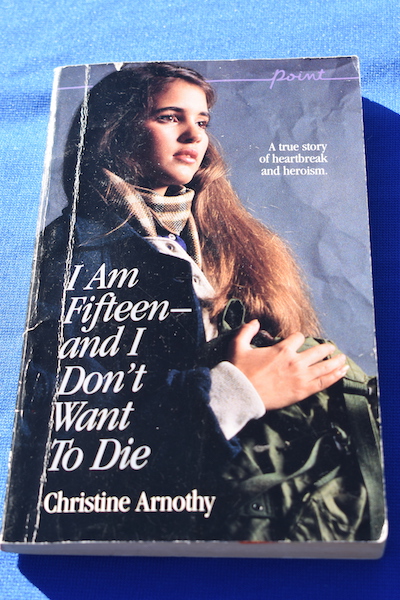
I Am Fifteen – And I Don’t Want to Die by Christine Arnothy, 1956.

Christine Arnothy was a fifteen-year-old girl during the siege of Budapest during World War II.  In this book, she recounts her memories of that time, based on diaries that she kept.  Following the war, she worked in a bookstore in Belgium before writing her memoirs.  This book was awarded the Prix de Verities, which is a French prize for nonfiction.

When the book begins, Christine and her parents are hiding in a cellar during the siege of Budapest along with their neighbors.  It is difficult for them to keep track of the time because they must remain in the cellar and limit lights that could give their location away.  After living in such cramped quarters for many days, everyone is getting on everyone else’s nerves.  They quarrel over scarce resources and hoard things for their own families, worried that their neighbors will take too much.

For a time, a young ex-soldier they call Pista (although he has another name) comes to stay with them, and he goes out to scavenge goods for them from ruined parts of the city.  While he does this, it raises their spirits and hopes for survival.  Unfortunately, death is all around them, and Pista is eventually killed by a mine.  There are scenes in this book that would make it frightening and disturbing for young readers.  Christine is fearful for her own life, worried that she will die in the cellar that has been their shelter.

When the German and Russian soldiers arrive, there is more slaughter.  Eventually, Christine and her family are able to get out of the city and go to the villa where they had originally hoped to go to escape the bombings.  They had already stocked the villa with provisions and were allowing some refugee friends of theirs to use it.  When they arrive, they discover that their “friends,” believing that they were killed in the bombings, have appropriated their belongings and actually seem disappointed to find that they are alive and want some of the provisions that are left.  Christine reflects on how quickly morals and ethics can be put aside in wartime.  Their supposed “friends” are not so friendly when resources are scarce and their deaths would have meant that they could keep more for themselves.

Transportation has been disrupted, but they are finally able to board a train to get to a small house they own in the countryside.  They remain there for three years before deciding that they need to leave entirely.

I found the story difficult to read because of all the sad and gruesome parts, but I found it interesting that Christine reflects that the part of her that died in the cellar in Budapest was the child that she used to be.  At the end of the story, she realizes that she has become an adult and, although she is worried about the life that she may be heading for, she is ready for a new life.

The book is available to borrow and read for free online through Internet Archive (multiple copies).

The Haunting at Cliff House

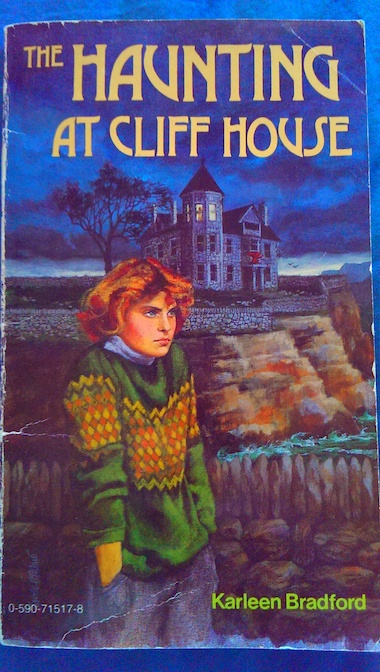
HauntingCliffHouseThe Haunting at Cliff House by Karleen Bradford, 1985.

This is a relatively short chapter book, but suspenseful, thoughtful, and well-written.

When her father inherits an old house in Wales from a distant relative, Alison, a young teenager, finds out that he plans for the two of them to spend the summer there.  Alison’s father is a university professor and is writing a book, and he thinks that the house in Wales sounds like a great place for him to get some writing done while he and Alison have a look at his new inheritance.  Alison isn’t enthusiastic about the trip, but she and her father are very close, especially because she lost her mother at a very young age.  Besides, the only place she could stay in Canada would be with her grandmother, and her grandmother didn’t seem enthusiastic about having her.

From the moment they arrive at the old house, called Pen-y-Craig or Cliff House by the locals, Alison has a bad feeling about it.  It stands on a lonely cliff by a small town.  The carved dragon over the door gives her the creeps, and there is something disturbing about a particular room in the house.  Sometimes, she can almost hear a voice calling out to her, and she has visions of another girl, about her age.  At first, she tries to tell herself that it’s all her imagination, but it soon becomes obvious that it’s not.

Some of the local people know that the house has an unhappy history, and Alison eventually learns that the great-aunt that her father inherited it from even refused to live there during her last years because it disturbed her too much.  A little more examination of the room that had disturbed her helps Alison discover the reason why.  After having a vision of a young girl hiding something behind a brick in the fireplace of one of the bedrooms, Alison searches the spot and finds a diary dating from 1810, written by a girl named Bronwen, who was the same age as Alison.  Like Alison, Bronwen was brought to the house by her widowed father and was unhappy about it, but those aren’t the only parallels between Bronwen’s life and Alison’s.

Alison becomes uncomfortable with her father’s new friendship with a Welsh neighbor, Meiriona.  Alison likes Meiriona’s younger brother, Gareth, but when it looks like her father’s friendship with Meiriona is turning into romance, Alison becomes jealous and fears changes in her close relationship with her father, a situation that mirrors Bronwen’s life when her father falls in love with her governess, Catrin.  Although Meiriona tries to be nice to Alison, Alison can’t bring herself to like her, and she argues with her father about it.

The only person who seems to understand her feelings at all is Gareth, and Alison confides her worries in him, both about Meiriona and about Bronwen, whose spirit keeps calling out to Alison to help her, although Alison doesn’t know how.  She struggles to read through the diary, whose pages are not all legible anymore because they’re damaged with age, to learn what happened to Bronwen and what Bronwen wants her to do now.  Gareth tries to reassure Alison that her father’s relationship with Meiriona will not be as bad as Alison thinks.  He thinks that the relationship would be good for both Alison’s father and Meiriona because they are both lonely, and he doesn’t think that Alison should worry about losing her father because he’s not worried about losing his sister, even if she goes to Canada to study and spend more time with Alison’s father.  At first, Alison isn’t comforted by these reassurances.  However, Gareth agrees that the matter of the ghost is serious, and he can feel her presence as well. Gareth warns Alison to be cautious about the ghost but to try to help if she can and to call out to him if she’s ever in danger.  Alison would really rather just go home to Canada, run away from her father and Meiriona, and forget the whole thing about Bronwen, but history seems to be repeating itself, and Bronwen’s voice calls out to her insistently for help that only Alison can give.

It’s a bit of a spoiler, telling you this, but although Alison at first thinks that the diary ends with Bronwen killing herself in despair, thinking that her father only loved Catrin and not her and that there was nothing left for her to live for, the truth is that Bronwen’s suicide attempt didn’t succeed and that she made another mistake that she wants Alison to help her to change.  Bronwen attempted to kill herself by going to a cave by the sea during a terrible storm, planning to allow herself to drown, but when the water started rising, she became too frightened and decided to leave by a secret entrance to the cave.  Not knowing that Bronwen was safe, Catrin attempted to save her and drowned in the cave herself.  As Bronwen was climbing to safety, she heard Catrin calling for her but was too frightened of the storm and angry at Catrin to go back for her.  Although Bronwen lived on after the incident, she could never get rid of her guilt at Catrin’s death, realizing that, even in the middle of her resentment toward Catrin, Catrin loved her more than she knew, even to the point of giving up her own life while attempting to save hers.

Now, the anniversary of Catrin’s death is approaching, and so is a storm very much like the one that killed her.  At the top of the cliff by the cave, Alison finds her time merging with Bronwen’s, and she will only have one chance to help Bronwen make the right decision the second time around.  Helping Bronwen to prevent the worst mistake of her life and to make a better choice also helps Alison to reconsider her own choices and future.  Just as Bronwen misjudged Catrin, Alison may have also misjudged Meiriona. Instead of losing her father or being forced to accept a poor substitute for her mother, Alison may be gaining a kind of sister who will love her more than she realizes.

The Talking Table Mystery

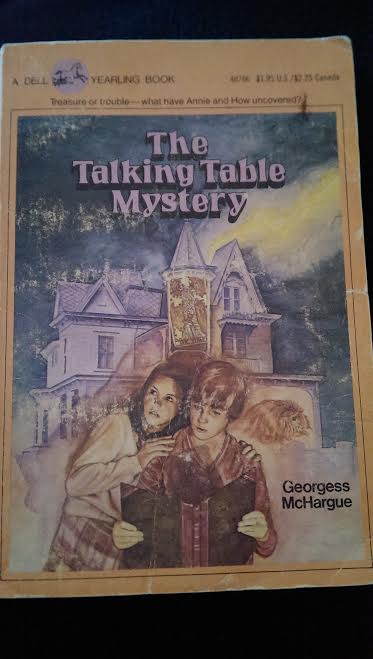
TalkingTableThe Talking Table Mystery by Georgess McHargue, 1977.

Annie Conway and her friend How are helping her great aunt to clear out her basement when they find a table that How thinks would work for his pet guinea pig’s cage. However, it’s not an ordinary table. It makes strange noises whenever they press on it, and in the box tied to the top of the table, they find a strange assortment of objects, including a little silver piccolo and some diaries.

Most of the diaries belong to Annie’s great grandfather, but there is one written by an unknown young girl. The girl apparently stayed in Annie’s great grandfather’s house years ago, and her diary refers to the girl’s mother’s strange behavior and the girl’s fears that something bad will happen. The diary itself is mysterious, but soon the kids start receiving threatening notes, telling them to hand over the diaries or something bad will happen. Who wants the diaries and why?

The book is available to borrow and read for free online through Internet Archive.

My Reaction and Spoilers

The basis for the mystery is 19th century spiritualism.  The former owner of the table was a spiritualist who used it for seances, creating rapping noises when the “spirits” were present.  Her daughter was the girl who wrote the diary.  She wasn’t happy about how she and mother kept moving around in search of new clients and how she had to help her mother by playing ghost during seances. They were staying with Annie’s great-grandfather because he was suffering from grief over the death of his young son, and the spiritualist was holding seances to try to contact his spirit.  At least, that’s what Annie’s great-grandfather thought.  The bad thing that the girl thought would happen was that she and her mother would be caught faking their seances, which turns out to be exactly what happened.  Annie’s great-grandfather was angry at being deceived and threw them out of the house, but he confiscated the rigged table and other things they used in their seances, including the girl’s beloved silver piccolo, so they wouldn’t be able to try their act on anyone else.

However, there is one more secret about Annie’s great-grandfather and the spiritualist. Annie and How eventually discover that they had a love affair during the spiritualist’s stay in the house. There is some discussion among the adults about how the spiritualist suffered more consequences and stigma for the affair than the great-grandfather did, although he was a married man when it happened.  As for what eventually happened to the girl and her mother after this incident, the clues are contained in the diary and with the people who now want them.

I thought that the use of the rigged spiritualist table in the story was fascinating. It’s basically like a piece of antique magician’s equipment that not everyone would know existed.  The story also introduces some interesting historical details about the concept of 19th century spiritualism and the types of people who followed it.  Annie’s great-grandfather was grieving for the loss of one of his young children, and like others of his time, he wanted to reach out to the spirit of the one he lost, in search of solace for the loss.  How much of the affair with the spiritualist was fueled by his grief and gratitude for someone he thought was helping him is unknown because we never hear his perspective on that, but his anger at discovering how he had been deceived shows that he did honestly believe that the seances were real and felt betrayed to realize they weren’t.  However, actions have consequences, and there were still some consequences from this incident that were never fully resolved.

The author is very knowledgeable on the subject of spiritualism, and she also wrote a nonfiction book on the subject.