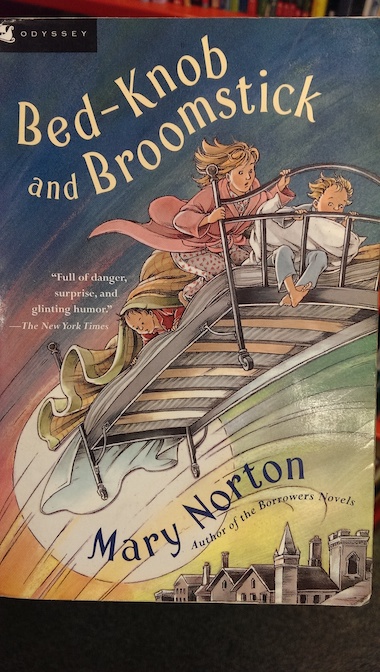
Bed-Knob and Broomstick

BedKnobBroomstickBed-Knob and Broomstick by Mary Norton, 1943, 1947.

This book is actually two books in one.  The title Bed-Knob and Broomstick is the one used for editions that include both the first book, The Magic Bed-Knob, and the sequel, Bonfires and Broomsticks.  Together, these two books were the basis for the Disney movie Bedknobs and Broomsticks, although the plot of the movie is considerably different from the two books. Because the movie is based on both of the books at once and because I read the combined edition, I’ll explain the plots of both of the books in one post.

There are two major differences between the movie and books that change many other things about the plot. The first one is that there is no mention of World War II in the books, even though the books were written during that time.  Miss Price was not studying magic to help the war effort, and the children were only in the countryside for vacation, not because they were evacuated there. Also, in the books, Emelius Jones (Emelius Brown in the movie) was a man they met when they traveled through time, not a man living in London during their own time.  He was not involved in Miss Price learning magic, although the two of them do end up together in the end.

The Magic Bed-Knob

At the beginning of the first book, the three Wilson children – Carey (who is described as being “about your age”), Charles (“a little younger”), and Paul (six years old) – are spending the summer with their Aunt Beatrice in Bedfordshire. There is never any mention of the children’s father in the books. Probably, their father is dead, although he might have left the family and went to live elsewhere or may be fighting overseas, although there is no mention of that in the book, making me think that it is probably not the case. The children apparently live with only their mother in London, and because she works, she always needs to find somewhere for them to stay during the summer, when they’re out of school. (This is a major plot point in both of the books.  In the Disney movie, the three children are orphans who have no memory of their birth parents, and their guardian was killed in a bombing shortly before they were evacuated to the countryside.  You only get their full backstory if you see the anniversary edition of the movie that includes the deleted scenes.)  While the children stay with Aunt Beatrice, they enjoy playing in the countryside, and one day, they happen to meet Miss Price, who they find with an injured ankle.

Miss Price is a respectable spinster from the village who gives piano lessons and is often seen riding around on her bicycle.  When they find her hurt, Carey says that they should get a doctor for her, but Miss Price insists that she doesn’t want one. Instead, she just asks the children to help her get home. As she starts to lean on Carey and Charles, Paul picks up a broom nearby. The older children thought it was just an old garden broom, but Paul calmly says that it belongs to Miss Price because it’s what she rides around on. The others are shocked, but Paul simply says that that he’s seen her improve in her flying, so Miss Price knows that he’s seen her riding her broom more than once. Miss Price is worried that everyone in the village will know now that she’s a witch, but Paul hadn’t even told his brother and sister what he’d seen.

The children help Miss Price get home, and they allow their aunt to think that Miss Price simply fell off of her bicycle. When the children are able to speak to Miss Price privately, they ask her directly if she’s a witch, and she admits that she’s studying to be one. She says that she’s had some talent for magic since she was young, but she never really had the time to develop it. The children are convinced that, while Miss Price might be a witch, she’s not a wicked one, and she says that’s true, that she started too late in life to be that way and that wickedness doesn’t come naturally to her. However, she’s still worried that the children might tell people about her magic.

Carey is the one who suggests that Miss Price give them a magical object as part of their pledge of secrecy (unlike in the movie, where it was Charlie’s idea), with the idea that, if they ever told anyone that she’s a witch, the magic would stop. Charles suggests that Miss Price could give them a magic ring that would summon a slave to do their bidding, but she says that she couldn’t manage that and that she has a better idea. Miss Price asks the children if they have anything on them they can twist, like a ring or a bracelet. The only thing they have is a bed-knob that Paul twisted off the end of his bed (basically, because he discovered that he could).

Miss Price says that the bed-knob will do nicely, and she casts a spell on it that will allow the children to travel to the destination of their choice when they put it back on the bed and give it a twist. If they turn it in one direction, they can travel in the present time, but turning it the other way can send them to the past. Also, because Paul was the one who had the bed-knob, he’s the only one who can make it work. Miss Price isn’t troubled by Paul’s young age because she thinks that it’s best to learn magic young, although she warns the children to be careful.

Because it’s Paul’s bed-knob, Carey and Charles give him first choice of where to go, but they think the places he wants to go sound mundane. He wants to either see a museum exhibit that the others saw without him once or to go home and see their mother in London. Carey and Charles try to persuade him to go someplace more exciting, but Paul insists that he wants to go home.

The bed whisks the children home to London, but when they get there, their mother isn’t home. Apparently, their mother has gone away for the weekend herself, and the children find themselves alone on their bed, in front of their house, on a foggy night. A policeman bumps into them, and when he demands to know who they are and where the bed came from, he doesn’t think it’s funny when they say, “Bedfordshire.” He takes them to the police station to spend the rest of the night. Fortunately, they find a way to get back to the bed and use the spell to return to their aunt’s house before they’re missed in the morning. It’s not quite the adventure that the children had been hoping for when they started out, but it’s just the beginning of their amazing summer!

However, magic turns out to be more dangerous than they thought. Their next adventure takes them to an island with cannibals (yeah, one of those scenes, sigh – I think that the island of talking animals in the movie was more fun), and they narrowly escape after Miss Price has a duel of magic with a witch doctor. Their magical adventures create problems that the children can’t explain to their aunt without giving away Miss Price’s secret. Eventually, their messes and wild stories cause their aunt to send them home to their mother. Miss Price considers that magic might cause more problems than it solves and tells the children that she’s thinking of giving it up for awhile. However, Paul keeps the bed-knob in the hopes that their adventures aren’t done yet.

BedKnobBroomstickChildren

Bonfires and Broomsticks

In Bonfires and Broomsticks, two years have passed since the children’s first adventures, and Aunt Beatrice has died. Carey and Charles, worried that Paul would talk too much about their magical adventures, tried to convince Paul that it was all just a dream, although they weren’t very successful.

Then, the children see an advertisement in the newspaper that Miss Price is offering to board a couple of schoolchildren in her house for the summer for a fee. The children’s mother works, and she always has to find somewhere for the children to spend the summer, when they’re not in school. They still have the bed-knob, so they tell their mother that they want to visit Miss Price, hoping they can have more adventures with her. At first, their mother doesn’t understand why they would want to visit Miss Price so badly, but since she seems like a nice, respectable woman and an old friend of Aunt Beatrice’s, she agrees.

Miss Price is happy to have the children stay for the summer, but they are disappointed when they learn that she was really serious about giving up magic. The children discover that Miss Price bought the old bed that they had used for their previous adventures at the estate sale after their aunt’s death. She’s been sleeping on it in her own room. They want to try the bed-knob on the bed, but Miss Price takes it from them. She tries to make their summer vacation a normal vacation with normal activities, like picnics and croquet.

But, even Miss Price can’t resist the opportunity to try the bed-knob one last time. One morning, Carey and Charles discover that Paul and Miss Price have traveled somewhere on the bed without them. When the two of them confront Paul about it, he says that they only went to a nearby town, just to see if the spell on the knob still worked. Carey and Charles understand, but Carey thinks that if they got to use the bed once more, she and Charles should have one more turn. She especially wants to try going into the past, which was something they hadn’t had a chance to try last time. Miss Price is reluctant, but finally agrees after Carey pressures her about it.

The children travel to London of 1666 (ending up there accidentally, when they were aiming for the Elizabethan era), where a man named Emelius Jones has been living as a necromancer. When he was young, he studied magic under a mentor who, as he was dying, finally told him that everything he learned was fakery. It was all an act that he used to get money from gullible people, although it paid very well. The old man leaves Emelius his business, but Emelius is always nervous, worrying both because someone might discover that it’s all a fake and because others might believe that it’s real and that he should be hung as a witch. The only reason why he stays with it is because he has no other business to follow.

The children meet Emelius after ending up lost and stopping at his house for directions. The children can see how nervous and unhappy Emelius is, and they ask him about himself, discovering that his home town is actually close to where they’re staying with Miss Price. They reveal to him that they are from the future and invite him to come home with them for a visit.

Miss Price isn’t happy to see that they’ve brought someone back from the past with them, but she ends up liking Emelius. Before sending him home, they learn that Emelius’s aunt, who lived near to where Miss Price now lives, died the same day that Emelius left London in the past, which is coincidentally shortly before the great fire that destroyed a good part of the city. They know that Emelius’s London lodgings will likely be destroyed in the fire as well, but at least he can move into the house that he will inherit from his aunt.

However, after they send him back to his own time, the children and Miss Price learn that Emelius never made it to his aunt’s house because he was executed for practicing witchcraft. Unable to leave poor Emelius to such a terrible fate, they come up with a plan to rescue him.

The combined book edition is available online through Internet Archive.

My Reaction and Spoilers

Changing Emelius’s past also changes Miss Price’s future. Neither of them has ever married, and both of them have been lonely, and they come to the conclusion that the two of them were meant to be together. In deciding that they will live their lives together on Emelius’s aunt’s farm in the past, they put an end to the magical traveling bed. Only Paul can make the magic bed-knob work, and once he sends them into the past (not going with them), they can never return. But, Carey has one final vision of the two of them, being happy together, so she knows that they will be alright.

Overall, I preferred the Disney movie to the original books.  I think the war-based plot was better than the children’s random travels to cannibal-filled islands (I never liked those tropes in children’s stories anyway) and other places.  At one point in the books, Carey did speculate about the use of magic in war, but she rejected the idea because the notion of someone with the ability to conjure a dragon that could breathe mustard gas or who could turn whole armies into mice was just too horrible.  The spell that Miss Price used against the Nazis in the movie was part of their plan to rescue Emelius in the second book, but I think the movie’s ending was much more exciting.
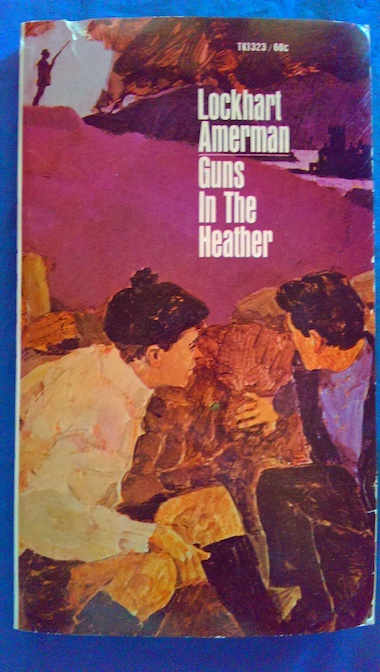
Guns in the Heather

GunsHeatherGuns in the Heather by Lockhart Amerman, 1963.
This book was the basis for the Disney made-for-tv movie The Secret of Boyne Castle. However, the book and the movie are very different.  Although they have a similar premise, many details were changed in the movie version, the first of which is that the location of the story was moved from Scotland, as it was in the original book, to Ireland.

Jonathan Flower, sometimes called “Posy” by his friends, spends most of his time at various boarding schools.  His mother died when he was very young, and his father has a government job that takes him all over the world, so Jonathan has been in boarding schools in various countries, seeing his father whenever he can during school breaks.  For the most part, Jonathan doesn’t really mind it.  He and his father get along pretty well, and he knows that his father’s work is important.

Right now, he’s at a boarding school in Scotland.  He’s made a lot of friends there, spending holidays like Christmas and Easter at various friends’ homes.  He’s also developed an interest in rugby and cricket.  He anticipates that his father will meet him at the end of the school year so that they can go mountain climbing together over the summer break.  However, shortly before his father is expected to arrive, Jonathan receives a telegram from him, saying that he is to go to a certain place and meet a Mr. Finch.  Because the telegram contains certain words that this father uses when a situation is urgent, Jonathan goes to meet Mr. Finch and is kidnapped.

Mr. Finch, who also goes by the alias Dr. Fisher, holds Jonathan captive in a house, pretending that Jonathan is a patient who has volunteered for an experimental treatment.  Fortunately, Jonathan’s father, disguised as a milkman, soon rescues him.

While Jonathan’s father, who is actually a government agent, attends to some of his duties, Jonathan tries to go to the American embassy, only to be misled and almost recaptured. For a time, he is on his own, unsure of who to trust and how to reconnect with his father. When the two of them finally meet again, they both seek shelter with friends, but their enemies aren’t far behind, no matter where they go.  They end up staying with friends who own an old castle, but their enemies are planning a siege.

My Reaction

The style of the writing in this book doesn’t make for a particularly easy read.  It’s not overly difficult, but it starts off slow and is very dense, unlike many more modern books.  The scenes also change quickly throughout the book, and I had trouble keeping track of who some of the characters were.  Overall, I preferred the movie, even though it didn’t follow the book very closely.

In the Disney movie version, a strange man drives onto the grounds of an Irish boarding school, stumbles out of his car, and whispers an urgent message to a teenage American exchange student (played by a young Kurt Russell and renamed Richard Evans) that is meant for his older brother.  Then, the man dies from a bullet wound.  Another man, who is ostensibly from the American embassy in Dublin, abducts Richard after saying that he needs to go to the embassy to make a statement about the stranger’s death.  Richard is also accompanied by an Irish friend, Sean, when he is lured away from the school, and his friend helps him as they escape from the enemy spies holding them captive.  The two of them search for Richard’s older brother (who they have only just learned is a spy, whereas Jonathan was aware that his father worked for the government) to give him the dead man’s message.  In both the book and the movie, there is a final showdown with the bad guys at a castle, but in the movie, they go to the castle to retrieve a secret message that the dead man left there.  I don’t think that the movie is available on dvd, but I have seen it on YouTube and Internet Archive.

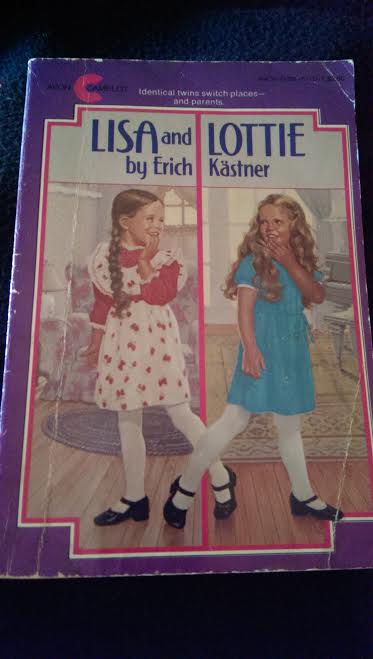
Lisa and Lottie

LisaLottieLisa and Lottie by Erich Kastner, 1969.
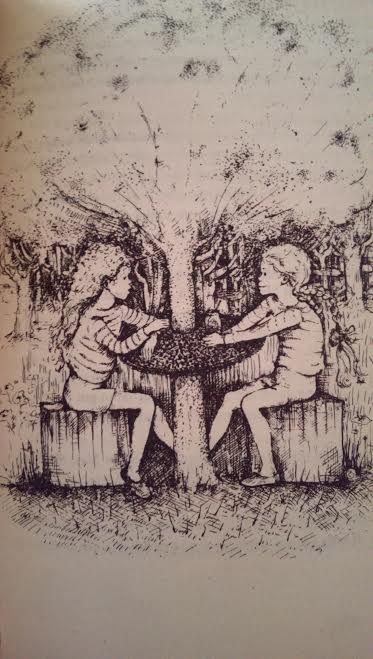
First, a note about the copyright: the date I give is for the edition I own, which is an English translation of the original German book.  The original copyright date for the story is 1949.  This is the story that was the basis for Disney’s The Parent Trap, both the version with Hayley Mills (1961) and the later Lindsey Lohan version (1998).  Neither movie completely follows the original story (although some of the dialog in the Hayley Mills version is almost word-for-word from the English version of the original story) because the settings are shifted to new locations, but both of them capture the concept of twins who were separated as infants by their divorced parents only to meet again years later by accident.  As in the book, each of the twins has been living a different kind of life with one of their parents, but they decide to switch places so that each of them can meet the parent they’ve never known.

Lottie Horn is a very serious little girl.  She can’t help it because she lives with her single mother, who spends much of her time working, and she relies on Lottie to take care of a number of household chores.  But, her mother feels badly that Lottie has been growing up so quiet and serious, so to help her relax and make more friends her own age, she decides to send Lottie to summer camp at Bohrlaken on Lake Bohren.

Shy Lottie thinks that her summer is going to be horrible when she meets up with boisterous Lisa Palfy, a girl who strangely looks exactly like her.  Lisa is shocked at the sight of this girl who looks so much like her, and after some teasing, joking, and staring from all the other girls, she loses her temper and kicks Lottie in the shin.  The camp leaders decide to give the two girls beds next to each other, saying that they’ll just have to get used to each other.  Lottie thinks that it’s going to be awful, but when Lisa sees how unhappy Lottie is, she apologizes and starts being nicer to her.

LisaLottiePic1

The two girls discuss their lives and their strange resemblance with each other, and some unsettling details are revealed.  First, they learn that they not only share a resemblance but the same birthday.  They also realize that they were both born in the same city, although Lottie now lives in Munich and Lisa lives in Vienna.  This strange coincidence is troubling enough, but then each girl reveals that she lives with only one parent: Lottie lives with her mother, and Lisa lives with her father.  Lottie has no memory of her father and no knowledge of what happened to him, where he might be, or even if he’s still alive.  Lisa also has no memory of her mother, but she did once see a picture of her, a picture which her father hid somewhere after he found her looking at it.  The girls start getting suspicious, so Lottie shows Lisa a picture of her mother, and Lisa confirms that it’s an identical copy of the picture of her mother she saw before.  Lisa and Lottie realize that they are long-lost sisters.

LisaLottiePic2Through the rest of the summer, the girls discuss their lives and parents in great detail and continue speculating about the reasons for their parents’ separation and why they were never told about each other’s existence.  They are somewhat angry at their parents for not telling them the truth, but they each also want to know more about the parent that they have never really known and perhaps to learn the truth behind their parents’ separation. They begin hatching a plot to switch places so that Lottie can go to Vienna to meet their father and Lisa can go to Munich to be with their mother.  They get little notebooks and fill them with as many details of their lives as they can think of so that each girl can seem to behave like the other, although they know it won’t be easy because they’ve lived very different lives.  They don’t like the same foods, and Lottie knows how to cook, but Lisa doesn’t.
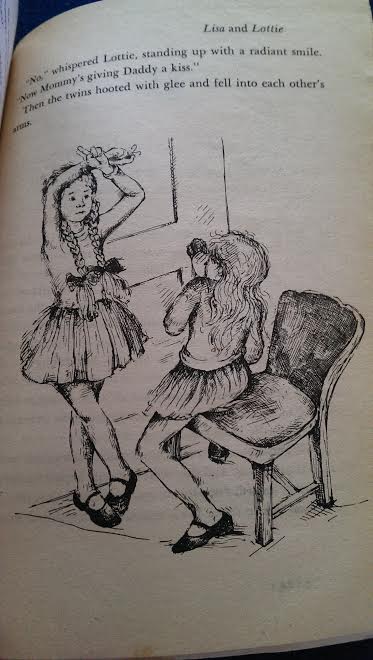
Still, the girls proceed with their plan.  When it is time to leave camp, the girls dress as each other.  Lisa puts her hair in braids as Lottie always does.  Lottie lets her curls hang loose, like Lisa usually does.  Then, each of them boards the train for the other’s city at the station.

LisaLottiePic3Lisa is overjoyed to finally meet her mother in Munich.  But, her mother has to work very hard as a photographic editor for a newspaper, and they don’t have much money.  Lisa isn’t as good at cooking or taking care of household chores as Lottie is, so she finds it difficult to help, although she learns quickly.

In Vienna, Lottie meets her handsome but somewhat reclusive father.  Her father is an opera conductor, but he’s also a composer who needs to spend much of his time alone in order to compose his music, which was the primary reason for the divorce.  He always wanted to devote his life to the arts, and he felt that marriage and family life got in the way, although he dearly loves his remaining daughter and dotes on her.

But, life in Vienna isn’t that great for either Lottie/Lisa or her father.  Rosa, the housekeeper who often looks after “Lisa” and takes care of their apartment only pretends to like her when her father is around and steals from the household funds.  Also, in spite of finally having plenty of time along for composing music (which is successful), her father is lonely and unhappy.  Although he doesn’t want to admit it at first, he misses the comforts of family life and the company of his wife.

Each girl, because of her different personality, manages to make changes in the life of the other and in their parents which are for the better, but the charade cannot continue forever.  Lottie finds out that their father is considering marriage to a woman who doesn’t like her.  Then, Lottie falls seriously ill.  More than ever, she needs her mother . . . and her twin.

The book is currently available online through Internet Archive (they have multiple copies).

My Reaction and Spoilers:

LisaLottiePic4The book is much less of a comedy than either of the two Disney movies, although there are some funny parts, like when Lottie (as Lisa) takes over the household accounts to stop Rosa’s stealing and ends up turning her into a much better housekeeper with her practicality.  Surprisingly, Rosa actually starts respecting her more and even liking her better because of it.
Much of the focus of the book is how divorce affects children as well as parents, although there is room for debate on how each side views the issue, and some modern families may disagree with some of the points characters in the story make.  The point of view of the story shifts between each of the girls and also between their parents and other characters to show different reactions to the situation.

The children are understandably upset at the entire issue and believe what their parents did was wrong.  The girls admit that they do not think of either of their parents as evil or cruel, but they view the separation and lies that were forced on them without their consent as cruel.  Lottie even has a nightmare which is a twisted version of Hansel and Gretel in which her father threatens to cut both her and her sister in half because it would only be fair for each parent to get half of each child.  At camp, the girls see one of their friends crying, having just found out that her parents are going to get a divorce.  Other girls at the camp call her parents mean for making the decision while she was away at camp and just springing it on her with no warning at all.  For the children in the story, the worst part about parents divorcing is when they give little or no thought to how the children will feel or be affected by the decision and don’t even talk about the situation with them.

Some of that sentiment is echoed by adults in the story, although the adults are a little more ambivalent on the issue, knowing that different people and different circumstances must be judged on an individual basis.  The adults try to do what they think is best for the children, but they make mistakes, partly because they are too absorbed in their own concerns to understand the entire situation, and they come to realize it.  The overall sentiment of the book seems to be that, while marriages are made up of only two people, families are made up of more, including the children.  When a couple divorces, it not only affects the marriage, but the whole family as well, and parents need to remember that.

Like the movies, the book also ends happily, and the father finds a way (with the help of Lottie) to balance his work life with his family life.

Candleshoe

candleshoeCandleshoe by Michael Innes, 1953.

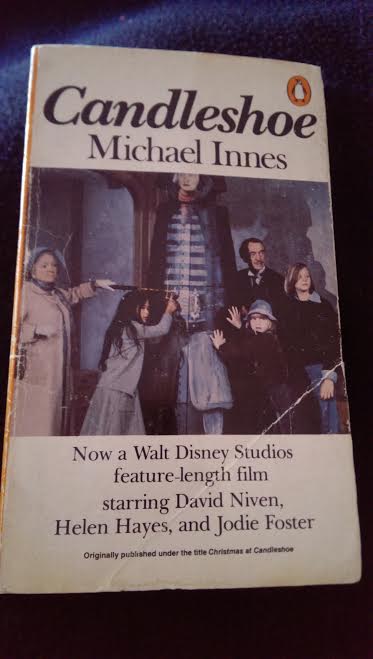
I own the movie version of the book, which was originally named Christmas at Candleshoe (although it’s not about the holiday).  It contains the text of the original story, but the picture on the front cover is from the movie.

The Disney movie is very different from the original book.  For one thing, the hero of the story is a boy (Jay), not a girl (Casey/Margaret), and unlike the movie version, the child’s identity is established for certain by the end of the book. The book has a happy ending, and so does the movie, but part of the movie’s point was that the idea of family isn’t dependent on blood relations alone, so it isn’t important whether Casey is really Margaret or not (although there are strong hints that she is).

The book is a bit hard to follow at first because it jumps back and forth between different places and different sets of characters, although it all takes place during the course of a single day and night.  Actually, I’m not sure this can really be called a children’s book, but I included it here because of the movie tie-in.  Because of the difficulty level of the book, I’d really recommend it for older children or adults.  Personally, I have to admit that I liked the movie better.

The story takes place in the mid-twentieth century, after WWII. There are two manor houses involved, Benison Court and Candleshoe. Benison Court, the newer of the two, is owned by the Spendloves, and Candleshoe, the older one, is owned by the elderly Miss Candleshoe. The two families are related, and neither one of them has as much money as they used to. The Spendloves take in some extra money by offering tours of Benison Court and showing people paintings and antiques owned by the family for generations. To raise some additional money, they decide to sell a couple of the paintings by Titian. To their surprise, the expert they call in to evaluate the paintings tells them that the paintings are forgeries.  Archdeacon, who cares for the antiques and library at Benison, reminds the Spendloves that during the war, the paintings were sent to Candleshoe for safekeeping.

Meanwhile, a couple of American tourists, the wealthy Mrs. Feather and her son Grant, having seen Benison, stop by Candleshoe. Mrs. Feather is fascinated by the old place, in spite of its state of disrepair, and Miss Candleshoe invites them to have dinner there and spend the night. Mrs. Feather has an interest in purchasing Candleshoe for herself and fixing it up.  Miss Candleshoe and her longtime friend, the retired chaplain, Armigel, know that there is not enough money for them to fix up Candleshoe, and they like the idea of traveling, so they are willing to consider selling the manor house. This plan does not sit well with Jay, the orphaned son of Miss Candleshoe’s housekeeper, Mrs. Ray.

After Mrs. Ray died, Miss Candleshoe cared for Jay, and now, with Miss Candleshoe and Armigel showing signs of senility, Jay has been handling much of the practical running of Candleshoe. On this particular evening, Jay is worried about more than the possible sale of the property. He has been noticing strange people paying unusual attention to the house. He suspects, correctly, that they intend to break into the house that night, and he has assembled a small army of local children, armed with antique weapons, to defend the place. Grant, befriending Jay, admires the boy’s practical turn of mind but worries that they are not up to the task of handling the siege that is coming to this isolated country house. As the danger presses closer, the Spendloves, Archdeacon, and the art expert are heading toward Candleshoe in search of the missing paintings.

The answer to all of these problems may lie in the strangest feature of the house: the Christmas box, a stone monument in the gallery made by Gerard Christmas and dedicated to the memory of an ancestor of the Candleshoes, who may have been a pirate. According to the lore of Candleshoe, the box will open at a time when Candleshoe is in crisis and will save the day.

The book is available online through Internet Archive.

But, is Casey Really Margaret?!

I think so. I want to say, “yes, she is,” but “I think so” is about as definite as I can be because the movie changed the story from the original book.

Whether or not Casey is actually Margaret, the lost heir to Candleshoe, is the burning question everyone is left with after watching the Disney movie Candleshoe. The movie deliberately left Casey’s true identity unresolved at the end, probably because they wanted to have the people at Candleshoe decide to accept her into their family on her own merits, not just because they had to because she’s the heir to the place. In the beginning, the audience is told that missing heir of Candleshoe, Margaret, was kidnapped as a young child by her own father, apparently in some kind of marital/custody dispute, and that she disappeared after his death in a car accident and has not been located although attempts to find her were made in the ten years that have passed since her disappearance. Casey is a teenage girl who was apparently an abandoned child with an unknown past and no memory of her early life who bears an odd resemblance to Margaret, including a couple of distinctive scars that are like ones Margaret was known to have. She is recruited as by con artist to play the part of Margaret, returning to Candleshoe as the lost heiress in order to gain access to the house and find a hidden treasure. Although Casey initially came to Candleshoe under false pretenses as part of a con with the promise of a share of the Candleshoe treasure and a red Ferrari as her payment, she eventually becomes fond of the people there and decides that she can’t let them be cheated by the real villain. Casey proves herself to be part of the Candleshoe family through her loyalty to them, and in the end, they would accept her whether she really was Margaret or not. It’s a nice sentiment, but viewers still have the urge to ask who Casey really is.

Casey is legitimately an orphan or abandoned child, found at about the right time and the right age and in the right place to really be Margaret. She has no memory at all of her early childhood, her parents, or where she came from, and she also bears some telltale scars that match ones that young Margaret was known to have. That’s what we’re told about Casey. Casey’s history is never explained in detail in the movie (we never find out under what circumstances she was found and entered into the Los Angeles foster care system), but from what we do know, her history meshes well enough with Margaret’s known past that it would seem plausible for her to actually be Margaret. Is she really Margaret, and Harry Bundage, the con man, just persuaded her that she was only pretending in order to use her for his own ends? Or, is the real Margaret still out there somewhere? If Casey actually is Margaret, did she lose her memory in the car crash that killed her father, or did he abandon her somewhere before his death, even though he had kidnapped her from her mother and took her to a completely different country?

When Harry Bundage is briefing Casey about Margaret’s background, he poses the theory that Margaret was in the car when her father crashed it and that she may have wandered off in a state of shock after the accident. That explanation might be partly for the benefit of the viewers, helping to explain how Casey could be Marget and not remember it. A young child suffering from shock might be unable to tell anyone who she was or what had happened to her. An accident may even have left some bruising that might have obscured the telltale scars that could have identified her, but again, the matter is never fully settled, and we just don’t know enough of Casey’s background to make a full connection. There are enough pieces to make it possible, maybe even probable, but nothing that definitively settles the matter.

In the final scene of the movie, Casey asks Margaret’s grandmother what will happen if Margaret is ever really found and comes home, and the grandmother says cryptically that maybe she already has. It’s a brief hint that the grandmother thinks Casey might really be her kidnapped granddaughter, even though she accepts that Casey was lying to her earlier about things she said she remembered and knows that Casey herself thought that she was just an imposter. Casey does have those telltale scars, and it does seem like quite a coincidence that two random girls of the same age and similar circumstances would have identical sets of scars. However, the movie stops short of declaring that Casey really was Margaret all along, and the unanswered questions still rankle viewers. So, some of us turned to the original book to get more detail, but it turns out that it doesn’t completely help.

As I said, the original book was different from the movie. Not only was the child hero in the book a boy instead of a girl, he wasn’t kidnapped and taken to America the way that Margaret was. In the book, Jay definitely knows who his mother was, and it’s the question of who his father was that establishes his identity as the heir to Candleshoe. It turns out that Jay’s father was the nephew of the lady of Candleshoe, making her his great-aunt rather than his grandmother. Her nephew had been a ne’er-do-well, and although his family didn’t know it, he had married an American woman before his death. He died not too long after the marriage, but by that point, he had fathered Jay. Jay’s mother knew about her husband’s family, but she wasn’t sure yet whether or not she wanted to tell them about Jay. She took the job as housekeeper so she could observe the family and decide whether or not to reveal their relationship. Unfortunately, she died in an accident before she made up her mind. By the end of the book, Jay’s identity is established, and he is definitely proven and recognized to be the heir to Candleshoe, and because of that, I believe that Casey really is the missing Margaret. At least, that’s as close to confirmation as we’re likely to get. If the child in the book was the rightful heir to Candleshoe, it would make sense if the child in the movie was, too, even if it’s not really the same child.

Of course, that’s not full proof, and it doesn’t answer the questions about Margaret’s kidnapping or her father’s accident or how Casey was found and placed in foster care in California without anyone else connecting her with the missing Margaret when Margaret’s disappearance was reported to the authorities and newspapers. I have a theory that Harry Bundage was right that Margaret was in the car during the accident and that she did wander away from the scene of the accident in shock and possibly suffering injuries that covered up her identifying scars, but that’s still just a theory. There’s nothing in the movie or book that I could use to prove it. We don’t even know exactly why Margaret’s father in the movie kidnapped her in the first place or why Margaret’s mother died not long after she disappeared. (A convenient accident or illness for story purposes so there’s one less person to try to identify Casey/Margaret, or did she kill herself out of despair at the loss of her husband and daughter? The movie doesn’t say, so those are just guesses, too.) There’s a lot of backstory missing, and the book doesn’t clarify these points because of the differences between the book and movie. I guess it’s not really important to the story in the movie, but inquiring minds still want to know.

Basil of Baker Street

BasilBakerStreetBasil of Baker Street by Eve Titus, 1958.

Some people may recognize the title character from Disney’s The Great Mouse Detective.  This is the original book that the Disney movie was based on, although the movie was very different from the original book.

The part that is the same is that Basil is a mouse who lives in the house of Sherlock Holmes at 221 B Baker Street. He and some other mice have built a little town they call Holmestead in the cellar.  Although Sherlock Holmes is unaware of Basil’s presence, Basil studies his methods and copies them, becoming “the Sherlock Holmes of the Mouse World.”  Like Sherlock Holmes, Basil also has a narrator for his stories, his best friend and fellow mouse Dr. Dawson, and they solve cases for their fellow mice in trouble.

BasilBakerStreetPicIn this book, Basil’s skills are put to the test when he is hired by his mouse neighbors to find their two missing daughters, a pair of twins named Angela and Agatha.  The twins have been kidnapped, and soon, a note arrives, saying that all the mice in Baker Street have only 48 hours to evacuate their home if they ever want to see the twins again.  A gang called The Terrible Three want to use Holmestead as their headquarters.  With only two days to solve the case, Basil and Dr. Dawson set out to find the gang and rescue the twins so that they can keep their wonderful home!

Basil of Baker Street is actually the first book in a series about Basil’s cases, and I think it’s really the best book in the series.  It is currently available online through Internet Archive.

The Mystery in Dracula’s Castle

MysteryDraculasCastleThe Mystery in Dracula’s Castle by Vic Crume, 1973.

This is a novelization of a live action Disney movie of the same name and contains photographs of scenes from the movie. The title of the book and the movie is a little misleading because, although the main characters are unaware of what is going on for most of the story, the audience finds out pretty quickly who the bad guys are and what they’re doing. In a way, it’s kind of like a Columbo story where the suspense is in watching the hero figure it all out. Also, there is no real castle or Dracula. Sorry. 😦 In spite of these short-comings, it’s still a fun story, and although the movie has not been released on dvd, it is possible to see it on YouTube (as of this writing).

Alfie and Leonard are spending yet another summer at their family’s beach house in a small town while their mother works on the new book she’s writing. They think this summer is going to be dull, but with jewel thieves in town, it soon becomes apparent that it’s anything but!

MysteryDraculasCastlePicAlfie is an aspiring film maker. Specifically, he wants to make horror movies, and he talks his younger brother into playing the part of Dracula in his latest Super 8 film. Leonard is only a reluctant vampire because he doesn’t like horror movies. He really wants to be a detective, like Sherlock Holmes. Back home, he and his brother saw police investigating the scene of a robbery at a jewelry store, and he’s decided that he wants to investigate crimes like that. Soon after they arrive at the beach house, Leonard adopts a stray dog and names him Watson so that he can be his sidekick.

Alfie laughs at his brother’s detective fantasies, but Leonard gets his chance to prove himself when they become involved with the thieves who robbed the jewelry store. The location that Alfie has picked for his movie is an old lighthouse, which he thinks looks like Dracula’s castle, and that is where the thieves are staying.  With the sheriff’s daughter acting as their baby-sitter and the heroine of their film and the necklace ending up in Leonard’s hands by accident, the thieves struggle to get it back before Leonard realizes what it is and where it came from.

This book is currently available through Internet Archive.  When the movie first aired on tv, it was shown in two parts.  Internet Archive also has the second part of the movie, but not the first (at least, not right now).  Sometimes, you can find part or all of the movie on YouTube.