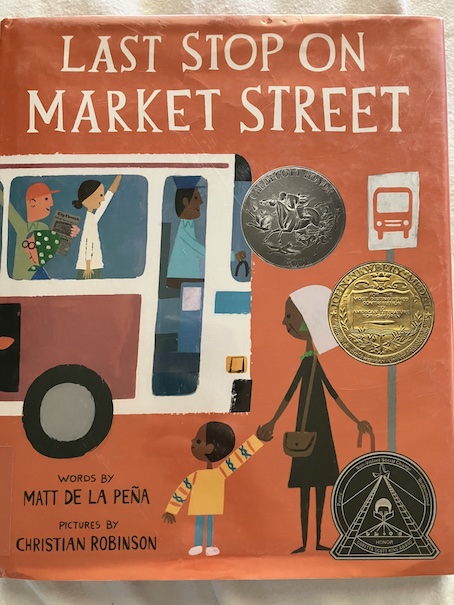
Last Stop on Market Street

After church, CJ and his grandmother have to wait for the bus while other people just get in their cars and leave. CJ is annoyed because it’s raining. He asks his Nana why they have to wait in the rain and why they don’t have a car. His Nana says that they don’t need a car because they have the bus.

The bus is interesting because many interesting people take the bus. The bus driver does little tricks, like pulling a coin from behind CJ’s ear, and there are interesting passengers, like the lady with a jar of butterflies and a man with a guitar.

While CJ’s friends, whose families have cars, go straight home after church, CJ and his Nana have somewhere else to go. CJ wishes that he could just go home, too, but Nana points out that the boys who just go straight home miss meeting so many interesting people. CJ does enjoy listening to the man with the guitar playing music on the bus.

CJ and his grandmother get off at the last stop on Market Street, which is in a bad neighborhood. CJ comments about how dirty it is, but his grandmother points out that people who surrounded by dirt know how to see what’s beautiful.
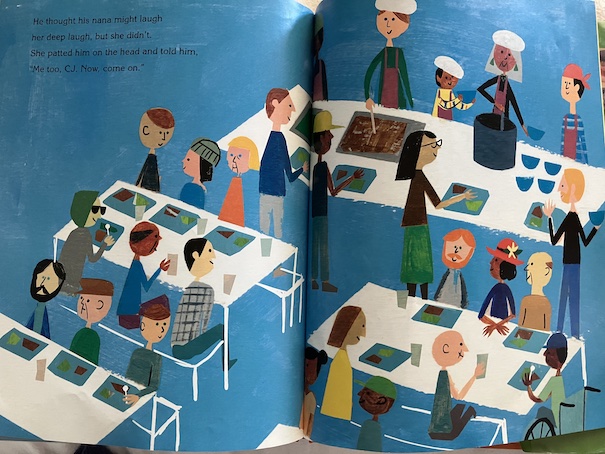
The reason why CJ and his grandmother are here is that they help out at a soup kitchen. CJ recognizes the faces of people he’s seen there before, and he realizes that he’s glad that he came.

This book is the winner of multiple awards. It’s a Newbery Medal winner, a Caldecott Honor book, and a Coretta Scott King Award honor book for its messages about appreciating and helping other people in a diverse community.

This is one of those picture books that I think can speak to adults as well as kids, maybe even more so because adults might understand some of the broader context of the story. CJ and his grandmother probably don’t have as much money as some of CJ’s friends and their families, which is why they don’t have a car. When CJ comments about why do they have to wait for the bus in the rain, his grandmother could have given him a straightforward answer about how they can’t afford a car, but that would have been depressing. Instead, she points out the positives of the bus and the people they meet. All through the book, she points out the positives about situations that both CJ and the readers can see are not entirely positive. It’s noticing these positives that help make the situation better.

CJ and his grandmother don’t have much money themselves, but Nana is teaching CJ how to help other people and build relationships with them. The people they meet are often poor people or people who are unfortunate in some way, but they still enjoy meeting these interesting people with colorful lives. There are times when CJ wishes that he could be somewhere else or doing something else, but yet, he also enjoys parts of where he is and realizes that what he’s doing is better than other things he could be doing. CJ and his grandmother experience the enrichment of life experiences and relationships with other people.

The Big Orange Splot

The Big Orange Splot by Daniel Manus Pinkwater, 1977.

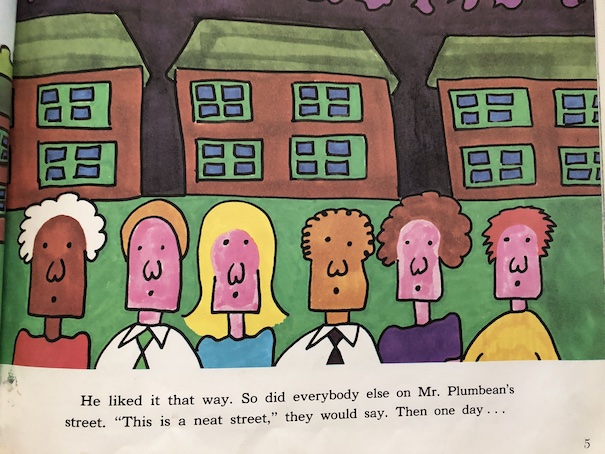
Mr. Plumbean lives in a neighborhood where all the houses look alike. He and his neighbors all think of the uniformity as making their street “neat” and tidy, and they appreciate it. Then, something happens that makes them reconsider.

For reasons that nobody ever understands, a seagull carrying a can of orange paint happens to fly over Mr. Plumbean’s house and drops the can, leaving a big orange splot on Mr. Plumbean’s roof. Mr. Plumbean realizes that the big orange splot means that he’ll have to repaint his house, but the painting project makes him think.

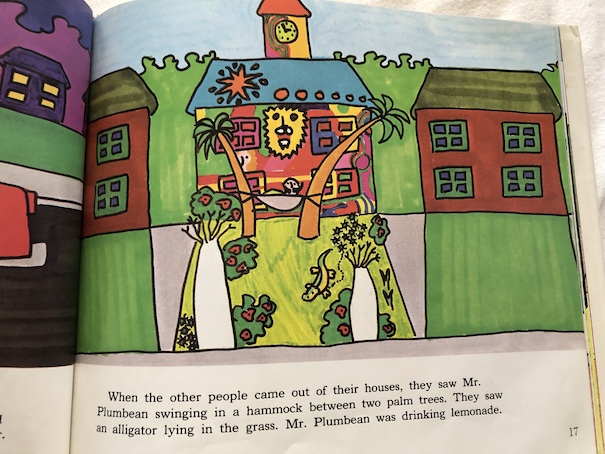
Instead of painting his house to look like everyone else’s, the way it was before, he gets a bunch of wild colors and turns the exterior of his house into a rainbow explosion, working around the big, orange splot on his roof! He adds paintings of animals and other things he likes and colorful patterns. It’s such a wild and crazy design that his neighbors think he went mad. Before long, he adds a clock tower onto his house and an alligator and some trees with a hammock in the front yard.

The neighbors think he’s gone too far, but Mr. Plumbean says, “My house is me and I am it. My house is where I like to be and it looks like all my dreams.”

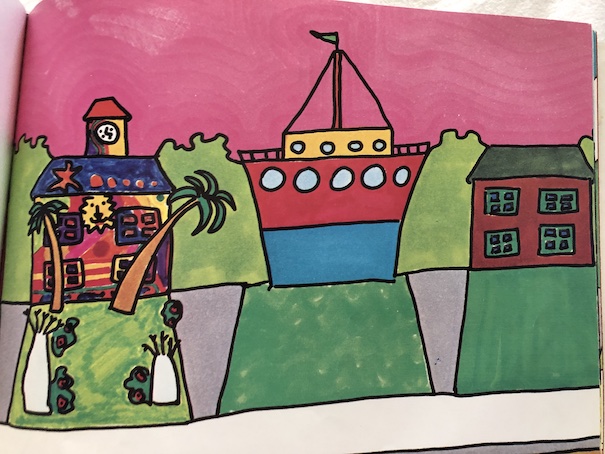
One of Mr. Plumbean’s neighbors tries to talk some sense into him, but instead, Mr. Plumbean talks to him about his dreams. The next day, the man goes out to buy some building supplies. It turns out that he always loved ships, so he turns his house into the ship of his dreams!

With Mr. Plumbean’s encouragement, other neighbors also start to change their homes to reflect their dreams, changing their quiet, “neat” street into a magical wonderland of imagination!

The book is available to borrow and read for free online through Internet Archive (multiple copies).

My Reaction

I remember this book from when I was a kid, and I always liked the pictures! It’s fun to imagine all the creative themes a house could have and what you might choose if you had the opportunity to live in a house that could look like anything you wanted. The houses shown in the pictures of the neighborhood end up looking nothing like their original shapes, except for Mr. Plumbean’s house, oddly. The others are vastly different from their original shapes, and the windows aren’t even in the same places, making them look like they’ve been completely rebuilt. This level of renovation would be difficult and costly in real life, but this story is meant to be fun and to celebrate imagination and the capacity people have to add a touch of color to their lives. If you read this book with a child, you can invite them to decide which of the house was their favorite at the end (mine was the one that looked like a castle) or what they would do if they could make their house look like anything they want.

In real life, I’ve never particularly liked those neighborhoods where all the houses look alike. I’m not the only one because tract homes and uniform suburbs were controversial from their beginnings in the mid-20th century. In the early 1960s, a song called Little Boxes (listen to it on YouTube) poked fun at the uniformity of suburban houses and the lives of the people in them (although the houses in that song were still different colors – just saying). The connection between the uniformity of homes and the conformity of the people living in them is a topic that resurfaces periodically in popular culture and other songs, like “Subdivisions” by Rush (listen to it on YouTube).

The themes of non-conformity and self-expression are pretty profound, but the story is lots of fun and isn’t too deep for kids. If you read the back section about the author, it explains that the inspiration for this story came from a time when he spilled orange ink on his own pair of new yellow boots.

This picture book is a fun story about non-conformity and self-expression. In the beginning, Mr. Plumbean is as content as anyone with his neat, uniform neighborhood until a strange, inexplicable accident creates a situation where Mr. Plumbean has to paint his house. Once he’s confronted with the task of repainting his house, Mr. Plumbean begins to consider the creative opportunities this chore provides, and he enjoys exploring the possibilities and changing his house to be more of a reflection of the wild and wacky person he really is or dreams of being. Once his creative side is unleashed, it begins to get his neighbors thinking along similar lines. True, they liked it when their street was neat and uniform because they could see the appeal of having things orderly, but it turns out that each of them also has an inner creative side that’s been waiting for a chance to get out. The non-uniformity and non-conformity of their street becomes more comfortable for each of them as they each embrace those sides to their personalities that they don’t normally show. When they come to accept and embrace their own dreams and each other’s, it doesn’t matter to them anymore that they’re not all alike. They’re comfortable with the wacky and whimsical parts of their personalities, and they’re not afraid to show them anymore. They’re happy with themselves, their homes, and their different visions.

I really liked the art style of the illustrations in the book. It’s very simple but colorful, and you can tell that the artist used markers because you can see the marker lines, especially in the backgrounds of the drawings. It makes it different from more modern books that use digital art. I like seeing signs of the physical materials used, and it gives the story a funky, organic feel that goes well with the theme.

As I said earlier, I did notice that many of the new home designs in the pictures don’t take into account where the houses’ windows used to be, but that’s just part of the whimsy of the story. We don’t need to worry about how these people accomplished these drastic changes so quickly and easily. It’s just fun to think about how you can personalize your space to reflect what’s important to you.

The Snowy Day

SnowyDay

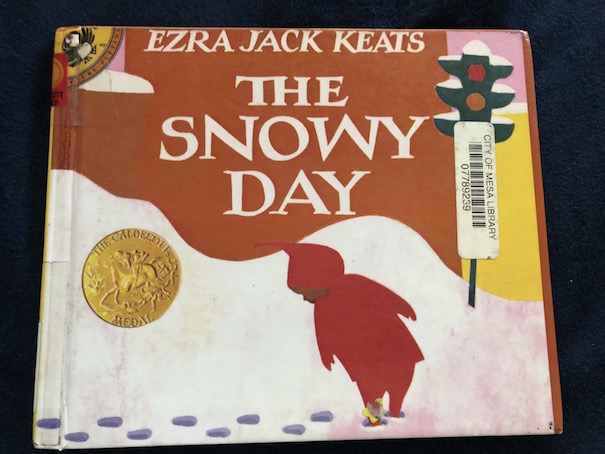
The Snowy Day by Ezra Jack Keats, 1962.

This is a pleasant, slice-of-life story about the fun and wonder of a snowy day for young children.

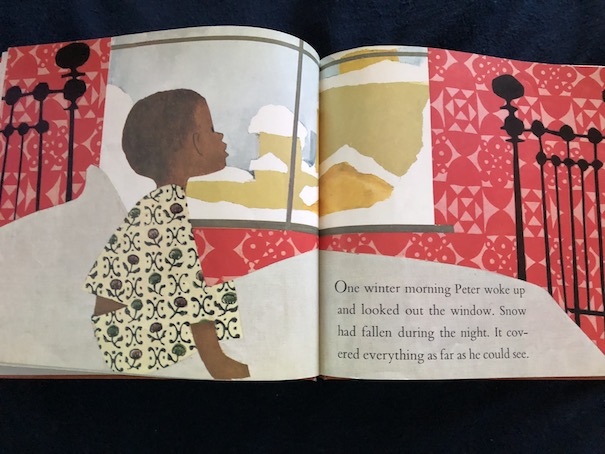
A young boy named Peter wakes up on a winter morning to discover that it snowed during the night.

SnowyDayMorning

Peter hurries out into the snow, experiencing all of the fun it has to offer.  He studies the footprints that he makes in the snow and uses a stick to make marks in the snow and knock snow off of tree branches.  He’s still too little to join in the snowball fight that the big boys have, but he has fun making a snowman and snow angels.

SnowyDayAngels

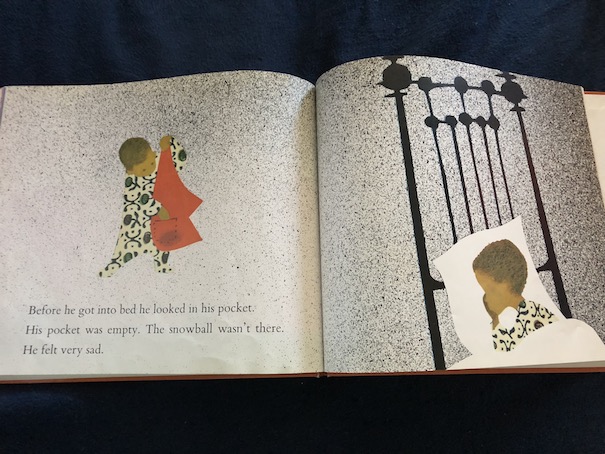
The snow is so much fun that Peter makes a snowball amd put it in his pocket to save for later.  Of course, the snowball in his pocket doesn’t last, and he worries that the snow outside will disappear as well, but there is even more snow the next day.  He gets a friend of his to come outside and join him in the fun.

SnowyDaySnowball

It’s a simple, sweet story about one of the simple pleasures in life and one boy’s discovery of the wonders of snow. It would make a nice, calm bedtime story for young children.

SnowyDayFriend

This book is also a Caldecott award winner, and it is noted for being one of the first children’s books to feature a black main character.  Peter’s race is never mentioned in the text and is not directly a part of the story, but it is shown in the pictures.  Really, I think that’s part of what makes the book so great; although the book was considered ground-breaking for representing minorities, it does so in a way that’s completely relatable because his story could really happen to just about any child.

The Surprise Doll

SurpriseDoll

The Surprise Doll by Morrell Gipson, 1949.

Mary is a little girl who lives by the sea. Her father is the captain of a ship, and he travels to different countries all over the world. Sometimes, he brings presents for Mary from his voyages. So far, he has brought six dolls for her:

SurpriseDollTeresaSusan – from England, with rosy cheeks

Sonya – from Russia, with a cute turn-up nose

Teresa – from Italy, with brown eyes

Lang Po – from China, with raised eyebrows

Katrinka – from Holland, with blonde hair

Marie – from France, with a smile that brightens her whole face

Mary loves her dolls, but she realizes that if she had a seventh doll, she would have a doll for each day of the week. She asks her father if he will bring her another, but he says that she already has enough dolls.

When her father refuses her request, Mary pays a visit to the local dollmaker. She takes along her six dolls and explains to the dollmaker why she wants one more. After studying Mary and her dolls, the dollmaker agrees to make one for her as long as she’s willing to leave her other dolls with him for a week. At the end of the week, Mary returns to collect her new doll and receives a surprise!

SurpriseDollDollmaker

The “surprise” isn’t much of a surprise to the readers because the “surprise doll” is shown on the cover of the book, but it’s a cute story about how people around the world have many things in common. What the dollmaker notices about Mary and her dolls is that Mary shares certain qualities with each doll, the ones listed in the dolls’ descriptions above. So, he makes a doll for Mary that looks just like her by using her other dolls and their shared features as models. Her new doll, Mary Jane, is an American doll, but she has features in common with Mary’s other dolls from around the world, just like children in America can share qualities with children in other places. It’s a soft message about diversity and finding common ground.

SurpriseDollSeventhDoll