How Tia Lola Came to (Visit) Stay

How Tia Lola Came to Visit Stay by Julia Alvarez, 2001.
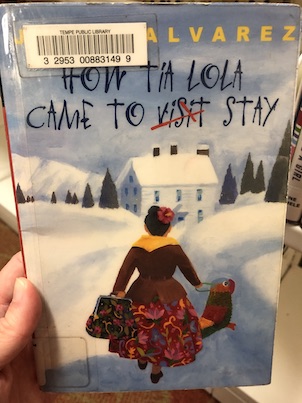
After Miguel Guzman’s parents get divorced, Miguel’s mother moves from New York to a small town in Vermont with Miguel and his sister, Juanita, and invites her favorite aunt from the Dominican Republic, Tia Lola, to come stay with them and help raise the children. Miguel’s mother has gotten a job as a counselor at a small college in the area, and because of the hours she works, she asks her aunt to come and be with the kids. Miguel isn’t enthusiastic about the arrival of this aunt, who has to be called “tia”, the Spanish word for “aunt”, instead of “aunt” because she doesn’t speak English. Miguel and Juanita know some Spanish, but they’re more accustomed to English because they’ve always lived in the US.

The move from New York to Vermont isn’t easy because Miguel misses his father and New York City, and there are no other Latino families in this small town in Vermont, making Miguel feel like he doesn’t fit in. Some of the kids in Vermont don’t even know that Miguel is Latino, mistaking him for being from some other ethnic group or asking him uncomfortable questions about the way he looks and why his skin is darker than everyone else’s. He misses his old friends in New York and still doesn’t understand why his parents couldn’t just stay married instead of turning their lives upside down with this divorce.

When Tia Lola arrives, Miguel can’t think of anything else to say to her in Spanish except “Te quiero mucho” (“I love you a lot”), which is something his parents say to him. He’s a little embarrassed that he can’t think of anything else and that his sister is more bold with her Spanish, but Tia Lola appreciates the message and says that she loves both Miguel and Juanita, too. Miguel isn’t sure at first how long Tia Lola will be staying with them, but he’s astonished at the amount of luggage she’s brought. She says that she didn’t know what she would need in Vermont, so she brought a little of everything. Among her belongings are potions because Tia Lola practices santeria, particularly related to healing. Miguel’s mother explains that Tia Lola is something like a doctor, but with magic. Juanita thinks that sounds exciting, and she can’t wait to tell other kids about her magical aunt when school starts again after the winter break, but Miguel hopes nobody else finds out about Tia Lola.

Miguel thinks that people will think Tia Lola is crazy for thinking that she can do magic and for her other odd habits. The beauty mark on her face tends to change positions because she keeps forgetting where she put it last time. She refuses to even learn English, saying that Spanish is easier, and if Americans are so clever, how come they haven’t realized that? Miguel dreads what the kids at school will say about Tia Lola because they already tease him about other things. They call him “Goose man” because of his last name and quack at him. (Yes, I know geese honk and ducks quack, but the kids apparently don’t.) Miguel knows that the kids are just trying to have fun, but all the teasing makes him feel really uncomfortable, like he’s always going to be an outsider. Tia Lola is a colorful but eccentric character. A couple of boys from the Little League team at school mistake her for a ghost when they drop by the house because she’s dressed oddly and is carrying a brazier for doing one of her spells to rid the house of evil spirits. Apparently, there were already some local rumors about the house being haunted before they moved in, and Miguel lets the other boys believe that they really saw a ghost for awhile because he can’t think how to explain what Tia Lola was actually doing. At first, Miguel hopes that Tia Lola’s visit will just be temporary so no one will find out who Tia Lola really is and tease him about her. However, he gradually becomes fond of her and comes to reconsider himself whether or not Tia Lola’s “magic” really works.

As the family settles into their new home and the children get used to Tia Lola, they have to sort out some problems and learn how to live with each other. When Tia Lola realizes that Miguel seems embarrassed by her, her feelings are hurt, but Miguel finds a way to let her know that he’s glad she came. Miguel loves the stories that Tia Lola tells them about their relatives and legends of the Dominican Republic, like la ciguapa, a story that Miguel puts to his own use. (I love books with references to folklore and legends!) When she finds out that Miguel wants to try out for Little League, she makes special foods for him to help him get stronger. When Miguel turns ten years old, Tia Lola helps to throw a surprise party for Miguel with the boys from Little League. Miguel is relieved when the boys accept Tia Lola and laugh about how they thought she was a ghost.

Tia Lola sometimes gets homesick for the Dominican Republic, but she begins making friends in Vermont, starting with a local restaurant owner who joins her for Spanish lessons and dancing lessons. Tia Lola points out that people can have fun together even when they don’t speak the same language. However, the kids begin giving her English lessons, and she starts to learn some phrases. Her first attempts to speak English in public don’t go well because, while the kids taught her to speak phrases, they didn’t make the meanings of the phrases clear. Tia Lola starts saying the wrong things at the wrong time until they find a way to help her understand what she’s really saying and when to say it.

Through it all, Miguel keeps wishing that, somehow, his parents could magically get back together. In spite of Tia Lola’s “magic”, Miguel’s life and his parents’ marriage don’t return to the way they were before. Everyone’s life changes. Miguel comes to realize that there can be good changes as well as bad, and some of the changes that seemed really bad at first turn out to be better than he thought. Tia Lola is one of the greatest good surprises of them all, and Miguel finds himself hoping that, rather than just staying for a short visit, Tia Lola will stay with them forever.

This book is the first of a series of stories about Tia Lola, and it is available to borrow and read for free online through Internet Archive (multiple copies).

My Reaction and Spoilers

There is an interesting element to this story that I didn’t fully appreciate until the second time around. The first time I read this book, I read it in Spanish, the only other language I know with any fluency besides English. When you read the book in English, there are English translations for the Spanish words and phrases that the children use with their aunt. I didn’t need English translations for these phrases because they were pretty simple, but they’re useful for anyone who doesn’t know Spanish or is just a beginner. (By the way, please excuse the fact that I haven’t placed the proper accent marks in the Spanish words. I know where they’re supposed to go, like the ‘i’ in “tia”, but I’ve been having trouble typing them on this keyboard. I can fix that when I figure out what the problem is.)

Because I grew up in the Southwestern US, I took Spanish classes all through school. It’s the most popular foreign language class in Arizona schools because there are people who commonly speak it around here. It’s a very useful skill to have. My speech has always been weaker than my reading ability because of the way classes are taught, and my speech practice has been irregular. I often read children’s books in Spanish to keep my vocabulary sharp, but when I try to speak, I’m often slow. In some ways, I understand how both Miguel and Tia Lola feel, trying to communicate when you’re still learning and you have an imperfect understanding of another language. One of the things I liked about this story is that it shows how it’s okay to start with an imperfect knowledge. In my experience, if you know some of another language, the other person will try to help you and meet you halfway. Even if you don’t say everything exactly right or you’re slow and clumsy, you can still find a way to get your point across, and the more you practice, the more you improve.

Miguel and Tia Lola go through that same process, starting out with communicating imperfectly and learning to meet each other halfway, not just with language but with learning to live together as family. Miguel’s mother says, “The easiest language to learn but the hardest to speak is mutual understanding.” Tia Lola seems to have a kind of magic about her, not the fairy tale kind, but the kind that comes from having a unique way of looking at things and from understanding people. She doesn’t magically have all of the answers, she makes embarrassing mistakes sometimes, and she can’t fix Miguel’s parents’ marriage, but she makes life better for the family by being there and caring.

When Miguel’s father finds out that Tia Lola is staying with them, he likes the idea because Tia Lola will help the children improve their Spanish, something that he also wants. Miguel confides his initial worries about Tia Lola and what the other kids will say about her to his father over the phone. Miguel’s father tells him that, if he is proud of himself and proud of his family, he shouldn’t care what other people think. It’s easier said than done with the other kids at school teasing Miguel all the time. Miguel’s father says that he’ll understand evenutally and also that accepting other people for who they are helps them become the best versions of themselves they can be. Miguel thinks about what his father has told him before about the harmful effects of stereotypes because people make unfair assumptions about other and the things other people have assumed about him because of his background. One kid at school told him that he was bound to make the Little League because his family is from the Dominican Republic, like his baseball hero Sammy Sosa, and that baseball must be in his blood, but Miguel knows that’s just a stereotype. Miguel’s father tells him that his skills at baseball are his own, not due to being from the Dominican Republic, and if he makes the team, it will be because his skills are good and he worked to develop them. It makes Miguel think about some of the things he’s been assuming unfairly about Tia Lola and what she’s like, and he begins looking at her in a different way.

The book ends at Christmas, one year after Miguel’s parents separated, they moved to Vermont, and Tia Lola came to stay with them. Miguel and his mother and sister accompany Tia Lola on a visit to the Dominican Republic, where he meets his other relatives and sees what Tia Lola’s original home is like. There, he makes it clear to her that he wants her to come stay with his family in Vermont permanently, and she decides that she wants to keep living with them, too.

The Magic Nation Thing

The Magic Nation Thing by Zilpha Keatley Snyder, 2005.

Abigail O’Malley’s life was turned upside down when her parents divorced when she was in kindergarten. They sold the family home, and her father went to live in Los Angeles and pursue his law career while her mother opened a detective agency. Abby isn’t fond of her mother’s detective agency and has no such ambitions herself. In fact, she would be satisfied if she just has a nice, normal family someday. She misses the nice house where her family used to live and doesn’t like the shabby Victorian house where she and her mother now live and use as the office of the detective agency. Abby envies her friend, Paige Borden, whose family has plenty of money and who life a much more “normal” life. Abby’s mother, Dorcas, isn’t too enamored of the Bordens, thinking that the family is boring. She wishes that Abby would become interested in joining her detective agency someday because the truth is that Abby isn’t quite normal herself, although she doesn’t like to think about it much.

Abby’s mother, Dorcas, says that Abby has an ability to notice information that other people miss, but that’s not quite it. Dorcas says that people in her family have had a “gift” for doing unusual things, like reading people’s minds or finding missing objects. Dorcas is convinced that Abby has inherited this “gift.” However, Abby denies having any such “gift.” As far as she’s concerned, she just occasionally gets hunches about things, and once or twice, they’ve turned out to be right. Abby resents the idea of a special gift partly because she thinks that her mother’s crazy desire to be a detective has something to do with her belief that she also has this special gift, and Abby doesn’t think she does. Abby doesn’t like to think about any of her relatives having been that strange. She just wants a normal family, like Paige’s.

However, Abby’s gift is re-awoken when her mother accepts a case involving a missing girl, who is believed to have been kidnapped by her own father because her parents are divorced. When Abby holds a locket belonging to the little girl, she begins to have visions, not unlike visions that she’s had at other times in the past. Mrs. Watson, who owned the day care that Abby used to attend said these vision episodes were just her imagination, which Abby used to think of as her “Magic Nation.” Abby has spent years trying to ignore it, but this is one of those times when it’s impossible to ignore. Abby has a vision of the little girl at Disneyland with her father. At first, Abby doesn’t want to admit the existence of this vision, but thinking about how worried the girl’s mother is, Abby casually suggests to her mother that, if the girl was taken in a custody dispute, her father might have decided to take her somewhere fun, like Disneyland, to try to win the girl’s favor so she’d want to stay with him. Her mother follows up on the hint, and with the help of the police, the girl is found and reunited with her mother.

That’s the end of the kidnapping case, but it’s only the beginning of Abby’s acknowledgement of her “gift.” Dorcas’s success in the kidnapping case brings more business to her detective agency. As Dorcas gets busier, Abby feels neglected, but Paige’s mother offers to look after her after school to help out, helping Dorcas to feel better about Abby’s friendship with the Bordens. Abby enjoys spending more time with Paige after school, and the girls even start getting along better with Paige’s annoying younger brothers, Sky and Woody. The youngest boy, Sky, particularly comes to like Abby when Abby intervenes after he makes the family’s intimidating cook angry by spilling juice in the kitchen. Abby sensed the boy’s fear and went to the kitchen to find out what happened. Although Abby still wonders how much of her “hunches” are really due to some kind of “gift” because they don’t work all the time, she increasingly realizes that what she still thinks of as her “Magic Nation thing” is not something that she can simply ignore.

Paige is fascinated by Abby’s mother’s work, and she particularly idolizes her pretty assistant, nicknamed Tree. When Abby tells her that her mother and Tree are investigating a case of arson, Paige talks her into coming with her on a little stakeout of their own, which messes up Tree’s actual stakeout and Dorcas’s plans. Dorcas is angry with the girls, and Abby finds herself using her “Magic Nation thing” to try to learn something about the arsonist and make up for ruining the stakeout. Abby does discover who the arsonist is, although she still doubts the reality of her “hunches.” When she shares that information with Tree, Tree also becomes aware of what Abby can do. Tree has known that Abby sometimes gets “hunches” about things, and although Abby still isn’t sure what to think about them, Tree says she’s noticed that Abby’s hunches pay off more than her mother’s do. Then, after the arsonist is caught and Paige goes overboard in her idolizing of Tree for catching the arsonist, Abby lets it slip that she was the one who figured out who the arsonist was.

Abby had been trying to keep this weird and questionable “gift” a secret, but once she tells Paige that she was the one who found the arsonist, she has to explain how she did it. To Abby’s surprise, Paige believes her about the “Magic Nation thing” and thinks it’s really cool. She’s noticed before that there are times when Abby seems to know things that other people don’t or learns things more quickly that most, and Paige thinks that’s a product of her “Magic Nation.” Paige is so enthusiastic about Abby’s “gift” that she thinks the two of them should start their own detective agency, and she starts trying to find cases for them to solve. Paige’s efforts to find an exciting mystery for Abby to solve don’t lead to much, and Abby finds herself doubting her “gift” and its usefulness again.

Then, Abby goes on a ski trip with Paige and her family, and young Sky disappears. Abby realizes that, whether or not her “gift” is real or reliable, she has to try again for Sky’s sake.

The book is available to borrow and read for free online through Internet Archive (multiple copies).

My Reaction

I like Zilpha Keatley Snyder books. She’s also the author of The Headless Cupid. This story is well-written and fun to read, and I enjoyed seeing how Abby comes to understand and accept her “gift” and make it work for her. I particularly liked the way that Abby comes to understand her “gift” and accept its limitations. There are points when Paige is disappointed or angry that Abby can’t use it to come up with all of the answers that she wants on demand, but Abby can’t make the “gift” do what her friend wants, and she makes it clear that Paige is going to have to accept that. Sometimes, Abby isn’t even interested in trying to use her gift in the way Paige wants, just like she isn’t really interested in using her gift to follow her mother’s profession. Abby comes to realize that an important part of learning to live with her gift is making it clear that this “Magic Nation thing” belongs to her – it’s her gift, to use or not use, as well as she can, in whatever way she sees fit. It’s her right to create her own boundaries, even refusing to talk about her “gift” when she doesn’t want to. The “Magic Nation thing” can’t be forced, and Abby herself won’t be pushed or bullied, either. This personal development is actually a bigger part of the plot than any of the mysteries that Abby solves or attempts to solve.

We don’t know what will happen with Abby and her “gift” after the story ends. There are hints that Abby might be willing to use her powers again, if the situation is important enough and she’s still able to do it. It seems that her mother no longer gets the visions that she used to get when she was Abby’s age, which is why her “hunches” don’t work out as well as Abby’s do now. Dorcas isn’t going to be able to rely on her “powers” to make her a great detective, but Abby comes to appreciate that her mother still enjoys her work and is pretty good at it, not because she’s relying on psychic powers, but because she works hard and is attentive to details. It’s possible that Abby’s powers will also fade as she grows up, but even if they do, it will be okay because Abby can also have a fulfilling life doing the things she loves and is good at. Dorcas is still more enamored of the idea of their shared “gift” than Abby is, but the reality is that neither of them really needs to rely on it. It might be there in the future, if they need it, but it’s not their only strength.

There are some contemporary cultural references in this story that help set the time of the story. Paige is a Harry Potter fan, Abby says that she has some Lemony Snicket books, and they refer to Jennifer Lopez, the Olsen Twins, Leonardo di Caprio, and Britney Spears.

Mystery at Kittiwake Bay

Mystery at Kittiwake Bay by Joyce A. Stengel, 2001.

Cassie Hartt has only recently moved to Kittiwake Bay, Maine with her mother and brother following her parents’ divorce. Her mother is a nurse, and she has found a job at the local hospital, which is actually 30 miles away from the little town where they were able to find a house. Because of her mother’s long commute, Cassie will need to look after her 7-year-old brother, Danny. Soon after arriving, she meets a nice boy named Marc Nolan, who is a little older than she is and loves boats, and a girl name Liz Painter, who likes photography and walks her cat on a leash. Liz is the one who introduces Cassie and Danny to the Beachcombers Club, which is a group for kids Danny’s age who like to go swimming and camping and the kids who hang out at the Sand Shack coffee shop. Marc is one of the Sand Shack kids, and so is a boy named Ryan Jerrick, who is Liz’s crush. Cassie is glad to be making friends and starting to get settled into her new home, but soon, there are complications.

One evening, on her way home from the grocery store with her dog, Sam (short for Samson), Cassie sees some mysterious figures sneaking around in the dark. She doesn’t know who they are, but the way they’re sneaking around worries her. She later learns that there have been robberies in the area.

Cassie develops a fascination for the large house that she saw on a cliff near the ocean, and Marc and Ryan tell her that’s a senior citizens’ residence called Waterview Manor. Both of them work there part time. Liz says that the house wasn’t always a senior citizens’ residence and that there are a lot of weird stories about the place. It was built by a rich man before the Civil War, but it became property of the town in the 1950s. One of the stories about the place is that it was once part of the Underground Railroad helping escaped slaves. The boys say that a woman named Mrs. Wentworth says that her grandfather was one of the people helping escaped slaves. There’s also a story about Captain Kidd hiding his treasure somewhere around the old house, although Ryan doesn’t believe any of these stories. He thinks Mrs. Wentworth just tells tall tales. Cassie thinks that she might like to volunteer at the house, like the boys did before they started working there as employees. If her little brother joins the Beachcombers Club, she’ll have some free time for volunteer work.

When Cassie goes to Waterview Manor to sign up, she witnesses an argument between Ryan and Mrs. Wentworth, who is confined to a wheelchair. Ryan was being disrespectful because Mrs. Wentworth was telling one of her stories about the history of the town that Ryan thinks is outlandish, and Mrs. Wentworth was telling him off. Ryan doesn’t actually like working at Waterview, but he has to keep his job because he needs the money. Cassie thinks he’s arrogant. Ryan has no patience for the fetching and carrying he has to do for the older people, and he thinks that Mrs. Wentworth’s mind is going. Cassie thinks that Mrs. Wentworth sounds like she still has her faculties and is sympathetic when Mrs. Wentworth laments about not being able to do things she used to do because her hands and feet won’t obey her anymore. Mrs. Wentworth is physically feeble these days, but she knows what she’s talking about when it comes to local history.

After she signs up to volunteer, Cassie can’t resist a peek into the forbidden East Wing of the house, and she meets Marc there. They both admit that they’re curious about the stories of treasure in the house. Unlike Ryan, Marc believes Mrs. Wentworth’s stories, and Cassie can’t wait to hear more!

Mrs. Wentworth used to be a history teacher, and she does know more about local history than Ryan gives her credit. She tells Cassie how her grandfather used to be a conductor on the Underground Railroad and how his friend, Mr. Palmer, who was the original owner of Waterview Manor, was a stationmaster, which meant that he hosted and hid the escaping slaves that Mrs. Wentworth’s grandfather conducted to him. Mrs. Wentworth’s grandfather told her about a secret room where they used to hide people and a secret tunnel that would take them to the landing site for the boat that would smuggle the runaways to Canada. When Cassie asks her about the story about Captain Kidd hiding his treasure somewhere in the area, Mrs. Wentworth said that her grandfather always believed he did, although Captain Kidd was much older than both her grandfather and the Manor. She explains a little about the life story of Captain Kidd and how it seems that most of his treasure was never found.

However, they soon have a more modern mystery on their hands. Whoever has been stealing things in the area recently seems to have started taking things from Waterview Manor. First, an expensive chess set belonging to one of residents disappears. Then, some jewelry and a coin collection disappear. Then, someone steals Mrs. Wentworth’s beloved lavaliere necklace, a special present from her late husband. For someone to both know about the residents’ valuables and to have access to them, the thief must be somebody working at the Manor! Who, could it be? Is it grumpy Ryan, who needs money? Is it John, another employee, who often acts a little strange? Could it even be helpful Marc, who seems nice but is often lurking around areas where both he and Cassie aren’t supposed to be? Or is it someone else Cassie wouldn’t even think to suspect?

The mysteries of the past start mingling with the mysteries of the present. Cassie sees signal lights from the tower of the old house that remind her of of the signals Mrs. Wentworth said the Underground Railroad used. Is someone now using them for a different purpose?

The book is available to borrow and read for free online through Internet Archive.

My Reaction

The Underground Railroad is a popular subject in US children’s books. There is something compelling about people sneaking around on clandestine missions and hiding in secret rooms and secrets passages, and since these things were used in the real life Underground Railroad, they make convenient devices for US children’s books with some historical flavor. The former Underground Railroad secret passage in Waterview Manor does play a role in this story. Someone is using it for a new purpose, just like they’re using signals from the tower.

The purpose of the Underground Railroad secret tunnel in the story is also to show that Mrs. Wentworth knows what she’s taking about when she tells her stories about local history. Ryan tries to discount her stories because some of them sound a little far-fetched and dramatic and because he thinks scornfully of the old people he serves in his job. Ryan has a negative attitude and looks at the elderly as being senile and demanding. Cassie feels differently because she has more empathy and, perhaps, because her mother is a nurse, which may make her more aware of the human condition and more comfortable helping other people. She seems to understand what Mrs. Wentworth means when she talks about finding it frustrating that she can’t do things she used to do, and she says that she agrees with Mrs. Wentworth when she says that she likes keeping her hair long even though a nurse at the Manor says it would be easier to care for if she cut it shorter. The nurse is probably thinking that short hair would be easier on those who might have to help Mrs. Wentworth wash and brush it, but Cassie understands when Mrs. Wentworth explains why she likes her hair long. Cassie thinks the people who live at Waterview Manor are interesting, and she admits to her mother that she likes to pretend that they’re her grandparents. She is fascinated by Mrs. Wentworth’s stories, and because she and Marc believe what she says, they are able to get to the bottom of the mysteries surrounding the Manor.

I was pretty sure I knew who at least one of the thieves was, and I was also pretty sure I knew why. I was correct in my first guess, but there were enough red herrings along the way to give me some doubts, so there was plenty of suspense in the story. One of them wasn’t fully aware of what he was getting involved with at first, but he does bear responsibility for what he did even after he knew.

This book also deals with the subject of divorce and how it affects families and children. Books like this were once rare, but they have been very common staples of children’s literature since the late 20th century, reflecting changes in American society and a growing willingness to discuss difficult topics with children. Moving to a new state and starting over after the divorce wasn’t easy for Cassie, her mother, and her brother. Cassie quickly becomes interested in the history of her new town, and it doesn’t take her long to find some new friends and a volunteer activity to keep her occupied. However, other aspects of the changes in her life and family will take longer to get used to. Her mother has to work long hours with a long commute, so Cassie frequently has to be responsible for her younger brother when he’s not at activities of his own, and her mother often isn’t home for Cassie to discuss things with her.

There is also some tension between Cassie and her brother because the divorce has changed their relationship with each other. Because Cassie has become more of a caregiver to Danny because her mother has to work, she has to make arrangements for Danny before she can do anything on her own, which sometimes makes things awkward for her. Danny also becomes jealous because Cassie does have more ability to do things on her own than he does and because she makes friends and settles into their new town more easily than he does.

One part of this book that I hated was when Danny intentionally left Sam outside alone to spite Cassie, and Sam is poisoned by one of the villains and nearly dies. Cassie is very upset with Danny because of this incident, understandably so, but I didn’t like it that the other characters were pressuring her to be okay with Danny and forgive him too quickly. They do this because Danny is young, they think that he left the dog out by accident, and Danny feels really badly about almost getting the dog killed. Cassie knows, although Danny doesn’t initially admit it, that Danny left the dog outside on purpose. That purposefulness maliciousness is not a thing that I think should be too easily forgiven, especially not because someone just “feels bad.” Let’s insist on a little empathy here, Danny. Cassie feels bad because you almost got her dog killed. Sam really feels bad because he’s the one who almost died! Maybe your feelings shouldn’t be given first priority here, since you were the one who caused the harm. Sam is a dependent animal. Under no circumstances should animal abuse be excused, and leaving a dependent animal outside alone to be lost, hit by a car, or yes, harmed by some other malicious person is abusive. Danny should not be given a pass for malicious behavior or animal abuse just because he “feels bad.”

Giving people that type of excuse for malice and abuse just encourages more of it in real life because the person finds that there are no consequences for their actions and it gets them the forgiveness and attention they want, so they keep doing it. It’s a dangerous thing to allow. The story makes it clear that Danny was acting out on bad feelings that he already had about the divorce and feeling neglected by both his mother and Cassie, but I think it’s important to make it clear to him that, even if he’s “feeling bad”, that does not give him the right to hurt other people or animals. Nobody has the right to hurt others just because they’ve got mixed-up feelings. I hate it that the other characters don’t seem to feel that way.

The story ends happily when Danny tries to make it up to Cassie by investigating the situation and Cassie rescues him from the bad guys. They have a heart-to-heart talk that makes Cassie realize how important Danny is to her and that she has to make time for paying attention to him and supporting him more during this difficult time. Still, I feel very strongly that the story and the other characters should emphasize to Danny that causing hurt because you feel hurt is wrong and damaging to relationships. The way the other characters tried to make Cassie feel bad about the situation also really felt like gaslighting. She had a real and serious reason for being angry with her brother, and it just made me really angry when they acted like she was the bad one because Danny was “feeling bad” and she wanted him to be accountable for his actions. He knew what he was doing, and he should have known it was dangerous to Sam, even if he didn’t know that someone was going to deliberately try to kill the dog.

I know that Danny has some emotional issues that need to be addressed, but I’m saying that he also has some behavior issues that also need to be addressed. There are helpful ways to deal with emotions and destructive ways to deal with emotions. Danny is not too young to understand the consequences of his actions and to accept them. I don’t think that learning that it can take awhile to regain trust after betraying someone’s trust is also an unbearable lesson. In fact, I’d call it a life skill. If it helps him to develop more empathy and consider other people and the consequences of his actions before he lashes out, it is worth it.