Madeline’s Rescue

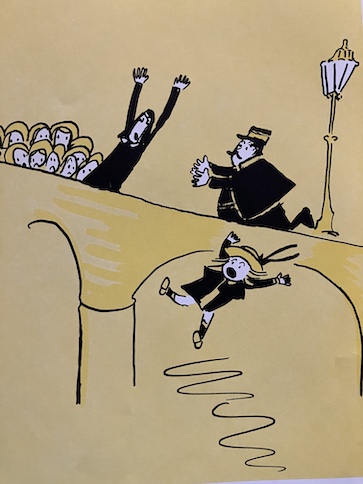
The Madeline stories are considered children’s classics, and this is one of the best-known books in the series. It starts out much like the first book in the series, introducing the old house in Paris where Madeline and her classmates stay for boarding school and describing how brave Madeline is. However, at the part that explains that Madeline knows how to frighten their teacher, Miss Clavel, Madeline falls from a bridge over the river while she’s trying to walk on the edge.

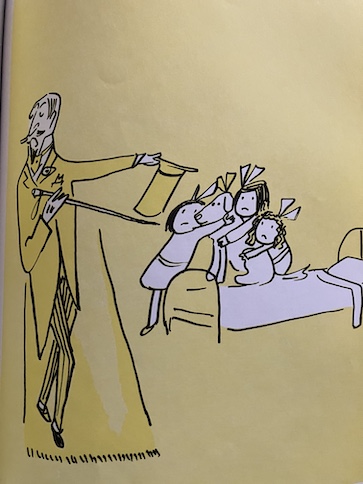
Fortunately, Madeline is saved from drowning by a dog that jumps into the water to save her. Miss Clavel and the other girls take Madeline and the dog back to the school, dry them off and put them to bed. The girls keep the dog and name her Genevieve. Genevieve is a smart dog, and soon, she’s a very pampered and happy pet.

However, when the trustees of the school come for an inspection, they raise a fuss about the girls keeping a dog in the school and turn Genevieve out! The girls are very upset, so they immediately go out and search for Genevieve.

Fortunately, Genevieve returns, and there is a surprise for the girls that finally settles all the arguments they’ve been having about whose bed the dog will sleep in that night!

The book is available to borrow and read for free online through Internet Archive (multiple copies).

As with the other books in the Madeline series, the beginning of the story echoes the first Madeline book, but this one expands on Madeline’s habit of walking on the edge of the bridge and frightening Miss Clavel, showing that Miss Clavel has reason to worry about Madeline’s stunts.

I remember reading this book when I was a kid and being really worried about what would happen to the dog, Genevieve! I always loved dogs, and I was worried about her when the trustees turned her out of the school. After Genevieve returns to the school, there’s no follow-up on how the trustees react and whether or not they approve of her and her puppies staying at the school, but it seems like everything will be okay. With plenty of puppies for the girls at the school, they no longer fight about who gets to sleep with Genevieve or give her attention. Staying at a boarding school where every girl gets a puppy of her own to look after would be a dream for many girls!

Something I noticed in this book is that the style of the pictures varies between cartoon style in black and yellow and a more impressionistic style with full color. This is also true in other Madeline books. The more colorful pictures tend to show more emotional or dramatic moments.

Lucky Dog Days

Pee Wee Scouts

Mrs. Peters tells the scouts that it’s Help-a-Pet month. The kids start talking about the kinds of pets they have, and Mrs. Peters asks them if they would like to do something to help a pet. She suggests that they could walk dogs at an animal shelter or raise money for homeless pets.

Mrs. Peters takes the scouts to an animal shelter. The kids like seeing all the animals, although Tracy turns out to be allergic to them. The other kids walk the dogs around the shelter yard. This turns into chaos because Rachel decides to walk a dog that’s really too big for her to handle, a St. Bernard. (The adults should have stopped her, but they never do in this series when a kid is about to do something they shouldn’t. They take Rachel’s word for it that she can handle a St. Bernard because she has walked her uncle’s Great Dane. However, even dogs of the same size don’t have the same temperament, and I think a real shelter worker would know the individual animal’s temperament and not offer an oversized dog with a lot of energy to a six-year-old child.) When her dog starts running and dragging her, the other dogs get out of control, too. Fortunately, they’re all in a contained yard, so none of them gets away. The incident ends with Rachel crashing into a lily pond in the yard.

Mrs. Peters tells the children that they will have a rummage sale to raise money for the animals at the shelter. All of the scouts will donate things to sell and collect donations from others. Tracy tells Molly and Mary Beth that she will help them collect donations. Molly is annoyed that Tracy is coming with them because she thinks Tracy is bossy and that her sniffling is gross. However, it turns out to be a good thing that Tracy comes because she brings a wagon with her to collect donations, which the other girls hadn’t thought to do. Unfortunately, their wagon disappears when the girls try to visit one last house to ask for donations and leave it unattended.

It turns out that some of the other scouts, Roger, Sonny, and Tim, found their wagon and try to claim the donations as their own at the next scout meeting. The boys say it’s theirs because they just found it on the sidewalk, but the girls tell Mrs. Peters what happened. Mrs. Peters smooths things over, saying that it doesn’t matter because these items will be sold to help the animals. Molly doesn’t think it’s fair for the boys to get credit for the work the girls did gathering donations, though. (I think Mrs. Peters should also have had a word with the boys about not taking things if you don’t know who they belong to and don’t have permission to take them. The adults in this series never explain things enough.)

There is one particularly fancy necklace that looks like diamonds among the donations. Mrs. Peters says that, rather than putting a price on it, they will auction it off to the highest bidder. They also have some adoptable dogs at the sale to attract people who might adopt them. It was Molly’s idea to have adoptable dogs there to sell because a lady expressed interest in Mrs. Peters’s big, black dog, Tiny. To Molly’s surprise, the lady who eventually buys the fancy necklace and pays a thousand dollars for it is the woman who donated it. When they ask her about it, she explains that it is a real diamond necklace and that she donated it by a mistake. However, even though she paid a lot of money to get it back, it’s still only a fraction of its real value, and she’s happy to make a big donation to a worthy cause.

In the end, Mrs. Peters congratulates the scouts on how much money they raised and how many animals were adopted that day. There is just one puppy left from the animals who were at the sale. The kids are attached to the puppy and don’t want to send him back to the shelter, so Mrs. Peters decides to keep him as a mascot for the troop. They name him Lucky, and Mrs. Peters says that they can take turns keeping him at their houses. (Except for the kids with allergies, like Tracy.)

The name of the book comes partly because the month is August, and Mrs. Peters explains to the kids what the “dog days” of summer are, although she just describes what the weather is like rather than explain why they’re called “dog days.” The term comes from the period after the rising of the dog star Sirius, but then again, I suppose that could be difficult to explain to six-year-olds. Not all adults would necessarily know it, either. I had to look it up myself to get the explanation. Even so, the name is appropriate because the theme of the book is pets, and it is set during late summer.

I still think that the adults in the story could explain some things to the kids more. That’s often a part of books in this series, although that’s also where much of the excitement of the story comes from, things going wrong because the kids don’t entirely know what they’re doing. Any lessons learned are more implied than spelled out.

The kids also keep insulting each other, even though they’re also kind of friends in the stories. We don’t really know why Molly thinks Tracy is bossy because she doesn’t really explain that. It just seems to her that Tracy tends to tell other people what to do and get her way. Molly relents a little in this book, though, because it turns out that Tracy has some good ideas, and even when she thought Tracy screwed up because they lost the wagon, everything worked out for the best.

The Case of the Invisible Dog

McGurk Mysteries

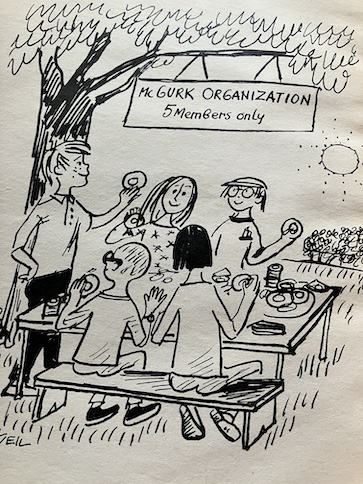
The members of the McGurk Organization are having their annual picnic in McGurk’s backyard when, suddenly, a doughnut leaps off the table and begins traveling through the bushes and grass. None of them can understand what’s happening because they can’t see anything that would cause the doughnut to move like that.

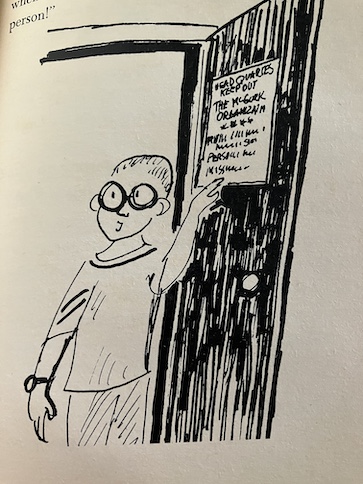
They go after the doughnut to see what happened, and they find Brains Bellingham, the nephew of Miss Bellingham, who lives next door. Brains has been staying with his aunt while his parents are out of town, and he always has a put-down for the members of the McGurk Organization. Brains is holding his aunt’s Yorkshire terrier, Dennis, and the missing doughnut, which has apparently been chewed by the dog. Brains apologizes for the dog ruining their “crummy” picnic, but he says that Dennis can’t resist doughnuts. However, that explanation doesn’t satisfy the McGurk Organization because none of them saw a dog carrying the doughnut, just the doughnut moving by itself. Brains makes an excuse about the dog being small and blending in with his surroundings, but the others can tell that he’s hiding something.

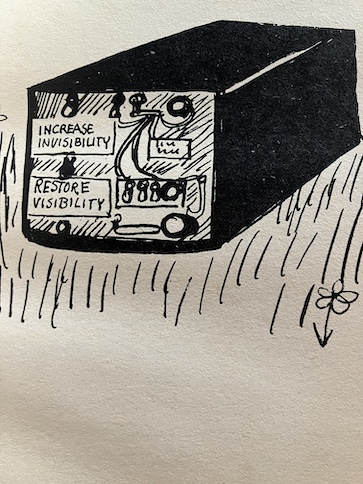
When Brains leaves for a moment because he says his aunt is calling him, they spot a strange black box in the grass. The box has dials and switches on it, and there are two labels: “Increase Invisibility” and “Restore Visibility.” Brains is known for building various inventions, so they know this is probably something he made, but does this device really make things invisible? Is that why they couldn’t see the dog when he stole the doughnut? They have a look inside the device, but since none of them is particularly good with electronics, they just know that it contains a bunch of wires and seems to be powered by batteries, and there is some kind of light inside the box. There are also doughnut crumbs inside the box.

When Brains sees them messing with the box, he yells at them to stop snooping. Joey, the organization’s secretary, knows that part of Brains’s problem with the organization is that he’s jealous because he really wants to join. He’s hinted before that they need a laboratory man to help them with forensics. McGurk might have taken him up on the offer except that Brains was condescending and insulting in the way he made it, calling them “dummies.” He’s a little younger than the rest of them, too, so his condescending attitude makes him seem even more like an annoying little kid. McGurk tries to ask Brains about his strange device, but Brains just refuses to answer and takes the box and the dog away.

The members of the McGurk Organization return to their picnic, but they can’t stop wondering about Brains, his strange invisibility device, and how he accomplished the trick with the dog and the doughnut. Most of the organization members are pretty sure that there must be some kind of trick to it, but they can’t figure out how Brains did it. While they discuss it in their basement meeting room, they hear what sounds like the jingle of dog tags, and Willie, who has a very sensitive nose, says that he smells a dog. They search the basement and find a dog’s rubber bone. Then, Brains shows up, looking for Dennis. To their astonishment, Brains seems to pick up an invisible dog, who seems to be struggling and making dog noises, growling and jingling tags!

When the organization goes to confront Brains about what just happened, they find him with his strange box. The box appears empty on the inside, but they hear dog sounds from it. Brains operates the controls and opens the box again, and Dennis comes out! Brains claims that he invented the invisibility box by accident while he was trying to develop a treatment for getting rid of Dennis’s fleas and ticks using light rays. Brains says that there is a side effect where Dennis sometimes turns invisible at random times without Brains intentionally turning him invisible but that he’s working on the problem.

McGurk is thrilled at the possibility that Brains might be able to build a machine big enough to turn a person invisible, and he even offers Brains membership in the organization if he can do it. Brains says he could, but to everyone’s surprise, he turns down the membership offer. He says that he knows they don’t really want him in the organization; they just want his machine. It’s a little embarrassing, but it’s true.

The members of the McGurk organization consider ways that they could get Brains to change his mind. McGurk considers blackmail, but Wanda says that wouldn’t be right for a detective organization. Wanda thinks McGurk should apologize to Brains for the way he turned Brains away when he tried to join earlier, but McGurk can’t stand the idea of apologizing. Willie thinks they could offer to pay Brains, but they don’t really have anything they could pay him. They all ponder what would happen if they let word of Brains’s invention get out to the public or even the government.

Then, Brains comes to them, asking for help. He says that Dennis has turned invisible again, and he’s run off! Can the McGurk Organization find an invisible missing dog?

The book is available to borrow and read for free online through Internet Archive (multiple copies).

I didn’t read this book when I was a kid, although I read many others in the series. Because I didn’t read this book before, I didn’t really know the story of how Brains joined the McGurk Organization. There are some references to it in some of the later books in the series, so I knew that, when the other members of the organization first met Brains, they were investigating him for some trick he’d played on them. I was used to Brains being their friend, so it seemed odd to see him as the antagonist/suspect they are investigating in this book.

During the story, the members of the McGurk Organization are pretty sure from the beginning that Brains is playing some kind of trick, but they’re not sure how. He does manage to convince them temporarily that he has successfully developed an invisibility device, but McGurk soon realizes that something Brains has said contradicts what’s happened. Then, he and the others reexamine what happened to figure out how Brains staged his tricks. They’re a little mad at being tricked, so they pull one more trick on Brains to get even before they all forgive each other. Brains shouldn’t have called the others “dummies” or been condescending to them, and the others shouldn’t have been too quick to write him off just because he’s a year younger than they are. In the end, McGurk says that anybody who’s clever enough to work out a complicated trick like this one deserves to be a member of the organization, and they hold another picnic to celebrate their new member.

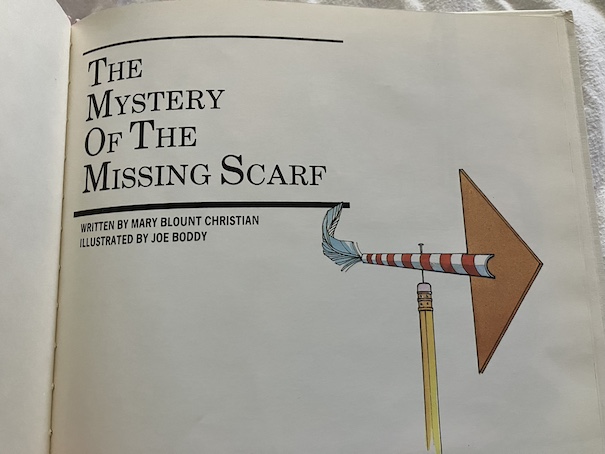
The Mystery of the Missing Scarf

This book is part of the Sherlock Street Detectives series.

Ann doesn’t have much confidence in her twin brother Walter’s dog Watson. She doesn’t think that he’s capable of learning tricks, and when Walter shows her the new trick he’s taught Watson, she isn’t very impressed. The trick is for Watson to just grab a red rag out of Walter’s hand and run off with it.

Ann is more concerned with getting her scarf washed and hung out to dry before they go see their friends. David and Pedro like Watson’s trick. At least, it’s a pretty good trick for Watson because Watson doesn’t know many.

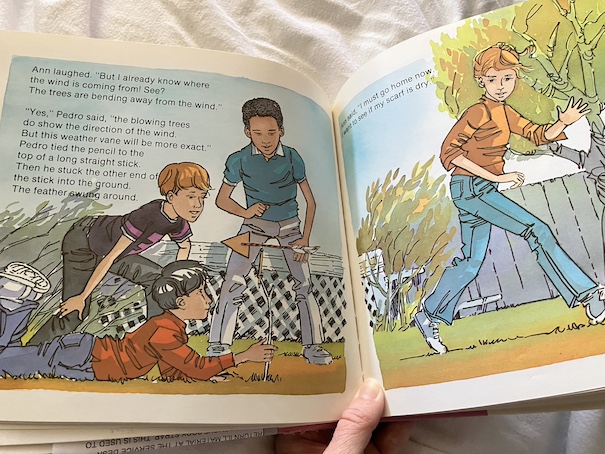
Pedro shows the other kids how he’s making a weather vane. It’s a windy day, so it’s a good time to try it out.

Then, Ann notices that the scarf she hung out to dry is gone! At first, she blames Watson for taking it as part of the trick Walter taught him. However, the dog is not at fault. Pedro uses his weather vane to show Ann how to find her scarf.

The book is available to borrow and read for free online through Internet Archive.

It’s a fun picture book mystery, but it’s also educational. I liked the part where Pedro explains how he made his weather vane. Kids can follow along with his explanation to make a weather vane of their own. The mystery of what happened to the scarf isn’t difficult, but the way the children found the scarf was clever. The book also has a vocabulary list and glossary in the back.

Scooby-Doo and the Haunted Doghouse

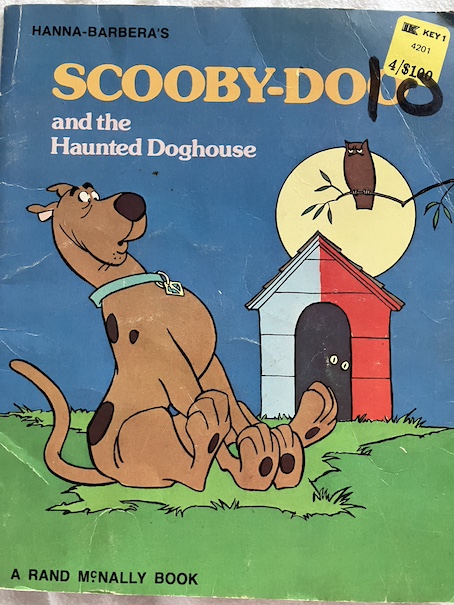
Scooby-Doo’s friends are building a new doghouse for him! They can’t decide what color to paint it, so they make half of it red and half of it blue. Scooby loves his new doghouse, at first, but then, something spooky happens!

One night, Scooby comes running into the house, scared. While Scooby cringes under the covers of Shaggy’s bed, Shaggy gets a flashlight and goes outside to see what scared Scooby.

When Shaggy looks in the doghouse, he sees a glowing pair of eyes, and then, something white runs past him with a shriek! Scooby and Shaggy both stay inside for the rest of the night, and in the morning, they tell their friends that they think the doghouse is haunted.

Their friends are sure that there must be some other explanation for what happened, but who or what was in Scooby’s doghouse?

The book is available to borrow and read for free online through Internet Archive.

Scooby-Doo was my favorite cartoon when I was a kid, especially Scooby-Doo, Where Are You!, and I’m still nostalgic about it! The mystery in the story is very simple, but suitable for young children with nothing truly scary about it. Even kids might guess what the solution is before the characters realize what’s in the doghouse.

Now that I think about it, it seems out of character for Scooby-Doo to have a doghouse because I don’t think he had one in the original cartoon series. I remember that he had a fancy one in one of the later spin-off series, but in the original series, he just always slept inside with his human friends. Of course, one of the hallmarks of the Scooby-Doo series is that there isn’t really a strict canon. Details about the characters and the Mystery Machine can change from episode to episode to suit the story without any real explanation because it’s a just-for-fun series.

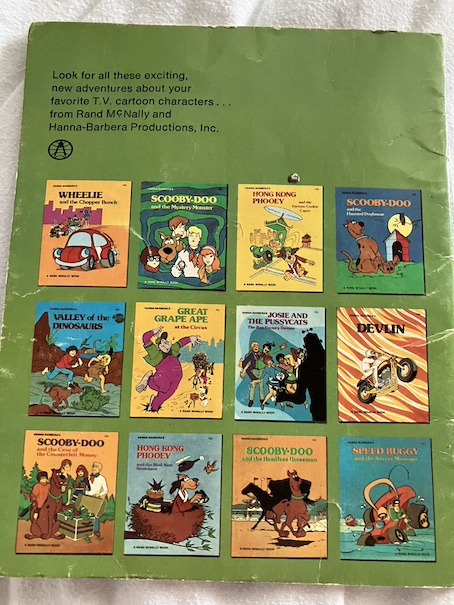
One of the things that I liked about this book was that it reminded me of all the other books I read as a kid that were based on popular cartoon characters. I think most of the cartoon series from my childhood in the 1980s and 1990s also had related books. On the back of this book, there are pictures of other books in this series, based on other Hanna-Barbera cartoon series, including other Scooby-Doo picture book mysteries.

Harry the Dirty Dog

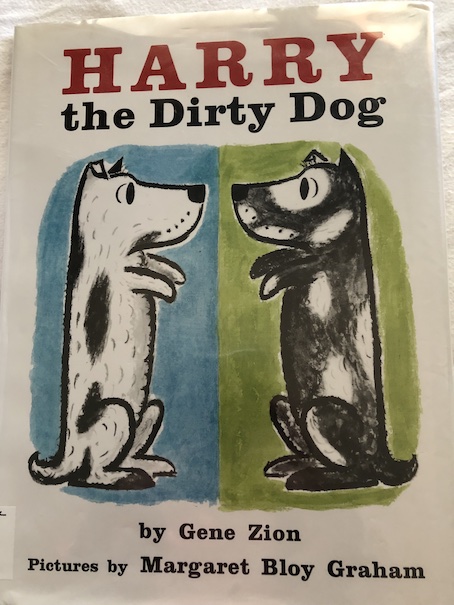
Harry the Dirty Dog by Gene Zion, pictures by Margaret Bloy Graham, 1956.

Harry, like other dogs, hates baths! One day, when he finds out that his family is about to give him a bath, he decides to steal the scrub brush! He buries the scrubbing brush in the yard and runs off into the city to have some fun and get good and dirty!

Normally, Harry is a white dog with black spots, but after a day playing with other dogs and running through construction areas in town, he’s so dirty that he looks like a black dog with white spots.

Eventually, he gets tired and hungry and misses his family, so he goes home. However, he has trouble getting his family to recognize him because he’s so dirty. Even when he does his usual tricks for them, they still don’t think he looks like their Harry.

At first, Harry fears that he’s lost his family because they don’t know who he is. Then, he realizes that what he really needs is the scrub brush and a good bath! He digs up the scrub brush again and manages to persuade his family to give him a bath.

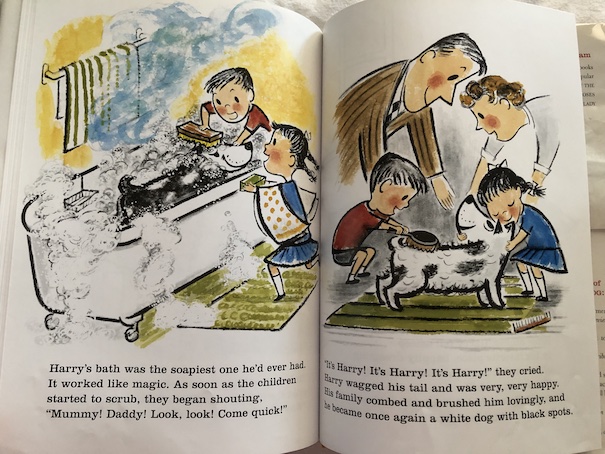
Once he’s clean, his family recognizes him. Harry sees the benefits of getting a bath, but he still doesn’t really like them, and he still enjoys the thought of getting nice and dirty again.

The book is available to borrow and read for free online through Internet Archive (multiple copies).

Dogs in real life often don’t like baths, and this whimsical picture book is about a dog discovering the benefits of a bath. When I was a little kid and I first saw this book, I was really worried that Harry would lose his family because they didn’t recognize him, but really, the family would have to be pretty dense for thinking that this dog, which looks like the same breed/mix as theirs and acts like theirs and does all the tricks their dog does but is just covered in dirt, must be a completely different dog. The story is just meant to be humorous, and it’s questionable in the end whether any lessons are learned. Yes, Harry now sees that getting a bath and being clean help his family to recognize him, but he still dreams about getting dirty, and he’s hiding the scrub brush under his bed. My dog also hates baths and fears the groomer, but I have assured her that I would still know her anywhere!

Bicycle Mystery

The Boxcar Children

Boxcar Children Bicycle Mystery cover

Bicycle Mystery by Gertrude Chandler Warner, 1970.

Boxcar Children Bicycle Mystery fixing a bike

Grandfather Alden tells the Boxcar Children that their Aunt Jane has invited them to visit her on her farm. To make the trip more interesting for the adventurous kids, he suggests that they make the journey to Aunt Jane into a cross-country bicycle trip. There are motels along the route where they can stay, or they can came out. They won’t be able to take Watch the dog with them this time because he’s getting too old to follow their bikes that long distance, but the kids like the idea of the cross-country bike trip.

The cross-country trip gives the Alden children the chance to meet new people and have adventures. Along the way, they stop to help Mrs. Randall, a woman who is worried about having to fix dinner suddenly for her husband’s boss while her house is a mess. The Aldens see how upset she is while they’re shopping for food themselves, so they volunteer to help her. The boss’s visit turns out to be a success, and rather than coming to discuss a problem at work, he’s there to tell the Randalls that he’s considering Mr. Randall for a promotion. However, the Alden children have the feeling that there’s something else worrying Mrs. Randall that has to do with her son, Carl, who isn’t there. Every time Carl is mentioned, Mrs. Randall seems worried.

Boxcar Children Bicycle Mystery dog in the window

As the children continue on their way, they get caught in a rain storm and take shelter in an abandoned house. There, they find a little gray dog, who seems friendly and well-behaved. The dog is very hungry, and they share their food with him. The dog seems eager to follow them when they leave. They try to tell the dog to go home, thinking that he probably lives somewhere nearby, but he insists on going with them. Benny starts calling the dog Shadow for following them. The Aldens don’t think they can keep Shadow because they don’t think Watch would like them getting another dog, and they’re a little worried that letting him follow them might be taking him further away from wherever he lives, but they don’t know what to do but take care of him until they can figure out where he belongs.

Boxcar Children Bicycle Mystery injured boy

Later, they meet a boy who is minding a roadside vegetable stand who has a broken leg. The boy says that he feels badly because his father can use some help picking vegetables, too, but he can’t do much since he broke his leg. The Boxcar children offer to help, and the boy and his father are surprised that they’re willing to work for free. The kids say that they’re just out for adventure right now, and they don’t mind helping. The father, Mr. Smith, notices the way that Shadow whines constantly, even though he doesn’t seem hurt. They talk about the dog and wonder who the owner is. Mr. Smith thinks that, if someone didn’t want the dog, they probably could have sold him instead of abandoning him. His son, Roy, noticed something odd while he was minding the vegetable stand. A pair of girls commented that it was the same dog that they had seen in a parking lot earlier. Mr. Smith suggests that the kids ask Miss Lucy at the post office if anyone in the area has lost a dog because she knows everyone and everything that’s going on. When they ask Miss Lucy, she says that nobody in the area has lost a dog, and Shadow isn’t at all familiar to her. Shadow seems to be an unusual breed, and Miss Lucy thinks that he looks funny.

As the children travel further, they spot a sign for a dog show. They decide that they should go to the dog show and see if they can meet people who are interested in dogs and might know what kind of dog Shadow is. They meet a man who tells them that the dog is a young show dog, and he offers to buy the dog. When the kids say that they can’t sell Shadow because he doesn’t belong to them, the man and his wife seem suspicious, and the woman takes a picture of them and the dog.

When the kids finally reach Aunt Jane’s farm, Uncle Andy recognizes the dog as a Skye terrier. The kids finally manage to locate the dog’s owner, and it turns out to be a surprise.

The book is available to borrow and read for free online through Internet Archive (multiple copies).

My Reaction

This is one of the early Boxcar Children books, written by the original author. Because of the cross-country trip format, the book is somewhat episodic, with incidents taking place at different places where the children stop on their trip. The story has more elements of adventure than mystery, but the mystery element is there, too.

The Boxcar Children frequently have more independence from adult supervision than most kids have today, which is part of the appeal that the series has for kids. I think that most people who rent motel rooms would be concerned about renting rooms to children by themselves, but it’s important to point out that the word “kids” is relative. In the later books in the series, the kids’ ages are frozen, so the eldest, Henry, never ages past 14 years old. However, in the earlier books, like this one, the kids did age. In this book, Henry is college-aged, so he’s not exactly a kid anymore. The book doesn’t provide an exact age for him, but he’s probably 18 years old or older.

Clifford Takes a Trip

Clifford

Clifford Takes a Trip by Norman Bridwell, 1966.

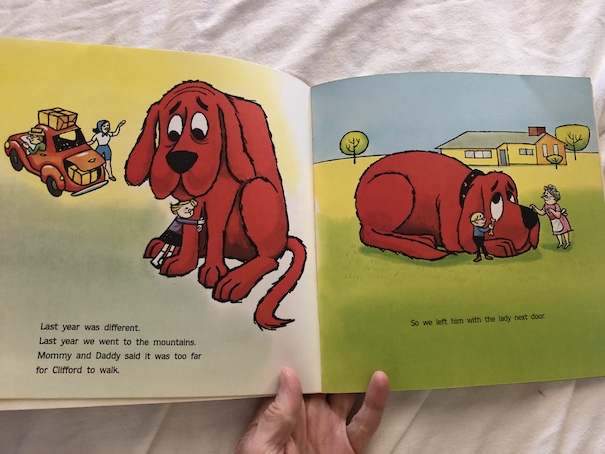
Emily Elizabeth and her parents don’t usually take long trips during the summer because it’s too difficult to bring Clifford along. He’s just too big to go on trains or buses. One summer, Emily Elizabeth’s parents decide to go camping in the mountains. They can’t take Clifford, so they leave him behind with a neighbor.

However, Clifford misses Emily Elizabeth too much, so he decides to go find her! A gigantic red dog can create a lot of chaos on a cross-country trip.

Along the way, he does help a man with a broken-down grocery truck, and the man is grateful enough to feed him.

He also arrives at the family’s campsite just in time to save Emily Elizabeth after she thought it would be fun to play with some baby bears she found.

The family considers that next year, they may find a way to take Clifford with them somewhere else.

The book is available to borrow and read for free online through Internet Archive (multiple copies, including one in Spanish).

My Reaction

Like all Clifford books, the humor is based around Clifford’s enormous size. Even though the family thought that it would be too far for Clifford to walk to come to the mountains with them, he tracks them down there anyway. Then, after he rejoins his family, he sleeps with Emily Elizabeth, his ear propped up to be her tent. The idea they’re considering next for transporting Clifford is a flat-bed truck. I could well imagine my own dog trying to track me down if I went on vacation without her, but fortunately, when your dog is about the same size as Toto in the Wizard of Oz, traveling with a dog isn’t as difficult.

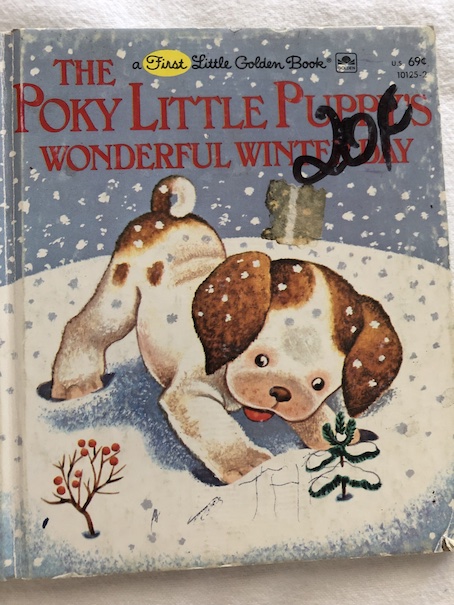
The Poky Little Puppy’s Wonderful Winter Day

The Poky Little Puppy’s Wonderful Winter Day by Jean Chandler, 1982.

This book is part of the Poky Little Puppy series of picture books from Little Golden Books.

The Poky Little Puppy is the last to wake up on this snowy day, seeing his brothers and sisters rushing outside to play as he starts his breakfast. When he finishes his breakfast and goes outside, he doesn’t see the other puppies, but there are children playing in the snow.

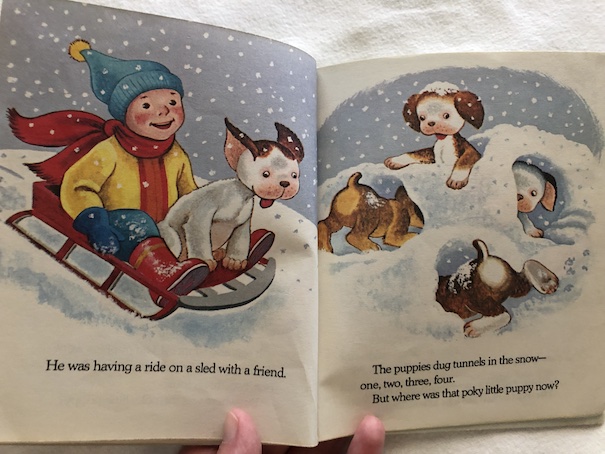
The Poky Little Puppy follows the puppy paws through the snow and finds his siblings. The other puppies go sliding now a hill together, but the Poky Little Puppy gets a ride on a child’s sled.

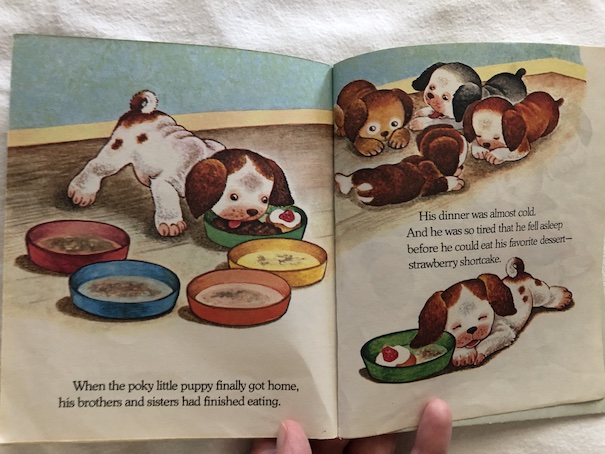
The Poky Little Puppy also tries to make a snow angel with a child and chases snowballs the children throw. He was the last puppy to start playing and the last to make it home to dinner because he is “poky” and arrives late to everything, but in the process, he had the most fun of everyone! (Although, he does fall asleep before eating his dessert.)

The book is available to borrow and read for free online through Internet Archive.

My Reaction

This is just a cute little story about the fun that a puppy has on a snowy day. I liked the message that the Poky Little Puppy has fun going through the day at his own pace and doing his own thing. Even though he isn’t always doing what his brothers and sisters are doing and sometimes trails behind them, he makes the most out of this fun, snowy day!

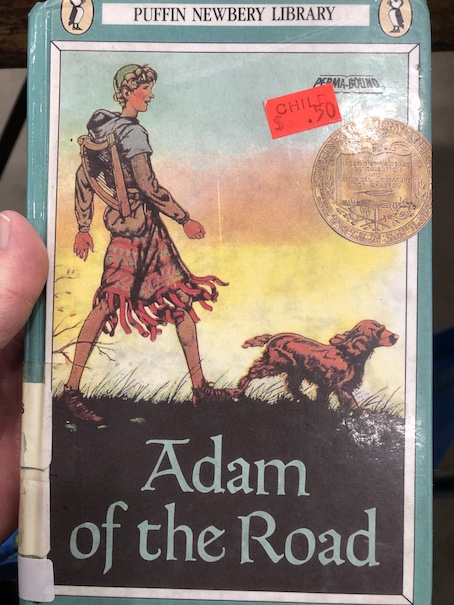
Adam of the Road

Adam of the Road by Elizabeth Janet Gray Vining, illustrated by Robert Lawson, 1942.

The story takes place in England in 1294. It’s summer, and eleven-year-old Adam Quartermayne is waiting for his father, Roger the minstrel, to come see him at the dormitory where he’s been living while he’s going to school at the Abbey of St. Alban. Roger Quartermayne has been in France, attending a minstrels’ school, where he has been learning new songs and stories. More than anything, Adam wants to go on the road with his father, traveling from town to town, playing their musical instruments.

Roger is a higher class of minstrel than most, truly skilled in his art, welcome even in noble manor houses and castles, and well-paid for his performances. Roger plays a viol, while Adam can play the harp. Adam practices his playing while at school and tells stories to the other students. Although his teachers would prefer that he spent his story-telling time talking about the saints, they allow him to entertain the other boys as long as his stories are tasteful and not rude or mocking. Adam’s father has impressed on him that a minstrel’s job is not to tell his own feelings but to choose entertainment that suits the mood of his audience, whether it’s happy or sad. (In other words, they know how to read a room, and a good minstrel can make the audience feel like he’s saying what’s on the minds of the listeners.)

Adam’s closest companions at school are his best friend, Perkin, and his dog, Nick. Since Nick isn’t allowed in the dormitory, Adam pays for him to board with a woman in town. He and Perkin go to visit Nick when they can. Adam has taught Nick to do entertaining tricks, as befits a minstrel’s dog.

When Adam’s father comes, he tells Adam that he has taken a position with Sir Edmund de Lisle and is now traveling with his party. Roger invites Adam to join him on their journey to London, and Adam eager accepts. His only regret at leaving the school is that Perkin cannot come with them, but Perkin says that they’ll see each other again. Perkin’s father is a ploughman (this video, from Crow’s Eye Productions, explains a little about the life of a ploughman and how they dressed), and he says that, if they pass through the village where he lives, they can stop and visit his parents and the parson who sent him to the abbey school.

The open road is like home to minstrels like Roger and Adam. They spend their journey entertaining Sir Edmund’s party with stories. Adam develops a crush on Sir Edmund’s pretty niece, Margery, although her brother, Hugh, is an annoying snob. Adam’s first efforts to join his father in playing music are awkward and embarrassing, but Roger says he will improve. Adam is also lonely without Perkin to talk to. There are other boys at Sir Edmund’s manor house, but they all ignore him. They become friendlier when Adam takes the advice of a friendly squire to lend them his horse for their jousting practice when Hugh’s horse is lame. At first, Hugh thinks that a minstrel like Adam wouldn’t know anything about martial arts, but Adam demonstrates that he has also had some training, causing Hugh to give him more respect. From then on, he is able to join the other boys in their games.

At the wedding of Sir Edmund’s daughter, Emilie, Adam has the chance to see many other minstrels and entertainers of various kinds. Although both Adam and his father are richly rewarded for their performance, Roger gambles away his share of the money playing dice with the other minstrels. He tells Adam to keep his own money close to him and not to hand it over to him, even if he asks for it. Roger recognizes that he has a gambling problem and can’t be trusted with money. Worse still, he gambled away their horse, too. It’s upsetting to Adam because they had never had a horse before, and he was fond of it. He also knows that Hugh was fond of that horse. Roger is embarrassed about what he has done, and Hugh worries that Jankin, the man who won the horse, will ride him to death because he doesn’t know how to take care of horses.

Although they are still in the employ of Sir Edmund, he will not be needing them for a while, now that the wedding of his daughter is over. Roger and Adam go on the road again, although they are supposed to return to Sir Edmund’s manor after traveling their route. In London, they meet up with Jankin again, and he tries to get Roger to gamble with him again for ownership of Adam’s dog, but Roger refuses, saying he doesn’t want to play anymore and the dog belongs to his son. However, when they happen to be staying at the same inn later, Jankin steals Adam’s dog!

Roger and Adam hurry after Jankin to get Nick back, asking people they meet on the road which way he went with their dog. They almost catch up to him at a ferry, but he gets on the boat and it leaves before they can reach it. Not wanting to wait for the ferry to return and desperate to reach his dog, Nick jumps in the water and tries to swim after the ferry, but he is still unable to catch up. When he climbs out of the river, he is alone and too tired to continue the pursuit anymore. He is separated from his father, but he still has his harp, thanks to a kind woman who helped him. What is he going to do? Will he ever find his dog or father again?

The book is a Newbery Medal winner. It is available to borrow and read for free online through Internet Archive (multiple copies).

My Reaction and Spoilers

The story offers a ground-level view of Medieval society. Through his travels, Adam mixes with children and adults from various levels of society. Adam begins at a monastery school, taught by monks. Then, he joins his father, working for a noble family and living at their manor, where Adam becomes friends with noble boys training to be knights. They meet other minstrels, and when they travel on the road, they also meet traveling pilgrims, stay at inns and speak to the innkeepers. When Adam is on his own, he briefly stays with a ferryman and his wife, travels with a merchant, is robbed by highwaymen and has to get help from local law enforcement, gets information from a shepherd, attends a large fair with people of all kinds, and toward the end of the book, spends time with Perkin and his family, helping his father with ploughing. Along the way, Adam learns many things about people and different members of society, including how girls are treated differently from boys, even in noble families and what common people think about the king and parliament and how they make laws.

During the course of the story, Adam and his father also discuss some of the philosophy behind their own profession. It begins with Adam’s reflection on what his father said about choosing his selections of songs and stories to appeal to his audience because his job is to please others, not merely himself. However, when Adam briefly joins up with some poorer minstrels, he comes to understand that it’s not just a matter of giving people what they want. A better minstrel not only gives people material they like but which appeals to the better sides of their personalities, elevating them to their highest versions of themselves, instead of just catering to everyone’s lower tastes. Understanding other people and their lives and tastes are critical to the job of being an entertainer. Adam also learns a little about the use of humor and how it can benefit both himself and others when used well. At one point, when Adam is recovering from an incident that was embarrassing to him, he makes a joke about it that amuses a new friend, and when his new friend laughs, Adam realizes that he feels better about the embarrassing incident. His use of humor softens his feelings of embarrassment and also provides a useful tool for entertaining and bonding with someone else. The story compares it to an oyster turning an irritant into a pearl that is both less irritating to the oyster and something beautiful for someone else. Although Adam goes through genuinely terrible circumstances through his travels, the experience shapes his views of life and the type of minstrel he wants to be.

I was genuinely worried about the animals in the story because I find it stressful to read about animal cruelty. Fortunately, both the horse and dog survive their experiences with Jankin, and Adam is reunited with his father and Nick.

I enjoyed the pieces of real Medieval songs that appear throughout the story, like Sumer is I-cumen In (You can hear the song in this YouTube video. This one explains what the Old English words mean. It’s about the beauties of nature and lively animals at the beginning of summer, apparently with a confusing line about farting billy goats.) and an old version of London Bridge is Falling Down, which also includes an explanation of the story behind the the song.

As another piece of trivia, Jankin is actually a Medieval nickname for John. In Medieval times, it was common to get new nicknames for certain common names by changing just one letter or sound in the name and/or adding “-kin” to the end of a name as a diminutive, like we might add a “-y” for Johnny. In fact, the name Jack that is used as a nickname for John comes from this earlier nickname – John to Jan to Jankin to Jackin to Jack. We get other nicknames that don’t completely resemble the original name from this same method of creating new nicknames, like the nickname Peggy for Margaret – Margaret to Maggie to Meggy to Peggy.