
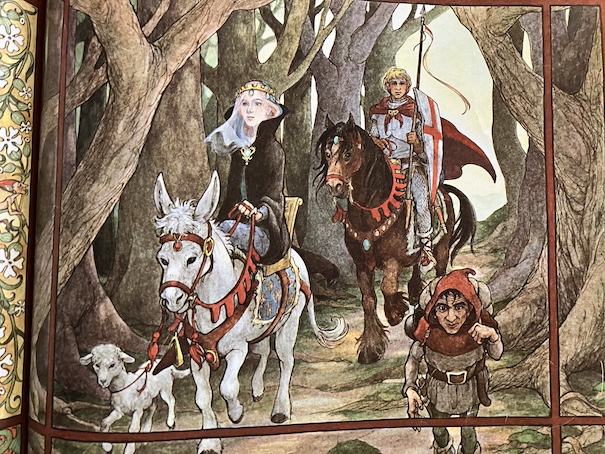
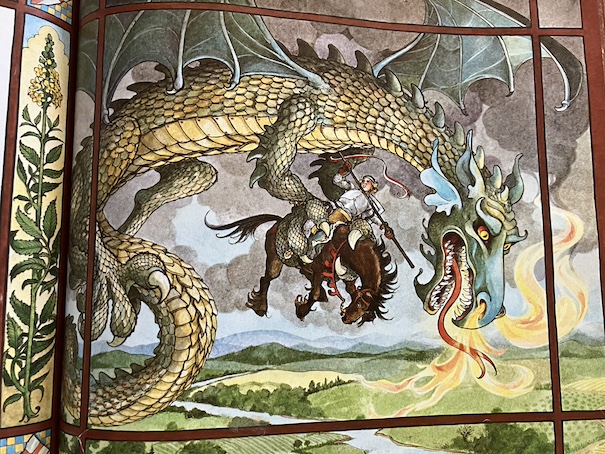
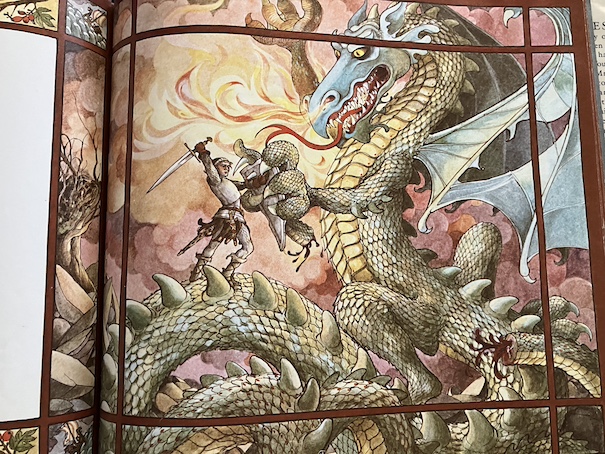
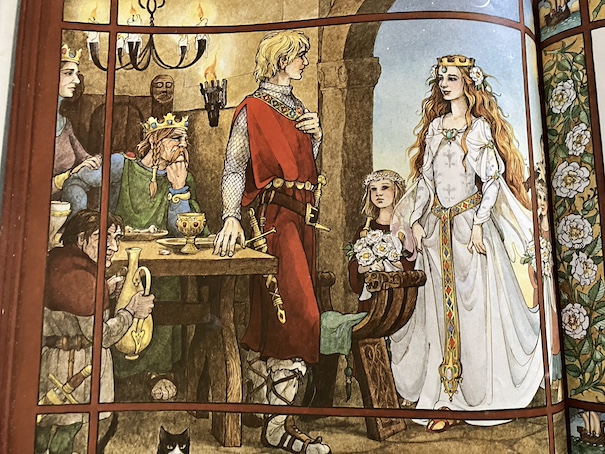
The Reluctant Dragon by Kenneth Grahame, illustrated by Michael Hague, 1983.
This picture book, with its illustrations, is from the 1980s, but the story by Kenneth Grahame is much older, from 1898. It was always a short story, originally published in a collection called Dream Days. In the original version, there’s an opening part that isn’t included in this picture book, where a girl name Charlotte finds large footprints from a reptile, and a man tells her the story of the dragon.
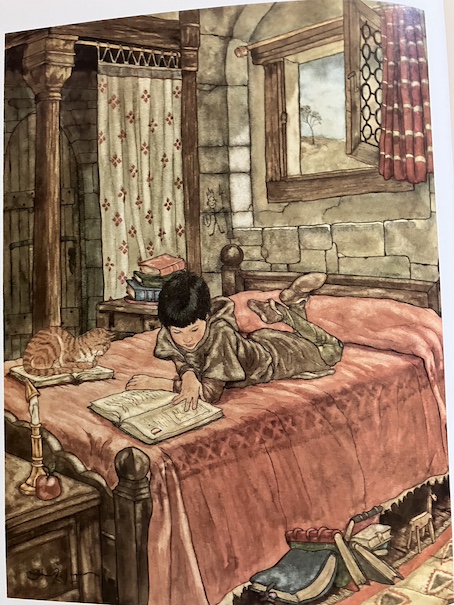
There is a shepherd whose son loves to read, borrowing books from a friendly member of the gentry who lives nearby. Not all parents from their class value book learning, but the boy’s parents appreciate it and support their son for spending time reading. One day, the shepherd comes home and tells his wife and son that he’s had a terrifying experience. While he was out with his flock, he heard a strange snoring nose, and when he went to investigate, he found a frightening-looking creature with scales, with its head sticking out from the cave.
The shepherd’s son isn’t as alarmed as the shepherd. He merely identifies the creature his father saw as a dragon. He knows about dragons because he’s read about them, and he’s thought for some time that the cave was probably a dragon’s cave. Rather than being surprised or alarmed about the dragon, his father’s discovery merely confirms what the boy already suspected, that a dragon might have lived in the cave once and that it would be a suitable dragon’s home. Furthermore, the boy says that dragons are quite sensitive creatures, so he might look in on this one at some point.

When the boy goes to visit the dragon, the dragon tells him he won’t put up with any rough stuff, like hitting or throwing stones. The boy says he wasn’t going to do any of that, and the two of them start to talk. The dragon hasn’t been staying in the cave for very long, and he’s not sure if he’s going to stay or not. It’s a nice place, but he’s not sure if he’s ready to settle down or not. He admits that he’s lazy, compared to other dragons. Other dragons do things like rampaging, chasing knights, and eating damsels, but this dragon would just prefer a quiet life with regular meals and time to snooze and make up poetry. The boy and the dragon talk about poetry and how it seems like nobody else around them appreciates it the way they do or understands why they like it.
However, the boy can see that there would be problems with the dragon settling in this area. Dragons and humans just don’t mix, even though this dragon isn’t interested in rampaging or doing the other things that would be likely to make enemies of the local population. Once word has gotten around that there’s dragon here, there are bound to be people who will try to hunt it with spears and swords because they’ll only see the dragon as a monster. The dragon has trouble grasping the idea that he could even potentially pose a risk to the human population or that anybody might see him as a danger.
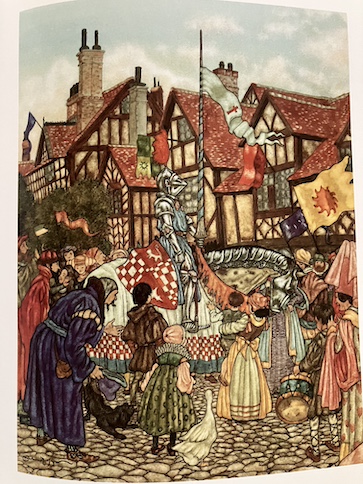
Eventually, word does get around that there’s a dragon living in the cave. The people in the village are both thrilled at this exciting thing happening to their village and plotting to rid their land from this supposed scourge, although the dragon has spent the entire time with his poetry and hasn’t been scourging anything. The village attracts the attention of St. George, the famous dragon slayer, and he comes to deal with the apparent problem.
The boy goes to the dragon and warns him that St. George is in town and that he’s got to prepare to face him and fight. Everyone in town is expecting him to, and they’re all excited about it because it’s the most exciting thing that’s ever happened there. However, the dragon says that he doesn’t like violence, and he doesn’t want anything to do with St. George. The boy worries that, if the dragon won’t take the threat seriously and fight, St. George will simply kill him, but he can’t seem to impress on the dragon just how much danger he’s in.
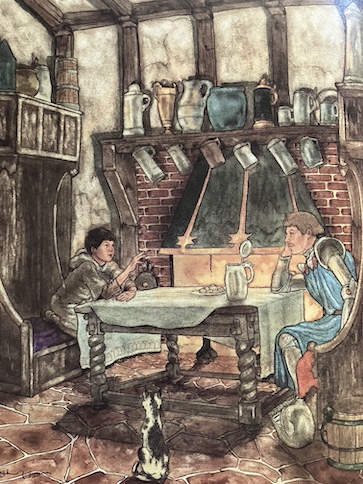
The boy tries to go to St. George and explain the truth about the dragon, but St. George doesn’t take him seriously at first. Everyone else in the village has been telling him tales of horror about the terrible things the dragon has been supposedly doing. The boy explains that the people in the village aren’t telling the truth because the truth is that they only want a fight. This is a quiet, boring little village, the villagers want excitement, and fights are a primary source of excitement for them. They don’t care at all that the dragon doesn’t like fighting and doesn’t want to be involved; they just want to stir things up with their stories and give St. George a reason to go over the dragon so they can watch the entertainment. When the boy explains that, right now, the villagers are taking bets on the upcoming fight, and so far, they’re favoring the dragon to win, St. George begins to think that maybe he’s been too quick to believe the villagers. He agrees to go with the boy to meet the dragon and talk things over.
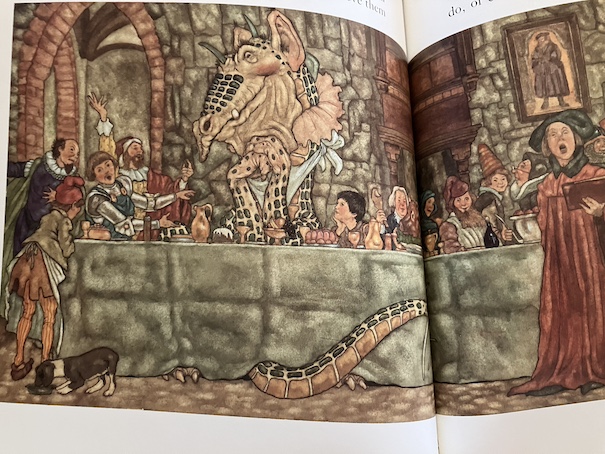
Both St. George and the boy think the best thing might be to have a fight and get it over with because that’s how things typically go with dragons, and it’s what everyone is expecting. St. George even says that he wouldn’t have to hurt the dragon much in the course of the fight, as long as it looks good to the spectators. The dragon isn’t thrilled with the plan because he still doesn’t like violence, and he doesn’t want to be hurt or even kind of hurt. The boy realizes that the dragon won’t be getting out of the experience, either. St. George would get the glory for the fight, but what’s in it for dragon? Fortunately, the dragon knows what he wants – to be the guest of honor at the victory banquet!
The book is available to borrow and read for free online through Internet Archive. The original story of The Reluctant Dragon was made into a cartoon film (with some slight changes to the story) by Walt Disney in 1941, and it was used as a vehicle for a film tour of the new Walt Disney Studios in Burbank, California.
My Reaction and Spoilers
This story is fun because it’s sort of a parody on folktales, especially St. George and the Dragon, subverting everyone’s expectations. The dragon in this story isn’t particularly fearsome and just likes poetry and a peaceful life, and the villagers, who are supposedly being terrorized, are actually the bloodthirsty ones. St. George is rather disappointed when he realizes that the villagers have been duping him with their stories, but he also realizes that they have to find a way to give the people what they want while sparing the dragon and making it so the dragon won’t be victimized later. Although the boy feels like they have to have a fight of some kind to appease the villagers, he also doesn’t want his dragon friend hurt, and he realizes that they have to consider what the dragon really wants.
The three of them work out a way to give the villagers a good show during their “fight” without the dragon getting really hurt. Then, St. George declares that the dragon has been defeated, and there is no need to cut off his head as the villagers have asked because the dragon has seen the error of its ways and repented, so there is no further need for vengeance. St. George’s victory speech also makes it clear to the villagers that he won’t put up with any more stories about the dragon’s terror because he knows that they can’t be true, that they should drop their prejudices because it’s pretty clear that they don’t know everything even if they act like they do, and that it’s wrong to make up stories about things that haven’t actually happened just for the excitement of doing so. I particularly like that last part of his speech/lecture: “And he warned them against the sin of romancing [in the sense of dramatizing and romanticizing things], and making up stories and fancying other people would believe them just because they were plausible and highly coloured.”
I feel like this is a lesson that more people could stand to remember this modern era of conspiracy theories, social media, and Internet rumors. Yeah, I’m particularly thinking of the stories about immigrants eating animals in Ohio. I’m never going to let that one go because everyone who fell for that and helped spread it was acting like the villagers in this story. They were irresponsible and attention-seeking, causing trouble and danger for people who did nothing to deserve it just for their own excitement and hysteria. It doesn’t help if people based some of their belief on old stories about other groups of immigrants eating pets. That actually makes it much worse because I know those stories were debunked decades ago, so they have even less of an excuse to fall for that now.
If you’re thinking at this point that the matter of rumors of pet-eating immigrants is unrelated to the story, I would argue that it fits in very well because, in both the story and in the real-life rumors, social acceptance is a major issue. The dragon wants to be socially accepted so he and stay in the cave that he now considers his home. He wants to be left in peace to compose his poetry but at the same time have the ability to have company and join in local festivities so he won’t feel too lonely. The problem is that the village people have their own expectations and plans to use the dragon as their personal source of excitement, uncaring about whether that costs the dragon his life or if it costs the knight his life while attempting to kill the dragon. They honestly don’t care who gets hurt or even killed as long as they get to see it, knowing that the stories they invent to tell St. George are necessary to make it all happen. Immigrants also want social acceptance and to be allowed to live their lives peacefully and go about their business in their new homes. People sometimes tell wild stories about them, things they made up themselves, knowing that they’re untrue and uncaring about the consequences for other people, for their own purposes.
The very first time I heard of the Springfield pet-eating hoax, I immediately thought of Janie’s Private Eyes, which I reviewed here years ago and contained references to similar accusations about immigrants. I read Janie’s Private Eyes when I was a kid, and since it dealt with the dangers of rumors and prejudice, specifically rumors about immigrants eating pets, I grew up figuring that these were things that adults should just understand and that only had to be explained to kids, who hadn’t heard about them yet. I don’t suppose everyone has read Janie’s Private Eyes, but I always thought, surely, by adulthood, they would have read something or had somebody clue them in at some point.
There was just no chance of me ever being impressed about humors of Haitian immigrants supposedly eating pets as an adult after hearing about long-debunked rumors about Chinese immigrants supposedly eating pets and Vietnamese immigrants supposedly eating pets and Mexican immigrants supposedly eating pets (I live in a border state, so other parts of the US may or may not have gotten around to that one). After all, how many sets of immigrants can you hear this about before it just becomes eye-rolling routine, like those dumb chain emails that used to be popular in the early 2000s or those supposedly shocking but highly improbable kidnapping stories you’re supposed to warn every young woman in your life about but which are almost direct rip-offs of badly-misspelled fan fiction from Wattpad that was written by teens around that same time period? In all those cases, they’re the some wild stories, just retold with a few minor details and the names of the characters changed.
Stories do matter. The ones we hear when we’re young live in our heads and influence the way we look at things when we’re older and how we respond to some of the questionable things that other people are bound to tell us later in life. In a way, I think it really helps to hear some of this bunk when you’re young, under circumstances where you can tell it’s bunk or with someone cluing you in, so you can get some of these ideas out of your head earlier in life and be better able to tell what’s old-fashioned, sensationalist bunk from someone playing up for attention when you’re an adult. I think that The Reluctant Dragon, although it can be taken in a lighter fashion as parody or satire by people who know the type of stories that are being parodied, also offers the opportunity to talk about the power of stories, how they change people’s views and motivate people to action, and the serious consequences of rumors.
Maybe some of the people spreading the Internet rumors really were ignorant and gullible, easily alarmed and manipulated by a wild story, and maybe some of them just wanted in on the excitement to get attention for themselves and never cared whether it was true or not as long as they could latch on to the attention the story was getting and make themselves part of it. I’m pretty sure that the people starting them and passed them on wanted excitement and attention. There is a certain thrill to passing on rumors, feeling special because you “know” something other people don’t know yet and maybe even wanting praise as well as attention for passing the story along. Maybe some of those people also wanted to get some kind of petty revenge on the immigrant population by saying something bad about them, they expected that people would believe them if they made the stories seem dramatic and plausible (like St. George said in the story), and like the villagers in the story, they did not think or care about what would happen to the people who were the subjects of their libel.
It’s the same sort of thing with most social media rumors, which often contain little truth and can do a lot of harm by people believing them and continuing to spread them, which is why I’m against them all in principle. I urge everybody, when you hear any sensational story through Facebook or any form of social media, to pause and do a little fact-checking before you send that story to anyone else. If you can’t verify it or if you find evidence against it, make no other comment on it other than a link to the evidence against the story (if possible) and a message saying that you don’t want to see any more rumors or conspiracy theories. (At least, I sincerely hope you don’t. I’m telling you, they’re only trouble, and real people get hurt because of fake news.)
In real life, I doubt most people, being told off, even in a nice way, for making up stories and getting caught in lies, would behave with as much grace as the villagers in the story. In real life, people get defensive when they know they’ve been caught and “fight back”, but the villagers just accept it as part of the excitement they wanted and focus on getting to the party they know they’re going to have. During his speech, along with his other admonishments, St. George lets the villagers know, subtly, that he’s discovered that they’ve also been staging animal fights and that this practice is going to have to end, and the villagers all know that he’ll personally be checking on that. At the end of St. George’s speech, there is “much repentant cheering”, and they all go to enjoy the banquet. If people are feeling a little awkward about their behavior or the situation, they’re still determined to enjoy themselves and this remarkable event as much as possible. Everyone relaxes at the banquet because the major event is over, everybody has had a taste of excitement and the spectacle they were craving, and St. George’s speech is over, so there’s nothing left for anybody to plan or worry about. Everybody has a good time at the party, and the dragon is pleased that he’s been accepted into society, so he will be allowed to stay in this peaceful place and even have some company, which was what he really wanted.








 Jestress's Forgotten Books and Stories