The Reluctant Dragon

This picture book, with its illustrations, is from the 1980s, but the story by Kenneth Grahame is much older, from 1898. It was always a short story, originally published in a collection called Dream Days. In the original version, there’s an opening part that isn’t included in this picture book, where a girl name Charlotte finds large footprints from a reptile, and a man tells her the story of the dragon.
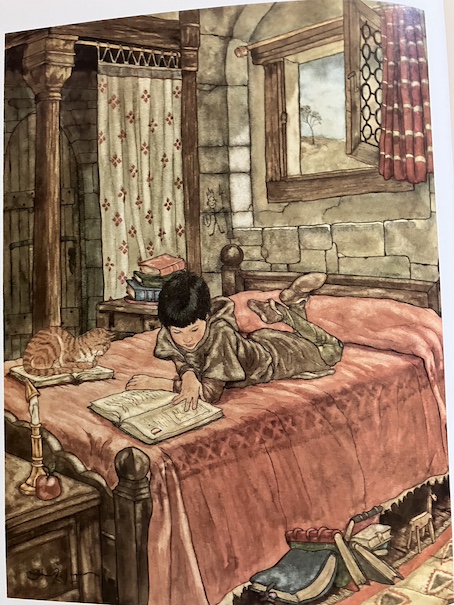
There is a shepherd whose son loves to read, borrowing books from a friendly member of the gentry who lives nearby. Not all parents from their class value book learning, but the boy’s parents appreciate it and support their son for spending time reading. One day, the shepherd comes home and tells his wife and son that he’s had a terrifying experience. While he was out with his flock, he heard a strange snoring nose, and when he went to investigate, he found a frightening-looking creature with scales, with its head sticking out from the cave.

The shepherd’s son isn’t as alarmed as the shepherd. He merely identifies the creature his father saw as a dragon. He knows about dragons because he’s read about them, and he’s thought for some time that the cave was probably a dragon’s cave. Rather than being surprised or alarmed about the dragon, his father’s discovery merely confirms what the boy already suspected, that a dragon might have lived in the cave once and that it would be a suitable dragon’s home. Furthermore, the boy says that dragons are quite sensitive creatures, so he might look in on this one at some point.

When the boy goes to visit the dragon, the dragon tells him he won’t put up with any rough stuff, like hitting or throwing stones. The boy says he wasn’t going to do any of that, and the two of them start to talk. The dragon hasn’t been staying in the cave for very long, and he’s not sure if he’s going to stay or not. It’s a nice place, but he’s not sure if he’s ready to settle down or not. He admits that he’s lazy, compared to other dragons. Other dragons do things like rampaging, chasing knights, and eating damsels, but this dragon would just prefer a quiet life with regular meals and time to snooze and make up poetry. The boy and the dragon talk about poetry and how it seems like nobody else around them appreciates it the way they do or understands why they like it.

However, the boy can see that there would be problems with the dragon settling in this area. Dragons and humans just don’t mix, even though this dragon isn’t interested in rampaging or doing the other things that would be likely to make enemies of the local population. Once word has gotten around that there’s dragon here, there are bound to be people who will try to hunt it with spears and swords because they’ll only see the dragon as a monster. The dragon has trouble grasping the idea that he could even potentially pose a risk to the human population or that anybody might see him as a danger.
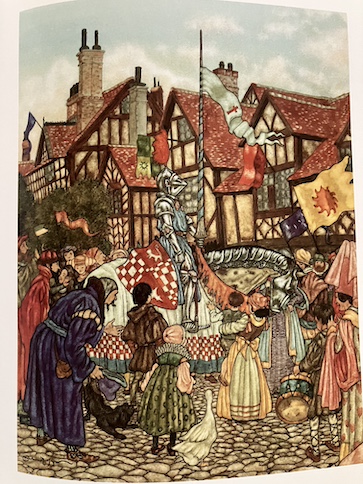
Eventually, word does get around that there’s a dragon living in the cave. The people in the village are both thrilled at this exciting thing happening to their village and plotting to rid their land from this supposed scourge, although the dragon has spent the entire time with his poetry and hasn’t been scourging anything. The village attracts the attention of St. George, the famous dragon slayer, and he comes to deal with the apparent problem.

The boy goes to the dragon and warns him that St. George is in town and that he’s got to prepare to face him and fight. Everyone in town is expecting him to, and they’re all excited about it because it’s the most exciting thing that’s ever happened there. However, the dragon says that he doesn’t like violence, and he doesn’t want anything to do with St. George. The boy worries that, if the dragon won’t take the threat seriously and fight, St. George will simply kill him, but he can’t seem to impress on the dragon just how much danger he’s in.
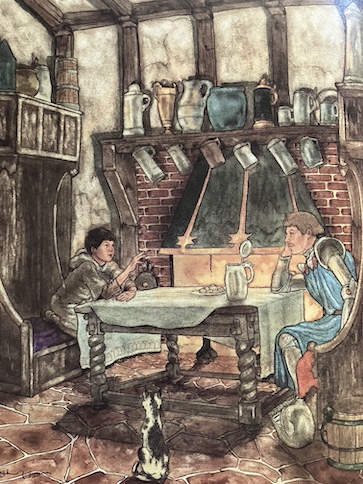
The boy tries to go to St. George and explain the truth about the dragon, but St. George doesn’t take him seriously at first. Everyone else in the village has been telling him tales of horror about the terrible things the dragon has been supposedly doing. The boy explains that the people in the village aren’t telling the truth because the truth is that they only want a fight. This is a quiet, boring little village, the villagers want excitement, and fights are a primary source of excitement for them. They don’t care at all that the dragon doesn’t like fighting and doesn’t want to be involved; they just want to stir things up with their stories and give St. George a reason to go over the dragon so they can watch the entertainment. When the boy explains that, right now, the villagers are taking bets on the upcoming fight, and so far, they’re favoring the dragon to win, St. George begins to think that maybe he’s been too quick to believe the villagers. He agrees to go with the boy to meet the dragon and talk things over.

Both St. George and the boy think the best thing might be to have a fight and get it over with because that’s how things typically go with dragons, and it’s what everyone is expecting. St. George even says that he wouldn’t have to hurt the dragon much in the course of the fight, as long as it looks good to the spectators. The dragon isn’t thrilled with the plan because he still doesn’t like violence, and he doesn’t want to be hurt or even kind of hurt. The boy realizes that the dragon won’t be getting out of the experience, either. St. George would get the glory for the fight, but what’s in it for dragon? Fortunately, the dragon knows what he wants – to be the guest of honor at the victory banquet!

The book is available to borrow and read for free online through Internet Archive. The original story of The Reluctant Dragon was made into a cartoon film (with some slight changes to the story) by Walt Disney in 1941, and it was used as a vehicle for a film tour of the new Walt Disney Studios in Burbank, California.
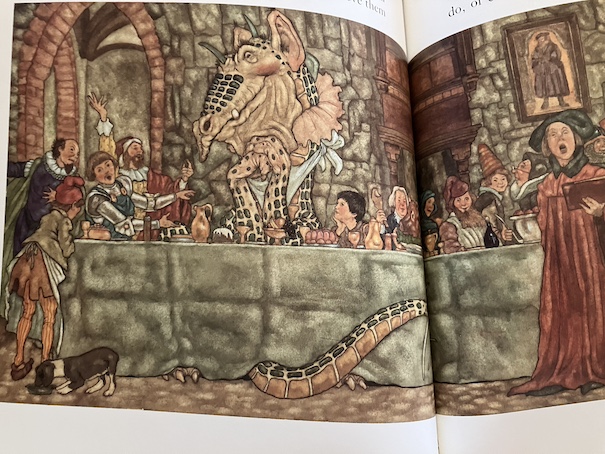
This story is fun because it’s sort of a parody on folktales, especially St. George and the Dragon, subverting everyone’s expectations. The dragon in this story isn’t particularly fearsome and just likes poetry and a peaceful life, and the villagers, who are supposedly being terrorized, are actually the bloodthirsty ones. St. George is rather disappointed when he realizes that the villagers have been duping him with their stories, but he also realizes that they have to find a way to give the people what they want while sparing the dragon and making it so the dragon won’t be victimized later. Although the boy feels like they have to have a fight of some kind to appease the villagers, he also doesn’t want his dragon friend hurt, and he realizes that they have to consider what the dragon really wants.

The three of them work out a way to give the villagers a good show during their “fight” without the dragon getting really hurt. Then, St. George declares that the dragon has been defeated, and there is no need to cut off his head as the villagers have asked because the dragon has seen the error of its ways and repented, so there is no further need for vengeance. St. George’s victory speech also makes it clear to the villagers that he won’t put up with any more stories about the dragon’s terror because he knows that they can’t be true, that they should drop their prejudices because it’s pretty clear that they don’t know everything even if they act like they do, and that it’s wrong to make up stories about things that haven’t actually happened just for the excitement of doing so. I particularly like that last part of his speech/lecture: “And he warned them against the sin of romancing [in the sense of dramatizing and romanticizing things], and making up stories and fancying other people would believe them just because they were plausible and highly coloured.”

I feel like this is a lesson that more people could stand to remember this modern era of conspiracy theories, social media, and Internet rumors. Yeah, I’m particularly thinking of the stories about immigrants eating animals in Ohio. I’m never going to let that one go because everyone who fell for that and helped spread it was acting like the villagers in this story. They were irresponsible and attention-seeking, causing trouble and danger for people who did nothing to deserve it just for their own excitement and hysteria. It doesn’t help if people based some of their belief on old stories about other groups of immigrants eating pets. That actually makes it much worse because I know those stories were debunked decades ago, so they have even less of an excuse to fall for that now.

If you’re thinking at this point that the matter of rumors of pet-eating immigrants is unrelated to the story, I would argue that it fits in very well because, in both the story and in the real-life rumors, social acceptance is a major issue. The dragon wants to be socially accepted so he and stay in the cave that he now considers his home. He wants to be left in peace to compose his poetry but at the same time have the ability to have company and join in local festivities so he won’t feel too lonely. The problem is that the village people have their own expectations and plans to use the dragon as their personal source of excitement, uncaring about whether that costs the dragon his life or if it costs the knight his life while attempting to kill the dragon. They honestly don’t care who gets hurt or even killed as long as they get to see it, knowing that the stories they invent to tell St. George are necessary to make it all happen. Immigrants also want social acceptance and to be allowed to live their lives peacefully and go about their business in their new homes. People sometimes tell wild stories about them, things they made up themselves, knowing that they’re untrue and uncaring about the consequences for other people, for their own purposes.

The very first time I heard of the Springfield pet-eating hoax, I immediately thought of Janie’s Private Eyes, which I reviewed here years ago and contained references to similar accusations about immigrants. I read Janie’s Private Eyes when I was a kid, and since it dealt with the dangers of rumors and prejudice, specifically rumors about immigrants eating pets, I grew up figuring that these were things that adults should just understand and that only had to be explained to kids, who hadn’t heard about them yet. I don’t suppose everyone has read Janie’s Private Eyes, but I always thought, surely, by adulthood, they would have read something or had somebody clue them in at some point.

There was just no chance of me ever being impressed about humors of Haitian immigrants supposedly eating pets as an adult after hearing about long-debunked rumors about Chinese immigrants supposedly eating pets and Vietnamese immigrants supposedly eating pets and Mexican immigrants supposedly eating pets (I live in a border state, so other parts of the US may or may not have gotten around to that one). After all, how many sets of immigrants can you hear this about before it just becomes eye-rolling routine, like those dumb chain emails that used to be popular in the early 2000s or those supposedly shocking but highly improbable kidnapping stories you’re supposed to warn every young woman in your life about but which are almost direct rip-offs of badly-misspelled fan fiction from Wattpad that was written by teens around that same time period? In all those cases, they’re the some wild stories, just retold with a few minor details and the names of the characters changed.

Stories do matter. The ones we hear when we’re young live in our heads and influence the way we look at things when we’re older and how we respond to some of the questionable things that other people are bound to tell us later in life. In a way, I think it really helps to hear some of this bunk when you’re young, under circumstances where you can tell it’s bunk or with someone cluing you in, so you can get some of these ideas out of your head earlier in life and be better able to tell what’s old-fashioned, sensationalist bunk from someone playing up for attention when you’re an adult. I think that The Reluctant Dragon, although it can be taken in a lighter fashion as parody or satire by people who know the type of stories that are being parodied, also offers the opportunity to talk about the power of stories, how they change people’s views and motivate people to action, and the serious consequences of rumors.

Maybe some of the people spreading the Internet rumors really were ignorant and gullible, easily alarmed and manipulated by a wild story, and maybe some of them just wanted in on the excitement to get attention for themselves and never cared whether it was true or not as long as they could latch on to the attention the story was getting and make themselves part of it. I’m pretty sure that the people starting them and passed them on wanted excitement and attention. There is a certain thrill to passing on rumors, feeling special because you “know” something other people don’t know yet and maybe even wanting praise as well as attention for passing the story along. Maybe some of those people also wanted to get some kind of petty revenge on the immigrant population by saying something bad about them, they expected that people would believe them if they made the stories seem dramatic and plausible (like St. George said in the story), and like the villagers in the story, they did not think or care about what would happen to the people who were the subjects of their libel.

It’s the same sort of thing with most social media rumors, which often contain little truth and can do a lot of harm by people believing them and continuing to spread them, which is why I’m against them all in principle. I urge everybody, when you hear any sensational story through Facebook or any form of social media, to pause and do a little fact-checking before you send that story to anyone else. If you can’t verify it or if you find evidence against it, make no other comment on it other than a link to the evidence against the story (if possible) and a message saying that you don’t want to see any more rumors or conspiracy theories. (At least, I sincerely hope you don’t. I’m telling you, they’re only trouble, and real people get hurt because of fake news.)

In real life, I doubt most people, being told off, even in a nice way, for making up stories and getting caught in lies, would behave with as much grace as the villagers in the story. In real life, people get defensive when they know they’ve been caught and “fight back”, but the villagers just accept it as part of the excitement they wanted and focus on getting to the party they know they’re going to have. During his speech, along with his other admonishments, St. George lets the villagers know, subtly, that he’s discovered that they’ve also been staging animal fights and that this practice is going to have to end, and the villagers all know that he’ll personally be checking on that. At the end of St. George’s speech, there is “much repentant cheering”, and they all go to enjoy the banquet. If people are feeling a little awkward about their behavior or the situation, they’re still determined to enjoy themselves and this remarkable event as much as possible. Everyone relaxes at the banquet because the major event is over, everybody has had a taste of excitement and the spectacle they were craving, and St. George’s speech is over, so there’s nothing left for anybody to plan or worry about. Everybody has a good time at the party, and the dragon is pleased that he’s been accepted into society, so he will be allowed to stay in this peaceful place and even have some company, which was what he really wanted.

Saint George and the Dragon

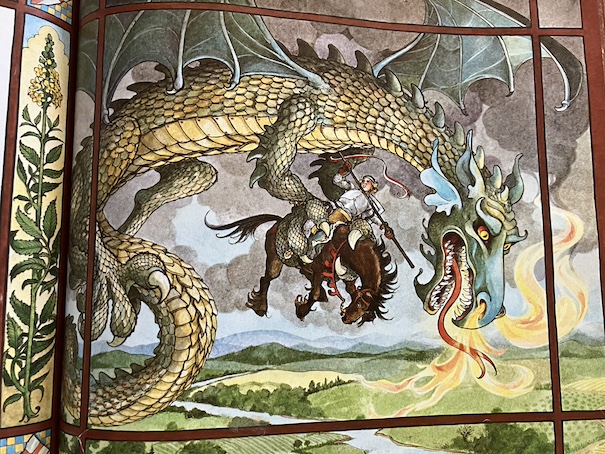
The story of Saint George and the Dragon is an old folktale. The story as told in this children’s picture book was adapted from Edmund Spenser’s Faerie Queene.

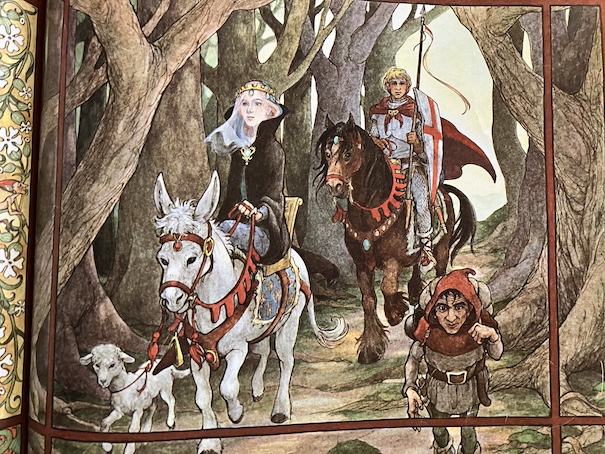
The Red Cross Knight, who carries a shield decorated with a red cross, does not know his own name or even where he came from. He only knows that the Queen of the Fairies has sent him to face a terrible dragon. He is accompanied on his journey by a princess with a little white lamb and a dwarf. The Princess’s name is Una, and her kingdom is being attacked by the dragon.

On their journey, they meet a hermit, who shows the knight a distant palace on a mountaintop, where angels travel between the palace and heaven. It’s so beautiful that the knight wants to go there immediately, but the hermit says that this palace is in another world and that he cannot go there until he faces the dragon. The hermit also reveals the knight’s past to him. He is not one of the fairy folk, although the fairy folk are the ones who sent him. The hermit knows that he was kidnapped by the fairies as a baby and hidden in a farm field, where he was discovered by a plowman who named him George. His true destiny is to become Saint George, the patron saint of England.

Una takes George to her parents’ fortress. As they approach, they see the dragon for the first time. George sends Una away from danger, and he and the dragon battle for the first time. The dragon picks up George, horse and all, and throws them to the ground. George manages to drive the dragon away, but he is also injured. At first, he and his friends think he is going to die, but he lies down in an ancient spring that cools and heals him. By morning, he is able to rise and fight again.

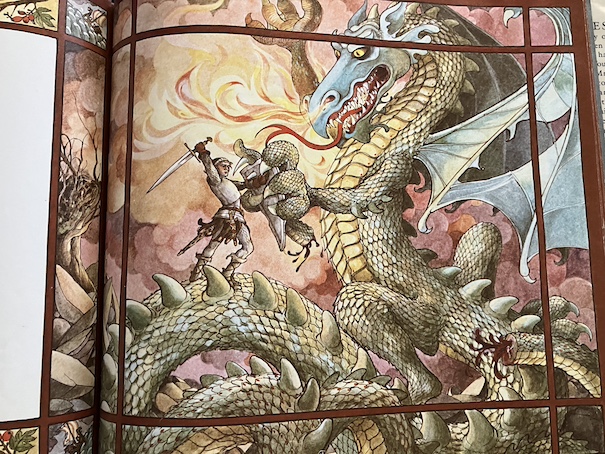
The second time George fights the dragon, he is able to cut off part of the dragon’s tail and one of its paws. The dragon’s fire finally drives George away, and once again, George seems too wounded to survive. However, he rests under an apple tree that drops healing dew, and George survives.

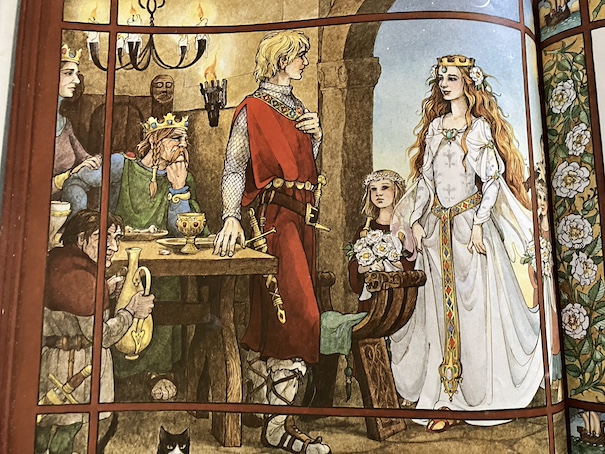
The third time George and the dragon fight, George manages to kill the dragon. Everyone celebrates, and Una’s parents thank George. The king gives George rich rewards, but George passes them on to the poor people. George is bound to the service of the Fairy Queen for six years, but the king allows George to marry Una and promises him that he will become the next king when his service is finished.

The book is available to borrow and read for free online through Internet Archive.

I love the colorful illustrations in this story, although some of them seemed a bit brutal for an audience of young children, showing George badly injured and the dragon spurting blood. Because I love folklore, I know that the legend of St. George and the Dragon is a Christian allegory, although it has some basis in earlier folktales and historical figures. I’ve heard different interpretations of what the dragon is supposed to represent. It can be a symbol of evil, the devil, or sin, and I think I’ve heard that it could represent paganism, which was replaced by Christianity (represented by St. George in the story), although I can’t remember where. In a way, I think this is one of those picture book that might mean more to adults because they would understand more of the symbolism, history, and folklore references in the story. On the other hand, who doesn’t love a story that ends with a gallant knight marrying a beautiful princess?

In case you’re wondering, the red cross on St. George’s shield isn’t the red cross used by the International Red Cross. However, Saint George’s Cross is on the national flag of England and is also part of the Union Jack flag of the United Kingdom.

As another odd piece of literary trivia, the legend of St. George has a connection to another story that I’ve on this blog, Phoebe the Spy. The connection isn’t an obvious one because Phoebe the Spy was set in New York during the American Revolution, which seems far removed from Medieval England. However, on April 23, 1770 (St. George’s Day), the St. George Society (originally called the Sons of St. George) was founded at the Fraunces Tavern in New York, just six years before the story of Phoebe the Spy begins at the same tavern. The St. George Society was and still is a charitable organization that helps immigrants from Britain, using the patron saint of England as its namesake.

The Dragons Are Singing Tonight

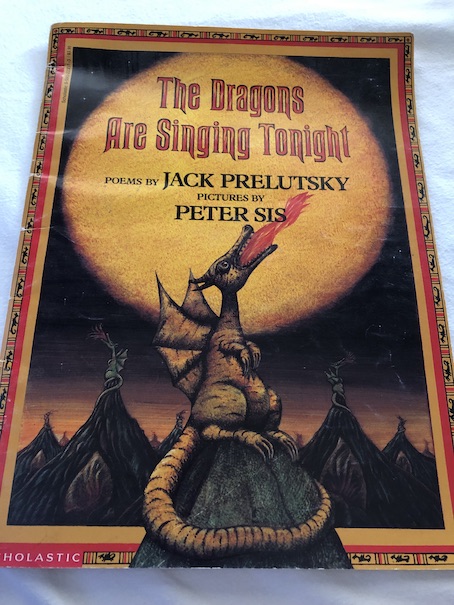
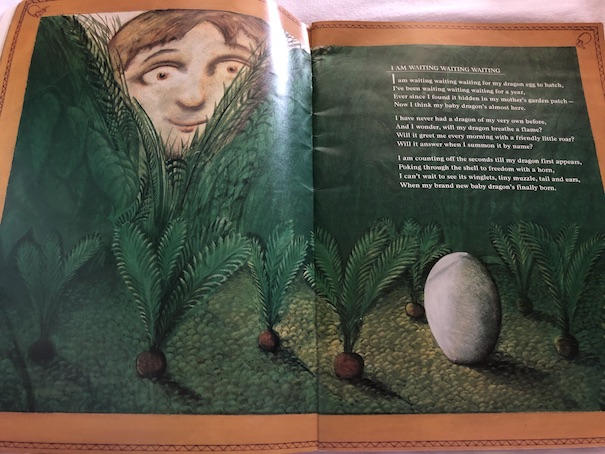
The Dragons Are Singing Tonight by Jack Prelutsky, illustrated by Peter Sis, 1993.

This is a picture book of poems about dragons, but that description doesn’t quite do the book justice.

Jack Prelutsky is best known for his books of humorous poems for children, but not all of the poems in this book are funny. Some of them are humorous or have humorous twists, but others are just about the magic and wonder of the idea of dragons, some of which only exist in the imagination. Sometimes, just believing in magic or imagining it can be magical by itself!

The pictures are all excellent, colorful, and fanciful, and they really bring the poems to life. The book is larger than average, and the pictures span full pages.

The book is currently available online through Internet Archive.

Searching for Dragons

Searching for Dragons by Patricia C. Wrede, 1990.

This is the second book in The Enchanted Forest Chronicles, continuing the adventures of Princess Cimorene, although the story is told from the point of view of Mendanbar, King of the Enchanted Forest.  The Enchanted Forest is no ordinary kingdom, and Mendanbar is no ordinary king.  To be King of the Enchanted Forest means being a skilled enchanter.  Mendanbar can use the forest’s magic directly, making him more powerful than wizards.  Most of the creatures in the forest obey him, and unlike ordinary people, he can find his way around the forest almost automatically, even though things in the forest tend to move around.

At the beginning of the story, Mendanbar’s steward, Willin, pesters him about the subject of getting married.  Mendanbar hasn’t given the matter much thought since his father died three years earlier, but then, there’s been a lot to do.  Queen Alexandra has several daughters, any of which would be considered “suitable,” but Mendanbar doesn’t like any of them.  Mendanbar is annoyed because he’d just gotten the elf clans’ feud settled and was looking forward to a period of relative calm, so he decides that he’s going to give himself the day off, for a change.

He decides to take a stroll by the Green Glass Pool to relax, but on the way, he encounters a princess.  That’s not too unusual for the Enchanted Forest (home to many fairy-tale creatures and the events that make up fairy tales), but this princess strikes Mendanbar as a particularly scheming and ambitious one.  She tells him a great tale of woe in which her wicked stepmother cast her out that Mendanbar can tell is carefully rehearsed and might have even been the idea of the stepmother in question, with the idea of hooking an adventurous prince.  (Royal families do things like that, see the previous book in the series.)  However, Mendanbar is puzzled because the forest usually keeps out people who are obviously selfish.  Then, the princess mentions crossing an area of waste to get into the forest, and Mendanbar is alarmed because there shouldn’t be a wasteland there.  Forgetting about the princess, he hurries off to investigate.

Sure enough, Mendanbar discovers that a section of the forest is actually missing, destroyed to the point where there are just dead stumps.  Even the magic is gone.  Upon further investigation, Mendanbar finds dragons scales.  He isn’t sure why the dragons would want to attack the Enchanted Forest because they haven’t had any quarrels and mostly leave each other alone.  On the advice of a nearby talking squirrel, Mendanbar goes to see the witch Morwen.

After examining the dragon scales, Morwen demonstrates that, although they appear to be different colors and look like they’re from different dragons, they have actually been disguised.  They are actually from one dragon only.  Morwen also doubts that a dragon was really responsible for the damage to the forest.  After all, why would a dragon waste time disguising his scales when he could just pick them up?  Also, healthy dragons don’t shed that many scales.  Morwen is a friend of Kazul, who is the current King of the Dragons, and she advises Mendanbar to go see Kazul. 

Morwen also chides Mendanbar for not visiting Kazul when she became the king the year before.  Mendanbar feels a little guilty, saying that he’s just been very busy, which is true.  However, Morwen points out that what he could use is more effective help to organize things in the kingdom, not just making lists of things for him to do, like his steward does.  It’s part of the reason why people are saying that Mendanbar should get married.

Before Mendanbar can visit Kazul, he gets an unexpected visit from Zemenar, the Head Wizard.  Zemenar says that the wizards have been having problems with the dragons (again, see previous book) and that the dragons will not let them enter the Caves of Fire and Night.  He hopes that Mendanbar will allow them access from the Enchanted Forest.  Mendanbar doesn’t really trust the wizards, and he refuses the request on the grounds that he has something important to discuss with the King of the Dragons himself.  Zemenar tells Mendanbar about Kazul’s princess, Cimorene, blaming her for the the “misunderstanding” between the wizards and dragons.  Mendanbar at first imagines that Cimorene is much like the scheming princess he met that morning, but soon discovers that she’s anything but.  Taking the enchanted sword that only the kings of the Enchanted Forest can use with him, Mendanbar goes to visit the dragons.

At Kazul’s cave, Mendanbar meets Cimorene, who informs him that her official title is now Chief Cook and Librarian.  She tells him that part of the point of advertising this title is that it cuts down on the number of princes who come around.  Lots of princes want to rescue a princess, but few people want to rescue a Chief Cook and Librarian.  Mendanbar finds Cimorene a surprising change from the other princesses he’s met.  Mendanbar also makes a positive impression on Cimorene by using his sword to fix a broken sink, even if she describes the magic as being a bit “flashy.”

However, all is not well among the dragons.  Although Cimorene is reluctant to admit it at first, Kazul has mysteriously vanished.  She was planning to go out and search before Mendanbar showed up.  Kazul had been visiting her grandchildren when she decided to go by the Enchanted Forest to investigate someone growing dragonsbane.  Mendanbar shows Cimorene the dragon scales he found, and she indentifies them as belonging to Woraug, a dragon who was changed into a frog in the previous book.

It doesn’t take the two of them long to realize that the wizards are back to their old tricks and scheming.  However, what would they really have to gain by setting the Enchanted Forest and the dragons against each other?  And where is Kazul?

Like the other books in this series, this book is full of humor and a touch of mystery.  There are many parodies on fairy tale tropes, including an Wicked Uncle who’s not very wicked and does both a favor and an evil deed for his nephew by sending him to boarding school instead of abandoning him in the forest to have an adventure, as he’d hoped.  There is also romance between Cimorene and Mendanbar.  As you might have guessed, Cimorene is just the kind of practical princess Mendanbar needs to help him manage the magical chaos that is the Enchanted Forest and Mendanbar is the kind of king who is happy to find an intelligent princess who can do magic and rescue dragons.

The book is currently available online through Internet Archive.

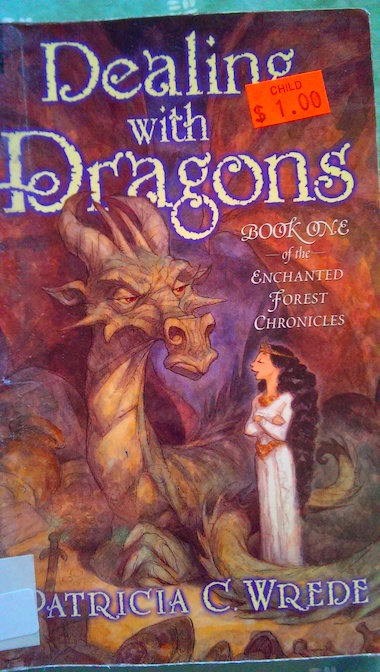
Dealing with Dragons

Dealing with Dragons by Patricia C. Wrede, 1990.

This is the first book in the Enchanted Forest Chronicles.  The fun thing about this series is that it parodies many popular fairy tales and their tropes.  Some of the books in the series also take the form of fantasy mysteries with some puzzle or nefarious happenings that the characters have to figure out.

From when she was a young child, Princess Cimorene of Linderwall has been bored with the kind of life that is expected from ordinary princesses.  Unlike her six older sisters, Cimorene doesn’t have golden curls.  She has black hair, and she’s way too tall for a cute little princess.  She’s also very stubborn.  When Cimorene gets bored of the usual princess lessons involving dancing, embroidery, and etiquette, she pushes other people in the castle into giving her different types of lessons.  First, she convinces the armsmaster to give her fencing lessons.  Then, she gets the court magician to give her magic lessons.  She also arranges Latin lessons, cooking lessons, economics lessons, juggling lessons, and so forth.  Each time her parents find out about her unusual lessons, they put a stop to them because none of the subjects that Cimorene finds interesting are “proper” for a princess to study. 

When Cimorene’s parents try to arrange for her to marry a prince that she doesn’t like, she finally decides that enough is enough.  Cimorene meets a talking frog in the castle pond, and after talking over her problem with him and saying that she’d rather be eaten by a dragon than marry the prince, the frog recommends that she run away.  He even gives her directions on where to go after she leaves the castle.  Not having any other plan, Cimorene takes his advice . . . and ends up at a dragon’s lair.

It works out for the best, though.  Rather than being eaten, Cimorene asks the dragons in the lair if they are in need of a princess.  She isn’t quite sure what princesses who are taken captive by dragons do, but she can cook (as part of her earlier cooking lessons) and do other chores.  Although one of the dragons, Woraug, wants to just eat her, the dragon called Kazul takes her on as her princess.

Cimorene finds it interesting being a dragon’s princess.  She cooks for Kazul and also helps to organize her treasure hoard and library.  As is expected when word gets out that Cimorene is a dragon’s princess, knights come to try to rescue her.  They are shocked when Cimorene turns them away, and it takes awhile before Cimorene is able to convince them that she’s really happy with the dragons and doesn’t want to be rescued.

Cimorene even makes new friends.  Morwen, a witch friend of Kazul’s, comes to visit and teaches Cimorene more about magic.  Morwen is also very practical and suggests putting up a sign (something like “Road Washed Out”) to discourage knights from approaching Kazul’s lair.  It is while Cimorene is putting out the sign that she means the wizard Zemenar.  His presence in the area is suspicious because wizards and dragons do not get along.  Wizards do not use their own magic but use their staffs to soak up magic from magical places or magical beings – like dragons.  When wizards take magic from dragons, they actually take part of their essence, and give them a reaction that’s similar to allergies.  Zemenar is also head of the Society of Wizards, so it’s doubly suspicious if he’s been hanging around a dragon’s cave.  When Cimorene tells Kazul and her friends about seeing him, they become concerned, wondering what he’s after.

Cimorene also meets other princesses who are the captives of other dragons: Keredwel, Hallanna, and Alianora.  At first, they also have trouble believing that Cimorene actually volunteered to be a dragon’s princess and that she likes it.  Cimorene doesn’t like the arrogant attitudes of Keredwel and Hallanna, but Alianora is pleasant, and the two of them become friends.  Alianora tells Cimorene that, although she was taken captive by Woraug, her family basically set her up for it.  Like Cimorene, she was under a lot of pressure to do the things that everyone expects of fairy tale princesses, but she wasn’t much good at them, and things never turned out as one might expect.  The wicked fairy who came to Alianora’s christening when she was a baby didn’t curse her; she just enjoyed the party and had a wonderful time.  Alianora also didn’t prick her finger on the spinning wheel that her busy-body aunt gave her, and when she tried to spin straw into gold, she got linen thread instead.  When various fairy tale schemes failed to work for Alianora, her interfering aunt arranged for her to visit a village, knowing that Woraug was going to ravage it.  As Morwen noted, princesses who are taken captive by dragons and then rescued can expect to make good marriages.  Although being abducted by a dragon was a shock, Alianora says it’s not so bad; Woraug mostly ignores her since she doesn’t know how to cook, and it’s a relief for her to get away from her nagging aunt.  The only downside is that the other, more conventional princesses are really annoying.  Alianora and Cimorene bond over their unconventional lives as fairy tale princesses.  Cimorene gets the idea to send some of her knights and princes to go rescue Keredwel, thus taking care of two problems at once.  Alianora also helps Cimorene with her efforts to find a fire-proofing spell to protect the princesses from accidental burning from the dragons, and later becomes her ally when things get more serious.

Zemenar returns to Kazul’s cave and, while Cimorene tries to subtly pump him for information, he sneaks a look at a book about the history of dragons.  He seems to be interested in the section about how they settled in the Mountains of Morning, how they chose their king, and the Caves of Fire and Night, where they found the special stone that they use to choose their king.

Then, the king of the dragons is murdered, poisoned by dragonsbane.  The wizards have a confederate among the dragons themselves, and they want something that only the king of the dragons can give them.

By the time the murder is committed, Cimorene and Kazul have a pretty good idea of who the conspirator among the dragons is.  The wizards think that they’ve found a way to rig the ceremony for choosing a new king so that the dragon who supports them will win, giving them what they really want.  However, Cimorene foils their plan with the help of her friends.  The mystery/conspiracy elements of the story are great and help add weight to balance out the lighter, fairy tale parody elements.

The book is currently available online through Internet Archive.

The Dragon Charmer

DragonCharmerThe Dragon Charmer by Douglas Hill, 1997.

This is a great fantasy story about a girl who learns to face her fears and persevere in spite of them. It has a good moral and is encouraging to anyone who failed at something but wanted to try again.

Elynne Danneby is afraid of dragons, which is a shame because her family makes its living by dragon charming. Every year, the dragons stop by her family’s farm on their migratory path, and Elynne’s father puts on a show for people who come to see the dragons. By playing a special tune on his pipes, Dan Danneby can put the dragons into a trance and safely walk among them. Only certain people have the ability to charm dragons. Elynne possesses that talent, but she has been unable to use it since she made a mistake while trying to charm dragons when she was a small child. They tried to attack her, and her father had to save her from them. Ever since, the dragons have terrified Elynne, but she is still fascinated by them and desperately wants to conquer her fear in order to charm them like her father does.

DragonCharmerPicThen, one day, a rare crimson dragon comes to the farm and lays an egg. It is extremely uncommon to see a dragon’s nest or a baby dragon, and Dan is excited about trying to charm the baby after the egg hatches. However, Dan’s assistant is greedy and decides to steal the egg and sell it. Elynne overheard him talk about his plans before the egg was stolen, but because she wasn’t sure of what she heard, she didn’t tell anyone. Elynne feels guilty about not preventing the theft of the egg, and in spite of her fear, she is determined to get it back. In the process, she not only conquers her fear but learns about a talent that she never realized she had.

The book is full of black-and-white drawings in a sort of cross-hatch style.

The book is available to borrow and read for free online through Internet Archive.