
The School at the Chalet by Elinor M. Brent-Dyer, 1925.
This is the first book in the Chalet School Series. This series is uncommon in the United States. People from Britain or countries with heavy British influence would be more familiar with this series. It’s considered classic!
When the story begins, Madge and Dick Bettany, who are brother and sister, a set of twins, are discussing their family’s situation. Their parents are dead, and they have very little money and no family members they can rely on. Madge and Dick are grown and are ready to begin making their own way in the world, but their younger sister, called Joey, is still a child, and her heath has been poor. Dick has a job, but he really can’t afford to support his sisters. However, Madge has had an idea: she wants to start a school. Dick worries that they don’t have the capital necessary to start a school, but Madge says that she could start one in continental Europe instead of England, where they are from, because the costs would be lower. She even has a specific place in mind, a chalet near a lake, close to a town called Innsbruck in the Tiernsee (Austria). Joey could live with her at the school and continue her education in the company of the other students, and Madge thinks that the climate there might even be better for her than England. She has already written a letter to find out if the chalet is available, and it is. If they sell most of what they own in England, Madge thinks that they’ll have enough to buy what they need in Europe. Madge says that she thinks she could handle about a dozen girls, between the ages of twelve and fourteen or fifteen. She knows someone who could help her teach, Mademoiselle Lepattre, and between them, they are qualified to teach French, German, sewing, and music. Dick is still a little concerned about whether or not Madge can pull off the school, but he agrees that she should go ahead with her plans (since she likely will anyway) and says that if she runs into trouble, she should contact him for help.
Madge even knows who her first pupil at the boarding school will be: Grizel Cochrane. Madge has already had her as a student, and she is friends with her family. She knows that Grizel has been unhappy at home since her father remarried because she and her stepmother do not get along. Grizel’s stepmother has already been pressuring her father to send her away to boarding school, but he loves her and has been reluctant to part with her. However, Grizel has been miserable, and her father decides would be more willing to send her away with someone he already knows. Grizel is pleased at the idea of joining Madge and Joey at a school in Europe, and the Madge gains her first student.
Dick and Mademoiselle Lepattre go to the chalet first to take the larger trunks and belongings and begin getting settled, while Madge, Joey, and Grizel follow them. Along the way, they see some of the sights of Paris. By the time they arrive at the chalet, Mademoiselle Lepattre’s young cousin, Simone Lecoutier, has arrived at the school to be a pupil, and Madge has arranged to accept an American girl named Evadne Lannis, who will arrive later. These four girls, Joey, Grizel, Simone, and Evadne, are the school’s first boarders. The school soon acquires a few day pupils who live nearby: Gisela and Maria Marani (a pair of sisters), Gertrud Steinbrucke, Bette Rincini, Bernhilda and Frieda Mensch (also sisters). Maria is much younger than the other girls, only nine, but her mother asked that she be admitted along with her older sister. There are public schools for children in Innsbruck, but the father of one of the new local pupils thinks that the Chalet School might be healthier for his daughter because, while he doesn’t think much of English educational standards (Grizel takes exception to that comment), they shorten the school day (compared to the average school day of Austria or Germany of the time) and encourage participation in sports and games. The local girls are curious to see what things are going to be like at an English style school, and if it will be like other English schools they’ve heard about. The school also soon gains more students and boarders:
- Margia and Amy Stevens – ages 8 and 11, their father is a foreign correspondent from London who needs to travel for his work, and the girls’ parents wanted to find a stable place for the girls to stay.
- Bette Rincini’s cousins, who have come to stay with her family
- A pair of sisters from another town across the lake
- Two more children from a nearby hotel
- Friends of Gisela from Vienna
- Rosalie and Mary, two girls Joey and Grizel know from England
As the school grows and the girls settle into life at the school, they make friends with each other, although it’s awkward in some cases. Madge notices that Simone is often by herself and she asks Joey if she and the other girls are being nice to her. Joey says that they try, but Simone often sneaks off alone, and she doesn’t know where Simone goes. Joey tries to ask Simone if she’s unhappy, and Simone tries to deny it. The truth is that Simone is really homesick. Joey finds her crying by herself later and comforts her, and Simone finally admits how much she misses her mother. Simone also says that she feels left out because everyone else at the school has someone to be close to. Other girls at the school share nationalities with at least some of the other students. Simone is the only French girl at the school. The Austrian girls are close to home, and Joey and Grizel already knew each other before they left England. Seeing the other girls being such close friends makes her feel more left out. Joey apologizes for making Simone feel left out and assures her that she will be her friend. Simone asks her to be her best friend because she really needs someone to confide in, and Joey agrees, although she finds Simone rather needy and clingy.
It turns out to be a difficult promise because Simone gets very jealous when Joey makes friends with other girls, and she tries to convince Joey to only be friends with her. Simone is very dramatic, and she even ends up cutting off her long braid in an effort to impress Joey and get her attention when she learns about the other girls who will be coming from England. Simone is so desperately lonely and finds it so difficult to make new friends that she is terrified that Joey will abandon her completely when she has other friends. Joey gets fed up with her behavior and tells her that she’s being selfish. Joey knows that Simone would find it easier to make more friends herself if she would stop moping and being sad and gloomy.
After Juliet Carrick, another English girl, joins the school, Gisela is made head girl, and other girls are made prefects. Bette is a sub-prefect, and one day, when she tells Grizel to put her shoes away, Grizel is rude to her, and Juliet laughs. Gisela and the prefects discuss the situation and agree that Grizel, who wasn’t causing problems before, is now acting up because Juliet thinks that it’s funny. When Gisela sends someone to bring Grizel to the prefects’ room to talk about it, Grizel refuses to come and see them, and she realizes that something needs to be done. If the head girl and prefects let a girl get away with disrespecting them or not following the rules, the prefect system and student government would fall apart. Grizel feels a kinship for Juliet because neither of them has a happy home life. Juliet has been raised to believe that the English are superior to everyone else, and she has no shame in showing it. Juliet encourages Grizel to adopt her prejudices, but at a school in Austria with students of varying nationalities, that can’t be allowed. Madge supports the prefects, and Grizel is punished for her behavior.
Juliet is still a bad influence, sometimes encouraging other girls to act up with her. When Madge refuses to allow the girls to pose by the lake for some film makers, Juliet convinces some of other girls to sneak away with her and volunteer to be filmed without Madge’s knowledge. However, the father of one of the local girls catches them. He explains to the film makers that it would be inappropriate to film the girls because they don’t have permission from either the girls’ parents or teachers, and he takes the girls back to the school. Grizel’s temper and excessive patriotism also get the girls into trouble when they encounter a German tourist who makes it plain that she is disgusted at the presence of the English girls. (This is after The Great War, World War I, so that may be the reason.) While the German woman was being deliberately rude and insulting to the girls, Joey points out that Grizel’s hot-headed reply to her has now caused them more trouble. Grizel does apologize for not using more restraint.
Juliet’s home life turns out to be even worse than the other girls know, but they learn the truth when Juliet’s father sends a letter to Madge saying that he and his wife relinquish their custody of Juliet to the school. The letter says that Madge can do whatever she likes with Juliet. If she wants to keep Juliet at the school and have her work for her future tuition, that will be fine, and she is also free to send Juliet to an orphanage. The point is that her parents have left the country, they consider Juliet a burden that they would rather not bring with them, and while they might one day feel able to reclaim her, chances of that are not looking good. When Juliet learns about the letter, she cries and says that she had been afraid that they would do something like this. Her parents tried to abandon her at a different school once before, but the school had insisted that they take her back. Madge now has no idea where Juliet’s parents are. However, she can’t bear to turn Juliet over to an orphanage, so she promises Juliet that she will keep her and that she can help to pay for her tuition by working with the younger children at the school. Although Juliet’s behavior hasn’t been very good up to this point, Juliet is grateful to Madge and does earnestly try to please her and to maintain her place at the school. Before the end of the book, Juliet’s parents die in an automobile accident, giving Madge and the school permanent custody of her. Most of the other students (except for Joey) do not know that Juliet’s parents tried to abandon her before they died.
Through the rest of the book, the girls have adventures together and forge the new traditions of their school. They celebrate Madge’s birthday, get stranded in a storm and have to spend the night in a cowshed, start a magazine for the school, and play pranks on each other. When Grizel’s pranks and disobedience go too far and she is punished harshly for it, she gets angry and runs away from the school, becoming stranded on a nearby mountain. Joey goes after her to save her, and both girls are ill after their experience.
The book ends with Madge and a few of the girls caught in a train accident. Fortunately, they escape the accident without serious injury, and they also manage to help the German woman who had insulted the girls earlier. A man named James Russell helps them. The book ends at this point, and the story continues in the next book in the series. James Russell is a significant continuing character.
The book is currently available to borrow for free online through Internet Archive.
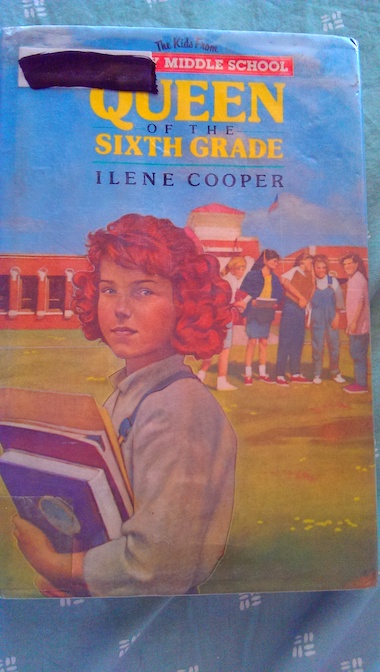 Queen of the Sixth Grade by Ilene Cooper, 1988.
 Jestress's Forgotten Books and Stories