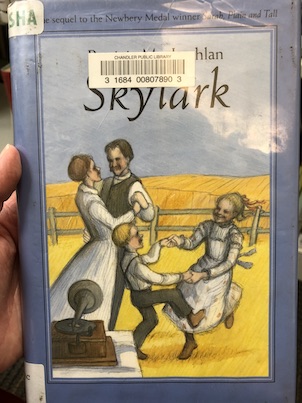
Skylark by Patricia MacLachlan, 1994.
The second book in the Sarah, Plain and Tall Series picks up about two years after the first book, shortly after Sarah marries Jacob, the father of Anna and Caleb. That summer is very dry, and people worry about when it will rain next. If there is no rain, their farms will be in danger. Some people have been known to simply abandon their farms and move on during especially long dry spells. Jacob says that their family won’t leave, no matter what, because “Our names are written in this land,” meaning that they have a commitment to it because they were born there and make their lives from the land. However, Sarah was born in Maine, and Caleb worries that, if the dry spell goes on too long, Sarah will want to return to Maine.
The year goes on, and Sarah settles in to life on the farm. Her cat, Seal, has kittens. Sarah reflects on the baby animals and seems thoughtful about babies. However, people are becoming ever more concerned that the water in the wells is lower than usual. As people keep hoping for rain, Sarah gets a letter from Maine, saying how lovely and green everything there is. The land around the farm is dry and brown, and the family has had to ration their water carefully, their supplies running increasingly low.
Eventually, a family from the area has to pack up and leave because their well is dry. Sarah is upset, trying to think of some way around the problem, but there is nothing to be done. Everyone’s supplies are running low, and they’re already doing everything that can be done. Sarah hates feeling helpless against the problem. When Sarah’s best friend, Maggie, talks about leaving with her family, Sarah says that she hates the land because it takes so much and gives nothing back. Maggie tells her that she’s like a lark that hasn’t come to land yet and that, if she is hoping to survive in this land and make a home there with Jacob, she will have to write her name in the land, just as he has.
Although the characters become increasingly distressed, in a way, I like the story for that. Sarah is a strong, capable woman, but even she doesn’t have all the answers to every problem. It’s upsetting for her to realize that, but it’s very human. After the family’s barn catches fire and burns down, Jacob persuades Sarah to take the children and visit her family in Maine. While they are gone, he will take care of the animals and try to keep the farm going, waiting for rain.
In Maine, Sarah and the children stay with Sarah’s aunts. Aunt Mattie, Aunt Harriet, and Aunt Lou, who have never married, are called “The Unclaimed Treasures.” They shower the children with affection. Still, the children miss their father and worry about what is happening on the farm. Sometimes, the children have bad dreams in which their father is unable to find them.
In the end, the rain comes on the prairie, and Jacob comes to Maine to collect his family. Then, the family learns that Sarah is expecting a baby. Anna worries a little because her mother died giving birth to Caleb, but Jacob and Sarah reassure her that everything will be fine. When they return home, Sarah writes her name in the dirt, signaling her commitment to her new life on the prairie.
There is a movie based on the book that follows the story very well. In fact, some of the dialog is almost word-for-word from the original. The book is available to borrow and read for free online through Internet Archive (multiple copies – including one in Spanish).




 Jestress's Forgotten Books and Stories