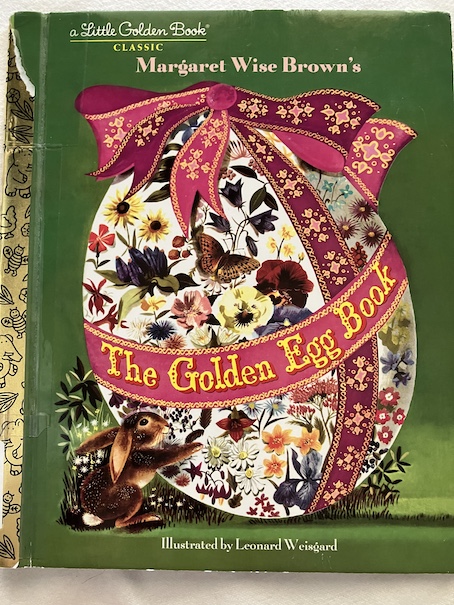
The Golden Egg Book

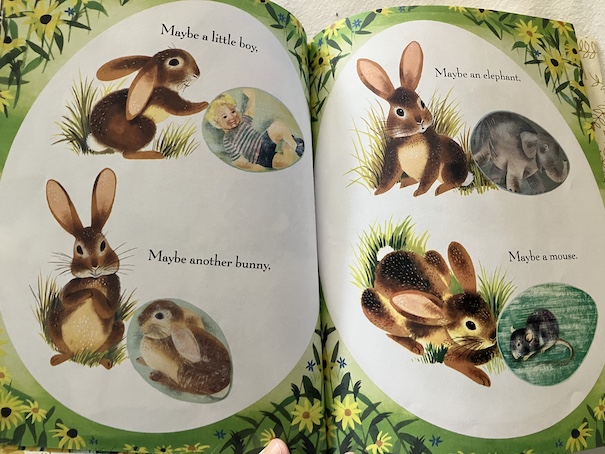
One day, a little bunny finds a blue egg. He knows there’s something inside the egg because he can hear it moving, but he doesn’t know what kind of egg it is. He imagines all the different creatures that could be inside the egg.
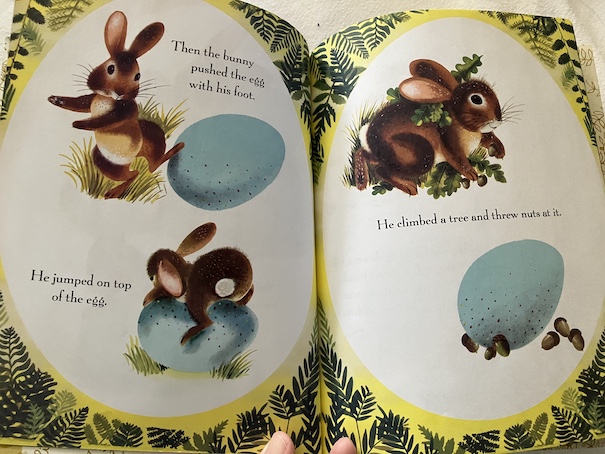
He tries to figure out how to get the egg open. He shakes it, kicks it, jumps on it, rolls it down a hill, and throws nuts and small rocks at it. Nothing he does causes the egg to open.
Eventually, the bunny falls asleep next to the egg, and while he’s asleep, the egg hatches! The animal that hatches out becomes the bunny’s best friend!
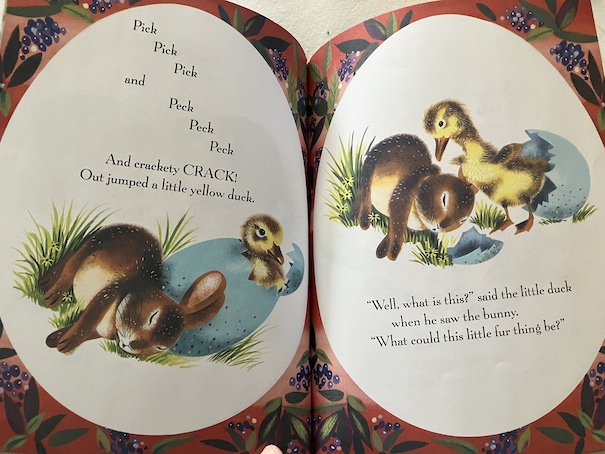
This is a vintage Little Golden Book, originally printed in the 1940s, about two young animals trying to figure each other out. The bunny apparently knows that some things hatch from eggs, but he’s not sure exactly how that happens or what sort of things might come from an egg. Even little kids will know that the things that the little bunny thinks might come from an egg are silly, like a little boy or an elephant, but that’s part of the fun of it.

There’s some repetition in the story, which young children enjoy, because when the duckling hatches out of the egg and finds the bunny asleep, he tries some of the steps that the bunny tried on his egg to get the bunny to wake up, like pushing the bunny with his foot, jumping on him, or rolling him down the hill.
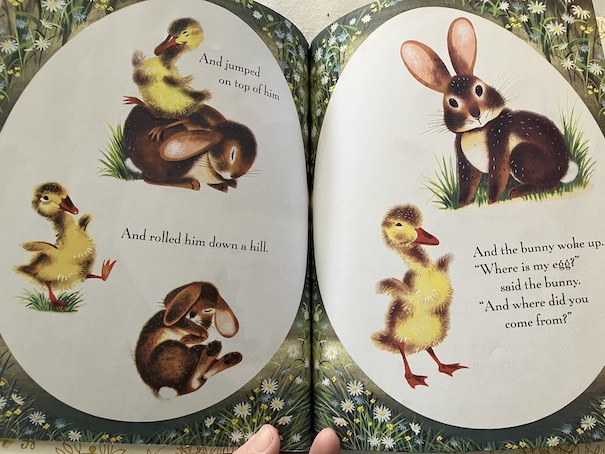
Fortunately, neither animal hurts the other in their attempts to hatch the egg or wake up the bunny, and the two become friends. It’s just a cute little picture book that might be fun for springtime or Easter!
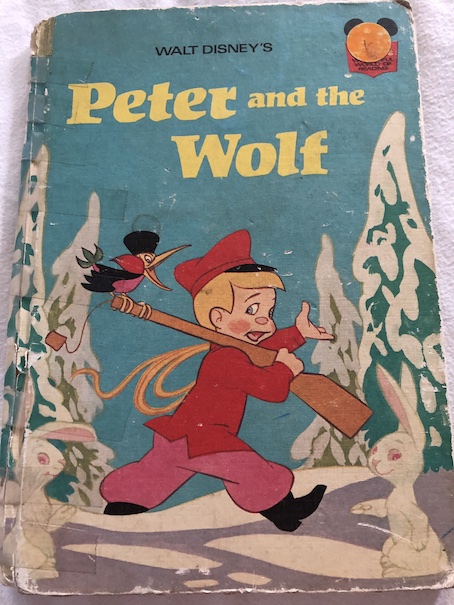
Peter and the Wolf

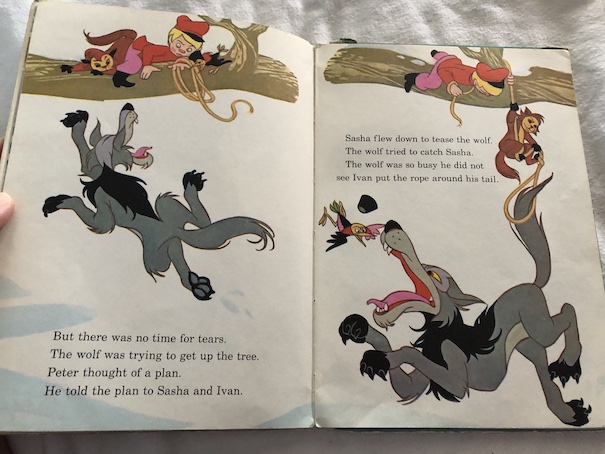
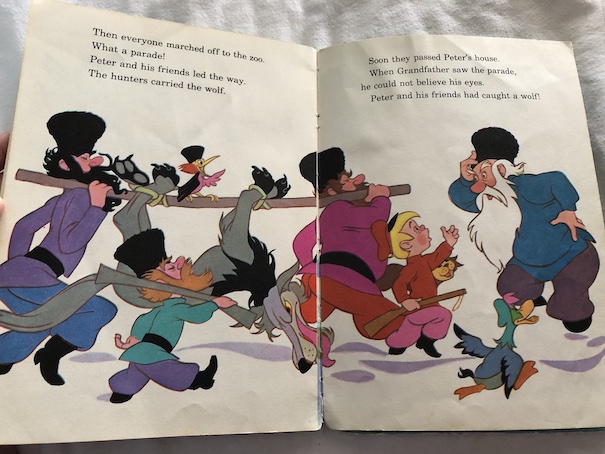
Peter and the Wolf by Walt Disney Productions, 1974.

This is the picture book version of Disney’s cartoon from 1946 based on Peter and the Wolf, which was originally a musical symphony for children, written by Sergei Prokofiev in 1936 for the Central Children’s Theatre in Moscow.

Young Peter lives with his grandfather near a forest in Russia. Peter’s grandfather warns him to stay away from the forest because there are hungry wolves there, but Peter thinks that he can catch a wolf himself. One day, while his grandfather is asleep, Peter sneaks out of the house to go catch a wolf.

Along the way, Peter’s friend, Sasha the bird, also warns him that there really are dangerous wolves in the woods and that he can’t hope to catch one with his toy gun. Peter insists that he’s going to try anyway, and Sasha says he’ll go along and help.

As they venture further, they are also joined by Sonia the duck. Ivan the cat tries to eat Sasha, but Peter makes him let Sasha go. Then, suddenly, a wolf appears!

The wolf chases Sonia, and at first, the others think he actually caught and ate her. They manage to catch the wolf by the tail. Sasha attracts some help from some passing hunters.

At first, the hunters want to shoot the wolf, but Peter asks them to take the wolf to the zoo instead, realizing that the wolf was just hungry. It tuns out that Sonia is safe after all, and they all take the wolf to show Peter’s grandfather.

The book is available to borrow and read for free online through Internet Archive (multiple copies).

The Story About Ping

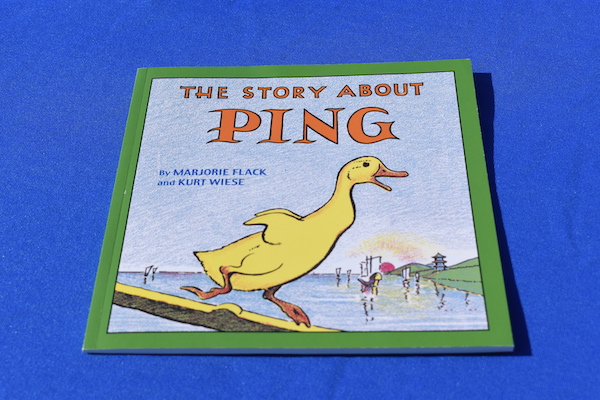
The Story About Ping by Marjorie Flack and Kurt Wiese, 1933.

Ping is a small duck who lives with his family on a boat on the Yangtze River in China.  Every morning, the master of the boat lets the ducks out to look for food on the river, and every evening, he calls them back. 

However, Ping hates it that the master gives the last duck to return at the end of the day a spank on the back, so when he realizes that he is late to return one day, he hides and is left behind.

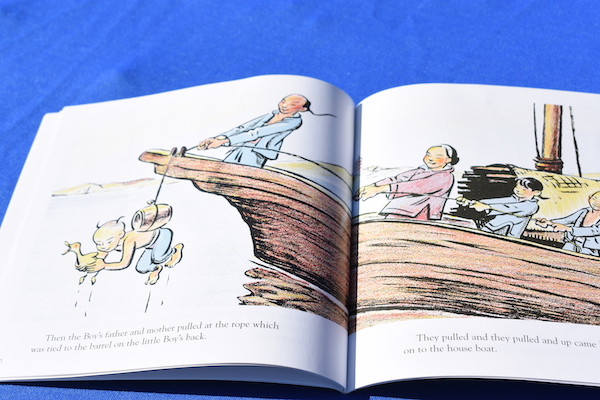
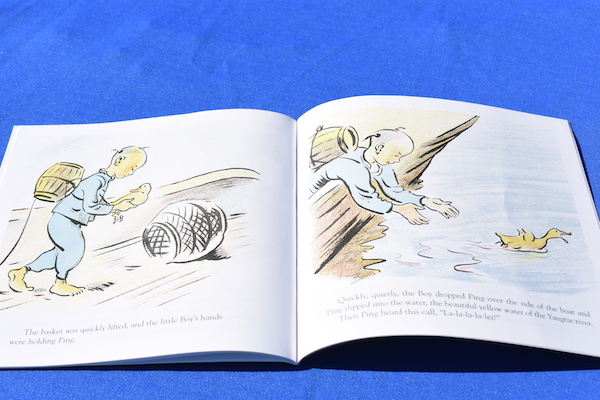
After sleeping on the river bank overnight, Ping sets out to find his family the next day.  However, there are many different boats on the river, and he has trouble finding the one where his family lives.  As he searches, he is captured by a boy who brings him onto his family’s boat.

To Ping’s horror, the family who captured him plans to eat him for dinner!  However, the boy who grabbed Ping out of the water thinks that he’s “too beautiful to eat.”  Without letting his family know, the boy frees Ping from the basket where he is being held captive.

As Ping swims away from the boy’s boat, he hears the master of his family’s boat, calling out for the ducks to return.  This time, Ping does return to his family’s boat, even being willing to take a spank for being late, glad just to be safe with his family.

In a way, this little story reminds me of one of the short humor stories in Wayside School is Falling Down.  In that story, a boy at a very strange school gets tired of following the school’s rules.  Some mysterious men explain to the boy that the rules are meant to keep the students safe and choosing whether or not to follow the rules means choosing between freedom and safety.  The story and the boy’s choice are meant to be humorous, but it is a good point about the purpose of rules.  Probably, the reason why the master on Ping’s boat spanks the last duck is to give all of the ducks a reason to hurry back to the safety of the boat.  Ping doesn’t really appreciate that until he sees the dangers that wait for a small duck, alone on the river.  In the end, he is willing to accept some discipline because he wants the safety it promises.  It’s not the usual message in a lot of modern children’s books, especially in the United States, where people and book characters tend to value freedom over safety (the choice made by the boy in the Wayside School book).  However, in this book, Ping and his family have something between total freedom and total captivity – they are allowed to swim pretty freely during the day as long as they return to the boat for safety at night. They get both some freedom and safety in exchange for following the master’s routine. Ping’s danger only comes when he breaks away from that entirely.

But, if you think that analysis is getting too deep, Ping’s adventures and his return to the safety of his family are endearing for lovers of animal stories. Kids who encounter this story will be reassured that Ping is still able to return to home and safety after his adventures!

The story has appeared in film and on television more than once. The book is available to borrow and read for free online through Internet Archive (multiple copies).