A Walk in Wolf Wood

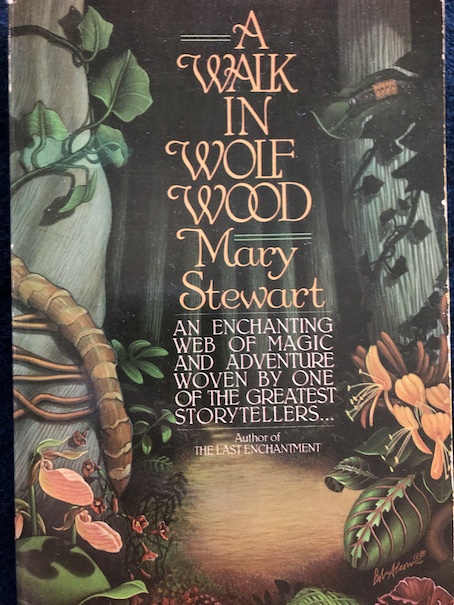
A Walk in Wolf Wood by Mary Stewart, 1980.
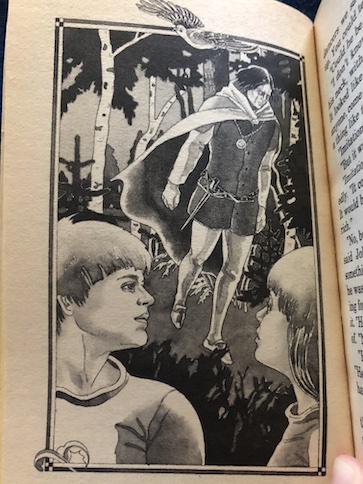
John and Margaret Begbie are traveling with their parents through Germany, and the family stops to have a picnic in the Black Forest. From their picnic spot, they can see the old castle on the hill that they visited earlier that day. The children’s parents doze off after lunch, but the children stay awake and see a strange man. The man walks by their picnic spot wearing an old velvet costume and a dagger in his belt, and the children see that he’s crying. The kids worry about the man because he seems so deeply distressed. They decide to leave a note for their parents and follow the man to be sure that he’s alright.

As they go after the man, they spot what looks like the tracks of a large dog, but the man didn’t have a dog with him. The kids realize that these are actually wolf tracks, and John remembers that their father told them that this area is called Wolfenwald, which means Wolf Wood. Then, they find the man’s gold medallion lying on the ground. Going a little further, they find an old cottage. The cottage looks abandoned, but they decide to explore around it anyway, just in case the man went inside. No one answers their knocks on the door, but they see the man’s clothes on the bed inside the house. They decide to leave the medallion with the man’s clothes and go back to their parents, but they suddenly notice that it has become night, and when they try to leave the cottage, they are confronted by a large wolf!

John frightens the wolf away by flinging the medallion at it. When the wolf is gone, the children decide that they have no choice but to risk going through the woods in the dark to find their parents. However, when they arrive at the picnic spot again, their parents aren’t there. The children find the note they left and a bar of chocolate. They eat the chocolate and lie down to wait for their parents to return for them, but the next thing they know, they are woken by the sound of a horn and the horses of a group of hunters. The hunters are pursuing the wolf. When they wave down one of the horsemen, he offers them a coin to tell him where the wolf is. Margaret points the man in the wrong direction to get the hunters off the trail of the wolf. The children aren’t really sure whether it’s a real wolf or just a dog that resembles one, but Margaret has the sense that the wolf needs their help.

The children also need help. They notice that the horsemen are dressed strangely, like people out of the past, and the coin that the man gave them is stamped with the year 1342 although it looks new. Even more strangely, the children suddenly realize that they understood what the man said even though neither of them can speak German. Is this is a dream, or have they gone back in time?

Not knowing what else to do, they decide to return to the cottage and see if the man who owns the medallion is there and can explain things. The man does have an explanation. He explains that he was the wolf. The man, whose name is Mardian, is a werewolf, and Margaret saved his life when she diverted the hunters. Mardian says that he and his family served the dukes who have ruled this land, and he and the current duke grew up together and were best friends for years. However, after suffering a terrible injury at the hands of an enemy and losing his wife, Duke Otho became a changed man, angry and bitter. In a fit of temper, he even accused Mardian of plotting against him. A real enemy in Otho’s circle, an enchanter called Almeric, used Otho’s suspicions to try to eliminate Mardian. When his plots to kill Mardian failed, Almeric used sorcery to turn him into a werewolf. Now, Alermic has promised a reward to the hunter who kills the wolf, and in the meantime, he has disguised himself as Mardian and taken his place in the duke’s castle. So far, the duke hasn’t even noticed that Mardian has been replaced by an imposter. Mardian believes that Alermic will use his position to kill both the duke and his young son so he can take the dukedom for himself. Can the children help Mardian expose the imposter and break the spell?

The book is available to borrow and read for free online through Internet Archive (multiple copies).

My Reaction

In order to reach the duke and get his help to expose the imposter, the children must disguise themselves as other children from this time period and join in the life of the duke’s castle. Mardian gives them a plausible cover story, in case anyone asks them who they are. They carry off the charade very well, and there are so many people and children in the castle that two more aren’t questioned. John is even mistaken for another boy, called Lionel. John doesn’t know who or where the real Lionel is, although he theorizes that the real Lionel might have died young because many children of this time period did. While real-life castles were full of many different types of people of all ages, I do find it a little difficult to believe that so few people are surprised by children who suddenly appear without any introduction. There does seem to be the implication that people do come and go from this castle, making it difficult to keep track of everyone.

Margaret and John also experience the different expectations people of this time have for girls and boys. John is immediately put to work as a servant, waiting on the noblemen of the duke’s court as a page along with the sons of the nobles. He also has to dodge the rough games that the other boys play that are meant to prepare them for war. On the other hand, Margaret is taken to the nurseries with the other young girls of the castle and lectured about how she should be quiet and modest. The girls are much more closely supervised than the boys, although she finds a way of slipping away from the others to meet with John.

I liked some of the descriptions of the Medieval food in the book. At one point, Margaret thinks she’s eating turkey (a bird native to the Americas and not found in Europe during this time period), but John tells her that it’s actually swan and peacock, birds which were eaten around this time. There are a few instances where alcohol is mentioned because people during this time period drink wine and small beer. The duke also insists that a boy bring him his favorite posset, a drink I discussed in my earlier review of the The Box of Delights.
The 13 Clocks

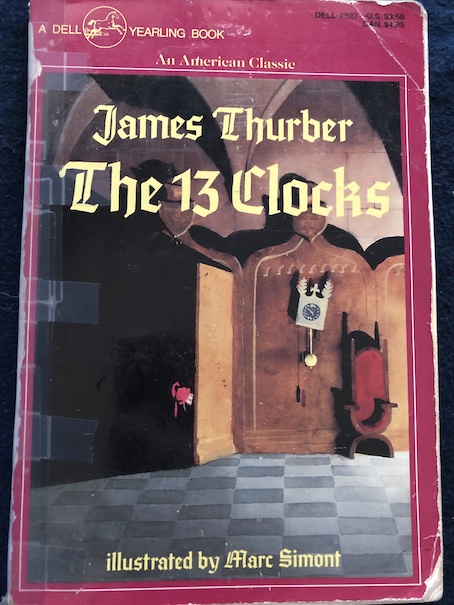
The 13 Clocks by James Thurber, 1950.

An evil Duke lives with his niece, Princess Saralinda, in a castle with 13 clocks that do not work. The Duke is a cold-hearted man, so cold that his hands are always cold, and he has frozen all of the clocks. Time itself seems frozen in the cold castle. The Duke comes to believe that he has actually “murdered” time, that it will never again be “Now” in the castle. The Duke is afraid of “Now.” “Now” has urgency and consequences, and he hopes that by stopping time, he will never have to confront “Now.”

One of the Duke’s fears is of his niece’s suitors. Princess Saralinda is lovely and as warm as the Duke is cold, so the Duke does not want to let her go. He needs her warmth as relief from his own coldness. Every time a potential suitor attempts to call on Princess Saralinda and ask for her hand, the Duke thinks up some impossible task for the suitor to accomplish with a sentence of death for failing to accomplish the impossible so Princess Saralinda will never be married.

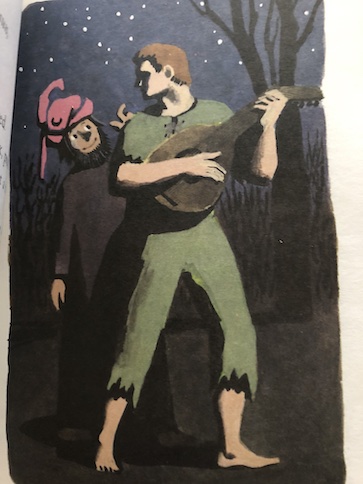
Then, a prince comes to town disguised as a minstrel named Xingu, which is dangerous because using a name that starts with ‘X’ is one of the things that the Duke sometimes kills people for doing. The prince is a youngest son, and as youngest sons often do in fairy tales, he has gone into the world to seek his fortune, adventure, and the lady of his dreams. At the town’s inn, the minstrel prince hears stories about Princess Saralinda, her suitors, and the Duke’s impossible challenges. In spite of the gruesome consequences for failing to complete the impossible tasks, the prince finds himself contemplating how he might be able to gain entrance to the castle and try his hand at defeating the Duke and winning the princess.

The minstrel prince begins making up a joking song about the Duke, and the people in town are nervous because the Duke kills people for any form of impertinence. One of the Duke’s spies, known as Whisper, witnesses the song and runs off to tell the Duke about it. Then, the prince is approached by a strange little man who calls himself the Golux and who offers to help him, although he freely admits that he makes up stories and often forgets what’s made up and what’s real. The prince doubts how helpful he can be, but the Golux suggests a story he can tell the Duke when the Duke considers killing him and feeding him to his geese, that Princess Saralinda can only be married two days after his death. The Duke would do almost anything to prevent Princess Saralinda’s marriage, so he wouldn’t kill him if his death might be the omen that causes her marriage to happen.

Soon, the Duke’s guards come to arrest the minstrel prince and take him to the dungeon. When he is brought before the Duke, the minstrel prince tells him what the Golux told him to say. The Duke isn’t sure whether he’s telling the truth or not, but since he’s not sure if he can kill him outright, he decides to set one of his impossible tasks for the minstrel to complete. The minstrel says that he can’t do an impossible task because he’s not a prince (as far as the Duke knows), but the Duke says that they’ll make him one just so he can do it.

As the guards escort the minstrel prince back to the dungeon, he sees Princess Saralinda, and she wishes him well, which is all that she can say in her uncle’s presence because she’s under a spell. The minstrel prince falls in love with her, and he realizes that his love is returned when she later manages to give him a rose.

In the dungeon, the minstrel prince encounters the Golux again and asks him how he got in and if there’s a way out, but the Golux is evasive, just telling another one of his stories about his mother being a witch and his father a wizard. However, the Golux has a useful suggestion for managing the Duke’s next impossible task: control what the task is through reverse psychology. He doesn’t use those exact words, but he tells the minstrel prince to beg the Duke to set him any task he likes but not to send him out in search of a thousand jewels. The Duke, being evil, will automatically set him the one task he begs not to be given. The minstrel prince says that he still can’t give the Duke a thousand jewels because he doesn’t have any jewels. The Golux points out that he’s no ordinary minstrel. He is actually Prince Zorn of Zorna, and his father will surely supply the jewels he needs. That’s all very well, but the prince isn’t sure if the Duke will give him the time he needs to reach his father and return.

Sure enough, the Duke sets the prince the task of getting a thousand jewels, but the matter is complicated because it turns out that he’s aware of who the prince really is. Knowing that it would take Prince Zorn 99 days to get the required jewels from his father and return, the Duke gives him only 99 hours to do it, and he further requires that all of the 13 clocks in the castle strike five o’clock (they are frozen at 10 minutes before five o’clock) when he returns with the thousand jewels.

The stakes of the task are high for both the Prince and the Duke because, as a guard explains to Prince Zorn, the Todal, which is a kind of blob monster in the service of the devil, waits to gobble up the Duke if the Duke fails to be sufficiently evil. If Prince Zorn passes whatever test the Duke sets for him, rescues the princess, and escapes, the Todal will surely put an end to the Duke.

The book is available to borrow and read for free online through Internet Archive (multiple copies).

My Reaction and Spoilers

This isn’t a princess book for young children because it has some dark content in it. The Duke is cruel to animals and has even killed children. The cruelty and killing isn’t described in detail, but the story is better for older elementary school children or middle school level. I’d say about 9 or 10 years old and older.

Through the course of the story, it’s revealed that Princess Saralinda isn’t actually the Duke’s niece. He later confesses that he actually abducted her from a castle as an infant, and even he isn’t completely sure of her true identity. Even as a child, she had that magical, glowing warmth that the Duke craves. He’s been raising her with the idea of marrying her himself when she’s old enough. He’s been unable to marry her up to this point because her former nurse was a witch and cast a spell that prevents him from marrying her until she’s 21 years old, and that time is approaching soon.

Part of the fun of this book is that it draws on many elements from fairy tales, like the woman who can cry jewels, which somewhat resembles the fairy tale about the kind girl whose words produce jewels and flowers when she speaks. The solutions to many of the problems in the story are also riddles. For example, if nothing makes a person laugh or cry, then literally nothing is what you have to provide. In the case of how to get the clocks moving again, Princess Saralinda has been the key all along. The clocks aren’t dead, merely frozen, and her warmth can get them moving again.

Of course, it all ends happily. Princess Saralinda’s true identity is established by the end of the story, and Prince Zorn is able to marry her. The Duke is thwarted and eaten by the Todal.