Samantha’s Cookbook

Samantha, An American Girl

This cook book is one of the activity books that was written to accompany the Samantha series that is part of the American Girls franchise. The American Girls books were written to help teach American history (as well as sell the accompanying dolls and accessories), so this book has recipes of the type that people would have eaten during the early 1900s, when the character of Samantha lived, and some historical information about cooking and dining during that period.

The first section in the book discusses innovations that made cooking easier in Samantha’s time than it had been in earlier time periods. The kitchen in Samantha’s house had running water, a gas stove, and an icebox for refrigerating food. Because Samantha comes from a wealthy family, who can hire people to cook for them, Samantha’s education focuses more on learning how to be a good hostess, meaning that she would be more likely to be in the dining room, helping to entertain guests, rather than in the kitchen, preparing food. However, Samantha would have been familiar with cookbooks, discussing new recipes and studying sections of cookbooks that offered advice about dining etiquette. There are sections in this book that discuss the role of servants in shopping for and preparing food and the proper way to set a table for an elegant dinner party.

After that, there is a section of cooking tips and kitchen safety tips. The recipes in the book are divided into sections based on meals, followed by a section of Samantha’s favorite recipes. The recipes are also accompanied by historical information.

The book explains that, because Samantha is from a wealthy family, her family’s cook begins making breakfast before Samantha wakes up in the morning, so it will be ready for her as soon as she’s awake and dressed. In her time, breakfast was typically the lightest meal of the day, but wealthy households had a variety of foods at breakfast. Breakfast was typically served with hot drinks. Adults usually had coffee or tea, while children might have hot chocolate.

  • Strawberries with cream
  • Ham slice
  • Cheese omelet
  • Saratoga potatoes – These are fried potato chips, which were a relatively new innovation in Samantha’s time. The book explains that potato chips were invented by a Native American cook at a resort in Saratoga Springs, New York in 1853 after a customer complained that the fried potatoes should be thinner.
  • Blueberry muffins

“Dinner” is usually the biggest meal of the day, but depending on when and where you live, that might be either the midday meal or the evening meal. In the past and in rural areas, “dinner” was often lunch. By Samantha’s time, as it typically is in modern times, it was the evening meal, after a family or individuals are home from work or school and have more time for a large meal. For wealthy families, like Samantha’s family, dinner was a very formal meal. They would often dress up for dinner, and at formal dinner parties, there would be name cards on the table to tell everyone where to sit. At a formal dinner in a household with servants, individual dishes and parts of the meal would be served in “courses”, but the number of courses could vary. Samantha’s family followed the English style, with fives courses at dinner. The book mentions Samantha’s family having soup, salad, appetizers, a main course with roasted meat, and dessert and coffee at the end of the meal. Some larger, fancier dinner parties could have many more, some as many as 18 courses!

  • Cream of carrot soup
  • Roasted beef tenderloin
  • Mashed potatoes
  • Fresh green beans
  • Corn oysters – These are fried corn patties.
  • French salad
  • Dressing
  • Ice cream snowballs – These are scoops of vanilla ice cream coated in shredded coconut.

This section has an assortment of recipes for Samantha’s favorite foods. The book explains that, while Samantha was being trained to be a hostess more than a cook, even wealthy girls like her would taught some basic cooking skills. Sometimes, Samantha would help the family’s cook in the kitchen and make some simple recipes.

  • Apple Brown Betty
  • Jelly biscuits
  • Cream cheese and walnut sandwiches
  • Chicken salad sandwiches
  • Gingerbread
  • Lemon ice

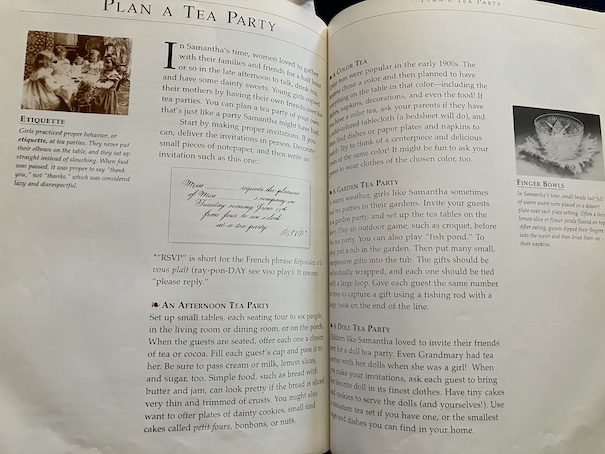
The book ends with a section about how to plan a tea party, like girls in Samantha’s time might have. The suggestions include themed tea parties, like afternoon tea, a color tea (a popular concept in the early 1900s, where everything at the party, from decorations to food, would be themed around a particular color), a garden tea party, and a doll tea party (girls would bring their dolls, and there would even be tiny treats to serve to the dolls).

The book is available to borrow and read for free online through Internet Archive.

The Enchanted Castle

Two brothers and two sisters spend most of their time at boarding schools. The boys go to a school for boys, and the girls go to schools for girls, so the only times when they are together are when they are home for school holidays or visiting at the house of a kind, single lady who lives near to their schools. Although the children’s parents are grateful for their single friend for hosting the children as guests from time to time, the children find it difficult to play at her house because everything is so neat and proper, and they don’t feel quite at home. Then, during one school break, one of the sisters, the one who makes it home first, comes down with measles. With their sister sick, the other siblings can’t go home, which is a great disappointment, and their parents have to make other arrangements for them. When the children tell their parents that they don’t want to visit the single lady for the entire school holiday, the parents arrange for the boys, Gerald and James (called Jerry and Jimmy), to board at their sister Kathleen’s school. It will be fine for them to be there because Kathleen (called Cathy) is the only student remaining at the school during the holiday, and there will only be one teacher there to supervise them, the school’s French teacher.

This arrangement suits them better than going to the single lady’s house, although they think that they ought to find something special to do during the school holiday. Kathleen suggests that they write a book, but the boys aren’t thrilled by the idea. They would rather do something outdoors, like playing bandits. However, they are a little concerned about the French teacher’s supervision. Fortunately, Gerald is good at charming grownups, when he wants to. Through a combination of flattery and small, thoughtful favors to the teacher, he gets on her good side, and he manages to convince her that he and his siblings would like to have some time to themselves to play and explore outside, maybe in the woods. The French teacher understands that what they really want is some freedom from supervision, but she agrees to give them some time to themselves.

The children don’t actually know if there are any woods in the area, but they decide to do some exploring and see if they can find an adventure of some kind. They end up getting lost during their exploring, but they find it exciting. When they sit down to rest, they find a cave and decide to explore it. The cave turns out to be a tunnel that leads them to a beautiful garden with a lake with a decorative waterfall and swans. The children imagine that it’s the garden of a magical castle. Going a little further, they find a thimble with a crown on it and a thread tied to it. It looks like the kind of thimble that might belong to a princess.

When they follow the thread, they find a young girl in a beautiful dress who looks like she might be a princess. She looks like she’s asleep, so she looks like an enchanted princess or Sleeping Beauty. Jimmy doesn’t really believe that she’s a princess, but the others aren’t so sure, and anyway, it makes a fun game to pretend that she is. Since Jerry is the eldest of the children, Cathy thinks that Jerry should kiss her to wake her up. Jerry refuses, so Cathy says Jimmy should do it. Although Jimmy is sure that she’s really just an ordinary girl dressed like a princess, he says he’ll kiss her to prove he’s braver than Jerry and that he should be the leader for the rest of the day.

When Jimmy kisses the girl’s cheek, she opens her eyes and says that she has been asleep for 100 years. She insists that she’s a real princess and asks them how they got past the dragons. Jimmy still doubts that, even though she shows them a mark where she pricked herself on a spindle, just like in the Sleeping Beauty story. She invites them to come back to the castle and see her beautiful things. The children say that they are hungry, so they go with her go get something to eat.

When they get to the “castle”, the princess brings them bread and cheese to eat with some water. This seem depressingly ordinary, and the princess apologizes, saying that was all she could find. However, she claims that the food in the castle is magical, so it can be whatever they want. The children imagine that it’s roast chicken and roast beef, but all they get is bread and cheese. Cathy doesn’t want to admit at first that it’s just bread and cheese because (like with the Emperor’s New Clothes), there is an implication that there is something wrong with her if the magic doesn’t work for her. Jimmy isn’t discouraged by that, so he asks the princess if it’s a game, but the princess denies it, insisting that the food is magical.

Then, the princess takes the children to a hidden door behind a tapestry. The room inside has paneled walls and blue ceiling with stars painted on it. The princess calls it her “treasure chamber”, but the room is completely empty. The princess acts surprised when the children say that they can’t see any treasure, and they refuse to believe it’s because they’re magical or invisible. The princess has the children close their eyes while she says some magic words. When they open their eyes, suddenly, there are shelves with jeweled objects on them. The children have no idea how the princess accomplished this trick, so they start to believe that maybe she can do magic.

The princess suggests that they all put on some of the jewels and be princes and princesses, too. It’s amusing for a while, but the boys start getting tired of dressing up, and they’re still a little skeptical about who the princess is. They suggest that they go play outside, but the princess insists that she’s actually grown up and doesn’t play children’s games, and she has the others help her put all the treasures back in their proper places. She tells the children that various pieces of jewelry have magical property. Jimmy asks her if that’s really true or if she’s kidding, but the princess insists that it’s true. Jimmy asks her to demonstrate how the magic works. The princess says that she will try on the magic ring that makes her invisible, but only if everyone closes their eyes and counts first.

When the children open their eyes, all of the shelves of jewels are gone and so is the princess. Jimmy says that it’s obvious that the princess just went out the door of the room. When they close their eyes and count again, Jimmy keeps his eyes open and sees the princess hiding behind a secret panel. When he tells the others, the princess says that he cheated. The weird thing is, even though they hear the princess say that he cheated, they still don’t see her. They tell her to stop hiding and come out, but she says that she already has. She says that if they want to pretend like they can’t see her, that’s fine, but the children seriously can’t see her. When the princess realizes that they’re serious that she’s actually invisible, the princess suddenly gets scared. She tries to shake the boys and get them to say that she’s not invisible, and Jerry catches hold of her, still unable to see her. She tells them that it’s time for them to go because she’s tired of playing with them.

Jerry makes the princess look in a mirror to prove that she’s invisible, and the princess gets very upset. Cathy sensibly tells her to just take the ring off, but the princess says it’s stuck. She admits that the whole thing, up to this point, was just a game of pretend. She says that the treasure shelves were hidden behind some paneling, and she just moved it with a hidden spring. She never expected that any of it was actually magical. The truth is that the girl’s aunt works at the house as a housekeeper and that her name is Mabel. She was just playing at being an enchanted princess because the rest of the household is away at the fair, and she happened to hear the other children coming through the hedge maze, so she roped them into her game.

Since one of the objects that Mabel claimed was magical was a buckle that would undo magical spells, Cathy suggests that she try the buckle. Mabel says that’s no good because she only made up that it was magical, but Cathy points out that she also made up the part about the ring being magical, and it turned out to be true, so she might as well try the buckle. Mabel would, but they accidentally locked the key inside the room and can’t get in now.

The children sit down to think about the situation. Since they can’t think what to do, the other children think maybe they should leave and go get their tea, but Mabel insists that they can’t just leave her invisible like this. Instead, she suggests that she go with them to tea and leave her her aunt a note. While they have tea, maybe they can think of something else to help Mabel. In her note, Mabel says that she’s been adopted by a lady in a motorcar and is going away to sea. The others say that’s lying, but Mabel says that it’s fancy instead of lying and that her aunt wouldn’t believe her if she said that she was invisible.

When they return to Kathleen’s school, they have tea and supper. They let Mabel have one of the three plates laid out for them, and Jerry and Cathy share one between them. Fortunately, the French teacher isn’t eating with them and doesn’t see an invisible person eating, but the children don’t know how they’re going to handle breakfast the next morning. They say that Mabel can stay the night with them, sharing Cathy’s bed and borrowing a nightgown. Mabel says that she can get some of her own clothes from the house tomorrow because no one will be able to see her and that she’s starting to see some possibilities for being invisible.

In the morning, the maid who comes to wake Kathleen sees Mabel’s discarded princess dress on the floor and asks Kathleen where it came from. Kathleen makes an excuse that it’s for playacting, which means that she and her brothers will have to figure out some kind of play to put on with it. Mabel thinks that acting sounds exciting, but Kathleen reminds her that she’s still invisible, so no one can see her perform anything.

The children feel bad about Mabel’s lies in the note to her aunt, and they insist that they should go and tell her the truth. Mabel doesn’t think this is a good idea because her aunt won’t believe her, but she reluctantly agrees. When they try to talk to her, the aunt doesn’t really want to listen to them, thinking that it’s just another one of Mabel’s pranks. She says that maybe Mabel was changed at birth and that her rich relatives have finally claimed her. They try to tell her that Mabel is with them, only invisible, and the aunt tells them not to lie to her. They ask about Mabel’s parents, and the aunt says that she’s an orphan. The children think that Mabel’s aunt is crazy because she doesn’t seem concerned about her and doesn’t want to hear anything they have to say, but Mabel says that she thought that her aunt might act that way because she spends so much time reading novels and can imagine anything.

In the meantime, Mabel has had some thoughts about what she can do. She says that she might be able to continue living in the house where her aunt works because the place is supposed to be haunted, so she can play ghost herself. However, the others think that she should stay with them. They just need a way to get some money to buy extra food for her.

Sine the fair is still going on, Mabel suggests that Jerry put on a magic show at the fair to get some money. The others say that Jerry doesn’t know any magic tricks, but Mable points out that it doesn’t matter when he has an invisible friend who can move things around, unseen, and make things disappear. Jerry dresses up as a conjurer from India (in a way that would be considered equal parts cheesy and offensive by modern standards because it involves black face), and he puts on the magic show with Mabel’s help. It’s incredibly successful, and toward the end of it, Mabel feels the ring coming loose. She takes it off and gives it to Jerry, who ends the act by vanishing himself.

Now, Mabel is visible again, and it seems like they’ve solved their problem, but now, they have a new one. The ring is now stuck on Jerry’s finger, and he is the one who’s stuck being invisible. Although Mabel can now go home, she insists on staying with the other children and taking part in their next invisible adventure.

Jimmy says that, if he was invisible, he would turn burglar. The girls point out that would be unethical, so Jerry decides that he will be a detective. There are advantages to a detective being invisible. Then, Mabel remembers that the treasure room is still locked from the inside, and they have to do something about it. Jerry says that, as an invisible person, he can sneak in easily enough through a window. When he does this, he ends up foiling a robbery by actual burglars, although he also ends up letting them escape from the police because he knows that conditions in prisons are horrible and can’t bring himself to send anyone there.

After his adventure, the ring comes loose from his finger while he’s in bed, and the maid at the school, Eliza, finds it and decides to “borrow” it for an outing with her fiance. When her fiance can hear Eliza’s voice but not see her, he thinks that he’s taken some kind of strange turn or fit, possibly because he’s been in the sun too long. The children convince him to go home and lie down while they deal with Eliza. They take Eliza on a little adventure of her own because they’re beginning to see that the ring doesn’t come off someone’s finger until its purpose is fulfilled. Afterward, they manage to convince Eliza that it was all a strange dream that she had because she felt guilty about taking the ring without permission. The children also think that the ring’s power might be diminishing and could be completely spent because it seems like its effect has been lasting shorter and shorter amounts of time every time it’s used. However, this is really just the beginning of the ring’s magic, and it can do much more than they think it can.

At this point, they feel a little guilty that they haven’t spent much time with the French teacher, who is supposed to be looking after them, so the buy her some flowers. She is pleased with the gift, and they have a little party with Mabel as their guest. They find out that the French teacher has artistic abilities, although she rarely has time to draw these days because she’s so busy teaching. Mabel also tells them more about the man who owns the house where her aunt works. Although the house is grand, the man who owns it doesn’t really have enough money to support it and live there full time with a full staff because his uncle wrote him out of his will for falling in love with a girl he didn’t approve of. It’s sad because he also never married the girl because she was sent away to a convent, and although he did try to find her, he never did. Mabel, whose knowledge of convents comes from the scandalous gothic novels that she and her aunt read (much like the kind the main character reads in Jane Austen’s Northanger Abbey), speculates that the girl might be bricked up in a wall by now because that’s the kind of wicked thing that happens in books. The French teacher tells her that real convents aren’t like that and that the women who live there are good and take care of girls without parents, although they can also be strict, and the girls aren’t allowed to leave. She says it in a way that implies that she was one of those girls raised in a convent.

Since the children had claimed earlier that they were going to put on a show of some kind with the princess outfit, they decide to go ahead and perform for the French teacher and Eliza. To fill out the audience for their performance, they make a bunch of stuffed dummies, which the French teacher finds amusing. The children use the ring as a prop in their play, although none of them put it on, and Kathleen wishes that the dummies were alive so they could have better applause from the audience. To the children’s amazement and the French teacher’s and Eliza’s terror, the dummies (which the children think of as “Ugly-Wugglies”) do come to life and start clapping. In a panic, the children debate what to do. Jerry realizes that the ring is actually a wishing ring and is responding to the children’s wishes, so he wishes on the ring that the dummies were not alive, to undo Kathleen’s wish, but it doesn’t work.

To Jerry’s surprise, the dummies begin speaking to him, although their speech isn’t clear because they don’t really have proper mouths. They ask him for a recommendation to a good hotel or suitable lodgings. The dummies don’t seem to know what they are, and they are behaving like respectable, aristocratic people. Jerry tells them that he can show them to some lodgings, if they will wait for him a little. He makes some excuses to give himself time to reassure the French teacher and Eliza that the effect with the dummies was just a trick pulled by the children with string, and he recruits Mabel to help him find a place for the dummies. He does this in an insulting and condescending way, and Mabel tells him off for that, but she agrees to help him. They decide to hide the dummies somewhere on the grounds of the big house where Mabel and her aunt live, thinking that the magic will wear off eventually and that the dummies will turn into dummies again by morning. The dummies turn nasty when Jerry and Mabel try to shut them away, and they are helped by a strange man.

The strange man demands an explanation from the children about the angry people they’ve shut away, but the children don’t want to explain. The man says, if they won’t tell him what’s going on, he’ll simply have to let the people out and ask them, but the children are afraid of what the dummies will do if they’re released. The man assumes that the imprisoned people are other children and this is all some children’s game, so Jerry and Mabel decide that they have to tell him the truth, even though they know it all sounds crazy. They can tell that the man doesn’t really believe him. The man thinks maybe Jerry has a fever or something, and he says that he’ll see the children home. Jerry can tell that the man plans to open the door after the children are gone, and he warns him not to do that. He insists that the man wait until tomorrow to open that door and to wait for them to meet him to see it opened because, by then, they’re sure that the dummies will just be dummies again. The man reluctantly agrees.

When the children arrive the next day, they discover that the man didn’t wait for them to open the door, and he is now lying unconscious and injured, apparently attacked by the dummies. The dummies are gone except for the most respectable dummy, who seems concerned about the unfortunate man on the ground. Mabel runs for smelling salts to revive the unconscious man, and Jerry looks around to see where the other dummies are. They find that the other dummies have turned back into piles of old clothes, and only the one living dummy is left. He seems to be becoming far more real. The children revive the unconscious man, who turns out to be the new bailiff. The bailiff assumes that the strange visions he had were because he was injured accidentally. After the children are sure that he’s all right and send him on his way, they try to figure out what to do with the remaining living dummy.

The remaining dummy seems to have developed a life of his own and is quite a wealthy man, although the children aren’t sure that this will last because the ring’s magic never seems to last very long. Jimmy says that he wishes he was wealthy, and the other children are horrified to see him age quickly, turning into an elderly, wealthy man. Jimmy doesn’t seem to remember who they are, and he refuses to turn the ring over to them when they ask for it, trying to stop his wish. He acts like the dummy is an old acquaintance of his, and he just wants to go to the nearest railway station with his dummy acquaintance.

Jerry sends the girls home to make some excuses for his and Jimmy’s absence, and he follows the now-elderly and wealthy Jimmy on the train to London. There, he learns that Jimmy and the living dummy have somehow acquired business offices, staff, and backstories. Other people seem to have somehow known the two of them for years (a warping of reality that makes Jerry’s head swim because neither of them existed in their current state before) and say that they are business rivals. Jerry pumps a boy who works at one of the offices for information, claiming that he’s a detective and is trying to reunite the elderly Jimmy with grieving relatives. The boy’s advice is that it will be difficult to get through to elderly Jimmy but that he might use the living dummy’s rivalry with elderly Jimmy to arrange things. The living dummy (now known as U. W. Ugli) helps Jerry to get control of the ring, and he wishes himself and Jimmy back to the house where Mabel lives.

Jimmy is restored to his younger self, and the children debate about what to do with the ring. They can see that it has some dangers. Mabel says that she ought to put it back in the treasure room, where she found it. However, while they’re in the treasure room, they begin to wonder if any of the other pieces of jewelry are magical, since the ring became an invisibility ring after Mabel pretended it was. Mabel can’t remember exactly what she said any of the other pieces of jewelry did because, at the time, she was just playing pretend and making things up. Then, something occurs to Mabel. She realizes that the ring only became an invisibility ring because she said it was one, and it turned into a wishing ring when they started calling it that. She says that proves that the ring does whatever they tell it to do, changing its powers to match whatever they say. To prove the point, she declares that the ring will now make people tall, and when she puts it on her finger, she is suddenly unnaturally tall.

Mabel’s experiment did prove the point, but they now have to hide Mabel until the effects wear off. The children get a picnic from Mabel’s aunt and go to hide out in the woods overnight. However, Mabel complicates things when she turns the ring into a wishing ring, and then, she accidentally turns herself into a statue. The children have a nighttime adventure with some living statues, learning that all statues apparently have the ability to come to life at night. They can also swim, so they have a nice swim and a feast. The statue of Hermes tells the children that “‘The ring is the heart of the magic … Ask at the moonrise on the fourteenth day, and you shall know all.'”

Then, the children learn that Lord Yalding, the man who owns the big house, is planning to come, and that he is thinking of renting the house to a wealthy American. Mabel’s aunt is busy, getting the house ready for Lord Yalding and the American. However, it turns out that the children have already met Lord Yalding without realizing it, and with the ring and the treasures in the hidden treasure room, they have the power to secure his future and reunite him with his lost love … if only they can figure out how to manage the ring’s power without causing any more chaos.

The book is now public domain and available to borrow and read for free online through Project Gutenberg and Internet Archive (multiple copies), including an audio recording from Librivox. The story was made into a BBC television miniseries in 1979, but it’s difficult to find a copy these days. As of this writing (April 2024), the only dvd release was in Australia in 2013. Sometimes, clips of it appear on YouTube.

For the first part of the book, it isn’t obvious that there will be any real magic in the story. At first, the children are all just playing pretend with each other, and even when Mabel turns invisible, it’s possible to believe that the children might still be playing pretend and letting their imaginations run away with them. Because the adults don’t seem that concerned about Mabel, I thought that they might have been humoring the children in their game, but the children later realize that the ring has the effect of muting people’s concerns for the one wearing it, even if they’re doing something bizarre or dangerous. That ends when the person takes off the ring, and people become more concerned about them and where they’ve been. The magic in the story is real, and as the story continues it involves too many other people, even adults and various bystanders, for it to just be a game.

Throughout the book, various adults experience the effects of the magic ring and witness things that the children do with it. They come up with various explanations for what they’ve witnessed, so they can disregard it, but they unquestionably experience magical events along with the children and have some consequences from the children’s adventures. While Jerry retrieves Jimmy from London when he accidentally turns himself old and wealthy, they never do retrieve the living dummy, so U. W. Ugli remains doing business there until his magic finally wears off. His employees don’t seem to know what he is and have memories of having worked for him for years, so they report him missing when he finally disappears, and the notice appears in the newspaper.

There’s a lot of humor in the story as the children experiment with the magic, deal with the consequences of their adventures, and try to invent excuses to explain away the inexplicable. There are times when they do try to tell adults the truth about what they’ve been doing and what’s happening, but most of the time, the adults don’t believe them. Sometimes, they feel a little bad about lying to adults and making up stories, but they have to resort to that because nobody really believes the incredible truth.

When the children start telling Lord Yalding the stories of their magical adventures and about the treasures they’ve found in the house, they are unable to prove what they say at first. Lord Yalding gets a chance to experience the magic himself, he thinks that he’s going crazy. At the proper time, the ring’s magic reveals itself to Lord Yalding, his love, and the children so they can all see the true magic and learn the ring’s history, which is a story of magic and tragic love. Lord Yalding comes to understand that he is not crazy and that the magic is real. His lover makes one final wish that turns the wishing ring into a wedding ring. The magic ends, and the castle and grounds are changed because of it, becoming less grand and more ordinary, but Lord Yalding and his bride are able to have their happy-ever-after.

I thought it was interesting that the author provided a backstory for the magic ring, explaining where it came from and its effect on the house and its grounds. I didn’t think there were many clues to that backstory provided along the way, and some buildup to the explanation would have been nice. However, I recognize that the author didn’t have to provide any explanation for the magic at all. Many other fantasy stories don’t offer explanations for magical objects, leaving that up to readers’ imaginations, because the focus is more on the effects of the magic rather than its origins.

As far as we know, the children’s other sister, the one who was sick with measles in the beginning, never finds out what her siblings have been doing during this particular school break. The children remain close to Lord Yalding and his wife, and they host them at their house during school breaks afterward. In fact, it sounds like they spend more time with Lord and Lady Yalding than they do with their parents.

Overall, I enjoyed the story. E. Nesbit’s fantasy stories are children’s classics, and they have influenced other children’s fantasy books that came after them, especially Edward Eager’s Tales of Magic series.

Although the original story is now public domain, there are different versions of this book because there are simplified forms of the story for younger children, and some newer editions have removed some of the problematic parts of the story. Some of E. Nesbit’s books contain problematic racial language or stereotypes or have children doing things that would be unacceptable by modern standards. In this book, such incidents are relatively mild, and their absence wouldn’t materially change the character of the story.

For example, when Jerry dresses up an conjurer from India, he uses black face as part of his costume. In the 21st century, use of black face is considered derogatory toward people with dark skin. In a way, Jerry’s costume is played for comedy because it’s made from pieces of his school uniform, and someone points out that he’s left out spots in his skin makeup. Nobody believes that he’s a real conjurer from India, although they are impressed by his act because they can’t figure out how he accomplishes his tricks.

There is also some anti-Catholic sentiment, although the children seem to say certain things because they’ve gleaned them from sensational novels or things other people have said, and the author does correct for it. The first instance of this comes from Mabel’s concept of the dark deeds done in convents, which she has apparently learned by reading gothic novels. I’ve read some old gothic novels myself, and the idea that sinister things happen in secrecy in convents and abbeys was a popular concept from 18th and 19th century literature. It’s partly due to anti-Catholic sentiment and, probably, because the idea of a closed society that isn’t open to the general public makes for a compelling setting for dark secrets, somewhat like the way secret societies and boarding schools have become the setting for sinister happenings and dark deeds in Dark Academia literature. However, the other does have the character of the French teacher contradict this view of convents with a more benevolent and realistic one, that the people in them are caring but strict. There is one other comment that Jimmy makes in the story when he’s arguing with Mabel, when he seems to be implying something about Jesuits, a branch of Catholic priesthood:

“If you’d been a man,” said Jimmy witheringly, “you’d have been a beastly Jesuit, and hid up chimneys.”

I wasn’t entirely sure what this comment meant, although I think it might be a reference to the ways Catholics hid priests in priest holes, little hidden rooms, when they were at risk for arrest, torture, and even execution in Elizabethan England. Some of these little hiding places were in fireplaces, which I think is what the reference to hiding in chimneys means. At the time, the children were arguing about bravery, so I think Jimmy is implying that Mabel is the type to run and hide in the face of danger. (That might actually be the best option when there’s real danger. Just saying.) If I’ve understood his meaning, that makes Jimmy’s comment more of a slur against Mabel’s bravery than against Jesuits, although he does still call the Jesuits “beastly”, and he’s implying that’s a bad thing to be.

When you read public domain versions of the story online, they will have these elements in the story because they were part of the original book. However, if you find a physical copy in a library, it may or may not have these elements, depending on the printing. If it was printed during the late 20th century or any time during the 21st century, there is a good chance (although not completely guaranteed) that it’s a revised version and may have these parts written out or at least toned down.

The Bobbsey Twins of Lakeport

Bobbsey Twins

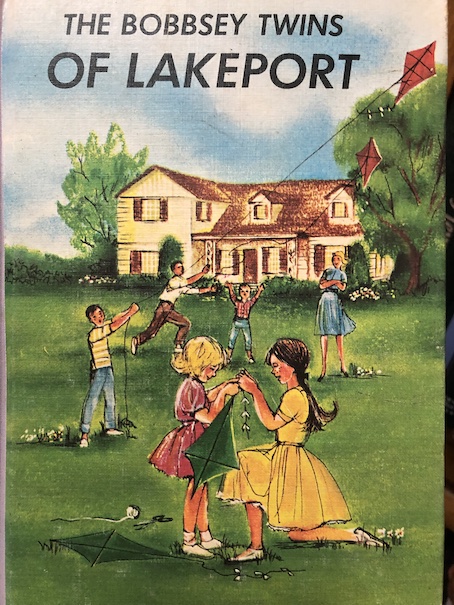
The Bobbsey Twins of Lakeport by Laura Lee Hope (Stratemeyer Syndicate), 1904, 1961.

Before I begin discussing the story, I need to explain that this story, I need to explain that, in the 1950s and 1960s, children’s series books from the Stratemeyer Syndicate that were still in print were rewritten and reprinted to update slang and cultural references and, importantly, to remove inappropriate racial language and stereotypes. This was the time of the Civil Rights Movement, and people were becoming more self-conscious about the language they were using and what they were teaching to children. The Bobbsey Twins was one of the series that was rewritten, and I was surprised by some of the things that appeared in the original printings of the first Bobbsey Twins series. As a kid, I was more familiar with The New Bobbsey Twins series, which was written in the 1980s and 1990s. The Bobbsey Twins was one of those series that has multiple sub-series, sort of like the various incarnations of Scooby-Doo cartoons, each one updated to fit the decades when they were written. The original Bobbsey Twins series was first written in the early 1900s, and the way it originally portrayed the black couple who work for the Bobbsey family was very problematic. I was really surprised. The edition that I’m describing below is the revised 1960s edition, with the problematic elements changed or removed.

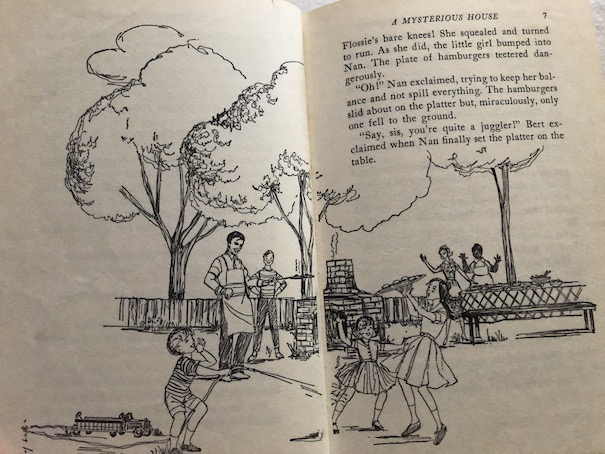
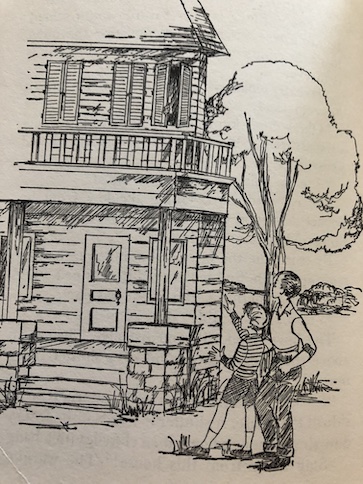
The story begins with both sets of Bobbsey Twins – the older set, Nan and Bert, and the younger set, Freddie and Flossie – disassembling their old tree house because they’re planning to build a new one. Six-year-old Flossie mentions that a spooky old house near their school is also going to be torn down, and Freddie says that another kid at school claims that house is haunted. The children’s father says that they must be talking about the old Marden house. It used to a farmhouse, but the town has grown around it. Mr. Marden was a wealthy man who had once been ambassador to Great Britain, and he build the large house when he retired. Since then, the place has become disused and badly run-down, which is why the kids think it’s spooky and why it’s going to be torn down.

The children’s mother explains that she knows Mrs. Marden, who is the widow of the original Mr. Marden’s grandson. Mrs. Marden is now elderly, and she sold the old Marden house to the school when she went to live in a nursing home. Mrs. Bobbsey says that she hasn’t been to visit Mrs. Marden lately, she decides to pay her a visit that afternoon. The kids are still curious about whether the house could be haunted, and they ask their mother to ask Mrs. Marden about it. It doesn’t seem likely that the house is really haunted, even though it is old and spooky-looking. Danny, the kid at school who claims that he’s seen ghosts around the place, is known for playing mean tricks, so he’s not a reliable witness.

Bert suggests to the others that they could go take a look at the house themselves. When they get there, they see men surveying the property. The men say that, after the house is torn down, it will be replaced by an addition to the school. The kids ask the men if they’re worried about the house being haunted. One of the men says that he heard some strange sounds, but he thinks it was just a couple of local boys playing a prank. The men don’t think that there’s a real haunting there. The Bobbsey Twins want to see the inside of the house, but the surveyors tell them that they can’t go inside because the house is locked up to discourage vandals. The kids spend a little more time with the surveyors, helping to hold their equipment and seeing how it works. However, the children are still curious about the house and wish they could investigate it more.

Then, when their mother comes home from visiting Mrs. Marden, she tells them that there really is a mystery about that house. Mrs. Marden’s memory is failing her, but she knows that some valuable souvenirs from old Mr. Marden’s time as an ambassador are missing. One of them is a cameo surrounded by diamonds (the book defines what a cameo is for the benefit of kids who don’t know) and a collection of obsidional coins. (The book also explains what these coins are. The characters had to consult a book because even Mrs. Bobbsey doesn’t know. I hadn’t heard of them before, either, because I don’t know much about coin collecting. They’re basically improvised coins made during times of siege to pay off soldiers. They’re made from whatever materials the makers had at hand and are often irregular in shape. I love stories that explain interesting and unusual historical details!) Mrs. Marden knows that she hid these things somewhere in the old Marden house, but she just can’t remember where. Since the house is going to be torn down, there isn’t much time left to find them!

Mrs. Bobbsey gives the children permission to investigate and tells them that the principal at their school has the keys to the house. She thinks that the principal might let the kids into the house if they explain that they want to retrieve something for Mrs. Marden. The school principal is surprisingly agreeable to the idea of the children poking around the old house and gives them the key, but Danny overhears their conversation and tries to convince them again that the house is haunted.

When the twins and a couple of their friends go inside the house, there isn’t much there. All the furniture has already been cleared out of the house, and it doesn’t seem to leave many possible hiding places to search. The only thing Mrs. Marden seems able to remember about the hiding place is that it has something to do with a hearth, but there are many fireplaces in the old house.

It turns out that the old house is hiding many secrets! There are secret passages and hidden trap doors. The kids also discover that someone is sneaking around the old house, someone who seems to know its secrets. Could it be Danny, playing ghost to scare them, or could it be someone who’s after the same treasure the children are trying to find?

The revised edition of the book is available to borrow and read for free online through Internet Archive (multiple copies).

My Reaction and Spoilers

New vs. Old Editions

I have trouble talking about the original edition of this book because I haven’t been able to find it. I’m not sure if that’s because the racial language was just too objectionable for anyone to want to put a copy online, even though it should be public domain now. Although, it could be that it is online but I just don’t recognize it because it’s called something different. Some of the revised Stratemeyer Syndicate books are so different from their originals that they’re barely recognizable as being the same story. Some original stories were considered so outdated that they were completely rewritten. I know something about the level of racial language and stereotypes in the Bobbsey Twins because I did find an older edition of the next book in the series, and I’ve read articles about some of the other books I haven’t read yet.

Even though this printing doesn’t contain the problematic racial language and stereotypes of the original, there were things some of the characters said that I still didn’t like. Mr. Bobbsey calls Flossie “my little fat fairy” as a term of endearment, but it sounds a little rude to me to call attention to her being “fat.” Flossie doesn’t seem to mind, probably partly because she’s only 6 years old and not at the stage where girls really start worrying about their appearance, but some girls can really be affected by being called “fat”, especially if there’s a lot of teasing at school aimed at “fat” people. The father similarly calls Freddie his “little fat fireman” because Freddie wants to be a fireman. Freddie doesn’t seem to mind it, either, but I still feel like the “fat” part is just unnecessary. If he’s going to give nicknames, why not just say “my fairy princess” or “little fireman”, sticking to words with positive connotations, without adding an extra, unnecessary word that can easily turn negative? I’m not fond of teasing, and I don’t think it’s a good idea to teach kids to tease or set them up for teasing later.

The Mystery

One thing that makes this story a little different from other books in the Stratemeyer Syndicate series is that the children get some adult help with the mystery. Usually, the children in Stratemeyer Syndicate series try to do everything themselves, but when the kids realize that there is a strange adult sneaking around the house and trying to scare them away, they tell their school principal, and he comes to investigate with them. However, even when the adults realize that there’s some strange adult lurking around and trying to scare the kids, nobody stops the kids from continuing to investigate the house.

There are various other little adventures that happen throughout the book, like Freddie getting lost in a department store and adopting a cat he names Snoop and the boys camping out with a friend but ending the trip when it starts to rain too hard. However, these incidents also help the kids to gather some additional clues to the main mystery.

The identity of the adult sneaking around the house would be impossible for readers to guess because we don’t really get to meet him until later. The kids are the ones who find the treasure, although it happens by accident. I would have liked it better if they had reasoned it out, but it’s still a pretty good kids’ mystery story.

The Wouldbegoods

The Wouldbegoods by E. Nesbit, 1901.

“We are the Wouldbegoods Society,
We are not good yet, but we mean to try,
And if we try, and if we don’t succeed,
It must mean we are very bad indeed.”

By Noel Bastable

The previous book in the Bastable Children series, The Story of the Treasure Seekers, ended with the children and their father going to live with their “Indian uncle.” The uncle isn’t identified by name, but he is apparently their real uncle, and he had only recently returned from living in India in the previous book, when he invited the Bastables to come live with him at Christmas. Since then, he has been helping the children’s father with his business, and the children are once again going to school, but not boarding school because their father doesn’t believe in boarding schools. However, the six Bastable children are still motherless and not accustomed to being supervised much in their free time.

During the spring, the children of one of their father’s friends come to stay for a visit. The Bastable children don’t like the other children much at first because they seem too timid and too well-behaved. The imaginative Bastable children decide that what these other kids need is a good game of pretend to get them out of their shells. One of the Bastables’ favorite books is The Jungle Books by Rudyard Kipling, so they decide to make their own jungle and act out scenes from the book. They give their guests the book to read, pointing out parts that they want to act out, while they go set up the jungle. They use the garden hose to create a waterfall, and they haul a bunch of their uncle’s taxidermy animals out of the house to set the jungle scene. They also set loose some guinea pigs and a pet tortoise and cover their dog in coal dust so he can be a wolf. Their father’s friend’s son, Dennis (called Denny), starts really getting into the game, but his sister, Daisy, prefers just to read the book. Matters come to a head when the boys frighten Daisy too much with their tiger costumes, and she faints. It is at that moment that their father and uncle arrive with some friends, seeing the children all gathered around Daisy, whom they first fear has died of fright. Some of the boys are nearly naked, their skin covered in brown dye so they’ll look like Mowgli from the book (no modern children should dye their skin for a costume like that, and that should be something adults explain to them, if they read this book), the taxidermy animals are all wet from the hose, the coal-covered dog is on the sofa inside, and the tortoise and one of the guinea pigs are never seen again.

Naturally, the adults are angry at the situation, and the children admit that their game went too far. The uncle swats the boys with his cane (not the girls because it would be ungentlemanly to hit a girl), and all of the children are sent to their rooms and put on a temporary diet of bread and water as punishment. Their father briefly talks of the possibility of boarding school, which shocks the children because they know how he feels about it. What the adults decide to do instead is to send the children to the country for the summer. Their friend from the previous book, Albert’s uncle, is an author, and he has rented a house in the country, where he will be writing. He always appreciates the children’s imagination and playacting, and he agrees to take all eight children, both the six Bastables and Denny and Daisy. (Albert isn’t there, so he’s probably somewhere with his mother.) Of course, since Albert’s uncle (who is never identified by any other name) will be writing much of the time, readers can guess that the children will have little supervision in the country.

The old manor house that Albert’s uncle has rented is a fascinating place. It has a moat around it, and a secret staircase, although it’s not really secret anymore because people already know about it. The eight children immediately begin doing things wrong in the country because they don’t know what they’re supposed to do and what they aren’t supposed to do, and adults usually only tell them what they’re not supposed to do after they’ve already done it. They ring a bell that is only supposed to be rung in emergencies, and they play in some hay that the horses are supposed to eat. Then, the girls in the group bring up an idea they’ve had.

The girls are still feeling guilty over the earlier bad behavior that got them sent to the country in the first place, so they’ve decided that it’s time for them all to reform their characters. Daisy in particular suggests that they form a society to do it because she knows that when people are serious about undertaking a good cause, they form a society for it. The boys aren’t as enthusiastic about the idea of forming a society around just being good, which doesn’t sound very fun or interesting, but the girls talk them into it. Oswald wants to know how it will be organized and who will be in charge, so they begin setting out some rules. Basically, all of the children are in the society, and nobody is allowed to leave it without telling the others. As long as they are in the society, they must always try their best to be good, and every day, they must try to do some good deed, which they will record in special book. After a debate about the name of their society, they decide to call it the Society of the Wouldbegoods. They also decide that this society must be kept secret from the adults, which is a major reason why their efforts turn out the way they do.

The first evening after they form the society, the children are unusually well-behaved but glum because they’re working so hard to be good. Albert’s uncle notices their odd mood, but they can’t explain to him why they feel this way, and he doesn’t press them. They also quickly have trouble finding good deeds to do, especially ones that are fun or interesting.

Dicky’s first good deed effort is to try to fix a window that seems broken to him, but it turns out that he doesn’t understand the reason why the window is the way it is. Because he changes it, a milk pan accidentally falls out the window into the moat. Oswald decides that the only good deed they can do is to retrieve the milk pan and fix Dicky’s mistake. They immediately recruit the other children to help them drag the moat, but none of them really knows how to do that, and by the terms of the society, they can’t ask the adults or tell them what they’re
trying to do. The only thing they can find to use for dragging the moat is a bed sheet, which they ruin by getting it dirty and tearing it, and it still doesn’t help them retrieve the milk pan. Failing that, they decide to make a raft and use it to reach the pan. This works better, but when they reach for the pan, the raft overturns and dumps everyone in the water, and Dora hurts her foot badly on an old tin in the water. Fortunately, the cook sees them fall in the moat, and she hurries to get Albert’s uncle, who gets the boat from the boathouse and rows out to rescue the children. (Apparently, the kids didn’t know there was a boat before they built the raft.)

Their next good deed goes better, although they don’t entirely think of it as a good deed. The children become fascinated with some soldiers who are training nearby. They like to watch the soldiers as they ride by and have their drills and exercises. When they wave to the soldiers, the soldiers blow kisses to the girls, which gives them a thrill. The kids dress up as soldiers and ask Albert’s uncle if they can borrow the old armaments that are decorating the walls of the old manor house as their weapons, and he says yes. (Oh, Good Lord, why? Nothing bad happens to the kids because of those old weapons, and they apparently don’t damage any of the antiques, but given their track record, this was taking a real risk.) The soldiers are amused by the children, and the next time they pass by, they stop and take a rest with the children. The captain of the soldiers takes some time to explain the soldier’s weapons to the children and tells them that they will soon be sent to the front overseas. (This is way too early to be World War I, and they refer to the Southern Hemisphere, so I think they’re talking about the Second Boer War, which was happening while this book was being written and published.) Before the soldiers leave, the children decide that they want to give them a parting gift, so they get some money from their father and give each of the soldiers a pipe and some tobacco, because the soldiers were all smoking during their rest break. Modern children’s books wouldn’t have the kids encouraging their smoking habit, but in this turn-of-the-century book, the gift goes over well. Sadly, the children never see any of the soldiers again after they leave for the front and don’t know what happened to them. Still, they did something nice for the soldiers.

The children’s experiences with the soldiers sets up their next attempt at a good deed, with mixed results. Part of it gets very uncomfortable, but it has a happy ending. The children notice an older woman who also watches the soldiers and seems to get very emotional when she sees them. They find out that her son is also a soldier who is already at the front, and she is very worried about him. The children decide that they should do something nice for her, so they try to weed her garden without permission. The problem is that the children
don’t know how to tell the difference between vegetables and weeds, so they also pull up her turnips and cabbages. The woman is angry with them, but they apologize and say that they’ll talk to their father about making things right with her.

Then, the children have to bring her a postcard addressed to her that was accidentally delivered to them with the mail for the manor house. They don’t even read it ahead of time although they could because they don’t want to do anything else wrong. This is a rare serious moment in this series because the postcard is from the army, and it says that the woman’s son is dead. The woman is very upset, and the children sympathize with her.

Then, the children decide that they can do something else nice for the woman by making a tombstone for her son. They know that he must have been buried at the place where he was killed on the battlefield, so he won’t have a normal tombstone in England, and they think it would be nice to make a memorial for him. The concept of making a memorial for someone who is buried elsewhere is actually a real thing. It’s called a cenotaph (although I don’t think these children know that word because they keep calling it a “tombstone”), and they are commonly done for soldiers who are killed overseas and buried there or whose bodies can’t be retrieved. (The musician Glenn Miller has one because his plane went down in the English Channel during WWII, and his body was never recovered.) Making a memorial of this type for the grieving family of a soldier would be a nice gesture, if it was done well and with the input of the soldier’s family. The kids do the best they can, carving a wooden tombstone and inscribing a beautiful message on it, but they don’t tell the soldier’s mother about it until after they’re finished. At first, the older woman thinks that they’re making fun of her grief, but Alice persuades her that’s not the case and convinces her to take a look. They decorate the tombstone with flowers and offer a lovely message about the soldier’s service to his country. The soldier’s mother is touched, and she appreciates the sentiment, although she has the children move the memorial to a more private spot. She likes it that the children continue to put flowers on the memorial, and she becomes friendly with them.

This episode also has a happy ending because it turns out that the reports of the soldier’s death were wrong. He was actually missing and injured, not killed. His mother and the children learn the truth when he comes home and sees the children decorating his “tombstone.” Fortunately, he is amused by the memorial and the touching sentiment expressed by the children, and his mother is overjoyed at his return. The children celebrate by chopping up the tombstone and using it for a bonfire.

Around this time, the children realize that they don’t have very many good deeds to record in their book, so they decide that they can make notes about any good thing that they notice someone else doing. Nobody is allowed to write about themselves or to persuade someone else to write something about them because bragging about their own good deeds wouldn’t be good or noble. It’s a fortunate decision because many of the children’s other adventures in the country aren’t directly related to the Society of the Wouldbegoods or their good deed efforts, but they count some of the things that certain children do during their adventures as good deeds (and Oswald gripes about things he did which he thought should have been counted but weren’t).

One day, the children are sent out on a long walk because Albert’s uncle has a headache and the children are making too much noise in the house. They decide to check out a tower that has some spooky local legends about it because it contains a tomb about halfway up the tower. The others credit Denny for a good deed because he offers to go first into the spooky tower. (This tower is somewhat based on a real landmark, but the
author took some creative liberties with it. The man who is supposedly entombed there, Richard Ravenal, isn’t a real person. He was created for this book, but he gets a mention in the lore of The League of Extraordinary Gentlemen.) The children have a frightening encounter there with a beggar. They give him a coin as a good deed, but he sees that the children have more money with them, so he locks them in the tower from the outside, telling them that he won’t let them out until they give him the rest. Oswald notices that there are bolts on the inside of the tower door as well as the outside, so he quickly locks them to make sure that the beggar can’t get inside. This turns out to be a good decision because, when the children toss the rest of their money to him, it isn’t as much as he thought they had, and he pounds angrily on the tower door. (Oswald thought that the others should have counted his locking the door as a good deed because it saved them, but they decide not to because it was really more “clever” than “good.” Oswald thinks that’s an unfair technicality.) The children are safe inside the spooky old tower until the beggar leaves, and they are able to signal to someone else to unlock the door from the outside. This incident wasn’t the children’s fault (for a change), but the adults insist that, from this point on, they take the dogs with them when they go very far from the house.

The children make some other attempts at doing good deeds on purpose, but again, they go horribly awry because the children don’t know what they’re doing, and they don’t talk to anybody else about their ideas before they do them. After they cause a disaster that ruins a fishing contest and wrecks a barge full of coal, which costs their father a lot of money to fix, Albert’s uncle explains to them the full consequences of what they did and how much trouble they caused for a lot of people. The children feel terrible about it, and Alice starts to cry. She doesn’t fully reveal the existence of their society to Albert’s uncle, but she does say that they’ve been working so hard at being good and doing good things, but nothing they do works out. She says that they must be the worst children in the world and dramatically says that she wishes they were all dead. Everyone is shocked by this, and Albert’s uncle calmly tells her that they’re not the worst children in the world. He says that he knows they’re all feeling bad about what they’ve done, and he does want them to feel badly because they have seriously caused some real problems, and he doesn’t want them to do these things again. However, he says that he doesn’t want them to give up on the idea of being good because that’s something that they will learn better how to do over time. Also, he notes that, in all the time he’s known then, none of them have ever done anything intentionally mean or wicked, they’ve never lied about what they’ve done, and they’ve always been sorry when things have gone wrong. Being truthful and genuinely regretful for causing harm are worthy qualities.

Oswald feels bad abut that part because he has realized that there’s one thing he’s done that caused a disaster, and he hasn’t admitted it to the others yet. What he did was unintentional, and he didn’t know the incident was his fault at first, but he’s been trying to work up the courage to confess since he realized what he did. Albert’s uncle’s kind words make Oswald confess right away, and Albert’s uncle is appreciative of his honesty for that, too. The others call credit Oswald’s confession as a good deed. He doesn’t think it is, but they say it counts because it was a difficult thing for him to do, and technically, he didn’t have to do it. At that point, nobody had guessed that he was responsible for one of the problems, and if he had kept quiet, it wasn’t likely that anybody would have found out. He had been honest because he simply wanted to be honest and do the right thing, even knowing that people might get mad at him or punish him for what he did.

Albert’s uncle forgives the children, although he still expects them to learn from their misadventures. At this point, the children also begin to consider just how far the Society of the Wouldbegoods will go. So far, it hasn’t been a great success, but they do appreciate what Albert’s uncle says about not giving up on the idea of trying to be good. Still, the children (especially Oswald), decide that it’s time to set an ending point for the society. They decide that each of them will try to do one more good deed of some kind, and when each of them has
one more deed to their name to put in their book, they’ll dissolve the society. From that point on, if any of them want to be good, they’ll do it on their own, when and how they choose do it. (The boys in the group are particularly relieved at this idea, although they’ve all been feeling some strain from the society.)

The children’s escapades still continue, some related to good deed efforts and some just part of summer activities that they do for fun. They try to hold a circus with some farm animals, which get loose. There’s a bonfire that gets out of control and burns a farmer’s bridge (although the children put it out themselves before it gets worse). Dora finds a baby who’s been left alone in his carriage and kidnaps/cares for it. At first, she thinks that maybe he’s the long-lost heir of a noble house who was kidnapped by gypsies, like in books,
and has been abandoned, so she must adopt him and care for him until he can be reunited with his family. Like many of the children’s good deeds, it has mixed results, but this one ends up being more on the side of good. She shouldn’t have just taken the baby from its carriage, and he technically wasn’t kidnapped until she took him. However, it turns out that his nanny was neglecting him, leaving him all alone while she flirted with her boyfriend. When the adults discover that the children have the baby and why they have him, the nanny’s neglect is exposed, and she gets fired.

A couple of the boys later buy a pistol, which they make all the children promise not to tell the adults about. (I thought at first that it was a toy pistol, but it apparently fires real bullets. God only knows why anybody thought it would be a good idea to sell these boys a real gun.) The boys were thinking at first that it would be handy to have if there was a burglar, but one of the boys accidentally shoots a fox with it and kills it. The other children, although they were pretending to be fox hunters, are upset at finding a real dead fox and bury it with a proper funeral before they know that it was one of the other boys who killed it. They get into some trouble over it from the master of fox hounds. The boy who shot the fox explains that, at the time he shot it, it was caught in a metal trap, and it bit him when he tried to let it loose, which is when he accidentally shot it. Albert’s uncle confiscates the pistol because none of this would have happened if the boys hadn’t been playing with a gun, and Oswald thinks that it would serve him right if they really did get a burglar in the house and were unable to fight him off. (I’m pretty sure that they’d be more likely to accidentally shoot one another or one of their own dogs before they shot anybody else.)

Toward the end of the summer, Albert’s uncle agrees to be a host for an antiquities society that wants to see the old manor house and investigate a nearby site for possible Roman ruins. Albert’s uncle is beside himself when he discovers that, rather than being host to a small club, more than 100 people show up to accept his invitation to have tea before touring the grounds. The children, inspired by a book called The Daisy Chain, decide that it would be amusing to bury some pottery that they made themselves, just so the antiquarians will definitely have something to find. That part turns out fine because the antiquarians can easily tell the pottery made by the children from actual antiquities, and they are amused by the children’s “relics.” The problem is that the children also decide to bury some pottery they found in the library along with their own pottery, and those were real relics. The antiquarians get excited when they find those, but Albert’s uncle realizes that those pieces of pottery belonged to the real owner of the rented manor house. The children have to go to the head of the antiquarian society to admit what they’ve done to get the antique pottery back.

From there, the children are inspired by something a tramp says to them to open up a stand offering free drinks (lemonade and tea), but it goes wrong when some people take advantage of their kindness. They also take part in some war games without realizing that it’s all a game or training exercise. Then, while acting out the pilgrimage from The Canterbury Tales, they meet a kind lady, who turns out to have a romantic past with Albert’s uncle! They’re not sure that they like the idea of Albert’s uncle getting married, but they’re willing to try to help him reconnect with his lost love if it will make him happy and for goodness’s sake!

THE EPITAPH

‘The Wouldbegoods are dead and gone
But not the golden deeds they have done
These will remain upon Glory’s page
To be an example to every age,
And by this we have got to know
How to be good upon our ow—N.’

by Noel Bastable

The book is now public domain, so it is available to read online through Project Gutenberg and Internet Archive (multiple copies, including audiobooks). There is also a LibriVox Audiobook on YouTube.

My Reaction

This book reminds me of a couple of more modern books, The Adventures of the Red Tape Gang by Joan Lowery Nixon from the 1970s and Why Did the Underwear Cross the Road? by Gordon Korman from the 1990s, which are both books about kids trying to do good deeds with unintentional and hilarious results.

Just as in the first book in the Bastable Children series, much of what the children do in this story is due to the children’s naivety and imagination and a lack of adult supervision. Oswald makes it a point to say that they were not entirely neglected by the adults while they were in the country. Although Albert’s uncle frequently had to spend time writing, he did spend plenty of time with the children, and their father and Denny’s father came to see them regularly, along with some other adults. The children enjoyed spending time with the adults and doing things with them, but Oswald doesn’t describe much of what they did with the adults because the things they did on their own were the most interesting. (In the sense of dangerous and disastrous, but also exciting.) At various times in the story, they meet up with adults who are happy to talk to the children and explain things about their business or how things work, but the children also like acting on their own initiative, without asking adults for advice or opinion or taking time to really prepare for things they want to do, like when Oswald didn’t want to take the time to actually train an animal to do something when the children decided that they wanted to have a circus with animals. The children’s innocence and ignorance are played for comedy, but child readers would probably appreciate the children’s sense of independence. Few modern children would be given even half of the opportunities the Bastables have to do things on their own and cause as much trouble as the Bastables do.

Racial Issues

In the first book of the series, I talked about some racial issues in the story, and there are also issues with racial language and attitudes in this book. I don’t know whether or not this book has been reprinted with altered language, like the first one. Some of the incidents in this book might take more editing than the first one, like where the kids darken their skin for acting out scenes from The Jungle Books or giving pipes and tobacco to the soldiers.

There is an instance of the use of the n-word in this book, and this time, it’s something Oswald says rather than something the adults say. Basically, he was talking about hard the children were working, and he was trying to imply that they were working like slaves, but instead of saying the word “slaves”, he says the n-word. Children’s word choice is influenced by the books they read reads and the things adults say around them, and we’ve already established that adults around them use the n-word in a casual way.

Again, this brings up the question of whether or not the author herself this that using the n-word is acceptable or if she’s just trying to portray the way some people around her talked. In a way, I think she does address this topic indirectly, although that might be unintentional. There is a point in the story when the children talk about unpleasant things found in poetry, like death and the devil, and they note that a person doesn’t always have to like the things they read or write about. It struck me that, perhaps, the author was trying to explain that she doesn’t always like, advocate, or believe in things that occur in her stories. This conversation isn’t directly related to the use of the n-word, so I’m not sure whether that would be one of the things that the author didn’t really like or not. It might have been a more general notion, like when authors write about sad things that happen or the things the children do that they really shouldn’t. It is a reminder, though, that characters are not exactly the same as their characters, and they may differ in important ways. The nature of the characters suits the story, but may not be a reflection of the author’s life and attitudes.

There is also one instance of an anti-Catholic attitude, but it’s played for humor. The kids are on a tour of Canterbury Cathedral, and their tour guide says, “This is the Dean’s Chapel; it was the Lady Chapel in the wicked days when people used to worship the Virgin Mary.”

(I’ve heard this accusation about Catholics worshiping the Virgin Mary before, all too many times, mostly from my Protestant grandmother. I belong to a family of mixed religions, and I had experiences like this from a very young age. Catholics don’t worship Mary. Catholics honor Mary, which is different. We also have a sense that those who were bound together by faith never lose that spiritual connection to the living members of the church when they die, so living Catholics can still communicate with the departed spiritually through prayer, which is what the whole thing about praying to saints is about. It’s about communication and spiritual support rather than worship. Catholics don’t have to do this if they don’t want to, but it’s always an option, if they feel the need of spiritual support from another soul who might understand their situation, because there is a sense that the spiritual connection is always there. Mary and the other saints are not substitutes for God or Jesus but rather part of an extended spiritual family that supports its other, younger, and more vulnerable living members in a spiritual way as they all, living and dead, serve and worship the same God. I suppose a simpler way of putting it is the concept that those who love us never leave us, or as C. S. Lewis put it in the The Chronicles of Narnia, once a king or queen of Narnia, always a king or queen of Narnia. Some bonds are unbroken by death. The punchline to the tour guide’s comment is in H. O.’s response.)

When the children think about the connotations of changing the name of the chapel from Lady Chapel to Dean’s Chapel because of changing worship styles, H. O. speculates, “I suppose they worship the Dean now?” You can imagine how well that question is received. Yeah, do they worship the Dean, or is the Dean just someone they’ve honored by naming something after him? You tell me if there’s a difference.

War and Soldiers

The scenes with the soldiers and war games remind me of something that the author couldn’t have known when she wrote the book. In the following decade, Britain would be involved with World War I (called the Great War before WWII), and many boys, like the kids in this story, would end up going to war. Oswald thinks that it would be exciting to be a soldier, but real war isn’t a game, and he might have many of his illusions shattered. Knowing what I know about this generation’s future, I have some real concern for the children in this story. There’s a very real risk that they could be killed in battle, just as the young soldier in this book that they built that tombstone for in this story could have died in the war that was being fought during his time. This story doesn’t go that dark because the Bastable Children series is a humor series, but there are moments of real sentimentality in the stories. E. Nesbit couldn’t have known about the war that was coming, but she did know about wars that existed during her lifetime. Introducing the children to the soldiers in this story introduces some serious concepts to the children, who are largely naive about many aspects of life, still thinking of many dangerous things as sources of excitement and adventure. We don’t know what happened to any of the soldiers the children befriended, but the knowledge that the old woman’s son almost died brings it to the children’s awareness that death is a very real possibility in that type of “adventure.” It’s a lesson that will accompany them into their future.

The Railway Children

Railway Children Cover

The Railway Children by E. Nesbit, 1906.

Railway Children toy train explodes

Three children in England live a comfortable and happy life with their parents. Roberta is the eldest, followed by Peter and Phyllis, the youngest. Their family has servants, their mother enjoys helping the children with their lessons and making up stories for them, and their father is clever at fixing broken toys. When Peter turns 10 years old, he is given an electric toy train (a relatively recent innovation for their time and the type of toy only a wealthy family could afford), which is a wonderful present because Peter wants to become a mechanical engineer. However, something goes wrong with the toy train, and it explodes at his birthday party! When Peter’s father comes home, he looks at the toy train and says that he thinks he can fix it, but before he can say much more, some strange men come to the house and want to talk to him. They spend a long time talking while the children’s mother takes the children upstairs. Then, their mother goes downstairs to see their father. When she returns, she seems very upset, but she doesn’t want to discuss it with the children. She only says that their father has been called away and that the children should go to bed.

The next day, their mother is gone for a long time, and the children are worried about what is happening with their parents. Their mother finally returns in the evening, tired and still upset. She tells the children that the men who came the night before brought very bad news and that their father will be away for some time, so she is going to need them to help her. She says that there will be times when she will have to be away for long periods and that she wants them to behave themselves and not fight while she’s gone. She doesn’t want to tell the children what the problem is or for them to ask her or anyone else any questions about it. She only says it’s about their father’s business and none of them really understand their father’s business. They know that their father works in a government office, so his business has something to do with the government, but their mother doesn’t want to say more than that.

Over the next several weeks, their mother is gone for long periods, leaving the children with the servants and with an older aunt who will soon be taking up a position as a governess for another family overseas. The children don’t get along with their strict aunt. The servants are usually more pleasant, but the children have the uncomfortable feeling that the servants know more about their father’s situation than they do. One day, in spite of his promise to behave himself for their mother’s sake, Peter plays a prank on the parlor maid, and the parlor maid angrily tells him that if he doesn’t fix his behavior he’ll go where his father has gone. The children don’t know what she’s talking about, and when they ask their mother, she dismisses the parlor maid. She wasn’t going to keep the parlor maid much longer anyway because she tells the children that they’re going to move to the country.

When they move, they can’t take everything from their house with them because the house in the country is smaller, and their mother says that they have to take the most useful things, leaving many of their prettier things behind. She tells the children that they’re going to have to “play at being Poor.” Readers will understand that they’re not just playing, but the children’s mother tries to frame their move as a great adventure rather than the misfortune it really is. For the children, it is a kind of adventure.

They take a train to the countryside, but when they arrive, they have to walk from the trains station to their new little house because there are no cabs there. A man brings their luggage in a cart. When they arrive at the house, which is called Three Chimneys, it is night, and the woman the mother hired to clean up the house and make supper for them is gone. The man with the cart says that she probably left because their train was late and that she probably left the house key for them under the door step, as people in the countryside tend to do. The key is there, but they discover that the woman hasn’t really done any cleaning for them, and she didn’t make supper. Fortunately, they do have some provisions, packed by the strict but thoughtful aunt, so they are able to put together a small meal for themselves.

Railway Children falling asleep outside

In the morning, Roberta wakes Phyllis and points out that they have no servants in this new house, so they had better get up and make themselves useful. They get things together as best they can for breakfast, although they don’t really know what they’re doing or where everything is. They start the kettle going too soon, burn the kettle, and let the fire go out. The children explore the house’s yard and garden. They can see the train tracks and a tunnel down the hill from the house, and they fall asleep outside because they got up too early. When their mother wakes up, she gets everything ready, fixing their clumsy efforts, and finds a note from Mrs. Viney, the cleaning woman. In her note, Mrs. Viney apologizes for not having everything ready for them the night before because there was a family emergency. She had to leave early because her son-in-law broke his arm, but she promises to be there later that morning to help them.

Life in the country is very different from life in their old home. Their mother now tells them that they are really poor. It’s summer, and the children are not going to school, and their mother spends most of her time writing because she wants to sell stories for money. The children still don’t know where their father is, and it still worries them, but they gradually get used to their new life and to not asking questions about their father. Deep down, Roberta knows that something terrible has happened and that their mother is very upset about it, but because her mother seems like she would be even more upset if the children knew the full truth or just how upset she is, Roberta makes a deliberate decision not to notice anything that her mother doesn’t want her to notice. Whenever it seems like her mother has been upset or crying or whenever there’s been any hint about her father, Roberta deliberately looks away and pretends that she didn’t see anything. She tries to keep cheerful and enjoy this “adventure” that they’re living.

The children develop a fascination for the trains that run by their house, and they go to have another look at the train station. They are not accustomed to being at train stations just to observe them, only to either catch trains or arrive on trains. They are fascinated to notice the details of the station and the train signals. They notice a white mark where the coal is stored, and Peter asks the porter what the mark is for. The porter tells him it’s to mark the level of the coal so they can tell if someone has taken some, giving them a friendly warning not to steal any.

The children’s new poverty doesn’t mean much to them at first because they still have plenty to eat, but when there’s a wet and chilly morning and Peter wants to light a fire, their mother tells him that they can’t afford to light fires in June and that they must save their coal for when it’s really cold. There are other little economies that the family must make. The mother tells the children that they can have either butter or jam on bread, but not both at the same time. If they eat too much at once, they’ll run out before they can afford more.

Railway Children station master

These small things that they can no longer afford give Peter an idea. He decides to stage a daring raid on the coal at the train station for the sake of their family. Although he knows that it isn’t really right, he doesn’t think of it as stealing but more like coal mining because he digs through the coal pile for the pieces underneath, which he figures they won’t miss. However, the station master catches him and insists that he and his sisters come into the train station and explain themselves. Peter explains how his family used to be able to afford fires on wet and cold days, but now they can’t because they’re poor. The station master becomes a little more sympathetic, but he gives the children a lecture about taking things that don’t belong to them. It’s still stealing, even if they think of it by another name. He lets the children keep what they’ve taken so far and lets them go with a warning not to do it again. Peter is horribly embarrassed by the incident, and he is uneasy for a while whenever he sees the station master, but the station master eventually lets him know that he is forgiven and gives them permission to visit the train station again.

The children enjoy visiting the train station and asking the friendly porter questions about the trains and how they work. The porter, whose name is Perks, likes chatting with them and answering their questions. The children watch the trains so much that they begin to recognize that each train is distinctive in its appearance. The trains no longer look all the same to them, and they start giving them nicknames, like the Green Dragon, because it’s pulled by a green engine. When Peter notices that individual trains have numbers written on them, Perks introduces him to the hobby of train-spotting, where people write down the numbers of trains that they’ve seen in a little notebook. (He doesn’t call it by that name, but that’s what he describes.)

The children become especially fond of the train they call the Green Dragon. Every day, they wave to this train, imagining that it’s a magical dragon that will carry their love to their father, wherever he is. Every day, a pleasant-looking older man who rides that train sees them and waves back to them. They begin to think of the man as a friend, waving to him and imagining that he’s also going somewhere to work on “business”, possibly with their father.

Railway Children Phyllis with note

Their new train friend turns out to be very important. When their mother becomes ill with a serious case of influenza, the doctor gives them a list of things they should get for her, most of which they just can’t afford. The children are willing to make do with a diet of bread and water to get her some of the things she needs, but even doing that won’t get her everything she should have. Then, the children come up with a desperate plan. They use a sheet to make a sign to tell the old man on the Green Dragon to look out at the station. When the train comes through the next time, everyone on that side of the train sees the sign, and they all look out at the station, confused because they don’t see anything unusual. It’s just Phyllis at the station, and she slips a note to the old man, explaining their situation and asking if he could get the things they need for their sick mother. The children promise that their father will pay him back or, if he’s lost all his money (as the children are starting to suppose is the case), Peter will pay him back when he’s a man. The nice older man is amused and touched by the message, and he sends them a package with all the things they asked for, plus a few more that he thought of himself. In the note accompanying the package, he says that they should tell their mother only that a friend who heard she was ill sent these things, although they should tell her the full story when she’s feeling well enough to hear it. The old man says that he knows their mother probably won’t be happy that they asked a stranger for help, especially not without asking her first, but he says that he thinks the children did the right thing.

The old man is right about their mother’s feelings. When their mother is well and realizes what the children did, she is angry, and she starts to cry. She says that, while they’re poor, they’re not destitute, and they shouldn’t go around asking strangers for things. Part of that is personal pride and shame at their family’s reduced circumstances. She still can’t bring herself to talk about what really happened to the children’s father and why they’re so poor now. However, they do come to rely on help from strangers and new friends, and they learn that people will help others if they’re asked. Even when they’re not rich themselves and could use some extra money, some people, like the local doctor, still let them them have services at reduced rates and take some pride in their ability to help someone who needs it and who appreciates the help.

Railway Children train engineers

When Roberta decides to get help to fix Peter’s broken toy train, she accidentally hitches a ride on a train engine because she thinks that the train engineers know how to fix trains. The book explains that there are different types of engineers, from people who build engines to people who drive train engines and people who build things like bridges. Not all engineers do the same things, and the people who drive the engines don’t repair them. Fortunately, one of the train engineers has a relative who can fix things. Touched at the young girl’s request for help fixing her brother’s toy, he arranges for his relative to fix it.

The family also comes to experience what it’s like to help someone else who’s less fortunate when a man gets off at their train station, obviously ill and speaking a language that nobody understands or even recognizes. The only language the children have studied in school is French, so they decide to ask him if he speaks any French, even though they can tell that’s not the language he’s speaking. It turns out that the man does also speak French. Their mother speaks better French than the children do, and when she speaks to the man, she recognizes who he is. He is an author from Russia. He wrote a book about the plight of poor people and how to help them, which the mother has read and really appreciates. However, this book put him on the wrong side of the ruling class in Russia, and he spent time in jail as a political prisoner. He was later exiled to Siberia and put in a forced labor camp. The mother is surprisingly frank about the conditions in the camp and the forced marches where prisoners were whipped and left to die if they couldn’t go on. Since this man was able to get away, he has come to England in search of his wife and child. He heard that they had fled to England after his arrest, but he doesn’t know exactly where they are in England. At the train station, he was trying to explain that he was ill and that he lost his train ticket. The family lets him stay with them for a time while he recovers his health.

Railway Children flags

The children become heroes to the railroad when they witness a landslide that blocks the tracks and use the girls’ red flannel petticoats to make warning flags to stop the train. The children averted a terrible accident, and they are publicly thanked and given gold watches as a reward. The old gentleman from the Green Dragon is there, and the children learn that he is a railway director. They write him another note, asking if they can talk to him about an unfortunate prisoner.

The old gentleman meets with the children at their train station the next time his train comes through, and the children tell him about the Russian author, who is still looking for his missing family. The children say that the gold watches are a wonderful reward, but they’re willing to sell them or trade them back to the old gentleman in exchange for help locating the author’s wife and children. The old gentleman recognizes the author’s name and says that he has also read his book. The old gentleman knows some people in the Russian community in London, and since the author is a famous man, people in the Russian community are likely to know where his wife is currently living. He’s happy that the children’s mother is helping the author, and he says he will be glad to make some inquiries on his behalf. The old gentleman also asks the children for more information about themselves. He soon follows through on his promise to help the author, bringing the man’s wife and child to him.

Much of the book is about giving and the ways people help each other. When the children arrange a birthday surprise for Perks, he gets angry at first because he thinks they’re giving him charity. He changes his mind when the children tell him how they collected the birthday presents from various people in the community because they wanted to show him how much they all appreciate him and help that he’s given them in the past. His wife says that he’s been ungrateful for rejecting the presents, but Perks says that it’s not just about being given things but how and why they’re being given. If people gave him things because they thought that he couldn’t afford them or couldn’t work for them, it would have been an insult because he works very hard. If they’re given out of friendship and returned favors, it’s different.

Railway Children Bobbie learns the secret

In the background of the story, there is always the question of what happened to the children’s father and why they had to leave their old home. At one point, their mother worries about why the children have stopped talking about their father and is afraid that the children are forgetting about him. Roberta admits that they talk about him when their mother can’t hear them because she can tell that their mother is sad whenever they mention him around her. Their mother admits that’s true, and she still doesn’t want to tell them the full reason why, only that something bad did happen, and it will be a while before their father can be with them again. The reason for the father’s disappearance adds an element of mystery to the story, although most of the book focuses on the children’s adventures in the countryside. There are clues along the way, from the men who came to get their father to the clothes that Roberta discovers that her mother is keeping for him. There is her mother’s reluctance to be sociable with other people and the way she talks when she describes how awful it is to be in prison, away from your family, and the reasons why a person might be arrested, which aren’t quite the same in England as the reason why the Russian author went to prison. These are the things that Roberta tries to ignore … until she finds something that starkly tells her what all of the adults already know. When Roberta understands the real problem, she can only think of one person who might be able to help: the kind old gentleman who helped them before.

The book is now public domain, so it is available to read online through Project Gutenberg and Internet Archive (multiple copies). There is also a LibriVox Audiobook on YouTube. It’s been made into a movie multiple times, and you can see the 2000 version online through Amazon Prime. It fits well with the cottagecore aesthetic! There is also a sequel movie, not based on an E. Nesbit book, which takes place during WWII, when the children in this story are adults and other children are evacuated to the countryside from London.

My Reaction and Spoilers

The Children’s Father

There are clues all the way through the story to what happened to the children’s father. He was framed for being a spy and a traitor in relation to his work with the government, although he didn’t do was he was accused of doing. People thought he was a traitor because there were letters found in his office that incriminated him, placed there by some unknown person, and these letters convinced the jury at his trial that he was guilty. The trial was conducted during those weeks when the children were at their old home with their aunt and were being told not to ask any questions. They left for the country after he was sentenced to prison. Their mother turns to writing, something that she already enjoyed, to earn money to support herself and the children, and she doesn’t want to see much of anyone because she doesn’t want to face their questions about her husband.

Railway Children the old gentleman

Roberta learns the truth about her father when Perks gives her some old papers with pictures in them to amuse Peter after he is injured by a rake the children were fighting over. The newspaper that is wrapped around the bundle has an article about her father. Roberta reads the article and then asks her mother for the full story. Roberta understands why her mother didn’t want to tell the children what happened because she also can’t bring herself to tell Peter and Phyllis what she now knows, but Roberta still wants to understand the situation herself, now that she knows about it. Her mother tells her that her father suspects that the real traitor and the person who framed him is the man who took his job when he went to prison, but he can’t prove it, and nobody believes him. Although her mother has told her not to ask people for things, the situation is dire, and Roberta can’t let her father stay in prison for a crime he didn’t commit, so she asks the kind old gentleman if he can make some inquiries into the situation on behalf of her father. She just can’t keep the matter to herself, and he’s the only person she knows who seems to have some authority and connections and might be able to do something. The old gentleman is happy to help, especially after the children help his grandson when he is injured.

In the end, the real villain is discovered, and the father is released from prison, but the readers and the children don’t see exactly how that happens because the old gentleman seems to take care of it in London, away from the children and their mother. The book ends with the father arriving at Three Chimneys, so the family is happily reunited, but we also don’t see what their lives are going to be like after that point. They no longer have their old home, and I find it difficult to believe that the father would want to return to his old job, like nothing had happened. If all of your co-workers believed that you were some kind of traitorous spy and seemed to like the guy who framed you, returning to that office would be far too awkward. It’s a life-altering event that might have potentially been life-destroying, not just a small misunderstanding. In the end, it seems like the family will be okay. The family has a wealthy supporter now, so the old gentleman might be able to help the father find a new job. The family has also come to enjoy living in the country and has some friends there, and the mother indicates that she wants to continue her writing, so they might not move somewhere else, at least not right away. It will take the family some time to sort out what they’re going to do, rebuild their family finances, and move on from this incident. We just don’t get to see all of that happening as readers. The book ends on the happy note that things are being set right, and the family is reunited.

The Meaning of Charity and Helping Others

I’d like to point out that there is a theme of rich people coming to the rescue of deserving poor people in many books from the 19th century and early 20th century, like in this book and The Five Little Peppers. People in these stories take pride in being self-sufficient and doing their best on their own, but in the end, it’s the recognition of their worthiness from someone with money and authority who is willing to supply support them that really makes a difference in their lives and saves the day. I’ve thought sometimes that the rich-person-to-the-rescue theme seems to contradict the do-it-all-yourself attitudes that the characters in these stories often have, but I think the key to understanding it is in what Perks says about his birthday surprises – it matters how and why gifts are given.

The same gift or act of kindness can take on different meanings, depending on the motives and attitudes of the giver. Perks would have been insulted if people gave him charity because, to him, it would be like people telling him that he was incompetent at getting things for himself and his family, which isn’t true. However, the same gifts take on different meanings when they’re meant as a salute to his friendship and helpfulness to others because he can tell himself that he did things to earn them. The children in this story earn the help they get from the kind old gentleman (who is never named in the story) and others in the community through their acts of kindness and heroism to the community, so they are demonstrating their usefulness and competence instead of asking for things they haven’t earned and don’t deserve. They can take pride in their competence and good deeds, so they’re not mere “charity” cases, who take without giving. At least, I think these are the implications of stories like this. I get the concept about personal pride, but I don’t feel the same way about it because I think there are more important priorities.

Railway Children Perks' birthday

Personally, I don’t have negative associations with the concept of “charity”, either giving or receiving. I’m more like Perks’s wife, who’s just grateful that somebody cares and that people think of them and are willing to give. I appreciate when things are getting accomplished, people are being helped, and objects are being put to good use by people who will actually use them. In situations like that, I’m more oriented toward the results than concerned about image. (My personal image has always been that of an oddball eccentric anyway. A basically pleasant and helpful oddball, but still an oddball. I like to maintain a certain level of eccentricity because I’ve discovered that there’s a kind of freedom in that. It’s like choosing to be a character actor instead of a teen heartthrob. Nobody can be a teen heartthrob forever, but being a character lasts a lifetime, and the ways you can do it are almost endless.) I have no objection to people giving me things I need or helping me accomplish things I want to do, and I’ve done the same for other people. It’s just life to me, and I think it’s best to focus on the good being accomplished and get on with doing things. (By the way, if you enjoy my nostalgic children’s book blog, please consider buying me a coffee to support the site! Proceeds will help support my book addiction, site maintenance, and future reviews and would be greatly appreciated.)

I’ve worked for nonprofits before, and people who work for nonprofits are there to do good and get the job done. They see needs in their communities, and they want to step in and supply them. There are people who make their lives and careers around making positive change. I certainly wouldn’t want people trying to stop those who are trying to do something good for others just because they have a negative attitude and no plan or effort for accomplishing positive change themselves. Of course, when you have a nonprofit or work for one, people come to you for things they need or to support your cause. They come to you because they’re in the mindset for making positive changes to their own lives or in the community, and that can also play into the concept of how giving is done. If someone just isn’t in the mindset of accepting help or gifts or making positive changes, there isn’t much to be done about it until they are in the mindset to do something.

Railway Children the Russian author

I think this book actually does a good job of presenting that concept. The mother’s and Perks’s sense of pride and attitude toward the concept of charity contrast with the old gentleman, who seems willing to just go ahead and get the job accomplished when he sees what people need or what they’re trying to do. Both Perks and the mother seem to feel a blow to their pride when someone helps them or gives them something, yet both of them are happy to offer help to others who need it. Being the one offering something rather than receiving it seems to make them feel like they’re in a position of strength and competence. The mother takes in both the ill Russian author and the old gentleman’s injured grandson, not seeing those as insulting acts of charity. It’s when she’s both poor and ill herself and doesn’t feel strong or competent that receiving help from someone seems to remind her that she’s vulnerable. I think that’s the feeling that gives her a negative attitude toward charity – perhaps not that she’s fine without help but the thought that she’s in a position to need some help is scary. While she’s sick and has a high fever, Roberta tends to her through the night, and she hears her mother calling out for her own mother. It’s a moment of revelation to Roberta that, no matter how old a person gets, they still have moments of vulnerability, when they need someone else to comfort and help them, like a mother would. It can be a bit humbling to go through those vulnerable moments and have someone see you being vulnerable, but it’s human. The revelation that mothers are also humans who sometimes need other adults doesn’t make Roberta love or respect her mother any less. In fact, it makes her appreciate her mother more for what she goes through for her family and makes her more determined to be helpful and supportive to her mother.

Railway Children Perks

I think Perks experiences a similar a similar attitude to the children’s mother. There are hints that he’s had a rough life himself and has worked hard for the level of stability he has now. When the children try to give Perks money for carrying the old gentleman’s gift to their mother to the house, he gruffly refuses it because he doesn’t want to take money for helping their sick mother. His refusal of their money for his service could be seen as an act of charity to them, but it’s framed more that he’s doing a personal favor or like Perks thinks that the children are offering him a kind of charity by trying to pay him for a service he is willing to provide for free. He also helps other people in the community, and helping others makes him feel strong and competent. Receiving something from others makes him feel like there’s something wrong with him or his life or like other people think there is. Perhaps it reminds him of hard times in his youth. It really seems like it’s only the attitudes of the giver and the receiver that determines what forms of giving are acceptable, and it’s bit subjective. The old gentleman understands that when he writes the note to the children that he sends with his gift to their mother, but he also says that he thinks they did the right thing. Maybe there are some kinds of giving or asking for help that are objectively good or right for reasons other than people’s opinions.

This is a good time to point out that the author of this story, E. (Edith) Nesbit, believed in socialism, although she wasn’t a radical on the subject. I think that’s why she examines the subject of helping others and receiving help from the point of view of people from different classes in society in this story. All of the adults in the story take some pride in their positions in society and in maintaining the appearances associated with those position. Victorian society was very class-based, but the family’s poor circumstances take them out of their usual class and changes the situation for them and others. The children and their mother sometimes really do need the help of other people, whether they like it or not, but they still have the capacity to help others in different ways. One of the themes in the story seems to be that everyone needs something from other people at some times. There are times when what they need might be help and support from others, and there are times when it might be a chance to show that they have the capacity to help others or appreciation for help they’ve already given.

This story raises many questions about giving which don’t have firm answers and can be viewed from different perspectives. Are all of the various forms of giving and receiving only different forms of charity, or are they just the interactions of human beings who all care about each other? Are people’s intentions or the image of giving really what’s important, or is it the giving itself? It may be better to give than to receive, but without someone willing to receive, what is the point of the act of giving?

For another early 20th century book that considers the differences between different classes of people and the meaning and benefits of charity, I recommend Daddy-Long-Legs, which is about an orphan whose college education is funded by a mysterious benefactor. That book is set in upstate New York, and it falls under the Light Academia aesthetic.

Fun Stuff

I always like seeing old books and historical books with scenes where people are playing games because I made a website about Historical Games. In this book, the children play a game that resembles Dumb Crambo (which was a precursor to modern Charades) called the Advertisement Game. In the Advertisement Game, the children act out characters they’ve seen in advertisements for each other to guess. There is also a scene with some boys from a nearby boarding school having a Paper Chase, which is a cross-country outdoor game. One player is the Hare, and he leaves a trail of bits of paper for other players to follow as the Hounds.

The Hidden Message

Adventures in the Northwoods

The Hidden Message by Lois Walfrid Johnson, 1990.

The story, like the others in its series, is set on a farm in Wisconsin during the early 20th century.

One night, Kate McConnell wakes up to hear her mother and stepfather talking. The family needs money for the new planting season, so Papa Nordstrom has decided to take a job in a lumber camp over the winter. It will keep him away from home for a couple of months. He doesn’t really want to leave his family, but there’s a new baby on the way, and they really need the money. His absence on the farm means that the children will have to take on extra chores to help out. Kate also worries because conditions in lumber camps can be dangerous. Her birth father was killed in an accident in a similar camp, and she doesn’t want the same thing to happen to Papa Nordstrom.

Before Papa Nordstrom leaves for the lumber camp, he butchers a pig so his family will have meat while he’s gone. With winter setting in, it’s important to make sure that food supplies are secure. That’s why Kate knows it’s serious when her friend Josie tells her at school that someone stole her family’s steer, the one they were planning to butcher for meat this winter. Her family has no other source of meat, and they might go hungry if they can’t find the steer. Josie asks Kate for help because she and Anders solved a mystery involving a mysterious stranger who took things before.

One of the possible suspects is an older boy who has recently returned to school, who the others call Stretch. Kate has never met Stretch before because he’s been gone from school, doing farm work, since before she arrived in the community. Anders knows him, though, and he tells Kate that Stretch is trouble. Part of the reason they call him “Stretch” is that he has a habit of stretching the truth. Kate finds Stretch handsome at first, but Anders warns her not to get involved with him. Kate thinks Anders is exaggerating about Stretch because other people at school seem to like him. Anders says that if Kate wants to like someone, she should like Erik instead. Kate has a kind of rivalry going with Erik since he dipped her braid in his inkwell, and it permanently stained her dress. Anders says that Erik didn’t really mean to ruin her dress, but Kate is still unhappy about the incident. So, although Kate can tell that Erik is more responsible in other ways and is a bright and dedicated student, and they go to the same church, she has reservations about liking him.

However, Kate soon comes to realize just how dangerous Stretch is. Their teacher warns them all away from the frozen lake because the springs in the lake make the ice unpredictable. While the others play on the playground, Stretch talks Kate into walking by the lake with him. He says that he knows it’s safe because he was out on the lake earlier that morning, although Kate has her doubts about it. Then, Kate spots Anders’s dog out on the ice. Worried about the dog, Kate tries to call to him, but the dog doesn’t come to her like he usually does. Kate steps onto the ice to get the dog, and the ice breaks. Kate nearly drowns in the icy water, but Erik saves her. Kate realizes that, when she was in danger because of Stretch, Stretch actually abandoned her to drown. Later, he won’t even admit that he was the reason why Kate went down to the lake in the first place. When Kate is warmer and able to think better, she also begins to realize that the reason why Anders’s dog wouldn’t come to her when she called was because she was with Stretch, and the dog is afraid of Stretch, indicating that Stretch has been cruel to the dog in the past.

Kate’s brush with death opens her eyes to what Stretch is really like. It also creates a problem because the teacher writes a letter to Kate’s mother about the incident, letting her know that Kate did something very dangerous. Kate doesn’t want her mother to know what happened because it would upset her, especially with Papa Nordstrom being away and the children supposed to be behaving responsibly to help her on the farm. Kate wants to hide the teacher’s letter and not tell her mother, although Anders and Lars try to persuade her to be honest about what’s happened. They argue about it, and Kate accuses them of wanting to tattle on her, threatening to tell on them if they do something wrong. She feels sorry for upsetting them, especially young Lars, but she’s afraid of how her mother might react when she finds out what happened. Anders warns her that her mother might still find out what happened from someone else and that by being dishonest and fighting with Lars, she’s starting something that she’s going to regret. But, Kate can’t even bring herself to confide in anyone that Stretch was the reason she went down to the lake. Even though he almost got her killed and didn’t even try to help her, she can’t bring herself to tattle on him. (That’s dumb, on several levels. I’ll explain why below.)

After the incident with Kate falling through the ice, Stretch avoids going to school for awhile. Then, one day, Kate sees him stealing candy at the general store. Even though Kate knows what she saw, she still can’t bring herself to tell on him, and she even begins making excuses for him in her mind to make him seem less bad. When he offers her a ride home, she’s a little hesitant, but she decides to accept to avoid the long walk home. On the way, she asks him why he didn’t help her when she fell through the ice, but he never answers her. She also notices that his hand is oddly blue, and when she asks about that, he says that he must have just worked that hand too hard when he was cutting wood. However, he doesn’t have wood in the back of his wagon. He’s hauling boxes of something. This time, she decides to tell Anders about Stretch stealing, but she doesn’t mention the boxes in the back of Stretch’s wagon because she still doesn’t know what to think about them.

The secret about the ice incident comes out when Kate’s step-siblings, feeling uncomfortable about her deception, play a prank on her to get her to tell on herself. Knowing how afraid of mice Kate is, they put a dead one in a box with the label, “Pretty on the outside, like this on the inside,” on top. When Kate opens it, she screams, and her mother comes running. Knowing why they played this prank on her, Kate explains the truth to her mother. Her mother gives her a punishment for lying to her before, and Kate sees how upset she is that Kate didn’t tell her the truth earlier.

However, Kate hasn’t quite learned her lesson about lying. She sneaks out when she’s supposed to be grounded in her room by climbing down the tree outside the window. While she’s outside without permission, she spots a loose cow belonging to Josie’s family and guides it back to them. It’s a good deed, but she was still out without permission, and Tina spots her. Kate is angry and accuses Tina of “spying” on her and tries to persuade her not to tell. Kate can tell that Tina is upset and worries about lying to her mother and making her mad. Kate feels badly, but she can’t seem to stop herself from doing these things. She still continues to sneak out during her period of being grounded. When little Tina tries to imitate her by climbing down the tree herself and gets stuck, Kate has to rescue her. Her mother spots them once they’re down on the ground, and Kate confesses everything.

Kate feels like an awful person because Tina could have been badly hurt or even killed by following her example. Her mother says that everyone is awful in the sense that humans are all imperfect, and that’s why they commit sins. That is why God sent His son to redeem human sins. It’s good to be sorry when you’ve done something wrong and ask for forgiveness because forgiveness will be granted, and if you accept Jesus as your Savior, he will take away your sins. (I’ve heard this before, the part about everyone being “awful”, or words to that effect. This is kind of a Protestant way to phrase this. When I’ve heard it before, it usually seems to be from Protestants with a more Evangelical outlook, although that might vary. I don’t disagree with the principles, but Catholics would say it differently, and I may include a little more about it in my reaction.)

Meanwhile, there are still more thefts occurring in the community. Someone robs Erik’s family of all of the vegetables and fruit they’ve canned for the winter. Having food stores stolen at the onset of winter puts the family in a precarious position, and everyone else in the community worries about their foods stores, too.

One day, when Erik is at Windy Hill, Anders starts teasing Kate about her organ playing. He takes it too far, and both Kate and Erik tell him to stop. To Kate’s surprise, Erik hits Anders when he refuses to stop when asked, and the boys start to fight. Kate’s mother comes in, stops the fight, and makes the boys clean the room as punishment, which leads to several revelations. Kate comes to realize that Anders is a major reason why Erik has been teasing her. Anders has been urging Erik to tease her and also using Erik as an excuse for his own teasing. Now, Erik is getting as tired of it as she is. Erik confides in Kate that he knows that Stretch was the reason she went down to the lake when she fell in, and the only reason he hasn’t told anyone else is that he can’t prove that Stretch was there or that he abandoned Kate when she got into trouble.

As the kids move Kate’s organ back into position from the cleaning, Anders almost drops his end, and he accidentally opens a secret hiding place in the organ, knocking a hidden book onto the floor. The book contains church hymns in Swedish, but there’s also a torn part of a note in English. Unfortunately, they don’t have enough of the note to really understand what it means. (This is the “hidden message” of the title, and it doesn’t enter the story until about the final third of the book. I suspected it was a Biblical quotation, but I couldn’t place it from the fragment.) The note fragment contains the word “fear”, which makes the children worry that someone might be in trouble and asking for help. Erik asks them when and where they got the organ, but Kate explains that they bought it a few months ago at a fair in Grantsburg, and she doesn’t even know the name of the man who sold it. Papa Nordstrom might know, but since he’s away, they can’t ask him.

Stretch still seems like the likely suspect for the food thefts. Kate has seen him do some suspicious things, and he’s been telling some obvious lies, but she and Anders have difficulty finding any positive proof to get the authorities to intervene. Then, the thief takes the pig that Papa Nordstrom left for his family and the lid from their stove, rendering the stove useless until it’s replaced. With the stakes that much higher, Kate knows that they have to catch the thief, fast!

Kate also manages to figure out who originally owned the organ and who left the book and the message in the secret hiding place. The original owner is someone Kate already knows who used to play the organ. As I guessed, the message is actually part of a Biblical quotation (Psalm 118, Verse 6). The message is part of the theme of the story, but it doesn’t have anything to do with the theft directly. However, some strange things that the former owner of the organ has observed help to provide Kate and Anders with the proof they need to get back everything that was stolen. The story ends at Christmas.

The book is available to borrow and read for free online through Internet Archive.

Themes and My Reaction

In some ways, I was disappointed in this book. The identity of the thief isn’t really a surprise. Most of the mystery concerns how to prove it. Also, even though the title of the book refers to the hidden message, the mystery doesn’t center around the hidden message, and the hidden message doesn’t contribute directly to the solving of the mystery. Its main contribution to the story is to provide a theme: “The Lord is on my side; I will not fear. What can man do to me?” This quotation does give Kate the courage she needs to confront the thief.

Honesty in Relationships

I don’t blame Kate for having reservations about liking Erik at first. I know that things end up improving between them as the series goes along and even during this book, but he really did do something dumb and started off on the wrong foot with her. He’s not the first to do it, and frankly, it’s become a rather sad cliche. (It’s not unlike Gilbert in Anne of Green Gables and the way he started off wrong with Anne by making those “carrots” comments about her hair.) I’ve heard people say that boys will do mean things like that because they like girls and just don’t know how to say it, but you can’t just let people keep causing problems without some feedback about it because it doesn’t lead to good relationships. You don’t want to give someone the impression that you’re okay with teasing or rough play when you’re not because, if they don’t know it bothers you, they’ll never stop doing it, and it will drive you crazy. We all teach people how to treat us through the feedback we give. If Erik really cares about Kate, he’ll learn to give her the kind of attention she wants instead of the kind she doesn’t.

I started feeling better about Erik when he started standing up to Anders because Anders was going to far and wouldn’t stop even after both Erik and Kate telling him to stop. I appreciated that, while Erik may have initially felt compelled to join Anders in teasing Kate, Erik seems to have developed a sense of when to stop teasing and is willing to draw a hard line when necessary, even standing up to a friend and telling him “no.” Toward the end of the story, Anders finally has an honest talk with Kate, asking her why she didn’t tell him that Stretch was with her at the lake and abandoned her when she got in trouble. The answer is that Anders teases Kate all the time about everything. His constant teasing prevents her from confiding in him about things that they really should discuss. His teasing shuts down conversations before they even start. Anders finally tells Kate that he is her brother and wants to help her when she needs it, and he says that he wouldn’t tease her about anything really important. That attitude sounds promising. Unfortunately, he still insists that he’ll be the judge of what’s important, so I think that relationship still needs some work.

I’ll never understand people who say that teasing helps build relationships. Never. I’ve never seen it work that way in real life, not for building relationships of any depth, at least not unless the relationship has already been established on another basis first. It usually goes the other way, preventing relationships from developing or getting deeper than being shallow because relentless teasing does tend to shut down conversations and prevent people from opening up to each other. Why should someone tell you anything at all if they know that’s the reaction they’re going to get from you and that you don’t care that they don’t like it? The only times when teasing seems tolerable in real life is when the people involved already have built solid relationships with each other based on other qualities, really know each other well, and trust each other. Relationships are frequently based on trust, and you simply can’t trust someone who’s not really listening to what you say so much as trying to figure out how to use any and every little thing you say as a punchline for a dumb and hurtful joke for their own amusement or so they can score a few points off someone else and feel clever about it. I see it more as using other people than building a relationship with them. I just don’t feel endeared to anyone who only seems to be using me to score points to impress some third party onlookers. You can’t build a relationship based on teasing by itself. At least, I know I can’t. It just doesn’t work. What I’m trying to say is that Anders has not built a relationship with Kate and is both oblivious or resistant to feedback. He does not know when to take a hint and shut up even when people tell him plainly and not even when someone physically tackles him to the ground over it. So far, Kate has been doing all the heavy lifting in her relationship with Anders, trying to win him over, and he’s not really giving her much in return, although he’s slowly starting to show some signs of being helpful.

The characters in the story also alternately worry about being thought of as tattle-tales or criticize others for “tattling.” I’ve always thought all that “tattling” stigma was dumb. I know sometimes “tattling” means complaining about really petty things to one-up someone else, which is truly annoying (as I think all forms of one-upmanship are). However, people also use that word to try to shame people for talking about problems that really do need to be discussed. The way I look at it, if you’re going to be either mean or an idiot in a way that hurts other people, you forfeit your rights to complain about those other people talking about your meanness or idiocy. It’s not like the person talking about you made you do what you did, they didn’t ask to hurt by you, and if you did what you did in public, where other people could see it, it already counts as public knowledge anyway.

In 1906, when the story takes place, the Kate’s biggest worry is that her mother will hear about things she’s done from a neighbor at church because that’s their biggest opportunity for seeing and talking to other people. Every kid at school knows that she almost drowned, and since that was the big event of the day, they all no doubt told all of their parents about it. It’s common knowledge, not tattling. In the early 21st century, news of Kate’s brush with death at the lake would be all over social media before the end of the day because an entire classroom of people is aware of what happened and will be excited to talk about it. Even in cases where something happened that wasn’t serious enough for the school to immediately call the parent and tell them directly, any usual incident at school will get around fast. Usually what irritates people about “tattling” is that it can be pointless, petty nitpicking. However, the lake incident in this book was a matter of life and death, so I think complaining about anybody “tattling” is pretty dang petty itself. I think there needs to be a distinction between petty complaining and serious discussion. I think the anti-tattling attitudes people have teach bad morals, including dishonesty, self-delusion, and excuse-making, all issues that Kate has to confront in herself during the course of the story.

By choosing not to “tattle” on Stretch, which actually wouldn’t be “tattling” so much as just giving an honest answer to questions people were directly and specifically asking Kate about how she happened to be out on the frozen lake, Kate has also left Stretch open to doing similar things in the future to other innocent victims. She isn’t helping herself or the next person who could use some honest warnings. She didn’t initially trust Anders’s warnings about Stretch because he wouldn’t answer her questions about Stretch in specific terms (perhaps for fear of being thought a tattler), but Kate is now in a position to describe Stretch’s behavior in very specific terms herself, from first-hand knowledge. Anders was trying to be honest with Kate in his warnings, but he wasn’t fully honest and is already known for being an annoying teaser, which is why he didn’t seem believable. For all Kate knew, it just might have been another of his dumb jokes to embarrass her. (Another problem with too much teasing – no one knows when you’re actually trying to be honest and sincere about something, and few people are prepared to believe it because those are not a teaser’s default modes. If the teaser has already built a relationship based on qualities other than teasing alone, I suppose those close to him might be able to tell the difference, but no one else will, and Anders hasn’t built that kind of relationship with Kate yet.) If Anders had simply said why he didn’t trust Stretch, maybe Kate would have believed him and been more careful in the first place. Kate had to learn the hard way that Anders was telling her the truth about Stretch, and now, she’s going to have to learn the hard way that she also needs to drop her “tattling” hang-ups and be fully honest with herself and other people. Again, we teach others how to treat us, and Stretch could use some fully honest lessons from various people in his life. Don’t worry; he does get some help at the end of the book.

I was interested in what Anders said at the part of the story where he and Kate are talking about whether it’s better for her to like Stretch or Erik. Anders says that Papa Nordstrom has said that liking people is a choice, and people can make good choices or bad choices about who to like, which leads me to a few comments I have about the religious themes in the stories.

Sin and Forgiveness

I’ve explained before that I came from a family of mixed religions, although I was raised Catholic, and my religious education has also been somewhat mixed from childhood, although mainly Catholic. The only reason why I mention it is because, although Catholics and Protestants have similar ideas about the flawed nature of humanity, the causes of sin, and the role of Jesus in redeeming humanity, they have different ways of phrasing these concepts, which can sometimes give people wrong impressions and make it seem like their views are more different from each other than they actually are. When I see it, the differences are partly on where each puts the emphasis and the words they use.

A friend of mine (Mormon) was taking a college religious studies course and she was irritated by the way the teacher talked about original sin and about human beings as being “awful.” I can’t remember the exact phrasing she said that the teacher used, but it was something similar to what the mother says in this book about everyone being “awful.” My friend told me about it because she knows I’m Catholic and don’t mind discussing these things, and she thought her teacher was Catholic. I said that didn’t sound like a Catholic speaking. I looked it up, and it turns out that the teacher was specifically speaking from an Evangelical viewpoint, which is what I expected would be the case because, as I said, I’ve heard this before. I get the concept, but I don’t like that phrasing. It seems like it implies that all humans are inherently “bad” (which is what got on my friends’ nerves), but that’s not really the concept, not in real life or in this book.

The article that I linked in the first paragraph of this section explains it very well, but as a quick overview, the real issue is not that humans are inherently “bad” or “awful.” Not completely. (That’s what some people call the doctrine of “total depravity“, although even some of its adherents say that’s still a misunderstanding of the concept of “total depravity.”) It’s just that human beings are not perfectly good. Humans are inherently imperfect, which is different from just being flat-out “awful.” We’re not completely good or completely bad, just imperfectly between the two. Since we have elements of each in us, neither side can be ignored to get the full picture, and we can make choices about which of our sides we favor and try to maximize. Because we are imperfect as humans, we all sometimes have impulses, desires, and lapses in judgement that lead us to sin. That’s a part of who we are, but at the same time, we also have other desires for relationships with God and our fellow human beings that lead us to self-improvement and a desire to do good for others.

As Papa Nordstrom observed, we all have the ability to make choices. (This is part of the concept of “free will.” Catholics believe strongly in the concept of free will and reject any concept that original sin renders people unable to use their free will to make good decisions and consciously reject flawed impulses. I think that helps make “original sin” seem less of a tragedy because, while there’s always a struggle, knowing that there are still things you can do about it helps. Nobody’s doomed just for being human.) People can make good choices or bad choices. They can choose to give in to their worst impulses or practice mindfulness and self-discipline to resist them and strive for improvement. Understand that there are times when anyone could potentially do the wrong thing or have the impulse to do it. It happens to everyone from time to time, in varying degrees, throughout their lives. But, having the impulse to do something doesn’t mean you have to give in to it every time. Because human beings are imperfect, we often need some help and support to make the right choices when we’re struggling, and that’s the help that Christians look for when they turn to Jesus, accepting Him as their Savior, the example of what to do when they’re not sure how to control their feelings and impulses. People just need to make the choice to seek out that help when they’re struggling with bad habits or a crisis of conscience because there is help available, both spiritual help and help from other human beings. People can choose to say they’re sorry for bad decisions they’ve made and ask for forgiveness and guidance for making better choices, both from God and their fellow humans. (Kate should have been honest with her mother because she’s there to help and guide her and needs to know when something serious happens.) I prefer that description to saying that “we are all awful.” We’re not “awful.” We’re imperfect, and even if we’ll never be perfect in our human state, we can improve. That doesn’t sound as bad, does it?

The part where Kate rescues Tina from the dangerous situation she was in because of Kate’s bad example sort of reminds me of the end of Disney’s Freaky Friday from 1976, when the mother and daughter are talking about what they’ve done and what they’ve learned from being each other for a day:

“I am so much smarter than I thought. And so much dumber.”
“Oh, my darling, aren’t we all?

Other Interesting Topics

I thought the part of the story where Kate was talking to her organ teacher, Mr. Peters, about the difference between playing by ear and learning the notes was interesting. Mr. Peters points out that Kate is in the habit of playing songs by ear but she hasn’t really learned to read music. He tells her that she’ll learn more if she gets in the habit of reading the music for herself instead of depending on someone else playing a song for her to learn it. She later uses her new knowledge of reading music to learn to play one of the songs in the Swedish book of hymns. Musical notes are the same even if the songs are written in other languages.