The Unbreakable Code

UnbreakableCode

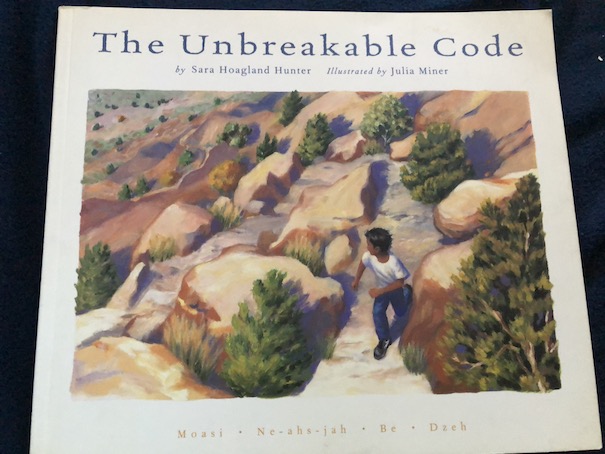
The Unbreakable Code by Sara Hoagland Hunter, illustrated by Julia Miner, 1996.

A young boy, John, is upset because his mother has recently remarried, to a man from Minnesota.  Now, John is faced with the prospect of moving to Minnesota, and he doesn’t want to go.  He would much rather stay with his grandfather on his farm on the Navajo Reservation.  His grandfather points out that he’ll return in the summer, but that hardly seems good enough.  Then, his grandfather tells him that he’ll be okay because “You have an unbreakable code.”

UnbreakableCodeJohnGrandfather

John asks what his grandfather means by that, and he says that the Navajo language is the unbreakable code.  John worries that he’ll forget how to speak Navajo, but his grandfather says that he never did even though he had to attend a government boarding school at a young age and that the language saved his life during World War II.  John’s grandfather was a code talker.

John’s grandfather tells John the story of how he became a Code Talker, starting with when he was at boarding school.  The purpose of the government “Indian Schools” was to assimilate Native Americans into white American culture.  They were known for forcing their students to abandon traditional clothing, cut their hair, take English names, and speak only English.  John’s grandfather describes having to chew on soap whenever he was caught speaking Navajo.  He was only allowed to return home during the summer to help his family with their sheep and crops.

UnbreakableCodeBoardingSchool

Then, when he was in his teens, during World War II, he heard an announcement on the radio that the Marines were looking for young Navajo men who could speak both English and Navajo.  Seeing it has a chance to escape, he ran away from school and enlisted.  After life at a harsh boarding school, the military marches and drills were no problem, and all of the Navajos already had wilderness survival skills.

After they had completed basic training, they were told that they were needed for a secret mission in the Pacific.  The Japanese had intercepted American radio transmissions and broken the codes they were using.   The Marines wanted Navajo speakers because the language was almost unknown outside of the United States, not many non-Navajos had ever learned it, and at that point in its history, the language had not been recorded in writing, so there was no way that the Japanese could research it and learn it.  The Marines and code talkers developed a system of code words in Navajo and military terms to use, so it wasn’t as simple as just speaking the language plainly.  The system was highly effective.

UnbreakableCodeTalker

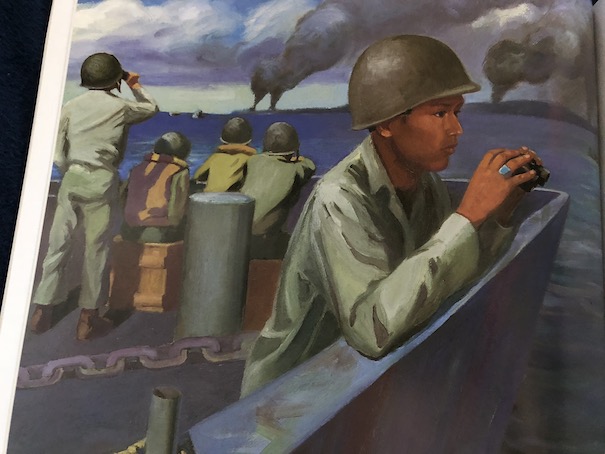
John’s grandfather goes on to tell John about how bloody the war was and how his life was constantly at risk.  Once, another American soldier even mistook him for a Japanese spy because he didn’t know what language he was speaking.  Fortunately, one of his friends intervened and saved his life.
UnbreakableCodeWar

The code was never broken during the war, and John’s grandfather eventually made it home safely.  However, the code talkers were not hailed as heroes because, for many years, the government wanted to keep the code a secret.  No one was allowed to talk about it.  John’s grandfather was glad to return to a peaceful life on his farm.

UnbreakableCodeReturnHome

His grandfather’s story gives John the courage that he needs to face moving to a new place.  After all, his grandfather had been to far more frightening places and faced them with courage.  Knowing his family’s history gives John a new sense of his own identity and the knowledge that his identity and language will remain with him wherever he goes.

This book is available to borrow and read for free online through Internet Archive.

My Reaction and Additional Information

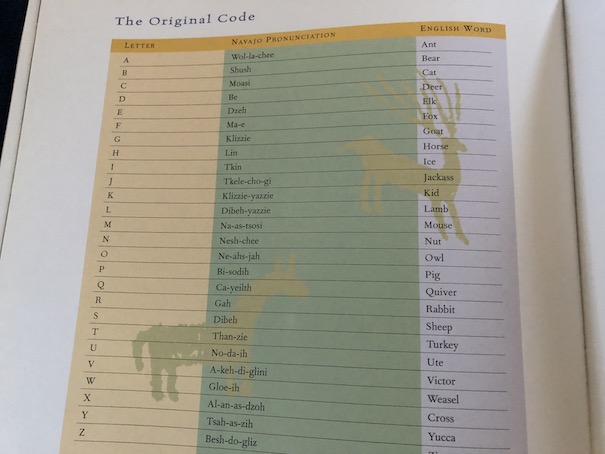
Even though this is a picture book, it isn’t really a book for very young children.  There are descriptions of the blood and violence of the war that would be more appropriate for older children.  There is a brief note from the author at the beginning of the book that explains a little about World War II and code talkers, and at the end of the book, there are charts that demonstrate how the code worked.  This book is an a good way to introduce students to the topic of code talkers if they have never heard of them before.
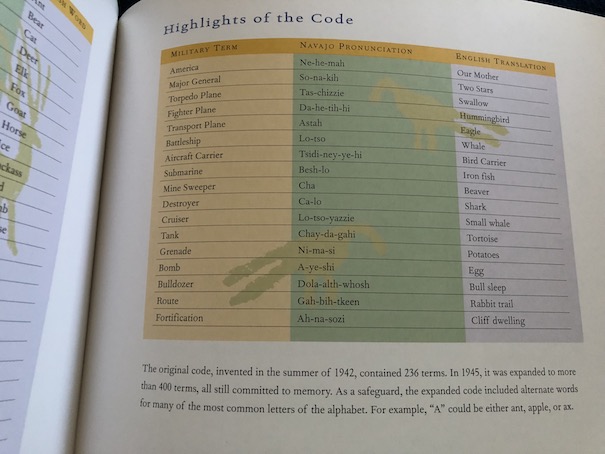
UnbreakableCodeTable1
UnbreakableCodeTable2

In modern times, there is a written form for the Navajo language, and since I grew up in Arizona, the colleges I attended had classes in Navajo for those who wanted to study the language.  I used to see the books for the classes in the school book stores, although I never studied Navajo myself.  I met one of the code talkers once when he came to speak at our college.  I believe that there are a few who are still alive at the time of this writing.
The Magic School Bus Lost in the Solar System

MSBSolarSystem

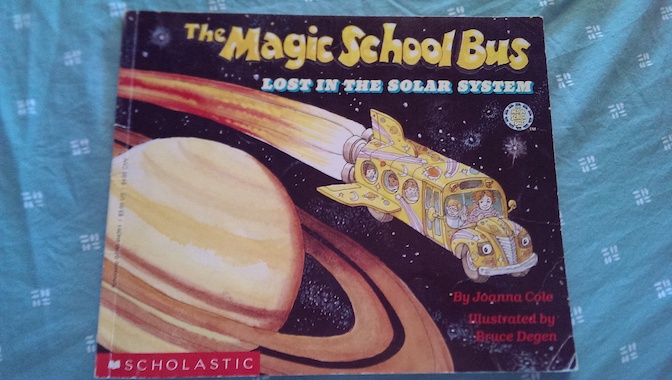
The Magic School Bus Lost in the Solar System by Joanna Cole, 1990.

Ms. Frizzle’s class is planning a trip to the planetarium as part of their lesson about the solar system, but of course, their magic school bus has other plans.  When they get to the planetarium and find out that it’s closed for repairs, the bus sprouts rockets and takes them on a real trip through the solar system.

MSBSolarSystemBlastOff

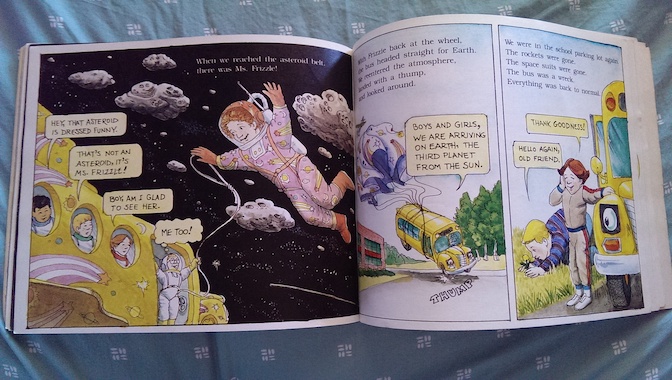
This time, the class is accompanied by Arnold’s visiting cousin, Janet.  Janet is a show-off who brags constantly about everything, making up stories when she has nothing real to brag about.  She gets on the other kids’ nerves, but when they’re separated from Ms. Frizzle because she got out of the bus to fix a taillight broken in the asteroid field, Janet takes charge, using Ms. Frizzle’s lesson plan to continue the field trip, eventually figuring out how to turn the bus around to rescue her and get back to Earth.

MSBSolarSystemMoon

All through the book, there are facts about the sun, the moon, and the planets in the solar system from the students’ reports.  Each time they stop at a planet, a scale shows the difference between Arnold’s weight on Earth and his weight on each planet.  The book considers Pluto to be a planet because it was written before its planet status was reconsidered.

The book is currently available online through Internet Archive.

MSBSolarSystemRescue

The Magic School Bus Inside the Human Body

MSBHumanBody

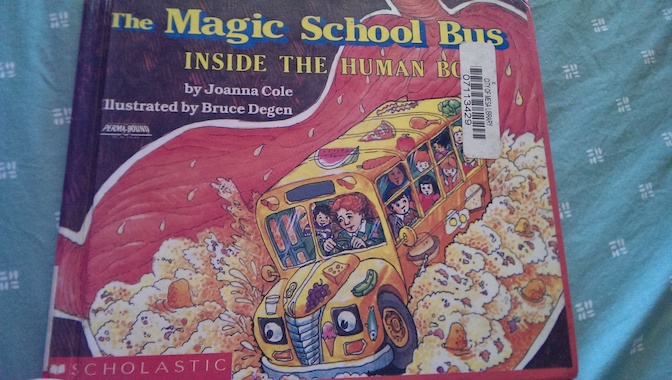
The Magic School Bus Inside the Human Body by Joanna Cole, 1989.

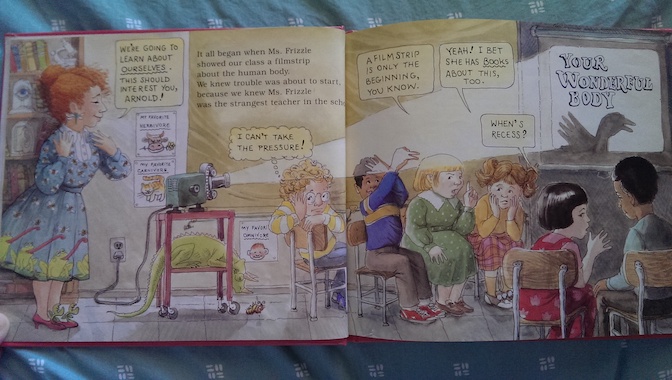
Ms. Frizzle’s class is now studying the human body, and they are going to take a trip to the science museum to see an exhibit about how bodies digest food for energy.  Of course, this is not going to be a normal field trip, but it is weirder than anything the students could have expected.

MSBHumanBodyFilm

After the class stops at a park for lunch, Arnold is accidentally left behind, and before they can go back for him, the bus shrinks small and is accidentally swallowed by Arnold.

MSBHumanBodySwallow

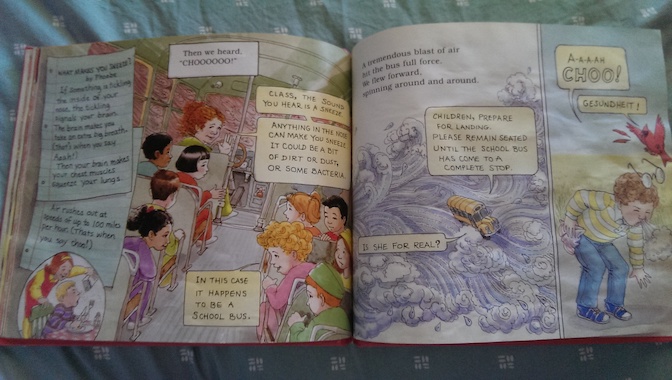
While his classmates take a trip through Arnold’s body, Arnold panics at being left behind and makes his way back to school by himself, accompanied by a sympathetic bird, not knowing where the rest of the class went.

MSBHumanBodySneeze

The book ends with a section of true and false questions that point out the impossibilities of the class’s field trip inside a student’s body, but also points out that the information about the human body itself is true.

The book is currently available online through Internet Archive.

The Magic School Bus Inside the Earth

The Magic School Bus

MSBEarth

The Magic School Bus Inside the Earth by Joanna Cole, 1987.

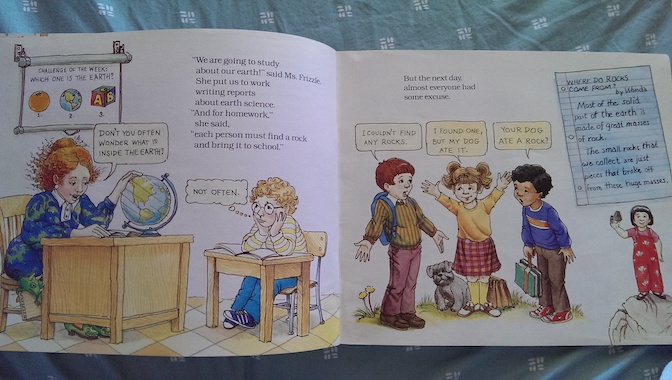
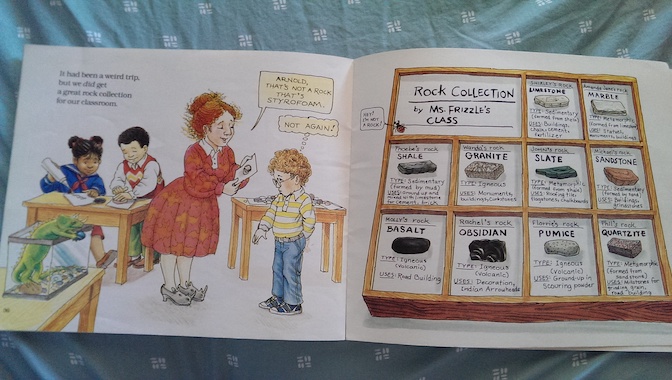
Ms. Frizzle’s class has a new student, Phoebe, who is about to discover that Ms. Frizzle is no ordinary teacher and that her class trips are nothing like any other field trip.  Ms. Frizzle’s class is studying the earth and rocks, and she assigns the students homework to find a rock and bring it to class.

MSBEarthHomework

However, even though it sounds like an easy assignment, only one person actually brought a real rock to class.  The others either didn’t bring anything or brought in pieces of old Styrofoam, bits of broken glass, or chips of concrete from the sidewalk.  With only one real rock for the class’s rock collection, Ms. Frizzle decides that the class should to on a trip to collect more.

MSBEarthFieldTrip

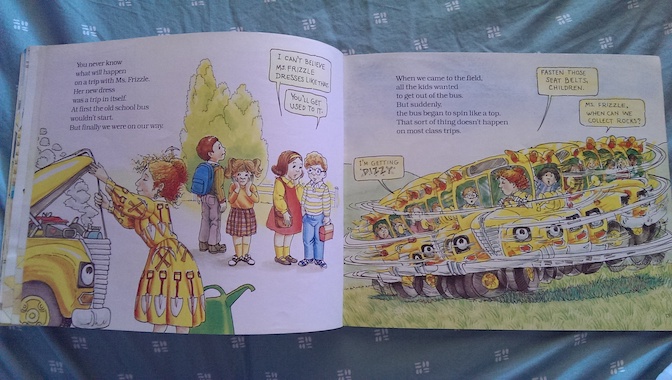
She takes the class on a field trip to a real field, but they’re not just going to collect rocks that they find lying on the ground.  The bus changes itself into a steam shovel, and Ms. Frizzle passes out shovels and jackhammers to the students.  They start digging down into the earth, uncovering new layers of rock as Ms. Frizzle explains what types of rocks are in the layers and how they formed.

MSBEarthDigging

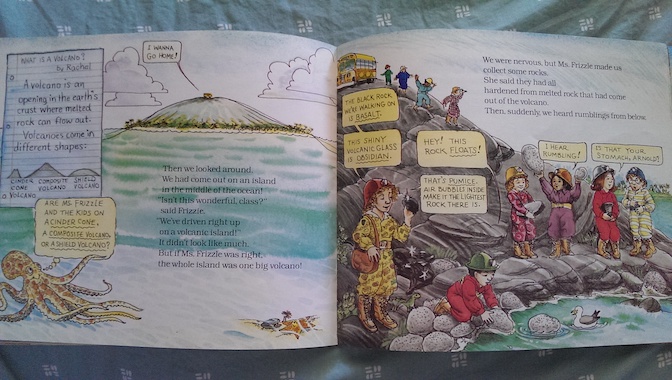
Before the field trip is over, the school bus, along with all the students, falls through the ground and into a massive cave.  They continue traveling all the way down through the center of the earth and out the other side, ending up on a volcano, where Ms. Frizzle calmly explains about volcanic rocks.

MSBEarthVolcano.jpg

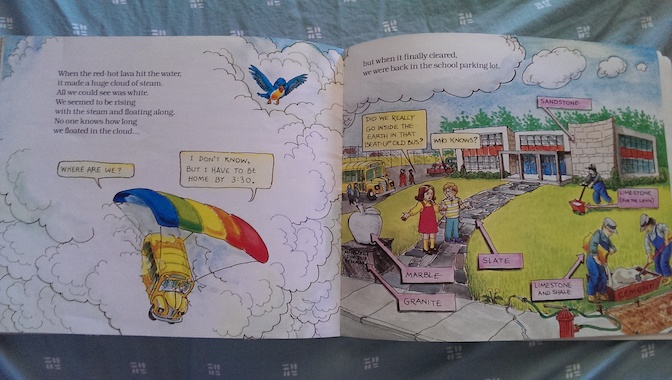
I like the picture at the end of the book, after the kids return to school, which points out that there are things all around them that are made out of the different kinds of rocks and minerals that they learned about on their trip.  Each type of rock is also shown in the class’s rock collection along with notes about the type of each rock and how it can be used.

MSBEarthReturn

The book ends with a mock phone conversation between a reader and the author and artist about the impossible things that happen in the book but noting the factual information contained in the story.  The book was featured on Reading Rainbow.  It is currently available online through Internet Archive.

MSBEarthRockCollection