The Curse of the Pharaohs

Sherlock Holmes’ Tales of Terror
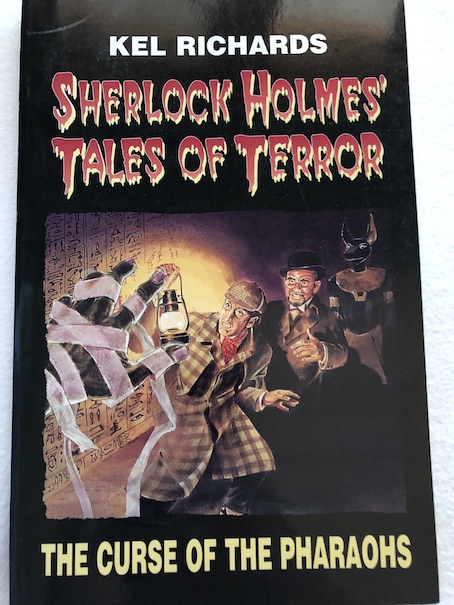
The Curse of the Pharaohs by Kel Richards, 1997.

This is the first book in a short series of spooky mysteries for children featuring Sherlock Holmes.

One foggy night, a woman named Laura Coffin comes to Baker Street to see Sherlock Holmes, and his friend, Dr. Watson. She’s very worried about her uncle, Professor Sloane Coffin, who is an Egyptologist, living in Scotland. He’s been very ill and is likely to die, but Laura is increasingly alarmed by his mental state. Her uncle has come to believe in the Ancient Egyptian religion and believes that, when he dies, he will return from the dead. He thinks this power to return from the dead and live forever will come from a diamond he found in a tomb in Egypt called the Eye of Osiris. Laura and her uncle’s doctor, Dr. Cabot, have also come to suspect that her uncle’s medical state may be due to poison, although they’re not sure who could be poisoning him. Laura has come to Sherlock Holmes because the local authorities don’t believe her.

The most likely suspects for poisoning the professor would be his lawyer, Mr. Grizzard, who has been staying in his house and seems to have a sinister and unhealthy influence over the professor; the professor’s manservant, who Laura suspects of plotting to steal her uncle’s diamond when he dies; and a mysterious Egyptian man who has been staying nearby and seems to be lurking around the professor’s property for unknown reasons. Sherlock Holmes promises Laura that he and Dr. Watson will come to Scotland and investigate her uncle’s condition. Privately, he tells Dr. Watson that he thinks that there is something else that’s bothering Laura, something that she’s not telling them.

When they arrive in Scotland, Laura is glad to see them, although Mr. Grizzard isn’t. Laura introduces them to Dr. Cabot and her uncle. Dr. Watson doesn’t recognize the disease that the professor is suffering from, and Dr. Cabot says that he can’t figure out why the professor is so sick. Based on the tests he’s done, the professor really shouldn’t be this bad, but he does look like he’s dying. The professor accuses his niece and everyone else of only being concerned about his diamond. The professor confirms that he believes everything that his niece said earlier. He says that he believes in Ancient Egyptian gods (he calls them “gods of darkness”, which doesn’t seem scholarly), and he believes that, through his diamond, they will bring him back to life, and he will live forever.

Soon after Holmes and Watson meet the professor, he suddenly dies. Mr. Grizzard explains the professor’s will and final wishes. Laura is the professor’s primary heir, but she cannot take possession of the estate until she is 21 years old, so Mr. Grizzard will be in charge of the estate as executor until then. The professor had an Egyptian-style tomb built in his backyard, and his wish was to be buried there, along with his diamond. Mr. Grizzard makes certain that the professor’s requests are carried out, including the requirement that the tomb must be able to unlock from the inside.

Holmes spots a man spying on the funeral. He and Watson take turns watching this man as he seems to be observing the tomb and waiting for something. As Watson watches this man during a storm, he sees the door of the tomb open and the professor come out! Unfortunately, Watson is knocked unconscious by a falling tree branch. When he wakes up, there is no sign of the professor, and the man who was spying on the tomb has been murdered!

Did Watson really see what he thought he saw? Did the professor really rise from his tomb and kill the man watching him? Why was this man watching the tomb in the first place? What will the professor do now, and what does he want?

My Reaction

When I first got this book, I wasn’t quite sure what to expect. Pastiches can take familiar characters in some unusual directions, and I had read a review criticizing this series for adding supernatural elements and Christian themes that weren’t found in the original Sherlock Holmes stories. I thought that the story would probably be a pseudo-ghost story, somewhat like Scooby-Doo mysteries, where it seems like something supernatural is happening, but there’s actually a rational, more physical explanation. However, I wasn’t completely sure for most of the book whether that would be the case or not. There’s room left for readers to wonder whether Professor Coffin has really risen from the dead or not.

For those who prefer the ghosts to have logical explanations … you won’t be disappointed. There is a rational explanation for everything that happens in the story, and there are multiple people who could be good candidates for the villain behind everything that happens. Some of my suspicions turned out to be correct, but there are actually multiple villains involved, which complicates the situation and offers surprises for readers.

The other reviewer was right that there are Christian themes in the story. The Christian themes don’t really come into the story until the end, when Holmes and Watson are discussing the case with Laura Coffin. Laura asks why God allows people to behave wickedly. Holmes and Watson say that it’s not so much a matter of God allowing it as people choosing to commit evil deeds, and reassuring her that, sooner or later, everyone faces the judgement of God. Laura feels disillusioned about some of the people she trusted, but they also reassure her that, as a wealthy young heiress, she has her life still ahead of her to enjoy, and she will find better people. The religious talk and the quote from the Bible do seem a little out of character because I can’t recall the characters focusing on religious morals in the original stories so much as the deductive process, but I didn’t think it was bad. It was just a brief conversation, not overdone. If the characters had talked that way all the way through the book, it might have been a bit much, but it seemed plausible enough for a brief conversation on the subject.

The themes of the story reminded me of the Sherlock Holmes computer game The Mystery of the Mummy, but the story in that computer game isn’t the same one in this book.

The Pharaohs of Ancient Egypt

The Pharaohs of Ancient Egypt by Elizabeth Payne, 1964, 1992.

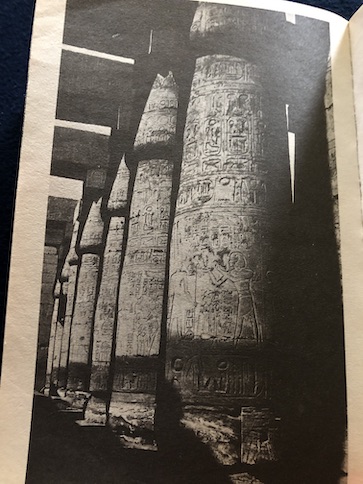
This is a book for kids about the lives of Egyptian pharaohs, including Hatshepsut, Akhnaton, and Rameses the Second. It also includes details of Ancient Egyptian history, daily life, and religion. I would put the difficulty level of the book around the middle school level. It’s a chapter book with very few pictures and more dense writing than others I’ve read in the same series. It’s one of the Landmark Books (called Step Up Biographies in earlier printings).

Egypt is among the world’s oldest civilizations, having a long history, extending over thousands of years. The Ancient Egyptians created a powerful legacy that has influenced other civilizations for millennia.

In the early days of Egyptian civilization, groups of small villages that early settlers had established along the Nile joined together to form kingdoms. At first, there were three of them:

  • The Bee Kingdom in Lower Egypt — at the Nile delta, on the Mediterranean
  • The Reed Kingdom in Middle Egypt — near the site of modern Cairo
  • The Hawk Kingdom in Upper Egypt — near the rapids that lay between Egypt and the Nubians to the South

If you’re wondering why “Lower Egypt” was in the northern part of Egypt and “Upper Egypt” was in the south, it’s because the Ancient Egyptians weren’t concerned about north and south with regard to their kingdoms. They lived along the Nile, their major source of water and transportation, and when they thought about the relations between cities and kingdoms, they were most concerned about whether they were upriver or downriver. So, “Upper Egypt” was the kingdom farthest upriver, and “Lower Egypt” was the one that was farthest downriver. The Nile just happens to flow from south to north.

Then, around 3200 B.C., the Hawk King known as the Scorpion conquered the kingdom in Middle Egypt. His successor Menes (also called Narmer), who ruled both Middle and Upper Egypt, conquered Lower Egypt as well, turning Egypt into a single nation with a single king. However, there were still rivalries between Upper and Lower Egypt, and the people in different regions spoke different dialects.

The Ancient Egyptians believed that their kings, called Pharaohs, were half-human and half-god. Part of the reason for this belief may have been because the Egyptians believed that a partially-divine ruler could help ensure that life in the Nile Valley could continue smoothly by appealing to his godly relations and partly because, if the king wasn’t completely human, he could be considered above the rivalries between the different regions and remain a unifying figure for the Egyptian people, no matter which region he had come from originally.

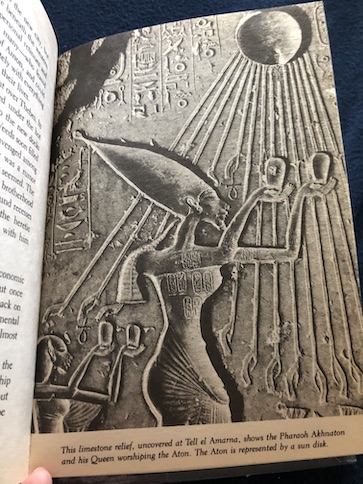
Although most Ancient Egyptians were polytheistic, like other ancient civilizations, there was one pharaoh who believed in only a single, all-powerful god. This pharaoh was Akhnaton, the father of Tutankhamen. (The book refers to Tutankhamen as a younger half brother of Akhnaton, but later sources say that he was Akhnaton’s son, although there is still some dispute about that. Either way, the two were related, and Tutankhamen was Akhnaton’s successor.) Akhnaton worshipped the sun, calling the sun god Aton. Part of the reason for this conversion to the worship of a single sun god instead of the many gods of the Ancient Egyptian pantheon may have been due to a power struggle between the pharaoh and the High Priest of Amon. However, Akhnaton seemed to genuinely believe in the Aton and was devoted to it, establishing a new capital city and outlawing worship of other gods. Unfortunately, his health was frail, and worship of the Aton didn’t extend beyond his death around the age of 42, with Egyptians returning to worship their old gods. Tutankhamen, who had been born Tutankhaton, changed his name and moved the capital away from Akhnaton’s city. Tutankhamen’s reign was short. He died in his late teens. (The cause of his death has never been precisely determined, although it seems likely that it was a combination of ill health, possibly a congenital condition due to inbreeding in the royal family, malaria, and a physical injury.) Tutankhamen’s main source of fame is his tomb, found largely intact in November, 1922.

Dynasties of Egyptian Pharaohs ruled Egypt for thousands of years, although in the later centuries of Ancient Egypt, foreign rulers moved in and took control for long periods. Then, in 332 B.C., Alexander the Great conquered Egypt, bringing it under Greek and Macedonian control and ending the reign of Egyptian Pharoahs forever.

Cleopatra: Queen of the Kings

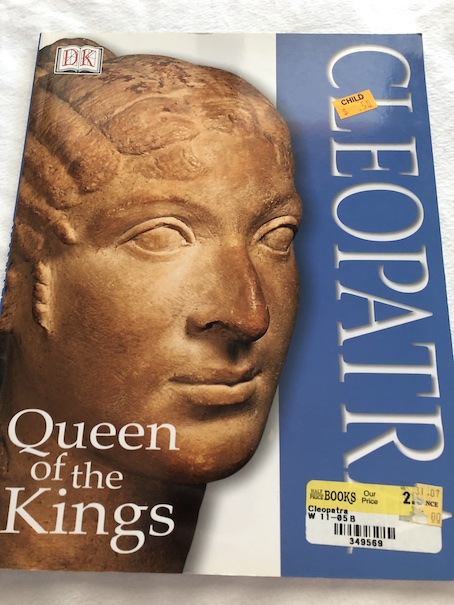
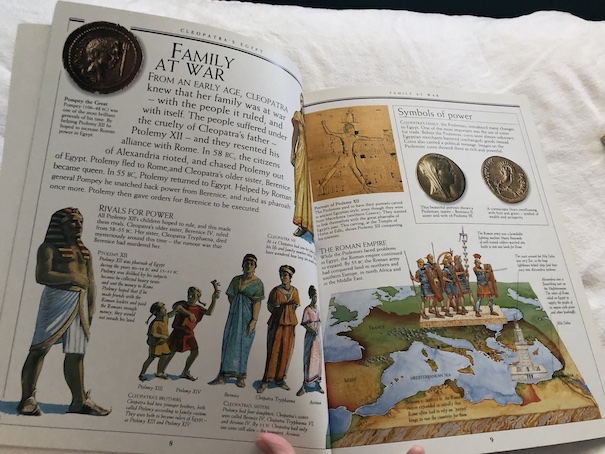
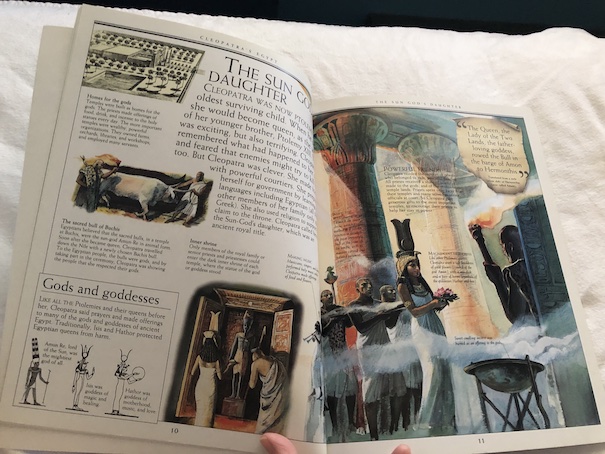
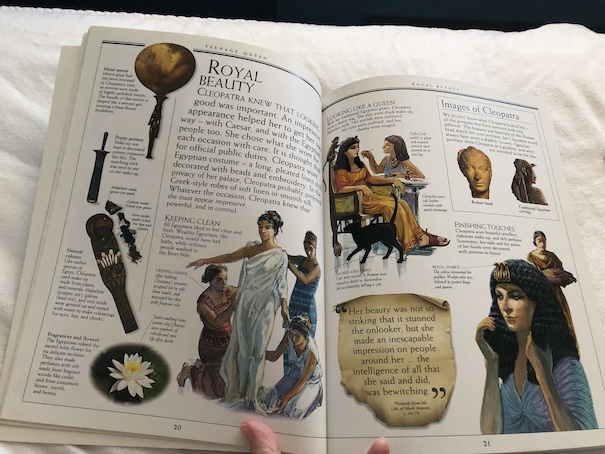
Cleopatra: Queen of the Kings by Fiona MacDonald, illustrated by Chris Molan, 1998, 2003.

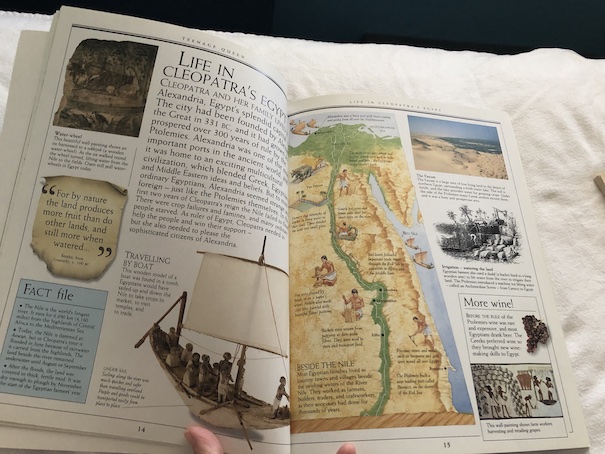
I always like books from DK Publishing because they have great illustrations, and they do a good job of helping to explain nonfiction topics, including different periods of history. However, one thing that’s important to realize is that you really have to read all of the small text that accompanies even the small pictures in order to get the full story. If you don’t, you may miss important details. Although this is a picture book, the detailed nature of the information and some of the dark subject matter make it inappropriate for young children.

This particular book is about the life of Cleopatra, the famous Egyptian queen. The queen we know as simply Cleopatra was actually Cleopatra VII. She was part of a dynasty of Egyptian rulers who were originally from Macedonia, a region of Greece. This dynasty was known as the Ptolemaic Dynasty because all of the kings in the dynasty were named Ptolemy, including Cleopatra’s father, Ptolemy XII. There were certain names that were repeated in every generation of the family and even within generations, like Ptolemy (Cleopatra’s two brothers both had this name), Cleopatra (Cleopatra also had a sister who was also named Cleopatra), and Arsinoe (Cleopatra’s younger sister). The book doesn’t fully explain why they came from Macedonia, but one of Cleopatra’s ancestors, Ptolemy I, was a Macedonian nobleman and a friend of Alexander the Great. Ptolemy I went with Alexander the Great on his military campaigns. Through his service to Alexander the Great, Ptolemy I was made the Greek governor of Egypt, ruling from the city Alexandria, which had been established by Alexander the Great. Alexandria was an important port city as well as the seat of the royal family. It was a gathering place of traders, scholars, and people from different cultures in Egypt, although average Egyptian citizens viewed it more as city of foreigners, just as the royal family itself was also foreign. That’s an abbreviated explanation of the family’s history, but it helps to understand that, while the family ruled Egypt for generations, they remained culturally Greek. The book mentions that most of the members of Cleopatra’s family only spoke Greek and that Cleopatra departed from the norm by learning to speak Egyptian.

Cleopatra was born into tumultuous times in the history of Egypt and her family. Her father was known as a cruel ruler who taxes his people heavily and sent large amounts of money to Rome, attempting to befriend Roman leaders and bribe them not to invade Egypt. In 58 BC, Alexandrian citizens had enough of Ptolemy XII and the way he catered to Rome, and they revolted, forcing Ptolemy XII to flee the city for Rome. Cleopatra was only fourteen years old at the time. Members of the family were left behind in Alexandria when Ptolemy XII fled, and Cleopatra’s oldest sister, Berenice claimed the throne in her father’s absence. The Ptolemies were always focused on maintaining their power, even in the face of competition or opposition from family members, and they were not afraid to fight or even kill each other to maintain control. Berenice may have murdered another of her sisters during her time as queen because she died under mysterious circumstances. However, when Ptolemy XII returned to Egypt a few years later, he had Berenice executed as a rival for the throne. By then, Cleopatra was the oldest surviving child of the family, with only her youngest sister and her brothers still alive.

A few years later, Ptolemy XII died, and Cleopatra acted quickly and prudently to secure both her life and her power. Her younger brother, Ptolemy XIII, had a claim to the throne, but he was still only twelve years old, and Cleopatra was eighteen. Asserting her authority over her child brother, Cleopatra took the throne as the oldest remaining offspring of Ptolemy XII and married her brother in order to turn her brother from a rival for power into a further source of her own authority. She could then rule on her brother’s behalf as his wife as well as his older sister. (Other Egyptian rulers had married close relatives for reasons like that. Tutankhamen was similarly the result of an incestuous royal relationship.) As queen, Cleopatra called herself the Sun God’s Daughter, an old royal title that tied her image to rulers of the past and the gods of Ancient Egypt.

From the beginning, being queen was a difficult task for Cleopatra. There were famines in Egypt during the beginning of her reign, and Cleopatra had to manage a response that would satisfy the citizens that she was doing her job as ruler. Family rivalries were also an ever-present danger. Cleopatra knew that she had enemies in her court, including people who favored her brother over her. As her brother got older, he became dissatisfied with the way his sister was ruling without sharing power and authority with him. For a time, Ptolemy XIII forced Cleopatra to flee Egypt and go to Syria. Cleopatra took her sister Arsinoe with her, both to protect her from their brother and to prevent her from trying to seize power herself. (In the Ptolemy dynasty, either could be a possibility. When family members weren’t in danger from each other, they could be a danger to each other.)

In the meantime, Julius Caesar came to Egypt to collect a debt that he claimed that Cleopatra’s father had owed him. He arrived during the power struggle between Cleopatra and Ptolemy XIII, and he decided that it would be for the best to try to mediate peace treaty with the two of them. He wanted to meet with both Cleopatra and Ptolemy XIII together, but Cleopatra knew that there was a risk that she might be killed if she showed up for a meeting. Yet, she did want to meet with Caesar because she recognized that he could be an important friend and source of protection for her. She ended up visiting Caesar in secret. According to legend, she had herself delivered to Caesar’s room in a rolled-up carpet. Caesar was charmed by Cleopatra and became her ally. When the news of their alliance spread, it tipped the balance of power in the royal family. Caesar learned that Ptolemy XIII’s adviser was plotting against him and had him executed. Ptolemy XIII fled with Arsinoe to join the Egyptian army and was later killed and found dead in Alexandria’s harbor. Getting rid of her brother/husband and his advisers secured Cleopatra’s position. She had one remaining brother, Ptolemy XIV, who was only eleven years old at the time, so she married him, too, further solidifying her power. As her ally (and possible lover), Caesar provided her with guards for her safety.

Cleopatra had a son named Caesarion, who was rumored to be Caesar’s son as well. However, Romans feared that Julius Caesar would proclaim Caesarion as his heir. They didn’t want him as the future ruler of Rome, citizens were appalled at the way Arsinoe was paraded through the streets as a war prize, and people generally began to fear that Caesar was becoming too powerful. In 44 BC, Caesar was assassinated by a group of senators. Cleopatra was in Rome when Caesar was killed, and she fled back to Egypt with her son. Around this time, Ptolemy XIV disappeared, and he may have been murdered by Cleopatra. With a son to inherit her throne, Cleopatra no longer needed Ptolemy XIV. However, her Roman protector was now gone, and Cleopatra still had enemies at court. Cleopatra’s remaining sibling, Arsinoe, sided with Caesar’s enemies and plotted against her sister and Caesarion.

Nobody knows exactly what Cleopatra looked like (statues and carvings of her don’t always look alike, and they may have been idealized images of her), but she took care of her appearance as part of her image as queen. Apparently, Cleopatra was more striking than beautiful, and what struck people about her the most was her intelligence and personality. Her charm was one of her most important tools in winning allies, and she used it again to win over a new ally to replace Caesar. She found a new ally in Marcus Antonius (also known as Mark Antony), one of the candidates to replace Caesar in Rome.

Mark Antony needed the control of Egypt and its resources and the support of Cleopatra for his own political purposes. To win his support for her purposes, Cleopatra began a romantic relationship with Mark Antony that eventually became a major part of the legends around Cleopatra. Although Mark Antony already had a wife in Rome, he became devoted to Cleopatra and fathered a set of twins with her and, later, a third child.

When Caesar’s nephew, Octavian, learned that Antony had divorced his wife and was conspiring against him, he declared war on Egypt to take down both Antony and Cleopatra. Cleopatra and Antony’s forces were defeated at the Battle of Actium although the two of the escaped. Feeling that the end was probably near, Cleopatra had stoneworkers hurry to complete her tomb. She began experimenting with poisons, and she and Antony swore to each other that they would die together. When Antony’s soldiers turned against him and refused to fight, Antony was disgraced and forced to flee. He ended up taking his own life by stabbing himself. Cleopatra had retreated into her own mausoleum, planning to die, but Octavian allowed her to remain there as a prisoner while she arranged Antony’s funeral. The exact cause of Cleopatra’s death has never been confirmed, but according to legend, she arranged her own death by the bite of an asp and sent a note to Octavian, asking that she be buried with Antony.

It’s a tragic end to a story that was full of treachery and family rivalries from the very beginning. Octavian refused to allow any of Cleopatra’s children to assume the throne of Egypt, ending the reign of pharaohs forever. Rome took control of Egypt, and Cleopatra’s children were sent to be raised by Antony’s first wife in Rome, Octavia (who was also Octavian’s younger sister). Caesarion tried to flee to Syria, but he was caught and executed by Octavian’s orders. No one knows what happened to Cleopatra’s other two sons because they disappear from historical records after this point, so they may have died young (or were murdered, given how things went in the powerful circles in which they lived). However, Cleopatra’s daughter survived, grew up, and eventually married the King of Mauretania, a region in North Africa. The book mentions that she had a son that she also named Ptolemy, but it doesn’t mention that this Ptolemy was the last king of Mauretania and was assassinated by Caligula. Caligula and Ptolemy were distant relatives of each other because Ptolemy of Mauretania was a grandson of Antony, and Caligula was descended from both Antony and Octavian. In many ways, it seems like this family’s greatest misfortunes were themselves and each other. Fortunately, the death of death of Ptolemy of Mauretania didn’t end the family line. It’s unknown whether or not Cleopatra has living descendants today, but Ptolemy of Mauretania did have a sister (the details of her life are unknown) and a daughter named Drusilla, who apparently grew up, married, and continued the family line. Further down the family tree, relationships and offspring become harder to trace.

Something I particularly liked about this book was the separation between the legends of Cleopatra and the her known history. As with other ancient historical figures, the history and legends go hand-in-hand, and it can become difficult to separate the two. The book is pretty open about which parts of her life are known, what can’t be firmly established, and which parts of her story come to us from legend and may or may not be reality. The final section in the book discusses the known facts and fiction about Cleopatra and possible confusions between her and other Cleopatras in her family (which may be another reason why not all of the images of Cleopatra look alike). It also explains the information about Cleopatra in Plutarch‘s biography of Mark Antony and how his stories inspired Shakespeare’s play and modern movies about Cleopatra.

The book is available to borrow and read for free online through Internet Archive.

The Case of the Muttering Mummy

MutteringMummy

The Case of the Muttering Mummy by E.W. Hildick, 1986.

Joey Rockaway needs to buy a special present for his mother’s birthday. Having broken his mother’s china cat ornament recently, he has decided that he will buy one of the replicas of a golden cat statue from Egypt at the Egyptian exhibit at the local museum. The other members of the McGurk Organization come to the museum with him, and McGurk uses this as an opportunity to give them a kind of memory test about objects in the exhibit.

Actually, everything in the exhibit is a replica, not just the items sold in the museum gift shop. Justin Matravers, a wealthy man who has recently died, collected Egyptian artifacts, but part of his will specified that the collection should never be put on public display. However, his widow, who wanted to show off the collection, had replicas made of everything in the collection so that she could have those put on display.

MutteringMummyCase

McGurk sneers about how everything in the exhibit is fake, although he is actually surprisingly superstitious. The museum always did have a real mummy case on display. They always said that the mummy case was empty, but some of the more superstitious kids, like McGurk, believe that there is a mummy inside the case and that there is a curse on it. McGurk has nicknamed the mummy Melvin. The other kids aren’t afraid of Melvin or Egyptian curses, and while they are looking around the Egyptian exhibit, Mari plays a joke by using her ventriloquist skills to make the mummy case “talk.” This trick sets off a bizarre mystery for the McGurk Organization.

A scholar and author, Harrison Keech, is sketching the replicas at the exhibit and witnesses Mari’s trick and Joey picking out the replica cat for his mother. After he asks Joey if he can take a look at the cat, Keech suddenly becomes very upset, saying that the cat statue is cursed! He says that Mari’s joke has angered the spirit of the mummy and awakened the spirit of Bastet. The mummy was a follower of Bastet, the Egyptian cat goddess, and it will now be drawn to the statue if they remove it from the museum. Mari tells Joey that she can tell from Keech’s voice that he’s making up the whole story and that he shouldn’t let that stop him from buying the cat.

MutteringMummyNight

However, strange things start happening after Joey buys the cat. It seems like someone is following him home, a dark, shadowy figure. Joey thinks it might even be the mummy, come back to life! The others are skeptical, and McGurk arranges a kind of test where Joey brings the statue with him to a meeting of the organization. Sure enough, a strange figure lurks outside their meeting, and they hear strange whispers in a foreign language!

The spookiness doesn’t last for long. It turns out that Mari, as well as being a ventriloquist, has some skill with different languages and recognizes what the “mummy” says as being Greek, not Egyptian, and the phrases as being typical things that someone might say in a restaurant. When the kids find a scrap of bandage outside, they are quick to notice that it’s a modern, elasticized bandage, like the kind you can get at any pharmacy.

So, the question becomes who is playing at being a mummy and why? Is it Keech, wanting to make the kids think that the mummy story he told them is real, and if so, what would he have to gain from it? The only other two people who know about the story are Joanne, who works at the museum, and Donny, her fiancé, who is jealous of the attention she’s been paying to Keech when he comes to the exhibit.

MutteringMummyLies

I have some complaints about this book that hadn’t occurred to me when I read it as a kid. At one point, Donny, who is described as being a social worker, comes to visit the kids because he wants to hire the organization to check up on Keech and his relationship with Joanne. Donny is very jealous, and when he explains how Joanne seems to be falling for all of Keech’s crazy mummy stories, he suddenly turns to Wanda and Mari and says, “You women, you’ll believe anything when a smarmy two-bit jackass like that starts shooting his mouth off!” That’s just really inappropriate for an adult to say to kids, and the whole situation is weird on several levels. First of all, Donny is an adult, and if he’s having issues with his love life, especially with the woman he thinks he wants to spend the rest of his life with, the last thing he should do is hire kids (even really smart ones) to handle the issues for him. Second, Wanda and Mari are young girls, not “women,” and what little girls believe is no business of Donny’s. Trying to imply that Wanda and Mari might someday fall for a “jackass” is not only insulting but implies that Donny is thinking about Wanda and Mari in terms that no grown man should be thinking about girls their ages. I find it disturbing that Donny is apparently a social worker, a person in a position of trust who is supposed to help people in difficult situations to manage their lives, and he’s acting like this. Also, toward the end of the book when the bad guy (I won’t say who it is here, although I thought that the answer was pretty obvious even early in the story) is making his escape, he shoves Joanne aside and calls her a “slut.” That’s pretty strong language for a kid’s book of this level. None of this occurred to me when I was a kid, so maybe other kids reading this wouldn’t notice, but I thought that I’d mention it because these things bother me now.

At one point, Brains gives a demonstration of using water displacement to determine the volume of irregularly-shaped objects, explaining how Archimedes discovered the principal (although I’m not sure that Archimedes’ Principal was quite as he explains it), as the kids investigate what makes Joey’s cat statue so special. You might be able to guess what it is. It seemed pretty obvious to me. The one thing that seemed the most puzzling was how it was done. Mari also offers an interesting explanation of the different kinds of lies that people tell and their motives for doing so.

The book is currently available online through Internet Archive.