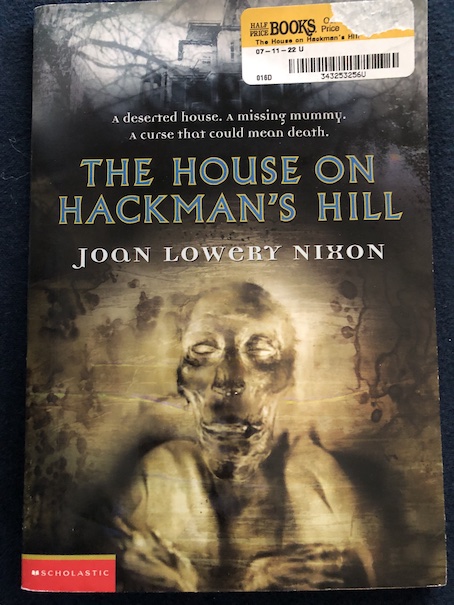
The House on Hackman’s Hill

House on Hackman's Hill cover

The House on Hackman’s Hill by Joan Lowery Nixon, 1985.

This creepy book is interesting partly because it is told in two parts. About half the story is a flashback that explains the history of the house and the mummy inside it, and the rest continues in the present day.

The very beginning of the story is in the present, starting with a pair of cousins. While they are visiting their grandparents, Jeff tells his cousin Debbie that he’s found out about an old, abandoned house nearby that supposedly contains a hidden mummy and that there’s a reward for anybody who finds it. Debbie doesn’t believe him at first, but he says that he heard all about it from their grandparents’ neighbor, Mr. Karsten. Jeff persuades Debbie to come with him to check out the old house. Debbie comes and takes pictures of it because she’s interested in entering a photo contest.

The place looks really creepy, and they have the odd feeling like somebody is watching them, even though the house is supposed to be empty. Debbie says that they should ask their grandparents what they know about the old house. At first, the grandparents don’t want to talk about it. They just say that it’s an old house and not very interesting. Debbie asks them directly about the mummy, and they say that there are a lot of rumors about the old place, but they don’t really believe them. The kids decide to talk to old Mr. Karsten again. Mr. Karsten says that he knows all about the old house on Hackman’s Hill because he lived there for awhile when he was young, back in 1911.

Paul Karsten’s Story

Paul Karsten’s mother was a secretary, and she went to work for Dr. Hackman, the former owner of the house, after the death of her husband. Dr. Hackman was a strange man with changeable moods. He was pleasant enough to Mrs. Karsten, but he hated children and didn’t really like having her son Paul in his house. Dr. Hackman was a history professor, specializing in Egyptology. He was approaching retirement, and he wanted to devote himself to his papers and his collection of Egyptian artifacts. Mrs. Karsten’s job was to help him catalog his collection, and Dr. Hackman offered such a good salary, Mrs. Karsten couldn’t refuse. The mummy was delivered the same day that Paul and his mother moved into the house.

Paul was given a room in the tower of the house, and while he thought that it had a great view at first, he got nervous when he noticed how the tower room was situated on the edge of a cliff. One of Dr. Hackman’s servants, Jules, makes a comment about how Paul should be careful because they don’t want “another accident”, refusing to say more about whatever “accident” occurred there before. Paul was uncomfortable with the house and with Dr. Hackman. He tells his mother that the house frightens him and that he wants to leave, but his mother reassures him that the place only looks strange because of the Egyptian artifacts. Paul found the artifacts he once saw at a museum exhibit frightening and he’s particularly disturbed by a statue that Dr. Hackman has of a man with an animal head, but his mother says that’s just a statue of an Egyptian god.

Paul had notice earlier that a long box had been delivered to the house, and he gives into temptation and tries to look inside. However, he is stopped by Jules. Jules and his wife Anna warn Paul that this house isn’t very good for children and that Dr. Hackman doesn’t like people nosing around or messing with any of part his collection. At dinner, Paul admits to Dr. Hackman that he tried to look in the box and apologizes for his curiosity. Dr. Hackman accepts the apology, and before Paul goes to bed that evening, Dr. Hackman shows him the mummy case that was in the box. Paul asks him if it’s real, and Dr. Hackman says it is. Paul says that he heard that it’s illegal to take real mummies out of Egypt, but Dr. Hackman says that there are ways, if you’re willing to pay for it, and he was. Dr. Hackman says that his eventual goal is to turn his house into a museum of Egyptian artifacts so that scholars will come there to study them and read his papers, and he will be famous. He also says that he knows how to protect himself from the mummy’s curse. The talk of curses scares Paul, but Dr. Hackman says that nothing has ever happened to him personally because of any tomb curses … implying that something might have happened to someone else.

When Paul tells his mother that Dr. Hackman has a real mummy, she is worried and upset. She doesn’t like the idea of people obtaining artifacts through unethical or illegal means, although she knows that the laws are poorly enforced. Mrs. Karsten doesn’t believe in superstitious curses, but soon, strange things begin to happen. While putting away his things in his room, Paul discovers a strange, triangular piece of gold metal with some kind of design on it. When he goes up to bed, he feels like someone is there in the room, although he can’t find anyone. During the night, he wakes up, sees that one of his windows is open, and feels an odd urge to walk toward it, but fortunately, his mother comes to check on him and stops him. Paul and his mother both realize that they were woken by the sound of a cry in the night. His mother supposes that it was some kind of night bird, but Paul knows that it was probably something to do with the curse.

Paul insists that Jules and Anna tell him about the accident that took place in his room. They say that they weren’t working for Dr. Hackman when it happened, but they know that the person who fell from the tower room was a guest of Dr. Hackman’s, he was from Egypt, he died when he fell, and his body was shipped back home. At first, Paul thinks that the gold piece he found probably belonged to the Egyptian guest, but that’s not quite it.

Dr. Hackman gives Paul the job of polishing some of his statues, knowing that they bother him. It amuses Dr. Hackman as a mean joke. However, Paul’s fear of them fades while working with them because he begins to appreciate their artistry. Dr. Hackman is surprised that Paul is able to see that and not just be afraid of the statues. Paul asks him about the statue of the man with the animal head, and he explains that it’s a statue of Anubis, the god of the dead, and scares Paul again by saying that Anubis is the one responsible for the curses on tombs. He says that Anubis’s head is a jackal head and that jackals hunt at night and have a bark like a cry. This confirms to Paul that the curse was responsible for the cry he and his mother heard.

Paul eventually comes to realize that the strange gold piece attracts the mummy and the mummy’s curse, which is why Dr. Hackman knows that he’s in no danger. Dr. Hackman put it in the tower room to make sure that the mummy’s wrath would only come to whoever was in that room … and that’s why he made sure that Paul was given that room, too. To protect himself and his mother, Paul knows that he has to get rid of that gold piece.

Mr. Karsten finishes his story by explaining to Jeff and Debbie where he hid the gold piece and how Dr. Hackman disappeared, apparently a victim of the curse. Nobody ever discovered what happened to Dr. Hackman, and the mummy disappeared that same night, but a museum has offered a reward for anybody who finds the mummy. Mr. Karsten says that various people have tried to stay in the house and find the mummy, but nobody has succeeded. Everyone has been frightened off after just a single night in the house.

Jeff doesn’t believe in curses, and Debbie agrees to accompany him into the old house to find the mummy and claim the reward.

Return to the Present

The rest of the story is about Jeff and Debbie’s adventures with the house on Hackman’s Hill. Jeff says that he thinks all the spooky curse stuff was just put on by Dr. Hackman, who was a mean old man having a joke by scaring a kid with all that talk of curses. Dr. Hackman was definitely a mean old man who enjoyed scaring young Paul Karsten, but questions still remain. How much of what Paul experienced was really real, and what happened to Dr. Hackman? If the curse was just something he made up, why did he scream the night he disappeared, and where did he go?

Jeff’s idea is that all the creepy stuff happened at night, so the best time to go look for the mummy would be during the day. (That’s actually pretty sensible. Why go to a supposedly haunted house during the night if you don’t have to?) The kids make a plan and put together a collection of useful supplies and food for their mummy hunt. They decide to go while their grandmother is busy watching her favorite soap opera and their grandfather is in town, arranging some sort of surprise for them.

When they enter the house, they discover that everything is still inside. All of the furniture and Egyptian artifacts are like Mr. Karsten described them. Debbie has an instant camera that with takes pictures that develop themselves. (No brand name mentioned, but basically, a Polaroid instant camera or something very similar. Those were popular when I was a kid in the 1980s and into the early 1990s, especially for families and amateur photographers. They’re not as popular now with the popularity of smart phones and digital photography, but they’re still around. Although police photographers now use digital cameras, instant cameras have been used in accident and crime scene photography because they produce quick results, the photos last for a long time, and because they develop immediately after being taken, they can’t be digitally altered. What I’m saying is that Debbie has made a good choice for recording their adventures and any evidence that they uncover, and it pays off almost immediately.) When Debbie takes a picture of the statues that Mr. Karsten told them about, she notices something frightening right away: the Anubis statue doesn’t show up in photographs.

Jeff discounts the photographic evidence because Debbie’s hand shook, and the picture is somewhat blurred. However, the kids start hearing noises in the house. Then, Debbie notices that a bad snow storm is approaching. She wants to leave the house immediately, but Jeff realizes that they can’t because they’d never make it back to their grandparents’ house by the time the storm hit. Night approaches, and the kids are about to see just how true Mr. Karsten’s story was. The kids are trapped in the house by the snow storm, but they’re not there alone.

The book is available to borrow and read for free online through Internet Archive (multiple copies).

My Reaction and Spoilers

I thought that this was a fun, creepy story. The creepiness is tempered somewhat in the first half of this story because it’s told in the form of a flashback. We know during the first part of the story that Paul survives his ordeals and lives to old age because he’s telling the story of what happened when he was young to Jeff and Debbie as an old man. When Jeff and Debbie go into the house themselves, it’s less certain what’s going to happen.

There are points in the story after Jeff and Debbie enter the house where it seems uncertain how much of what Paul Karsten experienced was supernatural and how much might have been due to the machinations of Dr. Hackman, who seems to have been a very disturbed man by himself. They soon discover that the house has secret passages that could allow Dr. Hackman to move around the house unseen and create some strange phenomena himself to scare or harm people in the house. There was a point where I thought perhaps everything would turn out to be part of some elaborate plot by Dr. Hackman or someone else, but (spoiler) there is real supernatural phenomena happening.

Before the end of the book, Jeff and Debbie discover both where the mummy is hidden and where Dr. Hackman hid the mummy’s golden eyes, which Anubis has been searching for all this time. They also learn what really happened to Dr. Hackman all those years ago. He apparently did become the victim of the curse that he had tried to evade by inflicting it on others. When the story ends, it seems that the curse is ended permanently, although Jeff and Debbie do manage to get some things out of the experience.

I liked how, even though the story does turn out to be supernatural, the author introduced the idea that it might not be because that element of uncertainty kept the suspense going for longer and introduced some interesting possibilities for readers to consider. It also made it a little more plausible that the kids would be willing to enter the house because they could believe that the house itself was harmless without Dr. Hackman there to continue his plots.
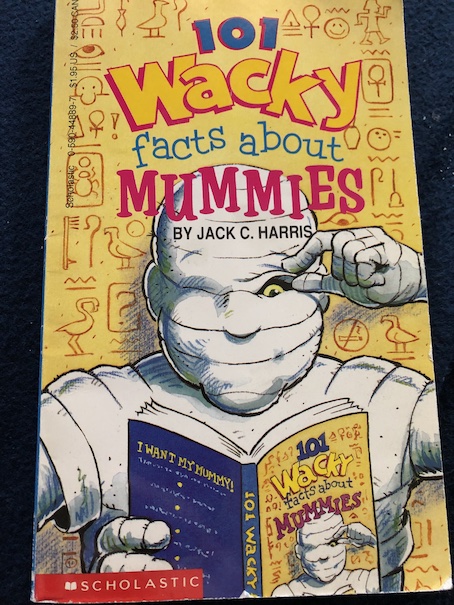
Wacky Facts About Mummies

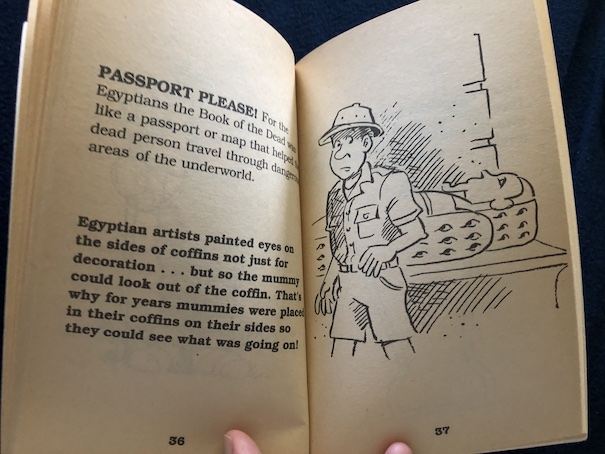
101 Wacky Facts About Mummies by Jack C. Harris, 1991.

This is a book of fun facts about mummies, particular ones from Ancient Egypt, but also ones from other parts of the world. Some of the facts and trivia have to do with the way mummies are made, and others have to do with the discoveries of mummies in modern times.

Here’s just a sampling of the kinds of facts the book offers about mummies in each section:

Will the Real Mummy Please Lie Down? – Basically introduces what mummies are and basic methods for making them and mentions that they’re thousands of years old and that many still have fingernails and toenails.

Egyptians: The Mummy-Making Masters – Facts specifically about Egyptian mummies, including the fact that the Ancient Egyptians never wrote a guide to how to make mummies and few sources have been found with any description of the process, so no one knows precisely what combination of preservatives they used.

Wrap Session! – More about how Egyptians made mummies, including how they removed bodily organs and stored them separately from the body, probably throwing away the brain because they thought that the heart was more important, believing it to be where intelligence and memory were stored. Sometimes, mummies were also painted in different colors to indicate if they were male or female – males were painted red, and females were painted yellow. Fingernails and toenails might also be capped with gold.

The First Mummy-Wrappers – This section is about the Egyptians who embalmed mummies. It was a profession that was generally passed down through families, and they lived in a special area of their city because other people didn’t want to live near people who handled dead bodies for a living. However, the embalmers often had servants or slaves who would be made to do the worst parts of the embalming.

Tomb It Make Concern – This section is about the construction of pyramids and tombs. Because they took years to construct, pharaohs would start the construction of their own tombs immediately on taking the throne.

Farewell, Mummy Dearest – This section talks about funerals, mourners, and what Egyptians believed about the afterlife.

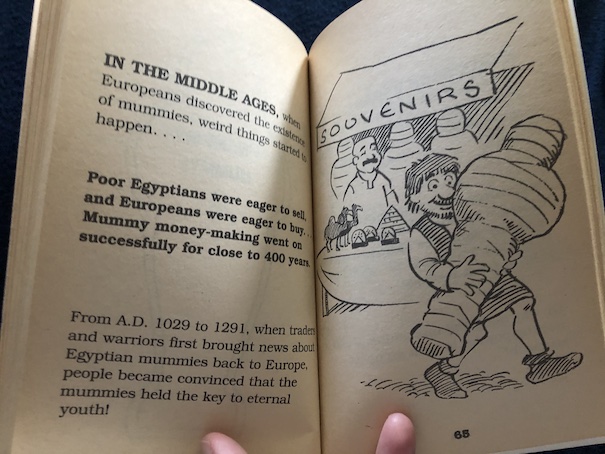
I Want My Mummy! – This section discusses things later people did because they were fascinated by ancient mummies. Sometimes, poor Egyptians would dig up mummies to sell or create fake mummies to satisfy demand. Sometimes, mummies were used in medicines because people believed that the secrets of their preservation could be used to heal the living or help them maintain their youth. During the 19th century, some people would hold “mummy unwrapping” parties, where they would show off and unwrap a mummy they had purchased.

The Chinchorro Connection – This section is about South American mummies.

Natural Beauties! – There are natural conditions that can preserve human bodies, like the cold in high mountains and the acids in peat bogs.

Better Left Shut: The Tomb of King Tut – King Tut’s tomb is one of the most famous Ancient Egyptian tombs because it was relatively undisturbed when modern people found it.

The Curse of King Tut’s Tomb – A series of strange and unfortunate events that happened around the time of the discovery of King Tut’s tomb led to the rumor that the tomb was cursed.

The book is available to borrow and read for free online through Internet Archive.

Blossom Culp and the Sleep of Death

BlossomSleepDeathBlossom Culp and the Sleep of Death by Richard Peck, 1986.

This book starts shortly after the previous book in the series ends.  After Blossom’s old history teacher was run out of town for his scandalous behavior, he was replaced by Miss Fairweather.  Miss Fairweather is a tough, no-nonsense woman who pushes her students to study hard and take history seriously.  Unexpectedly, she comes to appreciate Blossom, an outcast from a poor family, because Blossom demonstrates some knowledge of Ancient Egypt.  Little does Miss Fairweather know that Blossom’s comments in class were inspired by one of the visions that Blossom occasionally gets because of her psychic gifts.

Blossom experiences a visitation from the spirit of an Ancient Egyptian princess who says that she needs Blossom’s help.  Years ago, her mummy and some precious objects were stolen from her tomb.  The princess doesn’t seem to know exactly where her “earthly form” is now, but she’s sure that it’s somewhere nearby.  She’s very concerned because she senses that archaeologists in Egypt are digging to find her tomb and knows that when they finally reach it, they will discover that she isn’t there.  Rather than being concerned about her tomb being violated by the archaeologists, the princess senses that they are searching for her remains in order to venerate them, that if they find her mummy, they will take it to a place of great beauty where it will be treated with the utmost care and respect (a museum).  She wants that and fears that she will miss her chance at the kind of immortality that this form of glorification, care, and study will provide.  So, she asks Blossom to find her earthly remains and inform the searchers of her true whereabouts.  At first, Blossom has no idea how she can accomplish that, but the princess threatens her with a true Egyptian curse if she doesn’t try.

Then, Blossom receives a clue to the mystery in the form of a beautiful Egyptian scarab that her mother found one day while she was out scavenging.  If Blossom can find the place where her mother found the jewel, she can also find the princess’s mummy.  Fortunately, Miss Fairweather has assigned the class special projects about Ancient Egypt, and she is thrilled when Blossom says that she wants to study grave robbers.  Blossom sees this as a good way to collect some extra information about grave robbers that she can use to find the princess’s mummy as well as get a good grade in Miss Fairweather’s class.  It also proves to be an excellent way to draw Alexander Armsworth into her search for the mummy.

Alexander still denies to Blossom that he has real psychic abilities like hers, even after their previous adventures together.  He insists that it was just a phase that they were going through, one that he wants to leave behind.  He’s been busy flirting with Letty, the class snob, and he’s trying hard to get into a prestigious fraternity so that he can give Letty his fraternity pin.  Not only does Blossom think that the boys in the fraternity are a bunch of idiots who do stupid things, but the idea of Alexander giving Letty his pin as a sign of their relationship is just sickening.

Blossom is reluctant to admit her real feelings for Alexander, but the two of them are close in ways that Letty and Alexander never will be because of their shared abilities and adventures, and Blossom has a sense that their futures will be intertwined as well.  Alexander is angry that Blossom is roping her into yet another supernatural escapade, but he has to go along with her project idea because he has already gotten on Miss Fairweather’s bad side and needs to do well on the project to save his grade in class.

Along with the supernatural adventure, there is also a look into the past, the world of 1910s America as well as Ancient Egypt.  First, there are the traditions of stunts associated with Alexander’s initiation into his fraternity and the tradition of giving a girl a fraternity pin as a precursor to engagement (“engaged to be engaged”).  Then, they discover that Miss Fairweather is a suffragette, which is the reason why she left her previous teaching job.  Her feminist ideals cause problems for her in her new, small town when they become known, but with Blossom’s help, she wins over some of the influential women in town as well as a male admirer.

The book is currently available online through Internet Archive.

The Case of the Muttering Mummy

MutteringMummy

The Case of the Muttering Mummy by E.W. Hildick, 1986.

Joey Rockaway needs to buy a special present for his mother’s birthday. Having broken his mother’s china cat ornament recently, he has decided that he will buy one of the replicas of a golden cat statue from Egypt at the Egyptian exhibit at the local museum. The other members of the McGurk Organization come to the museum with him, and McGurk uses this as an opportunity to give them a kind of memory test about objects in the exhibit.

Actually, everything in the exhibit is a replica, not just the items sold in the museum gift shop. Justin Matravers, a wealthy man who has recently died, collected Egyptian artifacts, but part of his will specified that the collection should never be put on public display. However, his widow, who wanted to show off the collection, had replicas made of everything in the collection so that she could have those put on display.

MutteringMummyCase

McGurk sneers about how everything in the exhibit is fake, although he is actually surprisingly superstitious. The museum always did have a real mummy case on display. They always said that the mummy case was empty, but some of the more superstitious kids, like McGurk, believe that there is a mummy inside the case and that there is a curse on it. McGurk has nicknamed the mummy Melvin. The other kids aren’t afraid of Melvin or Egyptian curses, and while they are looking around the Egyptian exhibit, Mari plays a joke by using her ventriloquist skills to make the mummy case “talk.” This trick sets off a bizarre mystery for the McGurk Organization.

A scholar and author, Harrison Keech, is sketching the replicas at the exhibit and witnesses Mari’s trick and Joey picking out the replica cat for his mother. After he asks Joey if he can take a look at the cat, Keech suddenly becomes very upset, saying that the cat statue is cursed! He says that Mari’s joke has angered the spirit of the mummy and awakened the spirit of Bastet. The mummy was a follower of Bastet, the Egyptian cat goddess, and it will now be drawn to the statue if they remove it from the museum. Mari tells Joey that she can tell from Keech’s voice that he’s making up the whole story and that he shouldn’t let that stop him from buying the cat.

MutteringMummyNight

However, strange things start happening after Joey buys the cat. It seems like someone is following him home, a dark, shadowy figure. Joey thinks it might even be the mummy, come back to life! The others are skeptical, and McGurk arranges a kind of test where Joey brings the statue with him to a meeting of the organization. Sure enough, a strange figure lurks outside their meeting, and they hear strange whispers in a foreign language!

The spookiness doesn’t last for long. It turns out that Mari, as well as being a ventriloquist, has some skill with different languages and recognizes what the “mummy” says as being Greek, not Egyptian, and the phrases as being typical things that someone might say in a restaurant. When the kids find a scrap of bandage outside, they are quick to notice that it’s a modern, elasticized bandage, like the kind you can get at any pharmacy.

So, the question becomes who is playing at being a mummy and why? Is it Keech, wanting to make the kids think that the mummy story he told them is real, and if so, what would he have to gain from it? The only other two people who know about the story are Joanne, who works at the museum, and Donny, her fiancé, who is jealous of the attention she’s been paying to Keech when he comes to the exhibit.

MutteringMummyLies

I have some complaints about this book that hadn’t occurred to me when I read it as a kid. At one point, Donny, who is described as being a social worker, comes to visit the kids because he wants to hire the organization to check up on Keech and his relationship with Joanne. Donny is very jealous, and when he explains how Joanne seems to be falling for all of Keech’s crazy mummy stories, he suddenly turns to Wanda and Mari and says, “You women, you’ll believe anything when a smarmy two-bit jackass like that starts shooting his mouth off!” That’s just really inappropriate for an adult to say to kids, and the whole situation is weird on several levels. First of all, Donny is an adult, and if he’s having issues with his love life, especially with the woman he thinks he wants to spend the rest of his life with, the last thing he should do is hire kids (even really smart ones) to handle the issues for him. Second, Wanda and Mari are young girls, not “women,” and what little girls believe is no business of Donny’s. Trying to imply that Wanda and Mari might someday fall for a “jackass” is not only insulting but implies that Donny is thinking about Wanda and Mari in terms that no grown man should be thinking about girls their ages. I find it disturbing that Donny is apparently a social worker, a person in a position of trust who is supposed to help people in difficult situations to manage their lives, and he’s acting like this. Also, toward the end of the book when the bad guy (I won’t say who it is here, although I thought that the answer was pretty obvious even early in the story) is making his escape, he shoves Joanne aside and calls her a “slut.” That’s pretty strong language for a kid’s book of this level. None of this occurred to me when I was a kid, so maybe other kids reading this wouldn’t notice, but I thought that I’d mention it because these things bother me now.

At one point, Brains gives a demonstration of using water displacement to determine the volume of irregularly-shaped objects, explaining how Archimedes discovered the principal (although I’m not sure that Archimedes’ Principal was quite as he explains it), as the kids investigate what makes Joey’s cat statue so special. You might be able to guess what it is. It seemed pretty obvious to me. The one thing that seemed the most puzzling was how it was done. Mari also offers an interesting explanation of the different kinds of lies that people tell and their motives for doing so.

The book is currently available online through Internet Archive.

Egyptian Diary

EgyptianDiary

Egyptian Diary: The Journal of Nakht by Richard Platt, 2005.

A young boy in Ancient Egypt, Nakht, is excited because his family will soon move to Memphis because a distant relative has offered his father a job working as a scribe.  Memphis is a large, important city, with more opportunities than Esna, where the family currently lives.  Nakht is also training to be a scribe, so he begins writing an account of his family’s journey to Memphis and what they encounter when they arrive.

EgyptianDiaryPic1

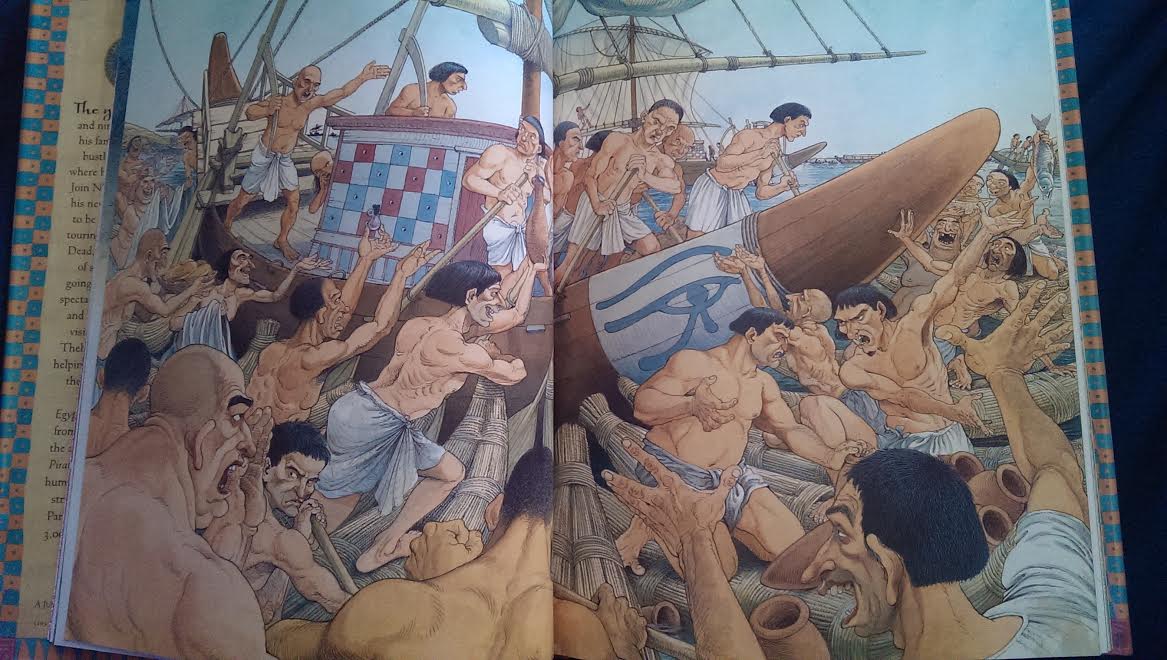
The journey to Memphis includes a boat trip down the Nile, past the City of the Dead near Thebes, where pharaohs are buried.  When they arrive in Memphis, they make themselves at home in their new house, which is bigger than their old one.  For the first time, Nakht has a private bedroom of his own, and the wall is decorated with a hunting scene.  Nakht also has a bed to sleep in, although he is still more accustomed to sleeping on a mat on the floor, as he did back in Esna.

In Esna, Nakht’s father had taught him his lessons as a scribe, but in Memphis, Nakht begins attending a school with other boys.  There, he practices his writing as always, although he must also learn the older, more formal hieroglyphic form of writing used on the walls of temples and for public inscriptions as well as the less formal writing used more commonly.  Nakht also receives lessons in building and engineering, which includes calculating the weight of the building stones, how many people it would take to move them, and how much food and drink the workers would need during their time of service).  Sometimes, their teacher also takes the students places for lessons, like taking them to the fields near the river so they can see how to build canals and how farmers water their fields.

There are many exciting things going on in Memphis.  Ships come and go from many places.  When the Nile floods, Nakht describes how the Controller of Granaries sets the taxes on grain for the following year by measuring the highest height of the Nile during the flooding time, which is an indicator of how good the next year’s grain harvest will be.  Nakht and his sister Tamyt witness the funeral procession of a scribe, complete with dancers, paid mourners, and a procession of servants carrying all of the furniture and supplies to be loaded into the man’s tomb for him to use in the afterlife.

EgyptDiaryPic2

Then, Nakht learns that his father and other scribes are investigating tomb robberies in Saqqara.  Nakht and Tamyt have never seen the tombs before, but their father refuses to let them come with him.  Instead, the two of them sneak over by themselves to have a look.  While they are there, they witness the robbing of a tomb!  They get a good look at an unusual ring on the finger of one of the robbers and are shocked to later see an identical ring on the finger of a very important person!

EgyptDiaryPic3

At the end of the story, when Nakht and Tamyt are rewarded for their role in catching the thieves, it is revealed that the current king of Egypt is Hatshepsut, who is actually a woman.

EgyptDiaryPic4

Among the other things that Nakht explains about his life are how the doctor treated him when he broke his arm, how grain is harvested, how different types of craftsman work, and how houses are built.  Nakht also undergoes a special hair-cutting ceremony as a coming-of-age ritual.

There is a section in the back that explains more about Ancient Egyptian history and society.  It also explains Egyptian writing, religion, mummies, and tombs.

The book is part of a series of historical picture books.  It is currently available online through Internet Archive.

The Vandemark Mummy

The Vandemark MummyThe Vandemark Mummy by Cynthia Voigt, 1991.
The Vandemark Mummy is an exciting mystery with believable characters. The story includes a bit of history about Ancient Egypt and side plots about the complications of family life, the role of women in society, and the nature of ambition.

Twelve-year-old Phineas Hall and his fifteen-year-old sister, Althea, have recently moved to Maine with their father, Professor Hall, because he got a job working at the small Vandemark College. Moving and starting over in a new place is never easy, but the move is more difficult for the kids because their mother didn’t come with them. Their mother is an ambitious, career-oriented feminist, and when she was offered an important job working for a congressman in Oregon, she could not bring herself to turn it down in order to go to Maine with the rest of the family.

Although the entire family talked the situation over, and everyone agreed to the current arrangements, no one is really happy about it. Althea particularly feels hurt. Even though she has shared her mother’s feminist ideals, she’s hurt by her mother’s apparent selfishness and the seeming ease with which she abandoned the family. Althea believes that her mother should have compromised on her career this time because her husband has made compromises for her in the past. To make herself feel better, Althea spends her time studying one of the oldest feminists, the Greek poet Sappho. Phineas, on the other hand, is just trying to be a normal kid and fight off boredom while waiting for the summer to end and school to start. But, boredom is the last thing on Phineas’s mind when the mummy arrives at the college.

The wealthy patriarch of the Vandemark family dies and leaves his collection of Egyptian antiquities (one of many collections he had) to the college, including a real mummy. The Vandemark family is a little disappointed because they had hoped that the collection might go to a much more prestigious institution, even though Vandemark College is named for their family. To the joy of the Hall family, Professor Hall is put in charge of the collection, which will be put on display in a new addition to the college library. Professor Hall lets Phineas and Althea go through the collection with him and another professor, Ken Simard. Although at first the collection does not seem to be particularly valuable, except for the unusually good condition of the mummy and the funeral wreath, it seems to be a lot more valuable to someone. After a failed attempt to break into the collection, someone later manages to steal the mummy. Then, Althea suddenly disappears. The adults suspect that Althea might have run away because of the troubles in their family, but Phineas knows better and begins a desperate hunt to find his sister.

One of the best things about the book is that it really takes both kids to unravel the entire mystery: Phineas for his persistence and decisive action and Althea for her more mature understanding of the thief’s motives. Although, even at the end, their family’s situation isn’t completely resolved, the kids’ experiences give them a new perspective on things. It would be a great book for middle schoolers.

The book is available to borrow and read for free online through Internet Archive (multiple copies).

Themes and Spoilers

I debated about saying more because I didn’t want to spoil the story too much, but after thinking it over, I can’t give my full opinion of it in this review without talking a little more about what Althea and Phineas learned from their situation.  If you’d rather not know more detail, you can skip the rest of this.

On the one hand, I was a little disappointed at the lack of complete resolution to the family’s troubles because, by the end of the book, I really cared about the characters and wanted to know what would happen to them, but I think the author purposely left the story open at the end so readers could imagine for themselves what the characters are going to do next.  However, there is one thing that is pretty well established at the end of the story: whatever happens to their parents, whether their separation is temporary, as they’d originally planned, or whether they end up divorcing, Althea and Phineas are going to be okay because they still have each other, their father, and their new friends in their new town.

In the beginning, their mother’s absence is worrying because they will now have to cope without her, and they don’t know what is going to happen to their family in the long run.  But, part of the children’s self-sufficiency actually does come from their mother and things that she taught them, whether she is with them or not.  The book does mention little things they learned from their mother.  It’s subtle, but she’s still with them because of the influence she’s had in their lives.  The kids also develop more of an appreciation for their own resources and abilities, which makes them less fearful.  One of Althea’s early characteristics was a long-standing fear of the dark.  After her ordeals, her father and brother expected her fear to be worse, but she tells them that she is actually less afraid now than she was before because she has learned something about circumstances she can control and ones she can’t.  She says, “I think, there’s a difference between being scared and not knowing how you’ll do, and being scared but knowing you’ll do okay.”  As she notes, if she goes to bed at home with the lights off and decides that she really can’t stand it, she can always get up and turn them on again.  She has realized that she has control in her daily life and actions she can take to make things better, which she didn’t have during parts of their adventure.  It gives her confidence.

The kids also learn lessons about the nature of ambition and about their own feelings.  In the beginning, Althea is more vocal about how she feels about her parents’ separation.  She feels betrayed because, although she learned her sense of idealism from her mother and thought that they shared the same views, her mother has now done something which she views as a selfish act, rejecting her family and her family’s needs solely in the name of her personal ambitions.  Phineas, on the other hand, doesn’t seem to know what to feel or is afraid to show his true feelings at first, just trying to keep busy so he doesn’t have to think about it too much because he thinks that his parents’ marriage is only their business.

At the end, the two alter their positions somewhat, coming a little more into agreement with each other.  Althea has the chance to contrast her parents’ marriage and ambitions with that of the villain’s (without naming names), and she sees the difference in the way each of them responds to the same pressures.  Although her father may have been hurt by his wife’s reluctance to make sacrifices in her ambitions for the sake of his and her preference for separation over compromise, he still genuinely cares about her and understands her ideals and what she really wants to achieve.  The fact that it’s only a separation, not a divorce, is a sign that the parents still care about each other and respect each other and hope that they will be able to reconcile eventually.  The villain doesn’t have those feelings, and unlike either of Althea and Phineas’s parents, really is motivated solely by selfish ambition.

Ambitions often require sacrifice in order to achieve them.  Revealing exactly what the villain sacrificed would say too much, but this person does end up losing pretty much everything in the end.  For the sake of her ambitions, Althea’s mother sacrificed her place in the family.  Although she thought that it would only be temporary, the hurt she caused her family members will probably have longer-lasting effects. When she calls them to find out what’s been happening, she learns what she’s been missing and the ordeals her children have faced without her, which leave her feeling both worried and left out, feelings that her husband understands and explains to the children (“One of the things she knew, without knowing how it would feel, is that we’d be able to get along fine without her.”), which shows that he is still in tune with his wife’s feelings.  Toward the end of the story, she is upset and seems hurt that Althea is too tired and busy talking to the police to talk to her much other than to briefly reassure her that she is now safe.  At that point, Althea needs her mother’s comfort less than her mother needs reassurance from her.  Althea feels a little bad about not being able to soothe her mother’s feelings because she is no longer as hurt and angry with her as she was before, but Phineas tells her not to worry if their mother’s feelings are hurt right now because she owes her daughter some hurt feelings.  In other words, Phineas has finally learned that it’s okay for him to have feelings and an opinion about the things happening in his family and to show them.  He recognizes how hurt and confused his sister was at their mother’s apparent betrayal, and he has decided that it’s okay for their mother to see that hurt and feel a little of it herself so that she will understand what’s really happening and what her children are really going through. They have coped without her, but the fact remains that she wasn’t there for her family during their time of crisis.

You’ve probably noticed that I’ve been focusing more on the mother’s ambitions and questioning her motives more than the father’s in the story.  That’s partly because that is the focus of the story.  The children do not see their father as abandoning the family for the sake of ambition because he didn’t.  They make it clear that he has supported his wife’s ambitions in the past, often at the expense of his own.  He mentions that the attraction of this new position that he has accepted is that it’s “the first job in fifteen years that I’m not over-qualified for, and I plan to enjoy it . . .”  He is primarily a scholar and has felt under-challenged intellectually.  Because he’s an academic, his schedule is more in sync with the children’s school schedule, which is why both of the children chose to go with him rather than with their mother.  He also makes time for his children and even involves them in his work when possible, supporting Althea’s interests in history and philosophy, which he shares.

At one point, Althea says to her father, “You and Mom don’t have exactly the same set of values, you know.”  The mother of the family is more concerned with money, climbing the occupational ladder, and achieving higher positions, higher salaries, and more influence.  She sees these things as ways of furthering the cause of feminism, and often works long hours away from her family for her jobs. In the past, she has used the fact that she earns higher salaries than her husband to convince him and the rest for the family to make accommodations for the sake of her jobs.  Althea says that her mother’s arguments aren’t honest and that her lack of support for her husband’s career as well as her own are a betrayal of the “equality” that she supposedly believes in.  It isn’t that Althea is completely opposed to her mother’s ambitions so much as she disapproves of the way her mother goes about achieving them. Her mother is apparently more concerned with status than the intellectualism that her daughter and husband crave.  Much of the conflict in their values comes down to what they think they need to feel fulfilled in their lives.  Because the characters seem to need different things, they are having trouble living a shared family life.  That’s the situation for the Hall family, as the book describes it.

In the end, this book is bound to spark a lot of opinions and discussions about the characters and their views and much speculation about what will happen next for the Hall family.  Will one or both of the parents change their view of the situation, just as Althea and Phineas have?  Will the mother, who admits that the job she took wasn’t what she had expected it to be, decide to quit and rejoin her family?  If she does, what will her role in the family be now that Althea and Phineas have become more independent than they once were?  Another character, who I haven’t mentioned before, is a female reporter in their new town who befriends the family and helps them through their ordeals in the mother’s absence.  In some ways, her values seem more in tune with the father’s than the mother’s are.  Is it possible that she could be the children’s eventual stepmother if the parents separate permanently?  Or will she only ever be just a supportive family friend?  Families in real life experience changes like these as children grow older and begin to forge their own identities and values in the face of changes in their lives, reevaluating their parents’ decisions and making ones for themselves.

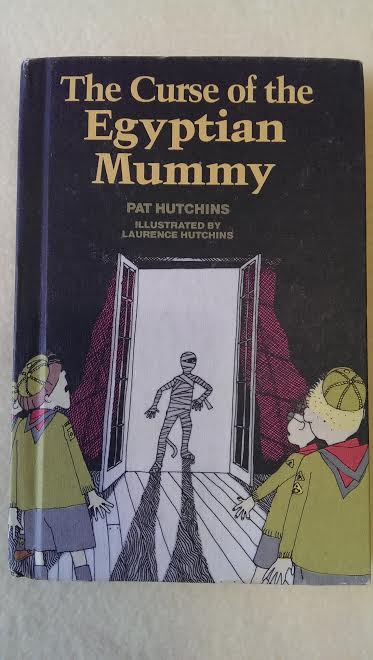
The Curse of the Egyptian Mummy

cursemummyThe Curse of the Egyptian Mummy by Pat Hutchins, 1983.

The 15th Hampstead Cub Scouts are looking forward to their camping trip. Miss. Hylyard, who runs a guesthouse for retired people, lets the scouts camp on her land and enjoys having them visit her house and entertain her guests. Mr. and Mrs. Webb are coming along to do the cooking, and their daughter, Victoria, will be there, too. She’s one of their friends from school.

Things start to get interesting pretty quickly when they hear that a man died from a poisonous snake bite not far from where they are camping. The boys are eager to show off their tracking skills by helping the police find the missing snake.  But, strangely, no one can figure out where the snake came from because none of the zoos in the area have reported one missing.  That’s only the beginning of what becomes a very strange trip for the scouts.

Sam finds a strange bird statue in a public wastebasket and decides to use it as the scouts’ new mascot. Then, someone trashes the campsite, and strange figures are seen running around the woods at night.  When Albert makes copies of the bird statue to earn his art badge, the first one is broken, and the second is stolen after some adult shoves Albert into the river near the camp.  Some of the guests at Miss Hylyard’s look suspicious, and when Victoria unexpectedly stumbles into an evening’s entertainment there still wrapped in bandages from the scouts’ first aid practice, a guest who was supposedly unable to speak suddenly blurts out, “The Curse of the Mummy’s Tomb!” in Arabic (which Miss Hylyard knows from her travels with her father).

Who are these mysterious people?  What is the importance of the statue?  And, is there really a curse?

The book is currently available online through Internet Archive.