Monster Manual

MonsterManual

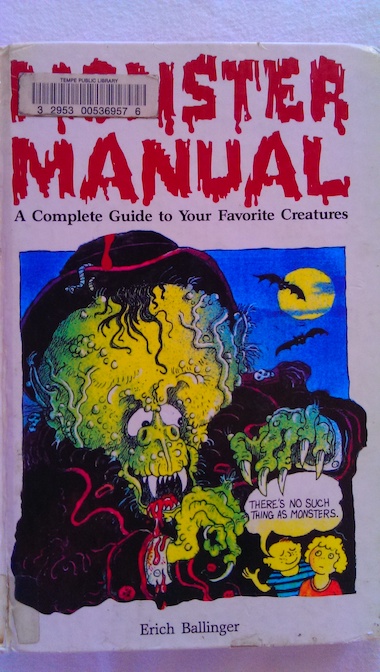
Monster Manual by Erich Ballinger, 1989, 1994.

This book was originally written in German and then translated into English.  It’s not a story about monsters but a kind of guide to monsters and other creatures found in fantasy, horror, and science fiction books and movies.  There are articles about different types of monsters, fictional characters, and monster-related concepts that are organized in alphabetical order, like a encyclopedia.  The creatures in the book range from traditional monsters from folktales and classic literature, like vampires, mummies, dragons, ogres, and creatures from Greek mythology, to modern ones from popular fiction, as seen on this monster family tree.

MonsterManualFamilyTree

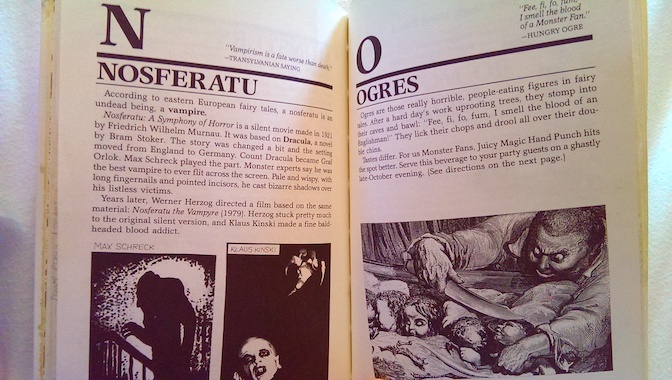
Some topics, like vampires, actually have more than one entry in the book.  There is the Vampires article, which talks about the general idea of vampires and traditional beliefs about them. Then, there are the articles about Dracula and Nosferatu, specific vampires from classic literature.  In the Nosferatu section, they tell you that the famous silent movie Nosferatu was actually based on Bram Stoker’s Dracula, just with the location and character names changed.  Unlike the suave-looking Dracula, who is not obviously a vampire at first sight, the vampire in Nosferatu was also depicted as an unearthly creature.  One thing they don’t mention is that Bram Stoker’s widow sued the studio that made Nosferatu for copyright infringement.  The studio went bankrupt, and all copies of the movie were supposed to be destroyed.  The only reason that we can see the movie now is that copies of it had already been sent overseas and preserved.  It’s now considered a classic silent film and has a cult following.

MonsterManualVampires
MonsterManualNosferatuOgres

Some articles are also activities, like the one about Drawing Monsters and the quiz to see how fearful you are.
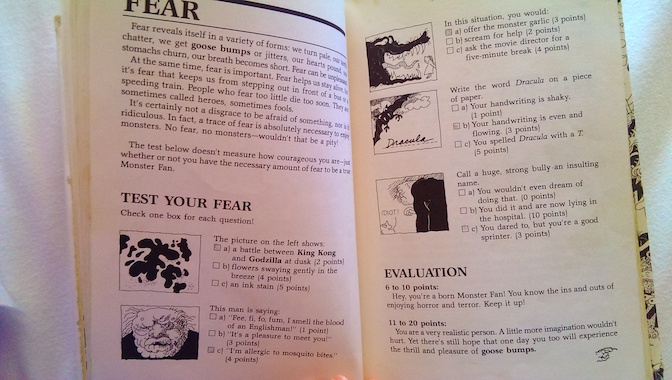
MonsterManualFearQuiz

All throughout the book, there are also segments of a comic strip at the bottoms of various pages in which a monster tries to frighten a young girl, who is unimpressed.  By the end of the comic strip, the girl and the monster become friends.

The book is available to borrow and read for free online through Internet Archive.

Encyclopedia of Legendary Creatures

LegendaryCreatures

Encyclopedia of Legendary Creatures by Tom McGowen, 1981.

This book is organized into brief encyclopedia-style entries, describing legendary creatures from around the world.  Everything is in alphabetical order, not organized by country or any other over-arching categories.

There are two things that I particularly like about this book.  One is that the mythological creatures in the book aren’t just limited to the common ones, like giants, vampires, werewolves, and unicorns (although they each have entries of their own); there are also some lesser-mentioned creatures like the Hulder Folk and the Abatwa People.  The Hulder Folk, who come from Norse folktales, look like ordinary humans, but they have tails like cows.  According to the book, they love to sing and dance, but their songs are always sad, which makes me think of country music.  They also can intermarry with humans, although their marriages are usually unhappy, which also, oddly, makes me think of country music.  The Abatwa People are part of the folklore of the Zulus in South Africa.  They are tiny people, but fierce warriors, and they get offended if people don’t treat them like they are the same size as humans.  (There are also real people in Africa called Abatwa who are pygmies.  The legendary people in this book may be connected to old legends about them, exaggerating their shorter-than-average height.)

LegendaryCreaturesNisse

The other thing that I really like about this book is the pictures.  There are many books about mythology and folklore that don’t have pictures of the creatures, and it really makes a difference being able to see what something looks like (or supposedly looks like, since these are legendary creatures) as well as read a description.

As a side note, there is an episode of the kids’ cartoon show, Arthur, where his friend, Sue Ellen, who isn’t usually frightened by scary stories, hears a strange noise that makes her think about various mythological monsters that she’s heard about in the different countries that she’s visited with her parents.  These unusual monsters, like Baba Yaga, Kappas, and Bashees, which most of her friends haven’t heard about before, do frighten her.  When I saw Kappas described in this book, it reminded me of that.