The Christmas Doll

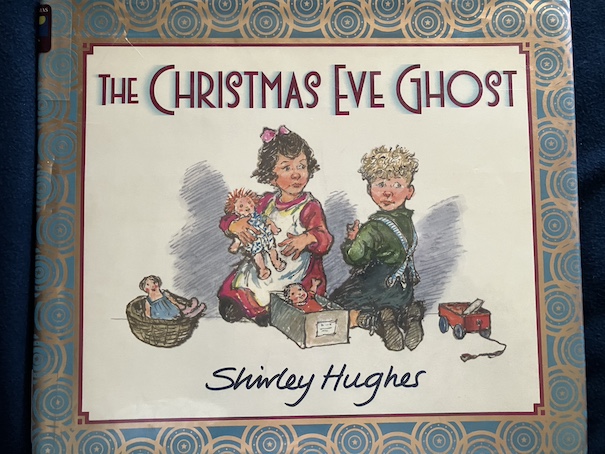
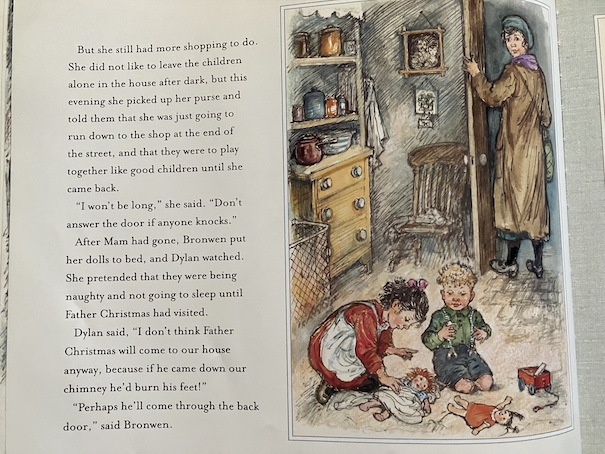
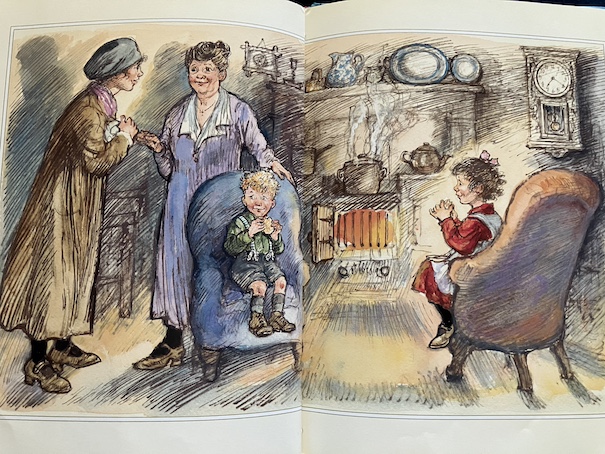
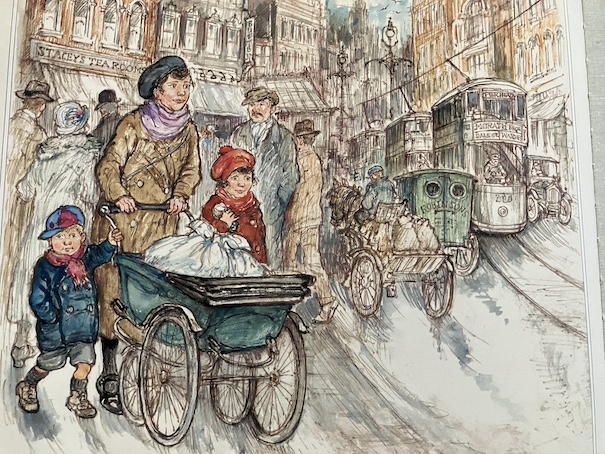
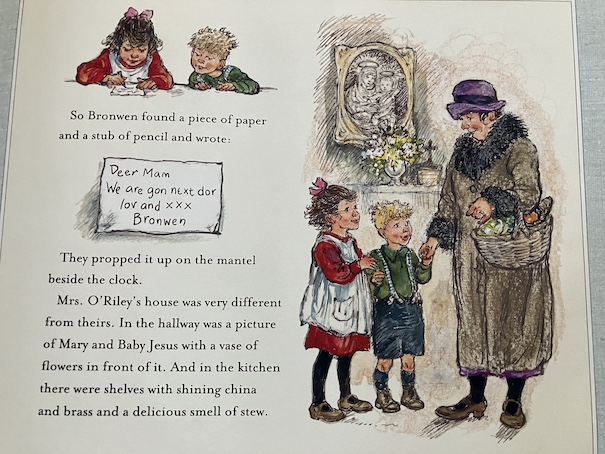
Young Lucy and Glory Wolcott are orphans in London during the Victorian era, 1848. Their parents died during a disease epidemic, and the penniless girls now live in a work house for orphans. They’ve been living there for 5 years, doing sewing for their support, although they are kept in terrible conditions there, with bad food. Then, another girl who lives in the work house dies of an illness, and people worry about the disease infecting others, as it did during the epidemic. Soon, other girls in the work house get sick. Lucy worries about her little sister, who is only 6 years old and already too thin from the bad food, will get sick and die, too. People begin saying that it may be safer living on the streets than being cooped up with the sickness.

The only comfort that Lucy and Glory have in their lives is each other and the story that Lucy tells Glory of her memories of Christmas with their parents. Glory was too young when their parents died to remember their parents or what life was like when their parents were alive, when they had someone to take care of them and actually had proper food. Glory loves the story that Lucy tells about the doll named Morning Glory that their mother gave her for Christmas but which was left behind when the girls were sent to the alms house and then to the work house when their parents died. Glory dreams that, someday, they’ll find that doll again. Lucy tells Glory that, when she finds her doll again, she’ll recognize her.

As more children at the work house die, Lucy increasingly fears that her sister will get sick and die. She thinks about running away from the work house with her sister, but she’s afraid of what they would do on their own. They don’t receive much food or care in the work house, and they’re subject to beatings and abuse, but what would they do on the streets, and how would they survive?

When Glory develops a cough, Lucy is sent to the sick ward at the work house, and Lucy is terrified that she will never come back. Both Lucy and Glory know that none of the girls who are sent to the sick ward with this cough have come back. Terrified, Lucy thinks that the only way to save Glory is to rescue her from the sick ward and get her out of the work house.

The two girls successfully run away, but once they’re on the streets, they have nowhere to go and don’t know what to do. They have nowhere to stay, and they have to sleep in the cold. Without food or money, Lucy trades a small pair of scissors that she brought from the work house for a couple of crumpets from a muffin seller, although a boy later tells her that the scissors were worth much more than that and that the seller took advantage of her. Lucy worries that they have no way to survive on their own because they don’t know what to do and have nothing else that they can sell or trade.

A kind washerwoman suggests to the girls that they go down to the river to join the mudlarks, who spend their days hunting for things to scavenge and sell in the mud at the river’s edge. Sometimes, she say, they find truly amazing things. With nothing else to do, the girls try it. The mud is smelly and disgusting, and at first, all they find are some old bones and bent nails. They’re about to give up when they find something that is truly amazing – a doll!

The doll is worn out, but its head is still good, and immediately, Glory declares that this is Morning Glory, the lost doll that has come back to them, just like the stories that Lucy has told her. With a heavy heart, Lucy realizes that they’re not going to be able to keep the doll. They have nothing else they can sell for money, and if they don’t sell the doll, they will have nothing to buy food and shelter.

At the suggestion of a rag and bone dealer, who is kind enough to let little Glory sleep by her fire for a time, Lucy takes the doll to a dollmaker. She hates having to do it and knows that it will break little Glory’s heart, but they are starving, and their lives are at stake. The doll is in such bad condition that only the head is worth something, and the dollmaker is prepared to offer Lucy a penny for it. That’s not much, but it’s more than Lucy was expecting. Then, something happens that changes everything for the better for Lucy and Glory.

The dollmaker notices the little morning glory flower embroidered on the apron Lucy is wearing. It’s actually Glory’s apron, and Lucy embroidered the flower for her because Glory was named after the morning glory flowers, just like her doll. The dollmaker asks Lucy who did the embroidery, and Lucy timidly admits that she did. At first, she worries that she shouldn’t confess that because she used thread from the work house to do it, and she would surely be punished for stealing if anybody knew. However, the dollmaker is impressed with Lucy’s sewing skills.

Then, before Lucy can leave the shop, the dollmaker gets word that Mary, the girl who sews the hearts on the dolls has been taken seriously ill and isn’t expected to survive. The disease that afflicted the girls in the work house is everywhere. The dollmaker worries because this particular doll shop is known for the signature hearts that are sewn onto their dolls, and the tradition is that only a girl can sew them, not an adult. Losing the girl who sews the hearts isn’t just sad but also serious for the doll shop because it’s only two weeks to Christmas, and they have a lot of orders to fill. If they can’t find another girl who can sew or break the tradition of the doll hearts, they won’t be able to complete their orders and will lose their shop’s reputation. Of course, it doesn’t take the the dollmaker long to realize that the solution to the problem is literally standing right in front of them.

Lucy is stunned when the dollmaker, Miss Thimbleby offers her the job of sewing the hearts on the dolls. It would only be through Christmas, but it would be regular work, something Lucy definitely needs. However, Lucy worries about what she will do with Glory. There doesn’t seem to be a place for her in the shop. Miss Thimbleby will let Lucy stay overnight in the shop to tend the fire, but Lucy isn’t supposed to let anyone else in after the shop is closed. Could she persuade Miss Thimbleby to let Glory in with her, or could Lucy find a place for Glory to be?

When Lucy returns to the rag and bone shop to talk to Glory, she discovers that the husband of the kind lady is much less charitable and has turned Glory out into the streets. In a panic, Lucy searches for her, losing their only penny out of her pocket. Eventually, she finds Glory with the boy who had told her that she was cheated over the matter of the scissors, Nick. Glory has told him about their escape from the work house, and Lucy sadly confesses her sale of the doll to Glory. Fortunately, Nick sees how Lucy’s new job at the doll shop can help them all.

Since the job requires Lucy to spend every night in the doll shop, tending the fire and keeping warm, Nick points out that Lucy can sneak him and Glory in after hours. In return for being allowed to sleep in the warm doll shop with the girls, Nick says that he will look after Glory during the day and that she can help him to make a little money that will help support them all. Nick is also a homeless orphan, and he get money catching rats and doing acrobatics on the streets. Glory doesn’t like the idea of the rats much, but Nick has her passing the hat while he performs on the streets. Her pitiful cough will help them get more charity.

It’s not an ideal situation, but Lucy agrees that this is the best way to manage things. Lucy continues to worry about her little sister, running around in the cold with Nick during the day, although they do have a warm place to sleep now. At night, Lucy lets Glory hold the doll Morning Glory, although she reminds Glory that the doll now belongs to the shop.

While working at the shop, Lucy notices that Miss Thimbleby also has a favorite doll, one that is never for sale. She calls this doll Charlotte and talks to it when she thinks nobody can hear here. The other women who work in the doll shop explain to Lucy that Charlotte, the real Charlotte, was Miss Thimbleby’s little sister. The sisters were orphans, like Lucy and Glory. Charlotte was much younger than Miss Thimbleby, and Miss Thimbleby raised her. Charlotte was the original hearts girl of the shop, the one who always sewed the signature hearts on the dolls and started the tradition. Sadly, Charlotte died young of an illness. The doll Charlotte was the very last one that the girl Charlotte gave a heart to before she died, and that’s why Miss Thimbleby refuses to sell it and sometimes talks to it, like she’s talking to her sister.

As Christmas approaches and Glory’s illness becomes worse, Lucy increasingly fears for her life. Glory’s illness is particularly bad on Christmas Eve. Miss Thimbleby has promised Lucy that, as part of the tradition of the hearts girl, Lucy may choose any unsold doll in the shop for herself on Christmas Eve. Lucy has her sights set on Morning Glory so she can return her to Glory, but a series of unexpected events and a generous, good-hearted decision from Glory lead to marvelous changes for the girls.

The book is available to borrow and read for free online through Internet Archive (multiple copies).

This story, set in a Dickensian London in the mid-19th century is touching and sometimes a bit tear-jerky, but it’s full of old-fashioned Christmas spirit! The book doesn’t minimize the risks to the children’s lives. The lives of poor people in this period were harsh, and children were vulnerable to being orphaned or even dying young of disease. The story even talks about children being taken advantage of by unscrupulous and uncaring adults, whether it’s being cheated out in a trade for food or the talk of children on the streets being kidnapped and forced into servitude as chimney sweeps. Parentless children on the streets wouldn’t know which adults to trust, and those realities are shown in the story. The children’s worries and hardships make the happy ending of the story touching.

Some readers might guess at the likely, most happy ending for the girls because there is one adult in the story who would have sympathy for a pair of orphaned sisters. The eventual fate of Morning Glory and whether her loss or gain would help Glory hangs in the balance for most of the story. The role Morning Glory plays in the ending of the story is important, and it’s Glory’s decision about Morning Glory that helps determine the girls’ fate and also touches two other lives. Don’t worry about the doll, though. The story works out well for the doll, being with someone who truly needs and appreciates her. The lives of all three children are changed for the better in the end, too.

The Scandalous Sisterhood of Prickwillow Place

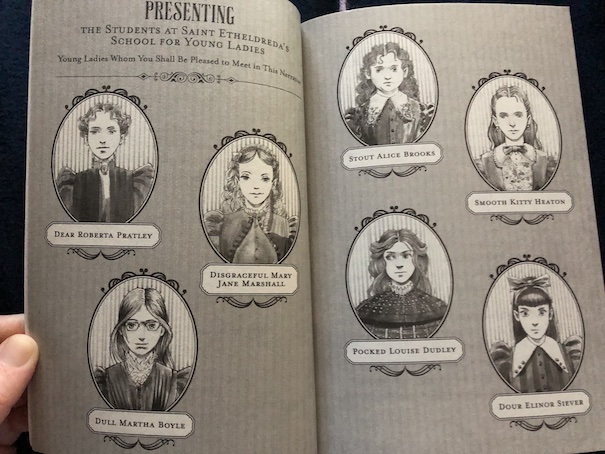
The story is set in England in 1890. There are seven girls at the proper Victorian boarding school known as Saint Ethelreda’s School for Young Ladies on Prickwillow Road in Ely. As the beginning sections of the book explain when they introduce the girls and members of their families and acquaintances, they were all sent to Saint Ethelreda’s because their families want them to become proper Victorian young ladies, ready to make suitable and socially-acceptably marriages. Some of the girls have defects in their characters or personal interests that are considered entirely unsuitable, and their families are hoping that the school’s discipline and propriety will cure them.

“Dear” Roberta Pratley – Her mother died while she was still young, and her father remarried. It was her stepmother’s idea to send her to boarding school, thinking her too soft, clumsy, awkward, and overindulged by her late mother. Her stepmother hopes that boarding school will strengthen her and turn her into a more graceful young lady. Roberta is known for being gentle and kind. She’s good at sewing.

“Disgraceful” Mary Jane Marshall – She was sent to boarding school by her mother, who has noticed that Mary Jane, while still rather young, is very pretty and precociously flirtatious, with a tendency to attract disreputable and penniless young men. Worse still, Mary Jane enjoys the company of these disreputable young men and regularly slips away from her mother to see them on the sly. Fearful that Mary Jane’s recklessness with young men will lead her into a disastrous marriage too early in life, her mother enrolled her in an all-female boarding school to keep her away from boys and, hopefully, give her a chance to mature and improve herself. So far, it’s not working. The only non-disreputable young man who interests her is the young local police constable.

“Dull” Martha Boyle – Martha has four brothers at home who make her life miserable with their pranks and teasing. Boarding school gives her an escape from them. She isn’t considered very bright, but she has a talent for music. She has a crush on a nearby farmer’s son.

“Stout” Alice Brooks – Poor Alice has a tendency to put on weight and is often compared unfavorably to her cousin Isabelle, who seems to be able to eat anything she wants without putting on an ounce. Alice doesn’t really hate Isabelle for this, but she’s tired of her grandmother’s criticism over it. She has a crush on a young law clerk.

“Smooth” Kitty Heaton – Kitty’s mother died when she was only four years old, and Kitty has no other siblings, which is a disappointment to her father, who hoped for a son to take over his business enterprises one day. Kitty’s father largely ignores her, and he has not yet noticed that Kitty is developing some shrewd business skills herself.

“Pocked” Louise Dudley – Louise’s face is scarred because she contracted smallpox at a young age. She survived this potentially-deadly illness because her devoted uncle, a talented doctor, nursed her through it. Ever since, she has revered her uncle and looks up to him as a mentor. Her uncle enjoys sharing his scientific and medical knowledge with her, he encourages her studies, and he thinks that she has the potential to a be doctor herself. Unfortunately, Louise’s parents don’t think that this is a proper profession for a young lady, so they sent her to boarding school to learn the kind of skills young ladies need to know to be wives and mothers. However, Louise has not given up her scientific interests.

“Dour” Elinor Siever – Elinor has a macabre side to her personality. Actually, her macabre side is most of her personality. When she was younger, she started sneaking out at night to explore, and she watched with fascination as the old grave digger in her town exhumed bodies to rob them or sell them for medical experiments. When the old grave digger spotted her watching him, she gave him a fright, and when her parents found out what she’d been doing, they packed her off to boarding school to put an end to this morbid interest and encourage her to be a sweeter, more cheerful, and more normal girl. None of that is working, but her morbid interests are about to come in handy when death comes to the little school.

One evening, while the headmistress of the girls’ school is dining with her visiting brother, both the headmistress and her brother are poisoned. The girls are saved because they were not eating the same food. Realizing that the headmistress and her brother are dead and quickly concluding that they were murdered, the girls debate about what to do. They consider calling a doctor, but it’s obviously too late for that. They could get the police, but before they do, the girls stop to consider what this will mean for themselves.

They have no idea who poisoned the headmistress and her brother. The girls prepared the food they were eating, so the poisoner could have even been one of them, or at least, they could be potential suspects. At the very least, the death of the headmistress means the end of the school, and the girls will all be sent home to their families. The truth is that the girls don’t want to go home. Each of them has some sort of tension at home or a reason why they were sent away, and they’ve all become like sisters to each other. More than anything, they want to be able to stay together and have some freedom from their tensions at home.

With their headmistress gone and no adults around to tell them what to do, what not to do, or how to be, the girls realize that they have unprecedented freedom to do as they like and be themselves, but that’s not going to last if they’re suspected of murder. Kitty is the first to suggest that they not tell anyone that the headmistress and her brother are dead, but she’s also the first to realize that, if they don’t find out who killed them, there will be a scandal, and each of the girls will be under suspicion for the rest of their lives. While Kitty relishes the idea of taking charge of the other girls and having them organize their own lessons and self-study from now on, according to the subjects that interest each of them the most, they also need to investigate and solve the murders. There is little hope for any of their future prospects if they have to go through life as murder suspects.

Their first problem arises when some friends of the headmistress and her brother show up unexpectedly as part of a surprise party for the brother’s birthday. Acting quickly, the girls hide the bodies and convince the guests that the brother has gone to India suddenly to tend to a sick relative and their headmistress has gone to bed because she was feeling unwell. However, one of the girls accidentally injures the ankle of the choir teacher, who has to spend the night at the school, causing them further complications. Desperately, the girls try to cover up the fact that their headmistress is dead and buy themselves time to investigate.

Although none of the girls is what their families consider a proper Victorian young lady, they each have skills that are useful to their deception and investigation. Kitty is good at organizing and managing people, and Mary Jane knows how to charm them. Elinor isn’t afraid of handling the dead, and Louise has scientific knowledge. Alice is the right size to pose for their headmistress in her clothes, and she has some acting ability.

Can the girls find the real murderer before someone figures out that two murders have taken place and blame the girls for them? What will the girls do if it turns out that the murderer is one of them? And, if it’s not one of them, what’s to stop the murderer from trying to kill again if he believes the girls’ ruse that their headmistress is still alive?

The book is available to borrow and read for free online through Internet Archive (multiple copies).

This is a humorous mystery with delightful characters! Although none of the girls is quite what their families or society wishes they were, readers will see that some of their supposed defects are actually strengths and skills. The humor in the story is dark, and the girls are unsentimental about the deaths of their annoying headmistress and her odious brother. They explain the reasons for their lack of sentimentality through their explanations of the victims’ characters. Neither of them was ever very nice to the girls, and they both had dark sides to their personalities.

Because some of the girls have morbid tendencies or possibly scandalous sides to their personalities that they need to cover up, it is plausible from the beginning that one of them could have had a reason to kill the headmistress, leaving readers more in suspense about the identity of the murderer. Although the girls love each other like sisters, there are moments when even they question whether they can really trust each other. However, the introduction of the headmistress’s friends and associates add other possible suspects to consider.

The first half of the book is largely about the girls getting themselves organized and covering up the deaths of the headmistress and her brother. They get more into solving the murders about halfway through the book, although they begin developing suspicions before that. I was pretty sure from the beginning that none of the girls did it, although the book does a good job of making it plausible that they could have. However, the girls soon learn that there were sides to their headmistress and her brother that they didn’t know about.

Early on, I had a theory that there could be more than one murderer involved. The headmistress and her brother didn’t seem to have exactly the same symptoms when they died, so I thought that it was possible that they were poisoned by different people coincidentally at the same meal. That’s not quite the right answer, although the parts of the story that made me think so are actual clues to what really happened. There are multiple villains in the story, some working together and some not. Some of what I suspected turned out to be true, but not all of it, and I didn’t figure out the whole situation before the characters explained it.

During the course of their adventures, the girls remain friends, and they also come to realize some things about themselves. Some of the girls develop budding romantic interests. Whether or not those fully develop, we don’t know, but it appears that there’s someone out there for everyone. Even Elinor finds someone to bond with over her morbid fascination for death. Some of the girls also come to realize talents they didn’t fully consider before and begin developing ambitions for their future. Kitty comes to reckon with her father’s lack of interest and emotional connection with her, and she also comes to realize that she shares some traits with him, even some of the less desirable ones. She realizes that she doesn’t want to be like her father, cold and commanding. While she felt little for her old headmistress, she was primarily motivated by her warm feelings for her best friends and fellow students, whom she regards as sisters. Because of her father’s detachment, she desperately guards the only warm connections she has in her life. Fortunately, the book has a happy ending. Circumstances allow the girls to continue with their education together in a way that supports all of their interests and under the guidance of someone who truly cares for them and understands them.

A Sweet Girl Graduate

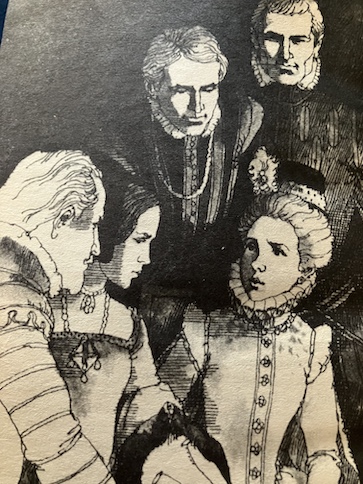
Don’t let the cover of this book fool you! Yes, it’s a 19th century novel for young girls, and there’s a strong morality aspect to the story, which is common for Victorian novels, but the story is not nearly so sweet and flowery as the cover indicates. This book is Dark Academia over 100 years before the term “Dark Academia” was coined and the genre/aesthetic became what it is today.

The story begins on an autumn evening. Priscilla (often called Prissie as a nickname) lives in a small country cottage with her aunt and her younger sisters, and she is packing to go to a college for young ladies. Her aunt isn’t sure about this recent trend of girls getting an education, but she is still proud of her niece. They discuss some last-minute advice for Priscilla, and although her aunt doesn’t have much money, she promises her a little extra as an allowance while she’s away. Priscilla says that she’ll write to her aunt, although probably not very often because she will be busy studying.

Priscilla’s three younger sisters will be remaining at the cottage with their aunt while she is away. Aunt Rachel, called Aunt Raby, is very strict, and the girls aren’t allowed to have much fun, so Priscilla’s sisters will miss her while she is away. Priscilla says that she will be at college for three years, and that she will visit when she can, at least once a year. Then, when she graduates, she will look for a good job so she can make a home for herself and her sisters together.

The younger sisters don’t entirely know it yet, but the stakes are high in the success of Priscilla’s education. Their father died when Priscilla was only 12, and their mother died when she was 14, which is when they moved in with their aunt. That was four years ago because Priscilla is now 18. There was a bank failure before their parents’ death which wiped out their savings, so the sisters have been entirely dependent on their aunt and her farm for support. The aunt works hard and has provided for their basic needs, although the family has no luxuries, and there was never really any expectation that the girls would have any education at all. However, Priscilla loves to read and has a talent for learning, so she has been teaching her younger sisters as best she can. The local minister, noticing Priscilla’s talent for learning and feeling fatherly toward her, has given her some extra tutoring in the classics, and he is pleased at how well she has managed the material.

The problem is that the girls’ aunt is now ill. She will not die from her illness immediately, but there is no cure for what she has (which is never explicitly named), and she and Priscilla know that she will die from it eventually. Over a period of two or three years, she will gradually become weaker, and she is already showing signs of that weakness. The aunt’s farm is legally entailed for another relative, so Priscilla and her sisters will not inherit anything from her and will have to find some way of making their own living after their aunt is gone. Priscilla goes to the minister and explains the situation, saying that she will have to stop her lessons and begin seriously learning skills that will help her find a job and support her sisters. She regards learning as a luxury that she will now have to go without.

Her first thought is that she should improve her sewing and become a dressmaker, but the minister can see that she doesn’t have much talent in that direction. He tells her that, besides being a pleasure, learning can also be a means of making a living. He thinks that Priscilla has the talent to become a teacher because of her learning ability and her skill in teaching her sisters. However, to become a teacher, Priscilla will need to attend college and graduate. At first, Priscilla doesn’t see how she can afford college, but her aunt sells her watch and the little jewelry she has, and the minister helps her take out a loan to pay for her education. He also helps Priscilla to study to pass the entrance examinations at St. Benet’s College for Women. Priscilla will need to do well in college for her sake and for the sake of her sisters’ future. People are depending on her, and she doesn’t want their help and sacrifices for her to have this chance in life go unrewarded.

The rest of the book is about Priscilla’s first year at college. During that time, she suffers from homesickness and social awkwardness because she has not been schooled in the intricacies of social manners and social classes. She confronts prejudice from the other students because she is poor, and they pressure her to act like they do and spend money as recklessly as they do. Priscilla has to learn to resist these pressures and temptations. It isn’t too difficult for her because she finds many of the girls at college to be shallow and not serious about her studies, and she doesn’t really admire them. However, she is soon befriended by a girl named Maggie, who is outwardly charming but inwardly miserable and complex.

Maggie’s friendship is often toxic to other girls, and Priscilla can see that she isn’t always honest and that she is not as devoted to other people as they are to her. She uses people for attention and affection, but Priscilla becomes fascinated with Maggie because she comes to realize that Maggie has layers and some of them are genuinely noble. For reasons that Priscilla doesn’t fully understand, Maggie is deeply troubled by the death of another student who once lived in the room that Priscilla now has at their boarding house. It seems like everyone at the boarding house is haunted by memories of Annabel Lee, and Maggie was once Annabel’s best friend. Maggie is moody and fickle in her temperament, and she hasn’t been truly close to many people since Annabel died, although she can charm people into do giving her attention and doing things she wants them to do. Priscilla has to be careful not to let Maggie manipulate her into getting into trouble, but she also benefits from Maggie’s friendship and has a way of bringing out Maggie’s better side.

During the course of the story, Priscilla has to face girls who don’t really want her at the college and who try to sabotage her socially and pressure her to leave. She also has to remind herself of her goals and the reasons why she came to college. When Priscilla is accused of a theft, both she and Maggie receive help from some mutual friends to realize the truth of what happened and the identity of the real thief, and Maggie is forced to confront a painful incident from her past that is still haunting her and which is the major reason why she acts the way she does.

There’s a lot more to unpack here, and I want to cover the story in more detail. If you’d like to stop here and read it for yourself, you can skip the rest of this.

The book is now public domain. It is available to borrow and read for free online through Project Gutenberg and Internet Archive (multiple copies, including an audio version). Later versions of this book were published under the title Priscilla’s Promise.

When Priscilla gets to college, she settles into her boarding house, which called Heath Hall and is run by Miss Heath. It isn’t until she gets to the boarding house that Priscilla realizes just how nervous and homesick she is. Because of her nervousness and the strangeness of living in a new place, she doesn’t present herself very well to the other students at first.

When she clumsily drops a coin, another student, Maggie, picks it up for her, and this is their first introduction. Maggie can tell right away that Priscilla is nervous and frightened, and her immediately impulse is to take Priscilla under her wing. Nancy, Maggie’s best friend, cautions her about how she treats new students. There are other students Maggie has been friends with when they first arrive, but she treats them like novelties. She acts like a friend and mentor for a couple of weeks, winning the girls’ confidence and making it seem like the start of a lifelong friends, and then tires of them and simply drops them. Nancy doesn’t think it’s right for Maggie to do this to the new girls, although Maggie brushes off her concerns. Nancy likes Maggie because she can be very sweet and fun, but she also recognizes that Maggie can be trouble, and she is sure that Maggie is going to recklessly cause some problems before she is finished with her education.

Maggie and Nancy notice that there is someone moving into the bedroom next to Maggie’s in the boarding house, and Maggie is upset because that room belonged to Annabel Lee. Annabel Lee was another student at the boarding house who was very popular with the other girls, but she tragically died of an illness. Nancy is practical and says that they couldn’t very well expect that room to be simply left vacant now that Annabel is no longer there. It’s just natural that the boarding house would rent it out to someone else eventually. Maggie is more emotional and says that they ought to have left it as a shrine to Annabel and that she is sure that she will hate the person who lives there. Nancy sighs, and when Maggie goes into her room, Nancy decides to introduce herself to the person who now occupies Annabel’s room, who turns out to be Priscilla.

Priscilla is unaware of who Annabel was, and she is still struggling with her nervousness and homesickness. Because Priscilla is trying to cover up for how nervous and awkward she feels, her manner just strikes Nancy as being cold and awkward, which makes Nancy feel awkward while talking to her. Nancy briefly introduces herself but doesn’t stay to chat long, although Priscilla secretly wishes that she had.

Priscilla continues to make mistakes through her first evening at the school. When she goes down to dinner, she enters the dining hall through the door that is normally reserved for the dons (teachers), and she sits at a table where the higher level students normally sit instead of with the other freshmen. Other students in the dining hall start talking about the nerve of some freshmen, getting above themselves, but Priscilla nervously isn’t sure what they’re talking about. Fortunately, Maggie decides to step in and help Priscilla.

Maggie sits next to Priscilla and gently explains to her what she did wrong. Miss Heath gave Priscilla a list of rules when she moved into her new room, and there was nothing about any of this in those rules. Maggie explains that there are certain, unspoken rules and customs among the students. Even though the students are supposed to be modern, liberal, and democratic by the standards of their day as part of this new generation of women seeking a higher education, Maggie admits that, deep down, they are still very conservative. She says this classist side of themselves shows itself whenever someone breaks their unspoken rules and social customs or steps out of their proper place. Priscilla thinks that the students at this school are cruel if they expect someone new to know rules that aren’t written or spoken about and that she is starting to wish she hadn’t come. Maggie hurriedly soothes her, saying that they’re not really that bad, and she invites Priscilla to her room to talk later so she can explain some things to Priscilla that she will need to know.

Nancy also steps in and tells Priscilla that most of the students take their tea up to their rooms after the meal, asking her if she would like to do the same. Priscilla, still nervous, decides that she will skip the tea tonight. Nancy says that, since this is the first night, she will want to spend the rest of the evening unpacking and that other girls in the boarding house will come to call on her. Priscilla asks her why they’re going to do that. Having lived on a farm, in a family that wasn’t very socially active, Priscilla knows less about social manners than she does about anything else. She isn’t accustomed to informal visits from people. Visits for her are usually more formal occasions, and she particularly has no idea what she’s going to say to these strangers who will be coming to call on her. Nancy, seeing that Priscilla is nervous and doesn’t know how to cope with the social aspects of the school and life in the boarding house, tells her that these are simply informal visits so the other students can introduce themselves to the new person in the boarding house. Nancy offers that, if Priscilla would like, she can spend the evening with Priscilla and help facilitate these introductions. Priscilla nervously murmurs that she would like that.

The boarding house is more luxurious to Priscilla than anywhere that she has previous lived, but it also feels cold and un-homelike to her. The other girls are bright and chatty, and Priscilla finds them a little overwhelming. When the other girls come to visit Priscilla, they also comment about Annabel, who used to live there, and how the room looks more bare without her and her things. It seems like the other girls are there mostly to see the room and remember Annabel than to see Priscilla, and Priscilla is too shy to know what to say to any of them. One of the girls kindly says that the place will seem better once Priscilla has really moved in and has a chance to add her own decorations. Another girl says it will never be the same as when Annabel was there, but the kind girl suggests some shops where Priscilla can find some room decorations and offers to go shopping with her.

Then Nancy arrives and intervenes, seeing how overwhelmed Priscilla is and encouraging the other girls to leave. Nancy offers to help Priscilla unpack and goes to borrow some matches from Maggie because Priscilla doesn’t have any to light a fire. Priscilla accepts the matches but tersely declines the offer of help unpacking because she doesn’t want Nancy to see how meager her possessions are. Nancy awkwardly says that she will wait in Maggie’s room and that Priscilla can join them for cocoa later. It’s a custom of the boarding house for the girls to have cocoa in the evening, and they often invite friends in the boarding house to their rooms to share cocoa and chat before bed. Maggie later calls Priscilla to join them for cocoa but refuses to enter Priscilla’s room herself, still too affected by the memory of Annabel.

Priscilla goes to Maggie’s room, and the girls have cocoa together. Nancy isn’t there because she has gone back to her room to do some work, and Priscilla finds Maggie charming. Maggie has a way of putting people at ease, and Priscilla finds herself telling Maggie about herself and her reasons for wanting an education. Before she leaves, Priscilla asks Maggie about Annabel because of what the other students have been saying about her. To Priscilla’s shock and surprise, Maggie immediately becomes distressed and refuses to talk about Annabel, bursting into tears. Fortunately, Nancy arrives and reassures Priscilla that Maggie will be all right. As Nancy walks Priscilla back to her room, Priscilla asks her about Annabel. Nancy doesn’t really want to talk about Annabel, either, but she tells Priscilla that Annabel was a very popular girl at school who is now dead, and she says that it’s better if Priscilla doesn’t talk about her now.

All the same, the other students at the boarding house won’t stop talking about Annabel Lee. Although Priscilla doesn’t really believe in ghosts, it feels to her like Annabel still haunts the boarding house and her room in particular. Everyone seems to have memories of her, and Priscilla’s presence and her occupation of Annabel’s old room brings them out. Priscilla is often left with the awkward feeling that she has somehow usurped Annabel’s place, or at least, that other students feel like she has. She wishes that she had been given some other room in the boarding house. Even Annabel Lee’s name reminds her of the song by Poe, which is familiar to Priscilla and which is about a love that survives beyond death. (I think the author picked that name on purpose because of the song.)

Before that first evening is over, Priscilla realizes that she has misplaced her purse somewhere. This is serious because it has her key in it and the little money she has. She goes looking for it, and she overhears Maggie and Nancy talking about her. Maggie assures Nancy that Priscilla will not replace Nancy in her affections. Maggie calls Priscilla “queer” (in the sense of “strange”) and admits that she is nice to younger girls at college because she craves their affection. Maggie says that it gives her “kind of an aesthetic pleasure to be good to people.” She knows that she has an ability to inspire affection in other people, and she absolutely craves seeing the look of grateful affection she gets from the younger girls she helps at school. Nancy asks her if she ever returns the love that she receives from other people, and Maggie says that she does sometimes. She says that she is very fond of Nancy and kisses her.

(Note: This conversation isn’t necessarily proof that this is a lesbian relationship, which would have been not only shocking but actually illegal in England during the time period of this story. The book was published in 1891, and later in the 1890s, Oscar Wilde was tried and convicted for homosexual acts, although part of his conviction was also that he committed acts with underage boys, which would still get him a conviction by modern standards.

Certainly, lesbians did exist during this period of history, and it’s possible the author might know more about it than she could explicitly state and may be basing the characters’ feelings off of people she knew or met herself. However, modern readers might want to hold off firmly deciding what the real relationship between Maggie and Nancy is because there are other factors that are revealed later in the story. In particular, Maggie is a complicated character, who cultivates relationships for attention and to fill some dark emotional needs, and these relationships are not honest because there is not necessarily any real affection or romantic interest behind them. Maggie does have a male admirer, who we hear more about later, and we also eventually learn why her relationship with him is complicated.)

Priscilla, who is a sincere girl of strong morals and deep affection, is shocked at the way that Maggie and Nancy talk to each other and about her, and she quickly returns to her room without finding her lost purse. She is angry about what she’s heard because, although both Maggie and Nancy have been friendly to her and helpful that evening, Priscilla can see that neither of them really likes her or cares about her. Maggie was just pretending to be nice just to get attention, and Nancy is jealous of her for the attention that Maggie has given her. Although these types of feelings are completely alien to an inexperienced and unsophisticated girl like Priscilla, she has just had her first taste of toxic friendship, and she is about to learn more.

When Priscilla is unpacked, and her meager personal belongings begin to fill her room, she starts to feel a little more at home, and she even begins to enjoy some of the newness of the college experience. She has more freedom at college than she ever has before, although she realizes that there is still a routine to college life, and conscientious girls follow the routine and both the written and unwritten rules of college society.

The book explains that life at college is somewhat like life at school, but much less restrictive because the students are considered young ladies rather than little girls. The freshmen are about 18 years old and are expected to graduate at about age 21, so all of the students are expected to behave as young adults. They are not closely monitored, and no one hands out punishments to students for neglecting their studies or misbehaving in minor ways. (What happens when students misbehave in major ways is addressed later in the book.) Basically, as long as the students are not breaking any laws or explicit rules and are not causing anyone serious harm or seriously disrupting the life of the college, there is little intervention. The students are expected to manage their time at college and organize their social lives and relationships with others by themselves. They are also not restricted to the college or boarding house. They may leave the college at any time for shopping or social engagements, although it is considered polite to let Miss Heath know where they are going and when they will be back, and they must be back before lights out. Priscilla has never been to school before, and she finds the unwritten social rules and the personal machinations of the other girls the most difficult part of her education.

Every morning, the girls in Heath Hall get up and start the day with prayers in the chapel. Nobody makes them go to chapel, but they generally do anyway because it’s expected, and participation in the routine activities helps them get along better. Then, they go to breakfast, where they select the foods they want to eat because the meal is served in the style of an informal buffet. Then, the students look at the notice boards. There is one notice board for announcing the lectures for the day and another for student clubs and social activities. The students use these announcements to plan their day. The mornings are always for educational lectures. Sometimes, there are more lectures in the afternoon, but there are also sports, gymnastics, and social activities. Nobody checks attendance at any of the lectures or activities, and if someone chooses not to attend something, nobody checks up on them. They can have lunch whenever they like, between noon and two o’clock in the afternoon, and the students typically have their afternoon tea in their own rooms, sometimes privately and sometimes with guests. Students study privately in their rooms whenever they like, and there are club activities between tea time and dinner, for those who wish to participate.

Priscilla has difficulties with the other students because she refuses to participate in the social activities of the college or go shopping with the other girls when they invite her. She even turns down invitations from other girls to have cocoa with them in the evening and chat, like she did with Maggie that first night at the boarding house. Having learned more about what Maggie and Nancy are really like, she becomes cold and distant with them, discouraging their friendship, but she also turns down possible friendships with the other students.

One day, two of the students criticize her for being unfriendly and not participating in the social life of the college. Everyone has noticed that Priscilla hasn’t even put up pictures or decorative knickknacks in her room or even purchased comfortable easy chairs for visiting, like the other girls have. Nancy tries to defuse the building arguments and criticism by saying that they mustn’t criticize the “busy bees”, the serious, studious students at the college because they are the foundation the college was built on. However, the other girls complain that college is also for fun and socializing, and if Priscilla is smart, she’ll stop fighting it and start participating with the other students.

The other students are about to walk out on Priscilla during this argument, but Priscilla stops them and shows them what she really has in her room. She shows them her empty trunk and explains that she has no pictures or knickknacks to put up in her room. She also shows them the contents of her purse (which she did find after she lost it) and how little money she actually has. She hasn’t gone shopping with the other girls or bought things for her room because she simply can’t afford them. She is from a poor family, and she is serious about her studies because she has to be, and her future depends on it. She acts the way she does because this is the life she lives, and this is what is right for her and her situation. The other girls just don’t understand because most of the girls at college are from wealthier families, and they’re not in her position. Priscilla has realized that she’s different from the other girls, but she doesn’t admire the other girls because she has already seen that there are problems with their behavior and priorities. She openly lets them know that she isn’t intimidated by them and will not be pressured into acting like they do because she simply can’t. It wouldn’t help her with her life or goals. The other girls are embarrassed and a little ashamed of themselves for not realizing her situation and for their shallowness and frivolous privilege. They leave Priscilla without saying anything else.

Nancy reports this conversation to Maggie and says that she admires Priscilla for her bravery in standing up to the other girls. Nancy never liked those particular girls because they are shallow, but she never had the nerve that Priscilla had to tell them off in that matter-of-fact way. Maggie asks Nancy if she’s going to worship Priscilla now, and Nancy says no but that she still admires Priscilla’s bravery. Maggie says that she doesn’t want to hear more about it because she doesn’t like hearing things about “good” people and their virtues, something which bothers Nancy. Nancy tells her to stop pretending that she doesn’t like goodness and morality, but Maggie says she really doesn’t. Hearing about Priscilla especially bothers Maggie because, although Priscilla initially opened up to her, she has not shown that grateful admiration toward her since that first evening, when she overheard Maggie talking to Nancy.

Maggie also has an unhealthy attachment to the memory of Annabel, and it still seriously bothers her that Priscilla has Annabel’s old room. Maggie can’t bring herself to look into Priscilla’s room or be reminded about Annabel, for reasons readers still don’t fully understand. Everyone liked Annabel at school, and people are still haunted by her memory, but for some reason, it’s worse with Maggie than with anyone else. She privately thinks that she cannot really feel love since she lost Annabel. It seems like Maggie had a similar sort of unhealthy attachment to Annabel as Nancy now has to Maggie.

This is where we begin to learn what is really going on with Maggie and what makes her tick. Maggie is not a happy person on the inside. In fact, she thinks of herself as the most miserable student at the college. Inwardly, she doesn’t think of herself as being either a good or lovable person, in spite of her outward charm and ability to inspire people to love her. She doesn’t really love herself. That’s why she always craves expressions of love and devotion from others but doesn’t seem able to really form relationships with others and maintain them.

However, there is one thing that really makes Maggie come alive. She loves the intellectual life of college. She forgets her misery when she loses herself in reading and translating classical works. Even her joy of classical studies can’t entirely distract her from her worrying love life. It’s a somewhat open secret that Maggie has a male admirer who writes to her sometimes, and this is a source of jealousy for the other students, especially Nancy and Rosalind (another younger girl that Maggie has been cultivating as an admirer), who both view this young man as a rival for Maggie’s attention and affection.

Although Priscilla recognizes that Maggie is a false person who is mainly nice to other people for some selfish fulfillment, she can’t help but be fascinated by her charm and intelligence. Maggie tries harder to get Priscilla’s attention because she still craves attention and affection, and she views Priscilla’s reluctance to give her what she wants sort of like her playing hard-to-get. Priscilla’s attempts to ignore her just make her want to try harder to win the prize she craves.

Miss Heath, who doesn’t seem to understand some of the unhealthy admiration other students have for Maggie, encourages Priscilla to not burn out on her studies and to give herself time to make friends like Maggie and to enjoy the social aspects of school life. She says that she has seen other serious students take on too much, burn themselves out, and fail to finish their education before. Priscilla, who has never been to school before, takes Miss Heath’s advice seriously.

Maggie discovers that Priscilla loves flowers, and she uses them to appeal to Priscilla’s love of beauty. She uses aesthetics and intellectual discussion to appeal to Priscilla’s love of study and the pleasures of learning. Gradually, Priscilla finds herself become more of a friend to Maggie. She confronts Maggie about what she heard Maggie and Nancy say to each other on their first night in the boarding house, but Maggie brushes away Priscilla’s concerns. She claims that she only said those things to punish Priscilla for being naughty by eavesdropping. Soon, Maggie and Priscilla are doing many things together, from going to church services together to having cocoa in Maggie’s room in the evening and talking about their studies. It seems harmless enough, and some people are a little relieved because Maggie had given up doing many things that she used to do with Annabel, when she was alive, because they reminded her too much of Annabel. It seems like Priscilla has somehow inspired Maggie to do things that had become emotionally painful to her, and some people think it’s nice that Maggie has found a new best friend and is moving on.

However, as I said, not everyone understands Maggie’s toxic friendships, the unhealthy attachment some of the other students have had to both her and the deceased Annabel, and her manipulation of other people. The ones who do understand these things are some combination of jealous and troubled, and Priscilla, who is still relatively naive, hasn’t grasped the precariousness of her social situation. She has to learn to walk a delicate line between staying true to herself and her goals and between staying on good terms with her new friends. It’s fine for her to like other people, like Maggie, but not to be led astray by them. She has also attracted attention from some other students who resent her and feel threatened by her.

The two girls Priscilla told off earlier about their wanting her to participate in frivolous social activities and spending money are bitter about their embarrassment and how Priscilla made them them look shallow by demonstrating her poverty and virtue. They’ve been going around the school, telling everyone the story of what Priscilla said, but casting Priscilla in a bad light. They try to make Priscilla seem like a self-righteous prig who is trying to shame them for participating in normal social activities. Their fear is that, if other girls at college like Priscilla and decide to imitate her, austerity will become the fashion of the day. They think that they will either not be allowed to participate in their social activities and forced to keep their noses to the grindstone from now on or will be shamed for having nice things in their rooms while Priscilla doesn’t. They don’t want to be pressured to give up these things or forced to study as seriously as Priscilla does, so they do their best to ruin Priscilla’s social reputation, discourage other girls from being her friend, and try to get other students to gang up on her.

Their efforts are partly foiled because Maggie is popular, and Priscilla has become Maggie’s special friend. Nancy is also Priscilla’s supporter because she was present during their confrontation with Priscilla and stands up for her against the other students. Although Maggie and Nancy seem to have a toxic friendship with each other, and Maggie develops a series of toxic friendships with other students, Maggie and Nancy become Priscilla’s protection against even more toxic students. Miss Heath and the teachers at the college also appreciate Priscilla and her work at the college. However, unbeknownst to Priscilla, the more shallow girls still resent her and are plotting against her.

Rosalind knows of the unhealthy attachment other girls at college have to Maggie because she also shares it. Rosalind is one of the younger girls Maggie has cultivated as an admirer but has largely neglected since she became tired of her and more interested in Priscilla. Maggie and Annabel were once the college’s power couple/friendship duo, although Annabel was the more popular of the two. Other girls even save pictures and autographs of Maggie and Annabel as souvenirs, like they’re celebrities, and Rosalind herself has a picture of Maggie that she sometimes kisses.

Since Annabel’s death from a sudden illness, Maggie has been the undisputed social queen, although Maggie’s thrill at the attention she receives is somewhat dampened by her sense of loss because she was truly attached to Annabel herself. She craves attention and admiration and can’t help but pursue it, but she doesn’t feel like she really deserves it. Not all of the other students really admire Maggie. Some of them see her for the manipulative girl she really is, and they get sick of hearing the others rave about her or talk about poor, tragic Annabel.

However, Rosalind’s resentment of Maggie’s indifference to her after manipulating her affections has made her admiration of her turn to hate. She tells another girl that she’s thinking that she should tell Miss Heath about the unhealthy attachment other girls have to Maggie and get her to put a stop to this Maggie admiration cult. (I would have been in favor of this, but sadly, that’s not what Rosalind does.) Then, Rosalind and the girls who resent Priscilla get the idea of ruining Maggie’s friendship with Priscilla and bringing them both down this way.

Rosalind tries to find ways to embarrass Priscilla socially and drive a wedge between Priscilla and Maggie. One day, she convinces Priscilla to go into town with her to pay her dressmaker, insisting that the dressmaker needs her money for her sick mother and that she wants company on the errand. Nancy tries to discourage Priscilla from going because the weather is bad and Priscilla has a cough, but Priscilla says that Rosalind talked her into coming. Since she promised, she has to go. Rosalind makes Priscilla wait in the cold and drizzle while she goes inside to pay the dressmaker and then takes Priscilla on another errand to see a friend before they go back to the college.

When they get inside this friend’s house, Priscilla realizes that Rosalind has tricked her into attending a party instead of just paying a short visit to a friend. Priscilla is under-dressed for this party and damp from her time outside, which is embarrassing. To make matters worse, Rosalind simply abandons her in a corner. Priscilla can’t bring herself to leave the party without Rosalind because she would be in trouble for returning to the college without her when everyone knows that they left together, and she can’t bring herself to search the party for Rosalind and demand that they leave because she feels out of place in her shabby clothes. She hears the fancy, catty women at the party gossiping about other women and the frumpy “girl graduates” of the college. Fortunately, the hostess of the party realizes that Rosalind has been treating Priscilla shabbily and makes her comfortable with some tea.

Then, Geoffrey Hammond, the young man who has been writing to Maggie, recognizes Priscilla and comes to talk to her. Priscilla explains her predicament and how Rosalind tricked her. Not only has Rosalind deprived her of study time by getting her to come to town on her errand and to this party, but if they don’t leave the party soon, they won’t get back in time for dinner, which would break one of the written rules of the college. Taking pity on her, Hammond goes to find Rosalind and talk to her. When he returns, he says that Rosalind has told him that she already told the principal of their college that they would be late for dinner, so they are excused. Priscilla is angry that Rosalind did this without talking to her, and she starts to create a fuss, but Hammond quiets her down, realizing that she is making a scene. He knows that she was nastily tricked, but he says, since they can’t get back to the college in time for dinner now, it would be more socially graceful for her to enjoy this party as best she can and then have words with Rosalind when they get back to college.

The two of them spend the rest of the party discussing The Illiad and The Odyssey. Priscilla shines in intellectual discussions about the classics, so Rosalind is a little jealous when she sees how well Priscilla is doing. She tries to ruin the moment by pretending that Maggie gave Priscilla a letter to give to Hammond and that Priscilla has either lost it or is withholding it. However, Hammond knows that Priscilla didn’t even know she was coming to this party and doesn’t fall for Rosalind’s story, disapproving of her. On the way back to the college after the party, Priscilla lets Rosalind know exactly what she thinks of her mean trick.

Later, at a cocoa party at the college, Rosalind tells the other students about the party, emphasizing Priscilla’s awkwardness and disdain of the fun. Then, she accuses Priscilla of flirting with Geoffrey Hammond. Everyone knows that Geoffrey Hammond is Maggie’s young man. The other girls don’t think Maggie treats him well, and some of them think they would be better for him, but they know that he’s devoted to Maggie. Rosalind is trying to make Priscilla look like a boyfriend-stealer.

Meanwhile, one of the girls at the college, Polly, has gotten badly into debt. Although most of the girls at the college are pretty well-off, compared to Priscilla, even girls from wealthy families can get into trouble with money, if they’re not careful. Polly admits that her father told her not to spend above her allowance, but she is accustomed to spending freely. Now, she owes a considerable amount of money, and the only way she can think of to raise what she needs without telling her father what she has done is to sell some of the lovely things she’s bought to furnish and decorate her room and some of her fancy clothes. Her friends at the college, who all admire her nice things, are all eager to buy things from her. Their only concern is to remind her not to sell anything that would belong to the college, only her own belongings.

All of the girls at college, except for Priscilla, are invited to attend the auction. They exclude Priscilla because they know she doesn’t have money and they think “Miss Propriety” would snub the event and perhaps tell the principals about it. Really, the other students don’t think the principals of the college would approve of this auction, so they’re careful to keep the event secret from them. Originally, Maggie wasn’t planning to attend the auction, although she was invited, because she doesn’t know Polly and doesn’t care for this kind of auction. Then, Rosalind badgers her into going, saying that she has become too proper, self-righteous, and basically, no fun anymore. Maggie cares about her social reputation, so she decides to go to the auction, and to Priscilla’s surprise, she drags Priscilla with her. This turns out to be a bad thing for Rosalind because now Maggie is angry with her and determined to teach her a lesson.

Maggie doesn’t really want anything at the auction and resents being pushed into going, but because she is one of the richest girls at the college, she can afford to bid much higher for anything there than the other girls. She knows the things that Rosalind wants to buy for herself, so she purposely bids on the items that Rosalind wants. It’s bad enough when Maggie wins the bid for a sealskin jacket that Rosalind really wanted by bidding higher than Rosalind ever could, but it’s worse when Maggie intentionally ups the bid for some coral jewelry and then lets Rosalind win it at a price that’s higher than Rosalind can actually afford. Now, Rosalind owes money to Polly. Even worse, when Rosalind writes to her mother to ask for more money, her mother tells her to return the jewelry she bought and to send the money she’s already spent back to her. It was really more money than her mother could afford to give her, and she only lent it to Rosalind because Rosalind said that she could get a bargain on a sealskin coat, which is a valuable garment. The jewelry is more extravagance than Rosalind’s family can afford.

All of the girls who attended the auction get into trouble for being there because the activity wasn’t sanctioned by the college, and the heads of the boarding houses find out about it. That means that Priscilla is in trouble for attending, too, even though she didn’t buy anything. Nancy asks Maggie why she went when she knew it would probably be trouble, and Maggie says that Rosalind brings out her worst side.

Maggie hates herself partly because she knows that she has a good side and a bad side to her nature, and she finds it hard to manage or cover up her bad side. Sometimes, she just gets moody and temperamental. She doesn’t want to pretend to be good all the time, even though she knows she’s supposed to restrain her worst impulses to get along in society. That’s why she finds virtuous people so trying. She has a hard time struggling with her inner nature and doesn’t like herself. She can’t understand people who aren’t the same, who seem to find it easier and more pleasant to be good all the time and who aren’t subject to the same dark moods and temptations that she has. Even so, Maggie still considers good and proper Priscilla her friend because Priscilla is sincere in her friendship for Maggie and brings out more of her better side, and Nancy, who respects virtue, still loves Maggie, even knowing her complicated nature and how she feels about herself. So, while Maggie’s friendships with Nancy and Priscilla seemed toxic at first, when she was looking at it from the perspective of how she uses them to bolster her self-esteem, we start to see that there are positive sides to these relationships. Both Priscilla and Nancy care about Maggie, even when she struggles to care about herself or them, and they encourage Maggie to be a better version of herself.

The episode of the auction, while getting the girls into trouble is actually a turning point in Maggie’s character development. Polly, Maggie, Priscilla, and other girls from the auction are called before Miss Eccleston, the head of Polly’s boarding house, Katharine Hall, to explain themselves and the auction. Polly explains how she got into debt and couldn’t bring herself to ask her father for more money. Miss Eccleston lectures Polly about the need to manage her money better and avoid spending more than she can afford. Then, she questions Maggie about why she was at the auction because, as one of the senior students, she should know better. Maggie takes responsibility for her presence at the auction and also Priscilla’s, saying that Priscilla is only a new student at college and that she insisted that Priscilla come with her. Miss Eccleston asks Maggie what she bought at the auction and if she paid a fair price. Maggie admits that what she paid for the jacket was less than its true value. Maggie accepts responsibility for her actions and tries to shield Priscilla as much as possible from the fallout of the situation, not wanting her impulsive decisions to negatively affect her.

Miss Heath and Miss Eccleston lecture the girls about the importance of moral principles at the college, but Maggie stands up for herself and the other girls. She honestly admits that she is not proud of herself and her role in the situation. However, she points out that, although Polly’s debt was shameful and her abuse of the allowance from her father, her dishonesty about her spending to her father, and the secret auction were all improper, none of the students have actually broken any explicit rules of the college. Miss Heath and Miss Eccleston are concerned with disruptions to the the boarding houses and how the students’ behavior reflections on the college. Maggie’s argument is based on the fact that none of the students are children, and how they conduct their personal affairs isn’t the business of the college, even if they haven’t conducted themselves well here. Arguing with the heads of their boarding houses goes against their authority and is disrespectful, but Miss Heath and Miss Eccleston say that they understand Maggie’s point and will take it into consideration when they decide how they will proceed and what they will say to the college authorities.

The students themselves appreciate Maggie speaking up on their behalf, but they’re also divided in how they feel about the auction and even about Maggie’s defense of what they’ve done. Some of the students, who never took the auction seriously, think that Miss Heath and Miss Eccleston were making too much of the situation and that Maggie was right to tell them so. However, the more serious girls have realized that what they did was improper, and even though Maggie was trying to defend them from consequences, her defiance and disrespect of authority in the situation has broken one of the unspoken social rules of the college.

The social order that keeps everyone at college more or less in harmony has been shaken by the incident and by the students’ mixed feelings about the situation, and they’re not sure how to make it right. Some students think that the residents of Heath Hall should stand behind Miss Heath and Maggie and their position that, while the auction was inappropriate, the students have learned their lesson from the experience and should be treated leniently. Others think that it was all beyond the bounds of proper behavior, and they no longer wish to associate with Maggie because of her defiant attitude. The students who never attended the auction are irritated by the students who did because they think they are bringing scandal on the college, and by extension, on them. They don’t want to risk their families criticizing them or removing them from the school because they find out what happened and are scandalized by it. The students who weren’t at the auction didn’t do anything wrong, and they look down on the other girls for causing trouble. Everyone is unhappy that the harmony of the school has been shattered, and students are pressuring each other to take sides in the controversy.

Rosalind is even more vindictive toward Priscilla after the auction incident and tries again to blacken her name around the college. She tells the other students that Priscilla was the one who told the faculty about the auction and got them in trouble, even though Priscilla was there with them and is now in trouble, too. She also repeats the story of Priscilla flirting with Geoffrey Hammond at the party. Maggie knows that Priscilla said that Hammond was nice to her at the party, so she tries to ignore what Rosalind says, and Nancy makes it clear that she doesn’t want to hear Rosalind’s sour gossip.

The fallout of the auction incident causes some students to change their minds about their relationships with each other and some to change their behavior. Rosalind tries to ingratiate herself to Geoffrey Hammond because she likes him and tries to blacken Maggie’s name to him to ruin their relationship. Maggie’s affection for Priscilla sours when Priscilla insists on speaking privately with Geoffrey Hammond and that she doesn’t want Maggie to hear what she has to say. Maggie thinks that maybe Priscilla has designs on Geoffrey Hammond, but that isn’t the case. Really, Priscilla wants to have a frank talk with Hammond about both Rosalind and Maggie.

Priscilla likes Maggie, but having gotten to know her, she has a realistic sense of what Maggie is really like now, both her good side and bad side. She recognizes that Maggie is a flawed person, and this is what she doesn’t want Maggie to hear her say to Hammond. She tells Hammond that she finds Maggie fascinating because she has never before seen such a flawed person who also has such a sense of nobility. She doesn’t want Maggie to hear her speaking of her flaws, but like Nancy, Priscilla knows that Maggie has them and yet has likeable and honorable qualities, like the way she admitted her faults at the same time as she defended her fellow students to the heads of their boarding houses. Hammond understands what Priscilla means because he feels the same way about Maggie. Both of them also understand that Rosalind is dishonest, and Hammond believes Priscilla when she says that Rosalind is saying untrue things about Maggie to ruin her reputation.

Maggie’s behavior toward Priscilla becomes colder because of the suspicions that she harbors about what Priscilla said to Hammond. She continues to act as a friend, but she’s not as warm as she was becoming with Priscilla before. Hammond sees what’s happening between the girls, and he is critical with Maggie about the sealskin coat that she bought too cheaply from Polly. Maggie didn’t really want the coat originally, and she’s a little ashamed of having it, so she returns it to Polly. Polly says that she can’t afford to repay Maggie for it now because she really needs the money, but Maggie tells her not to worry about it. If she likes, she can consider the money a loan and repay her during the next school term, which pleases Polly. This is part of Maggie’s nobler side.

When Priscilla goes home for Christmas break and sees her aunt and sisters, they welcome her. Priscilla is astonished when she sees how rough and cramped the little cottage seems to her now that she has become accustomed to the beauty and comfort of the boarding house at college. When she notices how her aunt has become more sick, she feels guilty for her feelings. Her little sisters are upset about her returning to college, and one of them accuses her of forgetting about them and having fun in college rather than making any money. It’s true that Priscilla has been studying and not earning money yet, and she feels guilty that she hasn’t thought much about her aunt or sisters while she was away.

She confides all of this to the minister, and he says that he understands. He thought that she might have feelings like this because of all of the changes she’s been experiencing in her life and her new glimpse of the wider world and the possibilities of life that lay ahead of her. He says that what she is feeling is natural and that she’s over-analyzing it. Priscilla is just currently preoccupied by all the new experiences that she’s been having. She’s been adjusting to all the changes she’s experiencing, and her view of the world is wider now than the narrower one she had when she just lived on the farm.

Priscilla also tells him a little about her friendship with Maggie and how much influence Maggie can have over her, that sometimes she feels like she would do anything for her. The minister reminds her that she would also do anything for her aunt and sisters. This new relationship, like the new experiences she’s been having in college, is fascinating to her for its newness, but he doesn’t think that it has replaced her older and deeper affections. She may have temporarily found herself overwhelmed and preoccupied with everything that’s new to her, but what is deep and most important to her is what will last.

Priscilla worries whether it’s right for her to be away at college with her aunt so sick, but the minister insists that she go back to college and her studies because it’s still important to her future, and her aunt wants her to continue. Her aunt confirms this. She understands that Priscilla is bookish person, like her father. While she appreciates her niece’s care and devotion, she knows that her niece has a future ahead of her, and she wants her to build her future.

In spite of the now-strained friendship between Maggie and Priscilla and Rosalind’s resentment against them both, Priscilla must return to the college and finish her studies. Priscilla tells Maggie that she needs to give up the classical Greek studies that they both love and focus on modern languages instead. It pains her, but Priscilla knows that she has almost enough education for a teaching position, and she must focus on the most practical studies for getting a job as soon as possible for her sisters’ sake. For the first time, Priscilla fully explains to Maggie the true circumstances of her family. This revelation and their shared love of classical studies brings out Maggie’s better nature once again, and she is inspired to find a way to help Priscilla and her family.

However, Rosalind still has not returned the coral jewelry to Polly, has not paid Polly the money she still owes her, and has neither returned the money she borrowed from her mother nor obtained any more money from her. Rosalind is determined to keep the coral jewelry even though her mother has urged her to return it and get her money back, but she still can’t fully pay Polly for it. Polly has now gotten more money from her father during the Christmas break and wants her jewelry back, so she would be happy to buy it back from Rosalind for what Rosalind paid for it. It’s Rosalind’s pride and resentment that keeps her from returning the jewelry. When she has an opportunity to steal the money she needs to pay Polly what she owes from Maggie and frame Priscilla for it, she takes it, thinking that she can solve her money troubles and get revenge on the girls she hates.

Because Priscilla isn’t popular at college, many of the other students are inclined to believe the suspicions about Priscilla being a thief when the theft is discovered. Maggie initially worries that Priscilla might be the thief because she knows that Priscilla was in her room earlier and that Priscilla’s family badly needs money, but after observing Priscilla’s reactions and thinking it over, she regrets her suspicions. Nancy staunchly insists that she’s on Priscilla’s side. Even so, Priscilla is so embarrassed by the accusations that she wants to leave college, but Hammond persuades her to stay. He says that, if she leaves now, not only would she be depriving herself of her education, but running away would seem to confirm everyone’s suspicions. Hammond knows more about Priscilla than he has admitted because the minister who has been helping her is his uncle, and Maggie has told him things about Priscilla’s situation.

Maggie does some soul-searching and must confront her remaining feelings about Annabel’s death and about Geoffrey Hammond to resolve her feelings about Priscilla and herself. The truth is that Geoffrey Hammond was once a childhood friend of Annabel’s. Although Maggie is in love with him and everyone at college thinks of him as being her young man, she hasn’t felt free to express that love because, in her mind, she still thinks of him as being Annabel’s young man. Maggie is an orphan and an only child who is not close to her guardian, and before she met Annabel, she felt like she hadn’t truly known what love was. She just never had anyone to be close to before Annabel. Now that Annabel is gone, Maggie feels like she can’t truly love anyone else and has felt like it would be especially wrong to love Hammond, even though he expressed his love for Maggie before Annabel’s death. Maggie revealed to Annabel that Hammond had proposed to her shortly before Annabel’s death from typhus, and Maggie has felt guilty about it ever since, thinking that the shock of this revelation contributed to Annabel’s sudden death. This is a major root of Maggie’s self-loathing and rejection of budding relationships and real love. Maggie feels like she can’t accept Hammond and his love any more than she could originally accept Priscilla moving into Annabel’s old room. She almost wants to leave college herself because of it.

However, Maggie now can’t stand the idea of Priscilla giving up her classics studies, where she is sure she could shine as a scholar, and she tries to enlist Miss Heath in persuading Priscilla to continue. Meanwhile, Priscilla is not interested in Hammond for herself and tries to enlist Miss Heath in persuading Maggie to accept his marriage proposal because Hammond understands Maggie better than she thinks and genuinely loves her for it. Miss Heath says that she can’t make up the girls’ minds for them any more than the girls can make up each other’s minds. She knows that Priscilla has good reasons for focusing on practical subjects, and she doesn’t want to interfere with that, but she decides that she should talk to Maggie about Annabel. Fortunately, some of the other girls at the college are starting to suspect the truth about the theft of Maggie’s money, and an invitation to another party at the same house where Rosalind tried to embarrass Priscilla before reveals the truth to Maggie. Miss Heath’s final revelation about Annabel straightens out many things.

One of the reasons why I wanted to cover this book was because it’s an early example of Dark Academia from over 100 years before this genre/aesthetic gained a name and became popular in the 2020s. Although people think of Dark Academia as a modern genre/aesthetic, it was built on Victorian aesthetics and very old concepts that have previously appeared in literature:

  • The value of education (with the apparent conflict between learning for pleasure and learning for a profession and students who attend college for purposes other than education, like social activities)
  • Class differences among the students (a major reason for the differences in the students’ purposes for attending college and what’s behind many of the unspoken social rules of college life)
  • The nature of the friendships and relationships among the students.

Modern Dark Academia novels have all of these, but Mrs. L. T. Meade did it about 100 years earlier. Some aspects of human nature and education just haven’t changed much.

L. T. Meade was the pen name of Elizabeth Thomasina Meade Smith. She was born in Ireland and was the daughter of a Protestant minister. Later in life, she moved to London. She started writing at age 17, and she wrote more than 280 books in different genres. She was also a feminist and the founder and editor of Atalanta, a popular late Victorian literary magazine for girls. Although her writing was extensive, Meade is best known for her books for girls, especially school stories. Her school stories continued to influence school stories for girls after her death.

Modern readers of Dark Academia will appreciate all the literary references in A Sweet Girl Graduate, from classics like The Iliad and The Odyssey to Edgar Allan Poe and his poem Annabel Lee. Priscilla quotes the poem in the story, and I’m sure that the poem inspired the author to write about the memories of the dead student, which is why she gave the character that name.

In a modern Dark Academia book, a girl like Priscilla might be led astray by a girl like Maggie. However, in this book, Priscilla is not tainted by Maggie’s toxic friendship because she realizes that Maggie has toxic qualities, and she is determined to resist them. Early into her time at college, she makes it clear to the other girls that she won’t be pressured by them into changing herself, and that attitude is part of what keeps Priscilla from being too manipulated by Maggie. She does find Maggie’s charm harder to resist than the catty peer pressure of the other girls at college because it has more pleasant and helpful aspects. However, Priscilla has some very definite limits, and her knowledge that she has to be responsible and take her future seriously for her sisters’ sake as well as her own keeps her from doing anything too irresponsible.

Because Priscilla makes it clear that she won’t change herself to fit in for the sake of friendship or social cred, Maggie actually finds herself changing more to fit in with Priscilla. It isn’t harmful for Maggie to change because she is already unhappy with herself and truly needs to change the way she acts and the way she looks at life and love. She craves Priscilla’s attention and affection because it is harder to get than most people’s and also because, deep down, Maggie still craves a replacement for the love and support she had from her deceased best friend, Annabel, and someone who can help her redeem herself from the guilt she has felt ever since Annabel died.

Toward the end of the story, we learn that Maggie hates herself and cannot truly bring herself to feel affection for other people because she blames herself for Annabel’s death. Annabel died of a sudden but natural illness, but the day she fell ill was the day when Maggie told her that Hammond proposed marriage to her. Since Hammond was Annabel’s childhood friend, Maggie worried that maybe Annabel harbored feelings for him and that the shock of hearing that he really loved Maggie might have been too much for her in her weakened condition. So, although Maggie still craves love and affection, she has purposely shut herself off from returning affection to anyone, especially Hammond, since Annabel’s death.

By being her sincere self, Priscilla brings out Maggie’s better nature, reminds her that she has lovable qualities in spite of her imperfections, and shows her that not all relationships end in death or tragedy. Although Maggie starts out by being a toxic friend, Priscilla is the antidote to the toxicity, turning this story into one of redemption rather than corruption. Miss Heath completes Maggie’s self redemption and reconciliation with Annabel’s death by telling her that she spoke to Annabel shortly before she died. At that time, Maggie herself was sick, although she didn’t get as sick as Annabel did. Annabel told Miss Heath to tell Maggie that she was happy for her and Hammond. If Miss Heath had told Maggie what Annabel said immediately, it would have spared Maggie and the people around her a lot of pain. She just didn’t pass on the message because Maggie was sick at the time and because she didn’t fully understand what Annabel was talking about until Priscilla explained Maggie’s feelings to her.

When Maggie finds out that Rosalind was the thief, she confronts her and makes her apologize to Priscilla and leave the college. Maggie admits to Miss Heath that it was a bit high-handed of her to impose these consequences on Rosalind. Maggie may have overstepped her authority by sending her away from the college, but Miss Heath says that she approves of the way she handled the situation. If Rosalind had remained at the college instead of leaving quietly, Miss Heath would have had to take the matter to the college authorities, who would have publicly expelled Rosalind for her theft. A public expulsion would not only have embarrassed Rosalind and her family and brought legal consequences on Rosalind, but it would have also publicly embarrassed the college. It’s better for everyone if they can manage the situation quietly. Priscilla tells Rosalind that she forgives her before she leaves, and at the same time, because Victorian novels tend to deliver moral messages in strong terms, Priscilla also gives Rosalind a guilt trip about how “you have sunk so low, you have done such a dreadful thing, the kind of thing that the angels in heaven would grieve over” and reminds her of how her mother is going to feel when she finds out why Rosalind had to leave college. Rosalind says that she regrets not being Priscilla’s friend instead of her rival. She would be in a much better situation in the end if she had let Priscilla influence her for the better rather than becoming her worst to try to get the better of Priscilla.

I was left partly thinking that Maggie never really apologizes to Rosalind for the way she treated her. Maggie does feel guilty about what she did at the auction, driving up the prices so Rosalind would end up owing money. If she hadn’t done that, Rosalind might not have been motivated to steal the money. However, even before that, Maggie toying with Rosalind’s feelings, leading her on to get her attached to her and then dropping her, was messing with Rosalind’s mind. This was the sort of situation that Nancy feared and tried to warn Maggie about because Nancy understands even better than Maggie how strongly Maggie influences other people’s feelings. Maggie assumes that her temporary pets among the students will get over it when she leads them on, gets them somewhat emotionally dependent on he,r and then drops them, but some, like Rosalind, are damaged by the experience.

Nancy has a strong moral center, so even though there are times when she is too attached to Maggie and jealous about Maggie’s attention, she would never stoop to Rosalind’s kind of petty revenge. At first, Nancy’s relationship with Maggie seems more devoted than is healthy, but Nancy’s moral center is what keeps her from being corrupted by Maggie’s toxic friendship in the way that Priscilla’s knowledge of herself and her goals and situation save her from corrupting influences. Nancy loves Maggie, but even though she loves her, she’s not blind to Maggie’s flaws and not afraid to tell her when she thinks that she’s done something wrong or is taking a bad outlook. Victorian novels emphasize morality, and Nancy is one of the moral voices in the story. She sometimes acts as Maggie’s conscience and tries to help Maggie understand other people’s feelings, although Priscilla is the one who truly motivates Maggie to make changes to her life for the better. Nancy’s moral outlook and admiration for virtue also leave her open to admire other people besides Maggie, like Priscilla, and her admiration of Priscilla’s virtues is what soothes Nancy’s jealousy for her and makes her look at Priscilla as another friend instead of a rival.

The boarding house has a cozy, old-fashioned atmosphere, with fireplaces and stoves, tea and cocoa in the evening, and some charming room decorations. I thought it was interesting that the students all have beds that are meant to look like sofas, basically day beds. Priscilla is right that even the basic rooms are fairly luxurious. There are electric lights at the school, although the students also use fireplaces and candles.

However, Priscilla’s room also has that “haunted” quality because of the memories of the popular student who used to live there and died tragically young. When Priscilla first moves in, other students, especially Maggie, find it upsetting, and Priscilla gets the creeps because of the way the other students talk about Annabel and Annabel’s room. That haunted quality wears off as Priscilla makes the room more her own and asserts her own identity over it and her situation. Annabel’s haunting presence in the story ends when Maggie realizes that she did not contribute to Annabel’s death and that Annabel was her faithful friend to the end. She finally becomes reconciled to Annabel’s death and ready to move on with her life and accept the love of other people, including her new friends and the man she really loves and who has loved her all along. The story starts out Dark Academia but ends with Light Academia because the characters have learned important things about each other and themselves and are headed in better directions in life.

For part of the story, I had wondered if Maggie was going to go down the dark path in the story and if Geoffrey Hammond would turn his attentions to the equally intellectual but more virtuous Priscilla. However, I was relieved in the end that Maggie resolved her inner turmoil and that Hammond stayed faithful to her. Priscilla never tried to steal her friend’s boyfriend and was only concerned for their mutual welfare and happiness as her friends. I liked the happy ending and how the story ended with more cozy feelings than angst and regrets.

I don’t really think so. I can’t completely swear to it, but based on the time period, the habits of people at the time, and the ending of the story, I don’t really think that the author was trying to imply that. If they were lesbians or bisexual, there is nothing that states it explicitly, although modern readers could read that into the situation. I can’t 100% declare it’s impossible, but the original Victorian readers of this book probably wouldn’t have drawn that conclusion themselves because they were probably not inclined to think that way about people in general since that sort of thing would be a taboo subject that young Victorian women reading this story might not have fully understood.

The characters’ interactions can be open to that interpretation by modern readers, but there are factors of the time period and the characters themselves to take into account. It’s important to acknowledge that the ways people spoke to each other and interacted were different during this time period. For modern people, kisses between teenagers or adults who are not related to each other are almost always romantic, but this book shows that this is not necessarily the case. Many people kiss each other in platonic ways during the course of this book. It seems to be a general way for women in particular to greet each other or express affection. Many friends kiss each other, and there are even times when Miss Heath will give students a kiss, which college staff and faculty would never do in the 21st century because for fear of giving people the wrong impression. We don’t regard that kind of exchange as appropriate or professional in modern times.

Various characters are enamored of Maggie because Maggie is a charismatic character who knows how to attract attention and get people to admire her. However, in the end, Maggie accepts Hammond’s offer of marriage and admits that she really loved him all along. We don’t know whether Nancy, Priscilla or Rosalind end up with boyfriends/husbands or not. The story ends with Priscilla determined to finish her studies and support her sisters, and Rosalind leaves college in disgrace because of her theft.

What might look like romantic crushes between females in this book ultimately turn out to be extreme girl crushes or cult of personality/toxic friendships. It seems to me that Maggie’s charisma helped her build a kind of cult of personality among her fellow students, where she was almost hero-worshipped or treated as a kind of school celebrity. Some of her friends are jealous of rivals for her attention and possessive of Maggie, which could indicate something deeper, but it’s not definite. Many of the girls are inwardly insecure at this time of their lives and separated from family and other friends while they’re at college, and a major part of Maggie’s appeal is her ability to put people at their ease, soothe ruffled nerves, and get people to depend on her for a boost of self-confidence, affection, and reassurance. Maggie fulfills people’s emotional needs, when she isn’t too preoccupied with her own emotional turmoil, so the attachment the other students experience to Maggie may be a reflection of their need for that type of emotional support rather than romance.

I’m pretty sure this is the explanation for Rosalind because Rosalind is not particularly happy and confident by herself. She attaches herself to Maggie because she craves her support and possibly envies her for the money and social status. Rosalind gets in over her head at the auction because she’s trying to buy status symbols. She tries to embarrass Priscilla and blacken her reputation to make herself look better by comparison, but it ultimately fails because she goes too far and commits an actual crime. Even before then, not everyone liked her underhanded behavior and toxic gossip. I’m pretty sure that Rosalind was after Maggie’s friendship and was upset at being snubbed by her because she felt dependent on Maggie for her own popularity and insecure emotions.

Only three people in the story seem to see Maggie for what she is, both her good and bad sides, and love her for it. Those people are Nancy, Priscilla, and Hammond. Hammond’s interest is definitely romantic love. Priscilla is fascinated by Maggie’s complex and contradictory character, and she wants to see Maggie happy. Nancy might come the closest to romantic love, but even that’s not definite. It could still be devoted (and occasionally excessive) friendship. Like Priscilla, she seems to appreciate Maggie’s complex character, although she also tries to do a little damage control when she sees that Maggie is likely to leave some emotional messes behind her because of the way she handles her relationships.

If this book were made into a movie today (entirely possible because it’s public domain), it wouldn’t surprise me if at least some of the characters were interpreted as lesbians or bisexual. Personally, I just think that the author was trying to make more of a statement about charismatic personalities and emotional manipulation.
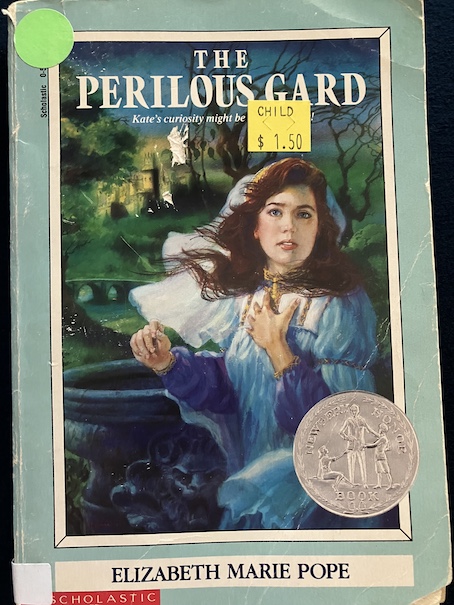
Madeline in London

This book is part of the Madeline series about a little girl at a small boarding school in Paris. The son of a Spanish Ambassador, Pepito, lives next door to the girls. He’s a menace to them at first, but the girls make friends with him. However, in this book, Pepito moves to London because his father has been relocated for his job.

When Pepito and his parents go to London, Pepito is unhappy there because he’s lonely for Madeline and the other girls from the boarding school. With Pepito growing thin and depressed from his unhappiness, Pepito’s father arranges for the girls from the boarding school to visit for Pepito’s birthday to cheer him up.

When Miss Clavel and the girls arrive in London, there’s a happy reunion, but then, they remember that they didn’t bring Pepito a present for his birthday. Madeline remembers that Pepito has always wanted a horse, and they find an old, retired army horse who is still healthy and gentle.

However, when they give the horse to Pepito, they quickly discover that there are complications to owning a horse as a pet. The horse hears a trumpet, and reacting to his army training, he runs off with Pepito and Madeline on his back to join a parade.

Then, they forget to feed him, so he eats everything in the garden, making himself sick. It seems like the embassy in London is no place for a horse, but Madeline and her friends may have room for one at their school!

The book is available to borrow and read for free online through Internet Archive (multiple copies).

Giving someone a horse for a present without checking with their parents or making sure that they have what they need to take care of a horse isn’t something that people realistically do, but the Madeline books rarely worry about the practicalities of a situation. It’s all fun and adventure!
I was seriously worried about the horse after they forget to feed him and he helps himself to random plants in the garden, especially when they find him with his feet up in the air. Fortunately, everything works out okay, which is characteristic of Madeline books, too. How the trustees of Madeline’s school will react when they find out that the girls now have a pet horse, since they raised a fuss earlier about the girls having a dog, is anyone’s guess, but the story doesn’t worry about that, either.

Like other books in this series, the pictures in the book alternate between limited color images, mostly in black and yellow, and full color images.

Saint George and the Dragon

The story of Saint George and the Dragon is an old folktale. The story as told in this children’s picture book was adapted from Edmund Spenser’s Faerie Queene.

The Red Cross Knight, who carries a shield decorated with a red cross, does not know his own name or even where he came from. He only knows that the Queen of the Fairies has sent him to face a terrible dragon. He is accompanied on his journey by a princess with a little white lamb and a dwarf. The Princess’s name is Una, and her kingdom is being attacked by the dragon.

On their journey, they meet a hermit, who shows the knight a distant palace on a mountaintop, where angels travel between the palace and heaven. It’s so beautiful that the knight wants to go there immediately, but the hermit says that this palace is in another world and that he cannot go there until he faces the dragon. The hermit also reveals the knight’s past to him. He is not one of the fairy folk, although the fairy folk are the ones who sent him. The hermit knows that he was kidnapped by the fairies as a baby and hidden in a farm field, where he was discovered by a plowman who named him George. His true destiny is to become Saint George, the patron saint of England.

Una takes George to her parents’ fortress. As they approach, they see the dragon for the first time. George sends Una away from danger, and he and the dragon battle for the first time. The dragon picks up George, horse and all, and throws them to the ground. George manages to drive the dragon away, but he is also injured. At first, he and his friends think he is going to die, but he lies down in an ancient spring that cools and heals him. By morning, he is able to rise and fight again.

The second time George fights the dragon, he is able to cut off part of the dragon’s tail and one of its paws. The dragon’s fire finally drives George away, and once again, George seems too wounded to survive. However, he rests under an apple tree that drops healing dew, and George survives.

The third time George and the dragon fight, George manages to kill the dragon. Everyone celebrates, and Una’s parents thank George. The king gives George rich rewards, but George passes them on to the poor people. George is bound to the service of the Fairy Queen for six years, but the king allows George to marry Una and promises him that he will become the next king when his service is finished.

The book is available to borrow and read for free online through Internet Archive.

I love the colorful illustrations in this story, although some of them seemed a bit brutal for an audience of young children, showing George badly injured and the dragon spurting blood. Because I love folklore, I know that the legend of St. George and the Dragon is a Christian allegory, although it has some basis in earlier folktales and historical figures. I’ve heard different interpretations of what the dragon is supposed to represent. It can be a symbol of evil, the devil, or sin, and I think I’ve heard that it could represent paganism, which was replaced by Christianity (represented by St. George in the story), although I can’t remember where. In a way, I think this is one of those picture book that might mean more to adults because they would understand more of the symbolism, history, and folklore references in the story. On the other hand, who doesn’t love a story that ends with a gallant knight marrying a beautiful princess?

In case you’re wondering, the red cross on St. George’s shield isn’t the red cross used by the International Red Cross. However, Saint George’s Cross is on the national flag of England and is also part of the Union Jack flag of the United Kingdom.

As another odd piece of literary trivia, the legend of St. George has a connection to another story that I’ve on this blog, Phoebe the Spy. The connection isn’t an obvious one because Phoebe the Spy was set in New York during the American Revolution, which seems far removed from Medieval England. However, on April 23, 1770 (St. George’s Day), the St. George Society (originally called the Sons of St. George) was founded at the Fraunces Tavern in New York, just six years before the story of Phoebe the Spy begins at the same tavern. The St. George Society was and still is a charitable organization that helps immigrants from Britain, using the patron saint of England as its namesake.

In Spite of All Terror

This story takes place during World War II and focuses on a child evacuee from London. The title of the book comes from a quote from Winston Churchill:

“Victory at all costs, victory in spite of all terror … for without victory there is no survival.”

Winston Churchill, May 13, 1940

It’s September 1939, and Liz Hawtin is an orphan living with her aunt, uncle, and cousins in London. Her mother died when she was a baby, and her father was killed when he was hit by a car a few years earlier. Liz’s overbearing aunt is making her life miserable and has been since she moved in with her relatives. It takes Liz some time to realize why her aunt doesn’t like her, but it has to do with social class, political philosophy, one-upmanship, and her aunt’s sense of fairness and entitlement – what sort of people are “deserving” and what sort of people aren’t.

The main problem is that Liz’s father was into socialism before he died. In fact, he used to give public talks about it, and Liz would watch them as a child, although she admits in hindsight that she doesn’t entirely agree with everything her father believed. One value that she and her father definitely shared was the belief that education is important. Liz’s entire family is working class, including her father, and none of them have ever had more than just very basic education. Her father was a very bright man, but like other members of their family, he had to leave school early and get a job because their family was poor. However, he urged Liz to study and get the best education she could because he realized that higher education is the way to move up in the world and get better jobs and a better position in life.

Liz’s current situation when the book begins is irritating to her aunt because Liz has both the academic potential to attend a better school than the ones her own children have attended and because Liz’s father had the foresight to take out an insurance policy on his life that has provided Liz with enough money to attend this better school and to buy good school clothes and the extra equipment and books that this better school requires. Every time Liz has needed something for school, her aunt gripes about how much it costs and what a waste of time and money it is. Liz gets her aunt’s permanent wrath by telling her straight out that the insurance money belongs to her and not her aunt and that it was meant for her education. This enrages her aunt because she had labeled her father as the foolish, idealistic socialist who was undeserving, so the idea that, because of him, Liz has both academic aptitude and the money to support her education seems supremely unfair to her. On some level, she probably realizes that Liz’s more advanced education will probably help her to be more prosperous than the rest of the family, and she hates it and is jealous. She takes every opportunity to criticize Liz and to tell her that her time spent reading and studying is wasteful. She encourages her children who, like other members of their family, all have to leave school early to get menial jobs, to give Liz a hard time. The only members of the household who like Liz are her gentle cousin Rose and her uncle, but it’s difficult for them to stand up for Liz and help her because the aunt bullies both of them as well.

At the beginning of the story, Liz is fifteen years old, and she is faced with a difficult decision. She is getting close to graduating from her grammar school. She badly wants to finish, but she knows that the insurance money is running out. Soon, she will be faced with the difficult decision of whether to leave the school without graduating and get a job, which is bound to be the menial work that her cousins are doing. Her aunt has always resented her and is eager to get rid of her, so she wants Liz to get work and start supporting herself as quickly as possible.

When World War II breaks out, Liz’s life is changed forever, and Liz realizes that, ironically, the changes are going to be for her benefit. Because Liz is still a student, she will be part of the government’s program to evacuate children from London to protect them from bombings. None of her cousins will be evacuated, even though they’re not much different in age from Liz, because they are no longer students, but Liz will be sent to the countryside with the rest of the students at her school. The government will also provide money for her support and education during the period of the evacuation, so Liz realizes that she will be able to finish her education after all. Rose and Liz’s uncle are sad at her leaving, but her aunt makes it clear that she is pleased that Liz will be leaving very soon and that she doesn’t want Liz to come back after the evacuation period is over. Once Liz is finished with her education and no longer part of the government program, Liz will be on her own in the world. It’s both a little scary but also liberating for Liz. She doesn’t know where she will be staying during the evacuation, but at this time in her life, it’s really better for her to leave her aunt’s house, finish her education, and establish an independent life.

Before she leaves, she says goodbye to her grandmother in London. She worries what will happen to her grandmother, her uncle, and Rose when she’s gone. Her grandmother isn’t worried for her own sake because she’s lived through war before, and nothing ever seems to happen to her. Besides, she knows where the shelters are for safety, and she’s sure that she can take care of herself. Liz knows that, once she is gone, her aunt won’t be able to pick on her all the time, and things are bound to get worse for her uncle and Rose, but there’s nothing she can do about that.
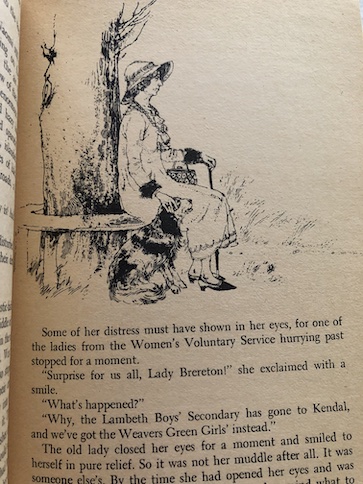
When she arrives at school, she and the other students are told that they are being sent to a small village called Chiddingford in Oxfordshire. It’s such a small town that it doesn’t even appear on the map in their school atlas. There, they will be staying in the homes of people living in the village. The headmistress reminds them all that this will not be an easy experience for them. Many children are being evacuated along with them, and all of them will experience homesickness and difficulties adjusting to the place where they will stay. She urges all of them to be kind to each other and considerate of their hosts in Chiddingford. The girls in Liz’s form (grade) are also going to be paired up with girls in the lowest form because these younger girls are new to the school and don’t even really know each other yet. The headmistress thinks that the experience will be easier on them if they have an older girl as a buddy, like an older sister. Liz pairs up with a shy girl named Veronica, who is wearing a school uniform that is way too big for her. Her parents were trying to save money by buying her a uniform that she could grow into. It makes Veronica a laughingstock among the other students, but Liz sympathizes with her, knowing what it’s like to worry about money and to feel different from everyone else.

The students are excited by their trip into the countryside. The village of Chiddingford is already expecting them, although they had originally been told that they would be hosting a boys’ school instead of a girls’ school. Lady Brereton’s daughter-in-law asked her to pick out a boy from the arriving students who would be a good companion for her sons. However, since there are no boys on offer after all, and she knows little about girls, having only a son and three grandsons, Lady Brereton decides that she’ll pick out a girl from the evacuees in the same way she would pick out a dog, which is something she does understand. She chooses Liz because Liz has an alert expression and stands with her head up and a look of spirit and resilience.

Liz finds the move to the countryside disorienting, although she likes the peacefulness of it. Her reception at the Brereton house is disappointing because Mrs. Brereton had her heart set on getting a boy. She has three sons and is single-mindedly devoted to them. A girl simply wouldn’t do as a companion for her boys. In fact, she thinks that having a teenage girl in their house might well lead her teenage sons astray. However, people are commanded by the government to take in evacuees, and Mrs. Brereton can’t just give Liz back or trade her for someone else just because she’d rather have a boy. It’s awkward for both of them because Liz knows that Mrs. Brereton really doesn’t want her and that she tried to get rid of her.

Mr. Brereton is an historian, and he once worked at a college near Liz’s old neighborhood. He describes the history of the area and the type of housing there to his sons. The Breretons are a genteel, highly-educated family. They’re also the sort of intellectuals Liz’s father used to disparage, the ones who came to the college in their area and observed their lower-class living like scientists watching an ant colony and would leave, thinking that they understood their lives, when they had only ever seen them from the outside.

The youngest of the Brereton boys, Miles, makes fun of Liz when he finds out that her school doesn’t teach Latin because he says that she’ll never be able to go on to university. It stings because Liz is more educated than the rest of her family and is proud of it. She angrily retorts that she doesn’t want to go on studying forever because she wants to do something that will help win the war. Unknowingly, she’s prodding a sore point in the Brereton family because the eldest boy, Simon, wants to enlist, but his family would rather that he continue his education at Cambridge and become a doctor. Simon does want to be a doctor, but he also feels called to aid the war effort. He feels torn because his family is telling him that he should let others take care of the war while he goes to school and learns something that will make a difference later, but he feels guilty for staying out of it. His grandfather, Sir Rollo, who was a brigadier general, says that 19-year-old Simon is a man now and must make up his own mind about what he wants and what he’s going to do. Liz wishes that she hadn’t said anything about helping the war effort because she didn’t know that it was a sore point for this family, and she certainly wouldn’t want to influence Simon to do something that was dangerous or wrong for him. He seems too gentle and intellectual to really be a soldier.

When her teacher, Miss Garnett, comes to check on her, and see how she’s doing in the Brereton house, Liz says that she doesn’t think she fits in with this family. Miss Garnett advises her to give it time. Liz realizes that the Breretons are a tempestuous family, and it’s not really her fault for setting them off. They get set off by other things and people, too. Liz’s family back in London wasn’t the nicest, and they had their fights and spurts of meanness, but Liz feels like the Breretons are more unpredictable. She doesn’t know their history, quarrels, and sore spots, so she has no way of knowing what will set them off next.

Liz feels a little better after talking to the other girls from her school, comparing their host families. As she describes the Breretons to her friends, their absurdities jump out at her, making the whole situation seem more humorous instead of tragic. Mrs. Brereton doesn’t want her, which is hurtful, but she’s stuck with her anyway, which is funny. Young Miles keeps teasing her about not knowing Latin by shouting random Latin words at her, which don’t even make sense when translated. Miles is learning Latin vocabulary and can conjugate verbs, but he doesn’t really speak it as a language. Mr. Brereton, the professor, reads in the bathroom, which is the girls say is pretty normal, but what he reads are heavy historical texts, and he keeps a notebook and pencil in there, too, so he can take notes. The other girls laugh at the silly habits of the Breretons and tell Liz about their own host family. Three of them are sharing a room over a local shop, and the family that keeps the shop are certainly not intellectual. They have no books at all in their house, and they seem to be slow thinkers, who have only “one thought about every two hours.” Liz, whose source of pride back in London was being more educated than the rest of her family and most of the people in her working-class neighborhood, realizes that the Breretons’ higher intellectualism has been making her feel inadequate, like just a silly school girl. However, she and her friends are really more in the middle, doing better than some people, if not as well as others, and that’s not a bad way to be. Their learning isn’t over yet, either.

There are also some consolations to life with the Breretons. The live in an old, converted mill, and Liz has her own room next to the wheel house. Mrs. Brereton thinks of it as a rough room, very simply furnished and really more suited to a boy than a girl, but Liz likes it and is grateful that she doesn’t have to share a room with anyone else. When she doesn’t want to talk to the Breretons, she can go to her room to be alone and read, burying herself in Pride and Prejudice and other books she enjoys. When Miss Garnett sees Liz’s room, she also thinks it seems fun, and the water sounds from the millstream and waterwheel remind her of being on a ship.

There is one other member of the family that Liz hasn’t met yet, the Breretons’ middle son, Ben. Ben is 17 years old, and from the way his family talks about him in his absence, he’s something of a disappointment to his parents. Although he is two years older than Liz, they are about the same level at school, which is hard for his rigorously intellectual family to accept. He also has a tendency to get into various scrapes. None of them are truly shocking, mostly ridiculous teenage escapades. Liz knows that she’s seen much worse in her old neighborhood in London, but Ben’s family disparages his foolish and embarrassing behavior.

The reason why he isn’t there when Liz first arrives is that he’s taking a bicycle tour of Wales. His family starts to worry about him because he doesn’t return when he was supposed to. Then, they get a call that explains his latest escapade. In a wave of patriotism because of the starting war, he tried to enlist in the RAF, even though he was underage. At the recruiting office, he tried to avoid telling the recruiters much about himself, so they wouldn’t know that he was really too young, but he forgot that he wrote his name and address on the outside of his kit bag. The recruiters contact his parents and send him home. It’s the sort of well-meaning but thoughtless mistake that Ben often makes. His parents again disparage his thoughtlessness, and Miles makes fun of him, but Simon angrily tells them all off. He says that he understands Ben’s feelings of wanting to make a difference. Even if what he tried to do was clumsy and not well-thought-out, it was still noble. The grandfather of the family says that he and their grandmother certainly won’t make fun of him when he returns home. Liz gets the feeling like Ben might be more her kind of person than the other Breretons.

Liz and Ben get along well with each other when they meet. Liz learns that the room where she is staying used to be Ben’s art studio. Liz feels badly that she’s taken his space, but he tells her that it can’t be helped. He tells her that he wants to be an artist, although his parents disapprove. His mother doesn’t think that it’s possible to make a living off of art, and his father doesn’t think his paintings are any good. Because his father is an historian and an intellectual, he thinks of art in terms of fine art. He had another professor he knows, an art expert, take a look at Ben’s work, and he didn’t think much of it, so Mr. Brereton concluded that his son had no art potential. Ben’s family whitewashed over all the artwork he did on the walls of his studio before Liz arrived. Liz thinks this is terribly unfair because there are many different styles and tastes in art. Just because Ben’s father and one art critic didn’t like Ben’s art doesn’t mean that he doesn’t have talent. Ben is still determined to be an artist in spite of what his parents say. He and his brother Simon are very close and understand each other because neither of them quite fit their parents’ expectations and have different priorities from their parents. Liz understands how both of them feel because her family also never understood her or supported what was important to her. She comes to view both Ben and Simon as brothers and enjoys spending time with them. Ben takes her out on the river in the family’s punt, and during the winter, he teaches her how to ice skate.

The book continues through the next year and a half, through the developments of the war and the lives and education of Liz and the Brereton boys. Although Mrs. Brereton didn’t initially want Liz, the Breretons become fond of her as she shares in their lives, and they come to understand one another. Each of them finds a way to make a difference in the middle of war, and through the hardships they face together and their shared lives, they become a family. When Liz gets a letter from her grandmother that lets her know that Rose is “in trouble” in London, she and Ben make a daring trip into the bombed city to rescue her cousin. The book ends at the beginning of 1941, just after the New Year, with the war still going on, but by that time, each of the young people in the story has found a direction in life and hope for the future.

The book is available to borrow and read for free online through Internet Archive (multiple copies). Because of the themes and some of the language in the story, I would recommend this book for teens and young adults. There are descriptions of bombings, war deaths, a teenage pregnancy (Rose, not Liz), and some mild swearing in several places. The violent parts aren’t as graphic as some descriptions I’ve seen in other books, but there is definite violence and death, so it’s not really a book for young children.

This story could fit well with both the Cottagecore aesethic and Light Academia. In the countryside, Liz is living in an unusual, atmospheric house, a converted mill, and the descriptions of her room sound enchanting! In some ways, the beginning of the book reminds me a little of Anne of Green Gables: an unwanted orphan who is taken in by a countryside family that originally wanted a boy, and a girl who loves books and is determined to pursue an education and make something of herself. Liz is a true book lover, and the story mentions the books that she reads and loves, like Pride and Prejudice by Jane Austen, Jamaica Inn by Daphne du Maurier, and Beau Geste by P. C. Wren. Liz doesn’t just read because she is required to read for her classes but because she really enjoys books. She also comes to understand things from books she reads, like the war around her and the feelings of some of the Breretons from reading Shakespeare’s Henry V. The insights that people gain from reading are part of the reason why literature is regarded as one of the disciplines of the humanities, the areas of study that provide insight into human nature and human potential. Liz combines the insight and knowledge she gains from reading and what she perceives around her to better understand the world and other people. In some ways, she fits a little better with the intellectual Brereton family than she thinks she will at first.

Later in the book, after Liz has seen more of the war directly, she wonders if there’s really a point to continuing her education or if she should just try to get a job in a factory and do her part. Studying things like poetry and Shakespeare in class just feel pointless and irrelevant in the face of the larger, life-and-death events happening around her. She could relate to the themes in Henry V, but Romeo and Juliet begins sounding pretty silly to her. Her teacher persuades her to continue her education, telling her that the more educated she is, the better she will be as a worker and an asset to her country. At first, Liz doesn’t see how, and her teacher explains that she is learning mathematics, which are used for the construction and calibration of weapons. She is also learning biology, which would be useful if she becomes a nurse or has to care for someone who is wounded. As for things like poetry and literature, anything she studies will teach her humility and give her mental maturity and greater understanding of other people – the goals of the humanities. We don’t know about all of her long-term career goals by the end of the book, but along the way, Liz continues her education, takes on part-time jobs, and finds ways to help the war effort and the people she loves.

The experiences of the evacuees in the story are very realistic. It’s important to note that child evacuations went in waves throughout the war, and Liz and her friends are part of the very first wave of Operation Pied Piper. When the war started, people expected that bombings would start almost immediately, which was why they tried to hurry as many children out of London as fast as they could. However, the book covers the real events and attitudes of the early war years, including the fact that the bombings didn’t begin as quickly as expected. When the bombings didn’t start right away, people started to think that the fear of bombings was an overreaction, and many families brought their children back to London from the countryside. Some called this phase of the war the “Phoney War” because people on the home front didn’t feel like there was a war really happening yet, and even on the front lines, there was relative quiet because the large scale operations hadn’t started yet. Liz feels more alone in Chiddingford when some of her friends from school return to London and leave her behind in the country. Liz knows that there’s no point in going back to London herself because her aunt won’t want her, and remaining with the evacuation program will allow her to finish her education. Of course, readers know that the Blitz is coming before the characters in the book do, and the people who returned to London will probably end up regretting it.

In real life, some of the children who returned to London prematurely were killed in the coming bombings, and others were sent away again in the next wave of evacuations. In the case of the kids in the story, Liz’s friends Annette and Naomi return to London, thinking that the risks of bombings were overrated. After the bombings start in the Battle of Britain, Liz’s grandmother writes to Liz and says that Naomi has been sent away again, this time to Wales, which was a destination for many evacuees. We never hear what happens to Annette.

The book did a good job of showing how evacuees and their host families experienced some awkwardness with each other because of their different lifestyles and social classes. Not only is Liz not from an intellectual family like the Breretons, but she also comes to realize that she lacks some of the table manners and social graces of people of their class. The book also explains how Liz and her friends speak differently from the Breretons. Liz and her friends are described as being “bilingual in two kinds of English.” When they’re with family and friends, they speak cockney English, but at school, they speak a more “posh” version of English. However, even their more “posh” English isn’t as high class as the way the Breretons speak because they are a family of people who have been to boarding schools and have higher levels of education. You can hear what a cockney accent sounds like, how it works, and the social significance it has from these videos:

  • 1976: COCKNEY accents from the BCC Archive (about 11 min.) – The people talking would have been alive during WWII, some of them probably around Liz’s age at the time. Some of them talk about the differences between the way they talk and how younger generations speak.
  • A LONDONER Explains How to Speak COCKNEY (about 13 min.)
  • The Story of COCKNEY the (London) Accent and its People (about 35 min.) – Explains more about the social history and cultural identity of Cockney people. This includes some of the historical information that Mr. Brereton, history professor, could recite, although Liz knows that doesn’t mean that he fully understands the realities of day-to-day life in the East End. Toward the end of the video, at about 27 min., there is a clip from a 1930s film as an example of how the accent used to sound because accents change over time.

The Breretons are using “received pronunciation” (RP), which is called “received” because people in England don’t tend to speak that way until they are taught to do it in the higher-class schools. It comes directly from having an education, particularly a higher education, so people who speak that way are immediately announcing their social class and education level with the way they speak. You can hear it and get an explanation of how it works from these videos:

  • Make Do and Mend (about 3 min.) – A 1940s educational film about making and mending clothes, to save on material for the war effort. Received pronunciation (RP) is also sometimes called “BBC pronunciation” because this is the accent that radio announcers would use. The announcers in this short film, one male and one female, are using 1940s RP.
  • 1967: John REITH explains the “BBC ACCENT” (about 10 min.) – From the BBC Archive, about why the BBC particularly wanted its announcers to speak RP. John Reith was the Director-General of the BBC, beginning in the 1920s and ending in the late 1930s. During WWII, he became Minister of Information, and from there, moved to various other governmental roles. This interview was his very last appearance on television. It took place when he become Lord High Commissioner to the General Assembly of the Church of Scotland. The interviewer asks him about the reason why, during his BBC years, he wanted his broadcasters to speak with an RP accent. Basically, the logic behind RP was to put more emphasis on education and ability to communicate clearly rather than the speaker’s regional origin. Particularly in radio, where listeners only have the voice to rely on and no visuals to clarify anything, it was important to have an accent that would be as clear as possible to the general population, where there would be no confusing regional pronunciations and slang. In the video, John Reith specifically says that they didn’t want there to be any accents that would seem comical or irritating to the listeners by seeming overeducated, undereducated, or too regional. They also debate the social implications of this and the effect of television, which was relatively new technology to them in the 1960s. Both of the men in the video are speaking a kind of RP, although they’re not completely the same as each other. John Reith admits that his speech still has regional influences because he’s from Scotland.
  • The RP English Accent (about 9 min.) – About who speaks RP, how it sounds, and the social implications. It also mentions how there are people, like the presenter, who speak a kind of RP but still with regional influence, which is similar to the way Liz and her friends are learning to speak in their school. It also discusses how WWII changed the way this accent was perceived and who would speak it because of social changes.
  • RP (Received pronunciation) vs POSH ENGLISH (about 23 min.) – Explains the origins and evolution of RP and the differences between standard received pronunciation (RP) and the more high-class or “posh” version that the upper classes would speak and how regional accents influence even RP. It also explains that, although this accent was known for being used by radio broadcasters, during WWII, radio broadcasters started using more regional accents to make it clear that they were authentic British people because Germans broadcasting propaganda were speaking English with an RP accent. This is one of the factors influencing changes in professional and social views about different types of British accents.

Why does all of this stuff about accents matter? It comes back to social class and education, both of which influence people’s prospects in life. A person’s accent, particularly during the mid-20th century and earlier times, reveals their background and the type of level of education they have. (Less so in the 21st century, after the influences of mass media – tv and the Internet – which enable people to hear more accents than they encounter in person in daily life, changes to the education system, and changing cultural attitudes.) Schools of the time knew that and would make sure that their students could speak in a way that would make them sound as educated at possible. A person who sounded as educated as they said they were would sound more skilled and competent to potential employers, enabling them to get “white collar” jobs, involving more clerical or specialized skills rather than manual labor, and rise up in the middle class. People who only had the the minimal level of education, like Liz’s relatives, wouldn’t have this influence on their speech, and that could be a barrier to finding better jobs, keeping them at a lower, working class level. 

Liz and her friends have been learning some RP in school, which is why they can speak more “posh” than the general cockney spoken around them in daily life, but the Breretons speak a higher level of RP because of their boarding school backgrounds and college educations, so even Liz’s more educated version of English isn’t up to their level of RP. Liz and her friends are learning to speak at a middle class level because they’re being prepared for possible white collar jobs and middle-class living. The students’ cockney families speak like the working classes because that’s what they are, and they’re less likely to move up in the world because listeners can tell that they don’t speak in an educated way. The Breretons speak like academics because that’s what they are, that’s what they’ve trained to be, they’ve had higher-class education, and they’re relatively upper-class or upper-middle class. Although the girls’ families think that the girls are learning to speak “posh”, and they are when compared to their relatives, the Breretons can still hear their background in their speech and know they’re not from the same class. This ability to almost diagnose someone’s background and education from a person’s accent influences the way people in the story and society of the time would think of each other right from their first meeting. Because they can tell some significant factors of a person’s background immediately, there was a tendency to jump to conclusions about a persons’ life, habits, and capabilities. Part of this story is about how they assumed too much before getting to know the details of other people’s lives and personalities, and that’s a factor that influenced social attitudes before and after the war. As the videos that I’ve referenced explain, the modern, 21st century versions of the dialects and accents in this story wouldn’t be quite the same as the ones the characters would have spoken in the 1930s/1940s because language evolves over time, but the videos will give you a sense of how the characters hear each other.

When Liz tells Lady Brereton that her father was a Communist, Lady Brereton is intrigued and fascinated but not overly shocked or disparaging. Liz is happy that Lady Brereton appreciates that he was a good and loving father and that Liz badly misses him even if his political views were unorthodox. Today, Britain is more of a democratic socialist nation than the United States, and the social programs of WWII, like the child evacuations, are part of the reason. Britain was a country that was very focused on social class, and before the war, the social classes seldom mixed. However, the war was a nationwide effort. People of all social classes were expected to do their part and work together, and programs like the child evacuations brought people of different social classes together in ways they had never been before. The result was that people of different social classes learned more about the ways other people lived, and because the evacuation system saved many lives and led to improvements in living conditions for some children from poor areas of the city, people in Britain became more interested in social programs to help the poor and create a more stable society. This isn’t the only reason for such social programs, but it was a contributing factor.

In the book, when Liz looks back on her father’s political views, she realizes that she shares some feelings with him but wouldn’t agree on everything he used to say, and that’s because of her own experiences. The social programs of the war helped her to continue her education and find a more stable life than the one she had with her aunt, but she also knows that she can’t rely on that type of support for everything and starts to look for ways that she can earn money herself and live an independent life. Her experience with and approach to social programs seems like a broader, more blended view. She has had experience with different social classes and different systems and can see the benefits and downsides of different ways of living.

For more information about the conditions and experiences of child evacuees, I recommend the following videos:

Evacuees of the Second World War: Stories of children sent away from home

From Imperial War Museums, a series of interviews with former child evacuees with background information. 10 minutes long.

Escaping the Blitz

This series of interviews with former child evacuees is much longer than the other one, about 40 minutes long. Part of this one brings up the subject of racial minority children who were evacuated. Children of different racial backgrounds or ones who looked like they might be could be discriminated against by people who were reluctant to host them because of the way they looked, but there were also some nice families who were willing to host them.

Evacuees

An hour-long documentary about evacuees’ experiences, good and bad, with interviews with individual evacuees as older adults. It includes the experiences of evacuees who were sent overseas and not just to the countryside. It also covers the effects that the experience had on their education and how they found it difficult to relate to certain types of lessons, like poetry lessons, because the themes were so far from their wartime lives. It also explains what happened to them after the war was over and the long-term effects that their experiences had on t hem.

What Living In London Was Like During The Blitz

Explains what conditions were like for those who remained in London during the war and what the evacuees were escaping. Timeline Documentary. About 50 minutes.

For other children’s books about WWII and child evacuees, I have a list of WWII books with additional resources. For books about child evacuees, I especially recommend Carrie’s War (1973) and All The Children Were Sent Away (1976).

A detail that I particularly liked about this book was the explanation of the the 1940s British school system at the beginning of the book. I’ve seen other explanations of the British school system online (like this one from Anglophenia on YouTube), but the explanation in this book does help because the main character’s education and future prospects are a major part of the story.

The attitudes about class and education surprisingly still resonate today. The type of education a child receives is often determined by the economic level of their parents and the type of life that the adults expect that the child will lead. All of the parents in the story have their own notions about what the young people should be doing with their lives, but the young people know that the world is changing, especially because of the onset of war. The things they want to do and the things they will have to do no longer match their elders’ expectations.

Liz knows that getting a good education is vital to her future, where she will have to make a living by herself, even though her aunt tries to shame her for being grand about her education and tries to make her feel like she should just go out and get a job like her kids did. The Breretons are just the opposite, seeing higher education as the only path to a secure future, while their sons realize that there are more immediate problems shaping their world and posing real threats to all of their lives. Each of the young people come to realize that there are decisions that they each need to make for themselves to take charge of their lives and handle what life has given them, even if the adults don’t understand.

Overall levels of education in society have risen in the decades since World War II. Technically, where I live, children are only legally required to attend school through 8th grade, but in actual practice, almost everyone gets at least a high school education because even the lowest levels of jobs in our society expect a high school level of education or an employee who is working toward one. There is very little that anyone can do with only an 8th grade education in the 21st century, and almost everything that provides a living wage requires either a college degree or some kind of vocational training beyond high school. There are almost no jobs that will take a person with a minimal level of education and no prior experience.

In 1940s England, there were more opportunities for people with little education to get jobs, which is how Liz’s cousins get jobs even though they leave school at about age 14, but even then, there aren’t many opportunities for jobs that pay well and little opportunity for advancement. Rose later has problems when she gets pregnant as an unmarried teenager, and her cruel mother throws her out of the house, into the bombed streets of London with no way to make her living. Liz and the Breretons help her, but they worry about her future prospects. She has little education and has worked in a shoe store, but she doesn’t know much else and has no other experience. Without an education or other means of support, there isn’t much else she can do. She doesn’t even have very many domestic skills and can’t sew or knit. The end of the book implies that Rose will learn to manage because she decides that she is determined to keep her baby and find a way to support them both, learning whatever she has to learn along the way, and Liz’s teacher, Miss Garnett, will also help her.

Liz loves her cousin enough to take some risks to reach her during the bombings of London and bring her to Chiddingford, but she comes to realize that she has underrated her cousin for being less educated and a bit foolish in her life choices. On the one hand, she is irritated with Rose for her foolish love affair with a man who doesn’t really seem to care about her and marries someone else instead. She and Ben face some real dangers going to London to find her and get her out of the terrible situation she’s in, so a foolish choice on her part does create some risks and hardships for others. However, she finds out that Rose understands some things about life and human relationships that Liz is just now beginning to understand. The reason why she had that love affair was that she felt emotionally neglected by her hard-hearted mother and desperately lonely after Liz left for the countryside. Her choice of lover turned out to be a bad decision, but she was so starved for companionship and affection that she was vulnerable. Part of the reason why Rose is now determined to keep her baby and not place it out for adoption is because she saw the awful way her mother treated Liz as an orphaned child and how badly Liz was starved for affection. Rose’s mother was cruel to her as well, but much more cruel to Liz because Liz wasn’t her own child. Rose wants her own child to know what it is to be genuinely loved and wanted, in spite of the hardships and stigma of being a single, unmarried parent in the 1940s. Liz is touched that Rose truly understands that important emotional need just to feel loved and wanted by someone, something Rose’s mother never seemed to understand or care about. Rose might turn out to be a better parent than her own mother.

The feeling of not being wanted and only reluctantly accepted was one that real-life evacuees experienced, and I thought that was well-represented in the book. When Liz first meets Mrs. Brereton, she reminds her of her aunt. She puts her own children first and is so absorbed with what she thinks are in her family’s best interests that she sees Liz as an inconvenience and possible threat instead of the vulnerable girl she really is. However, where Liz’s aunt never warmed up to her after they lived together for years, Mrs. Brereton does become fond of Liz and starts to think of her as part of the family. With her elder sons going off to war, she admits that it’s a comfort to her to have Liz there. Liz shares in the family’s ups and downs through the war and really becomes one of them. Her attitude contrasts with Liz’s aunt, who is self-absorbed and ready to abandon any of the children in the family, including her own, when they become too much of an inconvenience to her. Mrs. Brereton is different. There are times when she is disappointed or worried by decisions her sons make, but they’re still her sons. Once she starts thinking of Liz as one of the family, she extends the same loyal affection to her. She worries about Liz when she disappears for a time instead of being relieved that she’s gone, and she even takes in her cousin when Liz brings her from London.

It’s hard to say how much of the differences because Liz’s aunt and Mrs. Brereton are due to their relative social positions and how much are because they have different personalities. I’m inclined to think that it’s a combination of both. I can see that Liz’s aunt may feel more precarious in life because she’s a poor, working class woman and feels less able to provide for an extra person or someone in a situation that might require some sacrifices, like her orphaned niece or pregnant daughter. However, Liz’s gran, who is part of the same social class, thinks that Rose’s mother has behaved horribly, both for mistreating Liz for years and for sending her pregnant and penniless young daughter out into the streets while the city is being actively bombed, so it seems that not everyone in that social group would have the same reactions to these situations, and some might be willing to make more sacrifices to help someone in desperate circumstances.

There are themes all through the story about the human need for affection and relationships with other people. Partly, the ability to build relationships with others is recognizing the need for them and being open to building relationships. Mrs. Brereton isn’t really open to building a relationship with Liz at first, and Liz and the Breretons don’t really understand one another, but relationships are also built through shared experiences. Not all of the experiences that the characters in the story share are positive ones, but facing difficult situations together can also be a bonding experience. Mrs. Brereton bonds with Liz and Rose because, even though it’s difficult for her at first, she comes to recognize how Liz supports her family in difficult circumstances, and she’s willing and able to help them through difficult circumstances in return, as a family. Liz’s aunt loses her relationship with both girls because she never develops that appreciation for them or willingness to share in their lives and troubles.

The war is always around the characters, and the story is shaped by it. I thought the author did a good job of representing the early events of WWII and how characters would have reacted to them as they actually happened. Each of the young people in particular wants to actively participate in the events that are shaping their world, even though Mr. and Mrs. Brereton would prefer to keep their sons out of it.

The grandfather of the Brereton family understands how the young people feel, having once been a soldier himself. Ben and his grandfather are very much alike, noble-minded and eager to participate. Liz joins Ben and Sir Rollo when they take Sir Rollo’s boat to participate in the Dunkirk Evacuation as one of the “Little Ships.” They know that British soldiers need help returning to England, and they hope to rescue Simon, who has joined the army, and others like him. They end up leaving Liz behind at Ramsgate because they decide that it would be too dangerous to take her the rest of the way with them. Sir Rollo is in bad health and probably shouldn’t be undertaking such a long-shot mission, but family love and his desire to once again be in the thick of things, making a difference, override any thoughts for safety. In the end, he helps save many people, and because of his prior experience in war, he is able to teach Ben how to avoid the floating mines and sandbars in their way.

However, he doesn’t survive the mission himself. He is killed by enemy fire, but Lady Brereton reveals that he knew he was ill and dying anyway. One of the pen-and-ink pictures in the book is actually of Sir Rollo after he got shot, and I was a little surprised that the book would show a blood-stained dead body in that way. It’s not overly graphic, even in the illustration, and because it’s a black-and-white drawing, it’s a less alarming than seeing someone with a red blood stain. Still, I think sensitive readers should be aware that it’s there. The book doesn’t sugarcoat the nature of war at all.

Lady Brereton knew her husband very well and loved his noble qualities. Although he didn’t tell her ahead of time what he and Ben were planning to do, she suspected that he was going to attempt something of that sort. He was a veteran of the First World War, and he wanted his last act to be something heroic, to feel like he made a difference again before he died. Ben is injured during the mission, but he and his grandfather still manage to save many soldiers. It’s Ben’s first view of war directly, and although it was a terrifying experience, it doesn’t change his mind about wanting to join the RAF. His parents finally agree to let him enlist after he finishes his school exams that summer.

At the time the book ends, none of the young people are killed in the war. We don’t know what’s going to happen to all of them by the time the war is over because the story ends in early 1941, but their experiences have made them all realize what’s important to them and given them the determination to do their part in the war effort. The overall situation by the time the book ends is that Britain is feeling like it’s largely fighting the war alone because France has fallen to Germany and is now occupied, and while Britain is getting some supplies from the US, the US would not fully enter the war until the attack of Pearl Harbor in December 1941. For a more detailed explanation of the war situation in Britain in 1940, I recommend the Timeline documentary 1940: When Britain Stood Alone In WW2 on YouTube. Understanding the general course of events in context adds depth to the story.

Toward the end of the book, there seems to be a romance developing between Liz and Ben. Personally, I like to imagine that Liz and Ben might marry after the war. I’d like to imagine, too, that Rose might end up marrying Simon and have a comfortable life as a doctor’s wife after the war. That’s left to the imagination, though.

The Secret of Grey Walls

Lone Pine Series

The Secret of Grey Walls by Malcolm Saville, 1947.

It’s shortly after Christmas, and Petronella (called “Peter” by her friends) is home from boarding school for the holidays. She has a strange dream about running through the woods with an unfamiliar girl and finding a house with gray walls, but she’s not sure where it is or what the dream means. She wakes up when there’s a fire in her dream.

Petronella and her father live by themselves in the countryside because her mother died when she was a baby. Her father misses her when she goes away to school, but he knows that it’s important for her to go, and although he would like to spend all of their holidays together, he also knows that it’s important for her to spend time with her friends.

When Petronella goes to visit her friends, the Mortons, Mr. and Mrs. Morton and their housekeeper, Agnes all receive news that changes the children’s plans for the remainder of their vacation. (This is after Mr. Morton is home from the war after serving in the RAF.) Mr. and Mrs. Morton have to go to London to see a lawyer about some business, although they’re vague about the reasons why. Agnes’s news is that her sister is sick and in the hospital. With all of the adults leaving the Mortons’ house at Witchend, Mr. and Mrs. Morton wonder who they can have looking after David and the twins until they return. They consider different people they can ask, but Agnes says that all of the children can come to the village of Clun with her. Her sister has a very big house, and she’s been worried about not having anyone to look after the house while she’s in the hospital. There will be plenty of room for all of them, and Agnes says that she would appreciate the company in that big, old place. The children can even invite the other members of the Lone Pine Club to join them.

At this point in the series, not all members of the Lone Pine Club have actually met each other. David invited Jon and Penny, a pair of cousins, to join the club while visiting the hotel that Jon’s mother, who is Penny’s aunt, owns in another town. This trip will be an opportunity for the whole club to get together and get to know each other. Jon and Penny are very excited about the trip, especially Penny, who is a talkative girl who enjoys meeting new people.

On the train to meet the others, Penny strikes up a conversation with a man named Alan Denton, who brought a dog onto the train. Denton recently left the Navy and is heading home to manage his family’s sheep farm near Clun. He is very surprised when Penny says that they are also going to Clun because it’s a very small town, and few people visit there during the winter. The old house where they will be staying is usually run as a boarding house for summer visitors, but there won’t be anyone else there during the winter. The old house is called Keep View because it has a view of a crumbling old castle. There isn’t much else left of the castle other than the old keep. The children are fascinated as Denton describes the castle and other points of interest in the area, like a circle of standing stones. He says that visitors sometimes dig for old flint arrowheads.

The other kids are going to Clun by bicycle, except for Peter, who is riding her pony, Sally. Along the way, the kids meet up with a caravan of gypsies they know from a previous book. (Yes, this is a mid-20th century British children’s mystery adventure story, so of course, there are gypsies. The book spells it “gipsies,” and they also call themselves “Romany.” In the case of this series, the Romany are friends of the kids, not suspicious characters, as in many other children’s books from around this time.) The kids tell the Romany where they are heading, and they say that they’ve just left Clun. Ordinarily, they like the area, but there’s been some trouble there lately. Someone is stealing sheep from some of the sheep farms. The Romany know that people are often suspicious of Romany, so they thought that they’d better leave the area before someone accuses them of being involved with the thefts. Before the kids leave the Romany, the Romany remind them about the special whistle that they gave to Peter, saying that if she blows it, any Romany who hears it will come to help.

Peter, meanwhile, has a disturbing encounter on her trip to meet the others. She meets some men whose truck has broken down. The men behave oddly, and although the truck says that it’s a furniture truck, Peter is sure that she hears the baaing of sheep inside.

The kids don’t start to put together pieces of what’s going on until they reunite in Clun. While they are getting to know each other and exploring the area, they suddenly meet up with Alan Denton, who is distraught because his sheep farm has been the latest victim of the sheep thefts. Peter mentions to the others about the strange truck with the sheep sounds, although Denton dismisses the idea that Peter might have encountered the sheep thieves on her way to Clun because he doesn’t think that the thieves would have been able to load all the sheep onto a truck without being noticed.

Meanwhile, a strange man called Mr. Cantor rents a room at Keep View from Agnes. The boarding house doesn’t usually get boarders in the winter, and the children had counted on having the house to themselves during their stay. Mr. Cantor says that he’s recovering from an illness and needs some peace and quiet, which is disappointing to the children because that means that they’ll either have to spend most of their time outside or being very careful not to disturb Mr. Cantor. Although the children like being outdoors, it is cold, and they know they can’t be outdoors all the time, and a houseful of children isn’t usually quiet. Mr. Cantor seems a little strange, and some of the kids get the feeling that he isn’t quite what he seems to be, but he knows a great deal about the history and landmarks of the area. He entertains the children with stories about local history and ancient burials, and they begin feeling better about him.

However, something happens that causes them to becomes suspicious of Mr. Cantor. After a visit to Mr. Denton’s sheep farm, the children get lost. They find a strange grey house and try to ask directions there. Nobody answers their knocks or calls even though the children are sure that someone is watching them from inside the house. Then, they realize that someone is also watching them from the woods. They briefly see this person leaving, and this person has a bicycle that rattles badly. When the children get back to Keep View, they realize that the bicycle they heard belongs to Mr. Cantor because it makes that same distinctive rattle. Was Mr. Cantor spying on them? Who was in the house, and why didn’t they want anyone to see them. Does any of this have something to do with the sheep thefts?

The book is available to borrow and read for free online through Internet Archive.

My Reaction

I’m new to this series of mid-20th century British mystery adventure books. This is the first book I’ve read, so I’m really getting to know them as some of them are getting to know each other. I was a little disappointed that this particular book seems to be set after WWII is over because I knew that the series started during the war and that the war was part of the story, but that does put this book contemporary to the time when it was written.

This story and the series in general does have a similar feel to other British children’s mystery adventure stories and series written around the same time, especially the Enid Blyton books, such as Enid Blyton’s Adventure Series and The Famous Five Series. Like the characters in the Enid Blyton books, the members of this friendship club attend boarding schools and have outdoorsy adventures on school holidays. The Romany appearing in this book is also a common element found in Enid Blyton books and other children’s books written around the same time. In all such books, there are stereotypical elements surrounding the Romany characters, although I think the Romany in this book were treated more kindly than the ones in Enid Blyton books. The use of the word “Romany” as well as “gipsy” is one element of understanding, but also the Romany characters in this book are friendly and helpful characters, not suspicious ones. There are people who are suspicious that the Romany are involved in the sheep thefts, but our heroes know that isn’t the case, defend them publicly, and help to expose the real thieves.

I really liked the addition of Mr. Cantor in the story. Like other kids’ mystery books of this type, there is more adventure in the story than mystery, but the appearance of Mr. Cantor adds that needed element of mysterious. For much of the story, it’s difficult to say what Mr. Cantor’s motives are and whose side he’s on. The kids have the feeling from the beginning that he’s not quite what he seems to be, but they find themselves having mixed feelings and debating back-and-forth about him as the story continues. When he’s nice to them and telling them stories about the history of the area, they decide that they like him and that they were silly to be suspicious before. Then, when he seems eager to agree with the authorities that the Romany are responsible for the sheep thefts, they look at him suspiciously again. There are some funny moments when the youngest members of the group, the twins Dickie and Mary, make friends with Mr. Cantor and try to distract him and keep an eye on him while the others do some investigating. The twins are irritated at being left behind by the older kids, but they do throw themselves into the roles of spies and put a lot of effort into making Mr. Cantor their special friend, guilting him into spending time with them. Mary gets Mr. Cantor to entertain them by telling them fairy stories and acts sweetly enthralled, while Mr. Cantor struggles to come up with story ideas to keep the kids happy, and Dickie thinks that the whole thing is stupid and little-kiddish.

I was a little surprised at the way characters in the book talked to each other at times, both children and adults, although I suppose I really shouldn’t have been. They use words that sound rough and insulting, like “stupid” and “ass” in very casual ways, both in describing themselves and each other. I’ve heard that before in British movies and television shows, but it always surprises me because it sounds so ill-mannered. Nobody in the book or in any of the shows I’ve seen seems to mind it, though. It’s just surprising when you hear someone who seems like they’re from the upper classes or who is supposed to have some of the refinements of a boarding school education throwing around words that sound rude and insulting with no thought about it.

There is a foreword at the beginning of the book that says Clun is a real town, but the author took some creative liberties with the landmarks in the story.

Gone Away

I haven’t found a copy with its dust jacket intact.

Gone Away by Ruth Tomalin, 1979.

Time flies?
Ah no.
Time stays.
We go.

Sundial motto from the beginning of Gone Away

Francie is an only child living on a farm called Goneaway Farm in Sussex in the 1930s. It’s a very old farm, and there’s a story about it that, hundreds of years before, another family once lived there, another couple with only one child. One day, this family went to a fair in another town, Alchester, and for reasons nobody understands, they never returned to this farm. The farm stood empty for a long time before it had a new owner. Because this old family went away with no explanation, the farm came to be called Goneaway. In spite of this strange story and the age of the farm, Francie has never felt that the farm was haunted or that there was anything sinister about it. Then, Francie finds herself staying in a real haunted house.

There are no illustrations in the book. It starts with this quote.

Because the farm where Francie lives with her parents is far away from local schools, Francie studies her lessons at home with her parents’ help, but she often gets distracted by the animals on the farm and doesn’t focus on her lessons. Francie’s great-aunts, Aunt Berta and Aunt Fanny, live in Scotland, but when they come to visit the farm, they see how Francie isn’t getting her schoolwork done. The aunts are also concerned at how isolated Francie’s life is. There are no other children living nearby to be friends with Francie, and they think that her life must be lonely. They talk to Francie’s parents about sending her to boarding school, but they say that they can’t afford it. They can’t even afford a car, which is why they can’t drive Francie to school in town. The aunts remind Francie’s mother that she used to board in a private house with a nice family so she could attend school when she was young. Boarding with a family wouldn’t cost as much as a fancy boarding school, and she could come home on weekends. Still, Francie’s parents are reluctant to send her away because they think she’s too young, and they’re not ready to part with her.

When the aunts leave after their visit and her parents don’t bring up the subject of school again for a while, Francie is relieved. She loves her life on the farm, and she doesn’t want to leave. Yet, she also finds herself oddly disappointed, too. She’s read stories about children at schools, and their adventures do sound exciting. She thinks it would be ideal if she could go to school during the day and come home afterward, like other children do, but that just won’t work with her family’s circumstances. Her parents’ attempts to find friends for her just aren’t working, either. Her parents start inviting other farm families to visit on Sundays, but Francie doesn’t get along with their children. The reasons why she doesn’t get along with them are largely because the other children don’t behave well, but these incidents convince Francie’s parents that maybe the aunts were right and that Francie could benefit from going to school and meeting a wider range of other children.

Her parents write to the high school in Alchester and inquire about registering Francie. They arrange for Francie to take entrance exams, but Francie has mixed feelings about it. On the one hand, the idea of boarding and going to school, with the knowledge that she will come home on the weekends, seems exciting, but on the other hand, she worries that the children at the school won’t be any more friendly than the children of the nearby farm families. Her mixed feelings continue through the day when she and her mother visit the school. At first, Francie thinks that maybe she’ll flunk the entrance exams on purpose so she won’t have to leave her farm. Then, after the initial tour of the school, Francie thinks that going there may be exciting after all, so maybe she’ll try to pass the exams. The exams are difficult, and she expects she’ll fail them after all because she really can’t do the work. Her parents tell her not to worry because, if she fails this year, she can always study more and try again next year. However, it turns out that she did pass. The arithmetic portion of the exam really was too difficult for her because the person giving her the exam accidentally gave her a higher level test instead of the basic entrance exam, but Francie did an excellent job on the writing portion of the test.

Since Francie will be attending the school in Alchester after all, she and her mother begin shopping for her school uniforms and other supplies. Francie is still worried about the prospect of boarding with strangers in town, and her mother isn’t sure how to find a house or family willing to take her. A boarding prospect turns up because Francie is too small and skinny for even the smallest available size of the school uniform, and she and her mother have to visit a professional tailor. The tailor, Mrs. Majendie, also has a few rooms that she rents out to boarders. Francie isn’t sure that she’ll like boarding with Mrs. Majendie at first because she and her house seem a bit grand, her dog seems oddly bored and unresponsive to Francie’s friendliness, and her other boarder is the headmistress of another school in town, the Chantry School. However, the available room is beautiful, with a four-poster bed and tapestries, and the room has a view of the nearby churchyard, where the children from the Chantry School are playing among tombstones in the old graveyard. Mrs. Majendie says that the Chantry School was once a chapel, and her own house was once an old inn. She also says that a new housekeeper will be moving in soon with her daughter, who will attend the Chantry School. It all seems like a fairy tale kind of place to Francie, and she is reassured that there will be another girl living in the house with her, so she tells her mother that she would like to board there.

When she actually starts school, it goes pretty well. The classes aren’t too hard, the subjects are interesting, and she gets along well with the other girls. There is an older girl called Trixie who likes to play pranks on the younger students, and some of the girls tease Francie about her height, but the older girl who is assigned to look after her, Verity, tells Francie not to take any notice of those girls. At first, Francie is able to use her bicycle to get from school to the train station, so she is able to go home every night, but then, as the days grow shorter, and it gets dark sooner, she can’t do that anymore, so she starts to board in town with Mrs. Majendie.

Her boarding experience turns out to be different from what she first thought, though. It turns out that the new housekeeper isn’t very friendly, and her daughter decided to stay with her grandmother instead of coming to town with her mother, so the house is lonelier than Francie had expected. The atmosphere is also different in the winter than in the summer, when Francie first saw her room. The room seems colder, darker, and a little more sinister in the winter, and in the evening, there aren’t any children playing in the churchyard outside. At night, she hears strange sounds, like a tapping and a wailing. When Trixie learns that the place where Francie is boarding is Falcon House, she implies that there’s something really wrong with the place, but Francie assumes it’s just another of Trixie’s tricks. Then, when other students try to get Trixie to shut up and remind her that they all promised not to talk about it in front of Francie, Francie realizes that there really is something weird about the house. She tries to get Verity to explain it to her, but Verity refuses, which just makes Francie angry and more scared. Now, she knows there is a real secret about the house, but she doesn’t know exactly what it is.

A strange man comes to visit Falcon House, and Francie sees that his card says he is Dr. D. Bone Fane from the Circle for Psychical Research. Francie doesn’t know what it means, so she asks some of the other girls at school if they know. One of them, Bryony, says that she’s met this man before. He’s a ghost-hunter from the United States, investigating supposedly haunted places. Bryony’s father teaches in the Abbey choir school, and this man has been pestering him about stories of a haunting there, although Bryony’s father thinks it’s all boring nonsense. From this information, Francie realizes that Dr. D. Bone Fane is interested in Falcon House because he thinks it’s haunted. She confronts Verity about it, and Verity admits that there are stories of hauntings at Falcon house. Nobody’s ever actually seen the ghost that haunts the house, only heard things, and the only people who have heard the ghost are children. According to the stories, Mrs. Majendie’s own children were the last children to be haunted by the ghost, and they were so scared of the house that they begged their mother to send them to boarding school so they could get away from it. Francie is the first child to live in the house since the Majendie children grew up. Francie realizes that this is why the housekeeper didn’t bring her own daughter to the house and why she seems uneasy about Francie’s presence in the house. Mrs. Majendie even gave her nightlights as a gift because she was expecting Francie to be frightened. The headmistress at Francie’s school told everyone not to talk about the ghost stories, not because she believes in them, but because she was afraid that Francie would believe them and get scared. Everyone but Francie has known about the ghost stories from the beginning, and they’ve all been waiting to see what she will experience in the house, if anything.

The more Francie thinks about it, the more she realizes that she sensed the presence of the ghost on her first visit to the house. Besides the noises she’s been hearing at night, the dog in the house reacted to something at the top of the stairs, as if an invisible hand was petting him. When Francie returns to Falcon House after visiting Verity, it’s a stormy night, and she’s terrified about what might be waiting for her at the top of the stairs. However, when she gets there, and she realizes that it’s just her, the dog, and the ghost, she suddenly realizes that the ghost isn’t a menacing presence. The dog likes it, and it seems a little teasing, but it doesn’t mean Francie any harm. Strangely, its presence begins to feel reassuring to Francie because she’s no longer alone in the house, the only child among adults. The ghost is a child, too. In fact, it’s the ghost of the child from Goneaway, the one who disappeared hundreds of years ago, along with its parents.

The more that Francie investigates, the more she comes to realize that the ghost needs her help. Helping the ghost means learning the truth about the family who once lived on the farm that Francie calls home.

This book was originally published in the UK. The book is available to borrow and read for free online through Internet Archive. There is a sequel to this book called Another Day.

My Reaction and Spoilers

This book fits well with the Dark Academia aesthetic, and it could also be considered Dark Cottagecore because of the farm and countryside themes. When Francie is on the farm, she describes the animals and plants in the countryside. Francie’s school isn’t a boarding school, but she does have to board in a spooky place to go there. There are many literary references throughout the story, and there’s a note in the beginning of the book about the poetry references. Francie reads The Story of the Amulet by E. Nesbit for fun, and her class at school reads Treasure Island. She uses stories she’s read to help her understand what is happening around her. When she makes friends with a girl named Geraldine at school, Geraldine also uses story references to explain what she thinks is happening with the ghost.

When Francie first begins to interact with the ghost, she is only able to sense its presence but not really see it. As the ghost begins to interact with her, it gradually begins becoming more visible. At first, Francie can’t even tell whether the ghost is a boy or a girl, only that it’s a child about her size. She wonders why the stories she’s heard about this child and its parents never mention whether the child is a boy or a girl or what its name and age were. She thinks it’s sad that so many little piece of history get lost.

What she eventually realizes is that the child and its parents were probably plague victims because they disappeared around the time that the plague came through this area in the Middle Ages. She thinks that they probably caught the plague when they came to town for the fair and were buried in one of the unmarked mass graves she’s heard about, and that’s why they were never able to return home. When she talks it over with Geraldine, Geraldine realizes that the children who have been able to see the ghost were all suffering from homesickness when they first arrived at Falcon House. The ghost is awakened by feelings of homesickness in other children because that’s what the ghost has been feeling the entire time. What it wants is to go home to the farm, and Francie has to find a way to help bring it home with her. There is a twist in the ghost story later that leaves Francie wondering how much of what she’s perceived about the ghost is her imagination and another girl, the housekeeper’s daughter, sneaking around the house. However, there really is a ghost, and Francie does figure out how how to help it. It comes home for Christmas with Francie.

During the story, Francie struggles with the difficulties of being away from home and going to school for the first time, and she also starts to consider what it’s going to mean for her future. She still thinks of herself as living at Goneaway Farm, but then, the wife of a farm hand refers to her as becoming a “visitor.” Francie feels uneasy about that because she knows that the woman’s son also went away for school and decided that he would rather do something other than farming, so he now lives somewhere else. Francie still thinks of the farm as her home, and it upsets her to think of the farm without her or her life without the farm in her future. But, is that really what she wants? Before her great-aunts raised the issues of school and friends, Francie was content with her life and didn’t realize that either of those things was something she was missing or might want. Now that she’s going to school in town, meeting new friends, and experiencing some independence to explore the town on her own, what else might she discover that she wants and never knew she could experience before? Will the new things she learns and wants to experience mean giving up her old life, which she still loves? These are all questions that people have as they’re growing up and pursuing an education.

Nobody really knows where life will lead them when they’re just starting out, and that can be scary, but at the same time, growing up does mean change. The changes that Francie experiences are ones that she would have experienced anyway, eventually. Her mother understands some of how Francie feels because she also boarded as a child so she could go to school, but at the same time, Francie realizes that her mother doesn’t understand everything that she’s going through because she isn’t there with her every day. Her mother doesn’t fully know what her classes or teachers are like or what the other people she meets and lives with at Falcon House are like. For the first time in Francie’s life, she and her mother are starting to live different lives, and there are some things that Francie must experience and make decisions about on her own.

The practice of children from rural areas boarding at a private house to attend a day school in town is a real part of history, both in the UK and in the US. I covered that earlier when I reviewed Sixteen and Away From Home, a book set in the 19th century Midwestern US, and The Secret School, when a teenage girl named Ida wants to go to high school in the 1920s. Anne Shirley did the same in Anne of Green Gables, which is set in 19th century Canada. This is what children from rural areas in different countries have had to do if they wanted more schooling than they could get in their area.

There is a scene in the story with some gyspies. The book calls them both “gypsies” and “travellers.” One of them tells Francie’s fortune, which gives her hints about what to do. There is also a scene where girls from Francie’s school put on a performance, and there is a dancing dragon and a student who is dressed as a “Chinese boy” for part of it. The “Chinese boy” costume is only mentioned briefly and not described in detail. It’s the sort of thing that is discouraged now in school, people dressing up as people from other races.

The Richleighs of Tantamount

The Richleighs of Tantamount by Barbara Willard, illustrated by C. Walter Hodges, 1966.

The Richleighs are a wealthy Victorian family in England, their enormous wealth the product of generations of marriages between wealthy families. There are four children in the family (from oldest to youngest): Edwin, Angeline, Sebastian, and Maud. The four Richleigh children are accustomed to their family’s wealthy and luxurious lifestyle, brought up by their fond parents and the governesses and tutors they hire to oversee the children’s education. Overall, the children are happy and appreciate their privileged lifestyle, but there is one thing that bothers all of them. It has bothered them for a long time. They don’t understand why their parents won’t take them to see their family’s ancestral home, Tantamount.

The wealthy Richleigh family owns several grand houses (including one in Scotland and one in Italy), but Tantamount is a mystery to the children. They know it exists because their family has a painting of it, and their grandfather talked about it once. A distant ancestor built this castle-like mansion in Cornwall, on a cliff overlooking the ocean and in a mixture of styles from around the world, and it’s supposed to contain some amazing things. Yet, the children’s father says he has never been there himself. The children’s parents don’t even like to talk about the place, and they’ve never taken the children there. The children know that something mysterious must have happened there at some point, but they have no idea what it is. They just know that they would love to see the place and find out what all the mystery is about! They often speculate about what the place is like, what once happened there, and why they’ve never been allowed to see it.

One day, Sebastian, who is the one who usually asks the most questions, decides to press their mother for answers about Tantamount. She tells him that his great-great-great grandfather, who built the place, was an eccentric and that the mansion is just too big, too inconvenient, and too remote to be of any comfort or use. This inconvenience is one of the reasons why most of the Richleigh family just cannot be bothered to go there. Also, his mother admits that the Richleighs are actually a little ashamed of the house because it is so hideously, overly elaborate and vulgar, even by the luxurious standards of the Richleighs. Sebastian says that he would still like to go there for an adventure, but his mother sees no point to it. She tells him that he can’t always have everything he wants, that he’s already a very indulged boy, and that he should just be happy with what he has. However, the children’s burning desire to see Tantamount and experience what they imagine as its mysteries isn’t really about the physical ownership of the house or the fantastic things that are supposedly kept there but about the spirit of mystery and adventure. As wonderful as everything the Richleigh family has, the children are chasing something else: excitement!

The children’s parents are actually the ones who don’t seem to understand the emotional attachment that people can have to physical belongings. Twice a year, they have their children donated old toys of theirs to the poor, which is a good thing, but poor Maud is traumatized when her parents tell her that she must give up her old rocking horse, Peggy, and that they will replace it with a brand new one. It’s not because Maud has outgrown rocking horses, but Peggy is looking a little shabby from use, and they want the children’s toys to all be in the best condition. They don’t consider the emotional attachment that Maud has to Peggy from her hours of playing with her or that Peggy’s shabbiness is a sign of Maud’s love for her. When they tell Maud that old toys are dangerous for children to play with, Maud asks why they aren’t dangerous for poor children to play with, her mother just tells her not to answer back. (Meaning that she doesn’t have a good answer, and she knows it.) Sebastian says maybe it would be better to just buy the poor children a new rocking horse instead of sending them Peggy, but his father tells him not to be impertinent, showing that this ritual about giving toys to the poor isn’t really about doing something nice for the poor so much as updating the children’s toys for the newest and “best” when that isn’t really what the children themselves want.

Soon after the children’s father gives away Peggy, he falls seriously ill, apparently from something he caught from the family he gave Peggy to. The children worry about what his illness will mean for their family, especially if he dies. Their first thoughts seem fairly petty. They first think that maybe this wouldn’t have happened if he hadn’t decided to give away Peggy. Then, they realize that, with their father ill, they won’t be able to travel to Italy this summer, as the family planned. Then, they think that, if their father dies, they will all have to wear gloomy black, and either Edwin will become head of the family at age 16 or that their uncle will look after the family. Their uncle is a more dour man than their father, so that’s also a gloomy prospect.

Fortunately, the children’s father recovers, and the children are relieved. His doctors advise him to take a sea voyage to recover. The parents will be traveling without the children, and they won’t be going to Italy, but the children say that they understand that this is important to their father’s health. However, this does leave the question of what the children will do while their parents are traveling. The parents ask the children for their opinions about what they would like to do this summer because they want the children to have a pleasant time together while they are gone. There is only one thing that all of the children want, and this time, the children’s parents agree: the children will spend the summer at Tantamount.

The parents make arrangements with Mr. Devine, the agent who manages the property on behalf of the family, for the children to go there for the summer. The children will be chaperoned by their governess, Miss Venus, and Edwin’s tutor, Mr. Gaunt. Before they leave, the children’s father tells Edwin that, since he is 16, he’s no longer just a child, and if any situation should arise which requires him to take charge, he should, as the heir to Tantamount. If anything serious happens, and they need help, they can also send word to Mr. Devine. The children’s mother tells them that there will also be a housekeeper at Tantamount who has a daughter of her own, who will also be helping out.

From the moment their parents leave for their voyage and the children make their final preparations to leave on their trip, they feel like everything is changing. Although they were always aware that they were privileged, they never really noticed much about the details of their lives or home or thought very much about the people who served them. Alone for the first time with Miss Venus and Mr. Gaunt, Angeline is struck with the thought that she never really noticed much about Miss Venus as a person, even what she truly looked like. Before, she was always just the governess, just another part of the steady routine of the children’s lives, but now, dressed for travel and just as excited as the children, she really seems to be a real person. Even Mr. Gaunt is excited and not so much his usual somber self. The children quickly realize that, without their parents there to insist on proper behavior, stiff manners, and a certain appearance, the governess and tutor are relaxing and become more themselves. Mr. Gaunt tells the children stories about his past travels across Europe, and they’re much more fun to hear about than his usual dull lessons. As they step outside of their usual rigid routine, it seems like everything has magically come to life for the children.

When they first arrive at Tantamount, it’s dark, and the place seems sinister. However, they receive an enthusiastic welcome from the housekeeper, Mrs. Pengelly. In the morning, the children see how grand the place truly is. The rooms are big and elaborately decorated, and there are amazing views of the sea.

Even more exciting than that, the children also quickly realize that life at Tantamount offers them the opportunity for more freedom than they’ve ever had in their lives. Without their usual nurses to pick up after them or fuss over what they’re wearing, they are free to make these simple choices for themselves. The idea of looking after themselves for a change and doing things as they want to do them is exciting by itself. Some parts of looking after themselves seem a little daunting at first, but Angeline realizes that it’s also good for them. Young Maud worries about what “they” will say about things the children are doing, but the older children point out that there is no “they” to worry about. Their parents and nurses aren’t there, and everyone who is there technically works for them.

Eagerly, the children begin to explore Tantamount. It is filled with strange and wonderful things, but most of it is in shabby and neglected condition. There are magnificent statues that are crumbling and a beautiful chandelier lies smashed where it fell on the floor of the ballroom. Angeline first thinks that their father will blame Mr. Devine and Mrs. Pengelly for the condition of the house, but Edwin points out that the house has been neglected for generations by the Richleighs themselves. Who knows how many years ago the chandelier fell when nobody in their family even cared whether it was still hanging or not? Edwin himself says that if their ancestral home was neglected to the point where it started falling apart, their own family was to blame. The children discuss which is more of a “folly”, as Mr. Gaunt put it, to build such a grand place in such a remote location or to forget forget about it and let it fall apart. The word “folly” can refer to an unnecessary building like this, and Edwin says that Tantamount is a “folly” in the sense that the family has done well enough without it for years. Edwin says that their ancestor probably had fun building it and that men like that build grand things for travelers to marvel at, but apart from that, they have little use. Since then, most family members have barely even thought about Tantamount. The children begin to feel sorry for the mansion, almost like it’s a neglected animal with a personality of its own. The place starts to feel sad to them.

Edwin also points out that Tantamount is actually dangerous in its crumbling condition. He even saves Maud from stepping onto a section of floor that would have crumbled underneath her. The children realize that they will have to be very careful of everything they do in Tantamount.

Tantamount is a sad and scary place, but still exciting because the children’s adventure is only just beginning. When Miss Venus and Mr. Gaunt see the condition of Tantamount, they decide that they and the children cannot possibly stay there for the summer. However, the children have only just had their first look at the place and have only just begun to delve into its secrets and consider what might be done with the crumbling old mansion. Even more importantly, they have had their first real taste of the freedom and responsibility that Tantamount has offered them, and they won’t give it up so soon. Edwin asserts himself as the de facto head of the Richleigh family and tells the governess and tutor that they may leave if they find it too uncomfortable, but he and his siblings will be staying because they are family and this is their home.

At first, the children are nervous at sending the adults away, but Edwin has thought it out. He has noticed that Miss Venus and Mr. Gaunt are fond of each other, and he suspects that they might take this opportunity to run away and get married. The other children wonder if they will tell their parents that they are at Tantamount alone, but Edwin doubts it. It would take awhile for any message to reach their parents, and the tutor and governess also wouldn’t be too quick to admit that they had abandoned the children, even if the children did request it themselves. The children have also begun to suspect that Tantamount might not be all that it seems. Although their family neglected the place badly themselves, what exactly has Mr. Devine been doing as the steward?

The Richleigh children befriend Nancy and Dick, two sailor’s children who live by themselves nearby. Nancy and Dick are a little afraid of the Richleigh children at first, partly because Edwin attacks them when they first meet, thinking that they’re trespassers, and partly because they know more about the dark history of the Richleighs and Tantamount than the Richleigh children do. However, the children all become friends, and Nancy and Dick teach the Richleighs many things that they need to know to survive on their own at Tantamount. The Richleigh children are happy to get help from Nancy and Dick, and they’re especially happy that, for one in their lives, they’ve made friends on their own instead of just associating with the people their parents have picked out for them to meet. Nancy and Dick are far less fortunate than the Richleighs, and they open the children’s eyes to what poverty really means. Nancy and Dick are also on their own because their mother is dead and their father hasn’t yet returned from the sea.

The Richleighs are impressed with the things that Nancy and Dick know and can teach them, and they also enjoy the carefree summer that they spend with Nancy and Dick. While they’re happy to accept help from them, the last thing the Richleighs want is any adult finding out that they’re living alone at Tantamount. There are still mysteries there for the children to solve, and the last thing they want is to give up the first real freedom that they’ve ever experienced!

The book is available to borrow and read for free online through Internet Archive.

My Reaction and Spoilers

The Richleighs are practically the personification of a privileged Victorian family. Readers are told that the Richleigh children are accustomed to luxury, although the book is also quick to say that they aren’t spoiled because readers might find them insufferable if they were. However, in the first few chapters, readers might also realize that the Richleigh children are living a rather repressed and highly controlled life. They have all kinds of toys to play with but no control over whether or not they get to keep their favorite old toys. Their parents get rid of anything that they personally think is getting too shabby without regard for sentimentality. Peggy wasn’t just a toy to Maud; she was like an old friend, and she and her siblings are sure that her new owner won’t appreciate her as much or might do something horrible, like sell her for drinking money or turn her into firewood. The parents are unconcerned about Maud’s feelings. They and the children’s nurses are always telling children not only what they should do but how they should feel. When Angeline expresses an opinion, her nurses tell her that “Ladies don’t have opinions – they’re nasty things to have.” When Sebastian tries to make his mother understand how much it would mean to him and his siblings to see Tantamount, he talks about “adventure”, but the book hints that he may have also been thinking of “escape” – escape from the luxurious monotony of their lives, from the constant supervision and control of the adults, and from constantly being told who they are, what they should do, and how they should think and feel. The two oldest children, Edwin and Angeline, realize that their parents are prepared to give them anything they want, but only provided that the children want the things their parents think they should want, like the new rocking horse.

When the children are left to the own devices at Tantamount, they have to take responsibility for themselves and manage everything by themselves for the very first time in their lives. Rather than finding it frightening, however, the Richleigh children find it exciting. Young Maud is the one who’s the most worried because there has never been a time in their lives when the children haven’t had someone taking care of them and telling them what to do. Angeline thinks that learning to do things for themselves will be good for them, and she delights in making simple choices, even deciding what to wear without someone to tell them. However, Maud doesn’t even know how to dress herself without help, and she worries about what “they” would say. Sebastian points out that there is no “they” to say anything. The children themselves are in charge, and Sebastian is looking forward to them doing what they want to do. Maud doesn’t know how they’ll even begin to know what to do without someone telling them, but Edwin reassures her that they’ll figure it out.

Since Edwin is the oldest boy and he already has their father’s permission to act as the heir to Tantamount, the children immediately decide that he’s in charge. It fits the general pattern of Victorian society that they’re all accustomed to, and it makes Maud feel a little better that someone’s in charge. However, because Edwin now gets to run things the way he wants, he doesn’t just want to give his siblings orders. He establishes the group as a family council so they can discuss things and make decisions together. Although he maintains his position as the head of the family council, he cares about how the others feel, and over the course of the summer, he particularly comes to value the thoughts and advice of Angeline, who proves herself to be a sensible and practical young lady.

It isn’t long before the children discover the dark secret of Tantamount that they always suspected was there: it is being used as a hideout for smugglers and has been for some time. The reason why Mr. Devine hasn’t tried to maintain the house or a staff there is that he doesn’t want anybody snooping around and learning the truth about what he’s been doing there. When the children figure it out, they also realize that no one else is aware of their discovery yet. The locals might have their suspicions, but so far, nobody knows that the Richleigh children have made this discovery and that the children are staying at Tantamount all by themselves. However, this situation can’t last. Eventually, the smugglers will come back or Mr. Devine is bound to check on them, and the children will have to decide what they will do when that happens.

The children also must confront the knowledge that their own ancestors must have been the ones who started the smuggling and wrecking business and were responsible for the deaths of many sailors. There was a hint to the dark history of Tantamount in the painting the children have admired for years, but the children just didn’t understand the meaning of it before. The children’s parents don’t seem to be aware of any of this, or they would never have allowed the children to go to Tantamount at all. The children realize that the reason why Tantamount was abandoned by the family was that, at some point, some of the Richleighs decided that they didn’t want any part of this nefarious business anymore, so they got as far away from Tantamount as they could, created new lives and homes for themselves, and tried to prevent the younger generations of the family from finding out what happened there. This is the dark side of privileged families. Although much of the Richleighs’ wealth has come from wealthy marriages, not all of it has, and some has come from some dark sources.

The children still love Tantamount, even for its darkness, and they wish they could do something to cleanse it of all the bad things that happened there. Tantamount has changed them and allowed them their first tastes of freedom, independence, and self-discovery. The oldest children realize that their time there can’t last because their parents will come for them at the end of the summer, and there is still the matter of the smugglers. They try to think of a way to preserve some of the feelings of this transformative summer even when it’s time for them to go home.

In the end, the real villain eventually brings about his own end while trying to destroy Tantamount and hide its secrets forever, and the children pledge to themselves that they will rebuild it someday, but in their own way and for much better purposes. This is a secret that they keep from their own parents, just between the four of them, because this is something that they want and will pursue independently at some point in the future.

There are sad parts to the story as the children reflect on the abandoned and neglected nature of Tantamount and the evil that has happened there. However, there is also adventure and mystery and the kind of magic that comes from a carefree summer spent in a fantastic place!

The Secret Garden

The Secret Garden by Frances Hodgson Burnett, 1911, 1987.

When Mary Lennox arrives in England following the deaths of her parents, people think that she is a peculiar child. She was born and raised in India. She is very thin, and her skin has a yellowish tint because she was frequently ill there. She also has a sour disposition, and it’s not just because she is grieving for her parents. Mary comes from a wealthy family, but she has been emotionally neglected for most of her life. She has not experienced real affection from anyone in her life, so she feels little affection for anyone. Her father worked for the British government in India, and between his work and his own illnesses, he never really had time for Mary. Her mother was a beautiful but frivolous woman who spent most of her time at parties or entertaining her friends. Her mother never really wanted a child at all, and she left Mary’s care and upbringing to an Indian nurse, with the instructions that the nurse keep Mary out of sight as much as possible. Her mother just didn’t want to bother with her. Because her mother didn’t want to be bothered with hearing Mary cry, even as a baby, the nurse and other household servants gave Mary anything she wanted and let her do as she pleased to keep her content. As a result, Mary became a spoiled and unmanageable child, and governesses who came to teach her never stayed very long because she was so temperamental.

Everything changed when Mary was nine years old. A cholera epidemic broke out, and Mary’s nurse was the first to die in their household. (Mary’s frivolous mother even admits, in Mary’s presence, that she was warned to leave the area weeks ago, but she wanted to stay for the sake of a dinner party. When the nurse dies, she realizes for the first time that she’s been a fool.) The other servants forgot about Mary in their panic, and people fled the area. Mary is discovered alone in the house by soldiers, who inform her that her parents died during the night. Mary is cared for temporarily by a clergyman and his family, but she doesn’t get along with the other children because she is spoiled and temperamental. She likes to play alone, pretending that she is planting a garden, so the other children tease her about being Mistress Mary, Quite Contrary from the nursery rhyme. Then, she is sent to England to live with her uncle, Archibald Craven, at Mistlethwaite Manor. She knows nothing about her uncle or England, only that her uncle supposedly lives in an isolated house and never sees people.

The trip to England opens Mary’s eyes a little to the world and the ways of other people. She begins to notice that other children are treated differently from the way she’s always been treated. Other children seem to belong to adults who care for them, their mothers and fathers. Mary has never really felt like she belonged to anyone. In fact, many of her mother’s friends were completely unaware that she even had a child because Mary was always kept out of sight, and her mother had always lived like she wasn’t a mother at all. Mary has so little connection to her own parents that she doesn’t miss them at all when they’re gone. People keep saying that it’s such a shame that her mother was so beautiful and charming and that her daughter is so unattractive and unpleasant, but the adults also comment to each other that if Mary’s mother had spent any time with her or cared for her, Mary might be very different. Mary doesn’t think of herself as being unpleasant, although she often thinks other people are unpleasant.

On her arrival in England, she is met by her uncle’s housekeeper, Mrs. Medlock, a no-nonsense woman. Mrs. Medlock tells her that her uncle’s manor is grand but gloomy and peculiar. It’s 600 years old, located near a moor, has over 100 rooms (most of them closed up and unused), is full of fine things, and has a garden around it. It all sounds very different from India, and Mary finds it hard to form an opinion about it. Mrs. Medlock is surprised at how unresponsive Mary is, and Mary says that there isn’t much point in her thinking or feeling anything because what she thinks and feels won’t change her situation. She has to go live at the manor whether she likes it or not. Mrs. Medlock admits that is true and that she doesn’t expect that Archibald Craven will pay much attention to her. He was married, and he and his wife loved each other very much, but his wife died, and that’s part of the reason why he lives like a hermit now. He also has a crooked back and doesn’t like for many people to see him. This begins to awaken some feelings in Mary. For the first time in her life, Mary feels a little sorry for her uncle, hearing about the sad death of his wife. It reminds her of something from a book. Mary begins to think that life at Mistlethwaite Manor sounds like it’s going to be lonely and dreary. Mrs. Medlock says that she will be expected to entertain herself most of the time.

Mary’s first impressions are indeed as lonely and gloomy as she expects. When she arrives, he is met by more servants, not her uncle. Mrs. Medlock is told that Mary’s uncle doesn’t want to see her and that she should be taken to her rooms. She is told that her uncle is leaving for London in the morning, and that she will be expected to keep to her rooms.

The only person who is pleasant to Mary is Martha, the house maid. Mary is surprised at Martha’s friendly and open manner because the servants in India always behaved in a servile way, even taking blows and abuse without complaint. When Mary sees the moor for the first time in daylight, Martha asks her if she likes it. Mary says that she doesn’t, but Martha tells her that it’s only because she’s not used to it and that she’ll like it better when she gets used to it. Mary asks Martha if she likes the moor, and Martha says she does. She describes to Mary all of the things that she likes about the moor, including the plants, the smells, the fresh air, and the sounds of the bees and birds. Martha waits on Mary a bit, but not in the way that the servants in India did. Mary is shocked to discover that there are some things that Martha expects her to do for herself, like dressing herself.

There is some racial talk at this point in the story, but the attitudes of the characters are somewhat mixed. Some of it seems to be inappropriate or derisive (mostly on Mary’s part), but some of it also seems friendly or interested in other races (mostly on Martha’s part). Martha says that things in India were different because there were more black people there inside of white people. The story uses the word “black”, apparently not making any distinction between people from Africa and people from India, like all non-white people are “black” by default. (My conclusion, from this part of the book and some later comments, is that Martha actually doesn’t know the difference.) Martha confesses that, when she first heard that Mary was coming from India, she might even be black herself. Mary is enraged at the idea that anyone would think of her as being “black” or a “native”, and she calls Martha a “daughter of a pig” because that’s what people in India would have thought of as one of the worst possible insults. Martha is unphased by this temper tantrum and just tells Mary that there’s no cause to be angry and that girls shouldn’t use language like this. Martha says that she wasn’t at all upset when she thought that a black girl might be coming to live at the manor because she’s never actually met a black person before and was looking forward to having that new experience. She says that she has nothing against black people and has heard that they are quite religious. Mary tells Martha that she doesn’t know anything about black people because they are only servants, not people, and she bursts into tears. Mary thinks this because the only non-white people she’s ever known were servants, and she doesn’t want to be thought poor and servile. To placate Mary, Martha admits that she doesn’t know much about these things, but Mary is the one who is about to get some new learning experiences.

Martha, who describes herself as being a somewhat common person, says that her mother always said that it’s a wonder that rich children don’t all turn out like fools because they don’t do many things for themselves, and she says that it will be good for Mary to learn how to do some basic things to take care of herself, like how to get dressed without help. Mary tells Martha that it was “not the custom” for children in India to dress themselves because that was only life she ever knew. The servants used to dress her and do things for her like she was a little doll instead of a person, and at first, Mary doesn’t know what to do or say when Martha speaks to her in a personal way, like a human being, or insists that she do things for herself. It helps that Martha comes from a large family with twelve children. She might know a lot about the world and other cultures, but she knows a lot about what to do with children and what children can be capable of doing, and these are things Mary needs to learn.

Mary is surprised when Martha tells her about one of her brothers, Dickon. Dickon has a way with animals, and he has tamed some wild animals, including a wild pony that he can now ride. Mary has never been allowed to have a pet before, although she has always wanted one. Mary has rarely been interested in anything, but Dickon begins to fascinate her.

Since there is little in the house to amuse a child, Martha insists that Mary go outside by herself and explore. Nobody will entertain Mary, so she must learn to play and amuse herself. For a start, Martha says that Mary can go look at the gardens. Intriguingly, Martha mentions that one of the gardens is locked. Mary asks why, and Martha says that the garden used to belong to Mrs. Craven and that Mr. Craven has kept it locked since she died ten years ago. He even buried the key somewhere. In spite of herself, Mary begins to be very curious about the locked garden and the reason why it is kept locked. As she explores outside, she discovers that the house is surrounded by several walled gardens, most of which have open doors in their walls. It is winter, so most of the gardens are bare. It is dreary, but Mary sees a robin and is cheered by its singing.

Mary is not accustomed to people liking her or to liking other people, but she begins making friends with the gruff old gardener, Ben Weatherstaff. He can whistle for the robin, and it comes to him, and that intrigues Mary. The gardener tells Mary about robins and about the friendly robin in particular. Seeing him interacting with the bird prompts Mary to mention that she is lonely, a revelation that surprises her. Her nurse didn’t like her, and she was never allowed to play with other children, so she has never had any friends. Ben Weatherstaff understands about loneliness because he doesn’t have much company, except for the birds. He is accustomed to plain speaking, and he comments that he and Mary have much in common, both being sour of disposition and plain looks. Mary is surprised at this candor and at the image it has given her of herself. The only people who interacted with her before were servants, who were paid to praise their employers. It never occurred to Mary before how other people really saw her and that her lack of human contact and affection is part of the reason why she feels so sour, behaves badly, and has trouble feeling emotional connections to other people because, to her, that was just normal life. The move to England is starting to show her that what she has always thought of as normal isn’t really, and her version of normal wasn’t even really healthy for her. She is touched when the robin acts like it wants to be friends with her, the first living thing that really seems like it wants to like her, and Mary finds herself liking a living thing for the first time, too.

It starts to become routine for Mary to explore the gardens every day, and she begins to grow healthier with the fresh air and activity. The cooler climate of England agrees with Mary more than the warmer climate of India, and her explorations and time alone awakens her mind and imagination. Martha’s practical mother hass Martha give Mary a gift of a skipping rope and tells her to have Mary spend as much time outside as possible. Mary begins to like Martha’s mother and Dickon from the stories Martha tells her about them. She’s not accustomed to liking people, and it surprises her that she can like someone just by description, without even seeing them. Martha poses a question to Mary about whether or not she likes herself, a question her mother once asked her when she was being critical of other people. Mary never thought about it before, but she has to admit that, now that she thinks about it, she doesn’t really like herself, and she can now see why other people didn’t like her before.

Mary begins to grow closer to Martha, who is also lonely, in her own way. She misses her mother and all her brothers and sisters when she’s working at the manor, and the other servants make fun of her for her common speech and Yorkshire expressions. Mary doesn’t make fun of her speech because, after living in India, she understands that some people just speak different dialects and doesn’t consider it unusual to not understand everything a person says, so Martha doesn’t mind spending time with Mary and talking to her, answering her questions as best she can. It isn’t always easy because, as she admits to Mary, there are things about the house and Mr. Craven that she’s not allowed to talk about. Mr. Craven is a very private person, and Mrs. Medlock won’t let the servants gossip too much.

Mary asks Martha more about the locked garden and why Mr. Craven hates it. Martha says that she might as well know that he used to love it when Mrs. Craven was alive because the two of them tended it together and spent a lot of time there. There was a tree with a branch shaped like a seat, where Mrs. Craven liked to sit. One day, the branch broke, and Mrs. Craven was hurt so badly by the fall that she died the next day. Ever since, Mr. Craven can’t bring himself to enter the garden or even hear anybody talk about it.

Something that Martha refuses to explain to Mary is the mysterious crying noises that Mary sometimes hears. She makes excuses, like it’s the wind or another maid with the toothache, but Mary is sure that it’s a child crying inside the house. Mary tries to explore the house, but Mrs. Medlock stops her from poking around too much. It’s only outside that Mary is truly free to explore.

Then, while watching the robin the garden, Mary finds both the key to the locked garden and the door inside. At first, the old garden looks dead, but then, she finds some tiny growing things. Mary begins tending the garden herself, realizing that, if she weeds the garden, there will be more room for the plants to grow. She asks Martha some questions about plants and gardening, and Martha explains some things, saying that Dickon knows more about gardening. Martha is pleased by Mary’s new interest in gardening. She doesn’t know that Mary has gotten into the locked garden, but her mother said that it would do Mary good to have a little space to make a garden for herself. Without telling Martha her secret, Mary says that’s just what she wants to do. Martha helps helps Mary write a letter to Dickon, asking for his help getting gardening tools and seeds and getting her garden started.

When Mary finally meets Dickon, she lets him in on the secret of the locked garden, but she swears him to secrecy about it. Mary has come to identify with the garden because, like Mary herself, it’s been neglected for a long time. For ten years, it was left alone, and nobody cared whether it lived or died, but Mary cares. She is determined to help it live, and she doesn’t want anybody to stop her. Dickon also finds the secret garden fascinating, and he is willing to help tend it in secret. He shows Mary how to tell which plants are alive or dead, and he explains what they will need to do to restore the garden to its former glory.

Mr. Craven inadvertently gives Mary permission for her secret activities when he sees her for the first time, to check on how she’s doing. He apologizes to Mary for being a negligent guardian, admitting that he has forgotten to hire a governess for her. He is forgetful because his health is poor, but he says that he does care about her welfare. Mary begs him not to give her a governess right away because her health is improving from playing outside in the gardens. Mr. Craven admits that what she says agrees with advice that Martha’s mother has given him about caring for Mary, so he says that she may go without a governess for now and may spend as much time outside as she likes. He asks her if she would like any toys, dolls, or books, and Mary asks him if she can have some earth for planting things instead. Mr. Craven says that she reminds him of someone else, but he agrees that she can have any patch of earth that she likes, as long as it’s not being used for anything else. He is going to be traveling abroad for his health until next winter, so Mary knows that she will have plenty of time for working in the secret garden and Mr. Craven’s technical, if unknowing, permission.

The mystery of the crying that Mary sometimes hears is solved when she boldly investigates the sound one night and finds a strange boy, about her age. She asks him who he is, and he says that he is Colin Craven, Archibald Craven’s son. When Mary explains that Mr. Craven is her uncle, the two of them realize that they are cousins. Colin explains that people aren’t allowed to see him or talk about him because he is ill. His father worries that Colin will have a crooked back, like he does, and Colin doesn’t want anybody to see him like that. He admits to Mary that people used to take him places when he was younger, and people would stare at him and whisper about him, and he hated it. He could tell that people thought he looked sickly and that they were sorry for him. Colin thinks that he is too sickly to live to adulthood because he has heard people talking about the possibility of him having a lump on his back and the possibility of him dying when they think he couldn’t hear them or couldn’t understand. However, he has understood all of it from a young age, and it has always terrified him. He doesn’t even trust his doctor because his doctor is a relative of his fathers and stands to inherit the manor if Colin doesn’t live to adulthood. Colin can tell that the doctor is hoping that will happen. The doctor hasn’t actively tried to harm Colin, but he hasn’t been very much help, either.

Colin is every bit as spoiled as Mary was when she first arrived in England. Like Mary, he has been shut away from most people and looked after by servants, who give him anything he wants and do whatever he says because they feel sorry for him and because he throws fits when they don’t. His father rarely sees him because he looks like his mother, which makes him sad, and he fears that he will see Colin become deformed or sicken and die. In meeting Colin, Mary finds herself confronted by a child very much like herself, but it turns out that she’s more than a match for him. In fact, she’s exactly what Colin has needed, to the amusement of all the servants. She doesn’t give in to Colin’s imperiousness nor his hysterics. She offers him the reassurance that he has needed that he is not deformed nor likely to die when he admits to her what his real fears have been. She provides him companionship and also gives him new things to think about besides his worries. Because he rarely leaves his room, he doesn’t know anything about the secret garden, but after she has determined that he can be trusted to keep the secret, she tells him about it. Colin badly wants to see it, and Mary asks Dickon to help take Colin out to see the garden in his wheelchair. As the children enjoy and work in the garden, restoring it to life, it also offers new life to the neglected children. As the flowers grow and bloom, the children blossom, too.

The book is public domain now, and you can read it for free online through Project Gutenberg and Internet Archive. You can also read it in your browser through Lit2Go, which also includes audio readings of each chapter. There have been many different printings of this book with different illustration. The edition I used for the pictures on this review was from 1987. It has been made into movies several times.

My Reaction

Benefits of Nature and the Power of Positive Thinking

I love the atmosphere of The Secret Garden! The old manor house is wonderfully old-fashioned and gloomy. Mary’s bedroom has tapestries on the walls, and the house is mysterious and maze-like inside and surrounded by walled gardens and the open moor. Like Mary at the beginning of the story, I’ve never lived anywhere with a moor, and Martha’s descriptions of the plants and smells of the moor helped.

One of the most prominent themes in the story is the love of nature. The children see miracles in nature, and they find their interactions with growing plants healing to their spirits and bodies. There is also a strong emphasis on the power of positive thinking. The children come to realize that many of their emotional and health problems stem from their negative thoughts, and they make a conscious effort to focus more on positive things, replacing old, negative habits with healthier ones. The improvements they experience in their lives and attitudes give them encouragement to keep working on improving their thinking habits.

Frances Hodgson Burnett’s thoughts on healing and the power of positive thinking come from a time in her life when she suffered from severe depression and “nervous prostration.” While struggling to recover from her emotional disorder, she researched Christian Science, metaphysics, New Thought, and spiritualism. The philosophies of the characters in the story seem to be an amalgamation of different philosophies and schools of thought, not strictly adhering to anything in particular. There isn’t anything particularly religious about the children’s thinking, which I think makes sense because these neglected children probably haven’t been schooled much in religion. The children’s thoughts seem to be based on bits and pieces that they’ve read or heard about from others and some pieces of Eastern philosophy from Mary’s time in India, along with some things which seem to be their own invention. Colin thinks that the healing he experiences and the power of nature are some form of magic, and he decides that he’s going to spend his life experimenting with this type of magic and telling others about his discoveries. I found this part of the story interesting because Colin’s scientific concepts of magic and magical experiments remind me of Gerald Gardiner and the origins of Wicca (this Timeline documentary on YouTube explains it – the part about his youth is 10:30 in – that’s the part that reminded me the most of this book). Gerald Gardner was ill as a child because he was an asthmatic. The climate in Britain, where his family lived, didn’t seem to suit him, so his parents arranged for him to travel with a nanny. He spent much of his youth living away from Britain, in areas with warmer climates. The change of climate helped him, but during his travels, he also developed an interest in ritual healing magic and folk remedies, which he also believed helped him, and he conducted magical experiments to perfect his rituals. He combined these ideas and experiments with his own research into spiritualism and philosophical systems to form Wicca. Gerald Gardner was born before The Secret Garden was written, but his magical experiments and promotion of the Wicca movement occurred decades after this book was written, in the 1930s and 1940s, so Frances Hodgson Burnett couldn’t have used him for inspiration. I think it’s more that he found inspiration from similar spiritualist and philosophical sources, and he also used the natural environment in dealing with a chronic illness, as the author and the characters in the book did.

I don’t really believe in the more magical/metaphysical aspects of this type of philosophy, but a person’s environment can have a very real effect on their emotional and physical health. In my list of Cottagecore books, I talked about how people found solace in nature during the stress of the coronavius pandemic, and people have sought comfort in nature and the countryside for other forms of stress for generations. It’s a theme that often appears in vintage children’s literature, which made assembling the list of books with Cottagecore themes easy. People are often calmed by environments with plants and rooms with windows that allow them to see the outside world because they feel more natural. The need to feel in touch with the natural world was something discussed in the documentary about Gerald Gardner. It seems to be a fundamental human need, although people may experience it in different ways or on different levels.

There are also some scientific reasons why a person’s environment and the amount of time they spend outdoors can influence their health. Colin thinks of his magical experiments as a form of science, but more measurable forms of science include temperature, humidity, and the influence of sunlight in producing vitamin D in the human body. It’s not as romantic to look at it from this point of view, but these things to make a real difference to a person’s health. Some people’s bodies seem better adapted to certain types of climate, and moving to a different environment can potentially improve their health, depending on what conditions they have. The reason why my family moved to Arizona from the Midwest was that my grandfather suffered from arthritis from a relatively young age, and he was told by his doctor that he would improve in a warm, dry climate. My mother was also frequently ill in the Midwest, and her doctor said that it was because the winters in Ohio were too long and the summers were too short, so she was vitamin D deficient. People absorb vitamin D through the skin from sunlight as well as food, so spending time outside regularly can help them absorb more vitamin D. (Don’t overdo the sun bathing. Some time in the sun is good and can give your vitamin D a boost, but too much can lead to sun burns and skin cancer. There are happy mediums.) After the move to Arizona, both my mother and grandfather improved in health because the climate was better for their health conditions, and both of them could spend more time outside throughout the year.

They’re not the only ones I know of who have experienced this. Arizona has also been a destination for people with asthma for decades because they also seem to benefit from a warm, dry climate with plenty of sunshine and outdoor activity. In the Timeline Documentary about Gerald Gardner, they mentioned that one of the things Gardner did for his health after he returned to live in England was to become a nudist. I wondered if part of that could have been to maximize the amount of exposed skin that could absorb vitamin D. From what I’ve read, there does seem to be a link between low levels of vitamin D and asthma, but I’m not a healthcare professional, so I can’t be completely sure. My knowledge of this sort of thing is mainly anecdotal.

In the story, Mary didn’t seem to do well in India’s hot climate, but she felt better in England, where the climate was cooler. (I wondered early in the book if it was partly because her parents had her dressed in fashionable English clothes that were unsuited to India’s environment, but the book doesn’t clarify that point.) In England, she spends more time outside, partly because she needs to find ways to entertain herself, and also because being outside feels more comfortable to her than it did in India, so she receives more of the benefits of outdoor, physical activity. It seems like the key is noticing what your body seems to need and finding an environment that supports those needs or making lifestyle changes that allow you to take better advantage of the environment where you are. Of course, if you’re dealing with an illness, you should discuss treatment and lifestyle with your doctor and follow their guidance.

Racial Issues

There are some racial issues in this book, as I described above. The characters in the story have some false notions about people from India, although I found it interesting that Martha, who has never met anyone from India or people from different races in general, seems more positive and open to the experience of meeting different types of people than Mary. Of course, Mary has met people from India before, so she’s not curious about them. She thinks that she knows what they’re like, but her attitude is colored by her dysfunctional upbringing and her overall negative view of life and people in general. Even though she speaks about the Indians she knew in a derogatory way, I notice that, as she and Colin begin healing, she draws on her knowledge of Indian mysticism. She didn’t like her life in India because she was unhealthy and unloved there, but it does seem to have left its mark on her.

I’m not sure whether different editions of this book have changed the parts about Mary’s racial attitudes or not, but I know that there are some simplified or abridged editions, for those who might enjoy the general story without dealing with the objectionable parts.