Crispin and the Cross of Lead

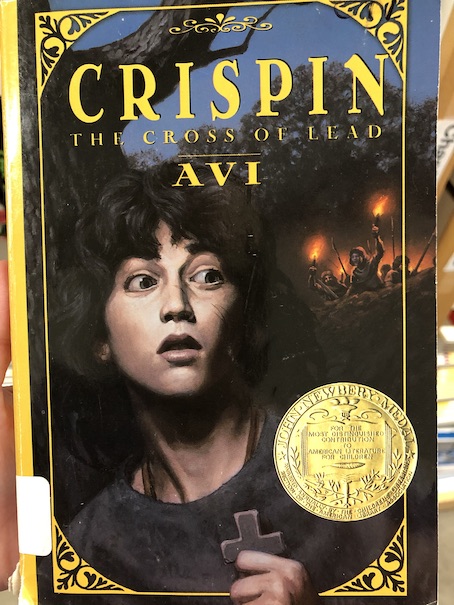
Crispin: The Cross of Lead by Avi, 2002.

The story begins in 1377 in England. It begins with the death of the boy’s mother, Asta. The boy is only known as “Asta’s son” at this point. Nobody has ever called him anything else for as long as he can remember. Even his mother only called him “Son.” He is 13 years old and has no knowledge of who his father was, although his mother told him that he died of the Plague before he was born. As a fatherless child, he was often taunted by others in their little village, and he noticed that no one really seemed to like his mother, although he never really understood why. The only real friend they’ve had is the village priest. With his mother gone and John Aycliffe, the steward of the manor of Lord Furnival that controls the area where they live, demanding his only ox as the death tax for his mother, the boy fears starvation.

As a bleak future lies before the boy, something happens which makes his situation even more dire. He witnesses a secret meeting between John Aycliffe and a mysterious stranger. The boy doesn’t understand the significance of the meeting, but Aycliffe catches him watching and tries to kill him. The boy escapes, but it soon becomes clear that he can’t go home again. Aycliffe has people hunting for him, and he overhears a couple of them talking, saying that the steward has accuse him of stealing from him. No one actually likes Aycliffe and they don’t really believe that the boy is a thief, but they have no choice but to follow the steward’s orders because he’s a relative of Lord Furnival’s wife, and that’s how he gained his position.

Not knowing why Aycliffe has framed him for theft and not having anywhere else to go, the boy turns to the village priest for help. He discusses the meeting he witnessed between Aycliffe and the mysterious stranger, and the priest reveals that Lord Furnival, who has been away, fighting, has returned home but is now dying. The stranger, Sir Richard du Brey, brought the news of Lord Furnival’s impending death, but the boy knows that Aycliffe and du Brey seemed concerned about another matter, something they said posed a threat to them.

The priest tells the boy that Aycliffe means to have him killed and that his only choice is to run away. The boy doesn’t see how he can do that or where he’s supposed to go because he has lived all of his life as a serf, bound to the land. The priest tells him that he needs to go to a big town and stay there for a year and a day to gain his freedom from serfdom (this was a true historical way for people to escape serfdom in the Middle Ages). The priest also tells the boy that his real name is Crispin, but his mother didn’t want anyone else to know, for reasons that he doesn’t explain. He asks Crispin if his mother ever told him anything about his father, but the boy just says that all he knows is that his father is dead. Crispin asks the priest if there’s something that he’s not telling him about his mother, but the priest doesn’t explain. Instead, he tells Crispin that the most important thing is for him to get away. He tells Crispin to hide in the woods while he gathers some things to help him on his journey, and he promises to tell him more about his father when they see each other again. He says that it would be safer for Crispin to know more right before he leaves. (You just know that when someone has something important to say but would prefer to say it later, that person is probably doomed.)

When Crispin waits for the priest to come for him later, a boy from the village shows up instead, saying that the priest sent him. The boy, Cerdic, guides him to Goodwife Peregrine’s house, and she advises him to go to the south because the steward’s men are searching the road to the north. She gives him some food and a cross made of lead in a leather pouch. Before Crispin leaves the village, however, Cerdic says that maybe he should head north after all because the steward might have been lying about searching the north, just to make Crispin think that he should go south. Cerdic says that the priest told him that the best way for Crispin to go would be west because that’s what everyone would least expect. It would be the last thing anyone would expect because the Lord Furnival’s manor house lies in that direction. However, Crispin soon discovers that he has been led into a trap and that the steward is waiting for him. He manages to escape, but he discovers that the priest has been murdered, preventing him from telling him whatever he knew.

Crispin wanders by himself until he finds an empty village where everyone was apparently killed by the Plague. However, there is one other person in the village, a traveling entertainer. The entertainer gives Crispin some food, but he also forces him to tell him his story. Realizing that the boy is a runaway, he forces Crispin to become his servant on the principle that a runaway serf can be taken by anyone. Crispin doesn’t want him for a master, but he has no choice because, if he refuses, the entertainer could easily turn him over to the steward at his former manor, where he would be killed.

The entertainer explains that his name is Orson Hrothgar, but his nickname is Bear because he is a large man. He shows Crispin his juggling and explains that’s how he makes his living. He asks Crispin what he can do, but all Crispin knows is the farming he did as a serf. Bear says that there is no way he could make a living on those skills in any city he went to and he’s going to have to acquire some new ones. Bear is a strange master, giving orders like a tyrant but at the same time claiming to hate tyranny and keeping Crispin firmly in his service while refusing to be called “sir” because he thinks that it makes Crispin sound too servile. As Bear and Crispin get to know each other, it starts becoming obvious that Bear is actually trying to help Crispin when he’s hard on him and even forcing him to serve him is actually in Crispin’s favor because Crispin doesn’t know how to survive by himself in the wider world and hesitates to make decisions for himself without guidance or orders from someone. The threat against Crispin’s life is real, and he’s gong to need help and guidance to survive.

Bear teaches Crispin how to sing and juggle so he can perform with him, but he also teaches the boy how to have some respect for himself and how to take charge of his own life. He can tell that Crispin has been badly neglected in his early life, taught only to obey orders and not ask questions. Because, for a long time, Crispin didn’t even know he own name, he thinks of himself as basically a nobody who doesn’t have a place in the world and isn’t worth anything to anyone. Bear takes Crispin in hand and shows him that his life and his own self are what he decides to make of them.

Bear’s own history is a strange story, and he tells Crispin how his father originally enrolled him in a Benedictine abbey at a young age to be a monk. While he was there, he learned to read and actually became a scholar, but before he took his final vows, he happened to meet a group of mummers, and he was charmed by the life of a traveling entertainer. He abandoned the abbey and traveled with the mummers for a time. He has also been a soldier, and during his time as a soldier, he met Lord Furnival. Crispin asks him what Lord Furnival is like because, even though he has always served on his land, he’s never actually met him. Bear describes Lord Furnival as a cruel man who used other men for his own gain and killed them when he had no use for them.

When they arrive at a new town, Bear assumes that Crispin will be safe to perform in public, having left his enemies behind because few people would pursue a poor boy of no important family or position over the theft that he was accused of doing back in his village. However, Crispin is alarmed to see Aycliffe as they enter the town. Bear realizes that there must be more to Crispin and his situation than even he knows. The murder of the priest back in the village is a shocking crime and must have been intended to silence him from telling whatever he knew. If Aycliffe poses a threat to Crispin, it seems that Crispin must also somehow pose a threat to him, a threat that he thinks must be eliminated. Discovering the reason for targeting Crispin also means unraveling the secrets of Crispin’s past and parentage, and along the way, Crispin also comes to a new vision of the future that he may build for himself.

There is a section in the back of the book which explains the history of this time period and some of the wider events that are a part of this story. The copy I read also had the text of an interview with the author.

This book is a Newbery Medal winner. It is available to borrow and read for free online through Internet Archive (multiple copies). There is also a sequel to this book called Crispin at the Edge of the World.

My Reaction and Spoilers

I read this book partly because I liked Midnight Magic by the same author, and I was pleased to see another mystery story by Avi set in Medieval times. However, the two books have a very different tone from each other. Midnight Magic featured palace intrigue and possible murder, but it was a spooky mystery adventure. Although there were dark themes, it had a sense of whimsy and fun adventure to it, playing with superstitions and a kind of spooky prank, even though it had high stakes. Crispin begins immediately with a mystery orphan who has people who are actively trying to kill him for reasons he doesn’t understand and who is forced to flee for his life. It’s much darker and more serious in tone, and there are parts where dead bodies are actually described in detail. This is definitely not a book for young kids!

The mystery in the story centers around the boy’s true identity and parentage. I thought it was obvious even from the beginning that the boy’s father would turn out to be someone important, whose identity might become known through the deaths of his mother and Lord Furnival and who might pose a threat to the villains in the story through whatever position and inheritance he might have.

It isn’t that much of a surprise that Lord Furnival is Crispin’s father. When he was alive (he dies during the story), he used women for his purposes as well as men. Crispin is not the only child he had by women other than his wife, who apparently, was unable to bear children. The story doesn’t explain who Crispin’s other half-siblings might be or where they are, but the other characters quickly realize that the reason why Lady Furnival and her kinsman, Aycliffe, want Crispin dead is that he might make a claim on his estate, or worse yet, other people might use Crispin to undermine their power. This is a dangerous time, and many people are competing for power and influence. Crispin’s mother was also no ordinary peasant girl. She has kin who are still alive and may be in a position to use Crispin and whatever inheritance or title he could claim to solidify their own positions. Even Crispin’s grandfather, if he became aware of the boy’s existence, might look at Crispin less as a beloved but previously unknown grandson, but more as an unexpected windfall that he could control and use to his advantage. Bear is really the only person who cares about Crispin’s welfare for his own sake, not for what he might be able to gain or achieve through him.

The plot is further complicated because it turns out that Bear is no ordinary entertainer. He turns out to be involved with a real historical character, John Ball, the priest who helped lead the Peasants’ Revolt of 1381. The pieces of philosophy that Bear discusses with Crispin throughout the story are not just academic, and for all of Bear’s apparent lightness as an entertainer, he is actually a deeply serious man who is participating in a clandestine organization that plans to put his principles into action in the form of a rebellion. In his travels, Bear acts as a kind of spy, carrying information to different leaders of his group. There are indications in the story of social unrest and the coming violence. Sadly, in real life, most of the leaders of this revolt were caught and put to death, including John Ball. This endeavor isn’t going to work out well for Bear’s associates and maybe not even for Bear himself, and that probably figures into the sequel to this book.

I particularly liked this book for the inclusion of many small historical details. Throughout the story, Bear and Crispin discuss aspects of Medieval law, social structure, and religion in England, and there are also some details about daily life and the Plague. The only Christian religion in the book is Catholic because the story takes place prior to the Reformation, so all of the religious talk in the book is from that perspective, although Bear and Crispin debate with each other about the role of God in determining a person’s position in life and human decisions (like when a person should wait to act on divine guidance vs making decisions for themselves) and the use of religious objects (like whether Crispin’s lead cross serves a purpose in prayer or if prayer should simply be private and mental, with no outside sign), which leaves room for readers to consider what they believe and their own views of the situation.

A small detail that I liked was Bear’s explanation of what the different colors of the robes of different types of monks mean. The different orders of monks and priests – Dominican (white robes), Franciscan (brown), and Benedictine (black) – still exist in modern times and still have a somewhat different focus from each other in their activities. As a Catholic, I know that Dominicans are usually (but not always) the priests who celebrate public masses in local churches (Bear describes them saying, “They preach well” because that’s a major focus of what that order of clergy does), and Jesuits (who don’t exist yet at the time of this story) are typically (but not exclusively) the ones who teach in Catholic schools (which I’ve never attended – I came up exclusively through public schools) and universities (Loyola Marymount University is an example). These are the two groups I’ve seen the most in my life in the modern southwestern US, but they are not the only orders of Catholic clergy. For example, the book didn’t mention the Cistercians, who also existed at the time of this story and are basically more strict, austere versions of the Benedictines. I like this particular detail because it shows how there is depth to every subject. A non-Catholic might not know that these different orders of clergy exist, and it matters because each of these groups does have a different focus in their views, methods, and lifestyles while still falling within the sphere of being Catholic. In Medieval England, because each of these groups would have performed somewhat different functions in society because of their different focus and people of the time would have been aware of the differences between them. If you’re a fan of Dungeons and Dragons, the concept of different subclasses of clerics have real-life parallels, not just in historical polytheistic religions but even in modern monotheistic religions.

It was common for Medieval monastic orders to support themselves through agriculture (when society was largely based on agriculture, abbeys kept their own lands and animals for support), but monks, priests, and nuns could also fulfill a variety of professions and services in society, some as charity and others as paid roles to support themselves and their orders. Aside from their basic religious functions, they could act as scribes, copying, writing, and illustrating religious and historical books and manuscripts on commission (essentially, the book publishers of their day, before printing presses were available). When Bear was young, his father enrolled him in a Benedictine abbey. He explains that he learned to read in different languages there, so this was probably the work they were preparing him to do if he had continued with his training there, rather than the public preaching he would have been taught to do if he had joined the Dominican order. It was one of the functions that Benedictines were known for, and it would have been a good order for someone to join if they wanted to lead an intellectual or academic life in the Middle Ages. Bear gets much of his philosophical attitude and reflection from his early Benedictine education, although he values the independent form of free thought that he developed through his years of travel to the more strict form of traditional scholarship the abbey would provide. Religious orders that emphasized reading, writing, and learning could also provide tutors to wealthy families to teach their children these skills and clerks (derived from the word “clergyman” or “cleric”), who would keep important financial, legal, and political records for influential people in society. Abbeys and monasteries might also provide lodging for travelers in places where there were no inns, hospitals for the sick and injured, and various forms of charity for those who needed it (the social services of their time). Although joining one of these orders involved strict rules and vows of chastity and poverty (any wealth they acquired was supposed to be used to support the group and their functions rather than mere personal gain), there were opportunities for intellectual as well as spiritual development and a chance to lead a more varied life than other parts of society might provide at the time.

In their travels, Bear and Crispin see many different types of people who would all have been part of Medieval English society. Not all of their jobs and positions are described in detail, but if someone was using this book with students working on a Medieval lesson unit, they could make notes about all of the different types of people Bear and Crispin meet and look up the details of their roles in society to get a more detailed picture of the world these characters are moving through.

Adam of the Road

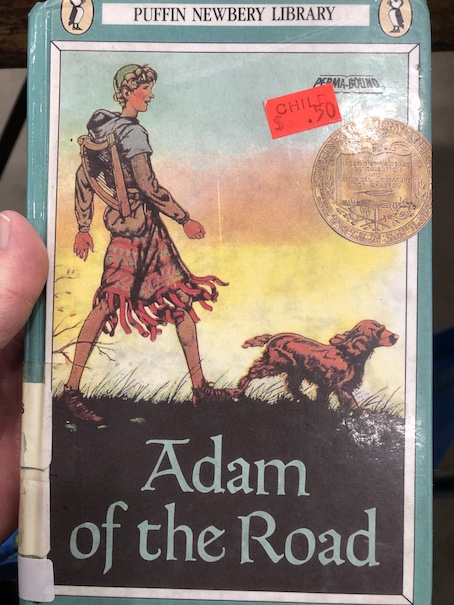
Adam of the Road by Elizabeth Janet Gray Vining, illustrated by Robert Lawson, 1942.

The story takes place in England in 1294. It’s summer, and eleven-year-old Adam Quartermayne is waiting for his father, Roger the minstrel, to come see him at the dormitory where he’s been living while he’s going to school at the Abbey of St. Alban. Roger Quartermayne has been in France, attending a minstrels’ school, where he has been learning new songs and stories. More than anything, Adam wants to go on the road with his father, traveling from town to town, playing their musical instruments.

Roger is a higher class of minstrel than most, truly skilled in his art, welcome even in noble manor houses and castles, and well-paid for his performances. Roger plays a viol, while Adam can play the harp. Adam practices his playing while at school and tells stories to the other students. Although his teachers would prefer that he spent his story-telling time talking about the saints, they allow him to entertain the other boys as long as his stories are tasteful and not rude or mocking. Adam’s father has impressed on him that a minstrel’s job is not to tell his own feelings but to choose entertainment that suits the mood of his audience, whether it’s happy or sad. (In other words, they know how to read a room, and a good minstrel can make the audience feel like he’s saying what’s on the minds of the listeners.)

Adam’s closest companions at school are his best friend, Perkin, and his dog, Nick. Since Nick isn’t allowed in the dormitory, Adam pays for him to board with a woman in town. He and Perkin go to visit Nick when they can. Adam has taught Nick to do entertaining tricks, as befits a minstrel’s dog.

When Adam’s father comes, he tells Adam that he has taken a position with Sir Edmund de Lisle and is now traveling with his party. Roger invites Adam to join him on their journey to London, and Adam eager accepts. His only regret at leaving the school is that Perkin cannot come with them, but Perkin says that they’ll see each other again. Perkin’s father is a ploughman (this video, from Crow’s Eye Productions, explains a little about the life of a ploughman and how they dressed), and he says that, if they pass through the village where he lives, they can stop and visit his parents and the parson who sent him to the abbey school.

The open road is like home to minstrels like Roger and Adam. They spend their journey entertaining Sir Edmund’s party with stories. Adam develops a crush on Sir Edmund’s pretty niece, Margery, although her brother, Hugh, is an annoying snob. Adam’s first efforts to join his father in playing music are awkward and embarrassing, but Roger says he will improve. Adam is also lonely without Perkin to talk to. There are other boys at Sir Edmund’s manor house, but they all ignore him. They become friendlier when Adam takes the advice of a friendly squire to lend them his horse for their jousting practice when Hugh’s horse is lame. At first, Hugh thinks that a minstrel like Adam wouldn’t know anything about martial arts, but Adam demonstrates that he has also had some training, causing Hugh to give him more respect. From then on, he is able to join the other boys in their games.

At the wedding of Sir Edmund’s daughter, Emilie, Adam has the chance to see many other minstrels and entertainers of various kinds. Although both Adam and his father are richly rewarded for their performance, Roger gambles away his share of the money playing dice with the other minstrels. He tells Adam to keep his own money close to him and not to hand it over to him, even if he asks for it. Roger recognizes that he has a gambling problem and can’t be trusted with money. Worse still, he gambled away their horse, too. It’s upsetting to Adam because they had never had a horse before, and he was fond of it. He also knows that Hugh was fond of that horse. Roger is embarrassed about what he has done, and Hugh worries that Jankin, the man who won the horse, will ride him to death because he doesn’t know how to take care of horses.

Although they are still in the employ of Sir Edmund, he will not be needing them for a while, now that the wedding of his daughter is over. Roger and Adam go on the road again, although they are supposed to return to Sir Edmund’s manor after traveling their route. In London, they meet up with Jankin again, and he tries to get Roger to gamble with him again for ownership of Adam’s dog, but Roger refuses, saying he doesn’t want to play anymore and the dog belongs to his son. However, when they happen to be staying at the same inn later, Jankin steals Adam’s dog!

Roger and Adam hurry after Jankin to get Nick back, asking people they meet on the road which way he went with their dog. They almost catch up to him at a ferry, but he gets on the boat and it leaves before they can reach it. Not wanting to wait for the ferry to return and desperate to reach his dog, Nick jumps in the water and tries to swim after the ferry, but he is still unable to catch up. When he climbs out of the river, he is alone and too tired to continue the pursuit anymore. He is separated from his father, but he still has his harp, thanks to a kind woman who helped him. What is he going to do? Will he ever find his dog or father again?

The book is a Newbery Medal winner. It is available to borrow and read for free online through Internet Archive (multiple copies).

My Reaction and Spoilers

The story offers a ground-level view of Medieval society. Through his travels, Adam mixes with children and adults from various levels of society. Adam begins at a monastery school, taught by monks. Then, he joins his father, working for a noble family and living at their manor, where Adam becomes friends with noble boys training to be knights. They meet other minstrels, and when they travel on the road, they also meet traveling pilgrims, stay at inns and speak to the innkeepers. When Adam is on his own, he briefly stays with a ferryman and his wife, travels with a merchant, is robbed by highwaymen and has to get help from local law enforcement, gets information from a shepherd, attends a large fair with people of all kinds, and toward the end of the book, spends time with Perkin and his family, helping his father with ploughing. Along the way, Adam learns many things about people and different members of society, including how girls are treated differently from boys, even in noble families and what common people think about the king and parliament and how they make laws.

During the course of the story, Adam and his father also discuss some of the philosophy behind their own profession. It begins with Adam’s reflection on what his father said about choosing his selections of songs and stories to appeal to his audience because his job is to please others, not merely himself. However, when Adam briefly joins up with some poorer minstrels, he comes to understand that it’s not just a matter of giving people what they want. A better minstrel not only gives people material they like but which appeals to the better sides of their personalities, elevating them to their highest versions of themselves, instead of just catering to everyone’s lower tastes. Understanding other people and their lives and tastes are critical to the job of being an entertainer. Adam also learns a little about the use of humor and how it can benefit both himself and others when used well. At one point, when Adam is recovering from an incident that was embarrassing to him, he makes a joke about it that amuses a new friend, and when his new friend laughs, Adam realizes that he feels better about the embarrassing incident. His use of humor softens his feelings of embarrassment and also provides a useful tool for entertaining and bonding with someone else. The story compares it to an oyster turning an irritant into a pearl that is both less irritating to the oyster and something beautiful for someone else. Although Adam goes through genuinely terrible circumstances through his travels, the experience shapes his views of life and the type of minstrel he wants to be.

I was genuinely worried about the animals in the story because I find it stressful to read about animal cruelty. Fortunately, both the horse and dog survive their experiences with Jankin, and Adam is reunited with his father and Nick.

I enjoyed the pieces of real Medieval songs that appear throughout the story, like Sumer is I-cumen In (You can hear the song in this YouTube video. This one explains what the Old English words mean. It’s about the beauties of nature and lively animals at the beginning of summer, apparently with a confusing line about farting billy goats.) and an old version of London Bridge is Falling Down, which also includes an explanation of the story behind the the song.

As another piece of trivia, Jankin is actually a Medieval nickname for John. In Medieval times, it was common to get new nicknames for certain common names by changing just one letter or sound in the name and/or adding “-kin” to the end of a name as a diminutive, like we might add a “-y” for Johnny. In fact, the name Jack that is used as a nickname for John comes from this earlier nickname – John to Jan to Jankin to Jackin to Jack. We get other nicknames that don’t completely resemble the original name from this same method of creating new nicknames, like the nickname Peggy for Margaret – Margaret to Maggie to Meggy to Peggy.

Island of Adventure

Enid Blyton’s Adventure Series

Island of Adventure by Enid Blyton, 1944.

Philip Mannering is spending part of his summer holidays at the home of one of his teachers, doing some extra studying, which is a bit depressing.  He has fallen behind in school because he recently suffered from Scarlet Fever and Measles, and he is trying to catch up.  He’s not the only boy studying at the teacher’s home, but he isn’t really friends with the others.

One day, he’s doing some studying on the hillside and hears a strange voice telling him to shut the door and not whistle.  There is no door on the hillside, and he wasn’t whistling.  Philip is very confused until he realizes that the voice is coming from a big, white parrot sitting in a tree.  Then, he hears a child’s voice calling the parrot from the garden of the teacher’s house.  Philip is happy, thinking that another boy has joined the study group, but it turns out that he’s only half right.

The voice in the garden belongs to Lucy-Ann Trent, who isn’t a student and isn’t there to study.  Her brother, Jack, is the one who needs to catch up in school because he never focuses on his studies.  Jack has only one interest in life, and that’s birds.  Jack owns the parrot, Kiki, and wants to be an ornithologist when he grows up.  He is bright but disinterested in anything that isn’t related to his chosen field.  Lucy-Ann is only there to spend time with him and keep him company while he gets extra tutoring.  The two of them are orphans.  They don’t remember their parents because they died in a plane crash when the children were very small.  Most of the time, they live at boarding school, which is why they don’t spend as much time together as they like.  Usually, during their holidays, they live with a fussy uncle, which is why the parrot is always barking orders at the children.

Philip also usually lives with an aunt and uncle when he’s not at school.  His father is dead. His mother is still alive, but she spends most of the time working at her art agency.  He also has a sister named Dinah, but they don’t usually get along.  Philip is surprised at how well Jack and Lucy-Ann get along with each other because he’s always fighting with his sister, who has a temper. (Although, admittedly, he does push Dinah to lose her temper.)  Strangely, Philip finds himself wishing that Dinah were also there because, when he becomes friends with Jack and Lucy-Ann, it occurs to him that she would nicely round out the group.

Philip, Jack, and Lucy-Ann become friends by bonding over their shared love of animals. Philip likes the parrot and tells Jack and Lucy-Ann that they would probably like his aunt and uncle’s house because they live by the sea, and there are many sea birds in the area.  Philip doesn’t know much about birds in general, but he likes collecting various small pets, including mice and caterpillars.  The teacher isn’t too happy about these animals because they disrupt study sessions.

Then, Jack and Lucy-Ann get a letter saying that they’re going to have to continue staying with the teacher through the rest of the summer because their uncle has broken his leg and can’t take them back.  The children aren’t happy about that and neither is the teacher because he had other plans after the summer tutoring session ended, even though the uncle has provided a generous check for the children’s care.

Then, Philip has a wonderful idea: maybe Jack and Lucy-Ann can come visit him and his sister at his aunt and uncle’s house.  Dinah has written to him that she’s bored and lonely and misses him, even though they usually fight.  She would like the company, and Philip knows that his aunt and uncle could use the money the children’s uncle is willing to offer for their boarding.  Jack and Lucy-Ann like that idea, but they’re not sure that their uncle and teacher would agree to let them go because they don’t know Philip’s aunt and uncle, and they think maybe Philip’s aunt and uncle wouldn’t want two strange children staying with them.  The children know their plan would be best for everyone, but since they’re not sure that they can persuade the adults, they take the attitude that it’s easier to ask for forgiveness than permission and plot for Jack and Lucy-Ann to run away and join Philip on the train home.  Jack and Lucy-Ann secretly send their trunks to the train station along with Philip’s and tell the teacher that they’re just going down to the station to say goodbye to Philip when he goes.  Then, they quietly buy their train tickets and leave.

When the children arrive at Philip’s home, Aunt Polly is irritated because she isn’t prepared for unexpected guests.  There are no rooms or beds for them, and she says that they can’t stay.  However, she is surprisingly won over by Kiki, who says, “Poor Polly!” over and over in a sad tone.  Not knowing that Kiki is also sometimes called Polly, Aunt Polly thinks that the bird knows her name.  She often feels overworked and rarely gets any sympathy, so she appreciates this gesture from Kiki, who repeats the phrase more often, seeing that it pleases Aunt Polly.  Aunt Polly is also charmed that Polly tells people to get a handkerchief when they sniffle or sneeze because she’s always saying that to Dinah.  When she telephones the children’s teacher to discuss the situation and learns about the fee the children’s uncle is willing to pay for caring for the children, she decides that maybe the children can stay after all.  The relieved teacher promises to endorse the check over to her.

Aunt Polly is relieved to get the extra money, and she reveals to the children that she’s been very worried about expenses because Philip and Dinah’s mother has been ill and hasn’t been able to send the money she usually sends from her job.  Her doctor says that she’s run-down and needs a rest, but her job is an important source of money to the whole family.  Everyone is relying on her, but since she hasn’t been able to send her usual support money for the children, Aunt Polly is worried about how she will afford the children’s school fees.  Philip bravely says that he’s willing to quit school and get a job instead to help out the family, but Aunt Polly says he’s still too young.  Philip has wished before that he was old enough to be the man of the family and provide for his mother.  His uncle isn’t much help with money and doesn’t pay attention to family expenses, too absorbed in his academic work.  Aunt Polly says that the money she’ll get from boarding the Trent children will help out.

Philip says that part of the trouble is that the house where they live is really too large. About half the house is crumbling into ruins from neglect, and the other half is really too big for Aunt Polly to maintain.  Aunt Polly agrees but says that moving would be difficult because few people would want a house like this one, crumbling and located in a rather lonely spot along the coast.  Besides, the children’s uncle loves it because he knows all the history of the area, and he wouldn’t want to leave.  Philip thinks the only thing that will really help is when he and Dinah are old enough to get jobs.  Then, the two of them will be able to help their mother afford a place for three of them.

Philip’s aunt and uncle have a gloomy man named Joe working for them, and he tells the children that the tower room where the boys will sleep on an old mattress (a prospect that seems adventurous to them instead of an inconvenience) isn’t a good room because it’s the only room where they can see the Isle of Gloom.  He says that bad things are associated with the Isle of Gloom because bad people who did terrible things lived there.  Jack asks Philip about the Isle of Gloom.  Philip says that it’s difficult to see, even from the tower room, and it’s always covered in mist.  Nobody lives there now.  Jack thinks it sounds great because the birds on the island have probably never seen people before and won’t be afraid of them, so he could get some amazing pictures.  He thinks maybe he’ll even find some rare birds.  Philip says that he and Dinah have never been there before themselves, and he’s not sure whether there are birds there or not. 

Staying at the house by the sea isn’t easy.  All of the children are expected to help with the chores.  There is no electricity, and they use oil lamps that need to be cleaned.  The water has to be pumped from a well.  Still, Jack and Lucy-Ann think that it’s just part of the adventure.  They enjoy going swimming and fishing with Philip and Dinah, and Jack has fun bird-watching, but Joe the handyman is always spying on them and acting creepy.  He keeps telling the children spooky stories about things lurking in the dark.  For some reason, Joe tries to discourage the children from exploring the area or going out in a boat, but they soon make an interesting discovery. 

While the children are exploring a cave, Philip teases Dinah, and she hits him.  He stumbles back and ends up in a hidden tunnel.  Philip and Jack explore the tunnel and discover that it leads to some carved stone steps and trapdoor that leads up to a storeroom that’s part of the cellars at the house.  Philip says that he never knew this part of the cellar existed.  The boys discover that the door to the storeroom is usually hidden by boxes, but Joe has the key and comes in.  Kiki, who is with Jack as usual, makes some sounds that terrify Joe, who thinks that there are strange and spooky things in the cellar.  The boys think that it’s hilarious that Joe got scared when he’s always trying to scare them.  They steal the key that Joe left in the door so they can come and go whenever they like, but they wonder why Joe even hides the door to the storeroom in the first place.  Philip is sure that even his aunt doesn’t know about that storeroom, or she would have mentioned it before.

Joe is definitely doing something suspicious, going out at night in a boat, fearful that the children will find out what he’s doing. The children make friends with a nice man named Bill, who is staying in an old shack nearby. Bill says that he’s there for bird-watching, but he doesn’t seem to know that much about birds or talk about them as much as Jack does. Bill has a boat and takes the children out sailing, but he doesn’t want to take them to the island and warns them to be careful of Joe. Does Bill know something the children don’t, or does he have some dangerous secrets of his own?

The book is available to borrow and read for free online through Internet Archive (multiple copies). It was first published in Britain, and some US copies use the title Mystery Island instead. The book was made into a movie in the 1980s, and you can see it on YouTube. The movie has John Rhys-Davies as one of the villains.

My Reaction

First, I’d like to get it off my chest that I didn’t like many of the family relationships throughout the book. Aunt Polly’s marriage is a little disturbing because she doesn’t have enough money to run the household, but her husband not only says that he has none to give her and wouldn’t give her any even if he did have money. He doesn’t seem to care about the welfare of either Polly, who is eventually revealed to have a heart condition, or the children in his care. He buries himself in his study most of the time and has almost no idea of what’s going on in the rest of the house or even who’s there. He’s not just obsessed with his studies, but at times, it seems like he’s deliberately hostile toward everyone else, including his wife, like their existence in the house is a terrible inconvenience to him.

I didn’t like the way Philip and Dinah were portrayed as always fighting physically in the book. Admittedly, my brother and I got into physical fights when we were little, but Dinah is twelve years old, and Philip is older than she is. Both of them seem to be too old to be acting the way they do in the story. Dinah is very emotional and has a hair-trigger temper, and Philip, knowing this, intentionally baits her into losing his temper. He likes to put creepy-crawly creatures on her or act like he’s going to, knowing she doesn’t like it and that she’ll react, and then he’s not happy when she lashes out and hits him. While Dinah shouldn’t react by hurting people physically, I could sort of understand it if she constantly has to put up with this from Philip. Living with someone who is always baiting you and escalating his behavior until you break would probably leave anyone broken in the end, and I can’t help but think that Dinah’s emotions would stabilize more if she didn’t have to deal with someone always trying to throw her off balance. Maybe she’d still be an emotional person, but I notice that it’s particularly Philip who gets her to fight physically while nobody else does because they don’t bait her into it. I found that sibling relationship kind of disturbing because Philip seems to know exactly what he’s doing, and as I said, he’s too old to be doing this stuff innocently.

Jack and Lucy-Ann seem to have a more fond sibling relationship. Lucy-Ann sometimes seems a little clingy with Jack, but I think that might be because the children are orphans and are not fond of their stern uncle, so they don’t really have anybody else to be close to except each other.

My copy of the book is one of the later editions that had some of the names and language changed to remove racially-problematic aspects of the story. In the original version of the book, the sinister handyman was a black man called Jo-Jo, and his race was unduly emphasized. I prefer the version where he’s just a weird guy named Joe.

The mystery isn’t bad. I knew right away that Joe was suspicious because he kept acting suspiciously, but the mystery is one of those type where it’s not so much about “whodunnit” as about “What is this person doing?” Readers know that Joe is up to something, but it isn’t clear for much of the book what it is. I had a couple of ideas early in the story, but neither was right.

Bill is also an interesting addition to the story. For part of the book, he looks a little suspicious because readers can tell that he’s not the bird-watcher he pretends to be, but he doesn’t seem to be allied with Joe. Bill is actually a good character, although he’s not what he appears to be, and he becomes one of the important characters in other books in the series.

Mary Poppins in the Park

Mary Poppins in the Park by P. L. Travers, 1952.

This Mary Poppins book is supposed to take place during the first three books in the series. It’s a collection of incidents that take place in the park. Each chapter is a short story, and each of the stories can stand alone.

I thought that the stories were fun, but there are a few instances of racial language that I didn’t like in the original version of the book. At various points throughout the original version of book, Mary Poppins chides the children for things they’re doing by calling them “Blackamoors”, cannibals on an island, or “Hottentots. ” In other words, she’s implying that they’re being “savages.” I know that notions of “savage natives” appear in other old children’s books, but I don’t think it’s a good idea to give modern children these ideas, and I don’t like it that Mary Poppins uses racial words as insults for the children in the story. Fortunately, later printings of this book rewrote these scenes to remove inappropriate racial language.

When I was writing this review, I told my brother the plot of one of the stories in the book,Lucky Thursday, and we had a good laugh over it. It was a pretty funny story to read. My brother asked whether the story was supposed to have a moral or teach children anything. I thought about it, and I suppose that part of the moral could be “Be careful what you wish for”, but in the end, I don’t think any real lessons were learned.

The book is available to borrow and read for free online through Internet Archive (multiple copies).

Stories in the Book:

Every Goose a Swan – When everyone seems to be daydreaming and pretending that they’re someone they’re not, Mary Poppins tells the children a story about a vain goose girl and the others around her who have grand ideas about who they think they really are. When someone points out the realities of being the people they like to think they are, they all decide that maybe it’s better to just be themselves.

Faithful Friends – Miss Andrews, a neighbor of the Banks families, has been advised to go traveling for the sake of her health by her doctor. Before going away, she asks the Banks family to look after her “treasures” during her absence. Mrs. Banks puts them in the nursery because she knows that Mary Poppins will look after them, although Mary Poppins is a little put out by this extra duty. The “treasures” turn out to be a collection of random knickknacks, battered and incomplete. The children are particularly interested in a pair of hunters with lion friends, but one of them is mostly missing, and they think that the lion missing his hunter looks rather sad. By coincidence (apparently), they meet a couple of policemen who are reminiscent of the hunters. One of them used to live near a jungle but had to return home because he lost a foot, like the knickknack hunter. He’s been sad since he got back because he says he’s missing a friend. However, he gets his friend back when a loose lion suddenly appears in the park. When children get home, the missing hunter is back in the knickknack, and the lion looks happy.

Lucky Thursday – Michael is unhappy because the other children got to go to the park while he had to stay home with a cold. The only interesting thing that happens is that he sees a strange cat out the window. Michael goes to bed in a bad mood, but the next day, all sorts of lucky things begin happening. However, it turns out that it’s not quite as lucky as he thinks. First, he doesn’t take care of some of the nice things he receives and loses them. Then, the mysterious cat leads him on what seems like a magical journey from the park to a castle of cats, and he is told that everything he’s received has been because he wished on the Cat Star the night before. Part of what he wished was just disgruntled grumblings, though, and part of the cats’ idea of fun and games is to make Michael answer riddles. If Michael answers the riddles correctly, he’ll get to marry one of the cat princesses, and if he doesn’t, he’ll have to work in the kitchen of the castle with other children who made foolish wishes. Michael does answer the riddles correctly, but he doesn’t want to marry a cat, and he has a desperate struggle to escape from the castle of the cats. He only manages to escape when he blows Mary Poppins’s whistle.

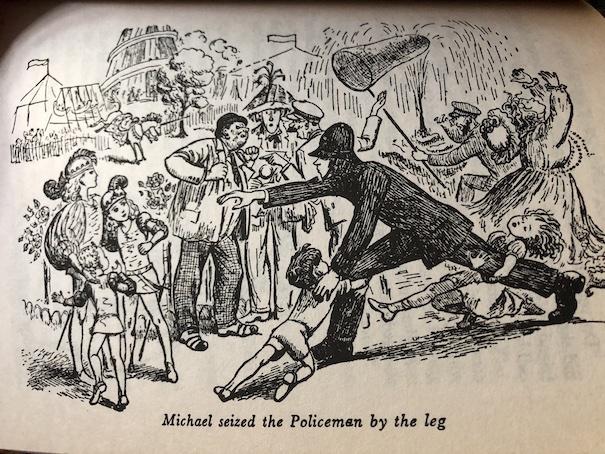
The Children in the Story – The park keeper isn’t very happy about the fair set up near the park because it always leaves such a mess. Mary Poppins and the children are also in the park, and Jane is reading aloud from The Silver Fairy Book. She and Michael start talking about the princes in one of their favorite stories. Then, the three princes come out of the story to see Jane and Michael. The princes say that Jane and Michael are the children in the stories they read, and they’ve entered their own book to visit them. They say that they’ve visited generations of other children before.

The princes have brought their unicorn with them, and when adults around them start noticing that there’s suddenly a real unicorn in the park, they start panicking and arguing among themselves about whether the unicorn belongs in the zoo, in a museum, or as a sideshow at the fair. The adults seem to feel like the princes and unicorn are vaguely familiar, but they can’t seem to remember why. Most adults forget about the princes when they get older, but not all. Bert the matchman remembers, and it turns out that Mary Poppins has also been nanny to the princes.

The Park in the Park – The children are playing in the park on a hot day. Jane is making little figures out of plasticine and a little park for them all. Michael is hungry, and the baker figure comes to life and gives him pie. The children get to know the other figures, and Jane is amazed that the characters have lives that she didn’t create for them. The figures don’t seem to remember that Jane made their little world, and Jane and Michael are astonished to realize that they have now become child-size in the little park she created.

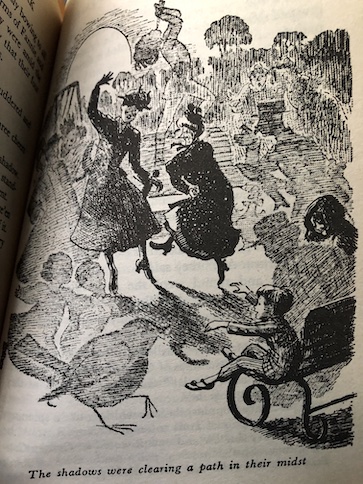
Hallowe’en – On Halloween, as the children are heading home with Mary Poppins with nuts and toffee apples, they meet the strange Mrs. Corey and her tall daughters. The children are told to be careful of stepping on shadows and that they should take care of their own shadows so they don’t run away. Mary Poppins hurries the children home and to bed, but the children find leaves that seem to be invitations to some kind of party. The children look outside and see shadows without people in the garden. The children follow the shadows, including their own, to the park. There, they see the shadows of everyone they know and even nursery rhyme characters. Mrs. Corey, her daughters, and Mary Poppins are there, and they explain that it’s the night before Mary Poppins’s birthday, and that’s what the celebration is about. They all dance with the shadows until Mrs. Boom arrives, upset, because her husband is distressed that his shadow is missing. Soon, other people also arrive to reclaim their shadows.

Mary Poppins Opens the Door

Mary Poppins Opens the Door by P. L. Travers, 1943.

This Mary Poppins book was written during World War II, and the author has an acknowledgement in the first chapter that things have changed because of the war. Like other Mary Poppins books, each chapter is its own short story, and the first one takes places on Guy Fawkes Day. A note at the beginning explains what Guy Fawkes Day is, and it also mentions that people haven’t celebrated it since the war began. However, the author says that she is sure that the situation is only temporary and that people will celebrate it once again after the war is over.

Sadly, people reading older versions of Mary Poppins books also have to be warned about the racial language. The stories are magical, but at the same time, one of the most grating things about the original printing of this book is that characters have a tendency to use racial language or racial terms as insults. When characters, even Mary Poppins, are irritated with each other, they’ll call people things like “Hottentot“, “black heathen”, “Blackamoor“, and similar things, implying that these people are behaving like “savages.” Some of the words the books use would be considered offensive by themselves, but it’s worse when they’re specifically used as insults. These incidents don’t take place in every story, but they happen throughout the original printing of this book, and they’re also found in other old Mary Poppins books. On a somewhat lighter note, I liked the character of Mrs. Clump, even though she’s an antagonist in one of the stories, because she used “vampire” and “pirate” as insults. If someone is going to use insults, I like them imaginative and funny like that. Fortunately, later reprintings of this book revised or removed the inappropriate racial language, so some people who grew up with the revised versions may not have even been aware that they were ever there.

This is the third time that Mary Poppins returns to the Banks household to be the children’s nanny. In the previous two books in the series, she came suddenly and left suddenly, without warning. Mrs. Banks finds it upsetting that Mary Poppins comes and goes so unexpectedly because she never knows if she can count on her to be with the children or if she will disappear suddenly. All the same, Mrs. Banks is always grateful when Mary Poppins comes because she’s so good at putting the household in order.

The book is available to borrow and read for free online through Internet Archive (multiple copies).

Stories in the Book:

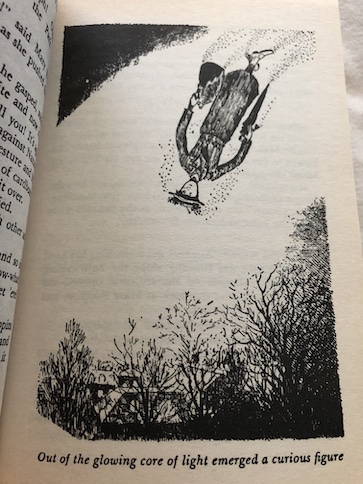
The Fifth of November – Mr. Banks is in a bad mood and declares that he won’t be home for dinner that night, upsetting his wife and children because it’s Guy Fawkes Day, and the family wants him to help set off fireworks. He won’t even shake hands with the chimney sweep, even though that’s supposed to be good luck. Part of the trouble is that the family is missing Mary Poppins, and they haven’t found anyone to replace her, leaving the house in disorder. Mrs. Banks considers hiring Mr. Banks’s old governess, but the children beg her not to because they know how strict she is. The discussion is interrupted by the chimney sweep. Mrs. Banks doesn’t remember scheduling the chimney sweep for the day, and the household staff panic at the idea of having to clean up after the chimney sweep. The chimney sweep offers to take the children to the park and set off some fireworks to give the household time to prepare for him, and the children eagerly accept. The chimney sweep and the park keeper set off fireworks with the children. For some reason, though, there are no sparks from the last rocket, and they can’t figure out why. As everyone else starts heading home, the children see something odd in the sky, a strange spark. It gets larger, and the children recognize it as Mary Poppins.

The children are overjoyed to see Mary Poppins again, and she takes them home. Mrs. Banks is also glad to see Mary Poppins again even though she’s still irritated at the way that Mary Poppins comes and goes suddenly without word or warning. Mr. Banks’s mood improves as well. Mary Poppins immediately starts making herself at home and putting things in order. She measures the children, but instead of learning their heights, she learns about bad habits they’ve developed. The children ask Mary Poppins if she’s going to stay with them this time, and she says that she’ll stay “until the door opens.” Jane is upset because the nursery door opens all the time, but Mary Poppins tells her that she means “the other door” without explaining what that means.

Mr. Twigley’s Wishes – When Mrs. Banks says that she needs to find a piano tuner, Mary Poppins recommends her cousin, Fred Twigley. She takes the children to Mr. Twigley’s house to see him. Mrs. Clump, the housekeeper, tries to send them away, but Mary Poppins pushes in anyway. Mr. Twigley has locked himself in a room. When Mr. Twigley finally lets Mary Poppins into the room with the children, they can’t see him at first. When Mary Poppins asks him what’s going on, Mr. Twigley explains that he’s been “wishing” and that he’s hiding from Mrs. Clump. He makes himself visible again and explains that, at certain times and under certain conditions, he has the ability to make seven wishes that come true. It’s a tricky business because it’s easy to waste wishes on whims and random thoughts. Mrs. Clump is scheming to marry him because she wants him to use his wishes to give her what she wants, and Mr. Twigley doesn’t want to marry her. When Mrs. Clump tries to come see him, Mr. Twigley suddenly wishes that he was somewhere safe, and he finds himself on one of the music boxes that he’s been making. Then, suddenly, the children also find themselves on music boxes. Mrs. Clump brings a policeman to deal with the chaos, and Mr. Twigley also traps Mrs. Clump and the policeman on music boxes. Mrs. Clump promises that she won’t try to force Mr. Twigley to marry her anymore if he lets her go. What Mrs. Clump had wanted Mr. Twigley to wish for her was a golden palace, so he shrinks her, turns her into a mechanical woman, and puts her into a music box golden palace.

The Cat that Looked at a King – Michael has a toothache the day after his birthday, and Mary Poppins says that it’s because he’s eaten too many sweets. Michael angrily tells Mary Poppins not to “look at him like that.” Mary Poppins says that “Even a cat may look at a king,” and the children and Mary Poppins talk about what the phrase means and if it’s true. A china cat from the mantelpiece comes to life and runs off. Mary Poppins tells the astonished children that the cat has gone to see the queen.

Mary Poppins begins telling the children a story about a king who thought that he knew practically everything, but he kept wondering about all sorts of random things that he doesn’t know. He would think of all sorts of random questions and then send his subjects out to find the answers for him. He kept everyone so busy with finding out random information and writing it down that ordinary tasks would be neglected. The queen feels neglected by the king, the kingdom is poor, buildings are crumbling because they aren’t being maintained, and the castle is infested with mice. Then, a cat comes to the castle and hunts the mice. Then, it sits on the king’s desk and stares at him. The king asks him what he’s doing, and the cat says that he wants to look at him. The king says the cat can look at him, and when the cat has had a good look, the king asks the cat what he thinks. The cat doesn’t think much of the king, and the king is offended because he thinks that his great knowledge deserves more admiration than that. The cat says that it knows everything, and the king says that’s impossible because even he doesn’t know everything. The cat says that cats know everything, and the king challenges the cat to prove it. The cat agrees to the challenge but sets the condition that whichever of them wins gets to govern the kingdom. As the king asks questions, the cat replies as if they’re all riddles. The king says that he’s not being serious and is missing the point, and the the cat says that all questions must have a point and his ridiculous questions don’t have one. The king is unable to answer any of the cat’s questions, but the queen, a page, and the prime minister can, so the cat says that he has the right to rule the kingdom with the help of the people who could answer the questions.

However, the queen, the page, and the prime minister all refuse to serve the cat because they are all dedicated to the king. The king repents of his foolish pride in his supposed knowledge and says that he’s not sure of who he is really anymore. The cat tells the king to look at him, and the king sees his own reflection in the cat’s eyes. When he sees himself, the king remembers that he’s actually King Cole, a merry old soul, and that he has no need of all these useless facts he’s been obsessing about. The cat says that he will let King Cole have the kingdom back if he can be allowed to visit the queen sometimes, and they agree.

The Marble Boy – Mary Poppins takes the children to the park, and although she doesn’t want to admit it, she is irritated that an old man is sitting in her favorite seat, reading a book. When the man closes the book and gets up, a statue of a boy with a dolphin suddenly leaps down from its pedestal and begs him not to stop reading yet because he’s been reading over the man’s shoulder and wants to finish the story. The shocked man apologizes but says that he has to get home to tea. The marble boy asks him if he can have the book, and the man is reluctant to part with it because he’s been wanting to read it for years, but he finally hands it over and leaves.

Jane and Michael ask the marble boy who he is and how a statue can read and jump off its pedestal. The boy says that his name is Nelius. He is an ancient statue from Greece that was separated from the rest of his family. He is often lonely, but he likes observing people in the park and reading over their shoulders. Mary Poppins, who Nelius says he knows because she’s an old friend of his father, tells Nelius to get back on his pedestal, but Nelius begs her to let him play with Jane and Michael awhile longer. Mary Poppins agrees that he can play with the children for the afternoon, but then, he has to get back on his pedestal before he’s missed.

Nelius enjoys spending time with Jane and Michael and going to the book stall with them. However, he does attract unwanted attention. Mrs. Lark sees his dolphin and thinks that he’s cruelly removed a fish from the water, and she says that she’s going to report him. Various people worry because Nelius is running around naked, so Mary Poppins gives him her jacket to wear. At the end of the afternoon, Nelius gives Jane the book the man gave him, asking her to let him read it over her shoulder, and he gives Michael some money that the man at the book stall gave him to buy clothes. By now, people have noticed that the statue is missing, and the mayor is demanding that the park keeper explain the situation.

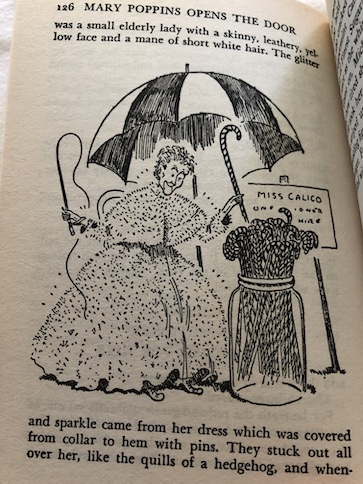
Peppermint Horses – Jane and Michael take their father’s walking sticks because they want to play horses with them, like they’re riding hobby horses. Mary Poppins gives the the walking sticks back to Mr. Banks and takes the children and Robertson Ay, who works for the Banks family, on errands. The children get tired of walking and start getting cross. Then, they see a woman named Miss Calico with what looks like a bunch of large candy canes and a sign that says she has horses for rent. The children are confused because they don’t see any horses. It turns out that Miss Calico’s candy canes are magical mounts that people can ride. Mary Poppins rents some of these peppermint horses for the children and Robertson Ay, and they ride them home through the sky, along with other people they know. Mary Poppins rides on her umbrella instead because she never uses walking sticks. The children want to keep their magical candy canes forever and continue to ride them, but they’re only rented. Miss Calico comes around at night and collects them.

High Tide – Mary Poppins takes the children to visit Admiral Boom and his wife because their parents want to borrow a bottle of port from them. They give them the port and a seashell for the children to enjoy. Michael is curious about what port tastes like, and Jane is fascinated by the seashell. She says that she would like to go see the sea.

That evening, while Mary Poppins is still having her half day out, the children hear a voice from the seashell telling them to dive in. They do and find themselves under the sea. The voice from the shell was a trout, and the trout introduces them to other sea creatures and takes them to a garden party that the creatures are having to celebrate high tide. Of course, Mary Poppins turns out to be the guest of honor.

Happy Ever After – It’s New Year’s Eve, and Michael wants to know what happens between the first chime at midnight and the last chime because he’s been told that the old year ends at the first chime and the new one starts at the last chime. Mary Poppins refuses to answer. She takes the children’s toys away from them, lines them up, and puts open books in front of them, also without explaining why, just telling the children to go to sleep.

The children wake up at the first chime of midnight and see their toys come to life. The toys lead the children to the park, where they see all sorts of storybook characters. (Friday from Robinson Crusoe is a rather uncomfortable character.) They explain that the period between the first chime and last chime of midnight on the New Year is called “the Crack”, and it’s the only time of year when characters can come out of their books, provided that they’re left open, and all be friends with each other, even if they’re enemies in their stories. It’s the only time when they truly have Happily Ever After. So, they all have a party to celebrate the Crack, and naturally, Mary Poppins is the guest of honor.

The next day, Michael asks Mary Poppins if they’ll ever have happily ever after themselves, and she says that depends on him.

The Other Door – Mary Poppins’s friends show up to say goodbye to her, although they try not to let the children know that Mary Poppins is about to leave. They all have a dance together, and Mary Poppins takes the baby home from the park before the other children. Jane and Michael realize that Mary Poppins is about to leave when her friends talk about “the door.” They rush upstairs to the nursery, but they don’t see her until Jane spots her in the reflection of the nursery in the window. The door in the reflection is the “other door” that she’d been talking about, and that’s the door that Mary Poppins goes through to leave. The children’s parents come into the room, and the children tell them that Mary Poppins is gone. Mrs. Banks is upset, but Mr. Banks dances because he likes the music from her goodbye party, which is still going on. The family thinks that they see a shooting star, but that’s Mary Poppins leaving. Still, they make a wish not to forget Mary Poppins.

The Dark is Rising

The Dark is Rising Sequence

The Dark is Rising by Susan Cooper, 1973.

The day before his eleventh birthday on Midwinter, Will Stanton has an uneasy feeling that something is about to happen. First, the rabbits that his family keep behave oddly. Then, other animals seem to be afraid of him when they never have before. When he and his brother James go to pick up some hay from Mr. Dawson, Mr. Dawson makes an odd comment about “the Walker” being abroad and that it’s going to be a bad night. Then, Mr. Dawson says that he has something for Will for his birthday. He gives Will an odd iron ornament and tells him to keep it safe and not talk about it with other people. Everything about this day seems odd to Will, but he accepts this unusual gift.

That night, Will has an increasing sense of terror, and a rook apparently breaks the skylight in his room during a snow storm. The next day, Will can’t seem to wake up his sleeping family. He puts on warm clothes and leaves the house with a strange feeling that this is somehow his destiny. Things in the area look different, as if he is now in a different time, sometime in the past. Eventually, he sees a man he knows who works for Mr. Dawson, John Smith. John Smith is working on horseshoes for a black horse that belongs to a mysterious stranger in a dark cloak. The mysterious stranger offers him food and a ride on his horse, but Will refuses both. The stranger gives him an uneasy feeling, and without really knowing why, Will says that he is looking for “the Walker.” The cloaked stranger tells him that “the Rider is abroad” and tries to grab him, but John Smith pulls him out of the way, and the stranger is angry. John Smith tells Will that he is just newly woken and will have to figure things out for himself but to trust his instincts today. A beautiful white horse appears, and John Smith says that Will can ride it, if he wants, but Will’s instincts tell him that he needs to go on alone. As he leaves, Will sees John Smith giving the white mare shoes that look like the iron ornament that Mr. Dawson gave him.

As he explores the countryside further, Will encounters a wandering tramp that he saw attacked by rooks the day before and confronts him as being “the Walker.” The Walker is defensive and suspicious, and he asks Will to show him “the Sign.” Will realizes that he must mean the iron ornament that he now wears on his belt, but before he can show it to the Walker, the Rider comes and frightens the Walker away. The Rider sees his Sign and comments that Will only has one of them so far, and that won’t help him much. Fortunately, the white mare comes and carries Will away from the Rider.

The white mare carries Will away into the hills, he has a sensation like he’s falling, and then, he finds himself alone in the snow near a pair of carved wooden doors that appear to be standing by themselves, attached to nothing. Will pushes on the doors and finds himself in what seems to be a great hall, hung with tapestries. There is an old woman and a tall man standing by the fireplace, and they greet him. Will tries to ask them about the doors and why they seem to be standing by themselves, but the doors have vanished behind him. The man says that Will’s first lesson is that nothing is what it seems to be.

The man introduces himself as Merriman Lyon (introduced in the previous book in the series), and he says that he and Will were born with the same gift, the power of the Old Ones. Now that it’s Will’s eleventh birthday, his gift is awakening, but he must learn how to control it. At first, Will doesn’t think that he has any particular gift, so Merriman shows him how he can receive mental pictures from someone else’s mind and send them a mental picture and how he can even put out a fire with his mind. Will becomes convinced that he does indeed have powers that normal boys don’t have. Merriman tells him that this gift is a burden, like many special gifts, but he was born with this gift for a special purpose.

Merriman says that he doesn’t want to tell him too much yet because the full knowledge of his destiny may be dangerous for him while he is still learning to use his gift. However, he does tell Will that he is actually one of the Old Ones, the first of his kind to be born in the last 500 years, and he will be the very last of them. Like other Old Ones, he will play a role in the battle between good and evil. His first role is that of the Sign-Seeker. He must find the six Signs and guard them. The iron ornament is the first Sign, but the others won’t be as easy to find.

Will returns to his family and his ordinary life, buying Christmas presents for his siblings for the coming holiday, but he knows that his life is no longer ordinary. He has much to learn about how to use his powers, and the sinister forces that pursue him to try to stop him from carrying out his mission.

The book is a Newbery Honor Book. It’s available to borrow and read for free online through Internet Archive (multiple copies). The book was adapted as a movie called The Seeker in 2007.

My Reaction and Spoilers

Fantasy books sometimes have to deal with the subject of religion and the relationship between magic and religion. This book also does so somewhat, but I noticed that it also seems to try to remove itself from consideration of the issue at the same time. At one point, Merriman discusses the idea of witches and witchcraft trials with Will, telling him that none of those involved were Old Ones, like the two of them. He says that everyone involved with witchcraft trials were ordinary humans, most of the people who were called “witches” were innocent victims although a small number were genuinely evil, and generally, the witchcraft trials were the result of human madness and irrationality, not genuine magic. In other words, readers don’t need to worry about trying to reconcile the power of the Old Ones with witchcraft because the author says that the two of them are two different, unrelated things.

Will and his family celebrate Christmas during the course of the book, and they go to church, so it’s apparently fine for an Old One to also be a Christian. Yet, there is a scene at church on Christmas where Will and John Smith have to stop the forces of the Dark attacking the church. The minister tries by calling on the powers of God and exorcising the evil spirits, but John Smith says that the minister’s efforts don’t work because “This battle is not for his fighting”, apparently indicating that the powers of Light and Dark as portrayed in this story are somehow outside of any religion or the interference of any god because they are forces that are completely unto themselves. The traditional Christian view would be that God commands the forces of good and light while the devil commands the forces of evil and darkness, but they’re saying here that’s not the case in this story. Will’s thought is that there is a place that exists out of time where all the Gods that ever were came from and also all of the forces and powers in the world, and it seems like some of these exist independently of each other, that they don’t have any beginning and so none of them is less old than any of the others. There is an element of pagan and folklore traditions that runs through these books, and I think that part of this concept references that, but I also see that looking at the battle between Light and Dark in this way, as being something independent of absolutely everything else, leaves the author of the stories free to have it play out in whatever way makes a good story without having to make it adhere to any rules and traditions other than the ones she’s chosen.

Of course, even fictional magic has to follow some rules in order to make logical sense to the readers. As I said, there are pagan and/or folklore traditions that are implied to be true or to have more significance than most people would suspect. Will uses holly as a form of protection for his home during Christmas. Aside from its association with Christmas, there are also many folkloric superstitions about holly. It is also revealed that part of what makes Will so special is that he is the seventh son of a seventh son, another concept from folklore.

A theme that is carried over to this book from the first one in the series is that evil can sometimes appear innocent and even friendly. People who have appeared as friends before can be revealed to be secretly evil or coerced to the dark side, even people who have been close before. Those who aren’t as in tune with the battle between good and evil may be fooled by friendly smiles, charming manners, and a pleasant appearance, but those who are aware of the difference between dark and light can feel when someone isn’t right.

There is one case in this book where a previously good person turns to the Dark because he feels betrayed about how Merry put his life at risk for the cause of the Light. I feel like this could have been avoided if Merry had been more honest with him in the beginning about the risks of what they were doing and the reasons why it was so important, but Merry seems to feel like it was all inevitable, something that was fated to be. Yet, at the end of this person’s life, Merry emphasizes that all of the choices this person made were his own, and although he went through much suffering because of things that had to happen as they did, he could have still had a better life even while undergoing his ordeals if he had made different choices along the way. I think I see what he means, that there are some things in life that are unavoidable but people can make them better or worse through their own choices and behavior, but I still feel like Merry set him up for this bad situation because he didn’t explain things properly when he should have. Maybe that was Merry’s bad decision, too?

Parts of this book actually reminded me of The Box of Delights, a vintage children’s fantasy book that also takes place at Christmas. In both books, Herne the Hunter, a character from folklore, makes an appearance, and the boys in each story get turned into different animals through their adventures with magical books.

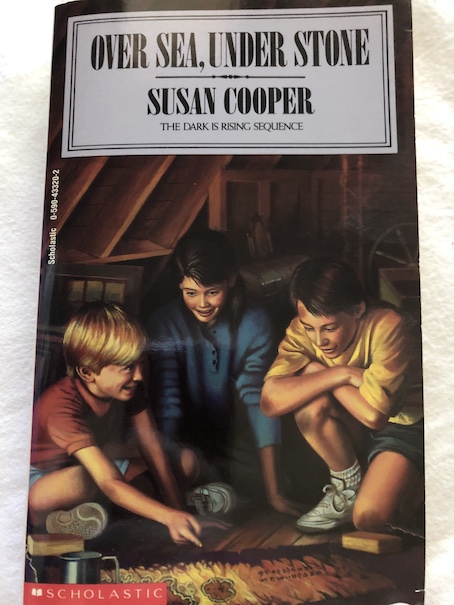
Over Sea, Under Stone

The Dark is Rising Sequence

Over Sea, Under Stone by Susan Cooper, 1965.

The Drew family is spending the summer in Cornwall with their Great-Uncle Merry. Professor Merriman “Merry” Lyon isn’t really a relative, but a very old family friend who teaches at a university and has a somewhat mysterious past. Of the three Drew children – Simon, Jane, and Barney – Barney is the one most looking forward to their time in Cornwall because he loves Arthurian stories, and he is fascinated by Cornwall’s connections with King Arthur. Simon is more interested in watching boats.

One day, while the children are bored because it’s raining, they start playing at being explorers inside the house where they’re staying and discover a secret passage to a hidden room. There, they find an old manuscript that seems to be some kind of treasure map! It seems like parts are written in Latin, but even Simon, who has studied Latin in school, can’t read it all. At first, they wonder if they should tell their parents about it, but they decide not to, at least not right away, because their parents would probably tell them not to touch it because it doesn’t belong to them. They feel like they just have to figure out what it means and what it might lead to.

The family makes the acquaintance of a yacht owner, Mr. Withers, and his sister, and the two of them invite the whole family to go for a ride on their yacht. Mrs. Drew is an artist and wants to spend the day painting, so she declines, and so does Jane. Jane says that she’s afraid of getting seasick, but really, the Witherses give her an uneasy feeling. Jane feels like there’s something that’s not right about them, and it’s strange that Miss Withers asks them if they’ve found any secret passages in the house just after they actually found one. None of the children confide anything in Miss Withers. Mr. Withers seems oddly interested in the books in the house.

The next day, while her father and brothers go out on the yacht with the Witherses, Jane studies the manuscript and tries to figure out what it means. When she also finds an old guidebook to the area in an old trunk, she realizes that the map on the manuscript shows the area where they are staying, but there’s something strange about the coastline. The coastline on the old map is a slightly different shape. Jane wonders if one of the two maps could be wrong or if the coastline has changed somehow over the years because the manuscript looks very old.

Since the guidebook was written by the local vicar, Jane decides to go see him and ask him about the coastline and whether it’s changed over the years. She takes along the guidebook but not the manuscript. However, the vicar she meets says he’s the new vicar, not the old one who wrote the book. She talks to him about the book and the coastline anyway, but he gives her a bad feeling, similar to the one that the Witherses give her. The vicar discounts the idea of the coastline changing, and he asks Jane uncomfortable questions about the books in the house, pressing her for answers that she doesn’t have and doesn’t want to give him.

When the boys come back from the yacht, and Jane tells them about the guidebook and the vicar, Simon is irritated that Jane tried to investigate the manuscript without them, and he doesn’t think she should have talked to the vicar. Jane says that she didn’t tell the vicar about the manuscript, only the guidebook, and Barney says that what Jane learned is important.

The next morning, they wake up to find that the house has been ransacked. Books have been tossed all over in the middle of the night by someone who was clearly hunting for something. The children are sure that their mysterious intruder was searching for the manuscript, which is safe because Jane had it hidden in her bed. But, who was it? Was it the vicar or the Witherses? All of them seemed interested in old books and manuscripts, and they all seem suspicious. What is the real significance of the manuscript anyway?

Still not wanting to tell their parents or the police who were called to investigate the break-in, the children confide in Great-Uncle Merry about the manuscript and their suspicions. Uncle Merry knows more about the manuscript than the children know, and he tells them about a lost grail, a copy of the original Holy Grail, inscribed with the true story of King Arthur and about an ancient struggle between good and evil, a struggle that the children have now joined.

The book is available to borrow and read for free online through Internet Archive (multiple copies). The book was once adapted as a tv mini-series, but apparently, no copies of it survive.

My Reaction and Spoilers

This book is the first in a series about the struggle between good and evil, known as the Light and the Dark, and all of the other books in the series also draw on Arthurian legends. Merry and the children appear in other books, although not always together. Merry (the children sometimes call him Gumerry, which is short for Great-Uncle Merry) isn’t quite what he appears to be, which is how he knows things that other adults don’t know. There are hints in this book about Merry’s real identity, but it isn’t explained in this book, although Barney has a feeling that his name is a clue.

When Merry explains about the battle between good and evil, he says that the struggle has been going on for ages, and neither side ever completely wins or completely loses. It’s like that in this story, too. At first, I wasn’t completely sure whether they would actually find the grail or if it would turn out to be a MacGuffin, only existing to drive the action without it being really important whether it was actually found or not. The heroes do actually find and successfully retrieve the grail, but they also lose the manuscripts they’ve found before they can completely study them. It’s a victory, but not a total victory, and the villains are still around and may reappear in the future. This story ends in a way that indicates that this could have been a standalone book, which it might have been originally, before the author decided to continue the series, but the ending is also open, making the continuation of the series natural.

There are references to old folklore traditions throughout the story. I’ve never seen The Wicker Man, but I saw a comment on a YouTube video where someone compares a public festival from this story to a scene in The Wicker Man, so there may be the implication that this is a more ancient form of celebration with more significance than the modern characters think. In fact, old traditions and folklore from the British Isles also appear in various forms throughout the series, and there are references to pagan beliefs.

I didn’t like the part where the kids were pretending to be explorers, and they were talking about acting out one of those scenes with “rude natives” (Simon’s words, and even he has to admit that he doesn’t quite know what it means when Barney asks him, although he’s aware that it’s a different sort of “rude” from the word meaning “impolite”) who want to make them gods and encountering cannibals. That type of scene always annoys me in books, and I’m sure that they’re referencing some of the vintage books I’ve read where that happens or ones very much like them. It’s really my only complaint about this story. Fortunately, that part doesn’t last very long because the kids find the manuscript and get on with the fantasy story.

The Children of Green Knowe

Green Knowe

The Children of Green Knowe by L. M. Boston, 1954, 1955, 1982, 1983.

Seven-year-old Toseland is traveling by train to stay with his great-grandmother Oldknow at the old family home, Green Noah, for Christmas. His mother is dead, and his father now lives in Burma with his new wife, who Toseland doesn’t know very well. He has no brothers or sisters, and he spends most of his time at boarding school, so he is often lonely, wishing that he had a family outside of school, like the other boys. His great-grandmother is the only other relative he has, and he has never met her before. He is a little nervous at the idea of meeting her because he knows that she must be very old.

When Toseland arrives at the station, it’s raining, and there has been flooding, but there is a taxi-man waiting to take him to the house. When he arrives, he is immediately fascinated by the large, old house and all of the things in it. It reminds him of a castle, and he marvels at how his great-grandmother could live in such a place. He is surprised at how at home he feels there and how easily he likes and gets along with his great-grandmother. For the first time in his life since his mother died, he really feels at home, and when he asks if the house partly belongs to him, too, his great-grandmother reassures him that it does.

The two of them talk about what to call each other. Toseland’s great-grandmother asks him to call her Granny (although she is still often called Mrs. Oldknow throughout the book), and she asks him if he has any nicknames. Toseland says that the boys at school call him Towser and his stepmother calls him Toto, but he doesn’t like either nickname. Granny Oldknow says that Toseland is a family name and there have been other Toselands before him. The last one was his grandfather, and his nickname was Tolly, so Granny asks him if he would like to be called that also. Toseland says that he likes that nickname better than the others, and his mother used to call him that, so he is called Tolly from that point on.

Granny Oldknow shows Tolly to his room and helps him begin to unpack. It’s a wonderful room with many old toys that used to belong to the other children who have lived in the house in the past. Among the toys is an old dollhouse which Tolly realizes is a miniature version of the house they’re in. When he finds the miniature version of his room, he notices that there are four beds in it instead of one. He asks Granny Oldknow if other children stay at Green Noah, and she cryptically says that they do sometimes, and he might see them, but they come when they want to.

Tolly becomes fascinated by a portrait of three children in old-fashioned clothes with their mother and grandmother. Granny Oldknow tells him that those three children lived in the house long ago. The oldest boy was an earlier Toseland, who was nicknamed Toby. His younger brother was named Alexander, and their little sister was named Linnet. Granny Oldknow had been an orphan when she was a child and was raised at Green Noah by an uncle. Because she was an only child, she often lonely and liked to pretend that the children in the picture were her siblings, so Tolly decides that he’d like to do the same thing.

Tolly asks his great-grandmother questions about Toby, Alexander, and Linnet and learns details of their lives. Toby had a sword because he was going to be a soldier when he grew up, a pet deer, and a horse named Feste who loved him. Alexander had a book in Latin that he loved to read and a special flute. Linnet used to keep birds in a wicker cage that is still in Tolly’s room, along with the toy mouse that used to belong to Toby. Sometimes, Tolly thinks that toys in his room move when he’s not looking, and at night, he hears children moving about and laughing, and he thinks that it’s the three children from the painting.

Tolly comes to the conclusion that the three children are still around Green Noah and that they’re playing hide-and-seek with them. He tries to play with them, too, and the children apparently give him a twig in the shape of a ‘T’. Granny Oldknow tells him that she used to play hide-and-seek with the children when she was young, and they would give her an ‘L’ twig because her first name is Linnet, like the little girl in the painting. Later, he hears the children singing Christmas carols. Tolly becomes frustrated that the children tease him and never really show themselves to him, but Mrs. Oldknow tells him that “they’re like shy animals” and that he has to give them a chance to decide that they’re ready to come to him.

He finds the key to the old toy box in his room, and inside the box, he finds more things that belonged to the three children. When he shows them to Mrs. Oldknow, she talks about how things were when the three children were alive at Green Noah. Tolly is shocked when he realizes for the first time that Toby, Alexander, and Linnet are all dead. Mrs. Oldknow gently tells him that they lived at Green Noah centuries ago and could not be alive now. Sadly, the children all died young in the Great Plague during the 17th century. Their illness was sudden and brief, and they all sickened and died in one day along with their mother. Tolly and his great-grandmother are descended from the children’s older brother, who wasn’t at home when this happened. However, the children never left Green Noah, which used to be called Green Knowe years ago. Tolly still loves the children, even though they’re ghostly and elusive. He craves the sense of family he gets from them, having been deprived of family feelings for so much of his young life.

Mrs. Oldknow continues to tell Tolly stories about the three children and other members of his family. As his connection to his ancestors grows, Tolly begins to catch glimpses of the children more and more, and eventually, he’s able to see them and talk to them. He asks the children about their mother, and the children say that she’s in heaven but doesn’t mind them coming back to visit their old home from time to time. The children don’t seem sad at being dead, enjoying the freedom of playing around their old home with the animals and the spirits of their old pets, who keep them company. Their final illnesses had only lasted a few hours before they died, and their deaths happened so long ago that they say that they hardly remember the Great Plague and what it felt like. Tolly is still sad and frustrated that the children appear and disappear so suddenly, but his attachment to them grows and so does his attachment to Green Noah itself. As Christmas comes, Tolly develops a bond with his family, both living and dead, and a realization that the old family home that connects them is also his home, a place they can all return to.

The book is the first in a series and is available to borrow and read for free online through Internet Archive (multiple copies).

My Reaction and Spoilers

This is a ghost story, but it’s not a scary ghost story. There’s nothing frightening about the three ghost children. It’s sad that they died so young, but at the same time, they’re not very sad about it themselves. They seem to enjoy playing together endlessly with the animals around their old home and seeing the new relatives who inhabit the house, their older brother’s descendants. Even their former pets are no longer sad at the children’s passing because they are also spirits who continue to play with them through the centuries. There is one semi-scary part of the story involving a witch’s curse placed on an old tree called Green Noah, which is how the name of the house was changed from Green Knowe, but Tolly is protected by the ghosts of his ancestors.

There is never any desire for the characters to rid Green Noah of its ghosts. They are family and are part of the place, as much a part of it as the living are. The ghosts do not feel trapped there, either. They are just revisiting the home they loved and the family members who now live there. They can come and go as they please, and the ghost children often do.

This also is not the kind of story where a child knows that a place is haunted but can’t convince the adults or tries to hide the ghosts’ presence from the adults. Mrs. Oldknow is fully aware that the ghosts are there and has known about them since her own childhood. Generations of children in the family have probably known about them and played with them, and they are also not the only family ghosts who inhabit the old house. At one point, Tolly and Mrs. Oldknow hear a woman singing and the rocking of a cradle, and Mrs. Oldknow says that she’s heard it before around Christmas, a grandmother singing to a baby. Tolly is confused because even little Linnet wasn’t a baby when she died, and Mrs. Oldknow says that this isn’t the children’s grandmother but somebody from generations earlier than the three children. This grandmother ghost has been around so long that Mrs. Oldknow doesn’t know who she or the baby are supposed to be, although we are told that they are about 400 years old, where the three children died about 300 years earlier. Generations of the same family have lived in the house and have all left their mark on it, and part of them is still there. Now, Tolly has also become part of this family home, and it’s also a part of him. The ghosts are hesitant to fully show themselves to Tolly at first and seem more attached to Granny Oldknow, probably because she’s lived there longer, since she was an infant. The ghosts know her, and she knows all of their stories. However, they are all family, and Tolly develops a new connection to his family as his great-grandmother tells him the stories about them, and he can hear and see the ghosts more often.

Really, that feeling of connection and connectedness is the primary focus of the story. In the beginning, Tolly is lonely, feeling like he doesn’t have a family and doesn’t belong anywhere or to anyone. His father lives far away in Burma with his new wife, and Tolly doesn’t feel connected to them. His mother is gone, and he spends most of his time at school, even having to remain there during the holidays when other students are going home to their families. His great-grandmother inviting him to Green Noah is the first time that Tolly feels a real connection to anyone in his family since his mother’s death, and through her stories and his encounters with the ghosts, he comes to see that he really is part of a much larger family, going back ages. Just because most of his family is now dead or scattered doesn’t mean that they’re not his family. They still love him, and he loves them, even across the centuries. Green Noah really is a family home, and it’s a place that family can return to, even those who seem to be gone forever. It’s a place that has known both the joys of a happy family and the tragedies of loss that families experience from time to time. Through it all, it’s still home, and importantly, it becomes the home that Tolly has been wishing for.

The story takes place in the days leading up to Christmas, and by Christmas, Tolly has received important presents. First, the ghostly Alexander grants him the give of his special flute, which had been a reward from King Charles II for singing so beautifully for him when he was alive. Tolly also has musical talents, and his great-grandmother decides to switch him to a different school so he can develop his talents and so he can stay at Green Noah during his school holidays. On Christmas, Tolly also receives his own pet dog, very much like the one that the ghostly Linnet owned, and he names his dog after hers, just as he has been named after all the other Toselands who have gone before.

In some ways, the story reminds me a little of When Marnie Was There (some people might know the story from the Miyazaki movie version), which has similar themes of family and belonging and ancestors reaching out across time to remind children that, while life is brief and often complicated, love is eternal and everyone belongs somewhere and to someone. However, The Children of Greene Knowe is a much gentler story, and it also contains some shorter stories about Tolly’s family.

The Little White Horse

The Little While Horse by Elizabeth Goudge, 1946.

The year is 1842, and Maria Merryweather is on her way to her family’s ancestral home, Moonacre Manor. Thirteen-year-old Maria is an orphan. Her mother died when she was a baby, and now, her father has died. Their house in London had to be sold to pay his debts, and now, Maria is going to live with a distant cousin, Sir Benjamin Merryweather, in the country. She is traveling with her nurse, Miss Heliotrope, who has taken care of her since she was little and is like a mother to her, and her dog, Wiggins. Maria and her father were never really close. Maria isn’t sure that she’s going to like living in the country because she is accustomed to city life and the luxuries that come with it. She fears that life in the country will be rough and full of deprivation.

Maria begins to feel better when she actually sees Moonacre. It’s a lovely, romantic, castle-like manor house. The manor also gives her an odd feeling of home because so many Merryweathers have lived there for so long. Sir Benjamin welcomes her, and she likes him immediately. Oddly, Sir Benjamin refers to has as “one of the silver Merryweathers”, saying that she was born during a full moon. It’s true that Maria has unusual silvery gray eyes. Sir Benjamin says that he’s a “sun Merryweather”, born at midday, but that’s okay because moon Merryweathers and sun Merryweathers get along well. He does have a rather warm, sunny appearance.

Sir Benjamin shows them around the manor and to their rooms. The furnishings are a little shabby, but they’re quite comfortable, and they like their new rooms. Maria is charmed because her room is in a turret, and it has a very small door that’s really only big enough for a small girl like her to get in. Miss Heliotrope is worried that she won’t be able to get into Maria’s room if she is ill and needs her, but Maria is sure that isn’t going to be a problem. She loves the room because it just seems so perfect for her. Wiggins even seems to be getting along with Sir Benjamin’s big, old dog, Wrolf, although Maria has some doubts that Wrolf is actually a dog because he doesn’t look like any dog she’s ever seen before.

At dinner that evening, Sir Benjamin talks about giving Maria riding lessons, saying that he has a little gray pony who would be just right for her. Maria mentions a beautiful white horse that she saw from the carriage as they were approaching the manor, but Miss Heliotrope didn’t see it and thinks she just imagined it. Miss Heliotrope thinks that Maria imagines things all the time, like the little boy named Robin, who had a feather in his cap and was a childhood playmate, but Maria insists that the boy really did exist and so does the little white horse. Thinking about Robin makes her wish that he was here to keep her company at Moonacre, but she hasn’t seen him for a couple of years and doesn’t know where he is.

There are a few odd things that Maria and Miss Heliotrope notice about Moonacre, though. Aside from the odd dog, Wrolf, Sir Benjamin seems oddly evasive about who and where the servants are. They never see them, yet someone has been doing the cooking and cleaning and making fires in the fireplaces. There’s even a fire in Maria’s room, but she can’t figure out how anyone got in to make one since the door is too small for even an adult Miss Heliotrope’s size.

The next day, a riding habit appears in Maria’s room. It’s very nice quality, even though Maria can tell that it’s second-hand because it’s an older style and a little worn and has the initials LM on it. Maria like it, but who used to own it, and who put it in her room? In the parlor attached to her room, Maria also sees an old painting that contains a white horse and an animal that looks something like Wrolf, although she’s still not quite sure what kind of animal it is. (What’s that “brave-looking” animal that has a tawny mane and a tuft on its tail? I’m sure if we think about it, it will come to us.)

Sir Benjamin tells Maria that she shouldn’t wander the countryside alone, but she is free to explore as long as she’s with her pony Periwinkle or Wrolf. The one place he doesn’t want her to go is Merryweather Bay because there are rough fishermen there. He refers to Maria as a “princess” and the area around Moonacre as her “kingdom,” and from the way he says it, it seems that he somehow means that literally. Even the local people seem to have some kind of awe and respect for her.

Maria finds the nearby village of Silverydew charming. The Old Parson introduces her to the children of the village, and they tell her about the mysterious “Black Men” (because they all wear black, not their race) who hang out in the woods and by Merryweather Bay. They set traps for animals and steal livestock from the locals, and everyone is afraid of them.

Maria also discovers that Robin is here in the village of Silverydew, and he rescues her from an encounter with the Black Men. Robin tells her that her ancestor, Sir Wrolf, who founded the Merryweather family, was the one responsible for making the Black Men as evil as they are, and because of that, his soul has been unable to enter Paradise. Locals say that his spirit rides around nearby Paradise Hill, weeping because of what he did, and he will continue to do it until someone finds a way of solving the problem he caused.

Maria asks what exactly Sir Wrolf did, and Old Parson tells her the story of Sir Wrolf and how he acquired the lands around Moonacre. At first, Sir Wrolf just owned the land where the manor house sits, but he wasn’t satisfied with that. Although he was known for being brave and jovial, he was also a greedy and selfish person who thought that he was entitled to take anything he wanted from anyone. First, he kicked the monks out of the monastery on Paradise Hill and used the monastery for a hunting lodge. A fierce lightning storm made him abandon it later because he believed that it was sent by the monks as punishment. Then, he decided that he wanted the woods and bay around Moonacre for hunting and fishing, but they belonged to another nobleman called Black William. He tried various ways to take those lands from Black William, including direct warfare, but he was unsuccessful. Then, it occurred to him that Black William had a lovely daughter, his only child, and if he married her, he would share in her inheritance. Sir Wrolf put on a show of apologizing to Black William and demonstrating that he had mended his ways so he could win the affection of Black William’s daughter. The daughter, who was called the Moon Princess because she was as fair and lovely as the moon, believed that Sir Wrolf was sincere and married him. Sir Wrolf did end up falling in love with his bride, and they had a child together, but the lands he expected to acquire through her were still on his mind. Then, Black William suddenly remarried, and his new wife gave birth to a son, who replaced the Moon Princess as the heir to Black William’s lands. Sir Wrolf was outraged by this reversal of fortune, and while he ranted about it, he let slip how he had married his wife in the hopes of getting her lands. The Moon Princess was shocked and hurt, and although her husband insisted that he had come to love her even though he had married her for selfish reasons, she no longer believed him. She grew to hate him for his deception and even turned against the son they had together. She wanted no part of Sir Wrolf’s life anymore. Then, worse still, word reached them that Black William had mysteriously disappeared and his young son was dead. Although there were no indications of foul play, and it was possible that neither of them had really died at all, the Moon Princess came to believe that her husband was a murderer. One day, she rode away on the little white horse that her husband had given her when they married, and she was also never seen or heard from again. With Black William and his son and daughter gone, Sir Wrolf finally had possession of the lands he had coveted for so long, but he was no longer happy. He genuinely missed his wife and felt guilty for what he had done, and he couldn’t enjoy his prize.

The Old Parson explains that the sins of the past still affect the present and will continue to do so until someone makes them right again. The Black Men who now inhabit the disputed lands are probably the descendants of Black William’s supposedly dead son. The Old Parson believes that the boy’s mother probably feared what Sir Wrolf might do to the boy when his father left them, so she pretended that he was dead already. Every generation of Merryweathers since then have tried to push the Black Men out of the disputed lands, but they’ve never been successful. Also, every generation, a young woman very much like the Moon Princess comes to Moonacre, and she gets along well with the sun-like Merryweathers, but so far, a quarrel has always separated them. Maria worries about that because she likes her cousin Sir Benjamin and doesn’t want to leave Moonacre. Old Parson tells her that part of the legend of Moonacre is that, some day, there will be a Moon Princess who will come and will not leave. The legend states that she will right the wrongs of the past and make peace again, but only if she can get over the prideful nature that all Moon Princesses have and love a poor man who is below her station. The townspeople are in awe of Maria because they hope that she will turn out to be that Moon Princess.

Maria adopts the mission of righting past wrongs, reconciling old quarrels, and bringing peace to the valley once again, but she’ll have to be careful. Not everyone is ready for peace yet, and she has to guard against falling into the same bad habits that others have before her. Before she can complete her destiny, she must speak directly to the Black Men in their castle and when she does, they make a bargain with her. They agreed to end their poaching and thievery if she can prove that Black William wasn’t murdered by Sir Wrolf and if she will restore not only their lands but the pearl necklace that belonged to the original Moon Princess. However, that necklace has been missing since the first Moon Princess disappeared. How can Maria give them something that she doesn’t have and doesn’t know how to find?

The book is available to borrow and read for free online through Internet Archive (multiple copies, including one in Chinese). There is also a movie version of the story called The Secret of Moonacre.

My Reaction and Spoilers

I didn’t read this book as a kid, but it’s one that I’ve been meaning to read for some time. I saw the movie version years ago, and I was curious about what the book was like. The movie and the book set up a somewhat different situation for the quarrel between the two families. In the movie, the quarrel was about the fabulous pearls owned by the first Moon Princess and not about land. Also, Loveday and Robin were members of Black William’s family in the movie, which they weren’t in the book, changing the dynamics of their relationships with Sir Benjamin and Maria.

This story is an enchanting light fantasy. The setting by itself is magical, and Maria’s rooms in the manor are like every little girl’s dream! The story also includes odd, seemingly intelligent animals with unusual capabilities, such as the Zachariah the cat, who takes messages for people and lets them into the manor house or guides them around, and Wrolf, who is clearly a lion, even though everyone calls him a dog. The fact that Wrolf is a lion dawns on Maria toward the end of the book, and Robin confirms that’s true, saying that they all keep calling him a dog because it sounds less scary, and they don’t want to alarm anyone.

Maria’s family history is not something to be proud of, as Old Parson points out. Her ancestors were not the greatest people, in spite of their land-ownership and high status. People are looking to Maria to be better than the others who came before her and to make past wrongs right.

From Robin’s mother, Loveday Minette, who also becomes like a mother to her, Maria learns a little more about what it means to be one of the Merryweather “Moon Princesses.” Gradually, it is revealed that Loveday was the last Moon Princess before Maria. She was in love with Sir Benjamin, and the two of them were going to be married, but like all Moon Princesses and Merryweather men, they had a stupid quarrel and parted. Loveday married someone else and had Robin, but even though she has remained near Moonacre and secretly helps the household, she has been careful not to see Sir Benjamin ever since. Over the years, she has come to realize that she made a terrible mistake with Sir Benjamin and regrets it, but like other Moon Princesses, she has too much pride to admit that she was wrong and apologize. She is more mature now, and she sees that, in some ways, she was aggravating to Sir Benjamin and provoked him, and having provoked him to anger, because Moon Princesses tend to love men with tempers (one of the curses of the Merryweather men), was too proud to make up with him. By the same token, Sir Benjamin was legitimately disrespectful of her and her feelings, and when he attempted an apology, it was a half-hearted effort that attempted to preserve his pride more than demonstrate care for Loveday’s feelings, which is why Loveday didn’t feel like she could accept it.

Members of the Merryweather family and the people they marry have a tendency to attach enormous importance to and emotional investment in small things (geraniums, the color pink, etc. – they either passionately love these things or are violently or oppressively against them), and then they blow up at each other when their partner doesn’t feel exactly the same way about them, taking it as personal insult if someone likes something they don’t like or doesn’t like something they do like. (Like in the Internet meme, “Stop liking what I don’t like!”) They don’t know how to tolerate interests they don’t share, not sweat the small stuff, or live and let live. I would say that a lot of it has to do with poor relationship skills and, ultimately, a lack of respect for other people, even the people they love. They don’t respect each well enough to find out why the other person cares so much about something that seems small and annoying. They are self-absorbed in their own feelings, seeing situations only from their own point of view and putting their own feelings first. They see every conflict as some kind of contest about who’s right, with the drive to win against each other, which puts them both in a position of being on opposite teams instead, where one of them has to get the better of the other in some way, instead of on the same winning team. The result is that neither of them ever really wins, and even if one of them defeats the other in something, they ultimately end up losing their whole relationship, so it’s a net loss for everybody.

This is the cycle that has repeated for generations in this family. Loveday realizes that, for this destructive cycle to end, the Moon Princess has to learn not to provoke the one she loves as well as overcome her sense of pride. Also the Moon Princess’s love (it’s pretty clear to everyone that it’s going to be Robin, in this case) has to learn to control his temper, not respond to things as if they were some kind of personal attack, and consider the well-being of others, especially his princess. Both of them need to learn caring and consideration for others and how to put aside pride and self-interest for the sake of peace, both in their personal relationship with each other and for the sake of the wider community. Loveday emphasizes to both Maria and Robin that they must not quarrel with each other. People are depending on them to put things right in the area, and their own future happiness depends on learning to get along with each other.

The things Loveday and other adults emphasize for the children are personal skills that real people do need to learn in order to have relationships with other people and be mature members of a peaceful, stable community:

  • Don’t aggravate people. You can’t have peace if you’re always teasing or provoking people, and picking fights.
  • Choose your fights carefully, and wherever possible, avoid turning small disagreements into big fights. Remember that any battle comes with a cost, and the costs of petty fighting are higher than the rewards.
  • Be considerate of other people’s feelings and respectful of their property. You don’t have the right to do what you want with other people’s property just because you want it or it bothers you that they have it.
  • Understand that nobody is perfect, including you.
  • It is not your partner’s responsibility to please you in every way or give you everything that you want. It is your responsibility to deal with your own emotions and control your own choices and behavior.
  • Sometimes, you really are in the wrong, and you can’t always have everything you want. Accept both of these facts with maturity and take responsibility for your choices.
  • Being wrong can be embarrassing, but not nearly as embarrassing or destructive as not dealing with situations that need attention or problems that need to be solved.
  • The problems you cause affect more than just you, and problems do not go away when they are ignored.
  • Whatever the circumstances, no matter who or what you’re dealing with, it’s never just about you.
  • The word “responsible” has two meanings. The first is being at fault. (Sir Wrolf was responsible for the situation in the valley and the problems it caused.) The second just means taking charge of a situation and doing what needs to be done, sometimes because you’re the only one who can or is willing to do it. (Maria didn’t cause the problems, but she was responsible because she fixed the problems.) The second type of “responsible” is necessary for successful relationships, no matter who the first type applies to.
  • Love requires understanding and accepting each other and allowing each other to be their own person with their own likes and dislikes.
  • Caring means making each other a priority, working as a team, and doing what’s best for the team, even if it requires some compromise and self-sacrifice.
  • Building a shared life or solving shared problems is team effort, not a competition with each other. There is no “winning” unless it’s a shared victory. Otherwise, everyone loses.

It’s not exactly a spell, but the children’s mission is based around learning to function as a couple and to control their tempers and personal behavior. Magical things do start to happen when they learn to consider others’ feelings and not just their own.

There does seem to be some magic in the story. Robin later explains to Maria that the reason why nobody else could see him playing with her in London when they were younger is because he was always in or around Silverydew or Moonacre. He says that he traveled to London to play with her when he was asleep, so he wasn’t physically there. It’s like a form of astral projection or out-of-body experience. Also, like Sir Benjamin’s “dog” turns out to be a lion, the “little white horse” turns out to be a unicorn.

I couldn’t help but notice that all of the known Moon Princesses since the first one and the men that they seem to love before before they quarrel with them seem to be cousins of each other. Loveday Minette and Sir Benjamin were cousins of each other because their fathers were brothers, and Maria and Robin are more distant cousins of each other because their grandfathers were brothers. The idea of marrying a cousin or even loving them romantically seems odd for modern times, but that did happen in noble families in the past, so it might not seem so odd for the characters and others in the story.

This book also taught me what a mangel-wurzel is. They just mention it in passing, like readers should know what it is. It has such a strange name that I had to look it up. It’s a kind of beet, and apparently, it has also been used to make “punkies” or jack o’lanterns in areas where people didn’t grow turnips, before people adopted pumpkins for the purpose. Just an odd bit of trivia.

The Hidden Treasure of Glaston

The Hidden Treasure of Glaston by Eleanore M. Jewett, 1946.

The year is 1171.  Twelve-year-old Hugh, a somewhat frail boy with a lame leg, arrives at the abbey of Glastonbury with his father on a stormy night.  Hugh’s father is a knight, and in his conversation with Abbot Robert on their arrival, he makes it known that, although he loves his son, he is disappointed in the boy’s frail condition because he can never be a fighter, like a knight’s son should be.  The abbot rebukes him, saying that there is more to life than war and that he, himself, is also of noble blood.  The knight apologizes, and says that, although it is not really the life that he would wish for his son, he asks that the abbey take him in and educate him.  Although the knight (who refuses to give his name, only his son’s first name) says that he cannot explain his circumstances, the abbot senses that the knight is in trouble and is fleeing the area, perhaps the country of England entirely. 

It is true that the knight is in trouble, and he is fleeing.  Since Hugh’s health is delicate, his father cannot take him along in his flight.  Realizing that the abbey will provide him with a safer life, Hugh’s father wants to see him settled there before he leaves and gives the abbey a handsome gift of expensive, well-crafted books as payment for his son’s education.  The abbot is thrilled by the gift, although he says that they would have accepted Hugh even without it.  Then, the knight leaves, and the monks begin helping Hugh to get settled in the abbey.

Hugh is upset at his father’s leaving and the upheaval to the life he has always known, although he knows that it is for the best because of his family’s circumstances.  Although the story doesn’t explicitly say it at first, Hugh’s father is one of the knights who killed Thomas Becket, believing that by doing so, they were following the king’s wishes. Hugh’s father did not actually kill Beckett himself, but he did help to hold back the crowd that tried to save Beckett while others struck the blows, so he shares in the guilt of the group.  Although Hugh loves his father, he knows that his father is an impulsive hothead.  Now, because of the murder, Hugh’s father is a hunted man. By extension, every member of his household is also considered a criminal.  Their family home was burned by an angry mob, their supporters have fled, and there is no way that Hugh’s father can stay in England.  However, the prospect of life at the abbey, even under these bleak circumstances, has some appeal for Hugh.

Hugh has felt his father’s disappointment in him for a long time because his leg has been bad since he was small, and he was never able to participate in the rough training in the martial arts that a knight should have.  Even though part of Hugh wishes that he could be tough and strong and become the prestigious and admired knight that his father wishes he could be, deep down, Hugh knows that it isn’t really his nature and that his damaged leg would make it impossible.  Hugh really prefers the reading lessons he had with his mother’s clerk before his mother died.  His father always scorned book learning because he thought that it was unmanly, something only for weak people, and Hugh’s weakness troubles him.  Hugh’s father thinks that the real business of men is war, fighting, and being tough.  However, at the abbey, there are plenty of men who spend their lives loving books, reading, art, music, and peace, and no one looks on them scornfully.  For the first time in Hugh’s life, he has the chance to live as he really wants to, doing something that he loves where the weakness of his bad leg won’t interfere. 

The abbot is pleased that Hugh has been taught to read and arranges for him to be trained as a scribe under the supervision of Brother John.  Hugh enjoys his training, although parts are a little dull and repetitive.  Hugh confides something of his troubles in Brother John, who listens to the boy with patience and understanding.  Although he does not initially know what Hugh’s father has done, Hugh tells his about the burning of his family’s home, how they struggled to save the books that they have now gifted to the abbey, and how there were more in their library that they were unable to save.  Hugh tells Brother John how much he hates the people who burned their home and how much he hates the king, who caused the whole problem in the first place. His father would never have done what he did if the king hadn’t said what he said about Thomas Becket, leading his knights to believe that they were obeying an order from their king.  Brother John warns Hugh not to say too much about hating the king because that is too close to treason and tells him that, even though he has justification for hating those who destroyed his home, he will not find comfort in harboring hate in his heart.  He also says that not all that Hugh has lost is gone forever.  People who have left Hugh’s life, like his father, may return, and there are also many other people and things to love in the world that will fill Hugh’s life.  Brother John urges Hugh to forget the past and enjoy what he has now.  When Hugh says how he loves books but also wishes that he was able to go adventuring, Brother John says that adventures have a way of finding people, even when they do not go looking for them.

One day, when Brother John sends Hugh out to fish for eels, Hugh meets another boy who also belongs to the abbey, Dickon.  Dickon is an oblate.  He is the son of a poor man who gave him to the abbey when he was still an infant because he was spared from the plague and wanted to give thanks to God for it.  Dickon really wishes that he could go adventuring, like Hugh sometimes wishes, although he doesn’t really mind life at the abbey.  Because Dickon is not good at reading or singing, he helps with the animals on the abbey’s farm.  Although he is sometimes treated strictly and punished physically, he also has a fair amount of freedom on the farm, sometimes sneaking off to go hunting or fishing.  He also goes hunting for holy relics.  Dickon tells Hugh about the saints who have lived or stayed at the abbey and how the place is now known for miracles.  He is sure that the miracles of Glaston will help heal Hugh’s leg, and he offers to take him hunting for holy relics.  Hugh wants to be friends with Dickon, but at first, Dickon is offended that Hugh will not tell him what his last name is.  Dickon soon realizes the reason for Hugh’s secrecy when a servant from Hugh’s home, Jacques, comes to the abbey to seek sanctuary from an angry mob that knows of his association with Hugh’s father.

The abbot grants Jacques temporary sanctuary but tells him that he should leave the country soon.  When Dickon witnesses Jacques’s explanation of why the mob was after him, comes to understand his connection to Hugh.  Although the mob does not know that Hugh is actually connected to Jacques, Dickon spots the connection and tells Hugh that he forgives his earlier secrecy.  Dickon even helps Jacques to leave the abbey the next day, in secret.

Now that Dickon knows Hugh’s secret, he lets Hugh in on his secrets and the secrets of the abbey itself.  He shows Hugh a secret tunnel that he has discovered.  There is an underground chamber between the abbey and the sea where more parchments and some other precious objects are hidden.  Dickon doesn’t know the significance of all of the objects, although there appear to be holy relics among them.  Dickon’s theory was that monks in the past created this room and tunnel to store their most precious treasures and get them away to safety in case the abbey was attacked and raided.  At some point, part of the tunnel must have collapsed, blocking the part of the tunnel leading to the abbey.  The boys are frightened away when they hear the ringing of a bell and can’t tell where it’s coming from.  Could there have been someone in a part of the tunnel that is now blocked off from the part where they entered?

Since Hugh is sworn to secrecy concerning Dickon’s discovery, he can’t ask Brother John about it directly, but he gets the chance to learn a little more when Brother John asks him to help clean some old parchments so they can reuse them.  Most of them are just old accounting sheets for the abbey that they no longer need.  Brother John said that they were stored in an old room under the abbey.  Hugh asks Brother John about the room and whether there are other such storage rooms underground.  Brother John says that there are rumors about a hidden chamber somewhere between the abbey and the sea where they used to store important objects for safety, but as far as he knows, no living person knows where it is or even if it still exists.  Hugh asks Brother John about treasures, but as far as Brother John is concerned, the real treasures of the abbey are spiritual.  However, when Hugh notices some strange writing on one of the parchment pieces that doesn’t look like accounting reports and calls it to Brother John’s attention, Brother John becomes very excited and orders him to stop cleaning the parchments so that he can check for more of the same writing.  Among the other scrap parchments, they have found pieces that refer to Joseph of Arimathea, who provided the tomb for Jesus after his crucifixion.  According to legend, Joseph of Arimathea also took possession of the Holy Grail, the cup that Jesus used at the Last Supper, which was supposed to have special powers, and that he left the Middle East and brought the Holy Grail to Glaston, where it still remains hidden. This story is connected to the legends of King Arthur, who also supposedly sought the Holy Grail. The parchments may contain clues to the truth of the story and where the Holy Grail may be hidden.

This story combines history and legend as Hugh and Dickon unravel the mysteries of Glastonbury and change their lives and destinies forever.  Although Hugh and Dickon both talk about how exciting it would be to travel and go on adventures, between them, Hugh is the one whose father would most want and expect his son to follow him on adventures and Dickon is the one who is promised to the abbey.  However, Hugh loves the life of the abbey and serious study, and Dickon is a healthy boy who is often restless.  Their friendship and shared adventures at the abbey help both Dickon and Hugh to realize more about who they are, the kind of men they want to be, and where they belong. Wherever their lives lead them from this point, they will always be brothers. 

There are notes in the back of the book about the historical basis for the story. In the book, the monks find the tomb of King Arthur and Guinevere. Although the story in the book is fictional, the real life monks of Glastonbury also claimed to find the tomb of King Arthur. The bones they claimed to find were lost when the abbey was destroyed later on the orders of Henry VIII, but this documentary (link repaired 2-27-23) explains more about the legends and history of King Arthur. The part about Glastonbury is near the end.