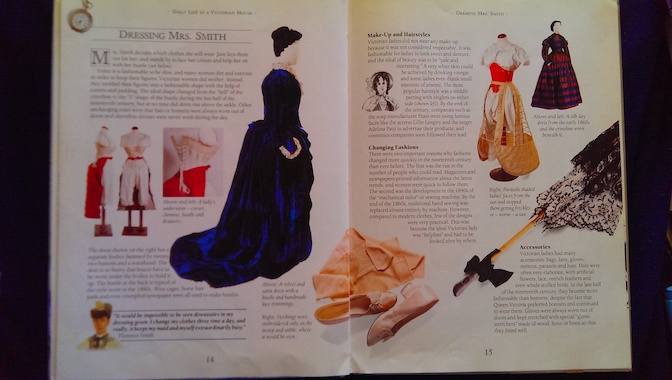
Daily Life in a Victorian House

VictorianHouse

Daily Life in a Victorian House by Laura Wilson, 1993.

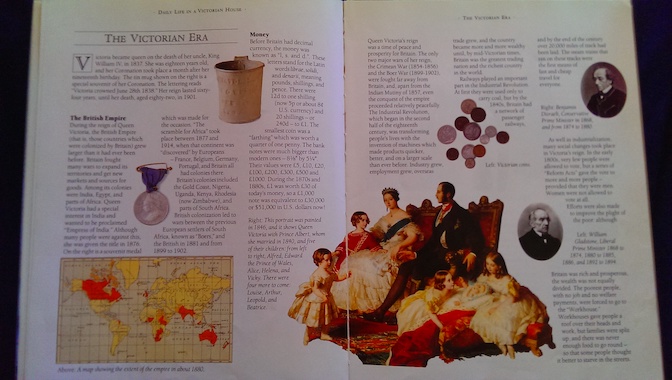
The book begins by giving some background on the Victorian era, which lasted from 1838, when Victoria became Queen of England, to Queen Victoria’s death in 1901. It was a time of expansion and colonization for the British Empire. Society was becoming increasingly industrialized and urban, although there was still great inequality about who had voting rights, and there were great gaps between rich and poor people.

VictorianHouseEra

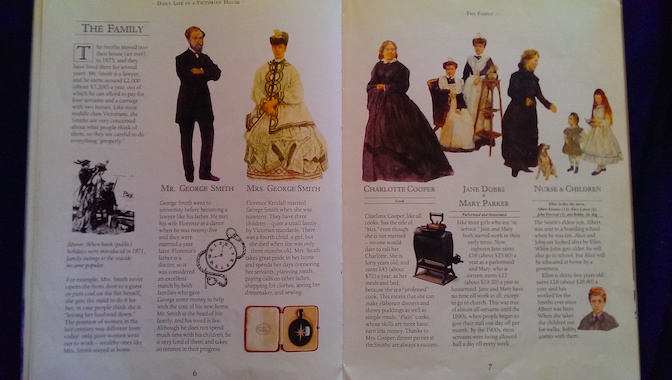
To explain what a typical day might be like for people living in the Victorian era, the book introduces a fictional upper middle class family, the Smiths. It explains some of the background of the Smith family and the members of the Smith household. Mr. George Smith, the head of the household, is a lawyer. His wife, Florence, does not need to work, so she spends her time overseeing the household servants, managing the household accounts (how much money is needed for household expenses such as food, clothes, and supplies), visiting friends, and shopping. Mr. Smith’s income is good enough to afford for the family to have a cook, two maids, and a nurse to look after the youngest children in the family.

VictorianHouseFamily

The Smiths have three living children. One of their daughters died in infancy, which was sadly common for that era. The eldest boy in the family, Albert, spends most of his time away at boarding school. The two youngest children, Alice and John, are cared for by their nurse. When John is old enough, he will go away to boarding school, like Albert, but Alice will probably be tutored at home. Their parents spend surprisingly little time with them, even in the general course of a day.

VictorianHouseClothes

There is a map of the Smiths’ house, and then the book begins explaining what each of the members of the house do at different times of the day. Each day, the servants are the first to get up because they need to light the fires to heat the house and start cleaning and making breakfast, which would be a large meal.

Something that I thought was interesting was that the cook typically purchased food from tradesmen who sold their goods door-to-door. This was also important to the maids, who are in their teens, because they worked such long hours that they really wouldn’t have had time to get away and met young men in any other way. Their suitors would likely be the young tradesmen. Of course, the young tradesmen would have met many young female servants at all of the households they visited during their daily rounds.

VictorianHouseKitchen

The maids would have spent their days cleaning, tasks that would have been more time-consuming without more modern inventions. Vacuum cleaners were invented toward the end of the era, in 1899. Cooking was also a time-consuming job, although the book does explain some innovations for the Victorian kitchen. Because Mrs. Smith had servants to do all of her cooking and cleaning for her, she never even went into her own kitchen at all. It was considered improper for a lady with servants to handle menial tasks herself, and the servants wouldn’t have welcomed her interference in their work.

I liked the sections of the book that explained about the lives of children in the Victorian era the best, although I was surprised at how little time children from well-off families would have spent with their parents. Generally, young children would see their parents in the morning for prayers and spend about an hour with their mother in the late afternoon. Other than that, they would spend most of their time in the nursery with their nurse, who would take care of them and didn’t welcome much parental interference any more than the cook would welcome the lady of the house supervising her work.

VictorianHouseToys

I also liked the sections about toys and games and entertainment as well as the description of what young Albert’s life would have been like at boarding school. The book also explains what life and childhood were like for less fortunate people during the Victorian era.

VictorianHouseSchool

Overall, I really liked this book. It’s a good introduction to Victorian history and life, and it does one of the things that I really wish adult books would do more often: have pictures. Pictures really are worth a thousand words, and actually showing the objects that people of this time would have used in their daily lives is far more effective than pages of lengthy descriptions of them in words only.

The book is currently available online through Internet Archive.
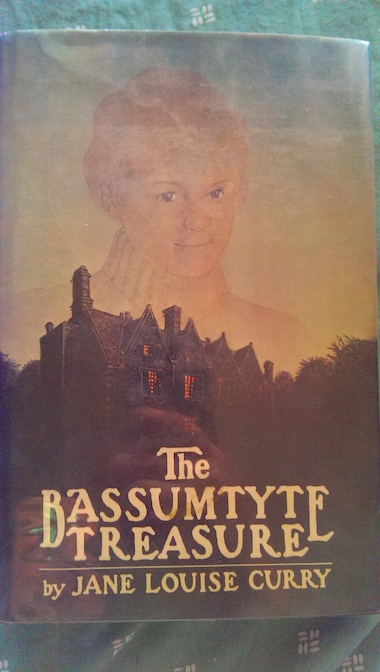
The Bassumtyte Treasure

BassumtyteTreasureThe Bassumtyte Treasure by Jane Louise Curry, 1978.

When young Tommy Bassumtyte’s parents died, he went to live with his grandfather. However, his grandfather is now dead, and he is living with his 92-year-old great-aunt, who is in a wheelchair, and her 72-year-old daughter, who has recently had her driver’s license revoked due to her poor eyesight. Although the pair of them have taken good care of Tommy, neighbors have become concerned that they will not be able to do so for much longer because of their age and failing health. Rather than see Tommy sent to a foster home, they decide that he must go to the man who Tommy learns should really be his legal guardian, a distant cousin also named Thomas who lives in the family’s ancestral home, Boxleton House, in England.

The elder Thomas Bassumtyte, who should have taken Tommy when his grandfather passed away, has also since died, but his son, also named Thomas, agrees to take him. Tommy is quickly shipped off to England before there can be a custody hearing in the United States about him because the relatives fear that some official might try to prevent Tommy from being sent out of the country. Tommy is eager to go because he remembers fantastic stories that his grandfather told him about Boxleton House. The current Thomas Bassumtyte also lives there, although the place has become rather run-down, and he fears that he will not be able to keep the place much longer. Thomas was a mountain climber, but he was injured in a fall and hasn’t been able to work much since. He tells Tommy that the two of them might have to move when he is fully recovered and can do more work for the Foreign Office, but Tommy loves Boxleton House from the first moment he sees it and wants to stay.

According to the lore of Boxleton House, a distant ancestor of theirs hid a treasure there, but no one has been able to find it. If young Tommy and Thomas can find it, it would solve many of their problems, and they would be able to keep the house and restore it. All young Tommy has is the mysterious rhyme that his grandfather told him and the strange medallion that his great-grandfather brought with him when he went to the United States in the late 1800s. Thomas tells him that the treasure was supposedly hidden by a distant ancestor of theirs who was fond of riddles, called Old Thomas.

The Bassumtytes were secretly Catholic during the reign of Elizabeth I. Old Thomas was alive then and had a son called Tall Thomas. Tall Thomas traveled frequently and was mysterious about the places he went. One night, he returned to Boxleton House with a young baby, who he said was his son. He had married in secret, and his young wife had died shortly after giving birth. Tall Thomas also brought her body back to Boxleton for burial. However, that wasn’t Tall Thomas’s only secret. Although he remarried, giving his son a stepmother, and lived on for a number of years, he was eventually executed for smuggling messages for the captive Catholic queen, Mary, Queen of Scots. The family was stripped of its noble title and only barely managed to hang onto their house and land. If there was a treasure hidden during this time, it was probably something that the Bassumtytes were afraid would be confiscated by the queen’s soldiers as punishment for the family’s disloyalty or something that Mary had given to Tall Thomas to hide for her.

As Thomas tells Tommy more about the house and the family’s history, he points out Tommy’s uncanny resemblance to Small Thomas, Tall Thomas’s son, as shown in an old painting. Tommy feels a strange connection to Small Thomas, and begins seeing and hearing strange things. An older woman comforts him in the middle of the night, having him recite the same rhyme that his grandfather taught him. A small painting later reveals that this woman was Small Thomas’s grandmother. She appears to Tommy other times, giving him a glimpse back in time and clues to solve the puzzles of Boxleton House.

It is only when Thomas accepts the advice of a family friend who works for a museum that they come to understand the full significance of their family’s heirlooms and the hidden treasure. The treasure may not be quite what the Bassumtytes have always believed it was, but then, the Bassumtytes themselves aren’t quite who they always thought they were, either.

The book is available to borrow and read for free online through Internet Archive.

Kat the Time Explorer

KatTimeExplorer

Kat the Time Explorer by Emma Bradford, 1998.

KatTimeExplorerTrain.jpgTen-year-old Kat is going to be living with her Aunt Jessie for the next year.  Her parents are botanists, and they are spending a year in South America, studying rain forest plants.  Aunt Jessie lives in a house in the same town as Kat and her parents so, by staying with her, Kat can continue going to the same school and see her friends.

Like Kat’s parents, Aunt Jessie is also a scientist and teaches physics at the same college where her parents teach when they’re not doing research abroad.  She inherited her house from their Great-Uncle Malcolm, who was an inventor.  Malcolm never invented anything that made much money or got much attention, but Jessie has been going through his things and discovered something interesting among his unfinished projects: a time machine.  The time machine seems to be nearly complete, although Jessie isn’t quite sure how to operate it or what should power it.  There is a drawing of a strange medallion in Malcolm’s notes, and Jessie found one with the same markings among Malcolm’s belongings, but it’s unclear whether this medallion is supposed to play any role in the time machine’s function or if it’s completely unrelated.

Then, Kat discovers another medallion in Malcolm’s old room, one with identical markings but made out of a different type of metal.  There is a space on the time machine for each of the medallions to fit.  When Kat experiments with how the medallions can fit into the machine, she activates it, transporting herself and Jessie back in time to England in 1851.

They find themselves on a train with other travelers heading to The Great Exhibition in London where people from around the world will be displaying new developments in industry and technology.  No one notices Jessie and Kat’s sudden arrival because the train is packed with people and the time machine has somehow altered their clothing and other small objects in their possession to ones that are appropriate to the period.  They also seem to be able to understand people speaking other languages neither of them knew before.  The time machine itself is packed into an ordinary-looking bag.  The two of them decide that they can’t use the time machine on the train where everyone will see them, and besides, they are both curious about the time they find themselves in.  After a temporary mix-up where they are separated at the train station, they find each other again and manage to locate a woman who will rent a room to them for a couple of days.

Unfortunately, when they start unpacking in their room, they discover that their bag was accidentally switched at the station for an identical one.  They no longer have the time machine and can’t get home!  Inside the bag they have, they find articles of men’s clothing, a small spring of some kind, an incomplete sketch of some kind of invention, a ticket to the Exhibition, and a letter written to someone named Edward from his brother Sidney about the Exhibition and the invention they plan to demonstrate there.  The brothers are very concerned about the success of their demonstration and are depending on results to make some money and save their family’s estate.  With those clues, Jessie and Kat must track down these inventors and find their time machine, saving not only themselves from being stuck in the past but the future of the two brothers!

There is an educational section in the back that explains about the Victorian Era and the Great Exposition.  It also discusses Victorian manners and tea parties.  There are tips for making little sandwiches of the kind people would eat at tea parties.

This book is part of the Stardust Classics series.

Castle Diary

CastleDiary

Castle Diary: The Journal of Tobias Burgess, Page by Richard Platt, 1999.

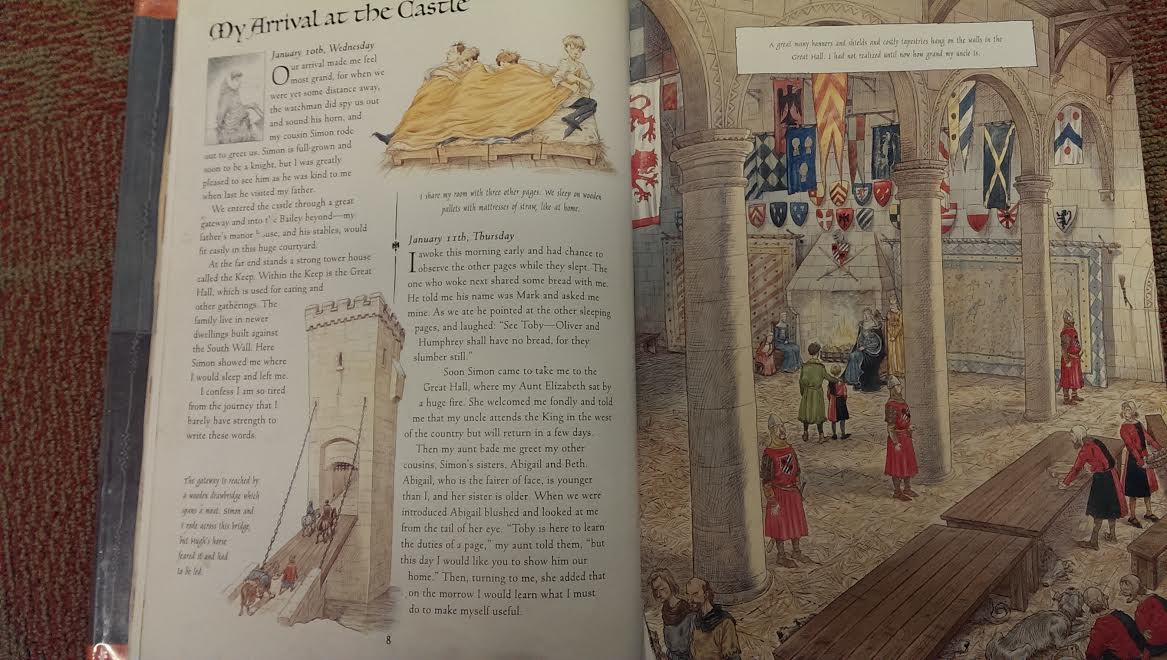
Tobias is an eleven-year-old boy living in England in 1285.  He is from a noble family, and his father is sending him to his uncle to become a page.  As a page, Tobias will learn manners and skills that he will need as he eventually becomes a squire and then a knight.  During the first year of his training that he spends with his uncle, he keeps a diary of everything that happens to him and everything he learns.  Toby is a fictional boy, but his life and family are meant to illustrate what life was like for a young boy from his social level during the Middle Ages.

CastleDiaryPic1

The castle were Toby’s uncle lives is much bigger than his parents’ manor house.  Toby has to learn the roles of all the servants who live there: who is in charge of what and who reports to who.  Not all servants are equal, and some command more respect than others.  Some of them are even from noble families like his, including his aunt’s companion, Isbel.  Toby himself is assigned to do chores for his aunt like running errands, delivering messages, serving food at meals, and holding up the hem of her cloak when she walks outside.

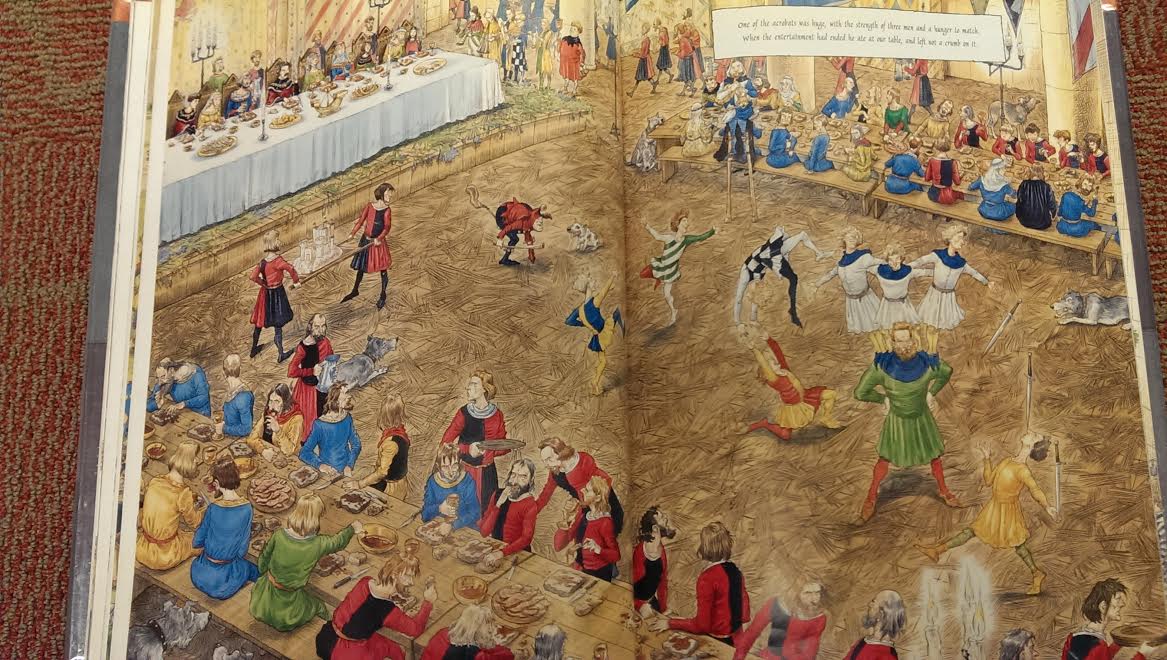
Toby shares a room with the other pages at the castle, all boys of noble families and destined to become knights, just like him.  They have lessons in reading, writing, mathematics, Latin, and scripture from the castle’s chaplain, and he is a harsh disciplinarian.  They practice their lessons on wax tables that can be smoothed out and used again.  The boys also learn manners and start learning archery and about all the weapons and armor that knights use.  When they have time to play, they try walking on stilts and play at being jousting knights by carrying each other on their backs and trying to knock each other off.

CastleDiaryPic2

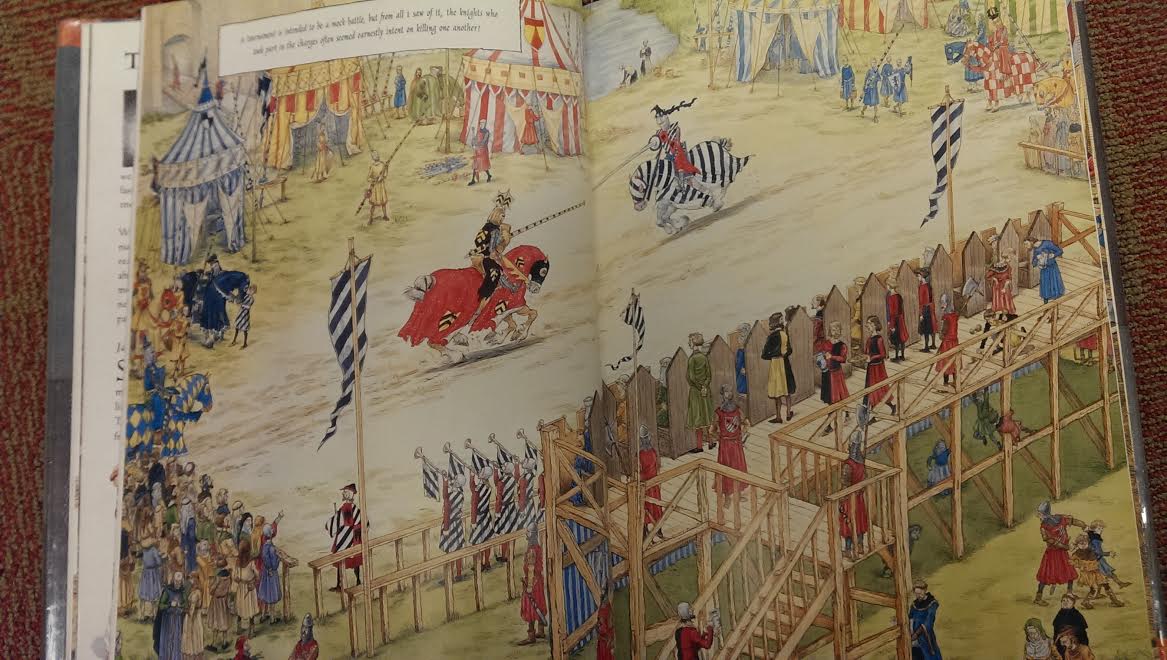
During the course of the year, Toby gets to witness a hunt, a joust, and a banquet with important guests.  At one point, he gets sick and receives treatment from a physician.  He also encounters a poacher on his uncle’s land.  This man is eventually caught (although Toby decides not to turn him in) and put on trial, but in the end, he is not punished because the jurors were sympathetic.  The book ends with a Christmas celebration, after which Toby goes home to visit his parents.

CastleDiaryPic3

In the back of the book, there is a section with more information about Medieval society, castles, sieges, weapons, armor, and the changes that eventually brought an end to feudal system that Toby knew.

The book is part of a series of historical picture books.  It is currently available online through Internet Archive.

CastleDiaryPic4

The Curse of the Egyptian Mummy

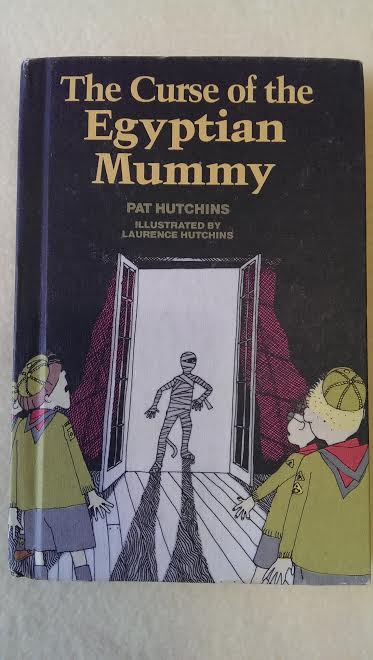
cursemummyThe Curse of the Egyptian Mummy by Pat Hutchins, 1983.

The 15th Hampstead Cub Scouts are looking forward to their camping trip. Miss. Hylyard, who runs a guesthouse for retired people, lets the scouts camp on her land and enjoys having them visit her house and entertain her guests. Mr. and Mrs. Webb are coming along to do the cooking, and their daughter, Victoria, will be there, too. She’s one of their friends from school.

Things start to get interesting pretty quickly when they hear that a man died from a poisonous snake bite not far from where they are camping. The boys are eager to show off their tracking skills by helping the police find the missing snake.  But, strangely, no one can figure out where the snake came from because none of the zoos in the area have reported one missing.  That’s only the beginning of what becomes a very strange trip for the scouts.

Sam finds a strange bird statue in a public wastebasket and decides to use it as the scouts’ new mascot. Then, someone trashes the campsite, and strange figures are seen running around the woods at night.  When Albert makes copies of the bird statue to earn his art badge, the first one is broken, and the second is stolen after some adult shoves Albert into the river near the camp.  Some of the guests at Miss Hylyard’s look suspicious, and when Victoria unexpectedly stumbles into an evening’s entertainment there still wrapped in bandages from the scouts’ first aid practice, a guest who was supposedly unable to speak suddenly blurts out, “The Curse of the Mummy’s Tomb!” in Arabic (which Miss Hylyard knows from her travels with her father).

Who are these mysterious people?  What is the importance of the statue?  And, is there really a curse?

The book is currently available online through Internet Archive.
The Mona Lisa Mystery

monalisamystery

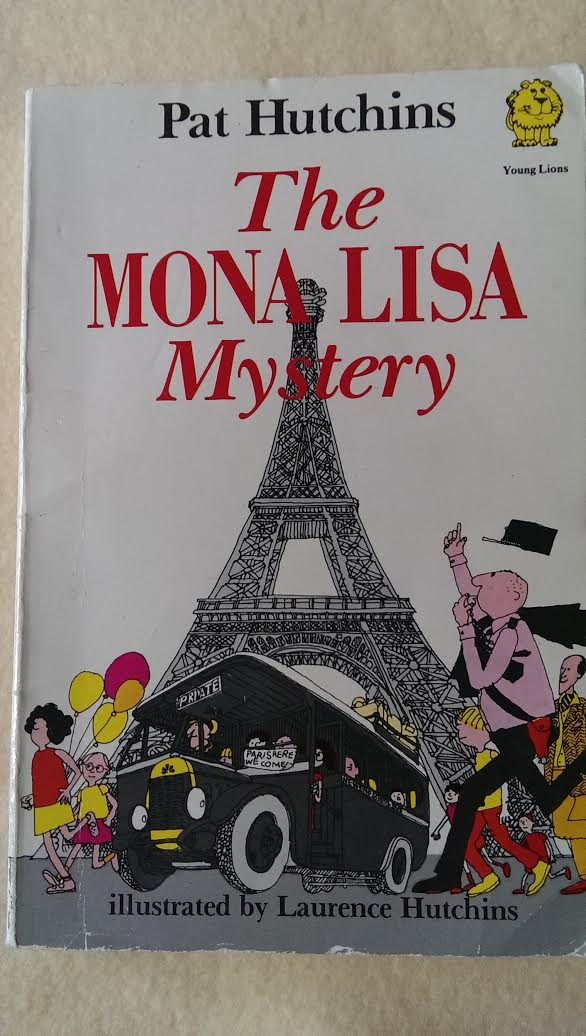
The Mona Lisa Mystery by Pat Hutchins, 1981.

Class 3 from Hampstead Primary School is taking a trip to France with their teacher, Mr. Jones. Miss Barker, their headmistress, was supposed to go with them, but she became ill, so their substitute French teacher, Miss Parker, will be going with them instead.  The kids aren’t happy about the substitution because they really like Miss Barker, and Miss Parker isn’t nearly as nice.

From the very beginning of the trip, strange things start happening. A black car follows them to the ferry and even around France. A doctor they meet on the ferry takes a room at their hotel, and unusual characters follow them everywhere they go, some of them in disguise. One of them even enters Jessica and Avril’s hotel room in the middle of the night.

At first, the children think that someone may be trying to kidnap Miss Parker since the mysterious strangers are showing unusual interest in her.  Then, the Mona Lisa is stolen while the children visit the Louvre!  The thief temporarily holds Jessica hostage before making his escape. Later, the painting shows up at their hotel, and Mr. Jones is arrested as a conspirator in the crime!

The children struggle to unravel the clues and the tangled mass of identities and prove their teacher’s innocence.  Who was really following who, who is the real conspirator, and can the children prove it and find the missing painting?

The book is available to borrow and read for free online through Internet Archive.

monalisamysterypic2

My Reaction

When I was a kid, I wished that my class could take a field trip to a foreign country! Technically, I suppose we could have since I live in a border state, but there’s nothing to see in the border towns here that would be as exciting as the Louvre. But, part of the fun of reading books like this is vicariously experiencing things you otherwise wouldn’t do.

This mystery story is the kind I think of as a fun romp – the characters are traveling around a bit and hijinks ensue as the students try to solve the mystery and save both the Mona Lisa and their teachers. One of my favorite parts as a kid was the running gag with the ketchup bottle.

Candleshoe

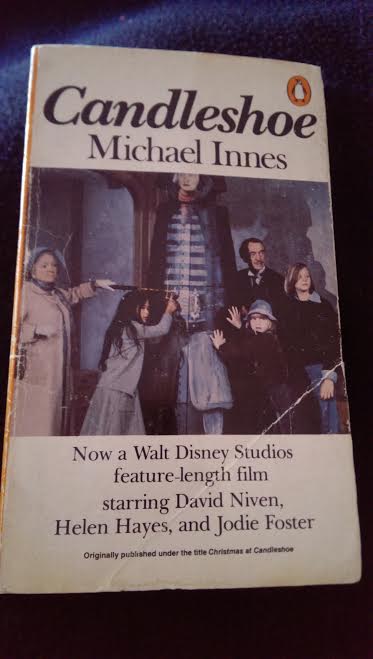
candleshoeCandleshoe by Michael Innes, 1953.

I own the movie version of the book, which was originally named Christmas at Candleshoe (although it’s not about the holiday).  It contains the text of the original story, but the picture on the front cover is from the movie.

The Disney movie is very different from the original book.  For one thing, the hero of the story is a boy (Jay), not a girl (Casey/Margaret), and unlike the movie version, the child’s identity is established for certain by the end of the book. The book has a happy ending, and so does the movie, but part of the movie’s point was that the idea of family isn’t dependent on blood relations alone, so it isn’t important whether Casey is really Margaret or not (although there are strong hints that she is).

The book is a bit hard to follow at first because it jumps back and forth between different places and different sets of characters, although it all takes place during the course of a single day and night.  Actually, I’m not sure this can really be called a children’s book, but I included it here because of the movie tie-in.  Because of the difficulty level of the book, I’d really recommend it for older children or adults.  Personally, I have to admit that I liked the movie better.

The story takes place in the mid-twentieth century, after WWII. There are two manor houses involved, Benison Court and Candleshoe. Benison Court, the newer of the two, is owned by the Spendloves, and Candleshoe, the older one, is owned by the elderly Miss Candleshoe. The two families are related, and neither one of them has as much money as they used to. The Spendloves take in some extra money by offering tours of Benison Court and showing people paintings and antiques owned by the family for generations. To raise some additional money, they decide to sell a couple of the paintings by Titian. To their surprise, the expert they call in to evaluate the paintings tells them that the paintings are forgeries.  Archdeacon, who cares for the antiques and library at Benison, reminds the Spendloves that during the war, the paintings were sent to Candleshoe for safekeeping.

Meanwhile, a couple of American tourists, the wealthy Mrs. Feather and her son Grant, having seen Benison, stop by Candleshoe. Mrs. Feather is fascinated by the old place, in spite of its state of disrepair, and Miss Candleshoe invites them to have dinner there and spend the night. Mrs. Feather has an interest in purchasing Candleshoe for herself and fixing it up.  Miss Candleshoe and her longtime friend, the retired chaplain, Armigel, know that there is not enough money for them to fix up Candleshoe, and they like the idea of traveling, so they are willing to consider selling the manor house. This plan does not sit well with Jay, the orphaned son of Miss Candleshoe’s housekeeper, Mrs. Ray.

After Mrs. Ray died, Miss Candleshoe cared for Jay, and now, with Miss Candleshoe and Armigel showing signs of senility, Jay has been handling much of the practical running of Candleshoe. On this particular evening, Jay is worried about more than the possible sale of the property. He has been noticing strange people paying unusual attention to the house. He suspects, correctly, that they intend to break into the house that night, and he has assembled a small army of local children, armed with antique weapons, to defend the place. Grant, befriending Jay, admires the boy’s practical turn of mind but worries that they are not up to the task of handling the siege that is coming to this isolated country house. As the danger presses closer, the Spendloves, Archdeacon, and the art expert are heading toward Candleshoe in search of the missing paintings.

The answer to all of these problems may lie in the strangest feature of the house: the Christmas box, a stone monument in the gallery made by Gerard Christmas and dedicated to the memory of an ancestor of the Candleshoes, who may have been a pirate. According to the lore of Candleshoe, the box will open at a time when Candleshoe is in crisis and will save the day.

The book is available online through Internet Archive.

But, is Casey Really Margaret?!

I think so. I want to say, “yes, she is,” but “I think so” is about as definite as I can be because the movie changed the story from the original book.

Whether or not Casey is actually Margaret, the lost heir to Candleshoe, is the burning question everyone is left with after watching the Disney movie Candleshoe. The movie deliberately left Casey’s true identity unresolved at the end, probably because they wanted to have the people at Candleshoe decide to accept her into their family on her own merits, not just because they had to because she’s the heir to the place. In the beginning, the audience is told that missing heir of Candleshoe, Margaret, was kidnapped as a young child by her own father, apparently in some kind of marital/custody dispute, and that she disappeared after his death in a car accident and has not been located although attempts to find her were made in the ten years that have passed since her disappearance. Casey is a teenage girl who was apparently an abandoned child with an unknown past and no memory of her early life who bears an odd resemblance to Margaret, including a couple of distinctive scars that are like ones Margaret was known to have. She is recruited as by con artist to play the part of Margaret, returning to Candleshoe as the lost heiress in order to gain access to the house and find a hidden treasure. Although Casey initially came to Candleshoe under false pretenses as part of a con with the promise of a share of the Candleshoe treasure and a red Ferrari as her payment, she eventually becomes fond of the people there and decides that she can’t let them be cheated by the real villain. Casey proves herself to be part of the Candleshoe family through her loyalty to them, and in the end, they would accept her whether she really was Margaret or not. It’s a nice sentiment, but viewers still have the urge to ask who Casey really is.

Casey is legitimately an orphan or abandoned child, found at about the right time and the right age and in the right place to really be Margaret. She has no memory at all of her early childhood, her parents, or where she came from, and she also bears some telltale scars that match ones that young Margaret was known to have. That’s what we’re told about Casey. Casey’s history is never explained in detail in the movie (we never find out under what circumstances she was found and entered into the Los Angeles foster care system), but from what we do know, her history meshes well enough with Margaret’s known past that it would seem plausible for her to actually be Margaret. Is she really Margaret, and Harry Bundage, the con man, just persuaded her that she was only pretending in order to use her for his own ends? Or, is the real Margaret still out there somewhere? If Casey actually is Margaret, did she lose her memory in the car crash that killed her father, or did he abandon her somewhere before his death, even though he had kidnapped her from her mother and took her to a completely different country?

When Harry Bundage is briefing Casey about Margaret’s background, he poses the theory that Margaret was in the car when her father crashed it and that she may have wandered off in a state of shock after the accident. That explanation might be partly for the benefit of the viewers, helping to explain how Casey could be Marget and not remember it. A young child suffering from shock might be unable to tell anyone who she was or what had happened to her. An accident may even have left some bruising that might have obscured the telltale scars that could have identified her, but again, the matter is never fully settled, and we just don’t know enough of Casey’s background to make a full connection. There are enough pieces to make it possible, maybe even probable, but nothing that definitively settles the matter.

In the final scene of the movie, Casey asks Margaret’s grandmother what will happen if Margaret is ever really found and comes home, and the grandmother says cryptically that maybe she already has. It’s a brief hint that the grandmother thinks Casey might really be her kidnapped granddaughter, even though she accepts that Casey was lying to her earlier about things she said she remembered and knows that Casey herself thought that she was just an imposter. Casey does have those telltale scars, and it does seem like quite a coincidence that two random girls of the same age and similar circumstances would have identical sets of scars. However, the movie stops short of declaring that Casey really was Margaret all along, and the unanswered questions still rankle viewers. So, some of us turned to the original book to get more detail, but it turns out that it doesn’t completely help.

As I said, the original book was different from the movie. Not only was the child hero in the book a boy instead of a girl, he wasn’t kidnapped and taken to America the way that Margaret was. In the book, Jay definitely knows who his mother was, and it’s the question of who his father was that establishes his identity as the heir to Candleshoe. It turns out that Jay’s father was the nephew of the lady of Candleshoe, making her his great-aunt rather than his grandmother. Her nephew had been a ne’er-do-well, and although his family didn’t know it, he had married an American woman before his death. He died not too long after the marriage, but by that point, he had fathered Jay. Jay’s mother knew about her husband’s family, but she wasn’t sure yet whether or not she wanted to tell them about Jay. She took the job as housekeeper so she could observe the family and decide whether or not to reveal their relationship. Unfortunately, she died in an accident before she made up her mind. By the end of the book, Jay’s identity is established, and he is definitely proven and recognized to be the heir to Candleshoe, and because of that, I believe that Casey really is the missing Margaret. At least, that’s as close to confirmation as we’re likely to get. If the child in the book was the rightful heir to Candleshoe, it would make sense if the child in the movie was, too, even if it’s not really the same child.

Of course, that’s not full proof, and it doesn’t answer the questions about Margaret’s kidnapping or her father’s accident or how Casey was found and placed in foster care in California without anyone else connecting her with the missing Margaret when Margaret’s disappearance was reported to the authorities and newspapers. I have a theory that Harry Bundage was right that Margaret was in the car during the accident and that she did wander away from the scene of the accident in shock and possibly suffering injuries that covered up her identifying scars, but that’s still just a theory. There’s nothing in the movie or book that I could use to prove it. We don’t even know exactly why Margaret’s father in the movie kidnapped her in the first place or why Margaret’s mother died not long after she disappeared. (A convenient accident or illness for story purposes so there’s one less person to try to identify Casey/Margaret, or did she kill herself out of despair at the loss of her husband and daughter? The movie doesn’t say, so those are just guesses, too.) There’s a lot of backstory missing, and the book doesn’t clarify these points because of the differences between the book and movie. I guess it’s not really important to the story in the movie, but inquiring minds still want to know.

All The Children Were Sent Away

It’s 1940, and Sara Warren’s parents are sending her to stay with her uncle in Canada until the war is over.  With the increasing bombings of England, her parents have decided that it’s just too dangerous for Sara to stay, and her uncle has written, asking them to send her.  Many other British families are sending their children away to escape the bombings, and Sara travels to Canada on a ship with other British child evacuees.  All of them are worried about the families they’ve left behind and what it’s going to be like, living in another country.  They also worry about whether or not they’re ever coming back.

Sara’s escort for the trip is Lady Drume.  She is a bossy, over-bearing woman with very definite ideas about how children should be raised.  She doesn’t like Sara to talk to the sailors on the ship because they can be “impertinent,” and she doesn’t want her to play with the other children because they’re “guttersnipes!”  She even refuses to attend the lifeboat meeting or let Sara go without her!  To Sara’s mind, Lady Drume is as bad as any Nazi.

Sarah still manages to make friends with some Cockney children, Ernie and Maggie, seeing them whenever she can get away from Lady Drume, and an old sailor called Sparky makes sure that she understands safety on board the ship and attends the lifeboat drills.

But, when Lady Drume forces Sara to cut her hair after she’s been waiting so long for it to grow out, Sara decides that’s the last straw!  With the help of her friends, Sara hides from Lady Drume on the ship.  In the process, she learns something about Lady Drume which changes some things for the better, although it takes an outbreak of measles for Lady Drume to really understand and appreciate Sara.

This book is available to borrow and read for free online through Internet Archive.

Part of trouble with Lady Drume and her behavior is that she’s actually very afraid.  She doesn’t like to talk about lifeboats or life jackets because the war and the possibility of sinking frighten her.  She deals with problems by being brusque and trying to ignore frightening things, charging on ahead with whatever seems like a practical course of action to her.  It’s not even just the war but the changing world around her that frightens Lady Drume, a woman who’s used to knowing who’s who and what’s what and getting things done the way she likes them.  But, the rigors of their journey and their mutual vulnerability when they’re sick help lower Lady Drume’s barriers.  Lady Drume isn’t a bad person, and in the end, she arranges a special surprise for Sara to make her exile from England more bearable.

The end of the story is a brief section explaining Sara’s return to England, having been away for a few years, and her feelings at seeing how England and her parents have changed during that time.

There is a sequel to this book that shows what happened during Sara’s time in Canada called The Eternal Spring of Mr. Ito.  It focuses on suspicion of Japanese people following the bombing of Pearl Harbor.  There were Japanese internment camps in Canada as well as the United States during World War II.

Sheila Garrigue’s books about child evacuees from England were partly based on her own experiences as a child evacuee during World War II, as explained in her obituary after her death in 2001.

The Mystery Hideout

MysteryHideoutThe Mystery Hideout by Ken Follett, 1976.

The first time Mick Williams meets Randall Izard (called “Izzie”) is when the news dealer Mick works for asks him to train the new boy on his paper route, and Mick learns that Izzie will also be going to his school. Mick doesn’t like Izzie much at first. The new boy speaks with a posh accent and is riding an expensive bike that he says was a present from his father, who makes television ads for a living. Mick doesn’t have a father, and he stole the bike that he rides for his paper route.

Mick guesses that Izzie’s family used to have more money but have fallen on hard times, which is why Izzie needs the paper route.  Mick is worried about his own future.  Someone is building a new hotel on the street where he lives by knocking down the old film studios, and his mother says that they’re going to demolish all the old apartment buildings around it.  That means that they’ll have to find a apartment, which isn’t easy because they don’t have much money, and not everyone wants to rent to a lone woman with a child.

Mick kind of envies the criminal gangs that he reads about in the paper, like the Disguise Gang.  They stage daring raids on banks while wearing clever disguises so that no one knows that they really look like.  They fool everyone and get away with tons of money.  Mick wishes that he was that clever!  If he was, his mother would never have to worry about money again.

MysteryHideoutPicBut, Izzie turns out to be a good friend for Mick.  They both love to play soccer, and Izzie tells Mick that his father used to work in the old studio buildings that they’re tearing down to build the new hotel. In fact, Izzie even knows a secret way in, so the boys sneak in to explore a little.  They’re goofing off with some of the props when they make the startling discovery that the prop guns are loaded with real bullets! Then, the boys have to make a run for it because there are other people sneaking around the old studios. What is going on there?

This book actually takes place in London. I don’t think they actually say the name of the city in the story, but they do mention the Thames, the money is all in pounds, and there are children playing cricket.  But, it’s the kind of story that could take place anywhere.  Mick and Izzie are realistic characters.  Both of them are worried about their families’ hard times.  Mick in particular wants to be the man of the house and to help his mother in her struggles to provide for them.  His inner debate about which side of the law he should be on is also feels real, and it’s satisfying what he chooses when he realizes what criminals are really like and the danger they pose to people he cares about.