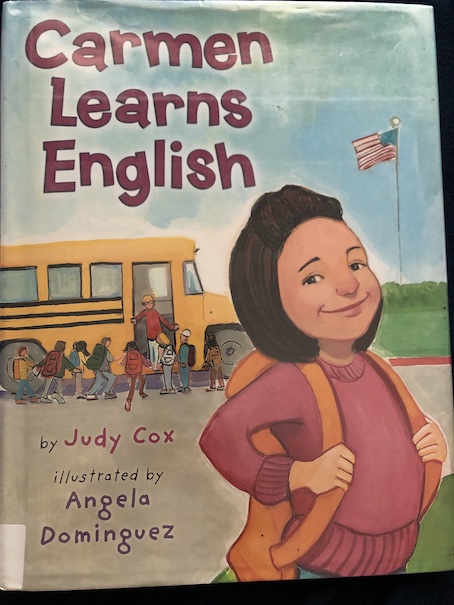
Carmen Learns English

Carmen is in kindergarten and has been learning English at school. Her little sister, Lupita, will start school next year, and Carmen thinks about how she wants Lupita to learn English before she starts school. The family is from Mexico, and the girls speak Spanish at home.

School hasn’t been easy for Carmen because the other kids don’t speak Spanish. They all speak English, and they speak fast, which makes it difficult for Carmen to follow their conversations. It helps that her teacher knows some Spanish. Her teacher’s Spanish isn’t very good, but in a way, Carmen finds that comforting because her teacher will understand if her English isn’t very good, either. People who are learning another language understand what it’s like when someone else is learning, too.

Carmen gradually learns new English words at school. When she gets home, she draws pictures of what she’s learned and teaches her mother and little sister the English words. At first, Carmen is too shy to say the words out loud at school because she isn’t confident about how she’s saying them, but she practices at home.

Sometimes, kids at school give Carmen a hard time. Some kids think that she talks funny. When she counts in Spanish instead of English, they think that she’s saying the numbers wrong. Her teacher helps by teaching all the class to count in both Spanish and English, so all the students will learn both languages. Carmen helps to teach the other students words in Spanish, and when she gets home, she teaches Lupita the English words that she has learned.

Because Carmen has been helping Lupita to learn English, Lupita will have an easier time at school than Carmen had when she started. Carmen realizes that she really likes teaching, and she thinks that she might like to be a teacher herself someday.

I thought this was a good story about a child starting school while having to learn a new language at the same time. My mother used to teach English language learners, and she liked the story, too. She said it reminded her of some of the students she used to teach.

I thought that the teacher’s approach, having Carmen teach the other kids some Spanish while she was learning English was a good idea. Some of the other students find Carmen a little strange and confusing at first because they don’t understand the way she speaks, but when they start trading words in different languages, they all start to understand each other better. The other students begin to understand the concept that people can speak in different languages and that there can be different words that mean the same thing, depending on the language they’re speaking. I think it also helps them start to identify with Carmen because, like her, they are also starting to learn an unfamiliar language. As I said, people who are learning a new language or who have studied another language before can understand the difficulties of now always knowing all the words they want to say or exactly who to say them and can sympathize with other people who are also learning new languages.

I also liked it that Carmen realizes that, if she helps her sister to learn some English before she starts school, her sister will have an easier time. She has compassion for her sister because of her own experiences and wants to make things easier for Lupita. By helping both her sister and her fellow students, she also learns that she likes sharing what she knows with other people. She discovers that she likes teaching and might want to be a teacher herself someday.

I read this book as an adult because it’s a relatively new book that didn’t exist when I was a kid, but it reminds me of another book that I did read as a kid, I Hate English, which is about a girl from China learning English. The Chinese girl has some similar troubles learning English and feeling uneasy around people who don’t understand her, although she also struggled with the fear that she would lose her native language or cultural/personal identity by learning a new one. Carmen doesn’t mention that in this story, but some of my mother’s old Spanish-speaking students had that worry when they were learning English, too. Perhaps part of the reason why Carmen doesn’t feel like that is because her teacher encourages her to teach the other students some Spanish, giving her the opportunity to keep speaking it from time to time and share the language with others. In a way, this story was closer to my experiences when I was younger because Carmen is like the kids my mother used to teach and because Spanish is what I studied in school myself.

Castle

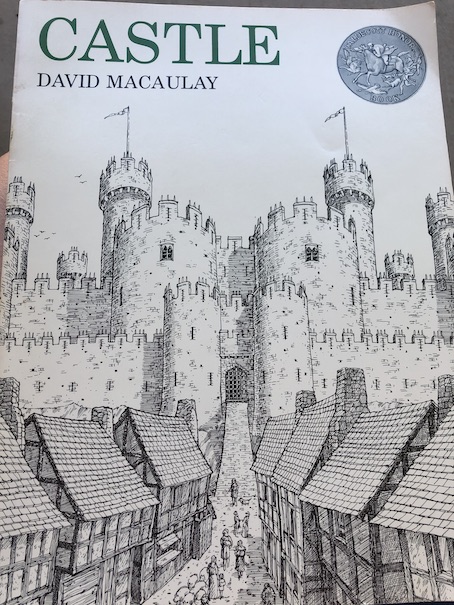
Castle by David Macaulay, 1977.

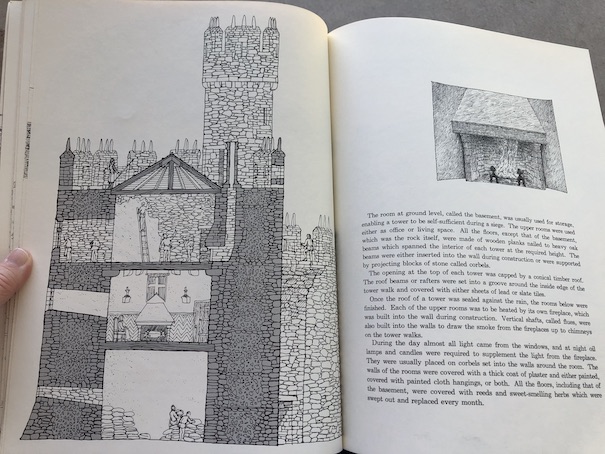
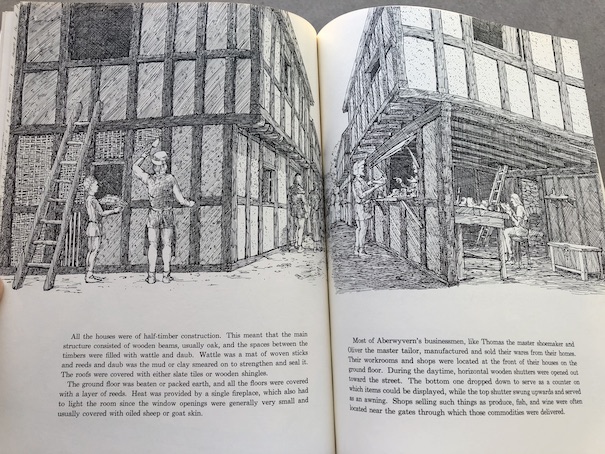
Castle is one of David Macaulay’s books about historical architecture, and like his earlier book, Cathedral, it has detailed and realistic drawings to explain each step in the building process.

The castle in the story is fictional, but it’s based on real castles built by English lords during the conquest of Wales, circa 1277 to 1305. The process for constructing the castle and the military strategy behind it are historically accurate. The English, under King Edward I, used a strategy of establishing permanent towns and castles in Wales to dominate the Welsh. The construction of these castles and their accompanying towns took years, but it was part of a long-term political and military strategy that actually aimed at avoiding direct armed conflict. The purpose of the castles and towns was not only to support the occupying English forces and settlers, but also to provide economic centers that the Welsh would also find beneficial. The idea was that the Welsh, while initially opposed to the interlopers, would eventually come to rely on the presence of the new towns for business and trade and not want to force the newcomers out. This strategy is in keeping with the nature of castles themselves because they are defensive structures, designed for holding off attackers in order to maintain territorial control, shielding the people within the castle so they cannot be forced out. The fictional castle in the story is built with a fictional town called Aberwyvern and belongs to a fictional nobleman, Lord Kevin.

The beginning of the book explains the military strategy of Edward I and how he appointed noblemen to build castles in Wales. When choosing the site for a castle, they would take into account the natural landscape and its defensive capabilities. For example, Lord Kevin’s castle will be built on a high outcrop on the edge of a river. The high ground and the surrounding water will make the castle harder to attack.

The book shows a plan of the castle that will be built and explains the different craftsmen who will be working on the construction, along with the tools they will use. The book then describes the various stages of construction, beginning with the preparation of the site and the digging of a moat that will separate the section of rocky outcropping where the castle will be built from the land around it, where the town will be located. The moat is important because it provides an extra defensive feature.

My favorite parts explain the living quarters of the castle. People think that castles must have been uncomfortable with bare stone walls, but actually, the walls are only bare in ruined castles that were exposed to the elements over time. When a castle was inhabited, the walls were covered with plaster. The plaster would be painted and/or hung with tapestries for decoration. Reeds and nice-smelling plants would cover the floors as a kind of carpeting, and the plants would be swept out and replaced regularly.

The castle and town take years to finish, and the pictures show how they look at each stage of construction, both in aerial view and up close.

Toward the end of the book, King Edward visits the castle and warns Lord Kevin that there have been some Welsh uprisings. Lord Kevin and his people make sure that they have enough food and supplies to last through a siege, and the following year, the castle’s defenses are put to the test when they do have to withstand a siege.

Eventually, the Welsh attackers are forced to retreat when they are unable to take the castle and they receive word that more English forces are coming.

Over time, the community includes people of Welsh and English descent, living side-by-side, and the town extends beyond the original town walls. The town walls are no longer necessary for defense. By that point, the castle itself is mostly neglected, and people sometimes scavenge stones from it for other buildings.

This book is a Caldecott Honor Book. It is available to borrow and read for free online through Internet Archive (multiple copies). There is also an animated film version of this story, which is available online through Internet Archive.

The Hidden Treasure of Glaston

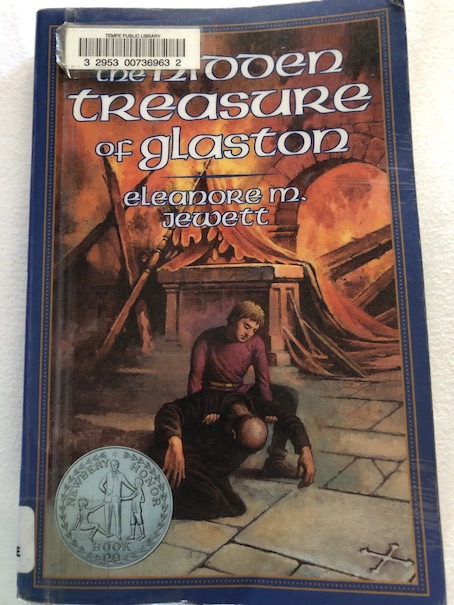
The Hidden Treasure of Glaston by Eleanore M. Jewett, 1946.

The year is 1171.  Twelve-year-old Hugh, a somewhat frail boy with a lame leg, arrives at the abbey of Glastonbury with his father on a stormy night.  Hugh’s father is a knight, and in his conversation with Abbot Robert on their arrival, he makes it known that, although he loves his son, he is disappointed in the boy’s frail condition because he can never be a fighter, like a knight’s son should be.  The abbot rebukes him, saying that there is more to life than war and that he, himself, is also of noble blood.  The knight apologizes, and says that, although it is not really the life that he would wish for his son, he asks that the abbey take him in and educate him.  Although the knight (who refuses to give his name, only his son’s first name) says that he cannot explain his circumstances, the abbot senses that the knight is in trouble and is fleeing the area, perhaps the country of England entirely. 

It is true that the knight is in trouble, and he is fleeing.  Since Hugh’s health is delicate, his father cannot take him along in his flight.  Realizing that the abbey will provide him with a safer life, Hugh’s father wants to see him settled there before he leaves and gives the abbey a handsome gift of expensive, well-crafted books as payment for his son’s education.  The abbot is thrilled by the gift, although he says that they would have accepted Hugh even without it.  Then, the knight leaves, and the monks begin helping Hugh to get settled in the abbey.

Hugh is upset at his father’s leaving and the upheaval to the life he has always known, although he knows that it is for the best because of his family’s circumstances.  Although the story doesn’t explicitly say it at first, Hugh’s father is one of the knights who killed Thomas Becket, believing that by doing so, they were following the king’s wishes. Hugh’s father did not actually kill Beckett himself, but he did help to hold back the crowd that tried to save Beckett while others struck the blows, so he shares in the guilt of the group.  Although Hugh loves his father, he knows that his father is an impulsive hothead.  Now, because of the murder, Hugh’s father is a hunted man. By extension, every member of his household is also considered a criminal.  Their family home was burned by an angry mob, their supporters have fled, and there is no way that Hugh’s father can stay in England.  However, the prospect of life at the abbey, even under these bleak circumstances, has some appeal for Hugh.

Hugh has felt his father’s disappointment in him for a long time because his leg has been bad since he was small, and he was never able to participate in the rough training in the martial arts that a knight should have.  Even though part of Hugh wishes that he could be tough and strong and become the prestigious and admired knight that his father wishes he could be, deep down, Hugh knows that it isn’t really his nature and that his damaged leg would make it impossible.  Hugh really prefers the reading lessons he had with his mother’s clerk before his mother died.  His father always scorned book learning because he thought that it was unmanly, something only for weak people, and Hugh’s weakness troubles him.  Hugh’s father thinks that the real business of men is war, fighting, and being tough.  However, at the abbey, there are plenty of men who spend their lives loving books, reading, art, music, and peace, and no one looks on them scornfully.  For the first time in Hugh’s life, he has the chance to live as he really wants to, doing something that he loves where the weakness of his bad leg won’t interfere. 

The abbot is pleased that Hugh has been taught to read and arranges for him to be trained as a scribe under the supervision of Brother John.  Hugh enjoys his training, although parts are a little dull and repetitive.  Hugh confides something of his troubles in Brother John, who listens to the boy with patience and understanding.  Although he does not initially know what Hugh’s father has done, Hugh tells his about the burning of his family’s home, how they struggled to save the books that they have now gifted to the abbey, and how there were more in their library that they were unable to save.  Hugh tells Brother John how much he hates the people who burned their home and how much he hates the king, who caused the whole problem in the first place. His father would never have done what he did if the king hadn’t said what he said about Thomas Becket, leading his knights to believe that they were obeying an order from their king.  Brother John warns Hugh not to say too much about hating the king because that is too close to treason and tells him that, even though he has justification for hating those who destroyed his home, he will not find comfort in harboring hate in his heart.  He also says that not all that Hugh has lost is gone forever.  People who have left Hugh’s life, like his father, may return, and there are also many other people and things to love in the world that will fill Hugh’s life.  Brother John urges Hugh to forget the past and enjoy what he has now.  When Hugh says how he loves books but also wishes that he was able to go adventuring, Brother John says that adventures have a way of finding people, even when they do not go looking for them.

One day, when Brother John sends Hugh out to fish for eels, Hugh meets another boy who also belongs to the abbey, Dickon.  Dickon is an oblate.  He is the son of a poor man who gave him to the abbey when he was still an infant because he was spared from the plague and wanted to give thanks to God for it.  Dickon really wishes that he could go adventuring, like Hugh sometimes wishes, although he doesn’t really mind life at the abbey.  Because Dickon is not good at reading or singing, he helps with the animals on the abbey’s farm.  Although he is sometimes treated strictly and punished physically, he also has a fair amount of freedom on the farm, sometimes sneaking off to go hunting or fishing.  He also goes hunting for holy relics.  Dickon tells Hugh about the saints who have lived or stayed at the abbey and how the place is now known for miracles.  He is sure that the miracles of Glaston will help heal Hugh’s leg, and he offers to take him hunting for holy relics.  Hugh wants to be friends with Dickon, but at first, Dickon is offended that Hugh will not tell him what his last name is.  Dickon soon realizes the reason for Hugh’s secrecy when a servant from Hugh’s home, Jacques, comes to the abbey to seek sanctuary from an angry mob that knows of his association with Hugh’s father.

The abbot grants Jacques temporary sanctuary but tells him that he should leave the country soon.  When Dickon witnesses Jacques’s explanation of why the mob was after him, comes to understand his connection to Hugh.  Although the mob does not know that Hugh is actually connected to Jacques, Dickon spots the connection and tells Hugh that he forgives his earlier secrecy.  Dickon even helps Jacques to leave the abbey the next day, in secret.

Now that Dickon knows Hugh’s secret, he lets Hugh in on his secrets and the secrets of the abbey itself.  He shows Hugh a secret tunnel that he has discovered.  There is an underground chamber between the abbey and the sea where more parchments and some other precious objects are hidden.  Dickon doesn’t know the significance of all of the objects, although there appear to be holy relics among them.  Dickon’s theory was that monks in the past created this room and tunnel to store their most precious treasures and get them away to safety in case the abbey was attacked and raided.  At some point, part of the tunnel must have collapsed, blocking the part of the tunnel leading to the abbey.  The boys are frightened away when they hear the ringing of a bell and can’t tell where it’s coming from.  Could there have been someone in a part of the tunnel that is now blocked off from the part where they entered?

Since Hugh is sworn to secrecy concerning Dickon’s discovery, he can’t ask Brother John about it directly, but he gets the chance to learn a little more when Brother John asks him to help clean some old parchments so they can reuse them.  Most of them are just old accounting sheets for the abbey that they no longer need.  Brother John said that they were stored in an old room under the abbey.  Hugh asks Brother John about the room and whether there are other such storage rooms underground.  Brother John says that there are rumors about a hidden chamber somewhere between the abbey and the sea where they used to store important objects for safety, but as far as he knows, no living person knows where it is or even if it still exists.  Hugh asks Brother John about treasures, but as far as Brother John is concerned, the real treasures of the abbey are spiritual.  However, when Hugh notices some strange writing on one of the parchment pieces that doesn’t look like accounting reports and calls it to Brother John’s attention, Brother John becomes very excited and orders him to stop cleaning the parchments so that he can check for more of the same writing.  Among the other scrap parchments, they have found pieces that refer to Joseph of Arimathea, who provided the tomb for Jesus after his crucifixion.  According to legend, Joseph of Arimathea also took possession of the Holy Grail, the cup that Jesus used at the Last Supper, which was supposed to have special powers, and that he left the Middle East and brought the Holy Grail to Glaston, where it still remains hidden. This story is connected to the legends of King Arthur, who also supposedly sought the Holy Grail. The parchments may contain clues to the truth of the story and where the Holy Grail may be hidden.

This story combines history and legend as Hugh and Dickon unravel the mysteries of Glastonbury and change their lives and destinies forever.  Although Hugh and Dickon both talk about how exciting it would be to travel and go on adventures, between them, Hugh is the one whose father would most want and expect his son to follow him on adventures and Dickon is the one who is promised to the abbey.  However, Hugh loves the life of the abbey and serious study, and Dickon is a healthy boy who is often restless.  Their friendship and shared adventures at the abbey help both Dickon and Hugh to realize more about who they are, the kind of men they want to be, and where they belong. Wherever their lives lead them from this point, they will always be brothers. 

There are notes in the back of the book about the historical basis for the story. In the book, the monks find the tomb of King Arthur and Guinevere. Although the story in the book is fictional, the real life monks of Glastonbury also claimed to find the tomb of King Arthur. The bones they claimed to find were lost when the abbey was destroyed later on the orders of Henry VIII, but this documentary (link repaired 2-27-23) explains more about the legends and history of King Arthur. The part about Glastonbury is near the end.
Tortillas Para Mama

Tortillas Para Mama selected and translated by Margot C. Griego, Betsy L. Bucks, Sharon S. Gilbert, and Laurel H. Kimball, illustrated by Barbara Cooney, 1981.

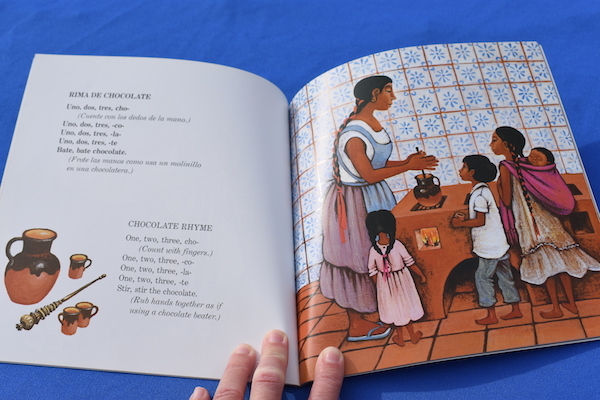
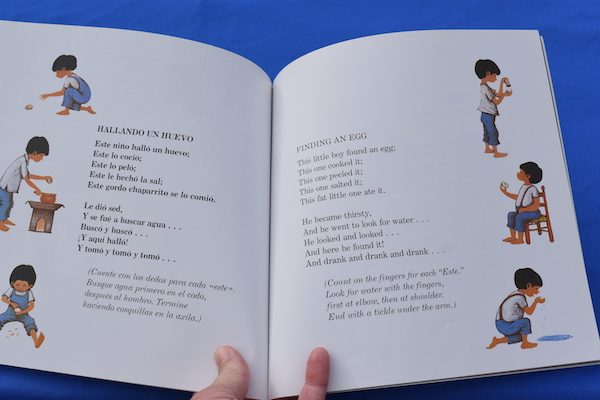
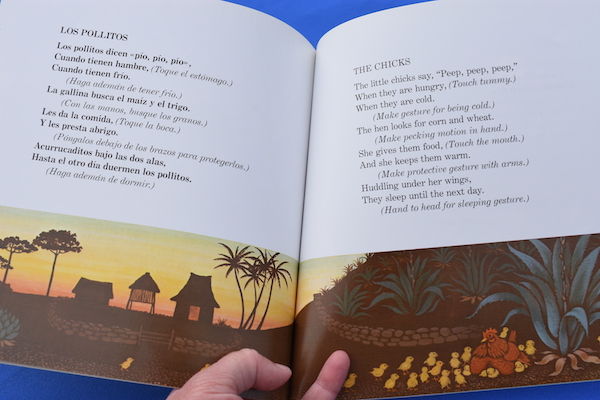
This is a collection of Spanish lullabies and nursery rhymes in the Americas.  The introduction to the book explains how these traditional rhymes have been passed down through the generations of families.  They are not specific to any one country, more generally known where there are Spanish speakers. The rhymes are in both in English and Spanish.

Like children’s rhymes everywhere, they are about small, everyday things, like family, animals, cooking, and other things people do every day, like helping little kids to get dressed.

There are rhymes and songs that involve counting on fingers or making hand motions.

My favorite is the lullaby Los Pollitos (The Chicks), which I first heard when I was little through Kidsongs. I always liked that song.

The illustrations, paintings by Barbara Cooney, are beautiful.  Some people may recognize the art style from her other works like Miss Rumphius and Roxaboxen.

Happy Birthday, Molly

American Girls

MollyBirthday

Happy Birthday, Molly! By Valerie Tripp, 1987.

MollyBirthdayEmily

Molly is excited because she has just learned that an English girl will be coming to stay with her family for a while.  The girl, Emily, is one of the child evacuees from London.  Really, she’s supposed to be staying with her aunt, who also lives in Molly’s town, but her aunt is in the hospital with pneumonia and won’t be able to take her for another couple of weeks.  In the meantime, Molly and her friends are eager to meet her, imagining her to be something like the English princesses, Elizabeth and Margaret Rose.

The girls have a fascination for England after all the things they’ve seen in movies and newsreels.  Recently, they saw a newsreel about bomb shelters in England.  Inspired by what they’ve seen, the girls make a pretend bomb shelter under an old table and enjoy pretending that they are like the people in the newsreel.  Molly’s brother, Ricky, says that it isn’t very realistic, and the girls say that they’ll have to ask Emily when she comes.

MollyBirthdayBlackOut

However, Emily turns out to be very shy and quiet.  She’s pale and skinny and hardly talks at first.  When the girls show her their “bomb shelter”, she doesn’t want to play in it.  Molly thinks that maybe Emily doesn’t like them, but her mother reminds her that, in World War II England, bomb shelters aren’t places to play.  Emily is the same age as Molly, and the war has been going on since she was a little kid.  Molly’s mother points out that Emily probably doesn’t remember much about life before the war.  Emily is accustomed to bombings and danger all around her, and Molly’s mother compares her to a flower “who’s not sure it’s spring yet.  It will take some time for her to realize it’s safe to come out now.”

Emily goes to Molly’s school, and their classmates are fascinated with her.  This fascination makes Emily even more shy than she would be otherwise as kids try to imitate her accent and ask her questions about what it’s like to see buildings bombed.  To the America kids, the war seems exciting, and they want to know what it’s like to see it up close, but Emily dodges their questions.

Molly finally comes to understand why Emily is so evasive when their town has a blackout drill.  When the drill starts, a siren sounds, and everyone has to go down into their basements until they get the signal that it’s all clear.  Molly is surprised to see that Emily is actually frightened by the drill, but everyone assures her that it’s just for practice, not because Illinois is actually going to be bombed.  In Molly’s family, it’s almost like a game, but Emily has memories of real bombings during the Blitz.  As they sit in the basement during the drill, Emily explains it to Molly: the fear, the explosions, destroyed buildings, people getting hurt or killed.  Molly and her friends thought it was exciting to hear about the war in newsreels, but living it is an entirely different thing.  The drill and everyone’s questions about what bombings are like bring back bad memories for Emily.

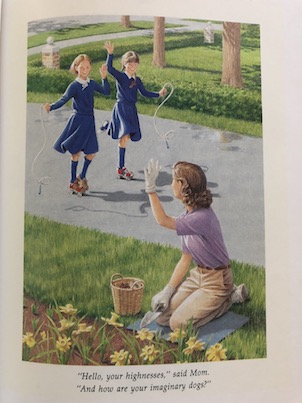
As Molly comes to understand Emily’s feelings more, Emily opens up to her.  The girls discover that they share a fascination with Princess Elizabeth and her sister Margaret Rose.  They start playing a game where they pretend to be the princesses, dressing alike in blue skirts and sweaters.  Because the princesses have pet dogs, the girls also pretend that they have dogs, using jump ropes as leashes for their imaginary pets.

MollyBirthdayPrincesses

Molly’s birthday is approaching, and she offers to let Emily share in her party and help plan it.  She’s curious about what people in England do on their birthdays, and the idea of an English tea party sounds great to her friends.  However, Molly doesn’t like the way that Emily describes English birthdays, and the types of sandwiches that the English tea with tea don’t sound very good.  Worst of all, Emily says that, at her last birthday before the war rationing started, she had a lemon tart instead of a cake.  Molly can’t imagine her birthday without a birthday cake.  Mrs. Gilford, the housekeeper, has been saving up rationed goods for her cake this year, and it’s what she’s been looking forward to the most!

Sharing things with Emily becomes more of a trial for Molly, and when the girls argue about their countries’ contributions to the war effort, they get into a fight and Molly starts thinking that she doesn’t even want Emily at her birthday party.  However, Molly’s mother points out to the girls that the war effort is a team effort.  A couple of special birthday surprises help the girls to make up, including something extra special that helps Emily to heal further from the trauma of the war.

In the Molly, An American Girl movie, Emily plays a larger role than she did in the books.  This is the only book in the series where Emily appears.  Her story was changed somewhat for the movie, too.  In the movie, she says that her mother was killed in a bombing.  In the book, her parents are both still alive, and it was her dog who was killed.  Molly doesn’t learn that until the end of the book when her family gives the girls a pair of puppies as a present, and Emily tells her about her pet dog who died.

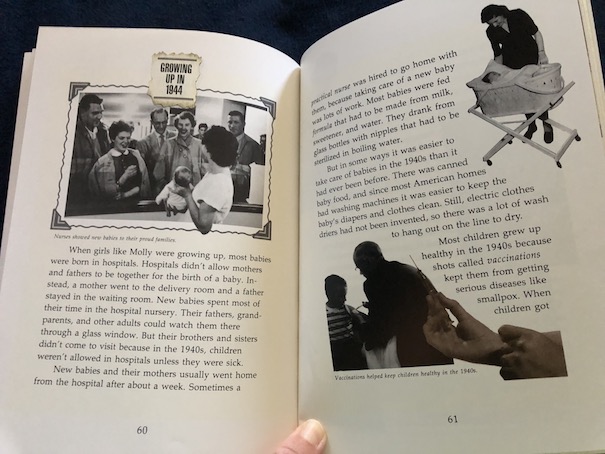
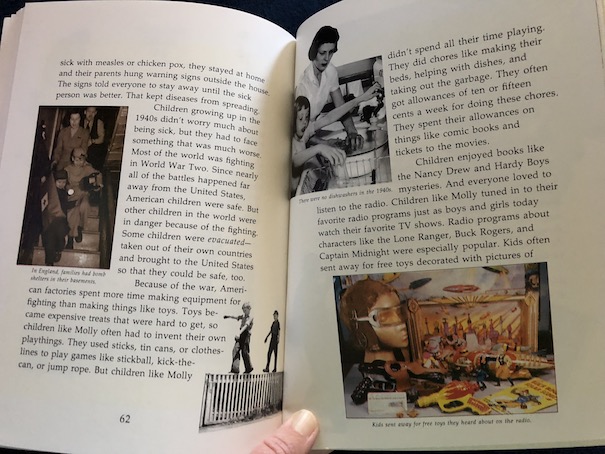
In the back of the book, there’s a section with historical information about what it was like to grow up in the 1940s.  It explains how women used to stay in the hospital for about a week after giving birth, and sometimes, they could hire a practical nurse to help them at home as well.  Canned baby food was a new invention, and vaccines helped to prevent disease.  Back then, people still got smallpox shots because the disease hadn’t been eradicated, but there was still nothing to prevent chicken pox or measles, so children with those diseases had to be kept at home with warning signs out front to tell people to stay away from the quarantined house.  (Note: My father was born in 1944, the year that this series takes place, and he said that throughout his early childhood, parents who knew of a child who had chicken pox would deliberately take their children to visit and get the disease.  It wasn’t that they really wanted their children to get sick, but since there was no way to prevent the disease at the time, they had to accept that it was inevitable that their child would catch it eventually, and chicken pox is somewhat peculiar in that there is a kind of age window in which the disease isn’t likely to be too bad.  If you waited too long, and the child got older or even to adulthood without getting it, it was bound to be much worse when they eventually caught it.  So, if your child was about the right age for getting it, in early childhood but no longer a baby, people thought it was best to get it over with so they could benefit from the lifetime immunity afterward.  This remained true even up through the 1980s, my early childhood, which is why I have a permanent scar on my face from the disease.  Now, there are vaccines to prevent it, although I understand that some people still have chicken pox parties in places where the vaccine isn’t readily available. If you have the option, go for the vaccine.  Preventing chicken pox also prevents shingles.)

MollyBirthdayHistorical1

The historical section also talks about child evacuees, like Emily, and what teenagers did during the 1940s.  It was around this time that people began looking at the teenage years as being a distinct phase of life, and businesses began specifically catering to teenagers.

The book is currently available online through Internet Archive.

MollyBirthdayHistorical2

I Hate English

HateEnglish

I Hate English! by Ellen Levine, 1989.

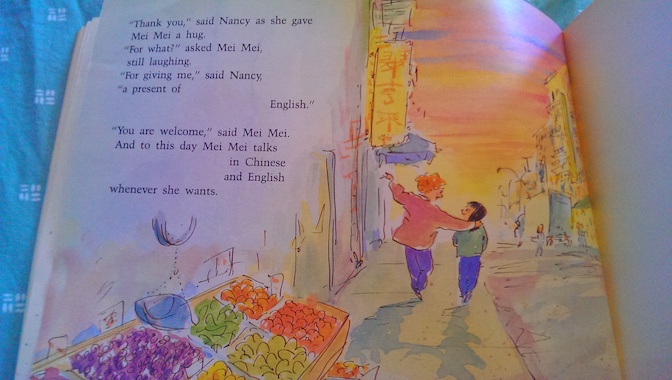
When Mei Mei’s family moves from Hong Kong to New York, she finds herself forced to go to a school where no one else speaks Chinese.  She is expected to learn English and to read, write, and speak in English, and she hates it!  To her, English is a very strange language, and the writing system is nothing like Chinese.  For a time, Mei Mei refuses to speak in English, even when she understands what is being said around her, because she hates it so much.

HateEnglishArrival

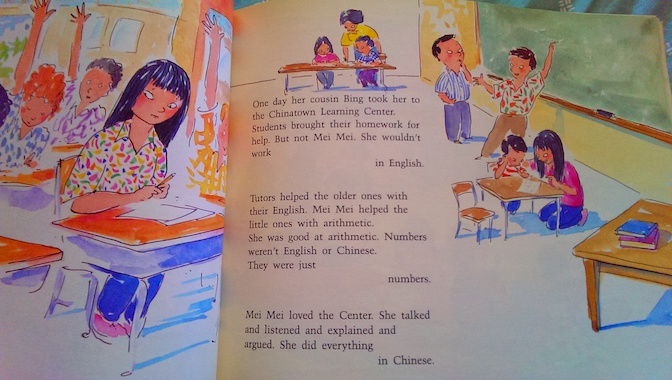
The only part of New York that Mei Mei really likes is Chinatown and the Chinatown Learning Center.  Mei Mei likes it because she is surrounded by people speaking Chinese. There, she can relax and be herself because people there understand her.

HateEnglishLearningCenter

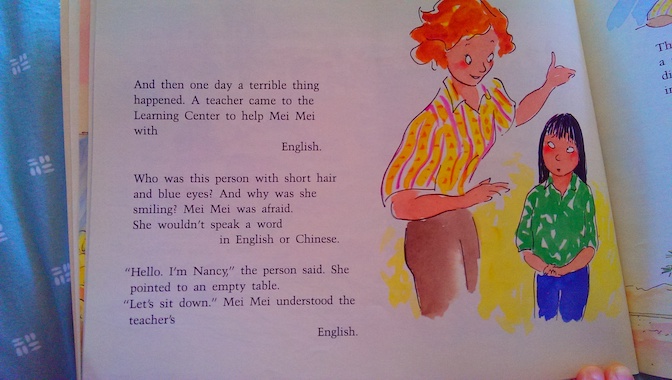
However, Mei Mei’s refusal to speak English isn’t helping her at school or anywhere else.  It’s keeping her from speaking to anyone outside of Chinatown, and it can’t continue.  When an English teacher, Nancy, comes to the Learning Center to help Mei Mei with her English, she resists learning at first.  She feels like she’ll lose her Chinese and part of her identity if she uses English.

HateEnglishNancy

At first, Mei Mei’s worries about speaking English intensify with Nancy’s lessons.  It disturbs her how English has words that would be difficult or impossible to translate into Chinese and English words seem to be coming more easily to her, even when she doesn’t really want to speak the language.  Nancy explains to Mei Mei that English is necessary for her because she will need it to talk to many people in America, and there are many people who also want to talk to Mei Mei and be her friend, including Nancy.  It’s only when Nancy overwhelms her by constantly talking in English and Mei Mei becomes desperate to talk about herself and be understood in English that Mei Mei realizes that speaking a new language doesn’t mean losing her identity.  It’s just another way of expressing herself, and she can go back and forth between the two any time she wants.

HateEnglishNancyTalking
HateEnglishMeiMei

Mei Mei’s feelings of strangeness in her new home and the difficulties of learning a new language are relatable.  The hardest part of the experience for Mei Mei is feeling like she might be giving up a part of her past, her culture, and herself by switching from Chinese to English.  But, refusing to speak English puts Mei Mei in the position of being someone who can only listen, never talk, limiting her ability to be understood and to make friends.  In the end, she comes to realize that speaking a new language is not a matter of giving up anything, just adding to what she knows and making herself understood in a new way.  It’s the beginning of expanding her horizons and building relationships with new people.

HateEnglishFriends

My favorite part as a kid was the part where Mei Mei and her friends went to the beach and cooked shellfish that they found.  It was interesting to me because I never lived near a beach when I was young.  The lifeguard at the beach tells Mei Mei and her friends that they can’t eat the shellfish, and they realize that he thinks that because he doesn’t know how to cook them.  I never did either and still don’t, but I liked hearing about it.

The book is currently available online through Internet Archive.