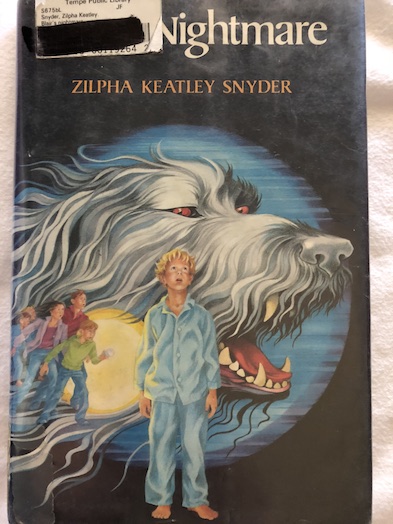
 Blair’s Nightmare by Zilpha Keatley Snyder, 1984.
Now that school has started in the small town of Steven’s Corners, the Stanley family kids are dealing with the problems that kids have, handling teachers, friends, and the local bullies. David has become the new favorite target of Pete Garvey, the bully in his grade in school. (At one point, he compares managing his time around Garvey to that old riddle about crossing a river where the boatman (a teacher, in this case) can’t leave one of the things he’s transporting alone with the other because one of them will eat the other – David sees himself as the prey and Garvey as the predator. Only, David, the prey, has to be the one to manage the maneuvering because the boatmen/teachers don’t.) Blair, David’s younger brother, also seems to be suffering from school stress, reverting to an old habit of walking in his sleep at night. Blair keeps saying that he’s getting up to see a nice dog who visits at night, but everyone thinks that he’s just dreaming while sleepwalking. David thinks that having a dog actually sounds nice and is hoping that he can somehow convince his dad of that, too.
Mrs. Bowen, Blair’s teacher, isn’t amused by his stories about the dog or some of the other things Blair has been saying at school, like his friend “Harriette”, whom no one else has been able to see but apparently lives in the Stanleys’ house (see The Headless Cupid). She thinks that Blair is “out of touch with reality,” and that his family should work on teaching him the difference between reality and fantasy.
In the middle of all this, things have been disappearing around Steven’s Corners, and people think that it might be the work of escaped prisoners. The police have been looking for some escaped prisoners in the area, although they haven’t found anything, and the prisoners might not really be around. David thinks that the things that have disappeared don’t really sound like the kinds of things that prison escapees would steal. He thinks it’s more likely that Garvey and his trouble-making friends took them.
Then, David starts hearing that, for some reason, the sheriff’s dog has become afraid of going near the woods. When they brought him out there to sniff for the escapees, he suddenly smelled something that seemed to make him very afraid, and now he shakes when they try to take him back to the area. Janie, David’s younger sister, has also become very interested in the story of the escapees and seems to be trying to start her own investigation into the matter.
Part of the story has to do with the differences between perception and reality. Amanda, David’s stepsister, proves to be an unexpected help in dealing with Garvey, taking it upon herself to punch him in the face when he tries to pick a fight with David. However, it makes David embarrassed that Amanda feels like she has to stand up for him, and it’s further complicated by the fact that Amanda and Garvey seem to have a mutual crush on each other. Life is full of mixed emotions, and David begins to discover that people’s personalities are more complicated than he once thought. Some of Garvey’s bullying and trouble-making is really a bid for attention. Garvey later admits that he didn’t really have intentions of beating David up; he was mostly hanging around David as an excuse to see Amanda and maybe do something that would get her attention. However, learning that being mean and threatening isn’t the best way to get the kind of attention he wants from people isn’t a bad lesson.
David also learns that Amanda’s feelings toward him are more complicated than he originally thought. Amanda and David fight a lot, and David thinks that she still doesn’t like having step-siblings, but she says that the reason she punched Garvey was that she suddenly realized that she couldn’t let anyone treat her brother badly. It surprises her as much as David that, somewhere during their past couple of years of living together as siblings, having adventures, and having fights and arguments, she has come to think of him as her brother. She shrugs it off as a sign that people just change over time. She also tells him not to worry about their parents getting divorced when her mother, Molly, argues with David’s father about Blair’s sleepwalking and “dream” dog. She says that their arguments are nothing like the ones that Molly used to have with her father and that it’s just human for people to fight once in a while.
As you might have guessed, there is also a lot more to Blair’s “sleepwalking” and his dog than his teacher suspects. One night, while Garvey is over with David and Amanda, they learn how very real (not to mention extremely huge) Blair’s dog is. For a time, all the kids in the family keep the dog a secret because they’re worried that their father will just send the dog to the pound. All the while, David’s father and stepmother argue about whether discouraging Blair’s “fantasies” is healthy for him or not. Molly doesn’t think it’s bad for a six-year-old child to daydream and have imaginary friends, but Blair’s father thinks that they should do as Blair’s teacher says and punishes the other children by revoking their allowance whenever they talk about Blair’s dog. They have no idea that they’re actually the ones who have the least sense of what the true reality of the children’s situation actually is, and the children find themselves having to accept their punishments without argument in order to keep the secret, seeing it as a noble sacrifice for the safety of their dog.
Eventually, the secret does come out after the dog, now called Nightmare, helps to save the children when they finally encounter the escapees. (You just knew they were hiding somewhere nearby, didn’t you?) Nightmare’s backstory is rather sad and involves animal abuse. His former owner actually tried to kill him, and he is injured. When the kids’ parents finally learn the full truth, David’s father tries to insist that his rule about no new pets applies until Molly says that having Nightmare around would actually make her feel safer.
Personally, I think that the father could have been a little more apologetic. He admits that the children were “not guilty” and that they can have their allowances back, but I would have liked to hear him actually say that he was “wrong”, using that word, and maybe add the word “sorry” to it. It feels like the father is still dodging the reality of his own actions himself, especially considering that the lessons that he was basically instilling in the children were that the “truth” is whatever the people with authority and the ability to punish you decide it is; if that doesn’t happen to be the real truth, you’re not allowed to speak up and say so or argue with them to have some compassion; and if you need to handle real-life problems that they’re denying exist, you have to do so in secret, behind the backs of authority, which is basically there to be part of the problem, not a source of help or solutions. Real life might sometimes work that way, but I don’t think it’s good to teach children that it’s the way things are supposed to be and that it’s the way they should behave themselves when they become the adults. Lots of things could have been cleared up much faster if the father had allowed open discussion or asked further questions or even done a little investigating on his own to figure things out. Parents not listening is a plot device used in a lot of children’s mysteries to set things up for the children to do their own investigating, but it always pains me a little because I’m the type to ask more questions. I like to be sure of my ground before I stand on it, and I don’t leave things alone if I think there’s a real problem. It also seems oddly out of character for the father of this story, considering that, in the first book, they established that he had never had a problem in the past with the kids keeping little animals that they found, like lizards and snakes. So, why wouldn’t he even entertain the notion that Blair might have really found a dog and started feeding it at night? If it had been me, given the kids’ history with animals and doing things in secret, I would have checked on what was really happening at night, just to be sure.
The matter of “Harriette”, who is a carry-over from the first book in the series (and may possibly be a ghost), is never cleared up. Blair says that Harriette helped lead him to Nightmare and told him that everything would be all right. The books in the series imply that Blair is psychic and that he can communicate with a girl who used to live in their house years ago, but it’s never established for certain. At the end of the story, David, who has been been considering the issue of perceptions vs. reality decides that who or what “Harriette” is – ghost or just Blair’s imaginary friend – may also be just a matter of perception, and that it is probably best left that way. Other than Blair’s occasional comments about Harriette, her presence is not felt by anyone else in the family, and there are no unexplained supernatural happenings in this story. There are, however, some dated references to ’80s celebrities, like Magnum and Burt Reynolds.
The book is currently available online through Internet Archive.




 Jestress's Forgotten Books and Stories