The Dreadful Future of Blossom Culp

DreadfulFutureBlossomCulpThe Dreadful Future of Blossom Culp by Richard Peck, 1983.

This book is part of the Blossom Culp Series.

It’s 1914, and Blossom Culp is just starting high school. Although the principal of her old school tells her that this is a chance for her to make a fresh start, it looks like Blossom’s future is going to be very much a continuation of her immediate past.  In high school, she’s still a social outcast, looked down on by girls from better-off families, like Letty, the class president.  Also, despite her principal’s assertion that Blossom’s previous forays into the occult were imaginary, the product of the mental confusion that accompanies puberty, and that she is bound to grow out of them, Blossom knows that her psychic abilities are a natural gift and will not be ignored.

Blossom begins high school friendless because Alexander Armsworth has been ignoring her lately because of his important new position as class vice-president, his infatuation with Letty, and his friendship with a couple of local hooligans, Bub and Champ. Alexander is looking forward to his role in planning the school’s Halloween Festival, telling Blossom that he’s over their earlier, childish occult escapades and the Halloween pranks he used to pull.  Meanwhile, all of the other girls in school are infatuated with their handsome history teacher, Mr. Lacy, and so is the girls’ gym teacher, much to Blossom’s disgust.  Blossom thinks that Mr. Lacy is full of himself and denies that she has any such silly crush on Alexander.

Blossom makes an unexpected friend in a girl called Daisy-Rae, a girl from the country who has brought her younger brother into town to attend school and hoped to get an education herself but has been too afraid of the big town to actually attend classes.  Daisy-Rae hides in the school during the day and lives alone with her brother at night in the old chicken coop at the abandoned Leverette house.  It is through Daisy-Rae that she learns that Alexander and his friends aren’t so above childish pranks as they claim to be.  Blossom also discovers that Mr. Lacy has been romancing her old principal.  Mr. Lacy isn’t quite what he appears to be and has some unsavory secrets in his past.

Matters come to a head when Alexander (at Letty’s urging) tries to persuade Blossom to dress up and become the fortune teller for the haunted house that the freshmen class is doing for the Halloween Festival.  The haunted house is also a fundraiser, and Letty figures that they can get extra money from people if they’re willing to pay to have their fortunes told, and who would be better for the job than Blossom?  However, Blossom isn’t one to go out of her way to please others, especially Letty, and it turns out that they’re holding the haunted house in the Old Leverette place.  For some reason, that old house makes Blossom’s mother uneasy.  She seems to think that it’s haunted, but in an unusual way.  Blossom tells Alexander that she will not agree to be their fortune teller until he agrees to check out the house with her before Halloween and find out what’s wrong with it.  She figures that, since both of them are psychic, they can learn what’s so unusual.

As Blossom learns, her abilities don’t confine themselves to the past and people who have died but extend to the future and the people who haven’t yet been born.  Inside the Old Leverette house, Blossom suddenly finds herself entering the distant future, the 1980s.  In the 1980s, the Leverette house is once again lived in, and Blossom meets a boy named Jeremy who is a lonely social outcast, like herself.  Jeremy is a computer nerd, living with his divorced mother.  He takes Blossom on a tour of their town as it is in Blossom’s future, much larger than it used to be and with many familiar landmarks missing.  However, what Blossom sees in the future gives her the inspiration she needs to solve her problems in the past and hope that things will improve.  In return, she also proves to Jeremy that he is far from alone and has had a friend for longer than he ever imagined.

The time travel to the 1980s comes off as being a little corny (or so it seemed to me), but the writing quality of the book is excellent.  The author has an entertaining turn of phrase, and the book, like others in the series, is humorous and a lot of fun to read.

Besides being a kind of fantasy story, there are some interesting tidbits of history in the book, showing how people lived in the 1910s.  Blossom explains about the things she and her classmates did at school, like wearing beanies on their heads to show which year they were (freshmen, future graduating class of 1918).  At one point in the story, Blossom takes Daisy-Rae and her brother to their first movie, a silent film with an episode of The Perils of Pauline serial.  While Blossom worries about the future, readers can get a glimpse of the past!

As for what Blossom learns about her own future, she avoids finding out too much because she’d rather not know the details.  However, there are implications that she and Alexander may eventually marry and live in his family’s old house.

The book is currently available online through Internet Archive.
Escape to Witch Mountain

EscapeWitchMountain

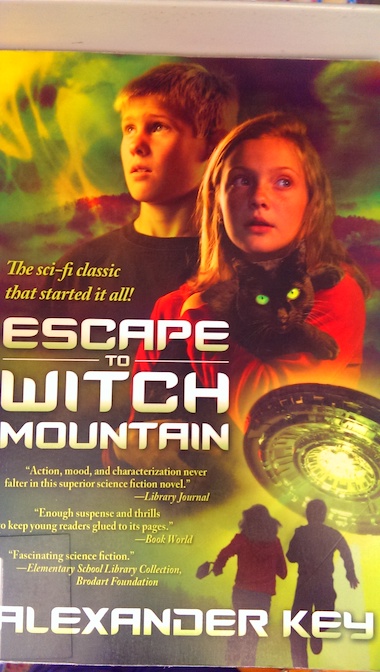
Escape to Witch Mountain by Alexander Key, 1968.

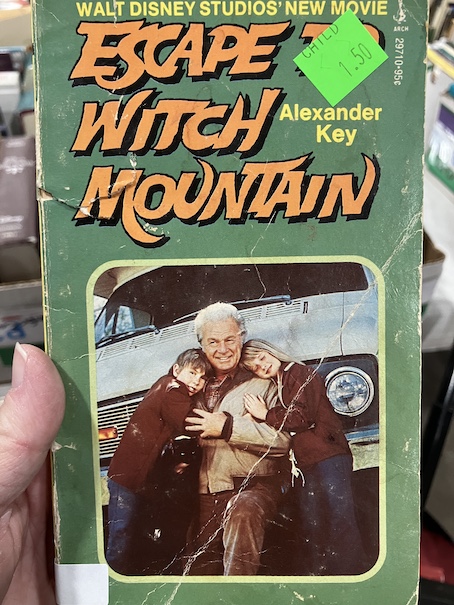
This is the book that the Disney movie of the same name was based on.  In fact, there have been three movie renditions of this book, although the 1975 Disney version is the one I know the best, and it’s the only film version to call the children by their original book names, Tia and Tony (other versions use the names Danny and Anna or Seth and Sara).  There are some major differences between the book and each of the the movies.  For one thing, most people in the book think that Tia is mute because she speaks at a frequency that ordinary humans can’t hear.  Only her brother, Tony, can hear what she’s saying.  She uses the little case with the double star emblem that she’s had ever since she can remember to carry paper and pencils so that she can write messages in order to make herself understood by other people.  In the 1975 movie, Tia can speak to Tony telepathically, but both children can speak aloud normally and be understood by everyone.

When the book begins, Tia and Tony know that they’ve always been different from other children.  They look different: they have olive skin, pale hair, and very dark blue eyes, which is a somewhat unusual combination. They can do things that others can’t: Tony can make things move with his mind, Tia can open locks without using a key or any other device, and only Tony can understand the strange way that Tia talks that others can’t even hear. They can’t remember any other home than the one they had with Granny Malone, the woman who adopted them, but now that she’s dead, they find themselves wondering who they really are and where they came from.  Tia has shadowy memories of a time before they came to Granny Malone, when they were on a boat and something bad happened to them, but she can’t quite remember what.

With no known relatives to go to, the children are taken to an orphanage, Hackett House, after Granny Malone’s death.  It’s a tough, inner-city environment, where no one has any patience with Tia and Tony’s strangeness.  However, when the children from the orphanage are sent to Heron Lake Camp in the mountains during the summer, a nun recognizes the double star symbol on Tia’s case as one that she had seen before on a letterhead, giving the children their first clue to finding their origins.

Then, a figure from one of Tia’s memories, Mr. Deranian, comes to the orphanage to claim them, saying that he’s their uncle. The children can tell that he’s no relative of theirs. They run away to see a kind priest, Father O’Day, an associate of the nun they met earlier. Father O’Day is the only one who believes the children when they talk about what they remember of their past and isn’t frightened by their strange mental powers. When the children show him a map that they found in a hidden compartment in Tia’s case, he offers to help them find the place marked on it and, hopefully, someone who knows who the children are and where they belong.

The book is currently available online through Internet Archive.  There is a sequel to this book which was also made into a movie, Return from Witch Mountain.
My Reaction and Spoilers

As the children and Father O’Day try to elude Deranian and the others who are chasing them, more of Tia’s memory returns. The children are from another planet. Years ago, their planet was destroyed when it crashed into one of their twin suns. Their people, who call themselves the Castaways, knowing that their planet would not be habitable for much longer, had already begun looking for a new home. Earth was the nearest habitable planet, so some scouts arrived early and began to create a home for them in the mountains of North America, which was the closest environment to their former home.

Unfortunately, when the rest of the children’s people came to Earth, the group that Tia and Tony were with crashed in Eastern Europe. The book was written during the Cold War, so the place where they crashed was controlled by Communists. When the Communists realized the powers these people possessed, they planned to make use of them themselves. One of Tia and Tony’s people escaped with the children and managed to get them aboard a ship heading for America. Before he died of a gunshot wound, he placed some money and a map in Tia’s case so that the children would know where to find the rest of their people. However, the children were traumatized by the experience, and Tia blocked the memory out of her mind. The ship’s captain, upon reaching the United States, gave the children to Deranian, a friend of his. Deranian, not knowing who the children were or what powers they possessed, gave them to Granny Malone to raise. Later, he found out about the children’s abilities from his contacts in Eastern Europe and tried to get the children back.

In the end, Father O’Day manages to reunite the children with the rest of their people, who take them to the community they have built on Witch Mountain, a place where locals are too superstitious to go, named for the odd things they’d seen there when the Castaways first arrived. Father O’Day plans to go there and join the community along with the children someday.

In spite of the Communists being enemies during the Cold War, Tia and Tony say that one of the reasons why their people had trouble establishing themselves in America at first was that they were unaccustomed to the idea of having to buy land to live on.  On their world, no one owned land; land was just there for people to live on and care for.  Their people’s early scouting expedition included selling pieces of their ships in order to raise enough money to buy some land in order to build their community.  Father O’Day is impressed with the Castaways’ commitment to the common good of all people and unselfish sharing.  So, although the oppressive Communist regimes of the Cold War are enemies in the book, some of the ideals of sharing and supporting the common welfare of everyone are still attractive ideals in the book.  The implication in the book is that Tia and Tony’s people are socially as well as technologically advanced and have created the best of all possible systems, a blending of ideals to create the ideal balance.

I can understand why the movies did not include Tia speaking at a frequency no one else can hear and appearing mute.  That would be difficult to show in a movie that relies on characters being able to communicate with each other, and it makes sense to replace it with an ability to communicate telepathically by choice instead.  None of the movies include the Cold War references that were present in the book, and the character of O’Day or the person who helps the children to reach Witch Mountain changes from movie to movie, but the plot of the 1975 Disney movie is still the closest to the original book.

Liars

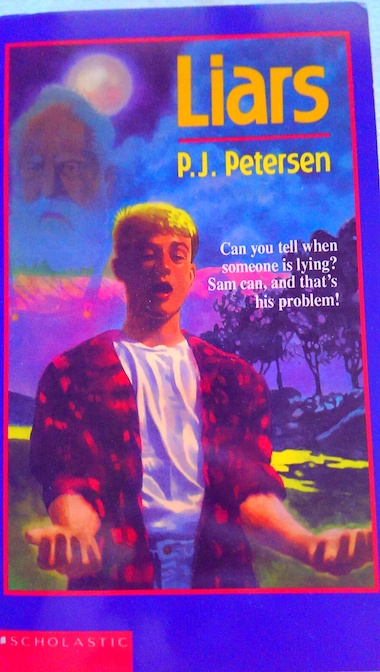
LiarsLiars by P.J. Petersen, 1992.

Sam lives in the small town of Alder Creek in California. The town is so small that they only have a one-room school (well, two rooms, if you count the library/storage room). Sam’s friend, Marty, describes most of what happens there as SOT (Same Old Thing) or MOTSOT (More of the Same Old Thing). However, their town contains some disturbing secrets, which they are about to learn.

Uncle Gene, an old man in town, has a reputation for being a “water witch.” He has the ability to find good sources of water when they need to dig a new well. He lets the local kids watch him when he’s using his dowsing stick and even lets Sam and Marty have a try. Sam has never really believed that Uncle Gene has any special abilities, even kidding Marty for believing in it. However, when Sam takes hold of the dowsing stick, he finds it drawn toward sources of water, like a magnet. Uncle Gene says that Sam has the gift and is a water witch, too. Sam is still somewhat skeptical, thinking that there’s probably something more scientific behind what he experienced, but from that time on, he finds himself sensing other odd things from the people around him.

In particular, Sam can sense when people around him are lying. It sounds like it would be a handy gift to have, but it has some drawbacks. Even when he can tell that someone isn’t telling the truth, he can’t tell exactly what they’re lying about. Some lies are obvious, like those of classmates bragging about things or Mr. Lopez saying that he enjoys living in the small town when, apparently, he really doesn’t. However, Sam can’t always distinguish between small lies or serious ones. Some lies seem to affect him more than others, possibly because the liars themselves feel more guilty about those, but by itself, that doesn’t tell him whether the lie is serious or not. He knows about Mr. Lawlor poaching animals in the forest, so that lie is also obvious to Sam, and he later realizes that his wife is lying about her teaching credentials. When he exposes Mrs. Lawlor’s lies, everyone becomes aware of Sam’s gift.

This ability becomes disturbing for Sam because it seems like everyone around him is lying about something. It’s also somewhat unsettling for some of his friends, like Carmen, who worries about what he’ll think of her if he catches her in a lie. Even Sam lies somewhat himself, saying that he knows that Carmen wouldn’t lie to him when he’s already caught her. But, Carmen sees right through his reassurance, even without sharing Sam’s gift. She’s the one who points out to him that the problem with his gift is that, even though he can tell when someone lies, he can’t tell exactly what they’re lying about or why they’re doing it. She mentions the little white lies people tell to spare someone’s feelings, like saying that they like a person’s clothes when they really don’t, but also how people sometimes lie when the truth is none of someone else’s business. The lie that Carmen told Sam earlier was about why the two of them couldn’t hang out together one day. She said that her parents were expecting company that evening, but the truth was that her parents have been fighting a lot, and she didn’t want Sam to see it because their personal problems are no business of his. This incident, along with a time when Sam has suspicions about an innocent person because the person falsely thought that she might actually be guilty of a crime lead Sam to worry even more about his gift.

However, there are real crimes being committed in his town, and Sam’s gift might be the only way to find who is behind it all. First, someone tries to break into Uncle Gene’s house. Uncle Gene thinks he knows why. Supposedly, there’s a hidden mine in the area, and he’s been looking for it for a long time. He thinks that he’s getting close and that someone was after his maps. Later, his house is set on fire.

But, is the lost mine the real reason why someone is after Uncle Gene? He’s been poking around in some out-of-the-way places during his search, and the kids know that he’s reported someone for growing illegal marijuana. Is the grower out for revenge? With Sam’s own father lying to him about his whereabouts, Sam worries that he may have something to do with what’s going on. It’s only a pity that his gift can’t tell him what his father, or anyone else, is lying about. It only tells him that they’re liars.

With more places making marijuana legally these days, this part of the story might not seem so serious as it did back in the 1990s, when schools were emphasizing that kids should “just say no” to drugs. Marijuana was viewed as being as bad as any other drug, and in this book, the grower doesn’t seem concerned about the possible medical uses.

Sam’s father is not the villain of the story, although he is engaged in something that he doesn’t want to reveal to his son or the rest of the town immediately. There is also a subplot about the death of Sam’s mother. She is already dead when the story begins, but Sam and his father haven’t completely healed. At the urging of Marty’s mother, who also helps Sam to explore his gift, the two of them begin talking about her more, when they had been avoiding discussing her for some time because talking about her was too sad for them.

In the end, Sam thinks that he’s found a way to stop sensing people’s lies (the less he pays attention to what he senses, the less he feels it, so he thinks that ignoring his gift will cause it to fade over time), which is a relief to him because he didn’t like always wondering what people were really lying about, and as Carmen said, some lies are for the best and should be none of his business. I think that’s true, especially the part about lying about things that should be no one else’s business. Some people can be rather pushy in wanting to know the details of other people’s lives, and if they won’t accept “I don’t feel like talking about it” or “I don’t want to tell you” for an answer, a lie of some sort might be a person’s only recourse. Depending on the circumstances, a lie might be harmful or it might protect. Like with Sam’s gift, it may not be immediately obvious which it is, either. Not that people should make a habit of lying, but there are times when it might be the best course of action for all concerned.

I’d like to add that there are many different ways of being truthful as well as lying.  If there are partial lies, and there are partial truths as well.  Some people think that politeness is a kind of lying, like in Carmen’s example of pretending that you like someone’s clothes when you really don’t, but that’s not necessarily so.  Being polite doesn’t mean that you’re pretending but perhaps you’re just choosing which of your thoughts are the most important to mention. Many, perhaps most of us, don’t just think one thing when someone asks us what we think about something.  For example, when someone asks your opinion of their clothes, you might think something like, “Well, I like the color, but I don’t like the style.  At least, I don’t like the way that style looks on you.  But, maybe that’s just because I’m not used to seeing you wear things like that.  I might change my mind later.  Actually, later on, I’ll probably forget that you ever wore that because I don’t care that much about clothes anyway.  Still a nice color, though.”  At least, that’s what goes on in my mind frequently.  There’s no point in telling anyone those random, meandering thoughts, so I just pick the most important part and tell them that I like the color.  Why bother being critical in an effort to sound truthful when the real truth of the matter is that clothes in general aren’t that important to me and I’ll probably just change my mind later, if it sticks in my mind long enough for me give it a second thought?

Then, there are the lies that some people label as the truth for their own purposes. I’ve seen plenty of people say harmful and insulting things to others and then hide behind the defense that they are “just telling it like it is,” when they actually aren’t. Usually, when people say that, they’re actually telling it like it isn’t: lies, exaggerations, or just plain insults disguised as truth. In those cases, their intentions were not to point out some important truth for the benefit of anyone.  Often, they were just trying to hurt someone’s feelings and then further hurt them by accusing them of not being able to handle the truth.  My rule of thumb for distinguishing between people who are really “telling it like it is” and liars who are just pretending is the same as the one I use with assessing advertisements: If a company has to shell out lots of money to tell you something about their product, it’s because what they’re saying isn’t something that you’d ever notice by actually using it.  If it were obviously true, there would be no need to put so much effort into telling you because you’d just know.  I think it’s the same with people who “tell it like it is.”  If someone has to actually say that they’re “telling it like it is,” it’s a strong hint that they’re probably not.  Similarly, anyone who brags about being truthful and trustworthy is probably doing it because they know that no one else would ever think to associate those qualities with them without being told.