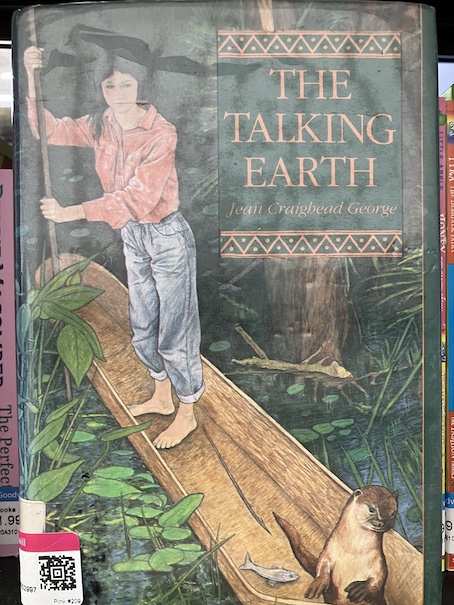
The Talking Earth by Jean Craighead George, 1983.
Billie Wind is a Native American girl from the Seminole tribe in Florida. When the story begins, Billie has been brought before the tribe’s elders because she doesn’t believe in the tribe’s legends about talking creatures, nature spirits, and other supernatural phenomena. It was her older sister Mary who reported her to the elders, and many of the elders are also her relatives, including her uncles. At first, Billie doesn’t take it seriously. She’s always been a very practical, literal-minded girl who has questioned all of the things that her elders have told her since she was small, and she doesn’t expect their response to be very different from any of the ways they’ve responded to her youthful doubts and questions. However, this time, the elders ask her what she thinks would be an appropriate punishment for her. Billie, thinking the whole thing is ridiculous, suggests that they send her out into the Everglades alone until she finds some animals who talk to her. She expects that the elders will veto that idea because she is probably too young to go out there alone for an indeterminate period, and it’s ridiculous for anyone to expect her to find talking creatures. To her surprise, they approve of the idea and begin preparing for her journey.
Although it was her suggestion, Billie is angry because she doesn’t really want to make this trip. She asks her sister why she reported her to the elders in the first place. Mary says that, ever since she started attending the school at the Kennedy Space Center, she’s been too scientific and that, someday, she’s going to be the head of her family. When that happens, Billie will need more than science to lead a family wisely. Still, Billie is resentful.
As she sets off in her little boat, Billie reflects on what makes her different from her sister. Billie takes after her mother, who is a very practical woman (while her uncle wants to send her off on the trip with a good luck blessing, her mother provides her with food and useful tools), and her father works for the Kennedy Space Center. Both Billie and her brother chose to attend the school there, which is very modern and whose scientific principals appeal to Billie’s practical side and her desire for facts and real answers to her questions about how the world works. Billie is very concerned with the major world issues of the day, which include the possibility of nuclear war (the book was written during the Cold War) and environmentalism. These issues are far more real to her than anything in her tribe’s folk tales, and she believes in her father’s assertion that the development of space travel is important because humans may eventually need to find another planet to live on. By contrast, Mary has refused to attend the Kennedy Space Center school and is deep into the folk tales and traditions of their people. Billie looks to the future, science, technology, and the possibilities that lie out among the stars for answers, while Mary immerses herself in ancient legends and her people’s strong connection to nature and the Earth.
Alone in the Everglades, Billie listens to the calls of birds, wondering if that qualifies as “talking animals”, but she decides it doesn’t. She can make hooting noises at an owl, but it can’t speak back to her in any human language. Looking around for a place to camp, she finds a cave by noting geographical features that indicate that there is probably a cave nearby. Does that qualify as the Earth speaking to her? Then, animals around her become frightened and flee! She wishes that the animals would actually speak and tell her what frightened them, but the smell of smoke soon tells her: there’s a wildfire! Realizing that she can’t possibly paddle her boat fast enough to outrun the spreading fire, she does the best she can to wet herself down with water and take refuge in the cave.
Huddled in the cave during the terrifying fire, Billie thinks about what she knows about wildfires. She knows that occasional fires are necessary for the environment because they clear out underbrush, and that they don’t normally burn hot enough to burn the trees. She also knows that white people, who aren’t as familiar with the environment, try to clear out underbrush to fight fires, which inadvertently makes them burn hotter and makes them more dangerous. Billie also wonders whether her tribe will see the fire and try to rescue her, but they probably don’t know that she’s caught up in it because they probably think she went in a different direction.
As Billie explores the cave a little more, she finds an ancient clay bowl. At first, she thinks that means that the cave was once used as a burial place by her people, but then, she realizes that the bowl is intact. If it was meant to be placed in a burial, it would have been broken. Exploring a little further, she realizes that someone once used this place as a home, and there are other artifacts and the remains of a bed that may have belonged to a distant ancestor. She lies down to keep herself safe from breathing too much of the smoke until the fire dies down.
When it’s safe, Billie explores further, finding carved steps in the stone. She thinks about what she knows about her people’s history and her ancestors. When she goes home and tells everyone where she’s been, she plans to bring her uncle, Charlie Wind, and maybe an archaeologist to investigate this place. However, she also discovers that the ground outside the cave is still hot from the fire, too hot for her to leave. She doesn’t have much food left, and she worries that she might die in the cave before she can manage to leave. Then, she thinks about the turtle and snakes that sought refuge from the fire in the pool nearby. They could be a source of food.
Hearing a sound that makes her think that it’s a call that Charlie Wind makes, she looks around, thinking maybe he’s come to rescue her. It’s not a human, though. At first, she thinks that she sees a little person looking out of the ground, like something from one of her people’s folk tales. It turns out to be a young otter in a hole. She befriends the little otter and manages to catch some fish from the little pool that helps them to survive in the cave. The little otter shows her that the little pool is deeper than she thought, and the little otter catches another fish. It explains to Billie what happens to the fish during fires. They take refuge in underground rivers and pools. She considers whether her ancestors carved these underground rivers on purpose to bring fish to her people. Searching the cave further, she finds many more ancient artifacts from her people, including an old, forgotten medicine bundle.
The destruction of the fire makes Billie think that her father and the other scientists must be right about the Earth dying and people needing another planet to live on. Yet, she soon finds growing plants in an unexpected place. Because the trees burned, light is reaching a place where it couldn’t reach before, and new plants are growing. In some ways, nature turns out to be more resilient and adaptable than Billie expected.
When Billie finally gets the opportunity to leave the cave and go home, she realizes that her boat has burned. She salvages what she can and a few useful artifacts from the cave, and she and her otter friend set out to find another way home. Billie manages to carve a new boat for herself, witnesses the destruction of the little island with the cave that sheltered her because of white people’s development, comes to understand more about the environment and cycles of nature, and befriends an orphaned panther cub and a turtle. The longer Billie has to learn to survive by herself in the natural environment, the more she comes to appreciate her friendships with animals and to understand that she needs a connection with nature itself. She talks to them and learns to read some of the signs nature gives her. Perhaps, after a fashion, animals and the forces of nature do speak to people who are prepared to listen.
The book is available to borrow and read for free online through Internet Archive (multiple copies).
My Reaction
This story is marvelous blending of coming-of-age and survival!
Some other reviewers on Goodreads took offense to the repeated criticism of white people ruining things. I didn’t feel the same way. For one thing, although the main character is a Native American girl, the author, Jean Craighead George, was a white woman. I don’t doubt that real Native Americans feel the way the main character does, but the author is still the one delivering the criticism. Jean Craighead George came from a family of naturalists, so it’s understandable that she would be critical of anybody who disregards or damages the natural environment, and she might well take issue even with the society/culture she was born into because of its treatment of nature.
That leads me to my second point, which is that the criticism delivered in the story isn’t about white people ruining everything and doing everything wrong but focuses, repeatedly, on two things that white people do that trouble the main character. First, the white people accidentally disrupt the natural environment, sometimes while trying to do things that they think will help, because they haven’t studied the environment well enough to understand the effects that their choices have. The way the character notes that clearing underbrush in an effort to stem wildfires actually makes the fires worse when they happen is an example of that. Second, white people destroy parts of the environment and what should be archaeological sites because they prioritize other things, especially development and urbanization. These things, while unpleasant, are true. The story isn’t inventing these problems, just noting them.
Billie doesn’t entirely give up her belief in science. However, through her experiences in the Everglades, she does learn to understand and appreciate the world where she lives more than she did before. Although space and the possibilities of the future are fascinating, so is the Earth, and Billie comes to realize that people need to understand and take care of the world they have rather than expecting to find another one. She doesn’t believe now that there is another planet exactly like Earth anywhere in the universe, and she realizes that, rather than searching for a new, more ideal world in space, people can find what they’re looking for by changing the way they look at the world where they live.
Throughout the story, Billie combines aspects of her people’s legends with scientific concepts that she understands, like “oxidation” and “air pressure”, and she sees how scientific disciplines, like archaeology, can help people to understand the past and how life has changed. Her new knowledge of the natural world doesn’t eliminate her understanding of science but augments it. She learns to read the body language and behavior of animals, realizing that this is a form of “talking.” By the time she encounters a Native American boy on a name quest of his own, Billie realizes that she believes in her people’s stories more than she thought she did. Explaining it to the boy, who also has a very modern view of life, helps her to clarify and share what she’s learned.

