The Prince and the Golden Ax

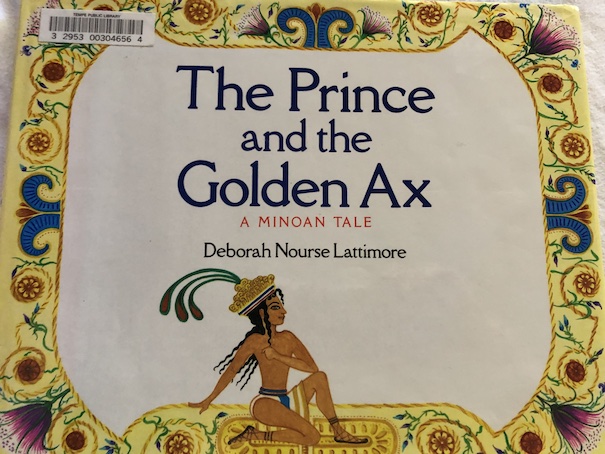
The Prince and the Golden Ax by Deborah Nourse Lattimore, 1988.

This story is based around the ancient Minoan civilization and the destruction of the island of Thera. Thera was a real place, and it was actually destroyed, but the story itself is fiction, based upon the pieces of information that the Minoans left behind about their culture.
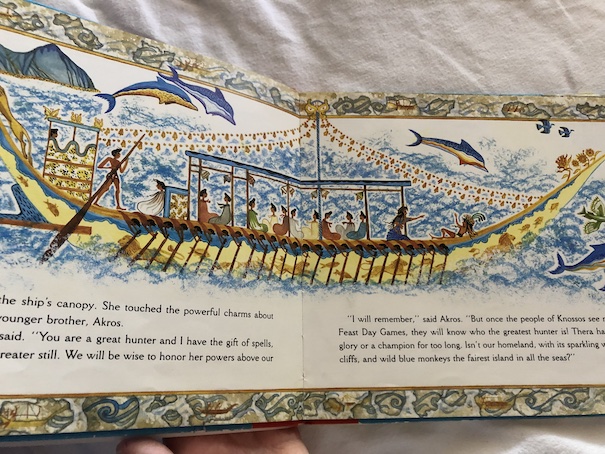
When the story begins, the city of Knossos on Crete is the home of the Goddess Diktynna. Princess Illyra and her brother, Akros, are on their way to Crete from Thera with their fleet of ships. Akros is eager to show off his skills at the games on this feast day, although Illyra cautions him to not show off too much and to remember to honor the goddess.

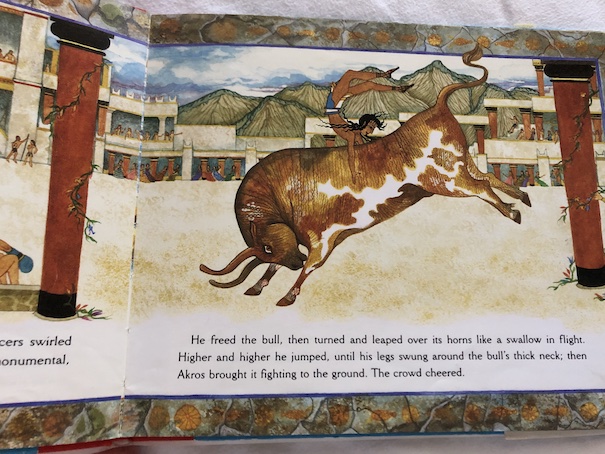
When they arrive at Crete, they are shown the goddess’s shrine with her statue holding the golden ax that is the source of her power. Akros is impressed by the golden ax and begins to think that if he had the ax, he could use it to bring glory to Thera. At the feast games, Akros shows off his ability to wrestle a bull. Full of pride for himself, he declares that he’s even better than the goddess because he did it without a golden ax. The goddess is angered by his comments and causes an earthquake.
The priestess says that Akros has challenged the goddess, and in order to make amends, Akros must find the golden-scaled fish of the Eastern Isle and obtain a bronze ax. If he fails to complete this task, the goddess’s golden ax will destroy Thera. Akros has no choice but to accept the challenge.

Illyria has the ability to use magic, and she helps her brother to complete the task successfully, but Akros can’t resist bragging about how easy it all was, angering the goddess again. This boast earns him a more difficult task, to capture a griffin and earn a silver ax.
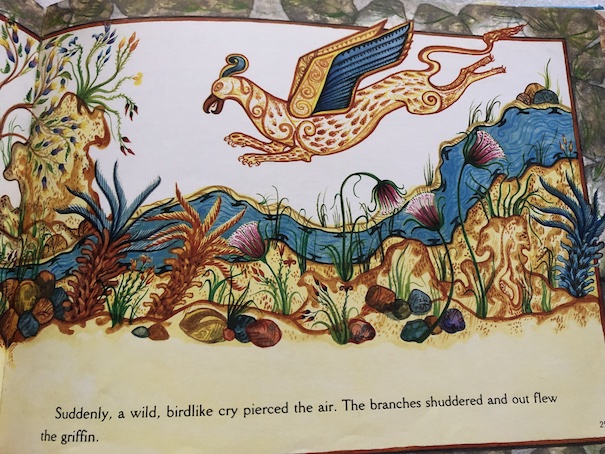
Once again, Illyria helps Akros to succeed in his task, but when he is presented with the silver ax, Akros insists that it’s not good enough for him and that he wants the golden ax. The priestess says that only a godlike hunter can have that ax, and if he tries to get it, his homeland will be destroyed. Still, Akros insists that he can prove that he’s good enough by catching a creature that no one, man or god, has ever caught before.

What Akros has in mind is catching the blue monkeys on the island of Thera. This time, Illyria refuses to help him because the blue monkeys are sacred. At first, Akros thinks that he’s managed to capture the blue monkeys without her help, but they have abilities that he never expected. As promised, when Akros fails to accomplish his boast, the island of Thera is destroyed, and Illyria and Akros only narrowly escape.

The book ends with the discovery of the remains of the palace of Knossos centuries later, when the image of the goddess and a small ax are discovered.

My Reaction

I knew at the beginning of the story that there couldn’t be a happy ending because I already knew what happened to the real island of Thera, now called Santorini. The island was largely destroyed by a volcanic eruption during the Minoan period, a cataclysm that may have sparked the legend of the sunken island of Atlantis. However, this story does not mention Atlantis, instead using the statue of a goddess found in the remains of the palace of Knossos as inspiration. In spite of the ending, I wouldn’t call this a sad story. The book doesn’t dwell on the aftermath of the destruction of Thera, and we don’t actually see much of the civilization of Thera, so there isn’t much for us to miss when it’s destroyed. The colorful pictures throughout the book are beautiful and actually feel rather cheery.

Trouble at School

The Berenstain Bears

Trouble at School by Stan and Jan Berenstain, 1986.

“When a problem at school
Is kept secret too long,
It can grow ’til a cub
Thinks that everything’s wrong!”

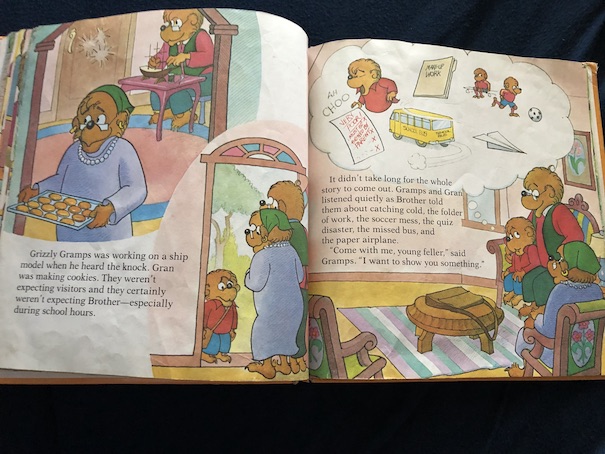
Brother Bear runs into problems at school after he catches a bad cold. While he’s recovering from his cold, he is allowed to watch tv and read comic books. His teacher sends home a packet of schoolwork for him to do, but he ignores it and forgets about it.

He doesn’t remember the packet of work until he’s better and going back to school. However, he soon becomes preoccupied with the news that Cousin Freddie has taken over his position on the soccer team during his absence.

When his teacher gives a quiz on the new lesson in division, Brother fails it. Brother is supposed to show the quiz to his parents and have them sign it, but his parents become preoccupied with Sister, who is now sick, and Brother doesn’t show them the quiz.

The next day, Brother is so upset about his bad grade and what’s happening on the soccer team that he doesn’t go to school. He makes his quiz into a paper airplane and throws it away.

Then, Brother gets the idea of going to see his grandparents for help. He explains the entire situation to them. His grandfather tells him a story that helps put the situation in perspective.

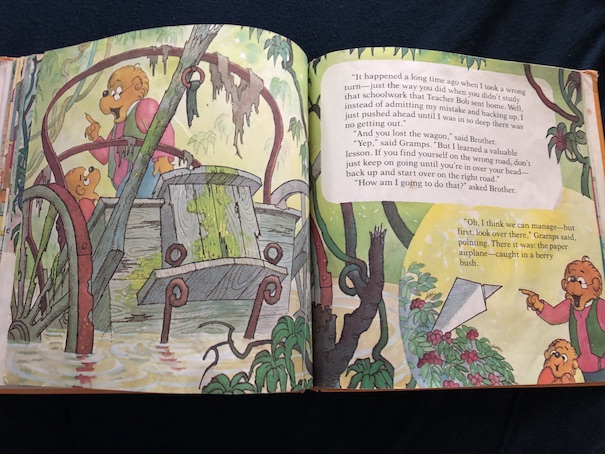
There was a time when Gramps did something wrong, and instead of admitting his mistake, he just kept going and made the problem worse, like Brother did by ignoring his schoolwork and not telling his parents about his problems at school. Gramps says that it’s best to admit when you’ve made a mistake so you can do what you need to do in order to turn the situation around.

They find the quiz that Brother threw away and go home to tell Brother’s parents about his school problems. They’re not happy about the situation, but they tell Brother that “It’s never too late to correct a mistake,” and Gramps proves to Brother that he can do division by having him divide a bag of cookies among the family members.

When Mama takes Brother back to school, he learns that nobody else in class did very well on the quiz, so the teacher is letting them do a retake. Now that Brother realizes what division is really about, he does much better. At the soccer game that afternoon, Brother also gets a chance to retake his old position on the team. If he hadn’t gone to school that day, he would have missed these chances to make things right, but because he did go and took the second chances that he was offered, things were much better by the end of the day.

Adults reading the story will recognize that the reason why Brother’s parents are supposed to sign his failed quiz is because that is how the teacher draws parents’ attention to problem areas that their children have so they can make sure that they can pay extra attention to the child’s homework and help him with his problem areas. It’s not about shaming or punishing the child but getting the child the help he needs to understand the subject. By hiding the bad quiz from his parents, Brother was avoiding the help that his parents were supposed to provide and making the situation worse. Parents can be disappointed when their children bring home bad grades, but this is a situation where parents would rather know than not know if their children are struggling with something because they generally want to help their children when they need it.

The lesson of the story is a good one. Anyone can occasionally make mistakes, have problems, or just plain fail at something, but the people who succeed in the end are the ones who face up to their problems and do what’s necessary to make them right. Some people feel overwhelmed when confronted by problems, but the best thing they can do is admit that there is a problem and that they’re feeling overwhelmed and get help from someone else. Brother could have just told his parents and gotten help with division immediately, as soon as he realized that neglecting his make-up work had left him behind in class. At first, he was too embarrassed and worried to do that, but he did manage to turn things around by talking to his grandfather about his problems and taking the help and advice that he offered. Making mistakes or even failing something doesn’t have to be scary or overwhelming because there are always things you can do to make the situation better and people who are able to help.

The book is available to borrow and read for free online through Internet Archive.

Alien Secrets

Alien Secrets by Annette Klause, 1993.

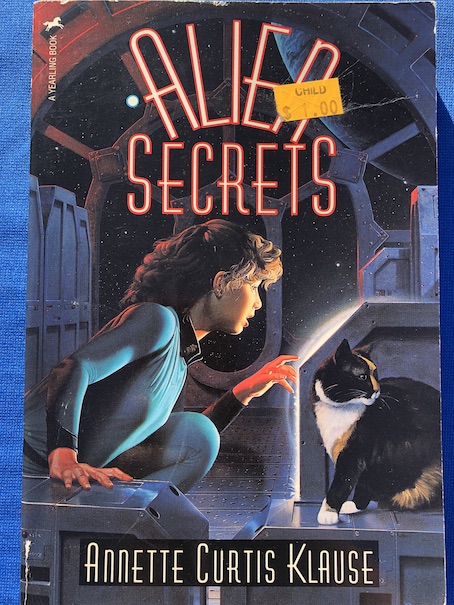
Robin Goodfellow, nicknamed Puck (her parents were fond of Shakespeare), is a human girl from Earth in the future.  When the story begins, she has been kicked out of boarding school on Earth and is traveling by space ship to join her parents, who are scientists who have been working on another planet.  They left Robin with her grandmother on Earth, who enrolled her in an English boarding school in order to give her some discipline and some friends her own age, but she was expelled for failing her classes (not to mention throwing a fit and burning her books when she discovered that she had failed).  Puck dreads what her parents will say when she arrives on the planet where they are now living because they had always hoped that Puck would also become a scientist and work with them, but this journey will change Puck’s life.

Before the ship she will be traveling on leaves Earth, Robin witnesses a man attacking someone else, possibly killing him.  Robin does not report the attack because she doesn’t know whether or not the other person was killed, and she doesn’t think that anyone will believe her anyway.  She witnessed this attack while sneaking around a place where she wasn’t supposed to be, and she is being sent to her parents in disgrace after being expelled, so she doesn’t sound like a very credible witness.  However, the man in the fight, Mizzer Cubuk (“Mizzer” is how they say “Mister” in the book), turns out to be traveling on the same ship as Puck.  All Puck can think of to do is to try to avoid him on the ship and hope that he didn’t get a very good look at her after she ran away from his fight.

To Puck’s surprise, the captain of the ship she is traveling on, Captain Cat Biko, asks her if she could make friends with an alien who is also traveling on the ship.  The alien is one of the Shoowa, who were enslaved by another group of aliens called the Grakk.  Now, he is free and finally traveling home to Aurora, the same planet where Puck is going.  The captain feels sorry for him and thinks that he might appreciate a friend and that he might find a human child less intimidating than an adult.

Later, Puck and other passengers are woken out of their sleep by the sounds of wailing and moaning.  One of the women on board, Leesa, says that she saw something that looked like a ghost that walked straight through her. Other people, who didn’t see or hear it, assume that it was nightmares or imagination, but Puck knows that it wasn’t.  One of the crew members, Michael, tells Puck that there have been rumors that the ship is haunted and that other people have seen and heard strange things.

Strange things are happening on the ship, and some of the passengers seem to be hiding something. Who can Puck trust, and who isn’t who they seem to be?

The alien who is traveling on board the ship understands Puck’s feeling of failure.  The alien, called Hush, says that he carries shame because he lost something important, something that his people were counting on him to take home to their planet.  Puck and Hush discuss how people from Earth had fought the Grakk and sought to learn about Grakk technology from Shoowa slaves who were freed after the war.  Even the ship they are now traveling on was once a Grakk ship.  The Earth people kept delaying sending the slaves home because they wanted to pump them for more information and because they were trying to decide if they could really trust them more than the Grakk.  After negotiating with the Earth people about returning home, the Earth people agreed, with some provisions.  They arranged for some of the Shoowa to stay on the Grakk home planet, still working with humans.  Some of them would travel on ships with Earth people, and some others could go home to their own planet.  Hush is the first one to head home, and he was entrusted carrying home an important symbol of his people that his family had protected for generations: a statue that represents a child because children are the future and a source of freedom, according to an ancient Shoowa prophecy. Unfortunately, the statue was stolen from Hush before he could return it to its rightful home. He reported the theft to the Earth security personnel at the station, but they didn’t take him seriously. They thought that he probably just lost it by accident.

The haunting is real in this book.  On a tour of the ship, Puck learns that the ship’s navigator has also seen the ghost aliens.  One of the characteristics of a ship’s navigator is the ability to see hyperspace, something that not everyone has the ability to do, although even scientists in Puck’s future time don’t seem to know why some people can do that and others can’t.  Slowly, it becomes evident that people who are able to see hyperspace are also able to see the ghosts.

On the journey to Aurora, Puck also learns that she is one of the rare people who are able to see hyperspace, giving her a possible future in navigating a space ship, something that she would really enjoy learning.  When she arrives at Aurora and is greeted by her parents, who have missed her while they were apart, Puck also comes to realize that her parents will always love her, even in spite of failing her classes. Even Hush’s people tell him that, although they are happy to have the statue back, his safe arrival was always the most important thing, and they wanted him to come home, whether he successfully brought the statue or not. Both Hush and Puck come to realize that their families will always love and value them even with their imperfections and failings.  With parents who love her and a new vision of the future ahead of her, Puck is ready to make a new life on Aurora.

The book is available to borrow and read for free online through Internet Archive.

Mystery of the Golden Horn

goldenhornMystery of the Golden Horn by Phyllis A. Whitney, 1962.

Vicki Stewart doesn’t mean to get into trouble. However, with her mother in the hospital with a back injury and Vicki in the care of her unsympathetic aunts, she has allowed her schoolwork to slide to the point where she cannot go on to the next grade. Faced with the prospect of admitting her failure to her friends, Vicki decides that she would rather leave school early and skip summer camp. Instead, she will join her father in Turkey, where he has been teaching at a girls’ college. The prospect of going to a new country and facing her father after her humiliating failure isn’t pleasant, either, but Vicki sees it as her only path to a fresh start. Indeed, her life will never be the same.

Vicki’s father rents his rooms from Mrs. Byrne, an American living in a palace that once belonged to a pasha along with her son, Ken, and her distant cousin and ward, Adria. Adria is about the same age as Vicki, and she has problems of her own. Adria’s parents are dead, and she has not been happy living with the Byrnes. Adria is something of a mystery to Vicki. She’s a dreamy, unpredictable girl who believes in magic spells and fortune-telling. A gypsy friend of Adria’s has told her that her fortune is to be found with a mysterious “golden horn,” and Adria’s single-minded pursuit of it has a tendency to get her into scrapes.

Unfortunately, Adria also tends to drag Vicki into trouble, partly because she is convinced that Vicki’s fortune is intertwined with hers. Vicki resents these complications in her life that add to her “problem child” reputation. However, she sincerely wants to help troubled Adria. Strange things are happening in the house, particularly in the spooky, disused haremlik, but not all of the strange things are Adria’s fault. As Vicki puzzles over these strange things and Adria continues her search for the golden horn, the girls gain new perspectives on their lives and their problems. The solutions aren’t as far-away and mystical as they think, but the girls will have to rely on themselves and each other to see them.

Phyllis Whitney’s books are wonderful for their colorful settings and insights on human nature. Vicki’s disappointment and embarrassment over her failure are true-to-life, and her struggle to change and redeem herself is something that everyone has experienced at some point. It’s a touching and reassuring story about how to deal with failure and life’s problems. The mystery is subtle (up until the end, you’re not quite sure how much of the trouble in the house is Adria’s doing and what her motivations are), and the setting is vivid and engaging. Whitney has also included interesting historical details about Turkey and comparisons between the past and present (by 1960s standards) culture.

The book is currently available online through Internet Archive.