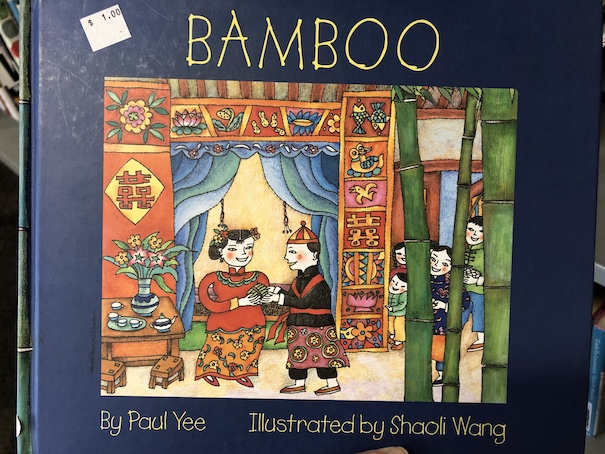
Bamboo by Paul Yee, illustrated by Shaoli Wang, 2006.
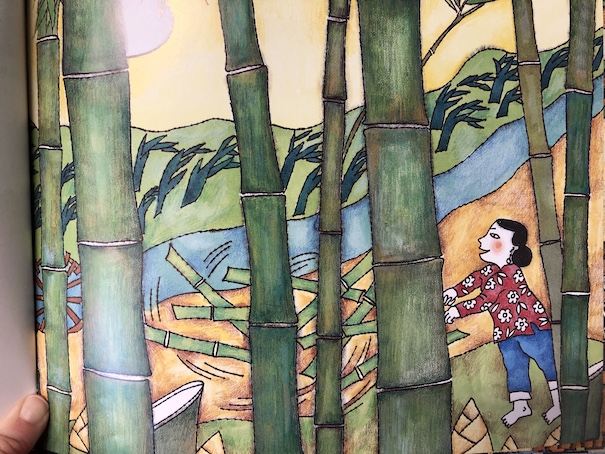
Bamboo is a young farmer. He falls in love with a girl called Ming and marries her. His brother, Banyan, approves of the marriage, but Banyan’s wife, Jin, doesn’t like Ming. When Bamboo and Ming marry, Ming gives Bamboo some bamboo seedlings, and they plant a bamboo grove.
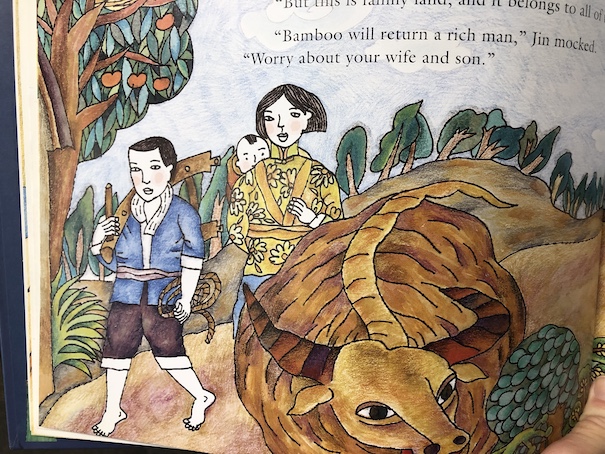
The two couples, Bamboo and his wife and Banyan and his wife, tend the farm together, although Jin complains frequently about the farm work. Then, Jin gives birth to a son, and Bamboo thinks that their growing family can use more land. He decides to go to the New World to earn more money to buy land.
Although the two brother have shared the farmland between them, Jin convinces Banyan to claim the best parts of the farm for them while Bamboo is gone. Her argument is that Bamboo will likely return rich, and Banyan needs to provide for his family. They leave very little for Ming to use to support herself in Bamboo’s absence.
However, the bamboo that Bamboo and Ming planted is magical, and it tills the soil for Ming. When Jin discovers that, she tries to steal the bamboo poles, but they hit her instead. In retaliation, she gets Banyan to throw the poles in the river. Ming cuts a new pole, and it helps her by carrying water. Angrily, Jin gets Banyan to destroy all the bamboo, but Ming’s field still grows rice, and the bamboo grows back.
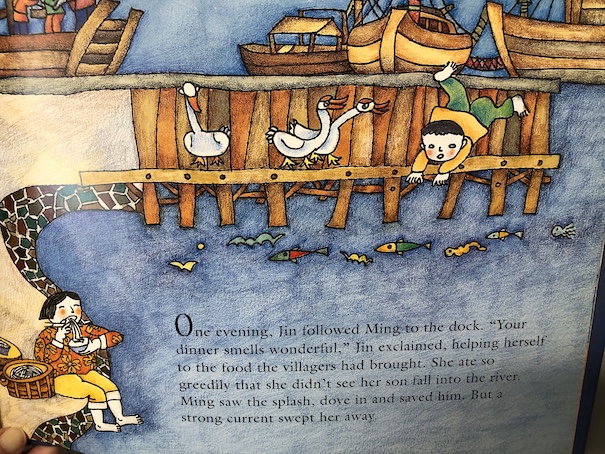
Bamboo writes to Ming that he is returning with gold, but then, she gets word that his ship has sunk. Still holding onto hope that he will return, she keeps going to the dock to wait for him. The kind villagers bring her food while she waits, but Jin eats it. While Jin is eating, her young son falls in the water, and Ming jumps in to help him. She saves the boy, but she is swept away by the current.
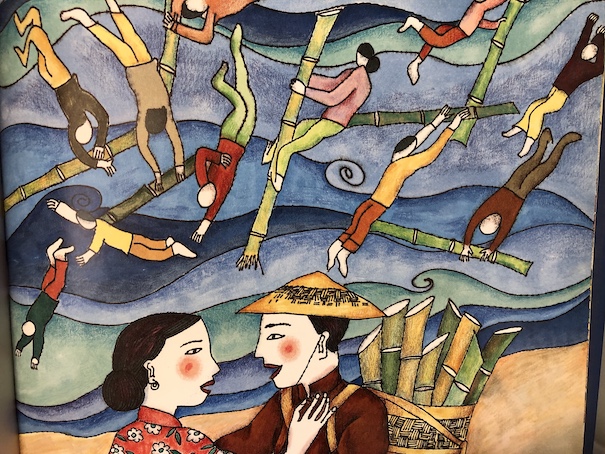
However, Bamboo saves her, and Ming discovers that Bamboo and the others on his ship were rescued by the bamboo poles that Banyan threw in the river.
The book is available to borrow and read for free online through Internet Archive.
My Reaction and Spoilers
This story is written in the style of a folk tale or fairy tale, although I don’t think it is a folk tale. The book didn’t mention that it was based on a folk tale or a retelling of an old story. It does have some similarities to fairy tales, with the cruel, greedy, and jealous relative; the kind and patient woman who is mistreated; and magical objects that help the good woman with her problems.
The trip to the “New World” and finding gold sounds a little more modern than most folk tales and fairy tales, like something that might have happened in the 19th century, but the idea of the husband being away on a long journey sets up the situation for what happens to his wife while he’s away. Like in fairy tales, everything works out for the best in the end. The bamboo poles that Banyan threw in the river save his life when they reach him, and when Ming saves her young nephew’s life, Jin apologizes for the way she’s been treating her. The story’s familiar themes are comforting. Readers can be confident that there will be a happy ending, and I liked it that the very act of throwing the bamboo poles in the river, which was meant to be a punishing act, is what saves the day.
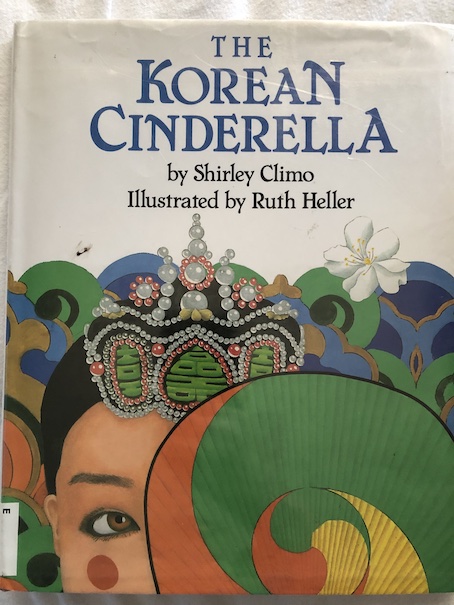
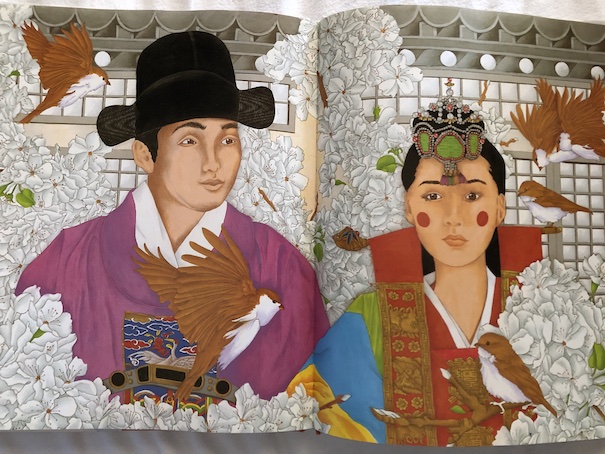
The Korean Cinderella by Shirley Climo, illustrated by Ruth Heller, 1993.
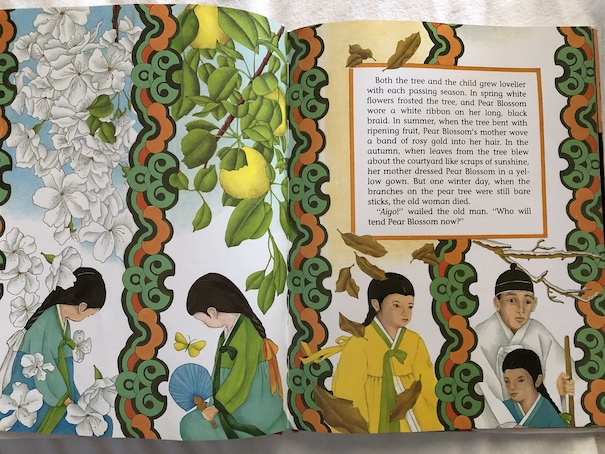
In this Korean version of the classic Cinderella story, a couple who live in a little cottage have a daughter they call Pear Blossom. Pear Blossom is a lovely girl, and when her mother dies, her father thinks that he should remarry, so he will have a wife to help care for his daughter.
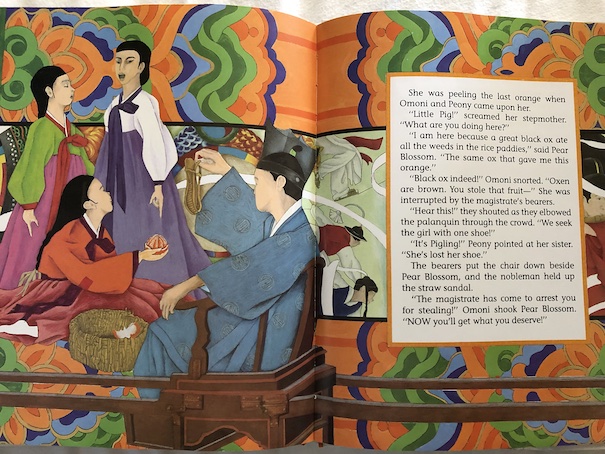
The village matchmaker matches him with a widow who also has a daughter, a girl called Peony. However, after the marriage, it becomes clear that Pear Blossom’s new “mother” doesn’t like her, and her new “sister” doesn’t either. Her stepmother and stepsister are jealous of her, so they nitpick everything she does and make her do all the chores. As Pear Blossom’s father’s health worsens, he is less able to interfere with their mistreatment of Pear Blossom, and the stepmother schemes to find a way to get rid of Pear Blossom entirely.
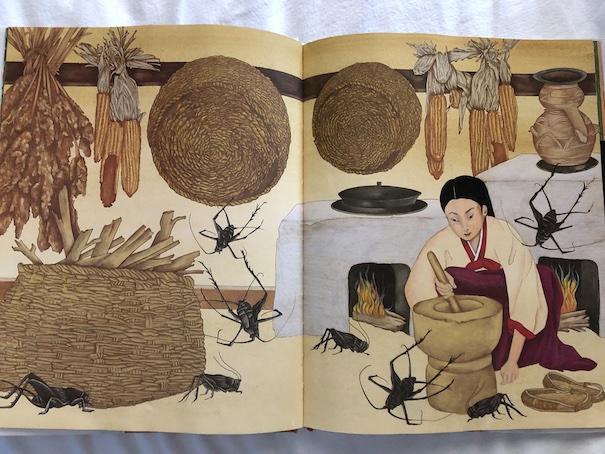
The stepmother keeps assigning Pear Blossom chores that she thinks will be impossible for her to complete, but various animals take pity on her and help her. A frog helps her to fill a jug that has a leak by plugging the leak, and some sparrows help her to hull a massive amount of rice.
One day, Pear Blossom’s stepmother and stepsister go to a festival in the village, leaving Pear Blossom at home. The stepmother says that she can only go to the festival if she weeds the rice paddies first. However, a huge black ox appears out of a whirlwind and takes care of the task for her!
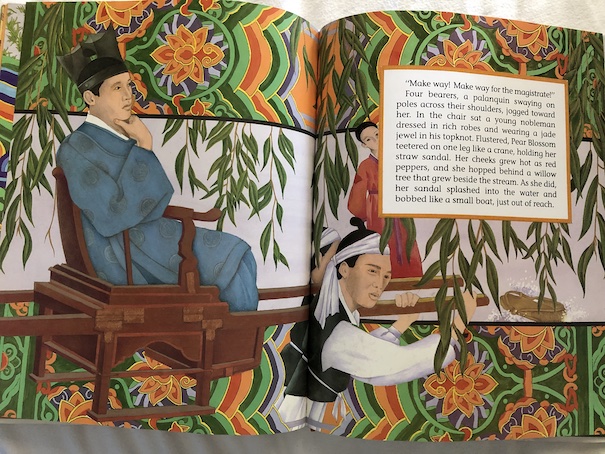
On her way to the festival, Pear Blossom sees the handsome magistrate but accidentally loses one of her sandals as she gets embarrassed and runs away. The lost sandal helps the magistrate to find Pear Blossom at the festival, and he declares that he wants to marry her.
There is an Author’s Note in the back of the book about the background of this fairy tale, and the author notes that there are multiple Korean versions of this story. There’s also an Illustrator’s Note that discusses the style of the illustrations. It explains about how designs that appear in the illustrations are based on designs from Korean temples, and there is also information about the clothing the characters wear.
The book is available to borrow and read for free online through Internet Archive.
My Reaction
Shirley Climo has written multiple picture books about versions of the Cinderella story form around the world, and it’s fascinating to see how a story that so many of us recognize varies from country to country while still maintaining the same basic pattern. An aspect of this particular version of the story that Climo explains in her Author’s Note is that the animals that help Pear Blossom in the story are sent by a kind of “goblin” called a tokgabi or doggabi. The story itself says this, but in folklore, this kind of “goblin” can represent the benevolent spirit of someone who has died. In this story, the spirit might be Pear Blossom’s mother. This explanation makes sense to me because I remember reading something similar about the Chinese version of the Cinderella story. The story of Rhodopis, which Climo retold in The Egyptian Cinderella, may be the oldest form of the Cinderella story, and it doesn’t have that element of the girl’s deceased mother helping her through trials until she finds happiness, but it does put the concept of the Fairy Godmother from European version of the story in a different light.
This is another children’s picture book where I appreciated the notes from the author and illustrator because they add more depth to the story. When I was a kid, I never read notes like that because I was only interested in the story itself, but notes like this make the book more appealing for older readers.
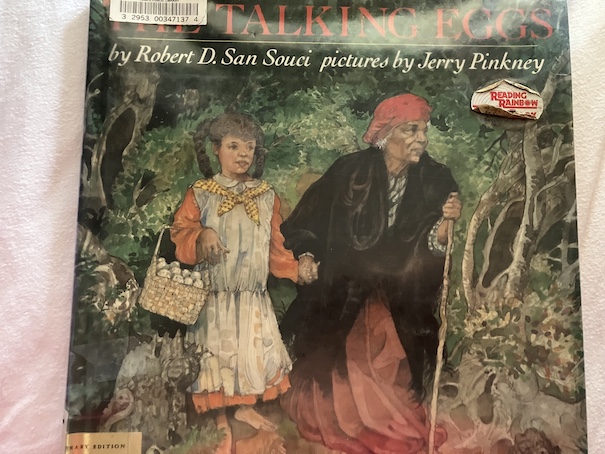
The Talking Eggs by Robert D. San Souci, pictures by Jerry Pinkney, 1989.
There was a poor widow who lived on a small farm with her two daughters, Rose and Blanche. Rose was the widow’s favorite daughter because she was so much like her mother. They were both mean and bad-tempered, and they had grand dreams of becoming rich someday, although neither of them had the slightest idea how to accomplish that. Blanche, on the other hand, was a sweet girl, and her mother made her do all the work while she and Rose just sat on the porch, talking about all of their grand dreams.
One day, when Blanche goes to fetch water from the well, an old woman approaches her and begs her for a drink. Blanche gives her some water, and the old woman thanks her, telling her that she will be blessed for her kindness.
However, when Blanche gets home, her mother and sister yell at her for taking so long. They hit her, and Blanche runs away into the woods. Then, she meets the old woman again. She explains to the old woman what happened, and the old woman invites her to come to her house. However, she cautions Blanche not to laugh at what she sees there. Blanche promises that she won’t laugh.
The old woman is no ordinary woman, and everything at her house is strange. Some of these strange things are amusing, some are amazing, and some are just plain weird and a little alarming. The animals are all strange, with chickens of different colors and cows with curly horns. Then, inside the house, the old woman removes her head and puts it in her lap to brush her hair. Then, the woman produces a fancy stew from just one old bone. After supper, they go outside and watch rabbits in fancy clothing dance.
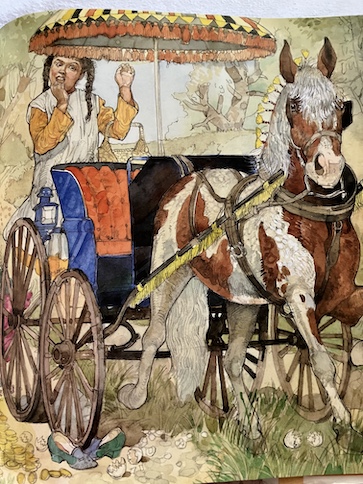
In the morning, the old woman tells Blanche to go out and gather some eggs before she goes home. Blanche is allowed to take any that tell her to take them and to leave ones that say not to take them. Blanche does as she is told, although the ones that tell her to take them are the plain-looking eggs, and the others are covered in jewels. The old woman tells Blanche to throw the eggs over her shoulder, one at a time, and when she does so, the eggs break and wonderful things burst out of them – fancy clothes, coins and jewels, and even a horse and carriage.
By the time Blanche gets home, she has many beautiful clothes, money, and luxurious things. Blanche’s mother pretends to be nice to her when she returns, but it’s only so Blanche will tell her where she got all the rich things. That night, when Blanche is asleep, her mother talks to Rose, telling her that she should also befriend the old woman and get the same rich rewards as Blanche. Then, they will steal all of Blanche’s things and head to the city to live the rich life that they’ve always dreamed of.
Of course, lazy and bad-tempered Rose isn’t as kind or hard-working as her sister. She ignores the old woman’s instructions and does everything she shouldn’t do. When she tries to force the old woman to give her riches, the old woman’s magic gives her and her mother their just desserts.
There is a note at the beginning of the book that this story comes from a Creole folktale that appeared in a 19th century collection of folktales from Louisiana by Alcee Fortier. It resembles folktales from Europe was probably adapted from fairy tales brought to Louisiana by French immigrants. It reminds me of the Mother Holle story, where a kind, well-behaved, hard-working girl is rewarded for following Mother Holle’s instructions, while her spoiled sister is punished for laziness and disobedience.
The old woman in this story is a similar figure to Mother Holle, with strange powers and magical objects, but there is no explanation of who she might be. The fact that she can remove her head just to brush her hair shows that she’s supernatural, but we don’t know if she’s supposed to be a witch or some other supernatural creature.
Personally, I don’t think I would laugh at any of the things in the old woman’s house. I think the strange animals sound more amazing than comical. I think I’d really be impressed by the different-colored chickens and the cows with the weird horns. I have to admit, though, that if someone takes off their head, my first reaction would probably be to run for it.
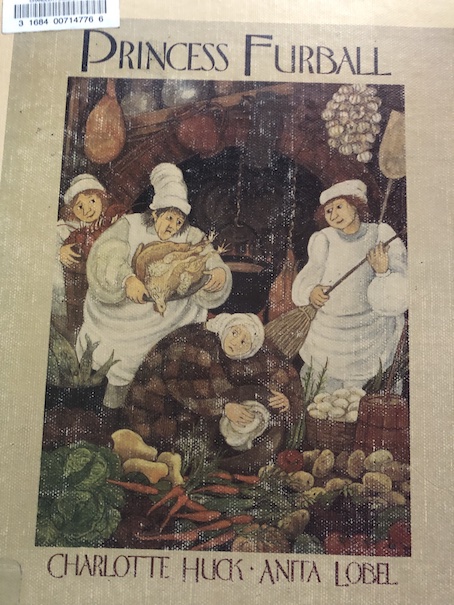
Princess Furball retold by Charlotte Huck, illustrated by Anita Lobel, 1989.
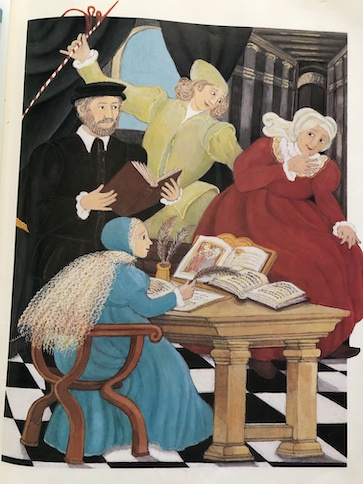
There was a princess whose mother died when she was only a baby and whose father never paid much attention to her. In spite of this misfortune, she had a happy childhood because her nurse loved her and let her play with other children. She arranged lessons appropriate to a princess with skilled tutors and let the princess learn how to cook in the royal kitchen.
However, when the princess was grown, the old nurse died, and the princess was very lonely. Her father only cared about the money he could get from the princess’s marriage, and to the princess’s horror, he arranged a marriage to an ogre who promised him fifty wagons of silver in exchange for the princess.
Unable to face the prospect of such a horrible marriage, the princess requests a special gift from her father for her wedding. She asks for three dresses: one golden like the sun, one silver like the moon, and one as sparkling as a the stars. She also asks for a special fur coat made of a thousand different types of fur. At first, the princess doesn’t think the king will be able to meet her demands, but to shock, he sets his people to accomplishing the task and presents her with everything she asked for.
Deciding that there is no other option but to run away, she takes the three dresses with her along with three small golden treasures that belonged to her mother: a ring, a thimble, and a tiny spinning wheel. She also takes along her favorite soup seasonings, which she got from the castle’s cook. Then, she puts on the bulky fur coat and flees into the woods.
In the woods, she is found by the hunting party of a neighboring king. At first, they mistake her for some kind of strange animal. When they find out that she’s a person, they take her back to their castle and put her to work in the kitchen. There, they make her do all the messy cleaning jobs. Nobody knows her real name, so everyone just calls her Furball after her strange, bulky coat made of a thousand patches of fur.
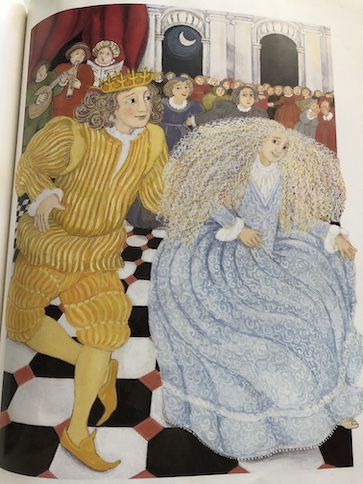
The princess always wears the fur coat as a disguise, but one day, she finds out that the young king of this kingdom is having a ball. She slips away from her kitchen duties and dresses in her dress like the sun. When she is unrecognizable as the kitchen servant, she is able to meet and dance with the king. Being herself is essentially a disguise!
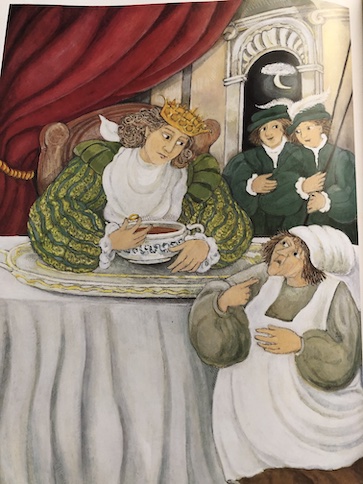
When she slips away from the king and returns to the kitchen, the cook has her make soup for the king, and she uses her special blend of seasonings. When no one is looking, she she also puts her golden ring into the king’s bowl. When the king finds the ring, he asks the cook about it. The cook admits that Furball made the soup, so the king questions her about the ring, but she doesn’t explain.
At the king’s next ball, the princess repeats the same performance, this time wearing the dress like the moon. This time, she slips the golden thimble into the king’s soup when she returns to the kitchen. Again, she doesn’t explain when the king questions her about the thimble.
As in many fairy tales, it’s the third time that’s the charm. When the princess shows up to a ball dressed her her dress like the stars and doesn’t have time to completely change when she gets back to the kitchen that all is revealed, and there’s a happy ending!
The book is available to borrow and read for free online through Internet Archive (multiple copies).
My Reaction
I remember reading this book when I was a kid in elementary school! I think I read it when I was about 7 years old, when the book was pretty new. I always liked fairy tales. There is a brief explanation at the beginning of the book that the story is a Cinderella variant. This version is very similar to the English folktale Catskin and to the tale of Many Furs or Thousand Furs by the Brothers Grimm.
Like so many little girls, I was fascinated as a kid with the concept of the dresses that resemble the sun, the moon, and the stars. The fur coat made of many animals is a little alarming to me now, but it makes a good disguise in the story. I love the illustrations that show the princess in all of her different dresses and the Furball disguise!
The story doesn’t explain why the princess put her treasures into the soup, but my guess was that she wanted an excuse to see the king again and a way to keep him intrigued about her identity and her relationship to the mysterious princess who keeps showing up to his balls. It’s only after the king decides that he really loves the mysterious princess that it’s safe to reveal her identity.
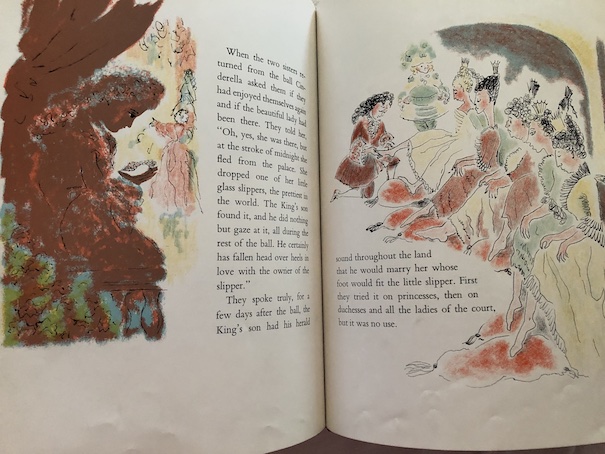
Cinderella translated and illustrated by Marcia Brown, 1954.
This is a retelling of the classic Cinderella story, translated from the French Perrault version by Marcia Brown, the author and illustrator of many other classic fairy tales and folktales for children.
As in the classic story, Cinderella is a girl with a cruel stepmother and a pair of spoiled stepsisters, who force her to do all of the work of the house and make her wear rags. Her father never stands up for her because he is too attached to his second wife to oppose her.
When it is announced that the king’s son is holding a ball and that the stepsisters are invited, they hurry to get ready, and they make Cinderella help them. Of course, nobody thinks that Cinderella should go to the ball, and the stepsisters laugh and tease her about it.
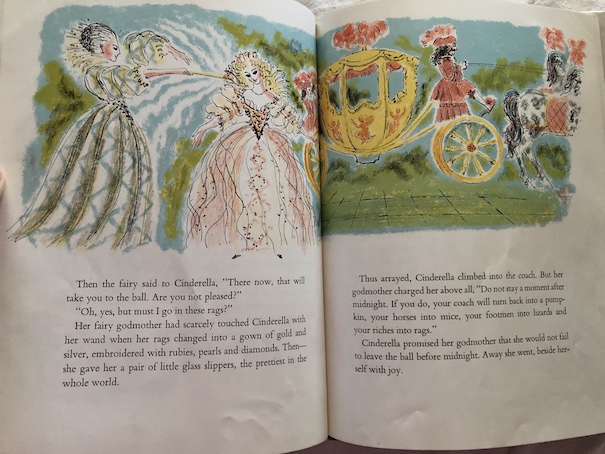
When they head off to the ball, Cinderella watches them go and cries. Then, her fairy godmother appears and tells her that she is going to help her. The fairy godmother turns a pumpkin into a fine coach, mice into horses, and a rat into a coachman. She gives Cinderella a beautiful dress to wear and a lovely pair of glass slippers. However, she warns Cinderella not to stay at the ball past midnight, when her magic spells will end, and everything will become what it was before.
At the ball, Cinderella charms the prince and has a wonderful time. She is even nice to her stepsisters when she encounters them. They don’t recognize her in her new finery. Everyone keeps wondering who the girl who appears to be a beautiful princess could be. Shortly before midnight, she leaves the ball abruptly and returns home before her stepsisters do. She tells her godmother everything that happened and that the prince invited her to a ball to be held on the next night.
The next ball is also wonderful, but Cinderella loses track of the time and runs away suddenly when the clock begins to strike midnight. In her haste to get away, she accidentally leaves one of her glass slippers behind. The prince finds it and decides to use it to find this beautiful, mysterious girl he has already come to love.
Many young ladies try on the shoe, including Cinderella’s stepsisters, hoping that it will fit them. However, it will only fit Cinderella, and only Cinderella has the other slipper in the pair.
This is a Caldecott Medal Book. It’s available to borrow and read for free online through Internet Archive.
My Reaction
The story follows the classic Perrault version of the Cinderella story. There are many variations of this fairy tale, but this one is often the best-known. In some versions of the story, Cinderella’s father is also dead, which is why she is left at the mercy of her stepmother and stepsisters, but in this one, he is still alive and is just unconcerned about Cinderella’s treatment. He is never shown in any of the pictures and plays no role in the story.
I enjoyed the illustrations in this book. They’re an unusual style. Objects and people in the pictures are only party defined by pen lines. Many of their edges are more softly defined by color.
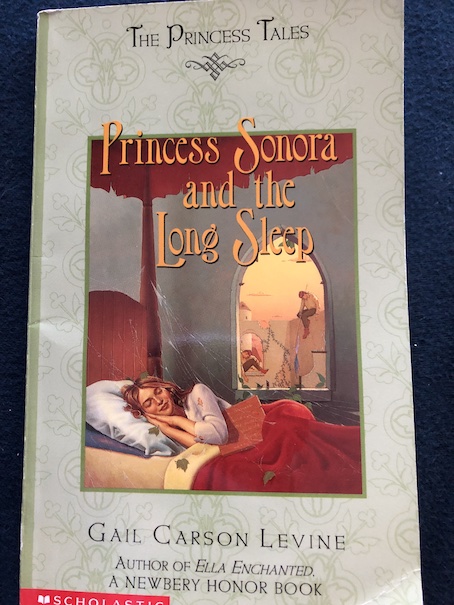
Princess Sonora and the Long Sleep by Gail Carson Levine, 1999.
This story is a retelling of the classic fairy tale, Sleeping Beauty. It’s part of a series of other retellings and re-imaginings of classic fairy tales called The Princess Tales.
When Princess Sonora was born, her parents invited the usual fairies to give her gifts. They do this because it can be dangerous to anger fairies, although fairies’ gifts are a risky proposition at the best of times. Unfortunately, there are two complications with the fairies who give Princess Sonora gifts. First, one of the fairies decides to top a previous fairy’s gift of intelligence by making Princess Sonora ten times as intelligent as any other human on earth. As a result, Princess Sonora is an unnaturally intelligent baby who begins to talk almost immediately and is smart enough to understand the second problem that arises.
Her parents neglected to invite a particular fairy because they’d heard a rumor that she was dead. Of course, the fairy shows up anyway, angry at the lack of invitation, and immediately curses Princess Sonora. As in the original Sleeping Beauty story, the curse is that, someday, Princess Sonora will prick her finger and die. Also, as in the original story, the last fairy who hadn’t yet given a gift uses her gift to soften the curse so that, instead of dying, Princess Sonora and everyone else in and around her castle will fall asleep for 100 years. She can’t completely remove another fairy’s spell because that might provoke a fairy war, but this change to the curse gives the family hope. She promises that Princess Sonora will meet an eligible prince when she wakes up. Princess Sonora, being an unnaturally intelligent baby who can talk, also gives her own feedback and suggestions on the situation, to her parents’ amazement. Her parents decide to try to prevent the curse from coming true by hiding anything that can prick Princess Sonora, but baby Princess Sonora has already realized that this will be impossible. She knows that the curse will come true someday, and as she lies in her cradle, she begins to make plans to prick herself on purpose, someday when she can choose just the right moment.
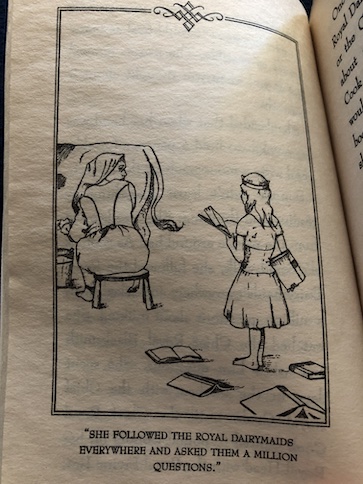
Being smart is generally a good thing, but Princess Sonora’s unnatural intelligence makes her a very peculiar girl in a number of ways. For one thing, she loves books and is always reading, even as a baby. She grows up to be a very studious girl. That’s not so bad, but Princess Sonora carries it to extremes. She also refuses to sleep. It’s partly because she knows that, at some point, she’s going to spend 100 years sleeping, so there’s no point in wasting more time asleep. She’s also afraid of sleep because she doesn’t know where her mind will go when she sleeps, and with her massive intelligence, she loves her mind and doesn’t want it to go away. Instead of sleeping, she just reads all night or thinks about things. Because of her intelligence, curiosity, and constant reading, Princess Sonora knows the answers to many questions, but people often find it irritating because they don’t want to hear her long explanations or all the ways she knows for people to do their jobs better. People start saying to each other, “Princess Sonora knows, but don’t ask her.” Princess Sonora wishes that other people would be more interested in what she has to say, but she knows better than to force the issue.
When Princess Sonora turns 14 years old, her parents begin looking for a prince she can marry, assuming that she doesn’t prick herself and fall asleep for 100 years first. They choose Prince Melvin, from a large and wealthy kingdom nearby. It seems like a smart match, but Princess Sonora knows it isn’t a good one. Prince Melvin has also received gifts from the fairies, and while they include positive qualities, like honesty and bravery, they don’t include intelligence. Prince Melvin isn’t very smart and wouldn’t appreciate any of the things Sonora knows or has to say. He would marry her anyway because he’s Honest and Traditional, but Sonora knows that she wouldn’t be happy. When she meets him, he’s very dull. The fairies made him a Man of Action, not of thought. He’s decided that thinking gets in the way, so he has few ideas and certainly no interesting ones. Sonora begins to think that the right time for pricking her finger might be coming soon. Pricking her finger doesn’t quite go as she had planned, but the curse works.
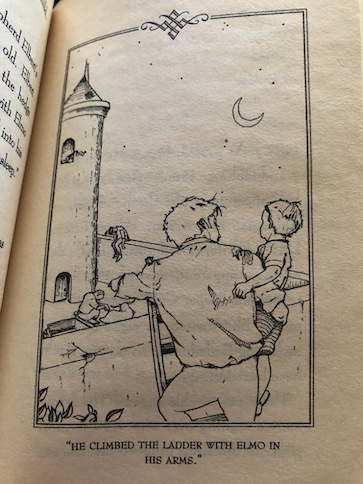
When Princess Sonora and everyone in the castle is put to sleep for 100 years, they are half-forgotten. Princess Sonora becomes a kind of legend, and the saying “Princess Sonora knows, but don’t ask her” becomes a common saying when someone doesn’t know the answer to something, with few people knowing who Sonora really is or why you’re not supposed to ask her what she knows. That is, until a prince with curiosity and a thirst for knowledge, someone who really needs Sonora’s knowledge to solve a problem, seeks her out for the answers he really needs. When Sonora wakes, she finally meets a prince needs a princess like her and is truly happy to hear what she has to say!
My Reaction
I liked this story when I first read it as part of a collection of other stories in the same series. Gail Carson Levine, who is also the author of Ella Enchanted, often writes stories themed on fairy tales but with her own twists. Princess Sonora’s extreme intelligence and fear of sleep weren’t part of the original fairy tale, although they fit this story nicely. I found the scene with the fairies giving Sonora gifts a little disturbing. When one of the fairies gives her the gift of beauty, the baby physically changes, and it is described as being painful. It is a theme in other stories by Gail Carson Levine that the magical gifts fairies give often have unfortunate side effects. Some of them really turn out almost like curses, but in this case, it turns out to be just what Sonora really needs and leads her to the person who really needs her. Even after people stop getting gifts from fairies when they’re babies, they still have quirks, and Sonora’s quirks fit with Prince Christopher’s quirk for curiosity!
The Twelve Dancing Princesses retold and illustrated by Ruth Sanderson, 1990.
This is a retelling of the classic German fairy tale collected and published by the Brothers Grimm in 1812. There are various retellings of this story, some changing the number of princesses and some giving the characters different names. This one is actually closer to the Andrew Lang version from The Red Fairy Book, published in 1890.
A king with twelve daughters has a strange mystery to solve. All twelve of his daughters sleep in the same room every night. The door to their room is always locked, but every morning, the girls’ shoes are completely worn out, like they’ve been dancing all night. The girls claim that all they do at night is sleep, but that doesn’t explain what happened to their shoes.
The king is confused and troubled by this odd mystery, so he promises the hand of one of his daughters in marriage to the man who can solve the mystery. A series of princes attempt to solve the mystery by sleeping in a room next to the princesses, but in the morning, each of the princes has mysteriously disappeared and the princesses’ shoes are still worn out.
With the mystery getting more mysterious and more urgent, with the princes’ disappearances, a commoner named Michael decides that he wants to try to solve the mystery. A woman Michael meets recommends that he take a job as a gardener’s helper at the castle and see if he can spot something that would give him a hint. The mysterious woman gives Michael a cloak that will make him invisible so that he can follow the princesses and see what they do.
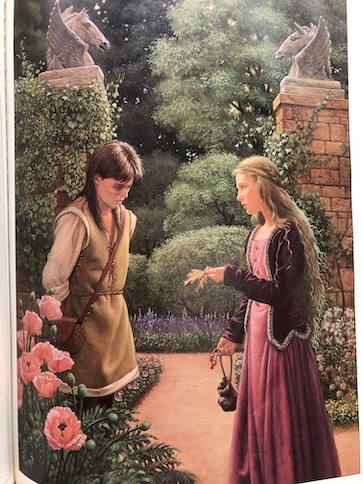
Michael first meets the princesses when the gardener sends him to give a bouquet of flowers to each of them. He catches the attention of the youngest princess, Lina. Lina’s sisters tease her about admiring a simple garden boy, but Michael also likes Lina.
Because he is a commoner, Michael doesn’t think that he can go the king directly and ask to investigate the mystery of the princesses, so he decides to use his magic cloak to spy on them secretly. When he’s invisible, he slip into their room before the princesses are locked in for the night and hides. After everyone thinks that the princesses have gone to bed, they get dressed as if they’re going to a dance, putting on their new dancing shoes. The eldest princess opens a special trap door in the floor, and they all leave secretly, with Michael following them.
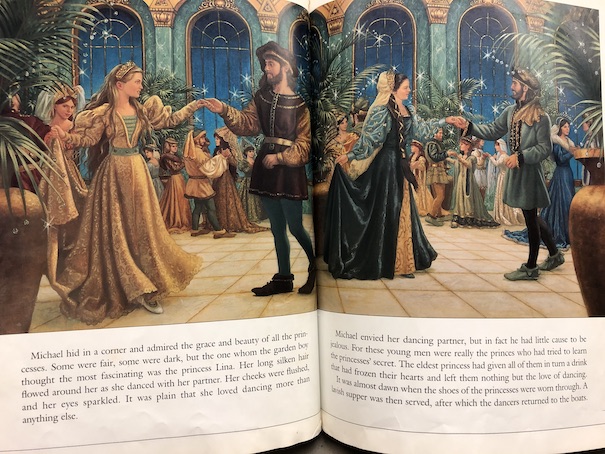
Michael follows the princesses through magical woods to a lake where the captive, now enchanted, princes wait to take the princesses to a magical palace in boats shaped like swans. There, the princesses dance with the princes all night, wearing their shoes to pieces.
Lina suspects that someone followed them because Michael accidentally stepped on her skirt a couple of times, and Michael confirms her suspicion when he places a branch from the magical woods into her bouquet of flowers. At first, Lina tries to bribe Michael into keeping their secret by offering him money, but he refuses. She asks him if he plans to tell the king and collect his reward by marrying one of the princesses, but Michael says he won’t. Lina tries to ask him why, but he doesn’t want to answer. The truth is that Michael loves Lina and doesn’t want to get her into trouble or force her to marry him if she doesn’t return his affections.
Eventually, Lina tells her eldest sister, the one who is controlling all of the magic behind their escapades, about Michael and what he knows. Lina’s sisters want to have Michael thrown in the dungeon to keep him quiet, but Lina is horrified and says that if they do that, she’ll tell their father the truth herself. Instead, they decide to openly invite him to their next dance and offer him the magical drink that would enchant him like they did with all of the other princes. Michael overhears their plan and decides that he will see if Lina really loves him. If can’t appeal to her heart, he’ll drink the drink and be enchanted.
When Lina prevents Michael from drinking the enchanted drink at the dance because she loves him and can’t stand to see him turned into a mindless magical slave, the spell is broken on all of the other princes. They all return to the castle, and the magical palace crumbles behind them. When they reveal the truth to the king, he makes Michael the heir to the kingdom with Lina as his wife.
I’ve heard many different versions of this story before, but there are always so many unanswered questions. Just how did the eldest princess come up with this whole magical dancing scheme in the first place? Where did she even learn to do magic? How come the princesses are never tired even though they dance every night instead of sleeping? (Well, I guess that could just be magic because magic can fill many plot holes.) Why did the king just keep giving the girls new dancing shoes when they kept wearing them out every night? My parents would have just stopped giving me things that I repeatedly broke, telling me that I can’t have new stuff if I can’t take care of the old. They’d probably say something like, “I don’t know what you’re doing with those shoes every night, but whatever it is, you’re not going to do it anymore because you won’t have them.” But, fairy tale characters just aren’t that practical, and if they were, the story would have ended much sooner. In fact, why didn’t the king himself just sit up for one night with his daughters and see for himself what they did or split them up and put them in different rooms of his castle to put an end to their hijinks? Just what is the king going to do with the eldest princess, now that he knows that she’s some kind of witch or enchantress? Did her powers break completely when Michael broke her spell? Also, what was the deal with the mysterious woman Michael met on the road, who gave him the invisibility cloak? How did she figure into this, or was she just some random, magical being or enchantress who, coincidentally, just happened to have a magical cloak that she could spare? The story doesn’t really say.
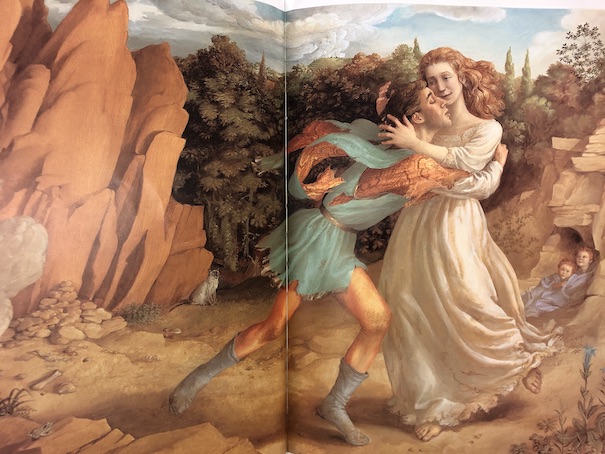
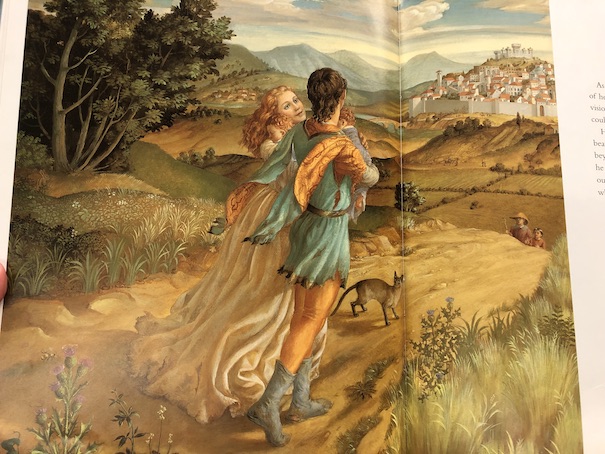
I love the pictures in this book because they are beautiful and detailed, but the art style is a little unusual. Instead of having every picture appear in its entirety on a page, some pictures wrap around to the next page, either giving a hint of what’s coming or a taste of what was on the previous page. Sometimes, I found myself wanting to see the whole picture at once, but I can see how the illustrator was trying to make scenes in the story kind of flow into each other.
The book is available to borrow for free online through Internet Archive.
The Elves and the Shoemaker story adapted by Lucy Kincaid, illustrated by Gillian Embleton, 1981.
I loved to read this folktale when I was a kid! This particular copy was made specifically for beginning readers with large type and a section in the back that shows key words in the story with little pictures to explain what they mean. Aside from my nostalgic associations with this book, I also really enjoy the detailed, realistic pictures.
There was a shoemaker who worked very hard but never seemed to get much money for the shoes he made. He and his wife are on the verge of starvation, and he only has enough leather to make one final pair of shoes.
Before going to bed, he cuts out the leather for the last pair of shoes, planning to sew them in the morning. However, in the morning, he discovers that someone else has already sewn the shoes together, and the shoes are very fine quality. The shoemaker has no idea who finished the shoes for him, but they did an excellent job, and he is able to sell them for enough money to buy food and enough leather for two more pairs of shoes.
Once again, he cuts out the leather for the shoes, and again, in the morning, he discovers that someone else has sewn the shoes together. The shoes are excellent, and he is able to sell them for enough to buy leather for four more pairs.
This continues night after night, and the shoemaker’s business begins to prosper, but he and his wife wonder who is helping them. One night, they hide and watch to see who will come to do the sewing. As they sit up, waiting, they see a pair of small elves who enter through the window and begin sewing the shoes together.
The shoemaker and his wife want to thank the elves for their help. Noticing that the elves are wearing ragged clothes and have no shoes of their own, they decide to make the elves their own sets of clothes and shoes.
On Christmas Eve, they put the elves’ new clothes on the table where the shoemaker usually puts the shoes that need to be cut and watch to see what the elves do. The elves are overjoyed to see the new clothes, realizing that they are presents for them. They immediately put the clothes on and dance around with happiness, singing that they don’t need to work anymore.
That is the last time the shoemaker and his wife see the elves, but the shoemaker’s business continues to prosper.
In the Harry Potter series, J.K. Rowling used the device of gifts of clothing ending a house elf’s service to a particular household, but she didn’t invent that concept. It was already a feature of folktales like The Elves and the Shoemaker, which was one of the folk tales collected by the Brothers Grimm.
This book is available to borrow and read for free online through Internet Archive. There are also many other versions of the same story.
This retelling of the classic fairy tale is a Caldecott Medal winner. The illustrations are beautiful! A note in the beginning of the book explains a little more about the author’s sources for the story as well as his view about it. Instead of focusing on an evil witch who holds a young girl captive, he presents “a mother figure who powerfully resists her child’s inevitable growth.”
A
couple who have wished for children for a long time are excited to realize that
they are finally going to have one!
However, the wife finds herself with an irresistible craving for the
Rapunzel (an herb) that grows in the nearby garden of a sorceress. She is so desperate to have some that she is
able to persuade her husband to steal some for her. But, even having some causes her craving to
grow.
When the husband returns to the garden to get more Rapunzel, the sorceress catches him. He explains the situation, saying that his wife’s craving is so intense that he fears she will die if she doesn’t get some Rapunzel. The sorceress agrees that the wife can have the Rapunzel she needs, but in exchange, she demands the child when it is born. Not knowing what else to do, the husband reluctantly agrees. When the wife gives birth to a baby girl, the sorceress comes, names the baby “Rapunzel”, and takes her away from her parents.
The sorceress cares for the girl and raises her. When the beautiful young girl turns twelve, the sorceress takes her to live in a tower in the forest. The tower is magical, looking narrow on the outside, but containing many beautiful and comfortable rooms. The only way in or out is through the window at the very top. The witch has Rapunzel let down her extremely long, beautiful hair so that she can climb up.
Rapunzel lives alone in the tower for years, until a prince happens to ride by and hears her singing. The prince is enchanted by the singing and asks questions about the tower at the nearest houses, learning about the sorceress and the young woman in the tower.
One
day, he sees the sorceress visiting Rapunzel and sees how she gets into the
tower. So, later, he calls to Rapunzel
himself, asking her to let down her hair.
Rapunzel is surprised and frightened at first, when she sees that her
new visitor isn’t the sorceress, but he speaks nicely to her, and they become
friendly. The prince proposes marriage,
and Rapunzel accepts. After that, he
visits her every night, without the sorceress’s knowledge.
However,
Rapunzel eventually gets pregnant, and when her clothes no longer fit her, the
sorceress realizes it. She calls
Rapunzel a “wicked child” and says that she has betrayed her. She cuts off Rapunzel’s long hair and exiles
her into the wilderness, alone.
The sorceress uses Rapunzel’s long hair to trick the prince into climbing into the tower. When he comes, she tells him that Rapunzel is gone, and he will never see her again. The prince falls from the tower, injuring his eyes. Blinded, the prince wanders alone for a year, lamenting for his lost wife.
Eventually, he finds Rapunzel in the wilderness, recognizing her singing. She has given birth to twins. Rapunzel’s tears heal the prince’s eyes, and he is able to see again. Realizing that they are near to his kingdom, he takes Rapunzel and the twins home.
The book is available to borrow for free online through Internet Archive.
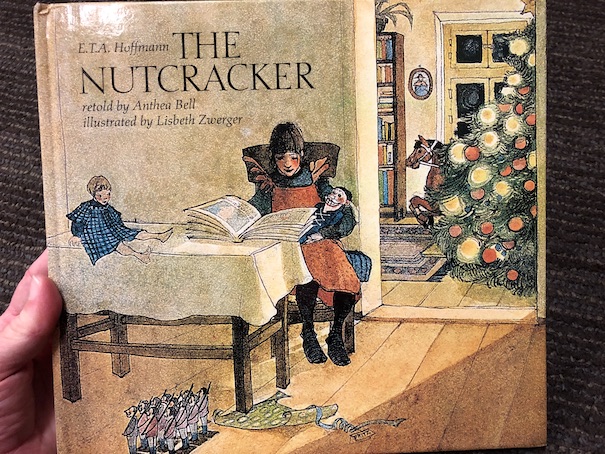
The Nutcracker by E.T.A. Hoffmann, retold by Anthea Bell, 1816, 1987.
The reason for the two dates of this book is that the original Nutcracker story was written by a German writer, E.T.A. Hoffmann, in 1816, as the novella The Nutcracker and the Mouse King. Some places, including the back of this book note different publishing dates for the original story because it was published more than once during the 1810s, as part of different story collections. This article gives more details about the original version of the story and different publications. Since then, it has been retold many times and in many different forms, including the famous ballet based on the story. In ballets and plays, the name of the heroine is often Clara, but in this picture book, as in the original story, the heroine’s name is Marie.
In the beginning of the book, which is set in the 19th century, Marie and her brother Fritz, are opening their Christmas presents on Christmas Eve. (The book explains that opening presents on Christmas Eve is a German tradition. A friend in Germany also explained that to me once because, in Germany, presents are supposedly brought by the Christ Child, not by Santa Claus. Since then, I’ve read that explanation may vary, depending on whether the household is Catholic or Protestant.) The children receive many wonderful presents, including a toy castle from their godfather, Mr. Drosselmeier. Marie’s favorite present is a nutcracker that looks like an odd little man. When Fritz is too rough with the nutcracker and breaks it, Marie takes care of it.
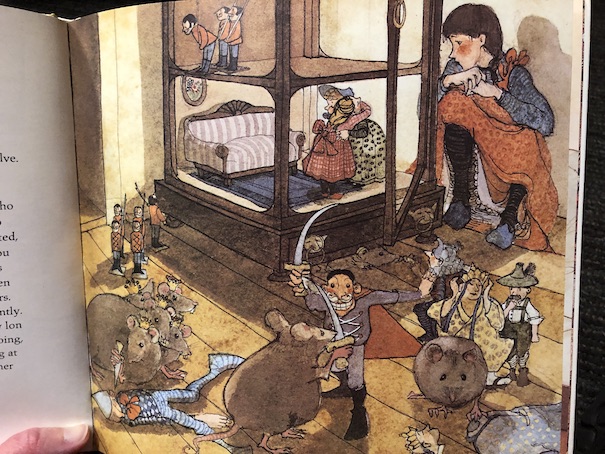
Marie stays up late, and when she finally puts the nutcracker away at midnight, she is astonished to see an army of mice coming out of the floorboards. The leader of the mouse army is the Mouse King, who has seven heads. The Nutcracker leads an army of toys against the mouse army. The mouse army appears to be winning, so, to save the Nutcracker, Marie takes off her shoe and throws it at the mice. Then, her arm hurts, and she apparently faints.
When Marie wakes up, she is in her own bed, and her mother tells her that she apparently put her arm through the glass door of the toy cabinet, cutting herself badly. When Marie tries to tell her mother about the battle between the toys and the mice, her mother and the doctor think that she’s ill and confine her to her bed for a few days. Mr. Drosselmeier repairs the Nutcracker and returns it to Marie, telling her the reason why nutcrackers look so strange and ugly, calling it The Tale of the Hard Nut.
Year ago, there was a royal banquet given by the King and Queen who were the parents of Princess Pirlipat. A mouse who claimed to be the queen of Mousolia demanded some food from the banquet as the Queen was preparing it. The King was angry that the mouse took some of the food and wanted revenge. The King asked his Court Watchmaker, who was also named Drosselmeier, to build some mousetraps to catch the mouse queen’s seven sons. When the sons were caught, the mouse queen vowed that she’d take her revenge on Princess Pirlipat. Princess Pirlipat was a pretty baby, but the mouse queen turned her ugly. The King took out his anger on the Court Watchmaker, ordering him to find a way to change Princess Pirlipat back to normal and threatening to behead him if he failed. After consulting the Court Astronomer, the Court Watchmaker learned that the key to breaking the spell on the princess was a special nut, which had to be cracked by being bitten by a man who filled certain special requirements, which all happened to be met by the son of the Watchmaker’s dollmaker cousin. The King had promised that the person who could break the spell could marry his daughter, but the mouse queen interrupted the last part of the ritual, causing the young cousin to turn ugly himself. When pretty Princess Pirlipat saw her rescuer turn ugly, she didn’t want to marry him anymore. The Court Astronomer said that the only way to break the spell on the young man was for him to defeat the new Mouse King – the mouse queen’s youngest son – and for him to find a woman who would love him regardless of his appearance.
Marie knows that the story is true because she has seen the Mouse King herself. She loves the Nutcracker and wants to help him. The Nutcracker returns to visit Marie during the night and makes repeated demands of her for her candy and toys. Marie knows that, no matter what she gives him, the Mouse King will keep returning to demand something else. The Nutcracker tells her that he needs a sword to fight the Mouse King. They borrow one from a toy soldier, and the Nutcracker successfully defeats the Mouse King, giving Marie his seven golden crowns.
As a reward for helping him, the Nutcracker takes Marie to the land where he is from, leading her there through a magic staircase in an old wardrobe. The Nutcracker’s land is beautiful, filled with candy and sweets and gold and silver fruit. (The Christmas Wood that they pass through reminds me of the woods in the wardrobe in The Lion, the Witch, and the Wardrobe.) The Prince Nutcracker’s home is Marzipan Castle in Candy City, where his beautiful princess sisters live. They welcome Marie and the Nutcracker home.
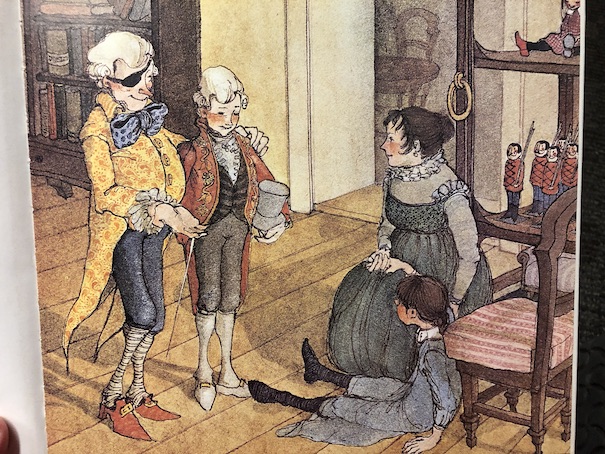
Then, suddenly, Marie wakes up, as if it were all a dream. However, Marie knows that it wasn’t a dream because she still has the Mouse King’s crowns. Marie tells the Nutcracker that she loves him. There is a sudden bang, and Marie faints. When she wakes up, she is told that Mr. Drosselmeier’s nephew has come to visit them. The nephew is the Nutcracker, restored to human form and now a handsome young man, thanks to Marie’s love. Marie later marries the nephew, and the two of them rule magical Kingdom of Sweets.
There is a section in the back of the book that explains a little more about E.T.A. Hoffmann and the original version of the Nutcracker story.
This book is available to borrow for free online through Internet Archive.

















 Jestress's Forgotten Books and Stories