Dealing with Dragons

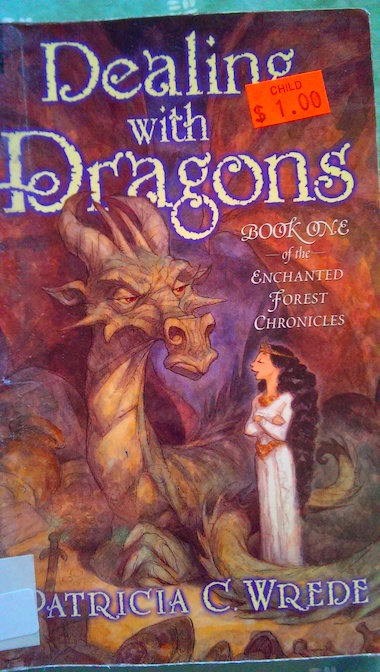
Dealing with Dragons by Patricia C. Wrede, 1990.

This is the first book in the Enchanted Forest Chronicles.  The fun thing about this series is that it parodies many popular fairy tales and their tropes.  Some of the books in the series also take the form of fantasy mysteries with some puzzle or nefarious happenings that the characters have to figure out.

From when she was a young child, Princess Cimorene of Linderwall has been bored with the kind of life that is expected from ordinary princesses.  Unlike her six older sisters, Cimorene doesn’t have golden curls.  She has black hair, and she’s way too tall for a cute little princess.  She’s also very stubborn.  When Cimorene gets bored of the usual princess lessons involving dancing, embroidery, and etiquette, she pushes other people in the castle into giving her different types of lessons.  First, she convinces the armsmaster to give her fencing lessons.  Then, she gets the court magician to give her magic lessons.  She also arranges Latin lessons, cooking lessons, economics lessons, juggling lessons, and so forth.  Each time her parents find out about her unusual lessons, they put a stop to them because none of the subjects that Cimorene finds interesting are “proper” for a princess to study. 

When Cimorene’s parents try to arrange for her to marry a prince that she doesn’t like, she finally decides that enough is enough.  Cimorene meets a talking frog in the castle pond, and after talking over her problem with him and saying that she’d rather be eaten by a dragon than marry the prince, the frog recommends that she run away.  He even gives her directions on where to go after she leaves the castle.  Not having any other plan, Cimorene takes his advice . . . and ends up at a dragon’s lair.

It works out for the best, though.  Rather than being eaten, Cimorene asks the dragons in the lair if they are in need of a princess.  She isn’t quite sure what princesses who are taken captive by dragons do, but she can cook (as part of her earlier cooking lessons) and do other chores.  Although one of the dragons, Woraug, wants to just eat her, the dragon called Kazul takes her on as her princess.

Cimorene finds it interesting being a dragon’s princess.  She cooks for Kazul and also helps to organize her treasure hoard and library.  As is expected when word gets out that Cimorene is a dragon’s princess, knights come to try to rescue her.  They are shocked when Cimorene turns them away, and it takes awhile before Cimorene is able to convince them that she’s really happy with the dragons and doesn’t want to be rescued.

Cimorene even makes new friends.  Morwen, a witch friend of Kazul’s, comes to visit and teaches Cimorene more about magic.  Morwen is also very practical and suggests putting up a sign (something like “Road Washed Out”) to discourage knights from approaching Kazul’s lair.  It is while Cimorene is putting out the sign that she means the wizard Zemenar.  His presence in the area is suspicious because wizards and dragons do not get along.  Wizards do not use their own magic but use their staffs to soak up magic from magical places or magical beings – like dragons.  When wizards take magic from dragons, they actually take part of their essence, and give them a reaction that’s similar to allergies.  Zemenar is also head of the Society of Wizards, so it’s doubly suspicious if he’s been hanging around a dragon’s cave.  When Cimorene tells Kazul and her friends about seeing him, they become concerned, wondering what he’s after.

Cimorene also meets other princesses who are the captives of other dragons: Keredwel, Hallanna, and Alianora.  At first, they also have trouble believing that Cimorene actually volunteered to be a dragon’s princess and that she likes it.  Cimorene doesn’t like the arrogant attitudes of Keredwel and Hallanna, but Alianora is pleasant, and the two of them become friends.  Alianora tells Cimorene that, although she was taken captive by Woraug, her family basically set her up for it.  Like Cimorene, she was under a lot of pressure to do the things that everyone expects of fairy tale princesses, but she wasn’t much good at them, and things never turned out as one might expect.  The wicked fairy who came to Alianora’s christening when she was a baby didn’t curse her; she just enjoyed the party and had a wonderful time.  Alianora also didn’t prick her finger on the spinning wheel that her busy-body aunt gave her, and when she tried to spin straw into gold, she got linen thread instead.  When various fairy tale schemes failed to work for Alianora, her interfering aunt arranged for her to visit a village, knowing that Woraug was going to ravage it.  As Morwen noted, princesses who are taken captive by dragons and then rescued can expect to make good marriages.  Although being abducted by a dragon was a shock, Alianora says it’s not so bad; Woraug mostly ignores her since she doesn’t know how to cook, and it’s a relief for her to get away from her nagging aunt.  The only downside is that the other, more conventional princesses are really annoying.  Alianora and Cimorene bond over their unconventional lives as fairy tale princesses.  Cimorene gets the idea to send some of her knights and princes to go rescue Keredwel, thus taking care of two problems at once.  Alianora also helps Cimorene with her efforts to find a fire-proofing spell to protect the princesses from accidental burning from the dragons, and later becomes her ally when things get more serious.

Zemenar returns to Kazul’s cave and, while Cimorene tries to subtly pump him for information, he sneaks a look at a book about the history of dragons.  He seems to be interested in the section about how they settled in the Mountains of Morning, how they chose their king, and the Caves of Fire and Night, where they found the special stone that they use to choose their king.

Then, the king of the dragons is murdered, poisoned by dragonsbane.  The wizards have a confederate among the dragons themselves, and they want something that only the king of the dragons can give them.

By the time the murder is committed, Cimorene and Kazul have a pretty good idea of who the conspirator among the dragons is.  The wizards think that they’ve found a way to rig the ceremony for choosing a new king so that the dragon who supports them will win, giving them what they really want.  However, Cimorene foils their plan with the help of her friends.  The mystery/conspiracy elements of the story are great and help add weight to balance out the lighter, fairy tale parody elements.

The book is currently available online through Internet Archive.

The King’s Equal

The King’s Equal by Katherine Paterson, 1992.

Everyone dreads the day that Prince Raphael will rule the kingdom instead of his father.  Prince Raphael is good-looking and highly educated, but he’s also selfish and greedy.  His one outstanding characteristic is that he’s arrogant.  He assumes that no one knows as much as he does about anything and no one is as deserving as he is . . . of anything.  Knowing that, as the old king lies dying, he makes his final decree that the prince will not wear his crown until he is married to a woman who is his equal.

When the prince hears that, he immediately becomes angry, saying (as his father guessed he would) that there could not possibly be any woman in the world who is his equal, who is as rich, intelligent, or beautiful as he is.  After his father dies, the prince immediately begins looting the kingdom for his own gain and generally abusing his subjects (as they had also guessed he would).  Still, he doesn’t have the one thing he really wants: his father’s crown.

The prince orders his councilors to find him an appropriate bride but (as the councilors feared), the task proves impossible.  No matter what options they place before the prince, the prince finds something about them to nit-pick.  Princesses of fabulous wealth are not beautiful or intelligent enough for him.  Princesses who have amazing beauty either aren’t beautiful enough or don’t know enough.  Princesses with amazing knowledge are still lacking in some area of knowledge or are just plain ugly in the prince’s eyes.  One by one, he dismisses them all.

Meanwhile, a farmer in the prince’s kingdom, has sent his daughter, Rosamund, to live in the mountains with their goats to avoid having the prince confiscate their only livestock, which he has done with everyone else.  During the winter, Rosamund and the goats almost starve, but they are saved by a magical Wolf.

The Wolf assures Rosamund that her father is alive and well, and Rosamund says that she is worried about what is happening in the kingdom.  The Wolf tells Rosamund that the kingdom would be saved if the prince finds the princess that he is looking for and that she should go to the capital and present herself as that princess.  Rosamund doesn’t see how she can do that because she is definitely not as wealthy as the prince, and she doesn’t think of herself as particularly beautiful or clever.  However, the Wolf tells her that her mother, who died when she was born, had blessed her, that she would be a king’s equal.  To fulfill her dead mother’s wish, Rosamund does as the Wolf tells her.

To Rosamund’s surprise, the prince falls in love with her beauty at first sight.  She also impresses him with her intelligence when she tells him that she knows what no one else does, that he is actually very lonely.  (Which is natural, since he thinks that no one can be his equal or true companion.)  Although she cannot demonstrate that she possesses great wealth, she can demonstrate that there is nothing in particular that she wants while the prince still feels like he is lacking things he needs (like his father’s crown).  The prince is satisfied that Rosamund has passed all the necessary tests to be his equal, but Rosamund turns the tables on the prince by pointing out that his description of her has made her more than his equal, challenging him to prove to her that he is worthy of marrying her.

It is in meeting Rosamund’s challenge, taking care of her goats in the mountains for a year, Raphael learns humility from the Wolf.  While he’s away from the palace, Rosamund tends to the kingdom, ruling more compassionately than Raphael had.  When Raphael returns, he is humble enough that he doesn’t think that he is worthy of marrying Rosamund, but his humility is precisely what makes him worthy, and they do marry.

My Reaction

Overall, I liked the story, although I wish that we could see a little more of the conversation between Rosamund and Raphael when she explains to him who she really is. They still get married, so whatever Rosamund told Raphael must have persuaded him, but it’s left to the imagination how she explains it. How I picture it is partly based on the fact that, during the last year, Rosamund has lived as a princess, even though she was originally a goatherd, and Raphael has lived as a goatherd, even though he is really a prince. By the time the year is over, they have each lived in the other’s place, and that is what really makes them each other’s equal. Raphael was callous and arrogant because he never thought about how other people lived until he tried it himself.

I don’t know if Rosamund really learned anything from her experiences as a princess, which bothers me a little because I think that she really should have because it was so far outside of her experience. We don’t really hear about that because the focus is on Raphael’s changing character. Personally, I’d like to think that part of what Rosamund may have learned is that running a country is a big, difficult job, and that, while her rule was better than Raphael’s for being more compassionate, it’s not a job that she would like to do alone, emphasizing that she and Raphael would be better ruling as a team than either of them would be by themselves. If Rosamund and Raphael really both need each other, it would be fitting for a story about equals.

Mufaro’s Beautiful Daughters

Mufaro

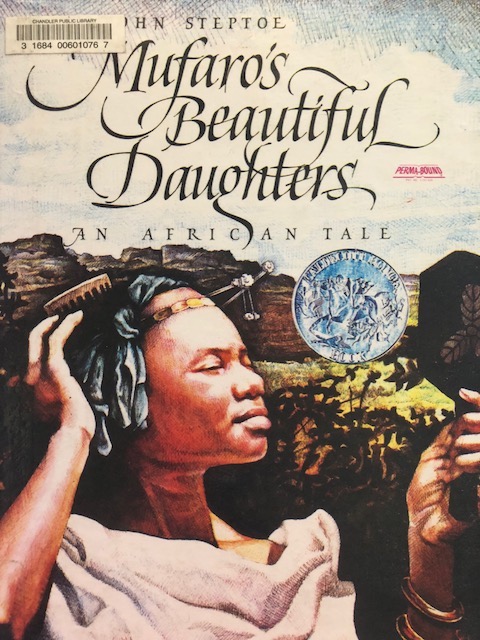
Mufaro’s Beautiful Daughters by John Steptoe, 1987.

This story, based on an African folktale, is somewhat similar to other folktales and fairy tales from other parts of the world such as Cinderella, Mother Holle, and Vasilisa the Beautiful, where a girl with a kind, hard-working nature triumphs over a mean sibling because someone in authority recognizes her good nature and rewards it.

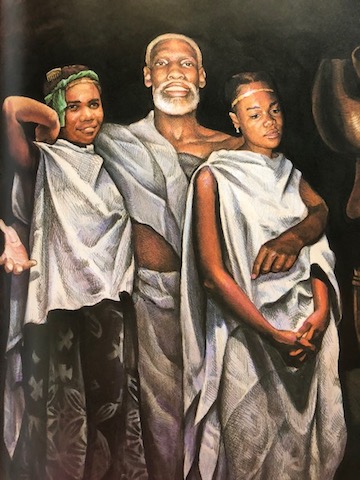
In a small village in Africa, a man named Mufaro has two daughters, Manyara and Nyasha.  Both girls are beautiful, strong, and clever, but they have very different natures.  Nyasha is kind, gentle, and patient.  Manyara is bad-tempered, jealous, and self-centered.  She frequently taunts Nyasha about how, one day, she will be the queen and her sister will be her servant.  When Nyasha asks her why she is so mean, Manyara says that she hates the way people praise Nyasha for her kindness.  She thinks that Nyasha is their father’s favorite child, and she wants to prove that Nyasha’s “silly kindness is only weakness.”

MufaroSisters

Since there is nothing that Nyasha can do to change her sister’s mind or attitude, she just continues doing her usual chores and being kind to people and animals.  In particular, she makes friends with a small garden snake, knowing that his presence in her garden will keep away pests.

Manyara is sneaky and always behaves herself when their father is present, so Mufaro doesn’t know about the troubles between his daughters.  When a messenger arrives, saying that the Great King is seeking a wife and that beautiful, worthy girls are summoned to his city so that he can choose from among them, Mufaro is proud and eager to present both of his beautiful daughters.  Manyara tries to persuade her father to send only her, but Mufaro is firm that both girls must present themselves for the king’s decision.

Manyara decides that the only way to get the better of her sister is to be the first to arrive and present herself to the king, so she slips out in the middle of the night and begins the journey alone.  However, both the journey and the king are not what Manyara thinks they are.  Along the way, Manyara encounters various strange characters who ask for help or offer advice, but thinking that a queen doesn’t need to pay attention to others or do anything she doesn’t want to, Manyara ignores them all.

Nyasha, on the other hand, gets ready to leave at the appointed time in the morning.  Everyone worries about Manyara but decides that the best thing to do is to follow her to the city, since she seems to have gone on ahead.  As Nyasha travels with the rest of their friends and family, she listens to the people Manyara ignored and shows them kindness.

MufaroCity

When they finally reach the city, Nyasha encounters a terrified Manyara, who hysterically insists that when she went to meet the king, she found a horrible monster instead.  However, like everything else, it’s just another part of the test, and Nyasha is the one who passes because she, like her sister, has actually met the king before, but unlike her sister, she actually paid attention to him.

MufaroSnakeKing

The pictures in the book are beautiful and colorful.  A note in the front of the book says that the buildings in the illustrations were based on an ancient city in Zimbabwe that is now ruins.  The note in the book also explains that the names of the characters in the story come from the Shona language.  The meanings of the names are clues to the characters’ natures.  Manyara means “ashamed”, and Nyasha means “mercy.”

The book is a Caldecott Honor Book.  It is currently available online through Internet Archive.
MufaroWedding

The Stinky Cheese Man

StinkyCheeseMan

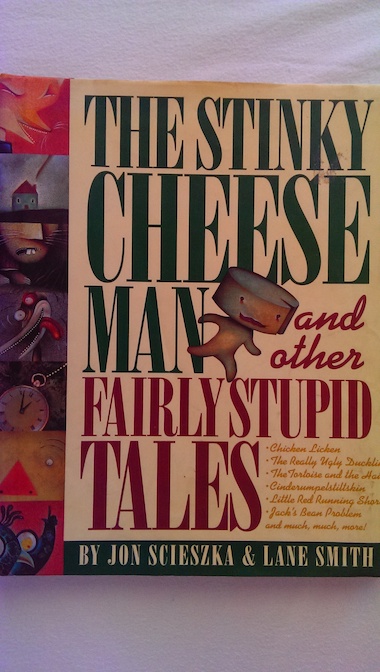
The Stinky Cheese Man and Other Fairly Stupid Tales by Jon Scieszka and Lane Smith, 1992.

StinkyCheeseManDuckThis book is a spoof on a number of classic fairy tales. As it explains in the introduction, the short stories included in the book are more Fairly Stupid Tales than Fairy Tales, giving the example of Goldilocks and the Three Elephants: A girl smells peanut porridge and wants to enter the elephants’ house to eat some and try out their furniture, but elephant furniture is too big for her to climb up on, so she just leaves, The End. That incredibly short story isn’t found anywhere else in the book, but it’s a good example of what the other stories are like.

Even the set up of the book is a joke, with the Little Red Hen showing up to demand help with her wheat only for Jack the Narrator to tell her that it’s too soon because they haven’t even had the title page yet. The title page has the words “Title Page” larger than the title itself, and the dedication is upside down because who would actually read it anyway? Then, Chicken Licken thinks that the sky is falling and that everyone should run and tell the President, but it turns out that what’s falling is actually the Table of Contents, which squashes everyone before Foxy Loxy can eat them.

Then, the rest of the stories begin:

StinkyCheeseManMattressesChicken Licken – As described above

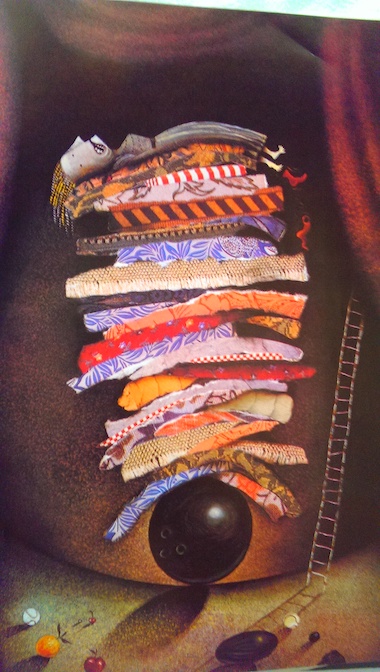
The Princess and the Bowling Ball – parody of the Princess and the Pea – Starts off like the original story with the prince’s parents testing princesses to see if they can feel a pea through a whole bunch of mattresses, but none of them ever do, so the prince takes matters into his own hands to rig the test in favor of the girl he really wants to marry.

The Really Ugly Duckling – parody of The Ugly Duckling – When the really ugly duckling grows up, he’s basically just an ugly duck. The End.

The Other Frog Prince – parody of The Frog Prince – The frog isn’t really a prince. He just said that because he wanted a kiss.

Little Red Running Shorts – parody of Little Red Riding Hood – Jack the Narrator accidentally spoils the story by revealing too much in his introduction to it, so the characters feel like there’s no need to act it out, and the Little Red Hen fills up the extra space, demanding to know why they haven’t gotten to her story yet.

Jack’s Bean Problem – parody of Jack and the Beanstalk – Jack the Narrator starts to tell his own story about defeating the Giant, but the Giant protests because he doesn’t like always being tricked and takes control and reads a story that he “wrote” himself, cut out of pieces of other random stories from different books. When the Giant threatens to eat Jack if he can’t tell a better story, Jack tells a story that constantly repeats until it transitions into the next one.

Cinderumpelstiltskin – parody of Cinderella and Rumpelstiltskin – Starts out like the usual Cinderella story, but Rumpelstiltskin shows up and offers to teach her how to spin straw into gold. Cinderella doesn’t see how that can possibly help her since he doesn’t have a gown for her to wear to the ball, so she ends up without either a gown or any gold.

The Tortoise and the Hair – parody of The Tortoise and the Hare – A rabbit tells the tortoise that he’s so slow that he can grow hair faster than the tortoise can run. By the end of the story, the tortoise is still running, and the rabbit is still growing hair.

The Stinky Cheese Man – parody of The Gingerbread Man – An old couple make a “child” for themselves out of stinky cheese. When he takes on a life of his own and run away, they don’t bother to chase him because they can’t stand the smell. Nobody else wants to chase him, either.

StinkyCheeseManCinderSo, why isn’t there a Little Red Hen story listed? At the end of the book, she shows up to complain about how she had to do everything herself to make the bread and nobody even saved space for her story (because Jack had to sneak away from the Giant after he fell asleep). The Giant wakes up and decides to make a chicken sandwich with the bread.

Understanding the jokes in the book requires a knowledge of the stories they’re spoofing, so this isn’t a book for very young children. Any kid who reads this should already know the classic fairy tales and be old enough to appreciate the humorous twists. I think kids feel clever when they realize that they can recognize the references in the stories and know where and how the parodies are different from the originals. Some of the humor has to do with the abrupt endings, simplifying issues that are more drawn-out in the original stories.  I remember liking this book when I was in elementary school!

The art style is very distinctive, with a number of cutout elements with different textures. It’s fascinating to see the way that the pictures were put together.

The book is currently available online through Internet Archive.

The Practical Princess

PracticalPrincess

The Practical Princess and Other Liberating Fairy Tales By Jay Williams, 1978.

PracticalPrincessSilverWhistleThe modern fairy tales in this book (these are not traditional stories or folktales, although they are written in the style of old fairy tales) feature brave and clever girls. These are not just damsels in distress who need to be rescued, but girls who play heroic parts in their own stories. However, I don’t want you to think that the stories get too preachy about girl power. Some of the men in the stories may seem less than heroic at, but each of them is clever in their own way, and they are sometimes the main characters in the stories as well. The stories don’t lecture you about how “girls are just as good as guys and maybe even better“ or try to make the girls look smarter by making everyone else look dumb or things like that (in spite of the name, “Stupid Marco”, Marco really isn’t all that bad). They’re just fun stories in a fairy tale style with interesting heroines. The best part is that the stories also have a sense of humor.

There is only one full-color illustration in the book. The other pictures are done as silhouettes.

The book is available to borrow and read for free online through Internet Archive.

The stories in the book:

The Practical Princess

When Princess Bedelia is born, she goes through the typical fairy tale ritual of having fairies give her gifts. One of them gives her common sense. When she grows up, she uses it to devise a clever plan to free her kingdom from a fearsome dragon. Unfortunately, she attracts the attention of the evil Lord Garp, who tries to force Bedelia to marry him. When Lord Garp tries to cheat at the tasks she sets for him to prove his worthiness and she catches him doing it, he imprisons her in a tower, and she must use her wits and the help of his other captive to escape.

PracticalPrincessMarcoStupid Marco

People think that Prince Marco isn’t terribly bright because, instead of applying himself seriously to his studies as his brothers do, he has a habit of spending his time daydreaming and writing poetry, and he can never remember how to tell left from right. However, he has three major accomplishments: he is an extremely likeable person, he can whistle very loudly, and he can cure even the worst case of hiccups. In his kingdom, it’s a tradition for princes to win their future brides by going out and rescuing a princess from something (how do all these princesses get into that much trouble anyway?). To make this task easier for Marco, his father tells him about a princess he can rescue and gives him a set of simple instructions to follow. Of course, Marco loses his way and the instructions. He meets a nice young woman named Sylvia who offers to help him, but still, nothing goes as planned. However, there’s more than one princess in the world and more than one type of rescuing, so things turn out well in the end.

The Silver Whistle

When Prudence comes of age, she sets out in the world to seek her fortune. Before she leaves home, her mother, the Wise Woman of the West, gives her a magical silver whistle. If she blows it once, birds will come to her. If she blows it twice, insects will come. If she blows it three times, animals will talk to her. However, she cannot blow it four times because it will break. Prudence finds employment with an old witch who has a plan to make herself beautiful so that the prince of her kingdom will want to marry her. Although Prudence has doubts about her plan, she uses her magical whistle to help her, but only to a point. Besides, people have different ideas about what beauty is.

Forgetful Fred

Fred works as kind of an odd job man for a very wealthy man named Bumberdumble Pott. However, he tends to be somewhat absent-minded because his real love in life is music, and he’s often thinking about that when he should be focusing on what he’s doing. Bumberdumble Pott continues to employ him because he’s pleasant, kind, and likable. In spite of his wealth, there is something that Bumberdumble Pott wants that he can’t buy: the Bitter Fruit of Satisfaction. It’s a rare fruit found a long way away, across mountains and deserts and is guarded by a dragon-like create, the Fire Drake. Bumberdumble Pott knows that he’s too old to undertake the quest for the fruit, so he asks among his servants if someone else will go on his behalf. The only person willing to try is Fred, and Bumberdumble Pott promises him half his gold if he succeeds. It’s a long journey, and Fred has a map to keep him focused on his task. In the end, it’s no fault of his when he isn’t able to bring the fruit to his employer for his reward, but Fred attains his own kind of satisfaction when he is able to live the kind of life he likes with the nice girl who tried to help him and is able to play his music as often as he wants.

PracticalPrincessPetronellaPetronella

For generations, the royal family of Skyclear Mountain has always had three princes, who are always given the names Michael, George, and Peter. When the princes come of age, they all go on a quest. The two eldest princes go out and seek their fortunes elsewhere, never returning to their kingdom, but the youngest always comes back with a bride to continue the royal line. When the current king and queen have a daughter instead of a son for their third child, they’re not sure what to do. They name her Petronella instead of Peter, but what’s the point of sending her out to seek a bride when she’s older?  As a princess, she should wait for a prince to seek her as a bride. However, when the time comes, Petronella insists that she wants to continue the tradition by going out to seek her fortune and find a prince for herself. Even though it seems oddly backwards from how things are supposed to go, her family agrees. When she and her brothers come to a road that divides three ways, they ask the old man sitting nearby where the roads go. He answers their questions, but Petronella asks him the correct one to release him from the spell that had kept him there. In return, he tells her that if she’s looking for a prince, she should try the house of Albion the enchanter, and he gives her advice about completing tasks that he will set for her and the rewards she should ask for, which will allow her to escape from the enchanter when she decides to flee with the prince. Petronella follows his advice, but the situation isn’t quite what Petronella thinks it is.  Like Petronella’s own situation, circumstances at the enchanter’s house are . . . oddly backwards. In the end, she ends up saving an enchanter from a prince.

Philbert the Fearful

Most knights can’t wait to charge into battle or undertake a dangerous quest, but Sir Philbert is different. He prefers to stay home, read good books, and look after his health. However, his doctor recommends that he undertake a quest because he needs the fresh air and exercise. Whether he really wants to or not, Philbert finds himself going on a quest with three other knights to save the emperor’s daughter from the fearsome enchanter, Brasilgore. The journey is dangerous, and two of the knights are killed, but Sir Philbert does return with the emperor’s daughter. When the other surviving knight complains that Philbert used more trickery than true bravery to defeat his enemies, the emperor explains the value of prudence. Philbert uses his wits to take care of himself and the princess, and there are benefits to staying alive rather than losing your life in a foolhardy stunt.

Papa Gatto

PapaGatto

Papa Gatto by Ruth Sanderson, 1995.

This beautiful picture book, set in a fairy-tale Italy, is based on several folk tales, as the author explains on the page with the publishing information.  Among the tales that served as inspiration for this story is The Colony of Cats, which is from Andrew Lang’s The Crimson Fairy Book.  In some ways, this story is similar to Cinderella and Mother Holle, with its wicked stepmother and stepsister.

In the distant past, so the story says, it was common for animals to talk, and one of the wisest cats was Papa Gatto, who served as an adviser to the prince.  Papa Gatto had a lovely wife and a beautiful mansion, but soon after the birth of their eight kittens, his wife died.  Needing someone to help care for the motherless kittens, Papa Gatto decides to advertise for someone to help.

PapaGattoAdvertises

In the town, there is a widow who has a daughter named Sophia and a stepdaughter named Beatrice.  As in many fairy tales, the widow favors her own daughter, who is lazy and spoiled, while giving all of the hard work to her stepdaughter, who is much nicer.  When they hear about Papa Gatto’s advertisement, Beatrice feels sorry for the young kittens and wants to help.  However, the widow, thinking of the generous fee that the wealthy Papa Gatto is offering, decides that she wants it for Sophia.  Sophia doesn’t want the job, but at her mother’s urging, she goes to see Papa Gatto anyway.

PapaGattoSophia

Papa Gatto gives Sophia the job tending his house and family while he’s away on a trip, but Sophia doesn’t know how to work hard and has no real intention of doing a good job.  She simply makes herself at home in Papa Gatto’s lovely mansion, trying on his dead wife’s jeweled collars as bracelets and neglecting the housework and kittens.  When Papa Gatto returns home and sees what she’s done, he sends her away in anger.

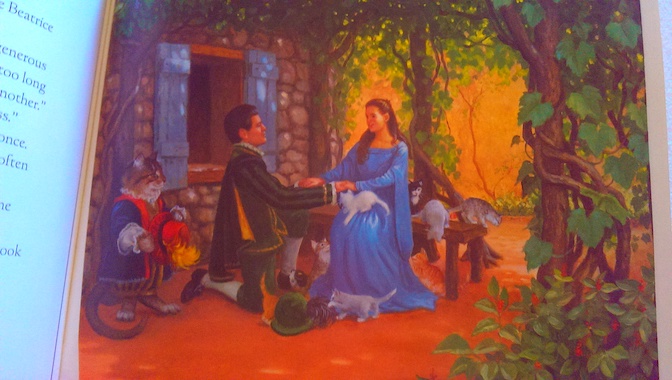
When Beatrice hears that Papa Gatto is once again looking for help, she goes to see him without telling her stepmother about it.  Papa Gatto sees how interested she is in the kittens and how gently she treats them, he gives her the job, reassured that she will do it well.

PapaGattoBeatrice

Sure enough, when he returns from his next journey, he sees that Beatrice has taken good care of the house and kittens and rewards her with the jeweled necklace/bracelet that Sophia had admired.  Needless to say, Beatrice’s stepmother and stepsister are angry with Beatrice when she returns home, and Sophia takes the bracelet for herself.

Meanwhile, Papa Gatto has told the prince about Beatrice.  The prince has been thinking about marrying, and he says that he would like to meet Beatrice.  Papa Gatto tells him that she will probably be at the coming fair in town, and the prince should attend and look for the girl with the bracelet.

At first, the prince mistakes Sophia for Beatrice, a deception that she and her mother encourage.  However, when the prince speaks to Papa Gatto again, Papa Gatto realizes the deception and sets things right.

PapaGattoRevelation

The pictures in this book are beautiful!  And, of course, there’s a happy ending.

I liked it that Beatrice didn’t accept the prince’s offer of marriage immediately, saying that she’d like to get to know him first.  It’s more sensible than the fairy tales where they get married right away.

PapaGattoHappyEnding

The Seventh Princess

The Seventh Princess

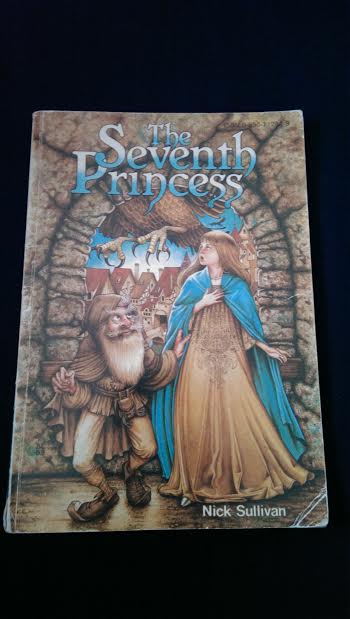
The Seventh Princess by Nick Sullivan, 1983.

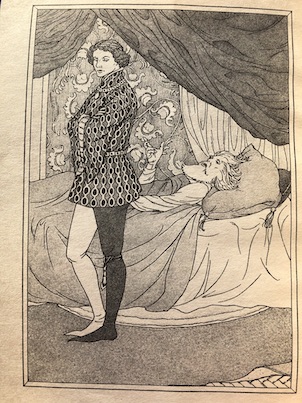
Jennifer never remembers her dreams, so she doesn’t think that she’ll be able to complete the essay that her teacher assigned them to write: My Strangest Dream.  While she’s worrying about not being able to finish her homework, she dozes off on the school bus on her way to school.

Suddenly, Jennifer finds herself in a beautiful carriage being driven through a dark forest.  Jennifer is happy that she’s apparently going to have a dream that she can write about, so she decides to enjoy it as much as possible, trying on the beautiful gown, cloak, and jewelry that she finds in the carriage with her.  Eventually, the carriage stops at a huge palace, and Jennifer comes to the realization that the carriage never had a driver.

She is greeted by Duke Rinaldo, the Lord High Chancellor of the kingdom of Eladeria. Jennifer is informed that she is Princess Miranda, the king’s adopted daughter.  Actually, Jennifer is the seventh of the king’s “daughters.”  There were six others before her . . . and their fates are unknown.

This is no ordinary dream.  The king of Eladeria is ill, possibly bewitched.  The king’s son is missing.  There is treachery in the palace.  People live in terror of the evil enchantress Swenhild and her harpies.  Soon, they will demand a tribute: a golden-haired princess with blue eyes . . . like Jennifer, er, Princess Miranda!

The only one who seems to want to help Jennifer is her new friend, Samson the dwarf, who is the palace’s court jester.  He introduces her to his friend, Prospero, who can do magic and understands more of what’s happening than most people.  He tells her that her only hope is to find the Paladian Scroll and use its power.  Can Jennifer and Samson find this mysterious scroll in time?  It might still be possible to save the other princesses, but Jennifer worries about whether she’ll ever wake up in her own world again.

This book is available online through Internet Archive.
My Reaction

One of the things that I love about this book is how it brings in some lesser-used fantasy creatures, like the harpies, and characters, like the dwarf jester.  The “was it a dream or wasn’t it” trope has been used a lot, but the adventure within the dream itself is fun, exciting, and very well-done.

The Ordinary Princess

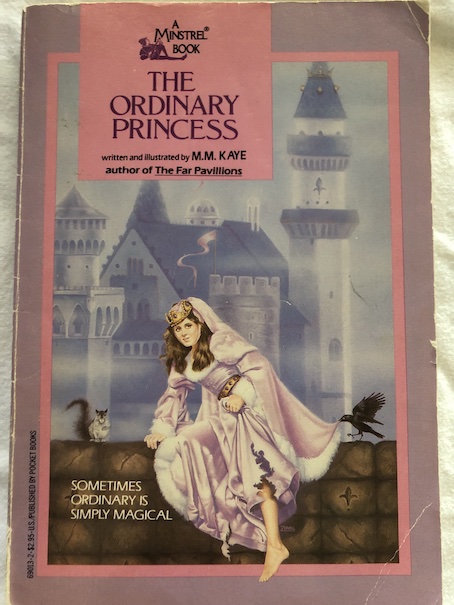
The Ordinary Princess by M.M. Kaye, 1986.

Lavender’s blue,
Rosemary’s green,
When you are king,
I shall be queen.

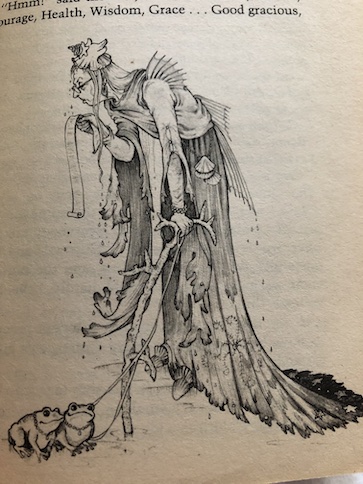
Everyone is excited when a seventh princess is born in the kingdom of Phantasmorania.  Everyone knows that seventh princesses are always the luckiest and the most beautiful.  Indeed, when Princess Amethyst Alexandra Augusta Araminta Adelaide Aurelia Anne is born, she is a beautiful baby who never cries and who has perfect blonde curls and blue eyes.  But, when one of her fairy godmothers, Old Crustacea, comes to the christening to give her blessing and sees all the perfect presents everyone has given her and little Princess Amethyst’s six perfect older sisters, she decides, “I am going to give you something that will probably bring you more happiness than all these fal-lals and fripperies put together.  You shall be Ordinary!”

Of course the king and queen are horrified, but there’s nothing to be done.  From that day on, Princess Amethyst becomes an ordinary baby who grows up to be an ordinary girl.  She cries when she’s hungry and tired.  Her golden hair darkens from golden blonde to a mouse brown and loses its curl.  She gets freckles!  Sometimes, she even makes spelling mistakes!

While everyone else is distressed at Princess Amethyst’s (now called Amy most of the time) lack of perfection, Amy realizes that Old Crustacea was right about it making her happier.  While her perfect sisters must behave themselves and keep their clothes clean, Princess Amy sneaks off to run and play.  She meets ordinary people, makes new friends, and has fun adventures.

But, eventually, all of her sisters grow up and get married.  When it’s Princess Amy’s turn, most of the princes aren’t interested because she’s not the beautiful, perfect seventh princess that she’s supposed to be.  Amy would be alright with that, but when her father and his advisors come up with an outlandish scheme to attract a prince that involves a dragon, Amy decides to put a stop to it by running away.

For a time, she lives a carefree life in the forest, but eventually, like all ordinary people do, she realizes that she’s going to need money to buy new clothes.  On the advice of Crustacea, she journeys to a neighboring kingdom and finds a job in the palace there as a kitchen maid. 

Actually, she finds more than that, finding her place in the world and someone who loves her for the ordinary princess that she is.

The book is divided into four parts, each of them titled after a verse from a version of the old folk song Lavender’s Blue (most versions say “lavender’s green” instead of “rosemary’s green”, although I do like saying “rosemary” better – this is the tune). The book also contains many small, black-and-white illustrations alongside the text.

It is available to borrow and read for free online through Internet Archive.

My Reaction

I think this is a beautiful book with a good message for girls. Being glamorous or trying to conform to someone else’s idea of perfection doesn’t bring as much happiness as knowing who you really are and finding someone who loves you and wants to live the same kind of life you do, imperfections and all. Not every “prince” out there is looking for the same type of “princess,” just the one that’s right for him. In the end, Amy finds a king who is just her kind of person.

The Plain Princess

The Plain Princess by Phyllis McGinley, 1945.

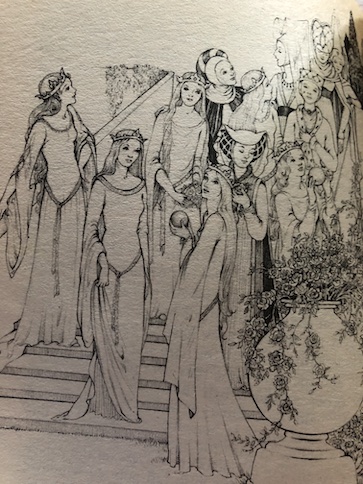
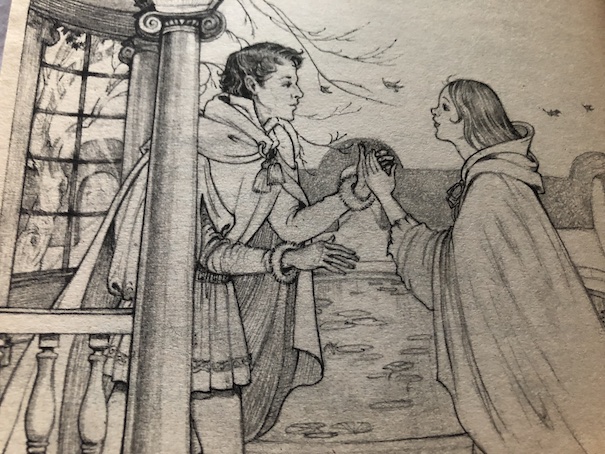
I would dearly love to see this book in print again!  It’s a charming modern fairy tale about a young princess who learns what beauty and happiness really mean.

Esmeralda is the only child of the king and queen, and she has just about everything that a girl could want. The author paints a pretty picture of Esmeralda’s charmed life at the castle and all of the beautiful things she has.

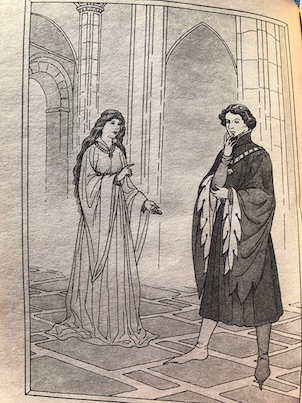
However, Esmeralda has one serious problem: she is plain. In her kingdom, in order for a girl to be considered beautiful, her nose must turn down, her mouth must turn up, and her eyes must have a twinkle in them. Esmeralda’s appearance is exactly the opposite. It is a serious problem because her plainness causes people to lose respect for her, and the prince that she is betrothed to refuses to take much of an interest in her.

Although her parents consult the finest physicians and wizards available, none of them can provide any solutions for Esmeralda’s condition. It is only after the king places an advertisement in the newspaper that a widow, Dame Goodwit, with five daughters of her own comes to the castle and offers a solution. However, she insists that Esmeralda must come and live with her family for nine months. At first, Esmeralda is distressed at leaving her home and living in much simpler circumstances that she is accustomed to, but the reasons soon become as plain as the princess herself.

As Esmeralda interacts with and becomes friends with Dame Goodwit’s daughters, Annabelle, Christabelle, Dulcibelle, Floribelle, and Echo, she comes to see herself and her old life at the castle differently.  At Dame Goodwit’s, she is expected to take care of herself and her belongings by herself, for the first time in her life.  She is given chores to do and becomes responsible for herself in ways that she never was before.  She also comes to see that, even though Dame Goodwit’s daughters are not princesses, in many ways, they are more knowledgeable and accomplished than she is, able to do many things that Esmeralda has never even tried before.  Little by little, Esmeralda learns and tries new things, even coming to enjoy her time with the family and becoming especially fond of little Echo, the youngest girl.  Her new experiences change her, her behavior, her attitudes, and eventually, even the way she looks.

The book is available to borrow and read for free online through Internet Archive.
My Reaction

In spite of the fairy tale atmosphere, there isn’t really any magic in the story, as the widow herself points out. The real magic of the story is in the lessons that Esmeralda learns: that beauty and change come from within and that the way we see ourselves and those around us is important. For those who might be concerned at the emphasis on “beauty” and “plainness”, it soon becomes apparent that the outward signs of beauty really stand for positive character traits: humility, pride in one’s own talents and accomplishments, and unselfish caring for other people. The book also has some very pretty illustrations, some of which are wide scenes taking up two pages. It’s a beautiful book and a beautiful story for any young girl.

I don’t think that the book was ever made into a movie, but there are multiple versions that are stage plays (the link is to a video clip from a stage version of the story), including some that are musical.  I have seen a script for one of them that has added religious themes that weren’t in the original book, but the site has since been removed.  I’m sure that the script still exists, I’m just not sure where to find it now.  Some of the narrator’s and characters’ dialog was taken directly from the original book, but the religious parts were added.  As I recall, it implied that the princess’s personality changes came through the grace of God or developed as her religious side also developed, but I can’t remember now exactly how they said it.  I think it may have included some Biblical quotes related to the personality traits the princess acquires.  At one point, it was the only script that I could find available for free online.  There are other play versions that are available for purchase elsewhere, such as Dramatic Publishing and Steele Spring Stage Rights.