#124 The Pumpkin Head Mystery by Gertrude Chandler Warner, 2010.
The Aldens are getting ready for Halloween, and they go to the Beckett farm to get some pumpkins. Mr. Beckett has been having trouble this year because he broke his leg. He’s been letting a hired assistant, Bessie, handle the pumpkin patch, but she is short-tempered and not very good with customers. Mr. Beckett fired her once before, but he had to take her back this year because he was desperate for help.
Mr. and Mrs. Beckett’s daughter, Sally, has been trying to persuade them to sell their farm and come live near her and her children in Florida. She thinks they’re getting too old to manage the farm by themselves and that this recent injury of Mr. Beckett’s proves it. The Becketts say that they don’t want to give up their farm and that they’re not ready to retire. Then, one of the farm hands, Jason, says that Mr. Beckett broke his leg while chasing a pumpkin-headed ghost, but Mr. Beckett denies that it exists.
Later, someone trashes the pumpkin patch and smashes a lot of pumpkins, and for some reason, Bessie faints. The real estate developer who is pressuring the Becketts to sell their farm, Dave Bolger, shows up again and tries to persuade the Becketts to sell. Sally thinks her parents should take the offer, but they still refuse. The Aldens help clean up the pumpkin patch in time for the next hayride, so the Becketts won’t have to cancel it, and Sally tells them that the farm is haunted and that the stories Jason has been telling about the pumpkin-headed ghost are true.
A glowing pumpkin has been seen floating through the fields at night, seemingly with no body underneath it. When it appears, they hear scary voices, telling them to leave the farm and leave the spirits in peace. Mr. Beckett did injure his leg while trying to chase after it on his horse. The Aldens think this sounds scary, and they ask Sally if the farm was always haunted. Sally admits it wasn’t, but she is serious that she thinks her parents should sell the place and move closer to her and her family.
The Aldens want to help the Becketts, and they start doing some seasonal work at the farm, making flyers for their hayrides and dressing up in costumes as part of the spooky attractions. Then, someone steals the scarecrow that Benny made from the Aldens’ house, and a new pumpkin-headed ghost appears on the farm!
Are there actually any ghosts, or is someone pulling a trick on the Becketts? Is it one of the people trying to pressure the Becketts to sell the farm or someone else, for a different reason?
My Reaction
I enjoyed this spooky mystery! The author did a good job of making multiple characters look like good suspects for playing ghost on the farm. Mr. Bolger and Sally both want the Becketts to sell the farm, and scaring farm workers and visitors away from the farm would add pressure to the Becketts. Bessie isn’t very good at her job, but the Aldens discover that she needs money because her husband is sick. Could she have been paid to commit some sabotage on the farm or could she be trying to get back at the Becketts for firing her last season? Jason has worked on the Becketts’ farm for years and seems to love the place, but he’s been arguing with Mr. Beckett about the way he runs the farm. Maybe Jason wants the farm for himself! There are some good possibilities for suspects.
There were some clues that I thought were obvious, like the connection between the disappearance of Benny’s pumpkin-headed scarecrow and the sudden appearance of a new pumpkin-headed ghost on the farm, but child readers may find the mystery more challenging. Even though I thought some parts were obvious, because there were several suspects, each of which seems to be doing something sneaky that they want to cover up, I wasn’t sure whether some of them might be working together or not.
The book has the right amount of spookiness for a Halloween story without being too scary for kids. In some ways, like with all Scooby-Doo style pseudo-ghost stories, I thought that it was a little silly for the plot to frighten people away from the farm to succeed. My reasoning is that, since this story is set in the Halloween season and some parts of the farm are deliberately set up as haunted attractions with people running around in costumes, I would think most farm workers and visitors would just attribute the pumpkin-headed ghost to either a Halloween prank or just part of the act at a spooky attraction.
One of the possible motives that they never discuss in the story is that the ghost act could be a publicity stunt to draw more visitors to the park. While the premise of the story is that people are being scared away, in reality, there are a lot of curiosity-seekers who would want to go to a supposedly haunted attraction to see what all the fuss is about. Publicity isn’t the real motive of the fake ghost, but I’m just saying that it could have been a real possibility that was overlooked. There are a lot of places, like hotels and restaurants in historic buildings, that capitalize on any potential ghost stories to attract curious thrill-seekers.
Something I appreciated is that the real estate developer is Dave Bolger, which is a homage to Ray Bolger, who played the role of The Scarecrow in the 1939 movie of The Wizard of Oz. Is that a hint? I’ve decided not to spoil the solution of the mystery!
The Case of the Counterfeit Coin by George Wyatt (Charles Spain Verral), 1960.
One Saturday, Jimmy Carson is going around, collecting fees from customers on his paper route, when he decides to stop for a soda. To his surprise, he discovers that one of the coins he has received from a customer turns out to be something very unusual. It appears to be from a foreign country, although Jimmy doesn’t recognize what country it’s from. When someone suggests that it could be a rare and valuable coin, Jimmy decides to call his friend and detective partner Brains Benton and ask him what he thinks about it. However, as Jimmy is talking to Brains at a public pay phone, someone tries to reach into the phone booth to grab the coin! Luckily, Jimmy notices in time and yells, and the person doesn’t succeed in getting the coin. Jimmy isn’t able to see the person’s face, but he gets a good look at their hand, the person’s hand has an odd, blackened thumbnail.
It seems that the coin has greater significance for someone than just an odd foreign coin that they accidentally spent instead of American money. When Brains looks at the coin, he identifies it as an ancient Athenian coin, but he also notices that someone has used modern implements on the coin and a varnish to make it look older than it really is. In other words, the coin might at first look like a collector’s coin, but it’s actually a fake. So, if the coin is fake, where did come from, and who wants it so badly?
The boys start going over Jimmy’s route to try to figure out where the coin came from and if any of Jimmy’s customers have a blackened thumbnail. It turns out that the coin came from Binky Barnes’s house. Binky is about their age, but the boys consider him to be a nuisance because he has a way of exaggerating things and is always telling tall tales. You can’t believe a lot of things that Binky says, but the coin apparently came from Binky’s coin collection. It was a new acquisition, and his mother was the one who accidentally gave it to Jimmy when paying him for their news delivery. That still doesn’t explain who was trying to steal it from Jimmy.
Binky is upset when the boys tell him that his coin is a fake, but they point out that he’s legally entitled to get his money back from the person who sold it to him. Binky says that he bought the coin at an old junk shop owned by a man named Silas Gorme. When the boys go to the shop with Binky, they discover that Silas Gorme is the man with the blackened thumbnail who tried to steal the coin from Jimmy!
Silas Gorme is quick to offer Binky a refund in exchange for getting the coin back, but Brains confronts him about how he tried to steal the coin from Jimmy earlier and demands to know where the coin came from. Gorme finally agrees to take the boys to the coin dealer he purchased the coin from, Jeremy Dexter. Gorme tells Dexter that he wants his money back because the coin is fake, but Dexter denies selling him a fake coin. When Dexter examines the coin, he confirms that it’s fake and that it looks like the coin he sold Gorme, but he insists that the coin he sold was authentic.
During the conversation with Dexter, it is revealed that Gorme sold the coin to Binky for less than he paid when it bought it from Dexter, which looks suspicious. Then, they find the tools used for creating the fake coin in Dexter’s shop, which also looks suspicious. Dexter denies that those tools belong to him, but the situation has now become a police matter. Brains is sure that Gorme planted the tools in Dexter’s shop to frame him, and Jimmy is concerned that Dexter is in trouble because of them. Can the boys figure out what Gorme’s game really is and prove it?
The book is available to borrow and read for free online through Internet Archive.
My Reaction and Spoilers
This story has the trope of a tomboy girl who is mistaken for a boy. Jeremy Dexter has a daughter called Terry. Terry is one of those neutral names that can be nicknames for other, longer names. In this case, Terry is short for Theresa. When the boys first meet her, she’s dressed in clothes that a boy might wear and a baseball cap, and when she gets mad at the boys for getting her father into trouble with the police, she tries to hit Brains and accidentally hits Jimmy. At first, Jimmy is ready to get into a fight with Terry, thinking that Terry is another boy, but Brains stops him and points out that Terry is actually a girl. Traditionally, it isn’t considered acceptable for a boy to hit or get into a fight with a girl, so Jimmy would look bad for hitting Terry back, even though she struck first. The whole situation is something of an old-fashioned trope that’s partly there to show how bright Brains is for noticing something that Jimmy didn’t.
Terry is also a Scrappy-Doo-like character, picking fights to prove she’s tough and charging in when she’s not supposed to, messing things up. Brains and Jimmy find her annoying because of that, and frankly, so did I. A tough and intelligent girl is good and could be a real help to the boys as well as being a client, but Terry’s a thoughtless, put-up-your-dukes kind of character and doesn’t really add anything to the plot besides comic relief. Really, it’s odd for her to be the kind of character who sees fist fighting as her first resort because her father is such a gentle, intellectual type. I just don’t see the point in it.
The mystery itself seems pretty obvious. Considering that only Dexter, the boys, and Gorme are present in Dexter shop when the counterfeiting tools are discovered, it seems pretty obvious who planted them. This is one of those books where there’s less emphasis on whodunit than how they’re going to prove it. I’m not that big on most howdunit style stories, but this one does have a bit of a twist because the boy discover that Gorme is really only the tip of the iceberg. He’s not just an unethical shopkeeper selling one duplicate coin so he can sell his antique coin and have it, too. I turns out that he’s just one member of a larger counterfeiting ring, and the others aren’t happy with him for drawing attention to their activities. Brains and Jimmy infiltrate the gang’s hideout to get the proof that they need to prove what’s really going on to the authorities.
The Silver Spoon Mystery by Dorothy Sterling, 1958.
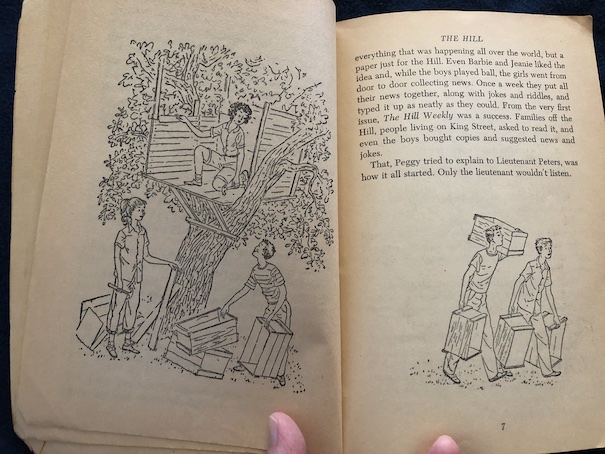
A group of families move into the new suburb built on The Hill overlooking the town of Dwighton. The kids in the new neighborhood become close friends, visiting each other’s houses, playing games, and running around town together. It’s idyllic, but then the boys in the group start playing baseball together, and they begin excluding the girls from the group, even though they’ve all played baseball together before and the girls are good at it. The boys also stop working on the tree house that the kids were all making together, taking some of the tools and materials and building themselves a clubhouse near the baseball field with a sign that says, “NO GIRLS ALLOWED.”
The girls are offended at suddenly being shunned by the boys, so they decide that they need to have some special project, something that will show the boys that girls are just as good as they are and that the girls don’t have to rely on the boys to have some fun. They decide to start a neighborhood newspaper, writing about local events and having fun stuff, like jokes. The newspaper is a success, and adult neighbors buy copies. Then, the boys decide to start a competing newspaper themselves. One of the girls, Peggy, is upset because she’s sure that the boys’ newspaper will be more successful. Some of the boys are older than the girls so they might write better, there are more boys than girls in the group so they have more people to gather news and sell papers, Davey is better at drawing cartoons than the girls are, and worst of all, the boys splurged to buy a hectograph, which uses a gelatin substance for making copies of writing and drawings (as in this video) and will allow the boys to print papers by the hundred (“hecto” means one hundred, and that’s how many copies a hectograph makes at a time). (This is before home computers, so the characters have to rely on manual printing methods. People used hectographs to make copies before modern copy machines, but modern hectographs still exist, and some people use them for artwork or tattoo stencils.)
Peggy’s afraid that the girls won’t be able to compete with the boys’ advantages and thinks that the boys are mean for trying to steal their business. Peggy’s mother tells her that she shouldn’t worry about being better than the boys but focus on being different. She says that the girls should make sure that their paper has different content from the boys’ paper so people will still have a reason to buy theirs even if they’ve already bought the boys’ paper. If the boys’ paper has cartoons, the girls’ paper should have things the boys wouldn’t think to include, like recipes, poems, and fictional stories that could be written and submitted by local people.
Peggy gets an idea from what her mother says, but it’s not a good one. Peggy still wants to show up the boys, and she thinks that the best way to do it is to get a “scoop”, meaning printing an exiting news story that the boys won’t have in their paper. The problem is that the girls don’t know where they’re going to get an exciting news story that the boys don’t know anything about. Nothing that exciting is happening in their town anyway. There haven’t been any shocking events, no murders, no robberies. Peggy tells the other girls that means that they have write about something that hasn’t happened yet. Peggy poses the idea of writing about someone stealing the silver on display at the local library that was made by the silversmith who was the founder of their town. Of course, the problem with that is that the silver hasn’t actually been stolen. One of the girls, Ellen, objects to writing a story about something that hasn’t happened because that’s not actually “news.” However, Peggy talks the other girls into it by saying that they would be writing about it as fiction because people write fictional books all the time, and that’s allowed. Ellen still isn’t convinced, but Peggy goes ahead and writes the story anyway. (Basically, she’s turning the girls’ newspaper into a tabloid, although the kids don’t seem to quite get the difference, even though Ellen can tell that this isn’t right for a newspaper.) The girls all discuss how they would go about stealing the silver spoons from the library, if they were going to do it, and Peggy writes the story from their speculations.
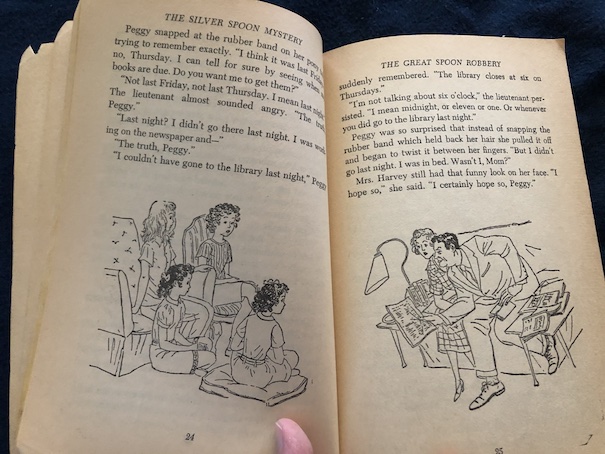
You just know that there’s going to be trouble with Peggy trying to sell a story that everyone knows didn’t happen, but what actually happens is even stranger. After the girls sell their paper with the spoon theft story, Peggy gets home to find a policeman, Lieutenant Peters, waiting for her with her mother. Lieutenant Peters wants to talk to Peggy about the robbery at the library because it turns out that the very night when Peggy was writing her big fictional scoop about silver spoons being stolen from the library, someone was in fact stealing silver spoons from the library, and this thief apparently did it the way Peggy described in her story. Lieutenant Peters wants to know everything that Peggy knows about the theft, and he won’t believe that Peggy wasn’t there to witness it because her description of what happened is so accurate. She even has a description of the thief in her story. Since the theft happened in the middle of the night, Peggy points out that she was asleep in bed, but even Peggy’s mother isn’t sure that Peggy didn’t sneak out. When Peggy’s friends show up at her house, Lieutenant Peters questions them too and comes to the conclusion that Peggy and maybe also her friends stole the spoons themselves to make their story true. Lieutenant Peters says that they’ll be forgiven if they give the spoons back, but the girls can’t do that because they don’t have them.
As Lieutenant Peters and Peggy’s mother continue to question the girls about their story, the girls admit that they made up the whole thing as a fictional story just to attract attention to their paper. Lieutenant Peters catches the boys listening in on their conversation and questions them about what they know about the situation. The boys don’t really know anything about the theft, either, but they were pretty sure that Peggy made up the story she wrote, and they’re fascinated that she might be about to be arrested and taken to “children’s jail.” Peggy’s mother believes her that she just made up the story and it’s all a coincidence that someone happened to steal the silver spoons from the library around the same time, but Lieutenant Peters isn’t convinced.
Word of the spoon theft spreads across town quickly, partly because of Peggy’s story in the neighborhood newspaper and partly because of the story in the regular news. People call Peggy’s house to ask for details, and kids at school look at Peggy and her friends suspiciously, wondering how much they had to do with the theft. Peggy is especially offended when Davey says that his father thinks that it’s an unlikely coincidence that Peggy would write a story about the theft and then the theft would just happen. Before the boys started their “no girls allowed” stuff, Peggy and Davey used to be close friends. However, Davey assures her that he doesn’t think that she’s responsible for the theft. He also tells her that he and the other boys are sorry about pushing the girls by trying to compete with their paper, and they’ve decided to give up theirs and let the girls use the hectograph. The kids discuss trying to investigate the crime themselves because, until the real thief is found, people are going to keep looking at the girls suspiciously.
Most of the neighborhood kids, both boys and girls, join the investigation as the “Hill Detective Club”, except for one of the older girls who is studying for exams and Davey’s older brother, Allen, the only boy who’s mad at the other boys because they don’t want to play baseball now. (Allen is apparently the one who started all the “no girls allowed” stuff because he didn’t make the high school baseball team and he’s been ultra-serious about practicing during the neighborhood games. He’s trying to organize a game between the boys in the neighborhood and their fathers. The book doesn’t explicitly say so, but there might also be an element of embarrassment for him that some of the girls play better than he does. Peggy is described as being the fastest runner in the neighborhood, and Ellen is a good batter.) As they begin their investigation, the kids visit the scene of the crime and study the ways the thief could have gotten into the library, starting to separate the made-up details from Peggy’s fictional story from the real facts and circumstances of the case. Peggy admits that her mind is biased because she still thinks of her story as the way things happened and her fictional suspect as the type of thief they’re looking for, but the truth is that they don’t know for sure how the crime actually happened or what type of person they’re looking for.
When the kids talk to one of the librarians, Miss Bancroft, they learn that the police did find a few sets of fingerprints on the case that held the silver spoons: Miss Lowell, the head librarian; Mrs. Simpson, a descendant of the town’s founding father and part of the local antiquarian society; and Mr. Weatherspoon, who owns a local antique store. Could one of these people be the thief?
The book is available to borrow and read for free online through Internet Archive.
My Reaction
To begin with, this book seems like it’s meant for fairly young elementary students. It tries to teach readers the meaning of some of the words in the story because some of the characters don’t know the meanings of various words the other characters use or words that they encounter in various places, like “descendant” or “optometrist.” The kids in the story are a variety of ages even though they all play together in the neighborhood, and I could understand why some of the younger kids would struggle with bigger words, but there were times when I thought that they were carrying it a little far. Peggy is twelve years old, so it seems like she should have been old enough to know what an optometrist is. Has she never had her eyes checked before? Actually, maybe she never has. If her vision is good or seems good, maybe her family just doesn’t bother. I guess it’s educational for young readers just branching out into chapter books.
I like books that bring up interesting historical topics. The parts about older printing/copying techniques and Mrs. Simpson’s old electric car with the steering stick instead of a steering wheel (possibly a Baker Electric, like the one Jay Leno owns, or something very similar – this video explains the history of the Baker Electric and shows what it’s like to drive it) were interesting, and one of the characters in the story explains more about the history of the town’s famous silver spoons to the kids. Although the town, its founder, and the spoons are all fiction, spoons of this sort did exist in real life. The silver spoons are specifically christening spoons. It used to be traditional to give presents made of silver to new babies and their parents for the child’s christening. One of the most popular presents of this type was small silver baby spoons, especially with special designs or engravings to remember the child’s birth. The character explains why this particular set of spoons is so distinctive, talking about their unique design, how antique dealers would be able to look them up in a reference book and learn their history, and how each of the of the spoons is marked with the maker’s hallmark, the special symbol that the maker would use to identify himself.
Part of the mystery hinges on the coincidence of the theft occurring just when Peggy decides to write a sensational story about an imaginary theft to get attention for her neighborhood newspaper. For readers, the question is whether the timing of the actual theft is really just coincidental or if there’s a direct connection between the story of the theft and the theft itself. I would have been very disappointed in the book if it was just a coincidence, so I immediately approached the story with the idea that the timing of the theft was a clue. I enjoyed considering different possibilities. My first thought, when the theft happened mysteriously immediately after Peggy and her friends invented their theft story, was that someone overheard the girls talking about how they would commit a theft like that and decided to use their imaginary scheme as their own. However, the conversation between Peggy and her friends took place in Peggy’s room, which was pretty private. For someone to overhear them, it would have to be someone in Peggy’s own house, possibly family or a neighborhood friend, or someone listening in from outside, probably one of the neighborhood kids. Those possibilities didn’t seem likely. Then, I remembered the Nero Wolfe murder mystery story Not Quite Dead Enough. What if the theft didn’t occur when the police thought it did (mostly because they believed Peggy’s original story) but actually at the point where the theft was supposedly discovered? The person who claimed to discover the theft was one of the people with the strongest motives to commit it, and this person could have done it after reading the fake news story, seeing an opportunity to make it true and cast suspicion on Peggy’s fictional suspect. The mystery is simple enough to figure out for an adult who likes mystery stories, but probably much more mysterious for kids. Once the kids realize who has the spoons, there is also the additional challenge of proving it and getting the spoons back without getting everyone in trouble.
I thought it was interesting that the story shows some of the problems with sensationalist or tabloid style “news” stories, or “yellow journalism“, as it used to be called. It’s the sort of “news” that relies on flashy and misleading headlines, buzzwords and catch phrases that appeal to its fans and rile them up emotionally, hyperbole and emotionally-charged language, conspiracy theories, pseudoscience, and poorly-qualified or debunked “experts”, to draw readership and advertising money. Basically, they aren’t really “news.” They don’t try to describe things as they actually happened for informative purposes. These are “news” stories that are less about fact than about entertaining their audience or shocking people and stirring up strong emotions to grab people’s attention. That’s basically what Peggy was trying to do with her fake news story, even if she wasn’t quite thinking about it in those terms. Just like tabloid or sensationalist news, Peggy’s story was almost a kind of fan fiction based on the real world. That is, she took real things and situations that she knew existed (the silver display at the library) and wrote an exciting conspiracy story around them that didn’t actually happen (the made-up theft) as a shocking, attention-getting entertainment piece to encourage people to buy the paper she and the other girls were selling. She thought what she was doing was like harmless entertainment, but it wasn’t because it was based on something real, and her made-up story had real consequences. Not only is there a direct connection between the fake story and the real theft, but Peggy’s fake story confuses people, including the local police and insurance investigator, because they have trouble telling how much of Peggy’s story is false, and it biases their minds and the direction of their investigations. Even Peggy herself sometimes gets confused during the investigation, mixing up details from her made-up story with real events. Even though she wrote the fictional story herself, knowing it was fictional, she gets hung up on the way she imagined things would happen when she invented the story and needs to be occasionally reminded to look at the situation as it actually exists, not as she imagined it would be. If the author of the fictional news story can’t even keep her own fiction and the real facts straight in her mind at first, how can the police or anyone else?
Sensationalist journalism can and has led to real problems in real life, setting up dangerous situations by stirring up the emotions of people who may already be unbalanced and suggesting unrealistic events or courses of action that interfere with people’s sense of reality and ability to make informed, reasoned decisions (something else that ties in with the story). In a famous real life case from the early 1900s, the famous newspaper publisher William Randolph Hearst had his own reputation seriously damaged when he published articles written by two of his columnists smearing President McKinley’s reputation and seemingly recommending his assassination. (“If bad institutions and bad men can be got rid of only by killing, then the killing must be done.”) These articles were published only months before President McKinley was actually assassinated. Hearst had used yellow journalism in his papers for years to manipulate public opinion to further his political causes and gain readership. (“War makes for great circulation,” Hearst said after successfully urging public opinion in favor of the Spanish-American War.) After the assassination of the president, people made a connection between the assassination the articles in Hearst’s papers seemed to be advocating (although they called it a “mental exercise” and a joke) and the assassination that actually happened. Whether Hearst actually wanted McKinley to be killed by someone or whether the man who assassinated McKinley was directly inspired by those sensationalist articles is questionable, but the suspicion that was what happened, in a sort of “Will no one rid me of this turbulent priest?” kind of moment, did seriously damage Hearst’s own political ambitions. Hearst did intentionally want to smear McKinley’s reputation, but his lack of consideration for the possible results of his stories, which seemed to be advocating an actual murder that did occur soon after, caused the public to turn against Hearst himself.
We frequently caution people to be careful of what they read because you can’t trust everything, which is sensible advice, but I’d go a little further and say, be careful of why you choose to read what you’re reading and why believe what you read. Was it because the information was presented logically and authoritatively, or is it because you decided ahead of time what you were going to read because of something you already believed or something you already knew you really wanted to do? Picking the right information source is good, but it may be even better to ask yourself what you, as an individual, plan to actually do because of the news sources you’re following. Is it a good thing to do that’s going to help someone or something that’s going to hurt people? Take a look in the mirror once in a while and question your motives as one of your own primary sources of information. You are the one who chooses what news sources you consume. You are the one who decides what you believe because you always have the choice to accept or reject anything you hear from someone else. You are the one who decides what your standards are and where your limits are set. You are the one person who knows exactly what you’re willing to do to accomplish your goals. You are the one who moves your body to the locations you decide to go and makes your mouth say the things it says and your body do the things it does. You are the one who has ability to say “yes” or “no”, not only to other people but yourself when necessary. Anything you may decide to do involves not just a single choice but multiple choices along the way that can only be made by you, so you’re going to have to be your own fact checker at every step, not just about what other people are telling you but what you’re telling yourself and why.
Sensationalist news stories are intentionally emotionally manipulative in order to get people hooked on reading that source, but you’re the only one who gets to decide if you’re hooked and what you’re going to do about it. The next time you read something that makes you really mad at somebody, before you do whatever you’re considering doing about it, pause a moment to ask, not just whether the source you just read might be wrong, but “What if I’m wrong? What if I’m wrong about this situation, and I’m about to do the wrong thing? Am I prepared to face the consequences for my actions if this turns out to be serious?” The reason for asking these questions is, if the consequences of what you’re planning to do are serious, there will be a point where people won’t want to hear about what you believed or thought you believed or what someone else told you earlier. If you’re the one who did the thing, you’re the one who’s going to be facing the consequences for that thing. There’s a point where everyone has to accept the consequences for themselves all by themselves. (To put a finer point on it, riot and people will riot with you, but you’ll be tried as an adult alone.)
The Case of the Muttering Mummy by E.W. Hildick, 1986.
Joey Rockaway needs to buy a special present for his mother’s birthday. Having broken his mother’s china cat ornament recently, he has decided that he will buy one of the replicas of a golden cat statue from Egypt at the Egyptian exhibit at the local museum. The other members of the McGurk Organization come to the museum with him, and McGurk uses this as an opportunity to give them a kind of memory test about objects in the exhibit.
Actually, everything in the exhibit is a replica, not just the items sold in the museum gift shop. Justin Matravers, a wealthy man who has recently died, collected Egyptian artifacts, but part of his will specified that the collection should never be put on public display. However, his widow, who wanted to show off the collection, had replicas made of everything in the collection so that she could have those put on display.
McGurk sneers about how everything in the exhibit is fake, although he is actually surprisingly superstitious. The museum always did have a real mummy case on display. They always said that the mummy case was empty, but some of the more superstitious kids, like McGurk, believe that there is a mummy inside the case and that there is a curse on it. McGurk has nicknamed the mummy Melvin. The other kids aren’t afraid of Melvin or Egyptian curses, and while they are looking around the Egyptian exhibit, Mari plays a joke by using her ventriloquist skills to make the mummy case “talk.” This trick sets off a bizarre mystery for the McGurk Organization.
A scholar and author, Harrison Keech, is sketching the replicas at the exhibit and witnesses Mari’s trick and Joey picking out the replica cat for his mother. After he asks Joey if he can take a look at the cat, Keech suddenly becomes very upset, saying that the cat statue is cursed! He says that Mari’s joke has angered the spirit of the mummy and awakened the spirit of Bastet. The mummy was a follower of Bastet, the Egyptian cat goddess, and it will now be drawn to the statue if they remove it from the museum. Mari tells Joey that she can tell from Keech’s voice that he’s making up the whole story and that he shouldn’t let that stop him from buying the cat.
However, strange things start happening after Joey buys the cat. It seems like someone is following him home, a dark, shadowy figure. Joey thinks it might even be the mummy, come back to life! The others are skeptical, and McGurk arranges a kind of test where Joey brings the statue with him to a meeting of the organization. Sure enough, a strange figure lurks outside their meeting, and they hear strange whispers in a foreign language!
The spookiness doesn’t last for long. It turns out that Mari, as well as being a ventriloquist, has some skill with different languages and recognizes what the “mummy” says as being Greek, not Egyptian, and the phrases as being typical things that someone might say in a restaurant. When the kids find a scrap of bandage outside, they are quick to notice that it’s a modern, elasticized bandage, like the kind you can get at any pharmacy.
So, the question becomes who is playing at being a mummy and why? Is it Keech, wanting to make the kids think that the mummy story he told them is real, and if so, what would he have to gain from it? The only other two people who know about the story are Joanne, who works at the museum, and Donny, her fiancé, who is jealous of the attention she’s been paying to Keech when he comes to the exhibit.
I have some complaints about this book that hadn’t occurred to me when I read it as a kid. At one point, Donny, who is described as being a social worker, comes to visit the kids because he wants to hire the organization to check up on Keech and his relationship with Joanne. Donny is very jealous, and when he explains how Joanne seems to be falling for all of Keech’s crazy mummy stories, he suddenly turns to Wanda and Mari and says, “You women, you’ll believe anything when a smarmy two-bit jackass like that starts shooting his mouth off!” That’s just really inappropriate for an adult to say to kids, and the whole situation is weird on several levels. First of all, Donny is an adult, and if he’s having issues with his love life, especially with the woman he thinks he wants to spend the rest of his life with, the last thing he should do is hire kids (even really smart ones) to handle the issues for him. Second, Wanda and Mari are young girls, not “women,” and what little girls believe is no business of Donny’s. Trying to imply that Wanda and Mari might someday fall for a “jackass” is not only insulting but implies that Donny is thinking about Wanda and Mari in terms that no grown man should be thinking about girls their ages. I find it disturbing that Donny is apparently a social worker, a person in a position of trust who is supposed to help people in difficult situations to manage their lives, and he’s acting like this. Also, toward the end of the book when the bad guy (I won’t say who it is here, although I thought that the answer was pretty obvious even early in the story) is making his escape, he shoves Joanne aside and calls her a “slut.” That’s pretty strong language for a kid’s book of this level. None of this occurred to me when I was a kid, so maybe other kids reading this wouldn’t notice, but I thought that I’d mention it because these things bother me now.
At one point, Brains gives a demonstration of using water displacement to determine the volume of irregularly-shaped objects, explaining how Archimedes discovered the principal (although I’m not sure that Archimedes’ Principal was quite as he explains it), as the kids investigate what makes Joey’s cat statue so special. You might be able to guess what it is. It seemed pretty obvious to me. The one thing that seemed the most puzzling was how it was done. Mari also offers an interesting explanation of the different kinds of lies that people tell and their motives for doing so.
The book is currently available online through Internet Archive.
The Headless Cupid by Zilpha Keatley Snyder, 1971.
This is the first book in the Stanley Family Mysteries series. Some people might be put off by the occult themes in this book, but this is a mystery story, and all is not what it seems. Read to the end or skip to the spoilers section to find out.
Eleven-year-old David Stanley has had to help take care of his younger siblings since his mother’s death. In some ways, he feels like his mother knew that she was dying before anyone else did, preparing David to help his father by taking care of his younger sister Janie and the young twins, Esther and Blair. David thinks that his mother might have been psychic because she tended to believe in some odd things and often knew things before other people did.
Now David’s father, a college professor, has remarried, to a divorced woman with a daughter of her own, Amanda, who is twelve years old. David likes his new stepmother, Molly, who is an artist, and he appreciates having someone else to help take care of the other kids. Amanda is a different story. She was an only child before her mother’s remarriage, and she’s not happy to suddenly have step-siblings, some of whom are rather young. Amanda has been unhappy in general since her parents’ divorce, and she wishes that she could go to live with her father full time. Her father says that he can’t take care of her because he has to work so much, but he spoils her whenever they spend time together. David has doubts about the things Amanda says about her father, but he and the others try to make her welcome in their new home.
With their family suddenly much larger, David’s father bought a new house for them to live in. Actually, it’s a very old house just outside of a small town. People call it the Westerly house after the former owners. Not long after the family moves in, they find out that people used to say that the Westerly house was haunted. Mr. and Mrs. Westerly used to travel around the world with their two daughters because Mr. Westerly worked for the government, but after they settled down to a quieter life in this small town in the late 1800s, strange things started happening in their house. Rocks would fly around the house, seemingly thrown by invisible hands, and someone (or something) cut the head off the carved cupid on the fancy staircase banister. The head was never found. These incidents were reported in the local paper, and people believed that the Westerly family was haunted by a poltergeist. These hauntings seemed to center around the two Westerly girls, particularly the older one, Harriette, which made some people think that the girls were faking the poltergeist. However, they were never able to catch either of the girls doing anything. The strange activities finally ended when the girls were sent away to boarding school, but now that the Stanleys have moved into the house, strange things are starting to happen again.
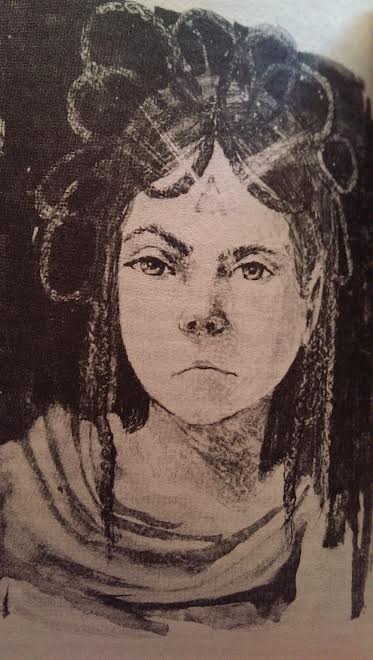
Amanda is fascinated by stories of the poltergeist. A friend of hers where she used to live (one her mother didn’t approve of) was teaching her about the occult and how to do magic spells. When David tells Amanda that he thought that his mother was psychic, Amanda is surprised, and she offers to teach David and the other kids about magic over the summer. David eagerly accepts the offer because he finds the subject fascinating and because it’s the only thing that Amanda really seems interested in. The other kids are also fascinated at the idea, even the littlest ones, which takes Amanda by surprise. She had expected them to be scared.
Still, Amanda begins leading the kids through a series of rituals that will supposedly initiate them into the occult world, all of which have to be done in secrecy, without the parents’ knowledge. They have to do some bizarre things like spend an entire day not talking (they have to take turns so the adults won’t notice, and it’s harder for some kids than others), spend a day where they can’t touch anything metal (mealtimes are awkward), offer “sacrifices” to the spirits (basically giving Amanda things she likes), and find animals to be their “familiars.” As some of these rituals and the kids’ strange, secretive behavior cause problems, particularly for David’s stepmother, David begins to suspect that Amanda’s “rituals” have an ulterior motive that has nothing to do with magic at all. Then, the poltergeist activity begins.
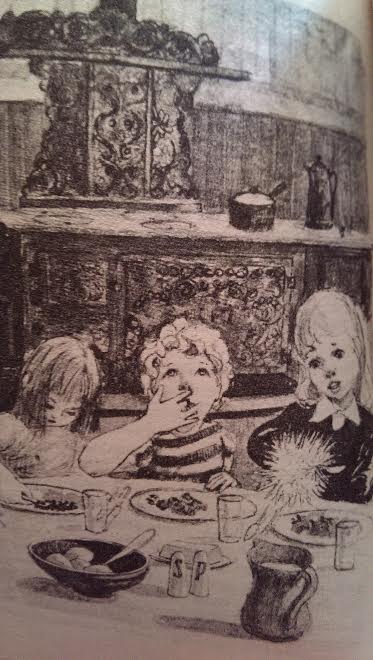
Just as with the Westerly family years ago, rocks are thrown around the house or found just laying around. Things are broken in the middle of the night. Have Amanda’s rituals somehow awoken the poltergeist once more? David has his doubts, suspecting that it’s part of Amanda’s playacting, but she is accounted for when some of these strange things happen. The younger kids are still more fascinated than frightened by these strange happenings, but their stepmother finds them particularly unnerving.
Then, just when David thinks that he understands the situation and Amanda seems to be calming down her occult talk and behaving more normally, something happens which is really inexplicable: the missing head of the cupid suddenly reappears.
This is a Newbery Honor Book. It is available to borrow and read for free online through Internet Archive.
My Reaction, Themes, and Spoilers
The reason why I want to explain some of this is because I think this book has received some unfair criticism because of the “occult” themes in the book, and I want to clarify the situation for the benefit of parents and teachers who have not yet read the book and may be concerned. I’m putting “occult” in quotes because, as I said before, that’s not really what’s going on. The book is a mystery story, and the “supernatural” stuff is largely window dressing for the real themes of the story, which have to do with unresolved feelings and revenge. The story even contains a kind of warning about getting involved with the occult, which is another reason why I think the criticism of this book is unfair.
That Amanda is faking at least part of the haunting is pretty obvious even early on, so I don’t think it’s much of a spoiler to say that. Amanda is an unhappy girl whose life abruptly changed with her mother’s remarriage, and her occult talk and fake witchcraft are part of her way of dealing with her feelings. She admits to David at the end of the story that she was purposely trying to frighten her mother, trying to “get even” with her for turning her life upside down, first by divorcing her father and then by getting married again, forcing Amanda to move to a strange town where she has no friends and live with a bunch of kids she hardly knows. Getting to know her new siblings better and sharing adventures with them helps, but it takes the frightening moment when the cupid’s head suddenly reappears to get Amanda to admit that real occult stuff scares her, too, and to confess the truth of what she did and her real feelings to her mother.
There are some elements of the happenings, particularly the reappearance of the cupid’s head, that are never fully explained, although David ends up knowing more than Amanda by the end. Some aspects of the situation are hinted at. There may be a real supernatural event at the end of the story. Blair appears to have inherited psychic abilities from his mother, and there is a distinct possibility that the Westerly sisters who once lived in the house were just as unhappy with their parents for the changes in their lives as Amanda was with her mother. Although the “poltergeist” as it first appears doesn’t exist, it may be that the “poltergeist” of the past remembers what it was like to be young and unhappy and that she wanted to make amends for past wrongs and to help another troubled young girl to make peace with her life and family. But, if you don’t like that explanation, there is a more conventional, non-supernatural explanation that David considers, which equally possible. Personally, I think it’s a combination of the two, but it’s not completely clear. I think the author left it open-ended like that to make readers wonder and to preserve the air of mystery after the other mysteries have been cleared up.
As a kid, I enjoyed the creepy aspects of the story and the sense of wonder the kids experience as they go through their “rituals,” trying to bring some magic to their regular lives, wondering if things like ghosts and magic can really exist. Now, I more appreciate how Amanda researched tricks used by fake psychics and mediums and used them creatively to her advantage. When I was a kid, I liked magic tricks, and psychics and mediums make use of those types of stage illusions and psychological tricks in their acts. I still have some books on the subject myself. I also like the way David sensed the truth behind Amanda and the strange happenings even though he didn’t really understand how or why it was done at first. David has some genuine curiosity about magic, but even after he realized that Amanda was faking things and was disappointed by it, he didn’t immediately tell the others. He could have unmasked her as a fraud, but he knew that would only earn her resentment. He wanted to understand her motives and help her feel better, giving her the chance to make peace with her mother herself and become part of their family.
This book has been frequently challenged because of the children’s inquiries into the occult, but I would like to point out that their “occult” experiments were all fake, pretty obviously so, and it is acknowledged that Amanda’s interest in the occult was fueled by her emotional distress (part of her urge to “get even” with her mother by causing problems). By the end of the story, Amanda and her mother have an honest talk with each other about everything. Amanda admitts her true feelings and makes peace with her mother, and she also says that her mother explained some things that Amanda didn’t know before. The book doesn’t say exactly what Amanda’s mother told her, but from the context, it’s probably something about the circumstances behind her parents’ divorce, something that they might not have wanted to explain to her earlier. I have a theory about it, although there’s nothing explicit that I could point to to prove it. I suspect that Amanda’s father had an affair and that the affair is continuing, which I think is the real reason why he doesn’t want Amanda to live with him full time. If Amanda were to live at his house, she would be sure to find out the truth. Maybe his girlfriend is even the housekeeper Amanda referred to, the one who doesn’t help take care of children because she’s “not that kind of housekeeper.” That possibility didn’t occur to me when I was a kid, but it seems kind of odd for a single man, living without children or other people in his house or other household staff to manage and who spends a large amount of time working away from home, to even have a housekeeper instead of simply hiring a maid or cleaning service to come in from time to time. Households with fewer people require less maintenance. There is less laundry to do, and single people who work tend to eat out or order in pretty often or make very simple meals, so I doubt he even needs much help with cooking. But, that’s just my theory. No one ever says why Amanda’s parents divorced in the story. The reasons are less important to the story than Amanda’s feelings concerning the divorce. Some of Amanda’s earlier resentment toward her mother was fueled by things that her father told her, making it seem like her mother was the one who caused the divorce. After talking with her mother, Amanda seems to realize that some of the nasty things that her father said about her mother may not have been true and that her resentment toward her mother for causing the divorce was needless. Much of the story involves unresolved feelings and the need to communicate them honestly.
The difference between reality and perceptions is also important to the story. Although Amanda at first tries to convince the other kids that she is an expert on all things magic, David soon realizes that she’s not: she acts like ordinary, easily-identifiable wild flowers are rare herbs, she can’t control her “familiar” because she has no idea how to handle animals, and when things happen that Amanda can’t explain, she’s the first to be terrified. In the end, Amanda gives up on the idea of the occult completely, realizing that the things she did were wrong and that she had gotten involved in something that she really didn’t want to be involved in. Many kids wonder about the supernatural when they’re young, and I don’t think it’s bad to point out to them that they if they experiment with such things, they may be getting involved in something they could regret and that they should consider their motives for wanting to do so. Playacting when you know it’s pretend is one thing, but not knowing if the scary stuff is real is another.
For further discussion of the dynamics of the blended family in this story, I recommend the SSR Podcast about this book. The podcast also points out that there is an incident in this story which might be racially problematic.
Anti-Plagiarism Check
I’ve been thinking about how my reviews could be used for plagiarism ever since I caught a couple of those essay-writing companies trying to follow my blog. It’s difficult for me to review certain books without giving spoilers, but I’d like to point out that none of my reviews explain everything there is to know about the stories. That would be completely impossible without reprinting the entire text of the book, which plagiarists are too lazy to read anyway. There are certain plot points which only a person who has actually read the book would understand and be able to explain. Teachers who suspect that a student has plagiarized a book review or only pretended to read the book should ask them to verbally explain the points that I have not covered in my review, giving them no chance to try to look up the answers elsewhere or try to find them by quickly skimming the book. I’m not going to print suggestions for questions to ask here because I don’t want to give the plagiarists a hint, and I doubt that teachers who have read the book recently themselves would really need a hint, but any teacher who contacts me via their official school e-mail address can discuss it with me. I know these stories well because I’ve loved them for years, and I’ve started a file with suggested plot points to discuss. I will not send this information to anyone who does not contact me from an official school e-mail address. Keep in mind that I can easily look up the name of the person who contacts me to determine whether I’ve been contacted by a teacher or a student.
It’s one thing for a student to want to discuss the book with someone to clarify confusing plot points, but it’s another to ask someone to do their homework for them. I know the difference, and I know homework when I see it. Let me explain something. All WordPress blogs have built-in analytics, and I’ve been studying SEO, so I pay attention to who has been visiting my site and how they get there. I know whether you came here by using a search engine or whether you were referred by another site, and I can also see search terms that you used. I added this note to this review specifically because I noticed that someone has been trying to Google what are plainly homework questions, and I just got a site referral from an online plagiarism checker. Yeah, I see what you did there. This is the Information Age, and when you go looking for information, sometimes, there’s someone else looking back at you, even if you can’t see them. Not everyone with a blog pays that kind of attention to their traffic, but some of us do, and while some may not say anything about it, some of us are also a little more vocal. I saw what you did, and I didn’t like it. I don’t know you, but I know you’re a fool, and your teacher has just discovered it, too. Now, we’re all aware. It’s your own fault, and it’s too late to whine about it now. I do sometimes help people who ask for it. You should have asked for help when you needed it instead of cheating and stealing my words. Maybe next time you’ll ask for what you need instead of just taking what you want.
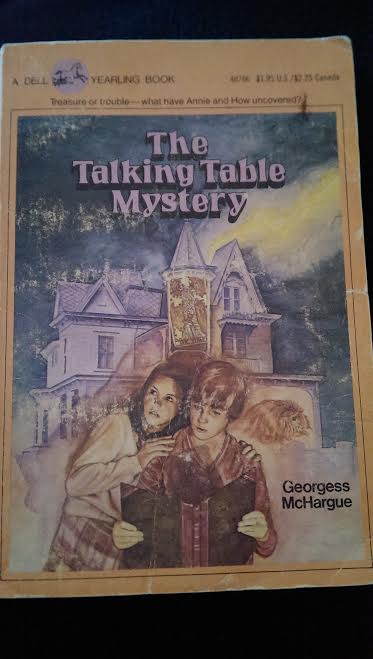
The Talking Table Mystery by Georgess McHargue, 1977.
Annie Conway and her friend How are helping her great aunt to clear out her basement when they find a table that How thinks would work for his pet guinea pig’s cage. However, it’s not an ordinary table. It makes strange noises whenever they press on it, and in the box tied to the top of the table, they find a strange assortment of objects, including a little silver piccolo and some diaries.
Most of the diaries belong to Annie’s great grandfather, but there is one written by an unknown young girl. The girl apparently stayed in Annie’s great grandfather’s house years ago, and her diary refers to the girl’s mother’s strange behavior and the girl’s fears that something bad will happen. The diary itself is mysterious, but soon the kids start receiving threatening notes, telling them to hand over the diaries or something bad will happen. Who wants the diaries and why?
The book is available to borrow and read for free online through Internet Archive.
My Reaction and Spoilers
The basis for the mystery is 19th century spiritualism. The former owner of the table was a spiritualist who used it for seances, creating rapping noises when the “spirits” were present. Her daughter was the girl who wrote the diary. She wasn’t happy about how she and mother kept moving around in search of new clients and how she had to help her mother by playing ghost during seances. They were staying with Annie’s great-grandfather because he was suffering from grief over the death of his young son, and the spiritualist was holding seances to try to contact his spirit. At least, that’s what Annie’s great-grandfather thought. The bad thing that the girl thought would happen was that she and her mother would be caught faking their seances, which turns out to be exactly what happened. Annie’s great-grandfather was angry at being deceived and threw them out of the house, but he confiscated the rigged table and other things they used in their seances, including the girl’s beloved silver piccolo, so they wouldn’t be able to try their act on anyone else.
However, there is one more secret about Annie’s great-grandfather and the spiritualist. Annie and How eventually discover that they had a love affair during the spiritualist’s stay in the house. There is some discussion among the adults about how the spiritualist suffered more consequences and stigma for the affair than the great-grandfather did, although he was a married man when it happened. As for what eventually happened to the girl and her mother after this incident, the clues are contained in the diary and with the people who now want them.
I thought that the use of the rigged spiritualist table in the story was fascinating. It’s basically like a piece of antique magician’s equipment that not everyone would know existed. The story also introduces some interesting historical details about the concept of 19th century spiritualism and the types of people who followed it. Annie’s great-grandfather was grieving for the loss of one of his young children, and like others of his time, he wanted to reach out to the spirit of the one he lost, in search of solace for the loss. How much of the affair with the spiritualist was fueled by his grief and gratitude for someone he thought was helping him is unknown because we never hear his perspective on that, but his anger at discovering how he had been deceived shows that he did honestly believe that the seances were real and felt betrayed to realize they weren’t. However, actions have consequences, and there were still some consequences from this incident that were never fully resolved.
The author is very knowledgeable on the subject of spiritualism, and she also wrote a nonfiction book on the subject.




 The Headless Cupid by Zilpha Keatley Snyder, 1971.
 With their family suddenly much larger, David’s father bought a new house for them to live in. Actually, it’s a very old house just outside of a small town. People call it the Westerly house after the former owners. Not long after the family moves in, they find out that people used to say that the Westerly house was haunted. Mr. and Mrs. Westerly used to travel around the world with their two daughters because Mr. Westerly worked for the government, but after they settled down to a quieter life in this small town in the late 1800s, strange things started happening in their house. Rocks would fly around the house, seemingly thrown by invisible hands, and someone (or something) cut the head off the carved cupid on the fancy staircase banister. The head was never found. These incidents were reported in the local paper, and people believed that the Westerly family was haunted by a
  Amanda is fascinated by stories of the poltergeist. A friend of hers where she used to live (one her mother didn’t approve of) was teaching her about the occult and how to do magic spells. When David tells Amanda that he thought that his mother was psychic, Amanda is surprised, and she offers to teach David and the other kids about magic over the summer. David eagerly accepts the offer because he finds the subject fascinating and because it’s the only thing that Amanda really seems interested in. The other kids are also fascinated at the idea, even the littlest ones, which takes Amanda by surprise. She had expected them to be scared.
 Just as with the Westerly family years ago, rocks are thrown around the house or found just laying around. Things are broken in the middle of the night. Have Amanda’s rituals somehow awoken the poltergeist once more? David has his doubts, suspecting that it’s part of Amanda’s playacting, but she is accounted for when some of these strange things happen. The younger kids are still more fascinated than frightened by these strange happenings, but their stepmother finds them particularly unnerving.
 There are some elements of the happenings, particularly the reappearance of the cupid’s head, that are never fully explained, although David ends up knowing more than Amanda by the end. Some aspects of the situation are hinted at. There may be a real supernatural event at the end of the story. Blair appears to have inherited psychic abilities from his mother, and there is a distinct possibility that the Westerly sisters who once lived in the house were just as unhappy with their parents for the changes in their lives as Amanda was with her mother. Although the “poltergeist” as it first appears doesn’t exist, it may be that the “poltergeist” of the past remembers what it was like to be young and unhappy and that she wanted to make amends for past wrongs and to help another troubled young girl to make peace with her life and family. But, if you don’t like that explanation, there is a more conventional, non-supernatural explanation that David considers, which equally possible. Personally, I think it’s a combination of the two, but it’s not completely clear. I think the author left it open-ended like that to make readers wonder and to preserve the air of mystery after the other mysteries have been cleared up.
 The Talking Table Mystery by Georgess McHargue, 1977.
 Jestress's Forgotten Books and Stories