The Case of the Crazy Collections

The Bobbsey Twins

Before I begin, I’d like to acknowledge Sean Hagins, for supplying me with photos of this book! Usually, I take pictures of books myself, but I just couldn’t find a physical copy of this one. Sean is a big fan of the Bobbsey Twins, particularly the New Bobbsey Twins mysteries, and you can see some of his video reviews as well as videos about his photography work on his YouTube channel, SJHFoto. Thanks, Sean!

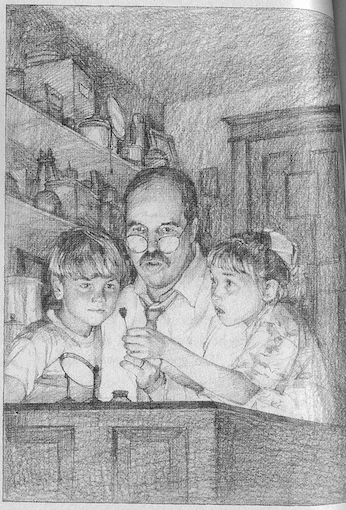
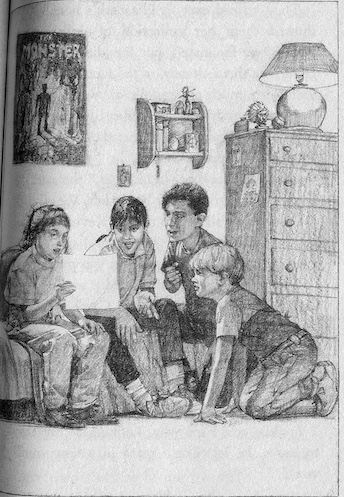
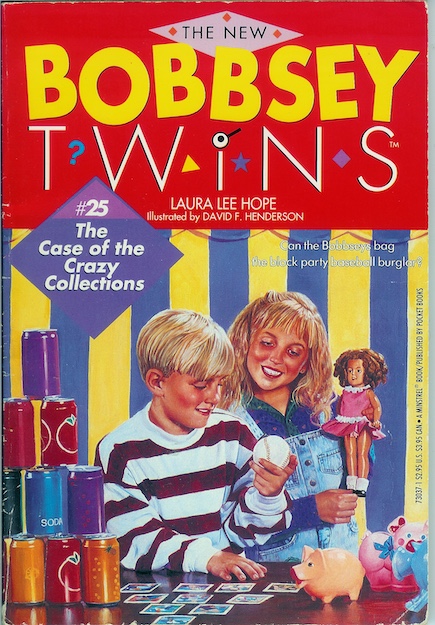
The Bobbsey twins’ neighborhood is having their annual block party, and the Bobbsey twins and their parents are helping to set up for it. As part of the party, the neighborhood has rented a tent, where kids from the neighborhood are displaying their collections. The neighborhood kids collect all kinds of things, like baseball cards, comic books, soda cans, autographs, and coins. One boy, Kevin, has an autographed baseball that his grandfather gave to him. The neighbors are charging people money to see the exhibit of collections, and the money will be used for a pizza party later.

Later, Kevin’s autographed baseball disappears. Could the baseball thief be Mr. Sher, a visitor staying with their neighbor, Mr. Andersen? Mr. Sher tried to buy the baseball from Kevin earlier, but Kevin turned him down. Then again, Kevin’s cousin, Steve, was jealous that Kevin has the baseball. Steve turned down the offer of some of his grandfather’s old collectible items in favor of a savings bond, which he has already cashed in and spend on video games. Steve tried to borrow more money from Kevin earlier, but Kevin turned him down because Steve hasn’t yet repaid him for money Kevin loaned to him before. Danny, the neighborhood bully, was also mad at Kevin earlier. He’s a friend of Steve’s and didn’t want to have to pay to see the collections. Then again, another local girl, Jennifer, collects autographs, and they see her at a collectors’ shop. Would she know the value of an autographed baseball, and was she trying to sell it? With so many people coming and going from the tent where the collections were on display, it’s hard to say who might have taken something. The thief may have even been the Bobbseys’ own dog, Chief, who has developed a habit of collecting and hoarding baseballs.

Then, another boy realizes that his prized hologram sticker is missing. Could the thief have taken that, too? Their clues are an unexplained slit in the back of the tent, some footprints, and a pin with Greek letters on it. Can the Bobbsey Twins find the valuable baseball and return it to Kevin?

The book is available to borrow and read for free online through Internet Archive.

Something I thought was interesting about this story was that it brings up the concept of collecting things for fun or sentimental value vs. collecting things because of their monetary value. Most of the kids in the neighborhood collect things just for fun. At first, Kevin doesn’t seem to fully realize the value of the autographed baseball. His attachment to the baseball is because he got it from his grandfather. When he had the offer to sell it to Mr. Sher, he refused because the baseball reminds him of his grandfather.

I had a strong suspicion about the identity of the baseball thief early in the story, and my guess turned out to be right, but I liked it that there were plenty of other suspects to consider. There are child suspects, adult suspects, and even the Bobbseys’ own dog. Any of these could be plausible. When they realize that the hologram sticker is missing, it raises the question of whether the person who took the baseball also took the sticker, if the sticker was taken by someone else, or if the missing sticker is just a red herring. Overall, I enjoyed the mystery, and I liked the abundance of suspects.

The Mystery of the Blue Ring

Polka Dot Private Eye

The Mystery of the Blue Ring by Patricia Reilly Giff, 1987.

When Dawn Bosco first joined Ms. Rooney’s class at Polk Street School, she stole Emily Arrow’s toy unicorn. Now, that incident has come back to haunt her. When the book begins, her theft of Emily’s unicorn was just weeks ago. Now, she and Emily are starting to be friends, although their friendship is a bit shaky.

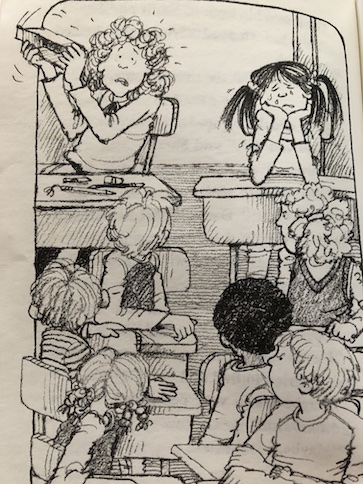
At school, the teachers are talking about vegetables because it’s Good Vegetable Day. Everything is geared around vegetables all day, and the art teacher has the children make sculptures of vegetables out of clay. Dawn is bored because she’s been reading a mystery book, and she’d rather be finding mysteries and learning to be a detective than making silly vegetables out of clay.

Dawn gets irritated with Emily when she says that she’ll make a cucumber, which is what Dawn was going to make because it’s easy. The teacher won’t let Dawn make a cucumber because Emily already claimed that idea, so Dawn has to make a carrot instead. (Not that much different in shape, really, except one end is more narrow.) However, she still resents Emily for using the cucumber idea first.

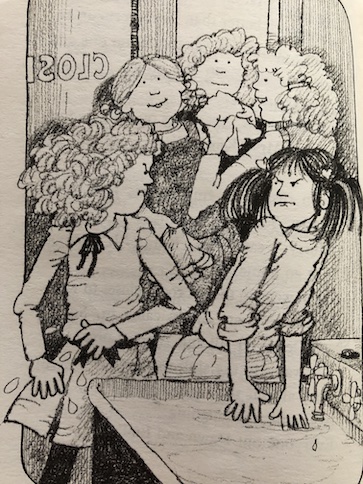
As the girls push against each other by the sink, cleaning up from using the clay, Dawn spots a ring next to the sink. Later, Emily says that her ring is missing. It’s a special ring with a blue stone that she got for her birthday. Dawn is pleased that she’s found a mystery to solve. Remembering that she saw a ring next to the sink in the art room, Dawn proudly goes back to the art room to see if she can find the ring and return victorious. However, the ring isn’t there when she checks.

Then, suspicion turns to Dawn herself. After all, everyone knows that Dawn stole Emily’s unicorn before. Instead of being the hero detective, Dawn is turning into the main suspect in this crime. Now, she really needs to find the ring to clear her name!

Dawn’s grandmother, Noni, gave her a special detective kit for her birthday. Dawn uses it to turn into The Polka Dot Private Eye to hunt down Emily’s ring.

The book is available to borrow online through Internet Archive.

My Reaction

I liked the way the series returned to the subject of Dawn’s theft and used it to spark a spin-off mystery series. This is the first of the Polka Dot Private Eye books. In this series, Dawn becomes a more likeable character than she was when she first appeared in Fish Face, and she gets a little comeuppance for her earlier, unpunished theft of Emily’s toy unicorn in the form of her classmates’ suspicion of her. When I read this book for the first time when I was a kid, I hadn’t read the book where Dawn was first introduced, Fish Face, so I didn’t really understand the relationship between Dawn and Emily and how Dawn took Emily’s toy unicorn. We never really find out in either book exactly why Dawn took the unicorn, although in this book, she thinks of herself as having “borrowed” it instead of having stolen it.

Reading Fish Face isn’t necessary to understand the basic story in this book, but after having read it, I appreciate Dawn’s position in this book a little better. By now, everyone knows what Dawn did, and although Dawn thinks of “weeks ago” as a long time ago, it’s not really that long, and it’s still fresh in everyone’s mind. Dawn is still a relatively new kid in class, and one of the few things everyone knows about her is that she has a history of taking things that don’t belong to her. It is a logical conclusion that Dawn might have helped herself to another of Emily’s belongings when everyone knows that she’s done it before. As my grandfather used to say, it’s easier to keep a good reputation than to redeem a bad one, but Dawn works at it and learns that she likes being a detective and that she has a talent for figuring things out. After Dawn figures out where Emily’s ring is, the two of them become better friends. Solving the mystery also makes Dawn a class hero and begins to establish Dawn’s reputation as a person who likes to solve mysteries and crimes rather than commit them.

This book gets bonus points from me for mentioning jelly sandals. Jelly shoes were a regular part of my childhood in the 1980s and early 1990s, and I’ve seen some of them return again in the early 2000s, probably partly because people my age now have children, and they’re nostalgic for some of the things from their childhoods. Jelly shoes (or “jellies,” as we called them) are sandals and sandal-like shoes made from flexible plastic in different colors, some clear or with sparkles inside. They were cheap when I was a kid, and I used to get a new pair or two when the weather turned warm. Eventually, they wear out, and the plastic bits snap. I’d wear them around my backyard with my toes sticking out the front as they started breaking, and I started growing out of them. By the time they were too broken to use anymore, my toes were usually beyond the bottom of the shoes, and I was always kind of proud of that because it was a sign that I’d grown over the summer. It wasn’t much of a loss when the shoes wore out because they’d be too small for me at that point anyway, so we’d throw them away, and I’d wear more solid shoes when the weather turned cold. Jellies, flip-flops, and cheap canvas shoes were a major part of what I wore when I was young and growing out of shoes fairly quickly. They were all inexpensive, and while they didn’t last very long, they lasted about as long as they needed to before I needed the next size and weren’t much to lose when I was rough on them.

The Mystery of the Disappearing Cat

Five Find-Outers

The Mystery of the Disappearing Cat by Enid Blyton, 1944, 1966.

Bets is happy that her brother, Pip, is coming home from boarding school, and he’s bringing his friends to visit. Now that the children are reunited, Bets and the others hope that they will find another mystery to solve! The others ask Bets if anything interesting has happened since they were home last, and she says not very much, although someone has moved into the empty house next door. The new neighbor is Lady Candling, who keeps Siamese cats.

The boy who helps the gardener, Luke, is nice and allows the children to visit and see the cats. Lady Candling says that the Siamese cats are valuable prize-winning cats. She keeps them in a large cage most of the time for safety, but Miss Harmer, the housekeeper, takes one out to show the children. Unfortunately, one boy, Fatty, owns a Scottie dog named Buster, and Buster comes into the garden looking for him. Buster frightens the cat and chases her! The cat claws Buster after he chases her into the bushes, and they manage to get Buster under control, but they have trouble finding the cat. Miss Harmer is upset that her cat is lost, and Bets goes to search for the cat.

While Bets is looking for the cat, the gardener, Mr. Tupping comes to find out what the fuss is about. Mr. Tupping is a violent and short-tempered man. (They also emphasize that he has a hooked nose, which I think is probably a stereotype. Enid Blyton’s books often contain derogatory racial stereotypes, although later printings have been revised to remove them.) Mr. Tupping hates children and animals, and he grabs Buster and locks him up, threatening to beat him later. The children try to help Buster, but he chases them out of the garden. Bets is left behind, but she locates the missing cat, and Luke helps to free Buster and get Bets out of the garden without Mr. Tupping seeing her. However, Mr. Tupping threatens Luke with dire consequences if he ever lets the children into the garden again.

This is just the beginning of their troubles with Mr. Tupping. When Mr. Tupping finds out that Bets has visited Luke again, he storms into Bets’s own little garden, rips her strawberry plants out of the ground, burns them, and yells at her. Bets is afraid to report him to the adults because she’s afraid that Luke will get in more trouble with Mr. Tupping. Luke is a poor orphan who lives with his stepfather, and he desperately needs the job, which is the only reason why he continues to work with the nasty Mr. Tupping. Mr. Tupping is also friends with the local policeman, and the children know that the local policeman resents them for solving a mystery before he did, so they’re sure that he will side with Mr. Tupping, no matter what they say about him.

Then, Lady Candling’s prize cat, Dark Queen, disappears, and Luke is blamed for stealing her! The children are sure that Luke is being framed for the cat-napping, but the evidence is against him. Pip and Bets’s own mother saw the cat in its cage when she went to tea with Lady Candling, and Luke was working in a garden bed nearby. Even Luke says that no one else went near the cage between then and the time when the cat disappeared. When a wooden whistle Luke made is found in the cats’ cage, the children are sure that it was planted to frame Luke, but how can they prove it? Then, the cat reappears, and later disappears again! What is going on?

The book is available to borrow and read for free online through Internet Archive (multiple copies).

My Reaction and Spoilers

I found this story frustrating because all of the adults in the story are so oblivious to Mr. Tupping’s violence and aggression. He is actively abusive to the children and animals, but nobody seems to notice or even inquire about signs of trouble. Bets’s mother never seems to notice that all of her daughter’s strawberry plants have suddenly disappeared from her garden and never asks her daughter what happened. Mr. Tupping is able to just march onto the family’s property and abuse an 8-year-old girl with complete impunity, and her mother never notices a thing. (Of course, if I were the girl in question, I would have done what I used to do when I was picked on as a kid – take a deep breath, throw back my head, and scream continuously until help arrives. I figured out at a young age that if you scream from your diaphragm, you can get extra volume and keep the scream going for longer without straining your throat, and it’s difficult for the adults to ignore. You can’t scream like that at every inconvenience or people will start to ignore it, but it’s definitely an attention-getter if you use it when it really counts! Just let Mr. Tupping explain his presence and actions when the adults come to find out why their daughter is screaming like she’s being murdered!)

Mr. Tupping is a very obvious villain. He’s also the first person on the scene each time the cat disappears, the one who strategically assigns Luke to work near the cats’ cages just before the prize cat disappears each time, and the keeper of the key to the cats’ cages when Miss Harmer is away, which she is each time the prize cat disappears. Yet, even though he has means (the key), motive (he hates the kids and animals and wants to get rid of Luke), and opportunity (always the first person in the cats’ cages whenever the cat disappears and the one person who controls where Luke is working), all of the adults immediately look at Luke as the thief, never even questioning Mr. Tupping. An adult would be more likely than a kid to know where to sell a prize-winning cat (heck, as a an adult, I wouldn’t even know where to deal in black market animals), but nope, all of the adults first think a kid did it, like kids have those kinds of criminal connections to the prize cat black market. It drove me completely crazy!

It’s worse because Mr. Tupping is friends with the local policeman and gets favoritism because of it. When the kids consult their friend who is a police inspector, he finds out that Mr. Tupping has a police record for being involved in a dog-napping case (surprise, surprise), which establishes his criminal history and connections to people who deal in stolen animals. I was disgusted that the local policeman never looked into his background himself, but I felt a little better when the inspector reprimands him for making friends with a criminal and overlooking evidence that implicated him and trying to prevent the children from bringing evidence and concerns to light. The local policeman is embarrassed, but at that point, I felt like he deserved to be.

The villain was obvious, but what saved this mystery was that he actually used a clever trick to confuse the time when he actually took the cat. I knew from the beginning who the cat thief was, so the real mystery for me was how he got the cat out of its cage without people seeing him. It turns out that Mr. Tupping takes the cat earlier in the day than everyone thought the cat was stolen. The Siamese cats look very much alike, but the one that was stolen had a marking that was different from the others. With a bit of paint, Mr. Tupping makes a different cat look like the missing one for most of the afternoon, quickly using a bit of turpentine to remove the paint at a strategic moment to make it seem like the cat disappeared at a time when Luke was near the cats’ cages.

Our Man Weston

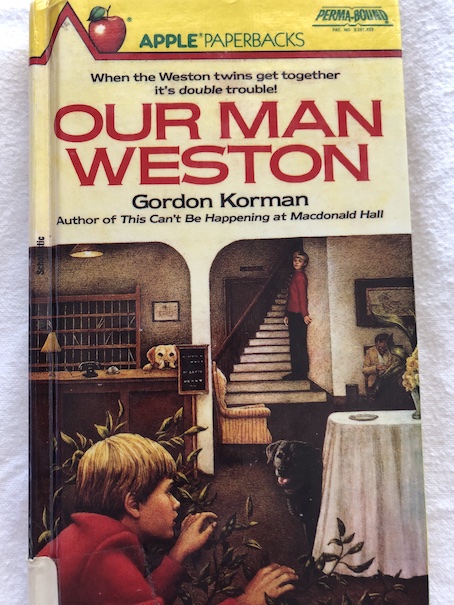
Our Man Weston by Gordon Korman, 1982.

Tom and Sidney Weston, a pair of identical twins, are excited about their first big summer jobs as service boys at a fancy resort hotel. Tom is thinking that the work is going to be easy and that they’ll have plenty of time to have fun, but then, he starts worrying about what kind of fun Sidney is going to try to have. Sidney mentions that they might see some interesting people at the hotel, and Tom remembers that Sidney thinks of himself as a detective and is always on the lookout for spies and criminals. It’s a real problem because Sidney is perpetually wrong in his suspicions about everything and everyone he tries to investigate. He’s gotten into trouble before for making false accusations, and because the two boys look alike, Tom sometimes gets blamed for things that Sidney does. Tom is really looking forward to this summer, and he’s determined that Sidney isn’t going to ruin their summer jobs.

Right from the first, Sidney is in detective mode. As the boys are picking up room service dishes, Sidney tries to study the dishes to make deductions about the people in each room. Tom tries to get Sidney to stop because their manager, Walter Parson, is a serious man with little patience, and he’s already annoyed that he has trouble telling the two boys apart. Sidney is excited when a hotel guest complains that her purse is missing, thinking that he’s found a case to investigate, but while he interviews her for details and pressing for details about a primary suspect, Tom just notices that the lady’s purse is still in her room. It wasn’t stolen, just misplaced. Tom uses this incident to emphasize to Sidney that he needs to give up this detective game because it only causes problems.

However, unbeknownst to the boys, there are real spies at the hotel, and they’re interested in the nearby air base, just like Sidney speculated might happen. The readers learn who the spies are right in the beginning, before the boys even know that there are spies. It’s a little like a Columbo mystery, where the identities of the villains aren’t a secret, and part of the suspense of the story is how the heroes will figure it out and prove it. Even though we know right away who the main villains are, Sidney is clueless.

Sidney continues investigating various guests as though they’re all spies or criminals, although he doesn’t seem at all suspicious of our real villains. He becomes convinced that Lawrence Waghorn is a spy when he’s actually a television writer who’s working on a script for a show about spies. He convinces the guest who temporarily lost her purse, Miss Fuller, that another guest, Mr. Kitzel, is a suspicious character, and she starts following him around and spying on him. In turn, Mr. Kitzel gets the idea that Miss Fuller either has an awkward crush on him or that she’s investigating him because he cheated on his taxes. He’s very nervous because she keeps following him around and tries his best to avoid her. Sidney steals his boss’s dog because he’s under the false impression that the dog is being trained to help the spies carry out their mission, and he seriously wants to inform the Prime Minister of Canada (where they live) and the President of the United States. Tom keeps trying to thwart his brothers’ various schemes and confiscate the spy equipment that he’s hidden around their hotel room. Confusion abounds, although some of its helps to inspire Waghorn, who has been suffering from a case of writer’s block.

Meanwhile, the real spy, Richard Knight (a pseudonym, county of origin unspecified), is trying to get his hands on a new airplane being tested at the nearby air base. He’s brought along a pilot named Bert Cobber. Cobber actually has military training and trained alongside the pilot testing the plane, “Wings” Weinberg. Weinberg has nerves of steel … except about anything related to his cadet days, having been partnered with Cobber, who is a skilled but reckless flier and nearly got him killed on many occasions while flying drunk, forgetting to put sufficient fuel in the plane, and repeatedly crashing. Weinberg hasn’t seen Cobber for years, but he practically has a nervous breakdown every time he relives those memories. A friend of Weinberg’s assures him that, if Cobber is really as reckless as Weinberg remembers, he probably got himself killed long ago, but Weinberg has the uneasy feeling that Cobber is still around somewhere.

Although many characters have the overall situation wrong, I appreciated those moments when some people got certain things exactly right. When Miss Fuller overhears Mr. Parson yet again mistaking Tom for Sidney and also quizzing him about why he’s getting mail from different government agencies, she steps up to tell him to stop his bullying, reminding him that mail is private and that the boy doesn’t owe him any explanation about his personal mail just because he works for him. She also tells him that he’s talking to Tom, not Sidney, and that he’s a fool for getting that wrong.

I also love it that the different government agencies that Sidney has been writing to already know who he is because Sidney has submitted many other inquiries to these various agencies. They’re all familiar with Sidney’s false accusations, and in their response letters to Sidney, they express both amusement for Sidney’s wild escapades and sympathy for whatever poor sap Sidney is suspicious of today. Sidney is never discouraged by their criticism of his wild theories or their requests for him to stop writing. It’s getting to the point where some law enforcement agencies are so fed up with Sidney that they wish they could find something to arrest him for.

Meanwhile, Richard Knight has noticed Sidney’s investigations, although he is unimpressed because he knows that Sidney is way off base. However, he hasn’t fully reckoned with the lengths Sidney is prepared to go to “save the western world”, and Sidney’s schemes interfere with Knight’s in completely unexpected ways.

My Reaction

I remember reading this book when I was in middle school, and I loved it. I remember thinking that it was really funny, although I’d forgotten a lot of the details since then. As an adult, I find Sidney more frustrating than I remember, and I feel sorry for poor, long-suffering Tom. As with the MacDonald Hall books by the same author but with different characters, Sidney’s crazy schemes end up working out for the best, and he ultimately saves the day, even though it’s largely by accident.

There are a couple of changes that I wish I could make to the story. First, I liked it that, while Mr. Kitzel isn’t a spy or a major criminal, he does have one guilty secret: he cheated on his taxes by claiming his dog as a dependent daughter. He becomes convinced that Miss Fuller is onto him for that. However, I’d like to create even more semi-guilty secrets for various guests at the hotel so that Sidney can be almost correct about some things while still missing the most suspicious person of all. As it is, Sidney is seriously way off base because he’s paranoid and delusional, although in a comedic sort of way. I don’t like characters that are intentionally stupid, so I’d like more secrets and petty crimes among the more innocent guests so Sidney can be almost right about them.

I’d also like to see Sidney develop some self-awareness during the course of the story. He is completely oblivious to his own failings and false conclusions and also to the way other people react to him, even when they tell him, in writing, that they don’t want to be bothered with his wild goose chases anymore. That’s part of the comedy of the story, but I find it a bit frustrating. Sidney does almost come to realize how other people look at him when he tries to persuade Miss Fuller that he was wrong about Mr. Kitzel being a spy, but she’s as impervious to correction as he is, so he ends up just letting her continue barking up the wrong tree. I think it would have shown more character development and maybe even have been more funny if Sidney comes to realize how Tom feels, trying to reign him in, if he had to try to control someone even more overly paranoid and determined than he is. The book ends well, but I think it would have been even better if, at the end, Sidney apologizes to Tom for everything he’s put him through, saying that, while everything worked out for the best, he realizes that he’s done a lot of things wrong and that he still has a lot to learn. Then, just when Tom thinks that things are going to calm down, he can see Sidney seriously reading a book about espionage or interrogation techniques and making notes or signing up for a summer correspondence course in criminal investigation, hinting that Sidney’s adventures aren’t over yet and leaving it open about whether he’s going to really learn something practical or just graduate to the next level of crazy.

Susannah and the Purple Mongoose Mystery

Susannah and the Purple Mongoose Mystery by Patricia Elmore, 1992.

This is the third book in the Susannah Higgins mystery series.

It’s summer, and Lucy has been helping Susannah practice for the Black Poetry Recitation contest. She’s not expecting the summer to get any more exciting than that because her father has told her that he can’t afford summer camp for her this year.

One day, Lucy and Susannah go to visit a friend of Susannah’s grandmother, Mrs. Quigley. Mrs. Quigley, often called Quiggy, says that she has a surprise for them. The “surprise” turns out to be that Quiggy has taken in a foster child, a girl named Theresa. Theresa is about the same age as the other girls and will be going to school with them in the sixth grade. Theresa tells the other girls that she likes Quiggy, but she doesn’t like Ruth, Quiggy’s cousin who lives with her. Ruth is a fussy woman who doesn’t like kids much, and Lucy tells Theresa that she’s like that with everyone. The only people Ruth really seems to like are Quiggy and her dog, Pipsqueak.

However, the girls are also shocked when they see that Quiggy’s garage has burned down. Fortunately, the fire didn’t spread to her house, but the garage is destroyed, and it looks like arson. Susannah tries to question Theresa about the fire, but Theresa says that she was asleep until Quiggy smelled smoke and woke her. Lucy thinks that the fire reminds her of when a girl she knew in second grade tried to set fire to a storage shed on the playground. Then, Lucy suddenly realizes why Theresa looks so familiar to her – Theresa was that girl from the second grade. Susannah doesn’t remember Theresa or the shed incident because she was going to a different school then.

Lucy is quick to suspect that Theresa is the one who set the garage on fire because of her firebug past, but Susannah is more doubtful. She wants to learn a little more about Theresa’s past since the second grade, where she’s been living, and whether she’s continued her firebug habit in other places she’s lived.

However, Theresa falls under suspicion again when another fire destroys Quiggy’s back porch, deliberately set by lighting a pile of newspapers on fire. Quiggy and Ruth were out at the time, and Theresa was home, but she says that she went to the park and didn’t know about the fire until she got back. Ruth is quick to accuse Theresa, saying that she knew that she’d be trouble from the beginning.

Mrs. Weinberger, the woman who called the fire department, said that she noticed the smoke right away because she was working in her garden around the time the fire started. When Susannah asks her if she was in the garden the whole time, she says that she did leave for awhile because she got an unexpected delivery of roses from a secret admirer, and the delivery boy even sang “You Are My Sunshine.” It sounds suspicious, like someone who knew Mrs. Weinberger’s normal habits deliberately tried to distract her so she wouldn’t see the arsonist arrive. Mrs. Weinberger describes the delivery boy, saying he looked about 18 years years old, he was blonde, and he had a tattoo on his arm. Also, both his shirt and his bicycle were purple. All she can remember about the name of the florist is “Mongoose”, which is a pretty odd name for a flower shop. The roses make it seem less likely that Theresa would have been the arsonist. Roses would be an expensive gift/distraction for a recently-arrived foster child to send.

When the girls learn from a boy Theresa used to live with in another foster home that she was sent away for trying to set a fire there, it looks bad for her. The girls talk to Theresa and suggest that she needs professional help, but Theresa denies ever setting any fires at all, at least, not on purpose. The fire at her last foster home was just a cooking accident, and Theresa wasn’t sad to leave there because the family wasn’t nice to her. As for the shed in the second grade, Theresa explains that she wasn’t actually trying to light the shed on fire. She was living in a foster home back then, too, and she’d just gotten a bad report card and a letter from her teacher that she was afraid to show to her foster family. She was trying to destroy them, and things just got out of control. Theresa insists that she would never want to do anything to hurt Quiggy or make her mad because she’s been nicer to her than any of her previous foster parents have, and she really wants to stay with her.

Theresa isn’t the only suspect for the arsonist, though. Could Ruth have somehow arranged the fires to get rid of the child because she didn’t want to share a home with her? What about Mr. Reid, the cranky next door neighbor who is annoyed about the sound of kids playing? There’s also Toby, Quiggy’s handsome nephew, who does handyman work for his aunt. He has access, but does he have a motive? What about George Peterson, who wants to buy Quiggy’s house? What about Arthur Featherstone from Theresa’s former foster home? Could he be holding some kind of grudge? It seems like the key to finding the real arsonist is finding the boy who delivered the flowers on the purple bike with the name “Mongoose” printed on it.

The book is available to borrow and read for free online through Internet Archive (multiple copies).

My Reaction

One of my favorite things about this series is that the author does a good job of making a number of people look like equally good suspects. In the beginning, I had multiple theories about who the real arsonist could be, and I honestly wasn’t sure who it was for much of the book. One of my early theories turned out to be correct, but I changed my mind two or three times along the way.

Something else that I’d like to mention is that, at one point, the characters go to the library to do some research, and they use microfiche to read some old newspaper articles. When this book was written, the Internet and the World Wide Web were just starting to evolve into something that the general public could use, but most people didn’t have access yet. Even libraries didn’t have the rows of Internet-capable computers they have now. Some may have been starting to get them by this point, but it was a gradual process, and I don’t think my local library had them until a few years later. In fact, I think this was around the time that my school’s library replaced the old card catalog with the new computer catalog, and it wasn’t an online catalog; it was just a database stored on the computer in the library. Remembering things like this makes me feel old, but I was part of that 1980s/1990s generation of kids (the very oldest of the Millennials) who were first taught to use more manual forms of data storage before being gradually trained in more digital forms as we moved up through the grades in school.

Because, in those days, in the 1980s and into the early 1990s, there was no ability for most public libraries and other institutions to scan documents, like newspapers, and upload them to the Internet for easy sharing, or just write them directly to the Internet in the first place, they would convert printed materials to microfiche, which are essentially smaller film images taken of the documents. In order to read them, you would have to use a microfiche reader, physically load the images you want on sheets of transparent film, and look at a magnified version of them on the screen, scrolling through them until you found the information you were looking for. There was no way to make the process go faster with a keyword search. It was a royal pain. I had to do it a few times for various school reports, and I never thought it was fun. If you look at this video of people demonstrating how to use a microfiche reader, you see how they have to turn the dial to get the image aligned properly so they can read it, and also when they physical move the piece of film in the opposite direction to the way the image scrolls on the screen. I always thought that was annoyingly counter-intuitive. I know why it does that, because it’s about where the viewer is positioned over the image, not where film is moving, but I remember being annoyed with it when I was a kid because I’d move it in the wrong direction and get mixed up. Maybe it’s just how my mind works. When you find the image/page you want on the microfilm, there is a way to print it out on paper. Some libraries still use microfiche (which is why this video exists), and it can be useful for looking at old records, but online archives are starting to replace this method of data storage. When my local library underwent renovations in the early 2000s, they decided to replace their old microfiche area with a new teen center and more computers. I think they sent the microfiche machines and archives to the local university library. I’m not even 40 yet, and I feel old.

Hester Bidgood

Hester Bidgood, Investigatrix of Evill Deedes by E.W. Hildick, 1994.

Hester Bidgood was a character in one of the McGurk fantasy mysteries, which involved time travel, and in this book, she investigates a mystery of her own in her own time, the late 1600s, Colonial America.

Goody Willson’s cat has been found, badly injured, with the shape of a cross burned into it. Some people are spreading the rumor that this is a sign that Goody Willson is a witch and that the injuries to the cat were a sign of God’s disapproval for Goody Willson’s “witchy ways.” Of course, Hester and her friend, Rob, don’t believe that. Old Mistress Brown worries that if the witch rumors go too far, everyone will soon be a potential witch suspect, like in Salem. Rob takes care of nursing the cat back to health, while he and Hester try to determine how the cat came to be injured in such a strange manner.

Rob knows what it’s like to be an outcast. Although he’s a white boy, he lived for a time among the Native Americans as a young captive and adopted many of their habits. He doesn’t know how to read, and Hester has been helping him. However, there are people in the community who don’t trust Rob because of his connections to the American Indians, and they call him derogatory names.

Hester and Rob consider that the mark on the cat could have been made by a branding iron. They go to the blacksmith and ask him if he has an x-shaped branding iron or if anyone has asked him to make one, but he says no. But, then Hester begins to consider that maybe the cross isn’t really a cross. A cross sign could also be made by putting two capital ‘T’s together at an angle.

Their investigations also take them to the old Morton homestead, where the entire Morton family was killed by American Indians some years before. Someone has been staying there in secret, and there are signs of blood, possibly from the injured cat. Gradually, Hester and Rob begin to put the pieces together, realizing who the person responsible must be and how this evil deed is actually connected to an earlier crime.

I didn’t really like this book because of the cruelty to animals. It wasn’t just what was done to the cat but also when Hester remembers Rob finding a dragonfly and considering taking off its wings. Hester stops him from doing it, but it’s still a disgusting thought. I thought that the villain was pretty obvious from the beginning, too, although I didn’t know the motive. When there’s a witch hunt, the person who is the most guilty is the first one to bring up the subject of witches.

The Case of the Weeping Witch

The Case of the Weeping Witch by E. W. Hildick, 1992.

This is one of the McGurk fantasy mystery books.

The kids are studying the history of their New England town in school. McGurk studies witchcraft trials, and he is outraged at how innocent people could be charged with witchcraft on little evidence and sentenced to death. When their teacher tells them that she has learned that a young girl was once put on trial for witchcraft in their town 300 years ago, McGurk convinces the others to try to use their “little black boxes” from the previous book in the series to go back in time and try to save the girl.

The girl, Hester Bidgood, is thirteen years old and turns out to be the goddaughter of Gwyneth, one of their friends from their last fantasy adventure. Gwyneth is now very old, but she remembers them and welcomes them into her home. A man in their community, Jacob Peabody, is trying to pressure Gwyneth into selling him her property. He is the one who brings charges of witchcraft against Hester. Hester calls herself an “investigatrix,” meaning that she is a detective, like the kids in the McGurk organization. She knows some disreputable things that Peabody has done, and Peabody wants to keep her quiet as well as force Gwyneth to give up her property. The McGurk organization is determined to save Hester, but they must be careful not to make anyone think that they might also be witches.

Of course, that turns out to be difficult because all of the modern-day members of the McGurk Organization have magical black boxes.

The book is currently available online through Internet Archive.

Spoiler:

Hester has a friend called Rob McGregor who was captured and raised by Indians when he was young. Although he now lives with his grandparents, he still has habits and skills that he learned from the Indians, and Hester likes to call him by his Indian name, Blazing Scalp (because of his red hair). I expected that Rob would turn out to be some ancestor of McGurk’s, just like the last book had a definite McGurk ancestor, because he has that distinctive red hair, but if there’s a connection, it isn’t definite.

Rob knows that Hester has learned that Peabody earned his fortune by cheating at cards and that he is hiding a mysterious guest in his house. Rob saves Hester when the people in the town try to conduct the water trial, seeing whether she will float or sink in water to determine whether or not she is a witch. Then, Rob and Hester hide in Rob’s secret lodge in the swamp while the McGurk organization tricks the man hiding in Peabody’s house into revealing himself.

The man, who has been going by the name Mica Holroyd, is really Matthew Hopkins, a former witch hunter who has been charged with witchcraft himself and is now a fugitive from the law. Once everyone in town realizes that Peabody is dishonest and harboring a fugitive, they know that the charges against Hester were false. Peabody and Hopkins are both sent back to England, never to return. When the McGurk organization returns to its own time, they learn that Rob and Hester eventually married and that the town gave Hester property that used to belong to Peabody as compensation for accusing her of witchcraft. Hester started a home for orphans and elderly people, which is now a retirement community in the kids’ town.

There is another book in the series which focuses on Rob and Hester alone, without the members of the McGurk Organization.

The Witch of Blackbird Pond

The Witch of Blackbird Pond by Elizabeth George Speare, 1958.

This is a book that is often used in American schools or recommended to students, but because of the complexity of the story and dark subject matter, I wouldn’t recommend it to young children. It’s more appropriate for middle school level children and older.

The year is 1687, and a sixteen-year-old girl named Kit (short for Katherine) Tyler is traveling by ship from Barbados to the Connecticut Colony. Kit was born in Barbados, where her grandfather owned a plantation, which he received in a grant from the king. However, Kit was orphaned at a very young age, and now, her grandfather has died, so Kit is on her way to live with her Aunt Rachel, her mother’s sister, who is married to a Puritan and is living in Connecticut.

In Barbados, Kit was part of a prominent, slave-owning family, but in Connecticut, she’s just another girl. The people in Connecticut are Puritans, which puts Kit on the opposite site of a political conflict. Her father’s side of her family in Barbados was on the side of the Cavaliers, who supported the king against the Puritans, or “Roundheads” in the English Civil War (1642-1651). Because her Aunt Rachel has married a Puritan, Kit’s Connecticut relatives are on the side of the Roundheads. When Kit first sets off on her journey, she has very little idea of the difference between the two and what it’s going to mean for her future life.

People in Connecticut do things differently, and from the very beginning, Kit strikes them as strange and unpredictable. She is impulsive, and even her grandfather used to warn her about thinking before she acts. Kit is accustomed to living in luxury, giving orders to slaves, and generally being allowed to do as she pleases. It comes as a shock to her that not only can she no longer do these things, but others may heap harsh judgement on her for behaving oddly, even when she does it in the name of a good cause.

Kit gets her first impressions of what life in Connecticut will be like when she talks to the ship captain’s son, Nat Eaton, and an aspiring clergyman named John Holbrook. John Holbrook is the son of a tanner who has had to work by day and study by night since he was young, and he struggles to complete his education because his family doesn’t have enough money to send him to college. Because Kit’s grandfather was wealthy, Kit has never really had to think much about money before. She never had to work or even do chores when she was young, and when she tries to talk to John Holbrook about the books that she’s read, he disapproves of her choice of reading material because he thinks that reading should be reserved for the serious study of religion.

Kit’s naivety and views of slavery are challenged when Nat Eaton talks her about the horrible conditions slaves endure when they are transported from Africa to the Americas and how many of them don’t survive the experience. Kit is accustomed to owning slaves and having them work for her, but just as she has never had to think about the cost of the fancy clothes and other luxuries that her grandfather gave her, she realizes that she’s never given a thought to where slaves come from and how. Kit learns that, while there are people in the North American colonies who own slaves, there are others who vehemently disapprove of the practice, including Nat Eaton. He says that if his family had dealt in slaves, they could have a lot more money, but they’re doing fine carrying more humane cargo and passengers.

Note: Racial issues are more of a side issue than the main part of the story, and this is the part of the story that addresses the issue the most. I can’t say that Kit ever comes to reverse her early view of slaves completely, but this is the beginning of a revelation to her, one of the first indications to her that the life she previously lived is actually the exception instead of the norm, and not everyone looks favorably on people who live the way she used to live. None of the main characters in the story are black.

Kit is dismayed that there seem to be few topics from her old life (politics, money, slaves, the luxuries she owned, the relative freedom she had, not having to work, having plenty of time to read whatever books she liked whether they were useful or instructive or religious or not, etc.) that don’t cause some awkwardness, discomfort, or disapproval from the people who live in the community she is about to join and who will now be playing significant roles in her life. People don’t seem eager to be friends with her, and they look at her suspiciously as a stranger.

As her ship nears its destination, a little girl on board loses her doll overboard and Kit jumps into the water to get it back, alarming everyone. Most of the other women and girls don’t know how to swim, and they think it’s strange when Kit says that her grandfather taught her how to swim when she was little. The sea around Connecticut is too cold for swimming, so they’re not used to the idea of recreational swimming. (This time period was part of the Little Ice Age, so the area was even colder then than it is today.) Some people also consider that one of the tests for witchcraft involves seeing if a woman could float in water, and they begin whispering that Kit might be a witch.

When Kit finally arrives at the town where her Aunt Rachel and Uncle Matthew Woods live, Wethersfield, she is disappointed to see that it’s much more rural than the community where she used to live. The streets are not paved. Kit is dressed in an overly-elegant way for the community and even for her own family. When she finally meets her aunt, she thinks that she must be a servant at first because she is dressed so plainly. Aunt Rachel is happy to see her, and Kit meets her cousins, Judith and Mercy. Judith is very pretty, and Mercy walks with crutches. Kit is surprised at the very simple way they live, and they are taken aback at her fine clothes and all of the possessions she brought with her in her trunks from Barbados.

Her relatives are stunned when they find out that Kit plans to stay with them. They had not even expected her to come for a visit, and they had not heard about her grandfather’s death. Uncle Matthew asks why she didn’t write to tell them that she was coming, and Kit admits that she was afraid to write to them because she didn’t want them to tell her not to come and she didn’t have any other choice but to come to them. After her grandfather’s death, the overseer of the plantation sold off the entire crop and kept the money for himself, and all of the other plantation owners in the area presented Kit with debts her grandfather had with them that needed to be repaid, so she was forced to sell off the slaves and almost everything else to pay them. (From Kit’s description about the sudden influx of supposed debts after her grandfather’s death, I wondered whether at least some of these supposed debts were fraudulent and if Kit was simply too young and naive to challenge them, being accustomed to her grandfather handling all of the family’s money and business arrangements, but I can’t really be sure. She doesn’t go into detail about what proof the creditors offered of the debts or if she simply took them at their word, and its only real importance is in helping to provide her with a reason for going to live with her relatives.) Aunt Rachel says that Kit did the right thing by repaying the debts and coming to them, but Uncle Matthew seems less sure. He disapproves of Kit’s grandfather for being a royalist and seems reluctant to take on a now impoverished relative accustomed to a luxurious life.

Kit tries to share some of her fancy clothes with her cousins when they admire them, and Judith and Mercy love the new clothes, but Uncle Matthew puts a stop to it. He disapproves of Kit’s clothes because they are just too fancy and he thinks they encourage vanity. Uncle Matthew is very direct with Kit, explaining to her that people in this family and in this community live a very different life from the one she is used to, and she is going to have to adjust to their ways if she wants to live with them. Adjusting to this new life, which is so different from everything she knew before, is a major struggle for Kit throughout the story.

Privately, Kit confides in Mercy that she had another reason for wanting to leave Barbados. There was a man there who was a friend of her grandfather’s. Her grandfather also owed money to him, but he would have forgiven the debt and paid the other debts if Kit had agreed to marry him. Other people in Barbados said that it was a smart match and that she should marry him, but he was fifty years old, and Kit couldn’t bring herself to marry someone so much older than herself. That’s why she wanted to leave Barbados in such a hurry and didn’t want to wait even long enough to write to her relatives. (The issue of the girls’ marriage options and what they mean for their family and future lives is a major focus of the story. It is taken for granted throughout the story that all of the girls will get married at some point and that their primary future occupation will be being someone’s wife. However, what being a wife means for them depends on who they marry, what their husband’s occupation and position in society are, and the type of lifestyle they can support.) Mercy says that Kit did the right thing by leaving Barbados and that her Uncle Matthew will get used to her being there if she can demonstrate that she can be useful (an important factor in the occupation of being a wife or daughter of a Puritan family).

Being useful is a problem for Kit, who is unaccustomed to doing work of any kind. She doesn’t know how to do even basic chores. People need to explain to her how to do everything, and even then, Kit is extremely clumsy and lacks the patience to follow their instructions properly. Judith loses her patience trying to teach her and isn’t happy to learn that they’re now going to have to share a bed. Kit appreciates Mercy for her understanding and her quiet strength. Even though some people disregard Mercy because of her disability, Kit knows that Mercy has valuable skills and that she can work as hard as anyone. Life with the Woods family is a monotonous series of chores that previously Kit would have thought of only as labor for slaves that she would never have to do.

Then, there are religious differences between her and her relatives. When Kit lived with her grandfather, they never attended regular church services, but Uncle Matthew’s Puritan household is strictly religious, so Kit is expected to go to church with the family. At the church services, she sees that other people in the community are wearing clothes that are about as fashionable as her own, so not everyone in the community is as strict in their dress as the Woods family is. However, Kit is bored by the services (which last all day), the other parishioners don’t seem very friendly, and it seems like word has spread that Kit is a charity case that her aunt and uncle have taken in. However, she does attract the attention of a young man named William Ashby, and Judith meets John Holbrook for the first time.

As Kit spends more time with her relatives, she discovers that Uncle Matthew is a local selectman but that he has political disagreements with some of the other men in town, and some of them think that he is less loyal to the king than he should be. Kit also becomes involved in the romantic interests of her cousins and confronted with some choices she needs to make about her own future. William Ashby is from a wealthy and socially prominent family, but Uncle Matthew dislikes the Ashby family for being Royalists. Kit learns that Judith was interested in William Ashby before she came, and she worries that Judith will be angry with her for attracting his attention, but Judith tells her not to worry about it because she is now in love with John Holbrook. Kit still feels uncomfortable at William’s sudden interest in her because she has only just come to live in the area, she knows very little about William, and the two of them don’t seem to have much to talk about during his visits with her. However, Aunt Rachel and her cousins encourage her to pursue the relationship because William Ashby’s family is prosperous and he can provide a good living for her. Kit is flattered by William’s attention because he admires her whether she is “useful” or not. With his family’s money and position, William Ashby could give Kit a life similar to the one she had before with her grandfather with nice clothes and relative freedom from routine household chores.

However, Kit’s views and ambitions in life begin to change when she starts helping her cousin Mercy to teach young children in the community’s dame school. Basically, a dame school was when a woman of the community would teach children basic lessons, such as reading and writing, informally in her own home for a fee. (For more information, see Going to School in 1776.) Mercy explains that after children learn to read in the dame school, they can go on to the more advanced lessons in the community’s formal grammar school. Kit always enjoyed reading and discovers that she likes working with the children. As a dame school teacher, Kit earns fees from the students and performs a useful service that she enjoys much more than weeding gardens, scrubbing floors, and other household chores. Kit was not raised to have a profession, but there is more than one kind of work in the world and even in this small community, and this particular kind of work suits her. It pleases Kit that the students appreciate her and enjoy her lessons and stories.

The girls’ romantic dreams and life decisions as they come of age and begin making lives for themselves in the community could make for an interesting historical novel by themselves, but there is more to this story. This is a witch trial story. Kit has already had people making witch comments about her because of her odd behavior, but through her work at the dame school, she demonstrates other odd habits that cause her to get on the wrong side of community members. When she gets the idea of having students act out the story of the Good Samaritan instead of simply listening to it, the situation gets out of hand. She is criticized for using the Bible for play-acting, and the dame school is temporarily closed. Then, Kit befriends Hannah Tupper, a somewhat eccentric widow who lives in an undesirable area near Blackbird Pond that often floods. Nobody understands why she wants to live out there, all alone with her cats, and people in the area say that she’s probably a witch. The truth is that she is known to be a Quaker, and the Puritan community doesn’t like to associate with her because of her religion. Kit likes Hannah because she is kind and understanding to her and calms her when she is upset, but her family doesn’t like her to associate with Hannah, saying that evil can seem innocent at first. Kit also realizes that, while William Ashby admires her, he is also scandalized by her behavior. Hannah, on the other hand, is supportive of Kit and helps her continue to secretly teach a young girl whose mother doesn’t want her to have reading lessons.

Kit’s friendship with Hannah gets her into trouble with community and even puts her life in danger. People in Wethersfield start to die from a disease that has struck the community, and Hannah is blamed. Kit risks her life to save her from an angry mob. Although she successfully gets Hannah to safety, Kit is also accused of witchcraft and put on trial.

I often find stories of people falsely accused frustrating, but this one has a good ending. There is a note in the back of the book that explains the historical background behind the story. Kit Tyler is a fictional character, but there are some real historical characters in the book, and the political situation involving the colony’s charter is real.

The book is a Newbery Award Winner. It’s available to borrow and read for free online through Internet Archive (multiple copies).

My Reaction

The time period of the story is a time of witchcraft suspicions, like those that sparked the infamous Salem Witch Trials in Massachusetts (1692-1693). Historically, suspicions of witchcraft and actual witch trials were more likely to occur in communities suffering from internal divisions and instability, especially when the community suffered some further calamity with no apparent explanation, such as a sudden epidemic of illness (possibly ergotism in Salem), heaping panic on top of existing community tension and anger. Then, the community would take out its feelings on someone who was generally disliked by a majority of community members, usually targeting someone who lacked resources to fight back against the allegations of witchcraft, like a poor woman or a widow. Basically, the community wanted someone who could serve as a convenient scapegoat (as described by the Salem Witch Museum) or whipping boy for the commu,nity’s roiling emotions and real problems that they either didn’t want to address or lacked the means to address. Even when it became obvious in hindsight that they had killed innocent people, most of those involved wouldn’t even suffer feeling guilty or bad about themselves for murder because there was always Satan and his trickery to blame for their own actions and decisions. No one could prove that they hadn’t been honestly deceived by the devil, so they would not be held responsible by their friends, who liked them personally and had been actively involved in the entire episode themselves. The community would already be accomplished at mental blame-shifting, so their minds would be relatively untroubled by personal responsibility. Knowing that they didn’t experience regret or remorse for their actions, that they felt right and good about their personal choices, doesn’t help the people they killed, the families of their victims, or people vicariously experiencing the injustice through history or historical novels. Miscarriages of justice are deeply frustrating, which is why I don’t normally like this type of story, although in the past, I’ve been fascinated by the historical background of this incidents, which is why I wrote a couple of papers on witchcraft trials, both American and European, in college, back when I majored in history. (Don’t make the mistake of saying anyone was burned at the stake for witchcraft in America. It’s not true, not even at Salem. The accused were hanged, and some were pressed to death with heavy rocks, but nobody was burned at the stake for witchcraft in the American colonies. That happened in Europe but not America, and it always annoys me when people get that wrong.)

In the book, the community in Wethersfield has all of the historical elements necessary for producing a witch hysteria. From the beginning, Kit notes the the political divisions in the community. Particularly, her uncle is at odds with other prominent community members about specific local issues and the amount of loyalty owed to the king, and there is also a conflict over the colony’s charter. Even though Kit would be the side of those favoring the king, more so than her uncle, the feelings that community members have about her uncle’s political position would give them a natural prejudice and suspicion toward what they would view as the strangest and most problematic member of her uncle’s family. Then, there is a sudden sickness that causes community members to die. The community also has an outcast who would make a convenient scapegoat, Hannah Tupper. When Kit first hears about her, her cousin Judith tells her that some people already think that she may be a witch. As both a widow and a Quaker outcast, she would have been unable to save herself from the townspeople without Kit’s help. When Kit provided that help, and the community lost their first choice of scapegoat, they picked Kit as their second choice, an acceptable substitute.

On the one hand, my own anger at the injustices of the past leads me to return the witch hunters’ judgement with some harsh judgement of my own. Some of the world’s most judgemental people are so unaware of any other emotions besides their own that they are shocked to discover that other people actually have minds and feelings and an equal ability to look back at them and assess what they see. I suppose that these people wouldn’t have guessed what future people would think when they looked back at them because their views of themselves wouldn’t match what independent observers, seeing their actions and the consequences across time, would see. Human beings often have internal fantasies about themselves where they are more brave, clever, attractive, and on the side of moral right than they actually are, and I think the witch hunters are a definite example of that. I don’t like people who wriggle out of personal responsibility, no matter why they do it, and if I’ve said it once, I’ve said it a thousand times, I only consider people as “good” as their own personal behavior and the way they affect other people around them. Nobody’s “good” simply because they say they are or like to think of themselves that way, especially if their real actions say otherwise. Actions speak louder than words. There are many things about the people in the community in this story (as well as in real historical communities) that don’t live up to my high personal standards. Offending me isn’t a criminal offense, and there aren’t many consequences for doing it, but it does provoke a lot of griping.

I think that there’s little point in having standards if you don’t actively live them, and although I think some of that sentiment would have been in the witch hunters’ thoughts, I further believe that everyone has an equal responsibility for both the standards they have and how they choose to demonstrate them. If people would give more thought to the “hows” of their actions and the consequences of what they do, I think there would be fewer problems in the world in general. I also think letting people get away with harmful behavior and not at least clearly criticizing it sets a terrible precedent that is likely to lead to further harm. In the book, once Kit’s name is cleared, she is inclined to forgive her accusers, although she is offered the opportunity to charge them with slander. I understand the reasons why Kit would decide not to pursue these charges, but at the same time, there is clearly one person in the story who was more responsible than the others for the charges brought against Kit and who has also been shown to be hostile toward her own innocent young daughter, and this person does not receive punishment for her actions in this story. I did feel better that the father of the child, realizing that his wife has been wrong about their daughter, falsely labeling her as a half-wit and keeping her from the education that she should have, stands up for the child and her continued education in the end, but I still kind of wanted to see the rest of the community give the mother more of a direct, official warning or censure to bring it home to her that there would be consequences for further misbehavior on her part because of the serious consequences, even possible death, that she almost imposed on others. Sometimes, I feel like this sort of conflict comes to an end too quickly and easily in stories with kind of an air of “We’re all good here now” without some of the underlying problems really being confronted or resolved. It happens sometimes like this in real life, but it’s not very satisfying, and just because some people say “We’re all good here now” doesn’t mean that everything is really fine and everybody involved is really fine. I’m never comfortable with pretending that things are okay that are clearly not. The mother of the child seems to have some mental issues of her own and some kind of emotional conflict over her own child that gives her a warped view of reality. That isn’t fully explained or resolved in the story, probably because the other characters don’t fully understand it, either.

Perceptions are important, but a person’s perceptions don’t stop reality from being, well, real. I know that, in real life, all or many of the supposed witch threats probably seemed real to the individual accusers in the middle of their personal panic, but the reality of the situation is that they did a great deal of harm to innocent people who were unable to stop them. In fact, they specifically targeted people they knew couldn’t stop them, which sounds pretty calculating. They did it because of their own personal problems and the demons that lived in their own minds, whether or not those mental demons had any supernatural help. It’s frustrating because you can’t communicate completely rationally with determinedly irrational people any more than you communicate can with dead people or fictional people and convince them to change their minds. There are times when there’s just nothing you can do when there is no way for the other person to receive new information or they’re just determined not to and no way to help someone who not only doesn’t want help but doesn’t think they need it and would be deeply offended and suspicious at the mere offer. On the other hand, the psychology of such incidents is kind of interesting.

Years ago, I attended a talk given by a team of professional ghost hunters where they said that people who call them to investigate hauntings in their homes tend to be people who are already troubled about something else in their life, such as money problems, marital problems, health problems (mental and/or physical), problems with their kids, or some combination of these. Then, when something happens that seems strange and inexplicable, they get startled by it because they’re already on edge. People who are more secure in their lives and are generally happy might brush off one or two odd things that happen as just rare oddities and forget about them, but people who are already upset about something else tend to seize on them. They become hyper-vigilant. They start noticing more and more odd things that they might otherwise have overlooked and draw connections between these things in their minds, actively looking for more. Soon, they have themselves convinced that they’ve got a full-blown haunting in their house, when at least some of what they’ve experienced is just the ghosts in their own minds. In one case, they said that a man was troubled by a mask he bought at a garage sale. He thought it was cursed because, soon after he got it, a bunch of bad things happened to him. (As I recall, his wife divorced him, he lost his job, and he had health problems.) The ghost hunters said, “To be fair, we don’t think that this mask was cursed when the man bought it. We think it became cursed because he bought it, and he continually blamed it for every bad thing that happened to him around that time, even though these things were probably going to happen anyway.” This is basically the same process that leads to witchcraft trials, except that in witchcraft trials, it happens on a larger scale. Witchcraft trials involve whole troubled communities instead of just a single troubled household.

This still happens in modern communities, but in places where people don’t believe in witches, it’s more likely to take the form of a kind of moral panic, where people get upset about a possible infiltration or excess of people seen as some kind of disruptive moral deviants, rather than a witch hysteria. In both cases, the community experiences extreme fear or paranoia about some perceived threat, but in moral panics, the perceived threat comes from some part of human society, like Communists during the Red Scare or some variety of criminal, not a supernatural force. Actually, I believe that we’ve been living in a state of moral panic in the US for at least the last few years, probably longer, on more than one front. I can’t help but notice that much of what’s been happening in modern times fits all the criteria and follows the typical stages of a moral panic, particularly the parts about the “hidden dangers of modern technology“, a belief in “a ‘hidden world’ of anonymous evil people“, and fear of an “evil stranger manipulating the innocent” (which, weirdly, is what I think is behind the willingness of some people to believe conspiracy theories in the first place as they accept stories that come from apparent “friends”, or at least people who look like people they might want to get a beer with or something – some people use them as their primary source of media, thus checking another box in the requirements for a moral panic and leading up to the final point). In my experience, the fear is particularly about evil people who want to “control” others and tell them what to do, the ultimate community boogeymen where I live. I’ve heard a lot about it for years from real people who habitually like to tell me what to do and how I should feel about things themselves.

This is kind of a digression from the story, but I put it here to illustrate that we might not have to question how people can get themselves into community hysteria over perceived threats, most of which prove to be not that threatening in the long term. Most people might not believe in witches anymore, but they’ve found plenty of creative substitutes for the same basic process over the years. A complete list would take too long to compile, but if you spend any amount of time on social media, you can come up with several “evil” or “deviant” groups or ideological concepts that people hate and fear in the space of a few minutes. Thanks to modern technology, you don’t have to wonder what’s going on in people’s heads. You can Google it. Many people will just tell you right up front what boogeymen are lurking in their minds, and they’ll gladly share that information with untold numbers of total strangers through Twitter, Facebook, and Quora, feeling validated and supported if faceless usernames agree and spread their stories, no matter why they do, and often raging against sinister forces trying to spy on them at the same time. It’s not rational, but it is recognizable. I put it to you that a few moments of honest self-reflection, considering not how you feel but what you’re actually going to do and what it’s going to mean in real terms, can be the stitch in time that saves nine. There are dangers to modern technology, but I don’t think they’re really that hidden. They’re the same dangers human society has caused itself in the past, just much faster, and they come mostly from the demons in the minds of the people involved. There is nothing online that wasn’t designed, written, promoted, spread around, and ultimately accepted by individual humans. It’s when people lose touch with the realities of the situation and the consequences that their actions have for real people around them in the real world that I really worry. It seems to me that blaming the Internet or the media for the things people have decided to do themselves has become the 21st century version of “The devil made me do it.”
Cassie Bowen Takes Witch Lessons

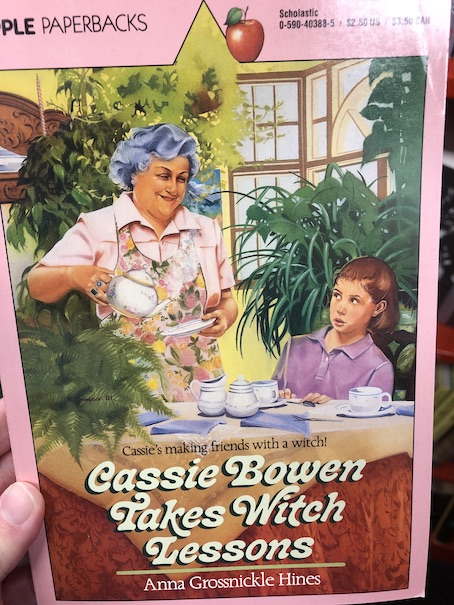
Cassie Bowen Takes Witch Lessons by Anna Grossnickle Hines, 1985.

Cassie Bowen and Brenda Bolter have been friends for years, but lately, Brenda has been getting friendlier with Sylvia, another girl in their fourth grade class at school. Sylvia is a mean girl, and the favorite target of her meanness is Agatha Gifford, the new girl at school. Sylvia likes to call her “Saggy Aggy” and “Thrifty Gifford” because Agatha always comes to school wearing dresses that are too loose on her and Sylvia thinks that she probably got them at a thrift store. Most of the girls at school wear brand new jeans, not dresses. Agatha doesn’t bother to fight back when the other girls tease her, and Cassie doesn’t know what to say or do about it, even though the teasing makes her uncomfortable, too.

Even if the other girls are right about Agatha wearing used clothes, Cassie can understand. Cassie wears jeans like most of the other girls, but hers are actually hand-me-downs from an older cousin. (The story of my own youth, too. Thrift stores are the story of my present because I still don’t have much money, and anything I don’t spend on clothes is something I could potentially use to buy books, most of which will also be used because I like older books and because it maximizes my buying power. Life and budgets are about priorities.) Cassie’s mother hasn’t had money to buy new clothes since Cassie’s parents got divorced. The book is vague about what happened in Cassie’s family before the divorce, but Cassie’s father now lives in another state and doesn’t even write or communicate with the family, and he’s certainly not sending money. Cassie’s mother says that he’s got to sort out his life, and Cassie says that her father is kind of a “creep” now, but the book doesn’t go any deeper into it. It’s more important that Cassie’s family is now tight on money, and Cassie has mixed feelings about the divorce. On the one hand, she misses her father and wishes that the divorce had never happened, but on the other, she’s also angry with her father for his part in the divorce and the ways that he changed from the father she knew and loved before. Cassie’s mother says that everyone changes over time, and sometimes, when they change, they grow apart. Cassie will soon come to understand that better through her experiences with Brenda.

Cassie doesn’t like the ways that Brenda is changing, and she resents Brenda sharing the secret hideout they built with Sylvia without even talking it over with her. One day, when the girls are going to their secret fort, they pass the old house where Agatha lives with her grandmother. There are neighborhood rumors that Mrs. Gifford is actually a witch because her old house looks kind of creepy and she often does odd things, like talking to her plants. As the girls pass her house, they hear her talking to her flowers, and suddenly, Sylvia trips up Brenda so that she goes sprawling into the flower bed. As Mrs. Gifford laments about her flowers, Sylvia dramatically exclaims that they must pick some flowers and actually starts yanking more out of the bed until Mrs. Gifford angrily chases them off with a broom.

Cassie is appalled by the entire incident, although she admits that it was funny, watching Mrs. Gifford chase the other girls. Brenda is fascinated with Sylvia because of the daring way she likes to show off and grab attention, and it inspires her to do the same thing, finding ways to make fun of people or cause trouble. It upsets Cassie, who just wants Brenda to be the same Brenda she’s always known. Brenda also tells Cassie that Sylvia has amazing things in her room, like a collection of glass animal figurines. Sylvia even gives her one to keep. Also, Sylvia’s parents supposedly let her stay up as late as she wants, and she can usually get her way with them just by throwing a tantrum. Brenda thinks that all this is cool, which makes her different from the kids I knew growing up. Most self-respecting fourth graders were beyond tantrums and would have been called babies if they had admitted to having one at that age. Having great clothes and a lot of cool stuff in her room would have gone a long way, though.

When the children’s teacher, Mr. Gardner, assigns the kids partners to work on presenting a story to the rest of the class, Cassie hopes that she and Brenda will be partners so that things can be like they were before. However, Brenda and Sylvia end up being partners, and Cassie is assigned to Agatha. Cassie isn’t enthusiastic about it, and Agatha notices, but Cassie decides that she’s going to be as friendly as she can. She asks Agatha about which story she would like to present to the class because she doesn’t like reading that much, and Agatha says that she knows because she’s noticed that Cassie is better at math. Cassie is surprised that Agatha would know that, considering how new she is, and Agatha says that she envies her because she’s been having trouble with fractions. Agatha says that she really likes the story The Nightingale because it reminds her of a beautiful music box that her grandmother owns, and Cassie is fascinated.

One day, when Cassie’s brother is off playing baseball and Brenda and Sylvia are working on their project together, Cassie passes by Agatha’s house and is invited in. Cassie hesitates at first because the house is creepy, but she has to work on the project with Agatha, so she accepts. Agatha’s grandmother serves the girls rose hip tea and cookies. Cassie thinks that rose hip tea sounds weird at first, but it tastes nice. Mrs. Gifford is an eccentric lady, but rather sweet. She introduces Cassie to Roberto, her favorite plant. Part of the reason why she talks to plants is that she lived alone and was lonely before Agatha came to live with her. She is also a member of the same gardening club that Cassie’s mother belongs to. Cassie uses the cookies at tea to explain fractions to Agatha, and Mrs. Gifford shows Cassie her music box, which is beautiful. The music box is special to Mrs. Gifford because it was the last present her father gave her before his death, when she was about the age of the girls now. Cassie understands the feeling because she prizes the teddy bear that her father gave her before he went away.

The more Cassie learns about the Giffords, the less strange they seem, and she no longer believes that Mrs. Gifford is a witch. Agatha tells Cassie that she lives with her grandmother because her parents were killed in a car accident. The only other family she has is an older sister who is away at college, which is why Agatha can’t live with her. Cassie acknowledges that Agatha’s situation is worse than hers because, even though Cassie misses her father, she’s not an orphan. Agatha also explains that the reason why she wears those dresses to school is that her old school was a private church school, where all the girls were required to wear dresses. When Cassie explains to Agatha’s grandmother that there is no requirement about dresses at their school and that most of the girls wear jeans, Agatha’s grandmother is surprised and says that she didn’t realize, so she buys Agatha some new clothes, taking Cassie with them on their shopping trip.

The new clothes fit Agatha better, and Cassie hopes that they will help her fit in better at school, but Sylvia and Brenda won’t let up on the teasing. In fact, Sylvia seems irritated at Agatha dressing more normally and mocks her, saying, “What’s she trying to do? Act like a normal person?” Cassie tries to tell them that Agatha is normal, but they don’t believe her. Soon after, Brenda asks Cassie if she wants to hang out when she’s on her way to see Agatha again about their project. In an effort to get Brenda to ease up on Agatha, Cassie asks Brenda to come with her so that she can see for herself that Agatha and her grandmother are fine.

The Giffords are nice to Brenda, but during the visit, Mrs. Gifford’s special music box disappears. Agatha says that Brenda stole it, and Cassie gets offended by the accusation, saying that Agatha is making it up and telling her that she doesn’t want to be friends anymore out of loyalty to Brenda. Unfortunately … Agatha was right, and Cassie is shocked when she discovers the truth. Cassie retrieves the music box from Brenda, but with Brenda and Sylvia both angry at her for taking the music box back and Agatha and her grandmother probably mad at her for bringing Brenda to their house in the first place and siding with her over the theft, what is Cassie going to do?

I think the ending of the story is very realistic, although it does leave some things unresolved. Agatha does forgive Cassie for not believing her after Cassie returns the music box. Cassie doesn’t tattle on Brenda and Sylvia because they had accused her of being a tattletale earlier, but she does eventually tell her mother everything that has been happening with Sylvia and Brenda. Her mother reassures Cassie that she did the right thing, even if Brenda didn’t. She says that it sounds like Cassie is angry at Brenda for a lot of things besides this, and Cassie agrees that she doesn’t like it that Brenda is so mean sometimes. Cassie mother says that everyone changes, and sometimes, they change for the better and sometimes for the worse. Cassie doesn’t think she and Brenda will ever be friends again, and her mother says that someday Brenda will also get tired of Sylvia’s meanness, but even if she doesn’t, Cassie will find plenty of other friends. Cassie realizes that she and Agatha really do understand each other, and she’s glad when they make up. At school, Sylvia and Brenda both tease Cassie now, saying that she’s taking witch lessons from the Giffords. It hurts Cassie’s feelings to see her old friend turn against her, but she follows Agatha’s advice and ignores them.

Sylvia and Brenda are never punished for the things they’ve done, which is sadly the case for most of the little bullies I knew as a kid. However, it is nice that Cassie and Agatha realize that they are better friends for each other than either Brenda or Sylvia would have been. I noticed that there is also potential for them to be friends with other people in their class besides Brenda and Sylvia. When Cassie got to school at the end of the book, a girl named Stacy asked her if she wanted to play tether ball, which shows that other girls don’t think badly of her for hanging out with Agatha. I also wished that the book would show more of Pam, who had been Sylvia’s best friend at the beginning of the book before Sylvia and Brenda started hanging out. After being abandoned by Sylvia, perhaps she would also be open to making some new friends. Cassie and Agatha might have other options for making new friends.

There is no magic in the story or witchcraft of any kind. In fact, Brenda and Sylvia probably never really believed that Agatha or her grandmother are actually witches. It’s more that, for reasons of their own, Sylvia and Brenda were looking for someone to pick on, and the “witch” accusations were just their excuse. That’s why they were so irritated when Agatha started dressing like the other girls. If their excuse for bullying Agatha disappeared, they didn’t want to lose their ability to bully her. It was never about making Agatha dress or act like the other girls; it was always about Sylvia and Brenda’s need to have someone to victimize. The truth is that even if the Giffords had seemed less strange in the beginning, Sylvia and Brenda probably would either have picked on them anyway or maybe selected some other victim, perhaps going straight to Cassie as their first choice, because they were looking for a victim and would have found one eventually because that was always their goal.

The Girl in the Window

Kiley Mulligan Culver lives in a fairly small town, Meander, in the southern United States.  Although not much usually happens in their small down, about a year before the story begins, a little girl named Leedie Ann Alcott was kidnapped.  The crime literally hit Kiley very close to home because she and her father (Kiley’s mother died when she was a baby) live on the Alcott family’s estate.  The Alcott mansion was once a plantation, and Kiley and her dad, who is an author, live in the old house that once belonged to the plantation’s overseer, so they know the Alcott family well.  Mr. and Mrs. Alcott are divorced, and Mr. Alcott lives in another state.  Mrs. Alcott owned a children’s clothing shop in town, Kiley would sometimes babysit or play with Leedie Ann, who was younger than she was.  In some ways, Leedie Ann was kind of like a little sister to Kiley.  At the time she disappeared, Leedie Ann was four years old, and Kiley was about nine.  Mrs. Alcott never received a ransom note for Leedie Ann, but everyone is sure that her disappearance was a kidnapping, not just a child wandering off.

A year later, when the story begins, Leedie Ann has still not been found, and no one knows what happened to her.  After Leedie Ann disappeared, her mother closed her clothing shop, and a strange gypsy woman named Pesha came to stay with her.  Pesha is mysterious and secretive, and no one knows why Mrs. Alcott has her staying with her, although they seem to be holding seances.

Then, one evening, Kiley looks up at the Alcott mansion and sees Leedie Ann Alcott standing in the window of her old room! But, before she can do anything, another, shadowy figure closes the drapes on the window.  By the time that Kiley can tell her father what she’s seen, Leedie Ann is gone.  Her father goes to the Alcott house to ask Mrs. Alcott if everything is all right and if she needs anything, and everything seems to be normal (or what passes for normal at that time).  Kiley’s father thinks that Kiley imagined the whole thing, but Kiley knows that she didn’t, and she is sure that she wasn’t mistaken and that it was really Leedie Ann.

Kiley tells her friend, Sarah, about what she saw and persuades her to help find out whether Leedie Ann is really in the Alcott house or not.  Sarah is nervous about it, but she agrees to go along with Kiley’s plan to go to the Alcott house and ask to use the bathroom, pretending that she has been waiting for Kiley to meet her at her house but that she just can’t wait anymore.  While Sarah is supposedly using the bathroom, she’s supposed to check Leedie Ann’s room upstairs.  Kiley can’t do this herself because she wouldn’t have the same excuse that Sarah would and because Mrs. Alcott would know that Kiley knows where the downstairs bathroom is and that she would have no reason to go poking around upstairs.

When Sarah follows through on Kiley’s plan and checks Leedie Ann’s room, she tells Kiley that she did see Leedie Ann there!  However, Pesha saw her spying and made her leave the house.  Kiley and Sarah think that perhaps Pesha has both Mrs. Alcott and Leedie Ann under a spell and is holding them prisoner in their house.  But, what can the girls do to help them?

Kiley comes up with a daring plan to trick Pesha into revealing what she knows about Leedie Ann Alcott by writing an anonymous letter to her as if she already knew that Pesha was involved in her disappearance, but the plan backfires.  The police reopen the inquiry into Leedie Ann’s disappearance (don’t ask me why they didn’t notice that the letter appeared to be written by a child), but Kiley accidentally implicates an innocent person.  Adults in town are nervous, and Sarah’s mother doesn’t want Kiley to see her anymore.  Just as Kiley thinks things can’t get any worse, Pesha asks for her help, offering a charm to help restore Kiley’s friendship with Sarah in return.  Pesha claims that her only purpose is to use her psychic abilities to help Mrs. Alcott find Leedie Ann and that what Kiley believed was Leedie Ann in the window was actually a mannequin left from Mrs. Alcott’s clothing store that Leedie Ann had always begged to have as a life-size doll for herself.  Is Pesha really as innocent as she claims to be?  Can Kiley trust her?  What about Mrs. Alcott?  Above all, where is Leedie Ann Alcott?

Although Kiley may have made a big mistake, the reopening of the kidnapping case does bring to light the real secret behind Leedie Ann’s disappearance.

The book is available to borrow and read for free online through Internet Archive.

One of the side plots in the story is about how differences between people can lead to mistrust because people sometimes get a false impression.  Kiley knows that her friends’ mothers don’t really approve of her because she is being raised by her father alone.  Some of her friends’ mothers, especially Sarah’s because she’s overprotective, think that Kiley is a wild child because she doesn’t have a mother to look after her, and they worry that Kiley will be a bad influence on their daughters.  Kiley does sometimes get into trouble because she’s a little daring and a little impulsive, but those are more personal character traits rather than the result of growing up without a mother, and some of her escapades are undertaken in the name of helping someone, like trying to find Leedie Ann.  Her friends’ mothers don’t understand Kiley’s intentions, though, and they never ask enough questions to find out what is really going on.  It seems oddly cold behavior from mothers to me.  Where I grew up, other people’s mothers would have taken more of an interest in a motherless child, purposely checking up on her and wanting to have her hanging around where they could keep an eye on what she was doing.  If they push her away, then she’s even less monitored than she was before.

However, Kiley realizes that everyone’s suspicions about Pesha, including her own, were also based largely on the fact that Pesha is different from everyone else.  For awhile, Kiley helps Pesha to hide from the police because Pesha fears their inquiries.  The two of them get to know each other better.  Pesha is actually a Holocaust survivor. Pesha has the tattoos on her body that the Nazis used to put on prisoners in their concentration camps (I’ve see those tattoos in real life, and I recognized them from the book’s description before Kiley understood what they were) and she tells Kiley about a place in Germany where her family was and terrible things happened.  Besides Jewish people, gypsies were also targets of the Nazis during the Holocaust and were sent to concentration camps along with them.  Pesha fears the police because she fears being locked up again, something that Mrs. Alcott tells to the police to explain Pesha’s sudden disappearance.  Knowing this helps Kiley to become more sympathetic to Pesha and more determined to help straighten out the mess that she helped to cause, eventually discovering the real whereabouts of Leedie Ann in the process.

Something that bothered me about the adults in the story, pretty much all of them, is their lack of interest in asking questions and taking charge.  Even after Kiley’s father realizes that she was helping Pesha to hide from the police, he doesn’t ask enough questions about why she was doing it.  He simply reports Pesha to the authorities and orders Kiley to stay out of it, just like he simply told her to stop imagining Leedie Ann Alcott and making up stories back when Kiley first saw the girl in the window.  Kiley’s father didn’t want to ask the awkward questions to verify what Kiley saw, so it was easier to assume that she didn’t see anything.  Part of that is a plot device, so that Kiley has a reason to dig for the truth herself, but it also figures into the way other adults, like Sarah’s mother, treat Kiley and how they approach the whole inquiry into Leedie’s disappearance.  Instead of checking on what motherless Kiley is doing and helping her father to supervise her, they want to just shrug her off as a problem they don’t want to deal with, figuring that someone else will handle it because they don’t want to get involved.  Then, when Sarah’s mother finds out about Sarah helping Kiley to write the letter that reopened the investigation, she refuses to tell the police the truth about it, allowing the investigation against Pesha to go forward even when she knew it was groundless, just because she didn’t want to get involved.  Disbelieving adults/adults not wanting to get involved is a trope of children’s mysteries because the adults’ non-involvement provides a reason for the children to investigate, but I still find it annoying and irresponsible.

Pesha’s innocence is finally established when Kiley finds the courage to admit what she did in front of everyone at Pesha’s court hearing.  Kiley comes to realize that a quality that she and her father both have is honesty.  Her father didn’t try to hide it when he discovered that Kiley was harboring a fugitive the way Sarah’s mother tried to hide the truth to avoid becoming involved and to hide her child’s involvement, and that’s something to be proud of.  The aftermath of her confession also gives Kiley the opportunity to spot the tell-tale clue of Leedie Ann’s current whereabouts, and Leedie Ann is safely returned to her mother.