The Case of the Crazy Collections

The Bobbsey Twins

Before I begin, I’d like to acknowledge Sean Hagins, for supplying me with photos of this book! Usually, I take pictures of books myself, but I just couldn’t find a physical copy of this one. Sean is a big fan of the Bobbsey Twins, particularly the New Bobbsey Twins mysteries, and you can see some of his video reviews as well as videos about his photography work on his YouTube channel, SJHFoto. Thanks, Sean!

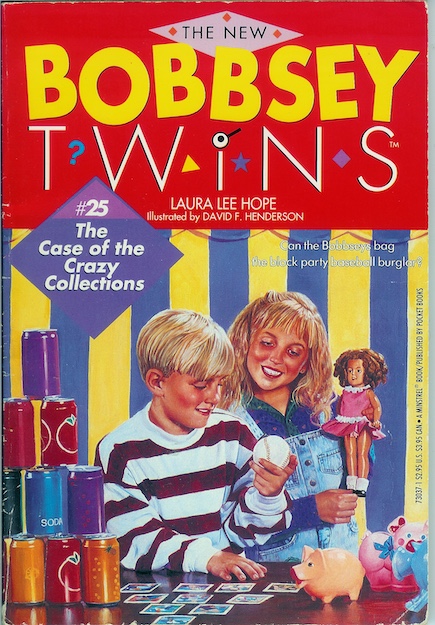
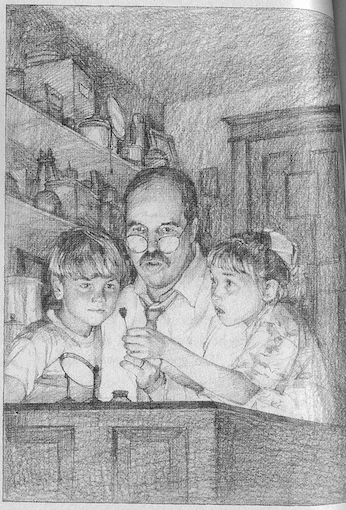
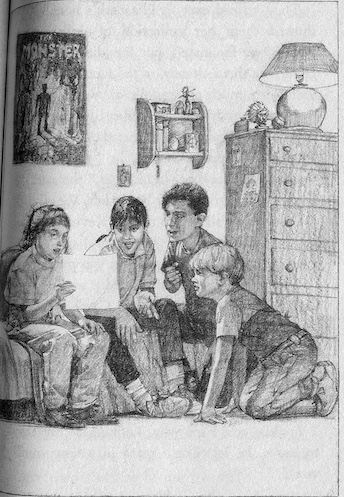
The Bobbsey twins’ neighborhood is having their annual block party, and the Bobbsey twins and their parents are helping to set up for it. As part of the party, the neighborhood has rented a tent, where kids from the neighborhood are displaying their collections. The neighborhood kids collect all kinds of things, like baseball cards, comic books, soda cans, autographs, and coins. One boy, Kevin, has an autographed baseball that his grandfather gave to him. The neighbors are charging people money to see the exhibit of collections, and the money will be used for a pizza party later.

Later, Kevin’s autographed baseball disappears. Could the baseball thief be Mr. Sher, a visitor staying with their neighbor, Mr. Andersen? Mr. Sher tried to buy the baseball from Kevin earlier, but Kevin turned him down. Then again, Kevin’s cousin, Steve, was jealous that Kevin has the baseball. Steve turned down the offer of some of his grandfather’s old collectible items in favor of a savings bond, which he has already cashed in and spend on video games. Steve tried to borrow more money from Kevin earlier, but Kevin turned him down because Steve hasn’t yet repaid him for money Kevin loaned to him before. Danny, the neighborhood bully, was also mad at Kevin earlier. He’s a friend of Steve’s and didn’t want to have to pay to see the collections. Then again, another local girl, Jennifer, collects autographs, and they see her at a collectors’ shop. Would she know the value of an autographed baseball, and was she trying to sell it? With so many people coming and going from the tent where the collections were on display, it’s hard to say who might have taken something. The thief may have even been the Bobbseys’ own dog, Chief, who has developed a habit of collecting and hoarding baseballs.

Then, another boy realizes that his prized hologram sticker is missing. Could the thief have taken that, too? Their clues are an unexplained slit in the back of the tent, some footprints, and a pin with Greek letters on it. Can the Bobbsey Twins find the valuable baseball and return it to Kevin?

The book is available to borrow and read for free online through Internet Archive.

Something I thought was interesting about this story was that it brings up the concept of collecting things for fun or sentimental value vs. collecting things because of their monetary value. Most of the kids in the neighborhood collect things just for fun. At first, Kevin doesn’t seem to fully realize the value of the autographed baseball. His attachment to the baseball is because he got it from his grandfather. When he had the offer to sell it to Mr. Sher, he refused because the baseball reminds him of his grandfather.

I had a strong suspicion about the identity of the baseball thief early in the story, and my guess turned out to be right, but I liked it that there were plenty of other suspects to consider. There are child suspects, adult suspects, and even the Bobbseys’ own dog. Any of these could be plausible. When they realize that the hologram sticker is missing, it raises the question of whether the person who took the baseball also took the sticker, if the sticker was taken by someone else, or if the missing sticker is just a red herring. Overall, I enjoyed the mystery, and I liked the abundance of suspects.

The Mystery of the Disappearing Cat

Five Find-Outers

The Mystery of the Disappearing Cat by Enid Blyton, 1944, 1966.

Bets is happy that her brother, Pip, is coming home from boarding school, and he’s bringing his friends to visit. Now that the children are reunited, Bets and the others hope that they will find another mystery to solve! The others ask Bets if anything interesting has happened since they were home last, and she says not very much, although someone has moved into the empty house next door. The new neighbor is Lady Candling, who keeps Siamese cats.

The boy who helps the gardener, Luke, is nice and allows the children to visit and see the cats. Lady Candling says that the Siamese cats are valuable prize-winning cats. She keeps them in a large cage most of the time for safety, but Miss Harmer, the housekeeper, takes one out to show the children. Unfortunately, one boy, Fatty, owns a Scottie dog named Buster, and Buster comes into the garden looking for him. Buster frightens the cat and chases her! The cat claws Buster after he chases her into the bushes, and they manage to get Buster under control, but they have trouble finding the cat. Miss Harmer is upset that her cat is lost, and Bets goes to search for the cat.

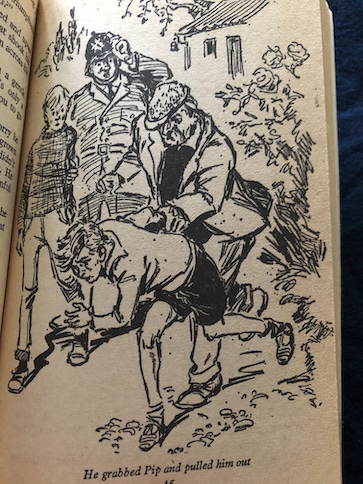
While Bets is looking for the cat, the gardener, Mr. Tupping comes to find out what the fuss is about. Mr. Tupping is a violent and short-tempered man. (They also emphasize that he has a hooked nose, which I think is probably a stereotype. Enid Blyton’s books often contain derogatory racial stereotypes, although later printings have been revised to remove them.) Mr. Tupping hates children and animals, and he grabs Buster and locks him up, threatening to beat him later. The children try to help Buster, but he chases them out of the garden. Bets is left behind, but she locates the missing cat, and Luke helps to free Buster and get Bets out of the garden without Mr. Tupping seeing her. However, Mr. Tupping threatens Luke with dire consequences if he ever lets the children into the garden again.

This is just the beginning of their troubles with Mr. Tupping. When Mr. Tupping finds out that Bets has visited Luke again, he storms into Bets’s own little garden, rips her strawberry plants out of the ground, burns them, and yells at her. Bets is afraid to report him to the adults because she’s afraid that Luke will get in more trouble with Mr. Tupping. Luke is a poor orphan who lives with his stepfather, and he desperately needs the job, which is the only reason why he continues to work with the nasty Mr. Tupping. Mr. Tupping is also friends with the local policeman, and the children know that the local policeman resents them for solving a mystery before he did, so they’re sure that he will side with Mr. Tupping, no matter what they say about him.

Then, Lady Candling’s prize cat, Dark Queen, disappears, and Luke is blamed for stealing her! The children are sure that Luke is being framed for the cat-napping, but the evidence is against him. Pip and Bets’s own mother saw the cat in its cage when she went to tea with Lady Candling, and Luke was working in a garden bed nearby. Even Luke says that no one else went near the cage between then and the time when the cat disappeared. When a wooden whistle Luke made is found in the cats’ cage, the children are sure that it was planted to frame Luke, but how can they prove it? Then, the cat reappears, and later disappears again! What is going on?

The book is available to borrow and read for free online through Internet Archive (multiple copies).

My Reaction and Spoilers

I found this story frustrating because all of the adults in the story are so oblivious to Mr. Tupping’s violence and aggression. He is actively abusive to the children and animals, but nobody seems to notice or even inquire about signs of trouble. Bets’s mother never seems to notice that all of her daughter’s strawberry plants have suddenly disappeared from her garden and never asks her daughter what happened. Mr. Tupping is able to just march onto the family’s property and abuse an 8-year-old girl with complete impunity, and her mother never notices a thing. (Of course, if I were the girl in question, I would have done what I used to do when I was picked on as a kid – take a deep breath, throw back my head, and scream continuously until help arrives. I figured out at a young age that if you scream from your diaphragm, you can get extra volume and keep the scream going for longer without straining your throat, and it’s difficult for the adults to ignore. You can’t scream like that at every inconvenience or people will start to ignore it, but it’s definitely an attention-getter if you use it when it really counts! Just let Mr. Tupping explain his presence and actions when the adults come to find out why their daughter is screaming like she’s being murdered!)

Mr. Tupping is a very obvious villain. He’s also the first person on the scene each time the cat disappears, the one who strategically assigns Luke to work near the cats’ cages just before the prize cat disappears each time, and the keeper of the key to the cats’ cages when Miss Harmer is away, which she is each time the prize cat disappears. Yet, even though he has means (the key), motive (he hates the kids and animals and wants to get rid of Luke), and opportunity (always the first person in the cats’ cages whenever the cat disappears and the one person who controls where Luke is working), all of the adults immediately look at Luke as the thief, never even questioning Mr. Tupping. An adult would be more likely than a kid to know where to sell a prize-winning cat (heck, as a an adult, I wouldn’t even know where to deal in black market animals), but nope, all of the adults first think a kid did it, like kids have those kinds of criminal connections to the prize cat black market. It drove me completely crazy!

It’s worse because Mr. Tupping is friends with the local policeman and gets favoritism because of it. When the kids consult their friend who is a police inspector, he finds out that Mr. Tupping has a police record for being involved in a dog-napping case (surprise, surprise), which establishes his criminal history and connections to people who deal in stolen animals. I was disgusted that the local policeman never looked into his background himself, but I felt a little better when the inspector reprimands him for making friends with a criminal and overlooking evidence that implicated him and trying to prevent the children from bringing evidence and concerns to light. The local policeman is embarrassed, but at that point, I felt like he deserved to be.

The villain was obvious, but what saved this mystery was that he actually used a clever trick to confuse the time when he actually took the cat. I knew from the beginning who the cat thief was, so the real mystery for me was how he got the cat out of its cage without people seeing him. It turns out that Mr. Tupping takes the cat earlier in the day than everyone thought the cat was stolen. The Siamese cats look very much alike, but the one that was stolen had a marking that was different from the others. With a bit of paint, Mr. Tupping makes a different cat look like the missing one for most of the afternoon, quickly using a bit of turpentine to remove the paint at a strategic moment to make it seem like the cat disappeared at a time when Luke was near the cats’ cages.

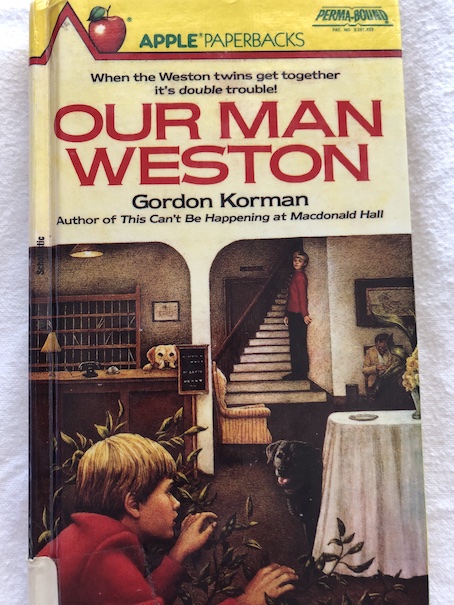
Our Man Weston

Our Man Weston by Gordon Korman, 1982.

Tom and Sidney Weston, a pair of identical twins, are excited about their first big summer jobs as service boys at a fancy resort hotel. Tom is thinking that the work is going to be easy and that they’ll have plenty of time to have fun, but then, he starts worrying about what kind of fun Sidney is going to try to have. Sidney mentions that they might see some interesting people at the hotel, and Tom remembers that Sidney thinks of himself as a detective and is always on the lookout for spies and criminals. It’s a real problem because Sidney is perpetually wrong in his suspicions about everything and everyone he tries to investigate. He’s gotten into trouble before for making false accusations, and because the two boys look alike, Tom sometimes gets blamed for things that Sidney does. Tom is really looking forward to this summer, and he’s determined that Sidney isn’t going to ruin their summer jobs.

Right from the first, Sidney is in detective mode. As the boys are picking up room service dishes, Sidney tries to study the dishes to make deductions about the people in each room. Tom tries to get Sidney to stop because their manager, Walter Parson, is a serious man with little patience, and he’s already annoyed that he has trouble telling the two boys apart. Sidney is excited when a hotel guest complains that her purse is missing, thinking that he’s found a case to investigate, but while he interviews her for details and pressing for details about a primary suspect, Tom just notices that the lady’s purse is still in her room. It wasn’t stolen, just misplaced. Tom uses this incident to emphasize to Sidney that he needs to give up this detective game because it only causes problems.

However, unbeknownst to the boys, there are real spies at the hotel, and they’re interested in the nearby air base, just like Sidney speculated might happen. The readers learn who the spies are right in the beginning, before the boys even know that there are spies. It’s a little like a Columbo mystery, where the identities of the villains aren’t a secret, and part of the suspense of the story is how the heroes will figure it out and prove it. Even though we know right away who the main villains are, Sidney is clueless.

Sidney continues investigating various guests as though they’re all spies or criminals, although he doesn’t seem at all suspicious of our real villains. He becomes convinced that Lawrence Waghorn is a spy when he’s actually a television writer who’s working on a script for a show about spies. He convinces the guest who temporarily lost her purse, Miss Fuller, that another guest, Mr. Kitzel, is a suspicious character, and she starts following him around and spying on him. In turn, Mr. Kitzel gets the idea that Miss Fuller either has an awkward crush on him or that she’s investigating him because he cheated on his taxes. He’s very nervous because she keeps following him around and tries his best to avoid her. Sidney steals his boss’s dog because he’s under the false impression that the dog is being trained to help the spies carry out their mission, and he seriously wants to inform the Prime Minister of Canada (where they live) and the President of the United States. Tom keeps trying to thwart his brothers’ various schemes and confiscate the spy equipment that he’s hidden around their hotel room. Confusion abounds, although some of its helps to inspire Waghorn, who has been suffering from a case of writer’s block.

Meanwhile, the real spy, Richard Knight (a pseudonym, county of origin unspecified), is trying to get his hands on a new airplane being tested at the nearby air base. He’s brought along a pilot named Bert Cobber. Cobber actually has military training and trained alongside the pilot testing the plane, “Wings” Weinberg. Weinberg has nerves of steel … except about anything related to his cadet days, having been partnered with Cobber, who is a skilled but reckless flier and nearly got him killed on many occasions while flying drunk, forgetting to put sufficient fuel in the plane, and repeatedly crashing. Weinberg hasn’t seen Cobber for years, but he practically has a nervous breakdown every time he relives those memories. A friend of Weinberg’s assures him that, if Cobber is really as reckless as Weinberg remembers, he probably got himself killed long ago, but Weinberg has the uneasy feeling that Cobber is still around somewhere.

Although many characters have the overall situation wrong, I appreciated those moments when some people got certain things exactly right. When Miss Fuller overhears Mr. Parson yet again mistaking Tom for Sidney and also quizzing him about why he’s getting mail from different government agencies, she steps up to tell him to stop his bullying, reminding him that mail is private and that the boy doesn’t owe him any explanation about his personal mail just because he works for him. She also tells him that he’s talking to Tom, not Sidney, and that he’s a fool for getting that wrong.

I also love it that the different government agencies that Sidney has been writing to already know who he is because Sidney has submitted many other inquiries to these various agencies. They’re all familiar with Sidney’s false accusations, and in their response letters to Sidney, they express both amusement for Sidney’s wild escapades and sympathy for whatever poor sap Sidney is suspicious of today. Sidney is never discouraged by their criticism of his wild theories or their requests for him to stop writing. It’s getting to the point where some law enforcement agencies are so fed up with Sidney that they wish they could find something to arrest him for.

Meanwhile, Richard Knight has noticed Sidney’s investigations, although he is unimpressed because he knows that Sidney is way off base. However, he hasn’t fully reckoned with the lengths Sidney is prepared to go to “save the western world”, and Sidney’s schemes interfere with Knight’s in completely unexpected ways.

My Reaction

I remember reading this book when I was in middle school, and I loved it. I remember thinking that it was really funny, although I’d forgotten a lot of the details since then. As an adult, I find Sidney more frustrating than I remember, and I feel sorry for poor, long-suffering Tom. As with the MacDonald Hall books by the same author but with different characters, Sidney’s crazy schemes end up working out for the best, and he ultimately saves the day, even though it’s largely by accident.

There are a couple of changes that I wish I could make to the story. First, I liked it that, while Mr. Kitzel isn’t a spy or a major criminal, he does have one guilty secret: he cheated on his taxes by claiming his dog as a dependent daughter. He becomes convinced that Miss Fuller is onto him for that. However, I’d like to create even more semi-guilty secrets for various guests at the hotel so that Sidney can be almost correct about some things while still missing the most suspicious person of all. As it is, Sidney is seriously way off base because he’s paranoid and delusional, although in a comedic sort of way. I don’t like characters that are intentionally stupid, so I’d like more secrets and petty crimes among the more innocent guests so Sidney can be almost right about them.

I’d also like to see Sidney develop some self-awareness during the course of the story. He is completely oblivious to his own failings and false conclusions and also to the way other people react to him, even when they tell him, in writing, that they don’t want to be bothered with his wild goose chases anymore. That’s part of the comedy of the story, but I find it a bit frustrating. Sidney does almost come to realize how other people look at him when he tries to persuade Miss Fuller that he was wrong about Mr. Kitzel being a spy, but she’s as impervious to correction as he is, so he ends up just letting her continue barking up the wrong tree. I think it would have shown more character development and maybe even have been more funny if Sidney comes to realize how Tom feels, trying to reign him in, if he had to try to control someone even more overly paranoid and determined than he is. The book ends well, but I think it would have been even better if, at the end, Sidney apologizes to Tom for everything he’s put him through, saying that, while everything worked out for the best, he realizes that he’s done a lot of things wrong and that he still has a lot to learn. Then, just when Tom thinks that things are going to calm down, he can see Sidney seriously reading a book about espionage or interrogation techniques and making notes or signing up for a summer correspondence course in criminal investigation, hinting that Sidney’s adventures aren’t over yet and leaving it open about whether he’s going to really learn something practical or just graduate to the next level of crazy.