
Immigrant Kids by Russell Freedman, 1980.
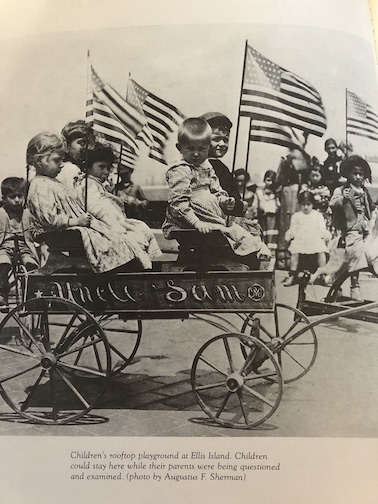
One of the best parts about this book is the pictures. The preface of the book specifically talks about photography at the turn of the 20th century, how cameras were still fairly new technology but growing in popularity. Cameras that were small enough to be held in a person’s hands were an 1880s innovation, and the book mentions that small cameras like that were known as “detective cameras” because they were small enough that they could be used to take pictures without the subjects noticing. Over time, it became easier for amateurs to learn to use cameras, and it became more common for people to take pictures of their ordinary, everyday lives. Pictures like these open up a window on the past. The pictures in this book are of children whose families had only recently arrived in America from countries around the world. The photographer for many of these pictures was Jacob A. Riis, a journalist in New York City who wanted to document the living conditions of poor immigrants. He published a book called How the Other Half Lives in 1890, in which you can see more of his work. Other pictures in this book are by Lewis Hine, who is known for his photographs of child laborers. They are not the only photographers whose work appears in this book, but they are the most famous.
The book is divided into sections, covering different aspects of the lives of immigrant children. In the chapter called Coming Over, the author describes what the journey to America was like. One of the primary motivations for people to come to America around the turn of the century was money and employment opportunities. If a family had little money and little or no chance of getting better jobs in their home country, they would decide to try their luck somewhere else. Because most of the immigrant families were poor, it was common for families to immigrate gradually. Often, the father of the family would come first, find a job, start establishing a life and home for his family, and eventually send for his wife and children when he’d saved enough money. The actual journey was by ship, often in “steerage,” the cheapest form of passage available, in cramped rooms in the ship’s hold.

Although the journey could be harrowing, one of the most nerve-wracking parts was the immigrant processing that took place at immigrant ports like Ellis Island. There were routine questions that immigrants were expected to answer and exams for them to take, and if the questioners weren’t satisfied, the immigrants could be sent back to the country they came from. Doctors would examine the immigrants to evaluate their health and look for signs of possible mental defects. They were particularly concerned about signs of infectious diseases. Sometimes, it was difficult for immigrants to answer all the questions because of language barriers and the immigrants’ own nerves at being interrogated. If an immigrant seemed too agitated, the examiners would typically let them rest for a while before trying again.

The other chapters in the book are At Home, At School, At Work, and At Play, which give more details about the lives of immigrant children as their families settled in America. They often settled in large cities because those were where the most employment opportunities were to be found. Because they didn’t speak much English and needed help learning how things worked in America, such as how to find jobs and places to live and how laws worked, they tended to settle in neighborhoods with others from similar backgrounds who could help them. That is why, even to this day, there are certain areas of large cities, such as New York, Boston, or Chicago, which are known for people of a particular nationality (like the Irish neighborhood, the Jewish neighborhood, Chinatowns, etc.). New arrivals often joined friends or relatives who had already been living in the US for a while, seeking help in getting themselves established. These ethnic neighborhoods were located in poor parts of town because the people there didn’t have much money. People lived in small, crowded apartments called tenements, sharing water and toilet facilities with other families because the apartments were not provided with individual facilities. However, once these groups of immigrant families became established, they remained established for a long time, and they gave these neighborhoods their own distinctive style.

School was often difficult for new arrivals because the children had to learn English before they could study other subjects. There were some special English language learning classes for them at larger schools with enough demand for them. At smaller schools which didn’t have these classes, they often had help from other children who had arrived in America earlier and could act as translators. They were also frequently put into classes for children who were younger than they were, studying easy subjects, until they had learned enough English to move up to classes with children their own age.
Typically, immigrant children aimed to stay in school until they were fourteen years old because that was the age when they could officially get full-time work. However, because their families were poor, the children might have to leave school early to find jobs and help their families make ends meet. The book describes how rules were frequently bent or broken because the laws were not well-enforced, and children often worked at younger ages, even under harsh conditions. For immigrant children, the most important education was that which taught practical, vocational skills that would help them find jobs quickly. Some agencies, like the Children’s Aid Society (known for the Orphan Trains), would help them with vocational training.

However, immigrant children still like to play. Boys and girls usually played separately. Boys frequently played games like baseball in the street, or stickball, which was a variant that could be played in smaller spaces. In stickball, the “bat” was a stick or the handle of an old broom, and the ball was rubber and allowed to bounce before it was hit. Girls would play other games, like “potsy,” which was a version of hopscotch.
Because of the lessons they were taught in schools and because the immigrant children mixed with children outside of their immigrant groups in school, the children absorbed the local culture and became Americanized faster than their parents. Many of them experienced the feelings of being torn between their parents’ traditions and wanting to fit in with society around them.
In each of the chapters in the book, there are anecdotes from people who had arrived in the US as children around the turn of the century, telling stories about different aspects of their lives.
The book is currently available online through Internet Archive.
 Jestress's Forgotten Books and Stories