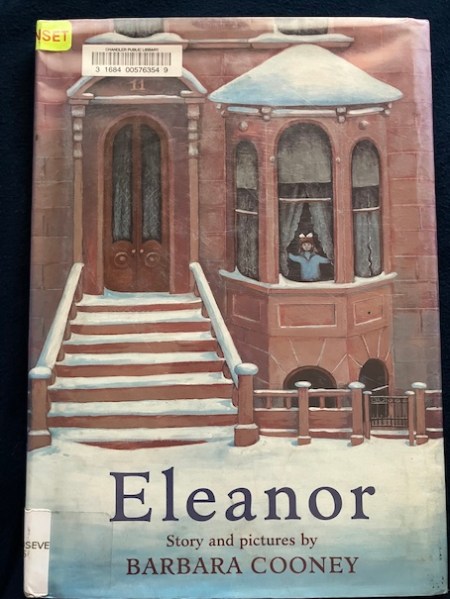
Eleanor story and pictures by Barbara Coooney, 1996.
This picture book tells the story of Eleanor Roosevelt’s early life. Eleanor Roosevelt (full name Anna Eleanor Roosevelt) was the niece of Theodore Roosevelt (called Uncle Ted in the book), and later, in life, the wife of Franklin Delano Roosevelt (a distant cousin) and First Lady of the United States. This book is about her childhood, so it doesn’t explain about her husband or marriage until the Afterword at the end.
Eleanor’s home life wasn’t particularly happy. She was a disappointment to her mother in a number of ways. Her mother had hoped for a boy, and she didn’t think Eleanor was a pretty baby. Her mother often called her “Granny” as a nickname because she was such a serious child and seemed rather old-fashioned looking, and she reminded her mother of an old woman. When Eleanor’s younger brothers were born, Eleanor often felt left out when her mother spent time with them.
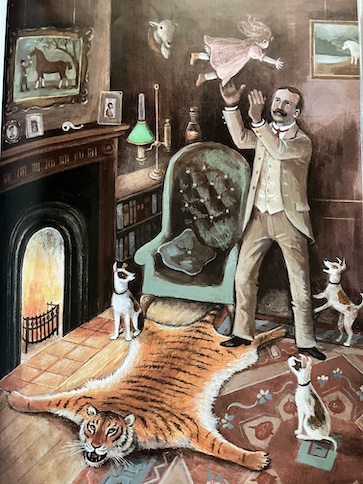
Eleanor’s father loved her and enjoyed playing with her and spending time with her, but she didn’t get to see him often as she was growing up. Her father, Theodore Roosevelt’s brother, Elliot Roosevelt, was a traveler and socialite and later became estranged from his family. Still, although he wasn’t a particularly reliable person and wasn’t present much, Eleanor was very attached to him and sometimes felt like he was the only one who really loved her.
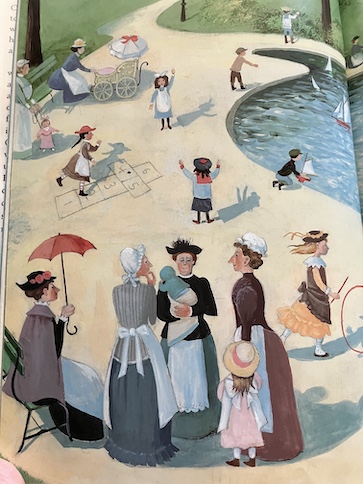
Much of Eleanor’s early life was spent with her nanny, who spoke to her in French, so she mastered the language at an early age. Eleanor was very shy, so she didn’t spend much time with other children. She did spend some time with relatives, too. Sometimes, she helped them with charitable projects, giving her a sense of caring for the less fortunate.
When Eleanor was eight years old, her mother died of diphtheria, and she and her little brothers went to live with her grandmother and the aunts and uncles who also lived with her. Her father had been living apart from the family at this time, but he returned after his wife’s death. After that, he would visit Eleanor sometimes and take her for outings. However, he was sometimes neglectful. The book explains that he died in a fall when Eleanor was nine years old.
Life with her grandmother was difficult for Eleanor because her grandmother made her wear old-fashioned clothes, she had a strict governess, and her aunts and uncles seldom paid attention to her because they were busy with their own work and projects. Other children didn’t think much of Eleanor because she was shy and wore old clothes. Sometimes, her cousin Corinny would join her for dinner, but Corinny never liked it because the house was so grim and silent.
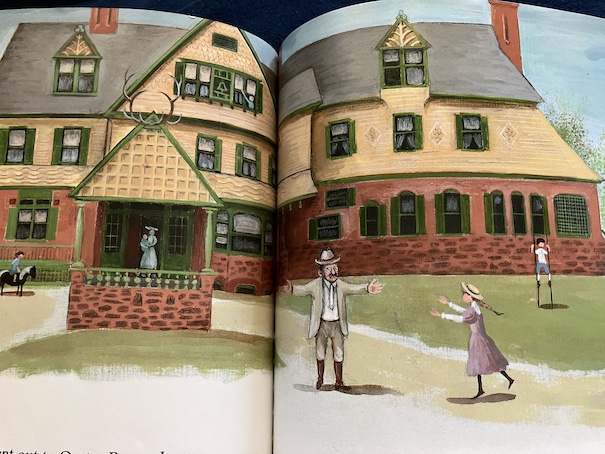
Eleanor was happier when they would go to her grandmother’s summer house, Oak Terrace. At the summer house, she could play games, daydream, read, and catch tadpoles with her little brother Brudie. Sometimes, she would go out in the rowboat with one of her aunts. There were also times when she visited her Uncle Ted and his family. Sometimes, she would play with her cousin Alice Roosevelt because they were the same age, but Alice teased her dreadfully, and Eleanor often found her a little intimidating. Her relatives encouraged her to be brave and to do things that she found scary, but she often found it difficult to keep up with them and some of their daring stunts.
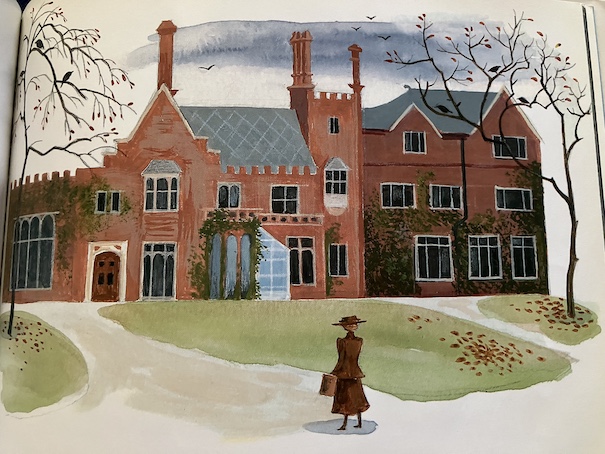
Eleanor was often considered the “ugly duckling” of the family, but things changed for her when her grandmother decided to send her to boarding school in England. She attended a school called Allenswood, and the headmistress, Mademoiselle Souvestre, became a mentor to her.
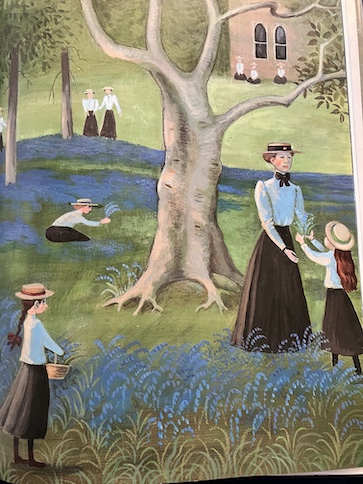
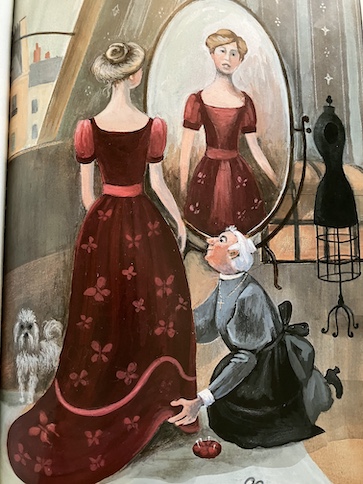
Thanks to the lessons in French from her former nanny, Eleanor excelled at boarding school. Because the school had a rule that the girls should only speak French at dinner, Eleanor was the only girl at first who felt comfortable talking, a rare change for her. Eleanor made friends with the other girls at school and was happy there. Mademoiselle Souvestre encouraged Eleanor’s sense of independence, opened her eyes to the world around her, took her along on trips to Europe, and advised her to get clothes made in Paris, ridding her of the clothes her grandmother made her wear. By the time she returned home from boarding school, Eleanor was happier and more confident than she had been before, and she credited Mademoiselle Souvestre for her influence.
The book is available to borrow and read for free online through Internet Archive.
My Reaction
I enjoyed this book for its focus on Eleanor Roosevelt’s childhood. Many books about famous people focus on what they did when the became famous, but I enjoyed seeing her as a shy, awkward child, when it didn’t seem obvious that she would one day be famous. By seeing how she grew up, I feel like I’ve come to understand more about her.
Eleanor Roosevelt came from a wealthy family, but her early life wasn’t very happy. She was deeply affected by her mother’s sense of disappointment in her for not being prettier and by her parents’ troubles and their separation from each other. She was orphaned at a young age, and one of her younger brothers also died not long after their mother. She often felt like she didn’t fit in with her family, and they didn’t seem to understand or appreciate her.
The book explains a little about her father’s estrangement from the family, but it doesn’t go into all the details or some of the dark reasons why. The truth was that he was an alcoholic. His alcoholism was the beginning of his strained family relationships, but then, he had an affair with a servant girl who worked for his wife and fathered a child by her. When that happened, Theodore Roosevelt had him forcibly removed from his family’s home and did his best to keep him away from his children as much as possible, even after his wife’s death. When the book says that Eleanor’s father died in a fall, that was a soft way of explaining it. The truth is that he committed suicide because he was drinking even more heavily after his wife and one of his sons died, and he was depressed about the rest of the family keeping him away from his remaining children.
I thought it was interesting that Eleanor really blossomed at boarding school. She had always been a shy girl, but she was very studious and spoke French, skills which suited boarding school life well. Boarding school encouraged her to spend more time around other girls her age and took her away from her family’s influence, giving her the opportunity to find herself and bond with other people. In particular, the headmistress of the school became her mentor and encouraged her to look at the world in new ways and to become the best version of herself.
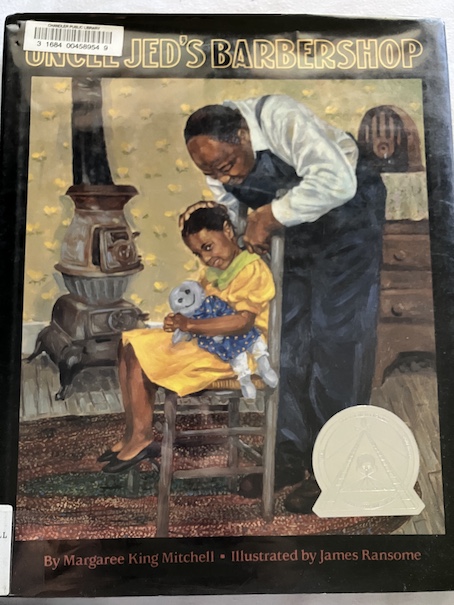
Uncle Jed’s Barbershop by Margaree King Mitchell, illustrated by James Ransome, 1993.
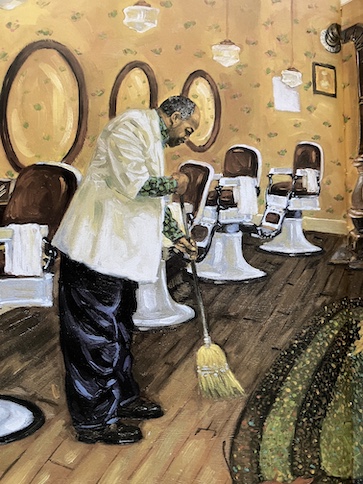
Sarah-Jean remembers her grandfather’s brother, Uncle Jed, and how he would travel to people’s houses to cut their hair during the 1920s and 1930s. He’s the only black barber in their area, so he cuts everybody’s hair in the black community. What he really wants is to own his own barbershop, with proper barbers’ chairs and equipment, but times are tough, and helping out his family means delaying his dream shop.
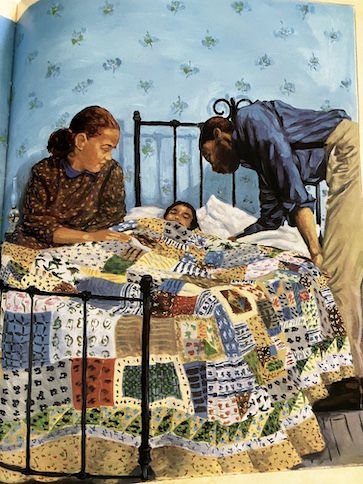
Everybody is poor in their town, so many people think Uncle Jed will never be able to get enough money to open a shop. However, even though things are tough and money is tight, Uncle Jed is willing to help out when he can. When little Sarah Jane develops a serious illness and needs an operation, Uncle Jed gives her father the money they need for her operation, saving her life.
Later, Uncle Jed loses his savings when the bank fails during the Great Depression, so he has to start saving all over again. Even though he has it hard during the Great Depression, Uncle Jed still helps other people, sometimes cutting hair for customers who can’t afford to pay him because they’re even worse off. He takes payment in whatever form they can offer, like garden vegetables or eggs.
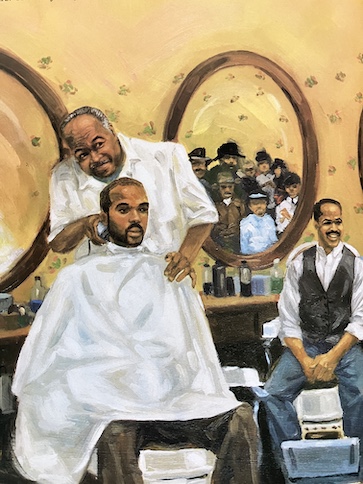
Eventually, things improve, and Uncle Jed is able to afford his barbershop, and everybody comes to the opening. He acquired his shop toward the end of his life, so he doesn’t have it for long before his death, but he was still happy because he accomplished his goal and did something people didn’t think he’d be able to accomplish.
The book received the Coretta Scott King Award.
My Reaction
I thought it was a nice story. The ending seemed a little sad, that Uncle Jed didn’t live very long after finally acquiring his shop, but the book has an optimistic tone. Although Uncle Jed accomplished his life goal toward the end of his life, he did get to accomplish it and enjoy it before he died. It’s less important how long he got to enjoy it than the fact that he did enjoy it.
It took a long time for Uncle Jed to accomplish his goal of having his own barbershop, but I think it’s important to note that he had a pretty good life along the way. Even though he lost his savings in a bank failure, he had steady work through the Great Depression, and he was also able to help friends and relatives when they needed it. He had good relationships with his family and neighbors because of his helpfulness and generosity, and everybody shows up to congratulate him when he finally opens his shop.
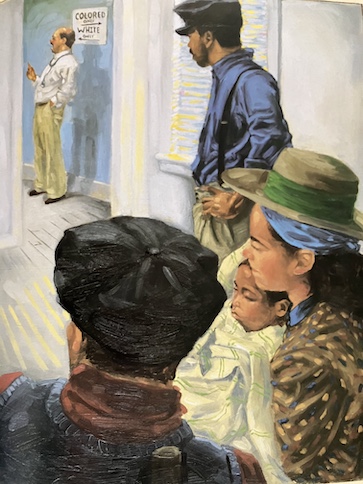
This story takes place in the South during times of segregation, which enters the story when Sarah Jane is ill and needs to go to the hospital. Although her condition is serious, not only is her family sent to a segregated waiting room, they also have to wait until all the white patients are tended to before the doctor will even see them. The doctor also insists upon payment before performing the operation she desperately needs, the implication being that the doctor will let her die if he doesn’t get paid up front to save her. Before anybody think that this is an exaggeration, that a doctor would refuse to treat a sick child or save her life because of her race, even during the Jim Crow era South, no, it’s not an exaggeration at all. It was routine:
“It’s absolutely incredible how little organized resistance there was,” says Theodore Marmor, emeritus professor of public policy at Yale University and a key health policy adviser during the Johnson administration.
Before the passage of Medicare and Medicaid, Smith says, the healthcare system was tightly segregated. Hospitals in the South complied with Jim Crow laws, excluding blacks from hospitals reserved for whites or providing basement accommodations for them.
“There were a lot of black communities in the South that had basically no access to hospitals,” says Smith. “Most of the black births in Mississippi were at home. The infant and maternal mortality rates were hugely different for blacks and whites because of that.”
The surgeon who developed the practice of blood storage and blood transfusions, Charles Drew, was also an African American who lived in the early to mid-20th century. He died relatively young of serious injuries from a car accident in North Carolina. There was a popular rumor, which was repeated on an episode of the tv show MASH, that he would have survived if he hadn’t been refused treatment at the hospital because he was African American. The reality is that doctors did try to save him, but his injuries were simply too serious for him to be saved. However, the rumor developed and persisted because the reality also is that hospitals of this time were known to turn away black patients. They had done it to others, so it was completely credible that they could have also done that to Dr. Charles Drew, even if they didn’t do it in this particular case. The fact that this rumor was completely believable and consistent with the practices of Jim Crow hospitals is an indication of their general behavior and conditions. With that in mind, it is also believable and credible that the doctor in the story would have refused to see a seriously ill black child until all white patients were seen and also that he would have refused her life-saving treatment until being paid.
However, rather than lamenting about the prejudices and inequities of this time period, the story focuses on Uncle Jed as one of the good people. The doctor and hospital in the story are not only prejudiced, but their behavior also contrasts with Uncle Jed, who is willing to put off payment or accept lesser or alternate forms of payment for people who need his services but are too poor to pay. The emphasis of the story isn’t on how bad other people or circumstances were so much as how Uncle Jed made things better for everyone as best he could. It meant some sacrifices on his part, putting off his own goals and dreams, but Uncle Jed enjoyed a good life and good relationships with other people along the way and accomplished his goals in the end.
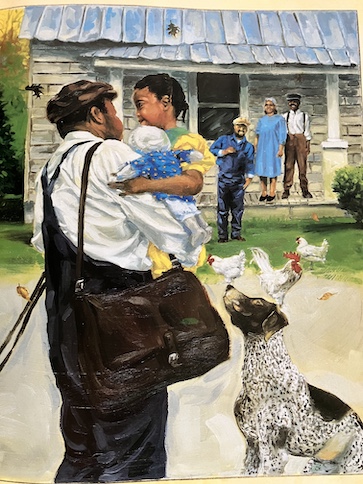
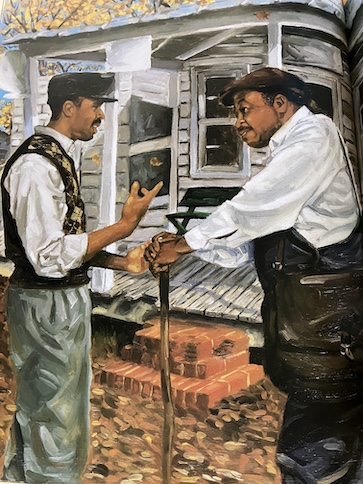
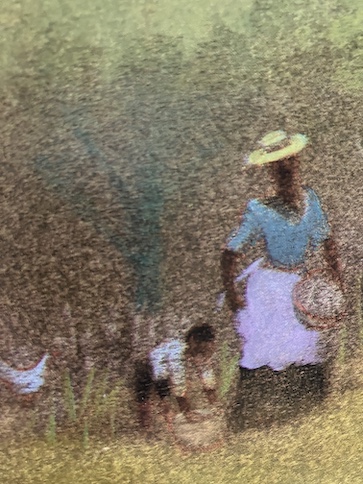
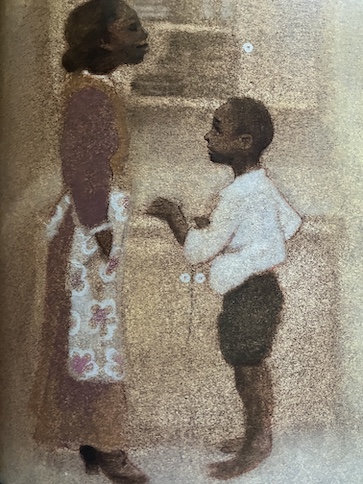
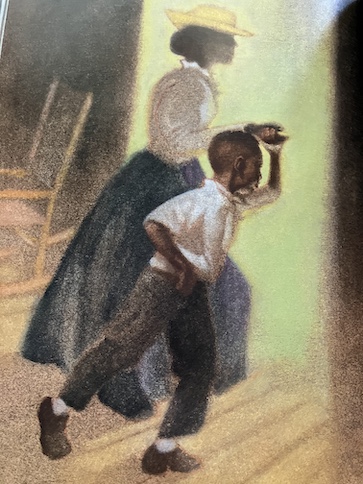
I also enjoyed the pictures in this story, showing the old-fashioned country and small town life in the early 20th century. The illustrator also did the illustrations for Aunt Flossie’s Hats (And Crab Cakes Later).
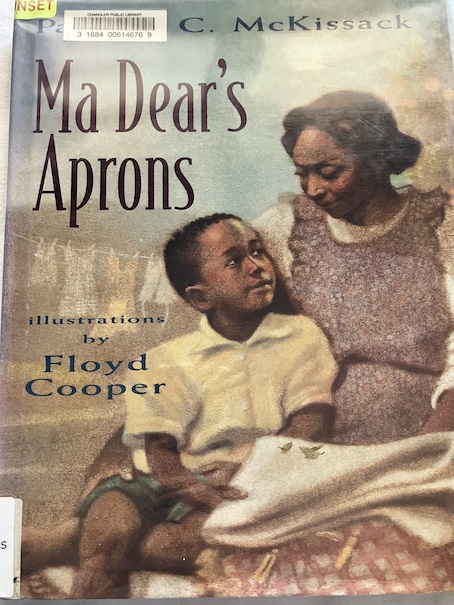
Ma Dear’s Aprons by Patricia C. McKissack, illustrations by Floyd Cooper, 1997.
Young David Earl’s mother, called Ma Dear, has a different apron for every day of the week, and David can always tell what day it is and what the task of the day is by which one his mother is wearing.
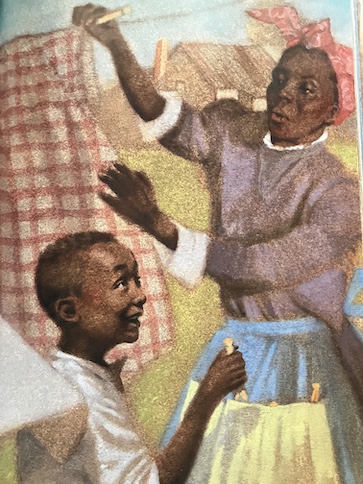
On Monday, she likes to wear her blue apron because that’s wash day, and she keeps clothespins in the pocket of that apron. After she’s done with the laundry, she has time to talk to David Earl, and she tells him about his father, who died as a soldier.
On Tuesday, she wears her yellow apron, when she does her ironing. On Wednesday, they deliver the finished laundry to their clients, and Ma Dear gives David Earl a treat from the hidden “treasure pocket” in her green apron.
On Thursday, Ma Dear wears her pink apron, and they pick vegetables and visit people who are sick or elderly at their homes. On Friday, Ma Dear cleans the house of another family, so she wears her brown apron. David Earl comes along, and she sings to him while she works. Saturday is for baking pies to sell, so she wears her flowered apron. She also gives David Earl a bath on Saturdays.
The best day of all, though, is Sunday. Ma Dear doesn’t work on Sunday, so she doesn’t wear an apron
My Reaction
The book starts with an author’s note, explaining that the characters in this story are based on her own family. “Ma Dear” was the nickname of her great-grandmother, Leanna, and Leanna was a single mother in Alabama during the early 1900s, who earned money by doing laundry, cooking, and cleaning for other people, like Ma Dear in the story. The story is about the family stories told to Patricia C. McKissack about her great-grandmother and how she made time for her children, even when she was tired from working hard. The aprons in the story are like one that Patricia McKissack inherited that used to belong to Leanna.
The author’s note, which I would have probably ignored when I was kid because I was too eager to get into the story, made this story better for me. I liked the explanation that this was a family story about a real person. The aprons are a device to help readers connect to memories of the real Ma Dear, similar to how the girls in Aunt Flossie’s Hats (And Crab Cakes Later) hear family stories and memories because they’re associated with the hats in their aunt’s collection. It’s a sweet way to share family memories.
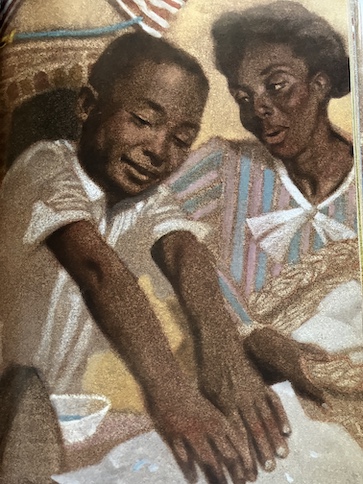
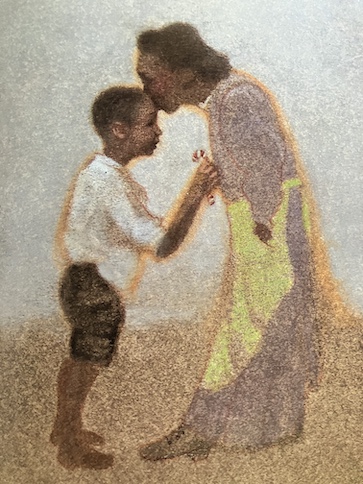
I also like the soft, old-fashioned pictures that accompany the story. Their softness and sometimes slightly blurred quality help create the mood of memories.
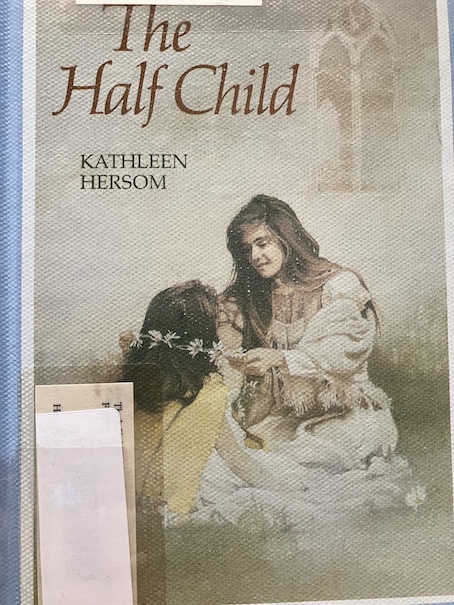
Lucy Emerson (Lucy Watson after her marriage) and her family live in an English village in the 17th century. As an elderly woman in her early 60s, she looks back on her sister, Sarah. She has actually had two sisters named Sarah, but it’s her first sister Sarah that she thinks of.
Little Sarah was always a strange child. From when she was very small, she would do odd things, like rocking back and forth while singing odd little wordless songs and being very clumsy. She could never talk clearly, and most people couldn’t really understand her. Because she is abnormal, she is quickly labeled as a “changeling” – a fairy baby substituted for a regular human child. Those who don’t call her a changeling call her a “half-wit.” Only Lucy really values Sarah, whether she’s a little human child or a fairy child, and she tries hard to understand her and take care of her. What Sarah likes best are the little “stone dollies” – small statues of praying children – in the local church, and she always asks Lucy to take her there to see them.
Lucy and Sarah’s mother is often harsh with Sarah out of frustration because she’s difficult to understand and difficult to deal with. Some people in the community think that she should be even more harsh with Sarah than she is because, if she really is a changeling, the fairies or Little People might snatch her back if she isn’t being treated well, being beaten or starved. Their Granny believes that Sarah is a changeling, and she implies it often, comparing a changeling child to a cuckoo’s egg, substituted in the next for another’s bird’s egg. However, their mother never refers to Sarah as a changeling and doesn’t seem to believe that Sarah isn’t really her daughter.
Then, one day, they can’t find Sarah. It seems like she’s wandered off by herself. Lucy looks in the church to see of Sarah went there to look at the “stone dollies.” Sarah isn’t there, but one of the dollies has the daisy chain that Lucy made for Sarah. According to superstition, a daisy chain helps to protect a child from the fairies, and Lucy thinks that, without it, maybe the fairies did carry Sarah away. On the other hand, maybe Sarah fell in the river, and it carried her away. Worried, Lucy desperately searches the village for Sarah, until one woman says that she saw Sarah in the churchyard. She would have walked Sarah home, but Sarah didn’t want to come with her, so she came to get Lucy to take her. Lucy hurries back to the churchyard and finds Sarah there, waiting for her. Lucy demands to know what Sarah has been doing, and she says that she’s been playing with the “little people.” Fearing that Sarah is talking about the fairies, Lucy demands to know if she’s seen them before or had anything to eat from them, but Sarah just says, “Not telling.” Lucy considers that maybe Sarah meant something other than fairies when she said, “little people.” Maybe Sarah just met some other young children, or maybe she was talking about playing with the stone dollies again.
One day, Lucy leaves Sarah at home with their mother when she goes to visit their older sister, Martha, who is working at a farm near a neighboring town. Lucy’s mother tells her that Sarah should stay home because it’s such a long walk to the farm, and Sarah is too little to handle it. When Lucy returns home from the visit, she discovers that something disastrous has happened while she was away. Lucy’s mother, who was pregnant and due to give birth in another month or so, accidentally tripped over Sarah in some way and fall, bringing on the birth of the baby too soon. A neighbor who came to borrow some salt found her and called the midwife to come and tend to her. The baby is safely delivered and survives, but Lucy’s mother is in bad condition.
While everyone was busy attending to the mother, little Sarah apparently ran away from the house and disappeared. Lucy is too worried about her mother and the baby at first to leave the house and go looking for Sarah, although she sends her brother to ask the neighbors if they’ve seen her. Her uncle promises to look for her in the countryside and to send out criers to the neighboring towns if she isn’t found. However, the town is also disrupted that day by soldiers who vandalize the town’s church! Later, Lucy goes to look for Sarah in her usual favorite spots, but she doesn’t find her. When Lucy returns home, her brother tells her that their mother has died.
Their father says that their mother’s last wish was that this new baby girl will be named Sarah. Lucy is shocked because she is sure that the sister named she already has is still out there somewhere, lost. Lucy’s father isn’t so sure. He seems to suspect that the rumors were right, that Sarah was always a changeling, that maybe she has gone back to the fairies now, and that this new baby may be the Sarah they were always meant to have. At least, Lucy’s mother seemed to believe that when she told him that this new baby was to be named Sarah. Lucy never thought that her father believed the changeling stories, but he privately admits to Lucy that he doesn’t really know what to think. None of it makes sense to Lucy because, after all, her mother was pregnant with this new baby while Sarah was still at home with them. If the first Sarah was taken away and the “real” Sarah left her in place, surely there would be two babies now – the “real” Sarah plus this other new sister. As it is, there’s only one baby and one missing sister. Lucy father says that if Sarah returns before the baby’s christening, they will choose another name for the baby, but if she’s still gone, she is probably gone for good, and the baby will be named Sarah.
Sarah is not found by the time the baby is christened, so the new baby becomes the “new” Sarah. Sarah’s father and sister, Martha, try to console Lucy about the loss of the first Sarah, saying that it might be for the best and that Lucy’s life will be easier now because Sarah was too wild, too strange, and too difficult to care for. Lucy feels even worse then they say that because, although Sarah was difficult to look after, Lucy truly loved her and didn’t think of her as a burden. Lucy takes care of her new sister for a couple of years, never giving up hope that she will find the first Sarah or at least learn what happened to her. When Lucy’s father decides to remarry, Lucy goes to work on the farm where Martha is working, leaving the new Sarah to be cared for by their stepmother.
It’s only after Lucy goes to work on the farm that she eventually meets someone who is able to tell her at least some of what happened to the first Sarah after she was lost.
The book is available to borrow and read for free online through Internet Archive.
My Reaction and Some Spoilers
I first read this story as a young teen in middle school, and I found it fascinating for the historical and folkloric connections. This story takes place over a period of years. The year when the older Lucy reflects on her sister Sarah is 1700. During the year that the first Sarah disappeared, Lucy is talking to someone else, and they mention the Roundheads and that the king was executed the year before, so they are referring to the execution of Charles I in 1649, putting the year of that conversation at 1650. Most of the book is set around the middle of the 17th century.
In real life, there were stories about changelings, fairy children substituted for human children as infants, and stories like this seem to have been used to explain human children born with deformities or disabilities of various kinds. Modern people might recognize that young Sarah was born with some kind of developmental disability, which is why she’s not like her siblings, but people in the past didn’t have as much ability to diagnose or understand people who were born “different” from others. They couldn’t understand how children with disabilities could be born to apparently healthy parents, especially ones who had produced other healthy children, so they explained it by saying that those children were not the “real” children but substitutes left by the fairies in exchange for the healthy human children, like a cuckoo lays its eggs in the nests of other birds, to be raised and cared for by them. In the story, Lucy’s grandmother makes the comparison between Sarah and the cuckoo bird, although Lucy is very upset by that description.
During the course of the story, Lucy, as the one who seems to understand Sarah the best and love her the most, struggles to find her missing sister and learn what happened to her. At various times, she also struggles to reconcile what other people tell her about Sarah being a changeling or being taken away by fairies with her own love for Sarah as her sister, a real sister and not just a changeling, and her own worries about the more mundane tragedies that can befall a lost and neglected child. There are times when Lucy finds it difficult to ignore the superstitions of the people who raised her, and she finds herself at least halfway believing in fairies and that the girl she loves as a sister is in danger from them. While Sarah is with her, she makes daisy chains for her to wear as a precaution against the fairies taking her, although those who seem to most believe that Sarah is a changeling would be happy to see her reclaimed by fairies in the hopes of getting the “real” child back.
When their dying mother insists that the new baby girl be named Sarah, Lucy is heart-broken, realizing that her mother believes that Sarah was a changeling all along and that this new baby is the “real” daughter that Sarah should have been. However, to Lucy, who always loved the first Sarah, this new baby is the imposter Sarah, the “new” Sarah, taking the place of the Sarah she has loved and cared for. She never feels the same way about the new Sarah as she did for the first Sarah.
What always interested me about the story since I read it when I was young was how it demonstrates that real phenomena and the more inexplicable parts of human nature are part of the basis behind folklore. All through the book, people refer to children like the first Sarah as being “changelings” because they simply don’t understand why these children are the way they are, but the superstition is ultimately less about people genuinely trying to understand something and more finding a way of taking out their emotions on the “problem” or finding an excuse for not really dealing with it. Beyond the adults simply failing to understand children like Sarah and help their development to the best of their ability, their superstitions lead some of them to be deliberately cruel to children like her in the hopes that the fairies will decide to reclaim them. When a child like that runs away or is lost and never recovered, the adults tell themselves that the child was simply taken by the fairies, apparently both as an excuse to stop looking for a child they don’t know how to handle and also to soothe themselves that they don’t have to worry about her anymore because she is being taken care of by her “real” supernatural family. Whether they really believe that’s what is happening on an intellectual level or not, if they can convince themselves and others that it’s true on an emotional level, then they’re basically letting themselves off the hook and getting rid of an unwanted responsibility without guilt, which sounds a lot less noble than trying to understand and help make the situation better. I think that attitude comes from the sense that these people didn’t think it was even possible for them to understand or deal with the situation. From that attitude, the notion of the “problem child” magically vanishing would be appealing.
It’s sad because, as readers realize, that is not actually the case. Sarah’s disappearance isn’t magical. What Lucy learns about Sarah after the time she disappeared contradicts that idea because she did almost die but was rescued by a kind stranger who happened to be in the right place to find her. Sarah’s eventual whereabouts are unknown at the end of the story because she seems to have wandered off when her caretaker died or shortly before that. Until the very end of the story, elderly Lucy thinks that Sarah is probably dead, having spent some time wandering wild somewhere, but the fact that she never learns for sure leaves it open that Sarah could be alive or for Lucy to convince herself that maybe she finally got Sarah back in the end. When another child, who is very like Sarah, is born into the family, elderly Lucy finds herself wondering again about changelings. Is this new child just another unfortunate child who happened to inherit the developmental disability that Sarah had, or has the original Sarah managed to come back to Lucy in another form? They are so much alike that Lucy begins speaking to her as Sarah, and the new child answers just like Sarah always did, leaving the situation ambiguous in Lucy’s mind.
Although Lucy is ambivalent in her feelings at the end of the story, modern readers will likely side with the more scientific explanation of heredity and genes that sometimes reappear in later generations, producing lookalikes and people with similar health conditions. However, I think that the author did a good job of depicting the uncertainty that affects people confronted by situations and conditions they have no capacity to understand. The people of Lucy’s time did not understand what causes developmental disabilities. Because they needed to come up with an explanation for something they couldn’t understand, they developed the superstition about children like Sarah not being fully human or being substitutes for the “real” children, who were abducted by supernatural beings. Lucy finds herself torn between her own sense that Sarah is her real, human sister and that there must be more logical explanations and her own inability to understand what ultimately happened to her sister.
The book is a little sad because readers can recognize that, with better understanding and support, the original Sarah would have lived a much happier life and that Lucy (and others who appear later in the story) wanted to give her the support she needed but just didn’t know how. At the end of the book, Lucy reflects that times have changed since she was younger. Most people don’t believe in changelings and other old superstitions in 1700, not as much as they did in 1650. The Puritans, in particular, reject all such ideas as “pagan superstitions.” Society seems to be moving more in the direction of rationalism. Lucy says, “So there are plenty boasting nowadays that they cannot believe in such hocus-pocus, and that they have what they call a scientific reason for explaining any strange happenings that occur, instead of blaming the fairies, duergars or witches even. Though much that some call scientific I would say was just plain common sense.”
Even though Lucy generally believes in the rational explanations for what likely happened to the first Sarah, she experiences some doubt again at the end of the story, when she’s confronted with the young relative who looks so much like her. I liked the way the story ends on a slightly ambiguous note, with Lucy reconsidering whether or not Sarah was a changeling and if she has come back to her in another form. Modern readers know that’s not likely, but it does speak to the lifelong uncertainty that Lucy has lived with and the element of uncertainty that often surrounds the human experience in general. Even in modern times, there are many things that we don’t fully understand. In the 21st century, we’re more likely to accept the idea that, just because we don’t know the explanation for something doesn’t mean that there is no explanation that humans can understand but that we just don’t understand it yet. Still, that feeling that there are things beyond our mental grasp still appeals to the human imagination. If Lucy wants to believe that she has found Sarah again, after a fashion, it might give her some peace. For me, though, I just feel a little reassured that this member of the next generation might get more of the love, attention, and support that Sarah always needed, at least from Lucy, and less of the superstition surrounding her condition.
In the section at the back of the book about the author, it says that Kathleen Hersom used to volunteer at a hospital working with mentally disabled children. She was inspired to write this story both because of that experience and because of her interest in folklore.
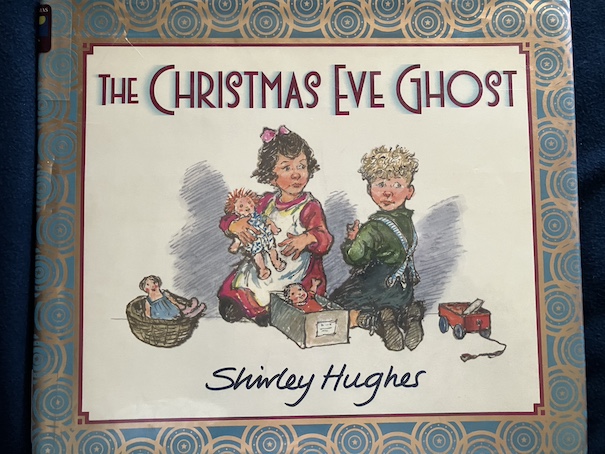
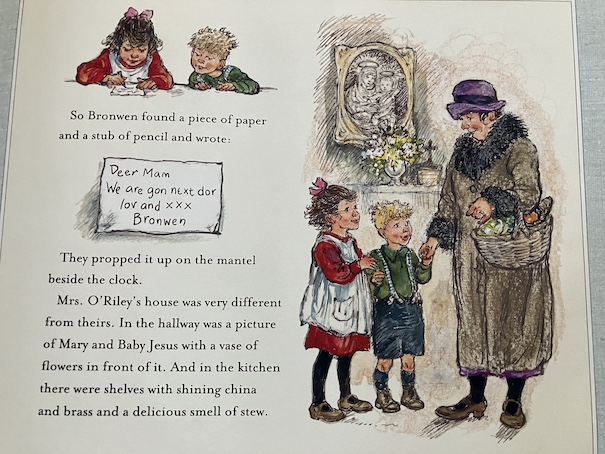
Bronwen and Dylan are two young children who live in Liverpool. They moved there from Wales with their mother after their father died in a mining accident. The family is poor, and their mother works out of her home as a laundress. When she has some free time, she tells the children exciting stories about dragons and ghosts.
The family living next to them, the O’Rileys, are also poor, but the children’s mother discourages the children from being too friendly with them. The children don’t fully understand why, but it has something to do with the fact that the O’Rileys go to a different church. Bronwen’s mother tells her that the O’Rileys are not their kind of people and that she doesn’t want her to go near their church.
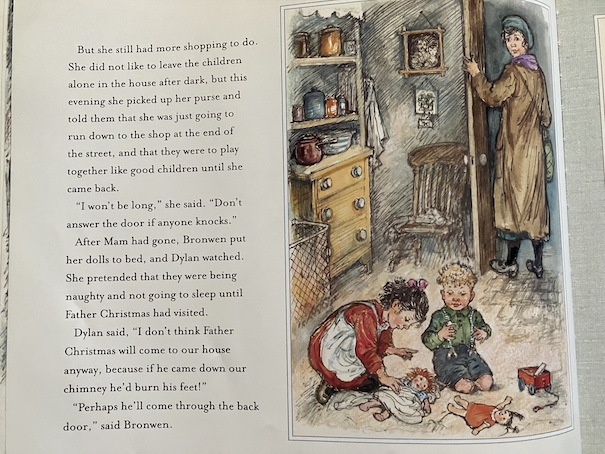
As Christmas approaches, “times are hard”, and the children’s mother doesn’t have much money. She saves what she can to give the children a bit of a treat, but she can’t spare much. Although their mother doesn’t like leaving her young children home alone, on Christmas Eve, the children are tired, and she needs to do a little more shopping. She tells the children to be good, play nicely, and not open the door for anyone and that she will be back soon.
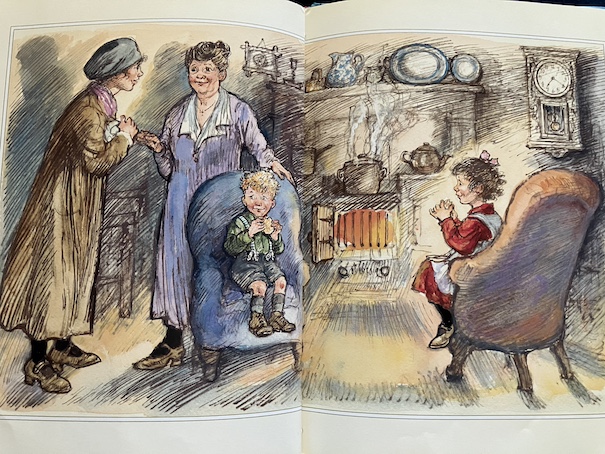
Things are fine at first, but then, the children begin hearing a strange sound. They can’t figure out what it is, but it seems to be coming from their mother’s wash house. Based on their mother’s stories, they think maybe it’s a ghost! In a panic, Bronwen and Dylan run out of their house and straight into Mrs. O’Riley. Fortunately, Mrs. O’Riley knows what the sound is, and as a mother herself, knows what to do.
The book is available to borrow and read for free through Internet Archive.
My Reaction
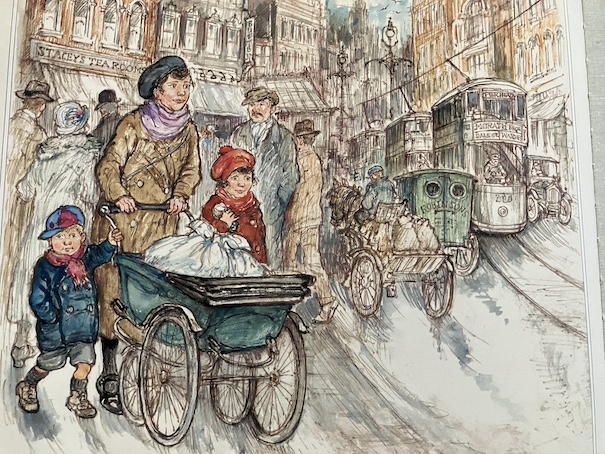
Although this story never explains what year it takes place, it appears to be set during the Great Depression. (Although the Great Depression started in the United States, and this story is set in England, economies all over the world are and have been connected to each other. When one country’s economy experiences something catastrophic, it affects everyone else. The Great Depression was a worldwide event.) The setting is partly in the way people are dressed but also in their circumstances. The way the mother does the laundry is an old-fashioned, labor-intensive process. More tellingly, not only is the children’s widowed mother poor and struggling to get by as a laundress, but the O’Rileys are struggling, too. The children in the story know that Mr. O’Riley and his grown sons often work at the docks, and when there’s no work for them there, they hang out on the street with other men looking for work, and they don’t always find it. This is a time when everyone is poor and suffering. In the back of the book, the author explains that the story was based on her own memories of growing up in Liverpool in the 1930s.
The book doesn’t explicitly identify what the O’Rileys’ religion is because the story mainly focuses on young Bronwen and her perspective. The Irish name is a clue, but Bronwen also says that she once looked inside the church that the O’Rileys attend, out of curiosity, and she saw stained glass, candles, and statues, far more decoration than she normally sees in the comparatively plain church she attends with her mother. These are features of Catholic churches that aren’t always found in Protestant churches, at least not to the same degree, especially in more strict Protestant churches. The religious symbols in the O’Rileys’ house also confirm that this is a Catholic family. The issue between Bronwen’s mother and the O’Rileys is the conflict between Catholics and Protestants, and Bronwen’s mother fearing that the O’Rileys and their different ways might have a negative effect on her children.
In real life, in the modern world, I wouldn’t recommend small children going into a neighbor’s house without their mother’s knowledge and approval, but in the story, it works out for the best. When Bronwen and Dylan’s mother finds out how Mrs. O’Riley helped look after the children when they were alone and scared, she realizes that she can trust the O’Rileys. Mrs. O’Riley even offers to look after the children sometimes when their mother needs to go somewhere, and the children’s mother is grateful. It’s difficult for her, being on her own and not living near other relatives, who could help look after the children. She needs someone to rely on for help sometimes, and the key to finding someone is being open to getting help from people around her, regardless of their religion.
I thought was also telling that the neighbors’ last name is O’Riley. That’s an Irish name. Bronwen and Dylan’s family moved to Liverpool, England from Wales, but it seems like the O’Rileys have probably moved there from Ireland. We don’t know the history of the O’Riley family and how long they’ve lived in Liverpool, but it seems likely that both of these families are from somewhere else, living in an area that probably has a lot of immigrants who are struggling to get established and look for new opportunities in a new place during economically rough times. Aside from the religious differences, their positions are probably pretty similar.
I enjoyed the old-fashioned charm of the pictures in the story. The family lives in a small, old-fashioned house, and they are obviously poor, but at the same time, it’s charming and cozy.
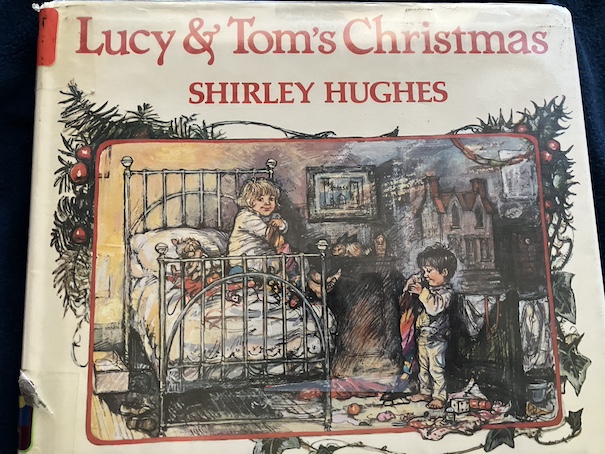
Lucy & Tom’s Christmas by Shirley Hughes, 1981, 1989.
This British children’s picture book shows a young brother and sister enjoying Christmas and celebrating many popular British Christmas traditions.
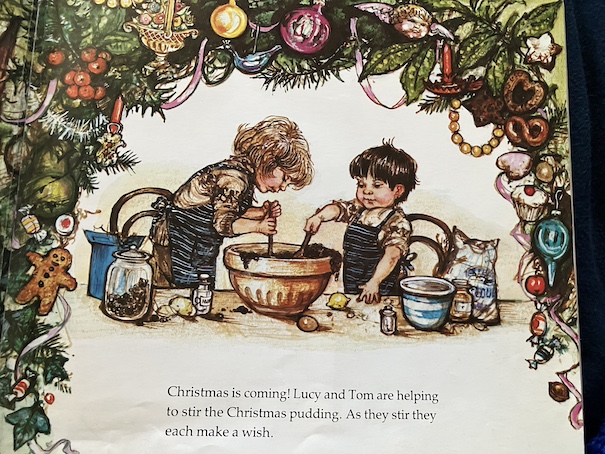
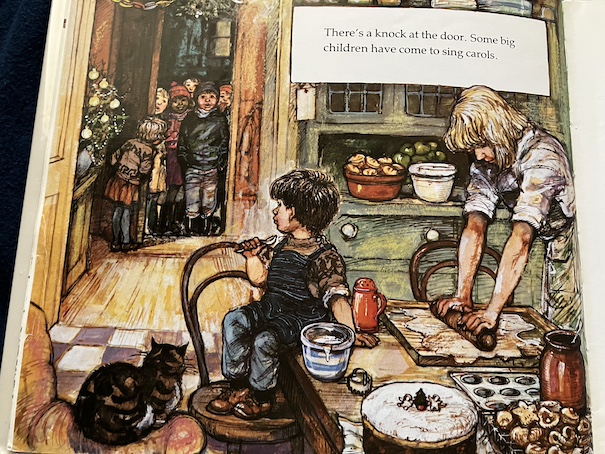
Before Christmas, Tom and Lucy help their mother make a Christmas pudding, each of them making a wish as they stir it. They see the postman delivering Christmas cards and packages, and they make Christmas cards of their own. They also help their mother to decorate the house.
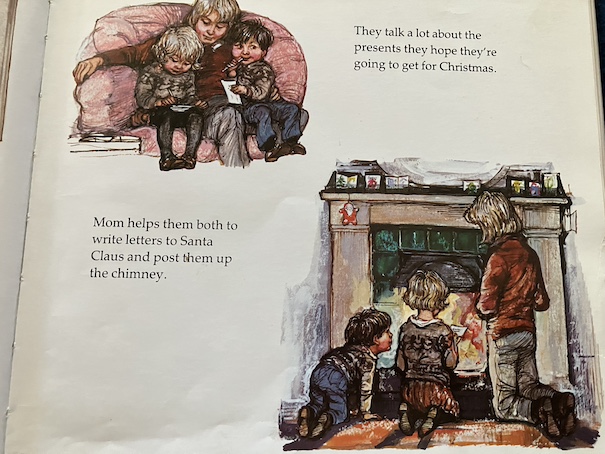
Each of them also has small presents for each other and other people in their family. They also write letters to Father Christmas and “post them up the chimney.” (In Britain, it’s traditional to burn letters to Father Christmas or Santa Claus because he can read their wishes in the smoke.)
They enjoy listening to carol singers and buying a Christmas tree in the market. On Christmas Eve, they hang their stockings at the foot of their beds for Father Christmas to fill with presents.
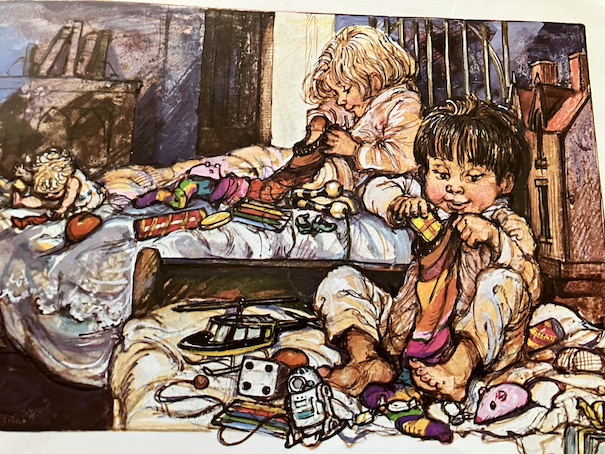
On Christmas morning, the excited children wake up early and play with the presents in their stockings. When their parents wake up, they unwrap their other presents.
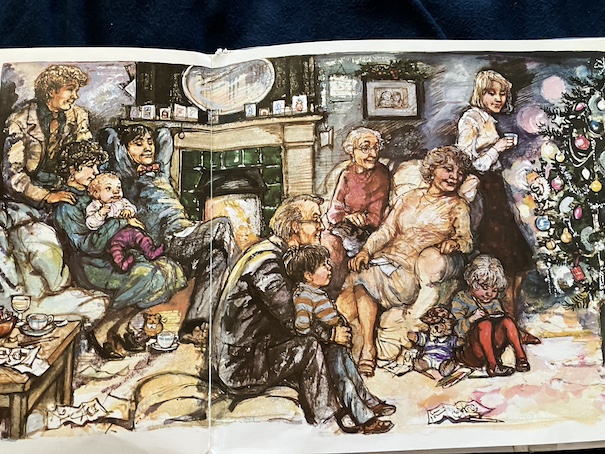
Later, they go to church, and friends and family come to their house for a turkey dinner. After dinner, they open Christmas crackers (party favors that open with a bang and have little prizes and paper hats inside – they aren’t as common in the United States as in Britain, but you can get them here). They give their guests their presents and play party games. It’s a Merry Christmas for everyone!
The book is available to borrow and read for free online through Internet Archive.
My Reaction
I enjoy seeing different types of traditions from around the world, and this picture book reminded me of a YouTube video I saw about British Christmas traditions. Many of the traditions mentioned in the video were also shown in the book, including burning letters to Father Christmas, hanging up stockings on the beds instead of by the fireplace, and opening Christmas crackers.
I loved the pictures in the book, showing the children participating in all of the Christmas activities. They are colorful and cheerful, and I enjoyed noticing little details among the children’s Christmas presents. In one picture, it looks like Tom has received a little R2-D2 robot.
An Ellis Island Christmas by Maxinne Rhea Leighton, illustrated by Dennis Nolan, 1992.
A six-year-old girl, Krysia Petrowski, knows that her family is preparing to leave Poland for the United States. Her father went ahead to America to establish a home for the rest of the family, and she knows that she, her mother, and her brothers will soon follow him. She doesn’t want to leave her home and her best friend, but her mother explains that life will be better in America because there is more food and there are no soldiers in the streets.
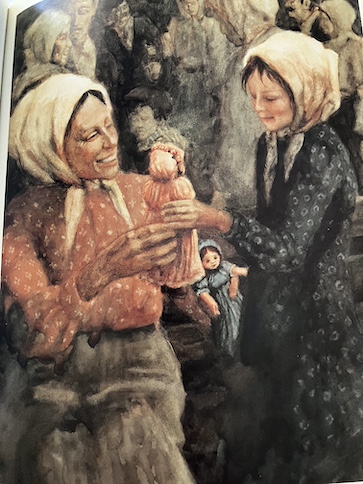
When the family begins packing to leave for America, they cannot bring everything with them because they have a long walk to get to the ship that will take them to America, and they can only bring what they can carry with them. The girl can only bring one of her two dolls with her, and she is sad at having to leave one behind.
When they board the ship, the conditions are cramped and cold. The food isn’t good, either. The voyage is rough and stormy, and many people are seasick. The one bright point is that Krysia meets another girl she knows from school, Zanya, so she knows that she won’t be going to America alone and friendless. Krysia and Zanya play together on the ship when the weather is better.
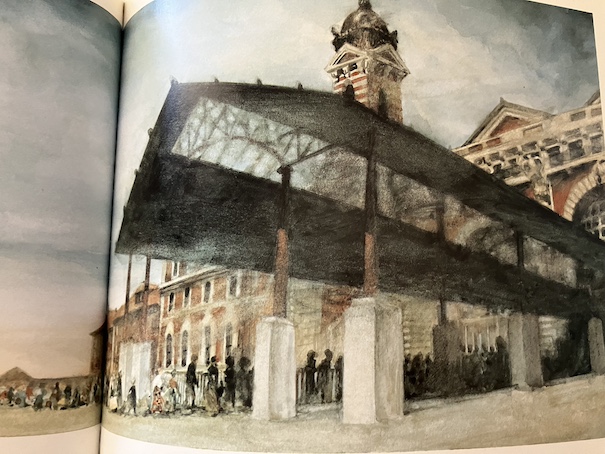
Finally, they reach Ellis Island on the day before Christmas. Everyone lines up, and the family has to show their papers to the immigration officials. Doctors look at them to make sure they are healthy enough to go ashore and into the city. Fortunately, they pass the health tests, although Krysia sees another woman who is told that she will have to go into the hospital or back to Poland because she is ill. The family converts their money to American money and buys some food. A man has to explain to them how to eat a banana because they’ve never seen one before.
Because it’s Christmas Eve, there is a big Christmas tree, covered with lights and toys. There is also a man dressed like Santa Claus, although Krysia thinks of him by the Polish name, Saint Mikolaj. They don’t receive any new presents, but Krysia’s mother does have a surprise for her. The best part is when Krysia’s father comes for them and takes them to their new home.
The book ends with a section explaining the history behind the story.
The book is available to borrow and read for free online through Internet Archive (multiple copies).
My Reaction
The focus of this story is all on the feelings and experiences of the immigrant family, especially little Krysia. Krysia’s impressions of the journey and the arrival at Ellis Island are all a child’s impressions, and she often needs explanations of what’s happening and what’s going to happen next, which is helpful to child readers.
The historical context for the story is provided in the section of historical information at the end and in some hints during the course of the story. The section of historical information in the back of the book discusses the peak years of US immigration, from 1892 to 1924. They don’t say exactly what year this story takes place, but it mentions 48 stars on the American flag. That means that this is the early 20th century, after Arizona and New Mexico were admitted as states in 1912. During that time, 70% of US immigrants came through the immigration center on Ellis Island, just off the coast of New York City. Of those who arrived at Ellis Island, about a third stayed in New York, and the others spread out across the US. The family in the story seems to be going to stay in New York, but because the focus of the story is mainly on the journey, there are still few details provided about this family’s background and circumstances. The section of historical information also explains a little more about the traveling conditions of immigrants around that time and what typically happened at Ellis Island, so readers can understand how the experiences of the characters in the story fit into the experiences of other, real-life immigrants. (For more details, I recommend reading If Your Name Was Changed at Ellis Island and Immigrant Kids, nonfiction books which echo many of the details included in this book.)
There is some discussion in the section of historical information about the reasons why immigrants left their homes, and we told in the beginning of the story that there are shortages of food in Poland and soldiers everywhere, but there is more that I’d like to say about this. Because I like to add context to historical stories, I’d like to talk what was happening in early 20th century Poland and what’s behind the circumstances the characters describe. During the 19th century, parts of Poland were under the control of three different European empires: Russia, Prussia (a German state), and the Austro-Hungarian Empire (while later dissolved into Austria and Hungary). The oppressive control of these imperial powers accounts for the soldiers the family describes on the streets. There were Poles who resisted the control of these forces and wanted to reunify their country, so the soldiers were to keep the population under control and put down resistance. Around the turn of the 20th century, Polish territories were also suffering from unemployment and land shortages, which explains the food shortages the family experiences. Because of these conditions, there was massive immigration from Poland to the United States during the late 19th century and early 20th century. The Petrowski family in the story would have been on the tail end of this wave of immigration because circumstances changed for Poland after World War I (1914 to 1918), when Poland became an independent country again. Some Polish immigrants to the United States intended to stay only for a relatively short time, hoping to save up money and return to their homeland with the money to purchase land or improve their family’s circumstances, but many of these people remained in the United States anyway.
Because the main character, Krysia, is only six years old, she likely wouldn’t understand the full background of her family’s circumstances and the political causes of the hardships in her country, but I like to explain these things for the benefit of readers. I think it’s also interesting that this story is a Christmas story. We are never told what the religion of the characters is, although it seems that they are Christian because they care that it’s Christmas. Many people from Poland were Catholic, so it’s possible that this family was Catholic, too, but it’s never clarified.
If you read the short biographies of the author and illustrator of the story, the author reveals that the inspiration for the story was the story of her own family’s journey from Poland. The illustrator says that he went on a tour of Ellis Island to prepare for producing the illustrations, and he tried to capture the “awe and anticipation” of the immigrants and the high vaulted ceilings and views of the New York skyline through the windows. I’ve also been to Ellis Island, and the illustrations in the book brought back memories of my trip there. I thought that the illustrator did a good job of capturing how big, impressive, and bewildering the Ellis Island compound would be to a young child.
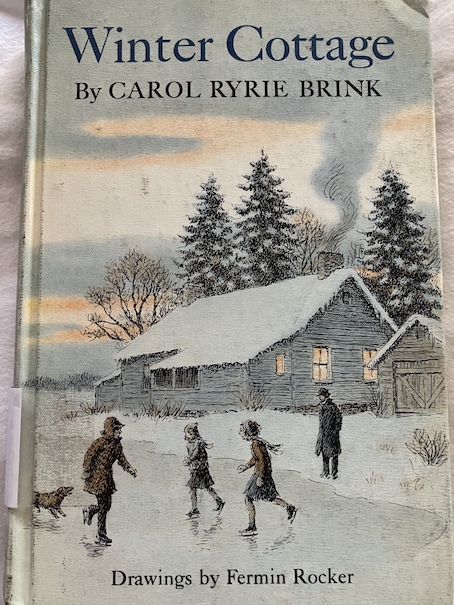
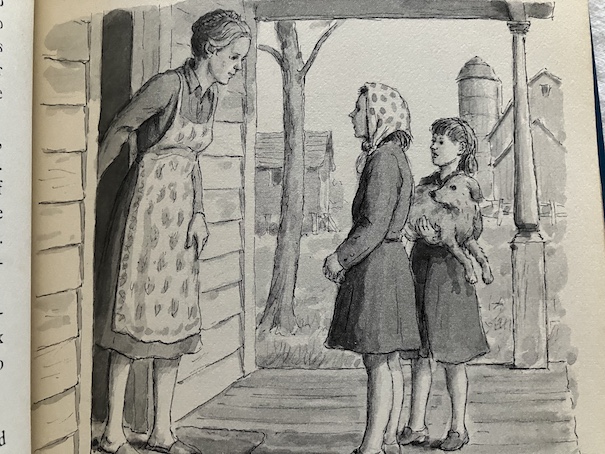
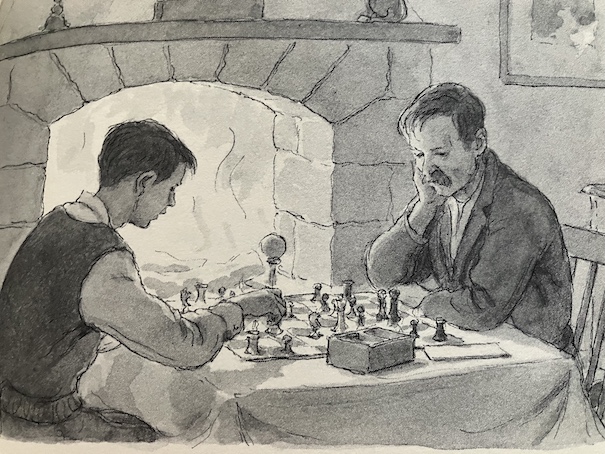
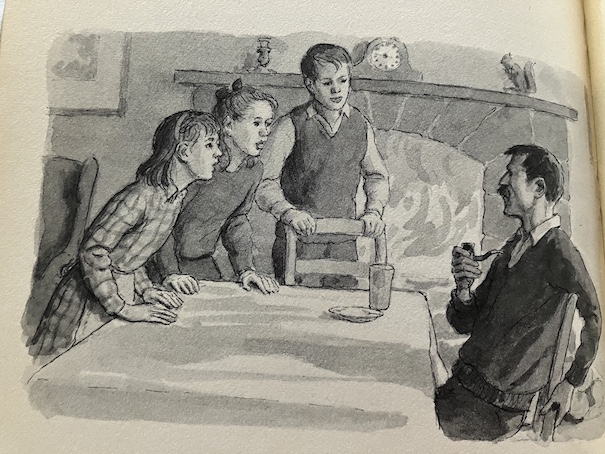
The Vincents own a summer cottage in Wisconsin. It was once an old farmhouse, so it is well-insulated and can be heated during the winter, but the Vincents only use it for about 2 or 3 months in the summer. The rest of the time it is empty and used by animals, like mice and woodchucks. However, that’s about to change.
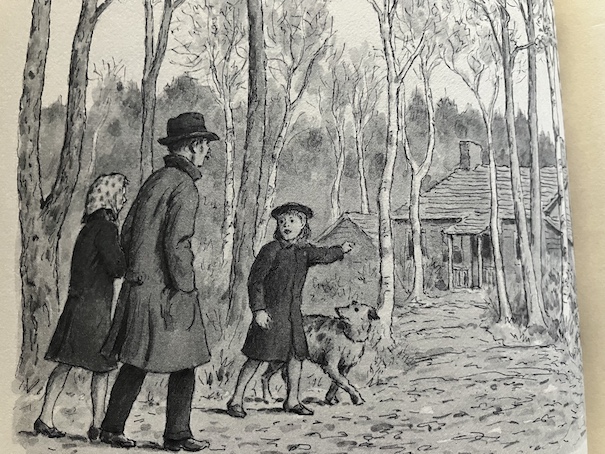
The year is 1930, the Great Depression has started, and many people are out of work and desperate to provide for their families. One such family, a father with his two daughters, happens to be passing near the Vincents’ empty summer house in the middle of October, when the Vincents have already long left the house, when their car suddenly breaks down. They were originally on their way to an aunt’s house to stay with her, but with their car broken down, they’re unable to continue their journey. Mr. Sparkes is a pleasant and easy-going man but impractical and a failed plumber. His eldest daughter, Minty, tends to deal with the practical aspects of things. Minty’s younger sister, Eglantine, called Eggs as a nickname, is the first to notice the empty summerhouse and suggests that, if they could get in, they could make some food. Needing a place to stay for the night and finding a window unlocked, they decide that they’ll go ahead and stay in the house. Although Minty has some reservations about staying in a house that belongs to someone else without their permission, she doesn’t have any better options, and she soon gets caught up in the excitement of exploring this unfamiliar house.
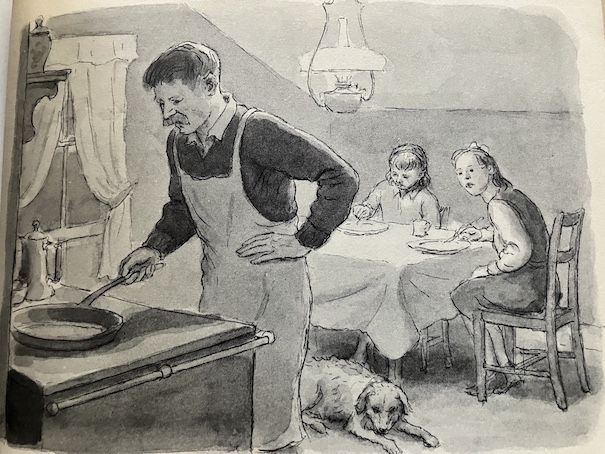
Mr. Sparkes feels like a failure because he’s been in and out of work, and typical jobs just don’t seem to suit him. Their Aunt Amy, the sister of the girls’ deceased mother, thinks that Mr. Sparkes is a failure and a silly, impractical man because he’s always quoting poetry, and his main talent seems to be making his special pancakes. There is some truth to what Aunt Amy says, and Mr. Sparkes acknowledges it. It seems like his only real talent is for making incredible pancakes, although his daughters reassure him that they love him and don’t see him as a failure. They were traveling to stay with Aunt Amy because they have no one else to stay with, but it’s clear from Aunt Amy’s letter that she isn’t looking forward to their arrival, and she also would not welcome their dog, Buster. Eggs says that she wishes they could just stay in this lovely cottage all winter, and Minty wishes the same thing, although she knows it isn’t really right for them to stay in this house without the owners’ permission. Mr. Sparkes likes the cottage, too, because it has a wonderful collection of books, including books of poetry.
The next day, Mr. Sparkes tries to fix the car, but he’s a terrible mechanic. He takes the engine apart and doesn’t know how to put it back together. The girls go to a neighboring farmhouse and ask if anybody there knows anything about cars. Mrs. Gustafson sends her son Pete with the girls to look at the car, and he manages to put the engine back together again, but he isn’t skilled enough to figure out how to fix the original problem. He says that they had better call a mechanic in town to tend to it and that it would likely cost them about $10. The girls are worried because they know that’s about how much money they have left, and if they spend it all fixing the car, they won’t have enough left to buy more supplies and travel all the way to where Aunt Amy lives.
When they explain the situation to their father, Mr. Sparkes says that he thinks they should just stay in the cottage for the winter. Minty says that isn’t right because the house doesn’t belong to them, but their father says that it isn’t doing the owner any good to leave it empty all winter. To make it right, he suggests that they could rent it, so the owner would profit from their stay. The girls ask where he would get the money to rent the house, and their father says he doesn’t know, but he’ll have all winter to think of something. When they leave the cottage in the spring, he plans to leave the money in the cottage with a note, explaining why they stayed there. The girls are relieved that they don’t have to go to Aunt Amy’s house, but Minty is concerned that, by spring, her younger sister and impractical father will have forgotten all about the rent money for the cottage, and she makes up her mind that she will think of a way to get the money herself.
Eggs comes up with a possible way to make some money when she shows her father a contest magazine that she found at the last place where they camped. There are various contests in the magazine that offer prizes, like prizes for solving puzzles or adding the last line to a limerick. Mr. Sparkes is intrigued by the contests, and he says that they can pass the winter by trying them. He’s particularly interested in the contest to write a poem to advertise butter because he loves poetry and the prize is $1,000, which is an enormous sum to them.
Life in the cottage is idyllic. They have some groceries with them to get themselves started, and their father enjoys fishing in the nearby lake for more food. The girls find nuts and cranberries, and their father cuts wood for the stove in the cottage. Minty takes charge of the house, making sure that they keep it neat for the Vincents. The girls learn that the Vincents are the ones who own the house and that they have a daughter called Marcia when they find some of Marcia’s belongings. Sometimes, Minty and Eggs think of Marcia as a friend, and Minty sort of idealizes her in her imagination. Minty likes to imagine the comfortable life she thinks Marcia lives, wherever her family lives in the winter, and she is determined that they won’t let her down by not taking care of the cottage or finding a way to pay the rent.
Then, Mr. Sparkes gets sick, and the girls are frightened because they don’t have much medicine and don’t know what to do. They try to get help from Mrs. Gustafson, but she’s away from home. As Minty is leaving the Gustafson farm, she happens to meet a boy who’s been hunting partridges, and in her desperation, she begs him for help. At first, he is surly and suspicious with her, but when he begins to understand the situation, he agrees to come have a look at her father. The boy, whose name is Joe Boles, is carrying a professional-looking medical kit and seems to know what he’s doing as he attends to Mr. Sparkes. The girls are grateful for his help, and they invite him to spend the night in a spare room in the cottage.
It turns out that Joe is also down on his luck. His father was a doctor, and the medical kit Joe carries used to belong to him. He gets his basic knowledge of medicine from his father and from his grandmother’s home remedies. Joe also wants to be a doctor, but he’s alone now and doesn’t know how he’s going to manage to get the medical training he really wants. Although he’s initially reluctant to explain how he came to be alone, he explains that his father was killed in a car accident. His mother is still alive, but she remarried to a man Joe can’t stand. Eventually, Joe just couldn’t take living with him anymore, so he ran away from home. Joe tells the family that he’s been camping in the woods. Running away from home may not have been the best decision Joe could have made, but he’s determined not to go back, and the family can’t criticize him too much because they’re also sort of running away and hiding out right now.
Joe seems to know what to do to help prepare the cottage for winter, and Mr. Sparkes says that they could use his help around the place. However, Mr. Sparkes admits to Joe that he can’t do much more for Joe than just give him a place to say for the winter, and a borrowed place at that. Joe says that’s fine, and he would like to stay with them for the winter, and he would be willing to pay for his room and board with his labor. The Sparkes family is thrilled to have Joe stay with them and help them. The only point that Mr. Sparkes insists on is that Joe write a letter to his mother to tell her that he’s safe so she won’t worry about him. He says that Joe doesn’t have to be specific about where he’s staying right now, but he knows that Joe’s mother will feel better, knowing that he has somewhere to stay for the winter.
With Joe, Minty and her sister explore the area more and visit the nearby Indian (Native American) reservation. Eggs is a little nervous about the Indians (the term the book uses) at first, worrying about scalping, but Joe tells her not to worry and that the locals are just curious about them. Joe worries less about people recognizing him as a runaway in the reservation village than in the town nearby because it’s a little more remote, although they do accidentally meet the local sheriff in the reservation store, who recognizes Minty from an earlier shopping trip to town. Joe does his best to stay inconspicuous.
While they’re in the reservation store, they learn that the reason why the sheriff is there is that the storekeeper’s son is in trouble. The son, who is a young man in his 20s, got drunk, broke into somebody’s house, ate some of their food, and fell asleep in their bed. The young man’s father argues with the sheriff that the son didn’t actually steal anything from the house, but the sheriff says that what he did was trespassing and that it’s illegal to break into someone’s house, stay there, and use their things without permission. He says that, for that charge, the son will have to spend a week in jail. This incident is troubling to Minty because she knows that she and her family also don’t have permission to use the house where they’re staying, and they’ve been there longer than this young man was in the house where he trespassed. When the sheriff points out that the weather is getting bad and offers to take the kids home, Minty panics at the idea of him finding out where they’re staying and tells him that they plan to spend the night at the reservation.
Of course, the kids don’t really have a place to stay on the reservation, and the weather is bad for camping. They are rescued by the village priest, who says that Joe can stay with him, and the girls can stay with Sister Agnes, one of the nuns who runs the mission school on the reservation. (“Indian schools” like this have a rather scandalous reputation these days for reasons I can explain below.) Minty says that they don’t have any money to pay for a place to stay, but Sister Agnes says that doesn’t matter because “God is your host.” In other words, they’re offering the children a place to stay out of kindness and Christian charity and don’t expect payment. There are some Native American children who also board at the school, some because their houses are too far away for them to travel back and forth between home and the school daily and a couple of children who are orphans and live at the school full time.
There is a scene where some of the Indians are playing drums and dancing, but not the ones living at the school. One of the nuns says that the dancers are “heathen Indians” and that “our Christian Indians don’t dance,” although Minty can tell that the Indian students at the school are feeling the rhythm of the song and enjoying it. Joe takes Minty and Eggs to see the dancers, and they find it fascinating. I didn’t like the “heathen” talk (although I think it’s probably in keeping with the historical setting of the story), but I did appreciate an observation that Minty makes, “Indeed it seemed to be a not entirely un-Christian gathering, for here and there among the gaudy beads was the gleam of a cross on the neck of some forgetful dancer.” That observation contradicts the idea that the dancers aren’t Christians because at least some of them seem to be. That and Minty’s observation that the girls at the school were interested in the dancing and drumming but were being careful not to show it hints at more complex feelings and social dynamics in this village. The people who run the school have some strong opinions about how proper Christians should act, but the Native Americans are still maintaining some traditional practices, and some people are walking a fine line in what they practice and believe.
One of the Indian girls at the dance invites Eggs to join in, and she does. Minty finds that amusing, and Joe tells her to let Eggs have fun because she’s enjoying herself. Sister Agnes asks them later if they enjoyed the dance, and Eggs says she did. Eggs later says that it seems like they don’t have much to do on the reservation, with no “picture shows” (movies) to see and not many toys, so she thinks that the dancing is part of their entertainment. Sister Agnes says, “They are heathen, but God will forgive them.” Minty isn’t too concerned about whether or not the dance might be “heathen” or sinful, but what Sister Agnes says makes her think about what God must think of her family for living in someone else’s house. She hadn’t given it much thought before, but she knows God must know what they’re doing, even if nobody else does, so she prays that He will forgive them, too, and thanks Him for being their host. Before they leave the reservation the next day, a girl Eggs befriended gives them a basket of wild rice, and Eggs give the girl her doll in trade.
When the kids return to the Vincents’ cottage, Mrs. Gustafson is there, visiting with Mr. Sparkes. Mrs. Gustafson seems to accept the idea that they’re renting the house from the Vincent family, although Minty is nervous when she mentions that she writes to them sometimes. Mrs. Gustafson also warns them to beware of strangers because, sometimes, gangster and criminals hide out in the isolated cottages in the area when things get too hot for them in Chicago. Joe has heard stories about that, too.
When the family starts getting replies to their contest entries, the results are disappointing. Many of the contests have catches because they expect entrants to buy things or subscribe to things. There is another contest that they hear about on the radio from a flour company, offering a large cash prize for the best breakfast recipe. Minty thinks that sounds better than any of the other contest options because of her father’s wonderful secret pancake recipe, although her father has become disillusioned with contests. They don’t have much time left to enter that contest, and Mr. Sparkes is reluctant to share the secret recipe. The kids end up spying on Mr. Sparkes to learn his recipe so they can enter the contest on his behalf.
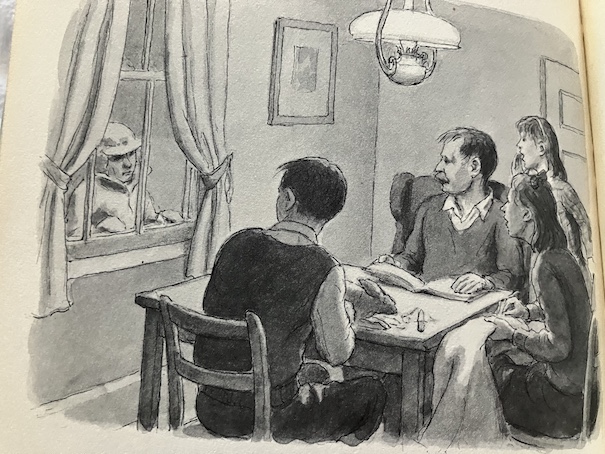
Then, one night, they see a man lurking outside the cottage in a blizzard. Minty warns her father not to let the man in, remembering Mrs. Gustafson’s warnings about criminals hiding out in the area and how they shouldn’t open the door for strangers. However, Mr. Sparkes worries about anyone who might be lost in the blizzard, and he has the children invite the man in. The man has a young girl with him, who is half-frozen and dressed as a boy, for some reason. When Minty realizes that the child is a girl and not a boy, the girl asks her not to tell anyone right away. Minty can tell that there’s something strange about this father and daughter pair, and it makes her uneasy. Then, Minty hears a report on the radio about a stolen car and a reward for information leading to the thieves. Is it possible that this man and his daughter are the ones who stole the car? Minty might consider turning them in for the reward money that her family badly needs, but with the blizzard, they’re now trapped in this cottage with this strange man and the girl. The girl, who goes by the name Topper, is fun and good at planning entertainment, but can she or her father really be trusted?
The book is available to borrow and read for free online through Internet Archive.
My Reaction
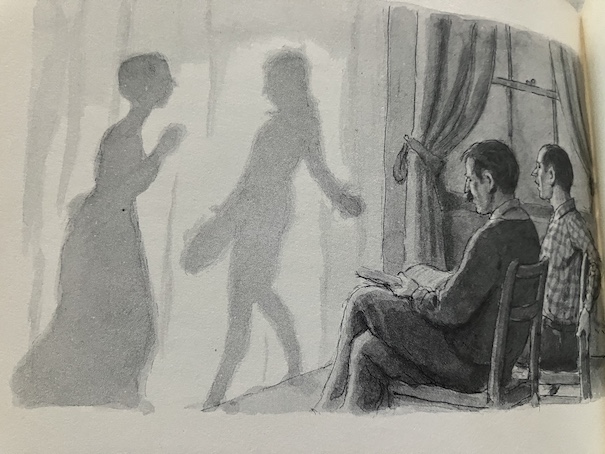
This book isn’t a Christmas story, although the title and some of the themes would have set it up well to be a Christmas story. It fits well with cottagecore themes, with the family, down on their luck, staying the winter in a cozy cottage and getting by as well as they can, enjoying simple pleasures. There’s a line in the story that I particularly liked, toward the end of the book, when the children put on a shadow play for their fathers:
“What a lot of fun you could have, Minty discovered, if you made unimportant things seem important and went about them with enthusiasm!”
I think that sentiment embodies the spirit of cottagecore. To really enjoy some of the simple pleasures of life, you do have to put yourself into the mindset that you’re going to enjoy them to the fullest! I read a book about Victorian parlor games that said something similar. A lot of old-fashioned entertainment and games are quite silly when you analyze them, but if you just throw yourself into them whole-heartedly, they can be great fun!
The family in the story is down on their luck and has their troubles, but their stay in the winter cottage is still an adventure, and they enjoy it. Their consciences do trouble them throughout the story because they’re aware that they’ve been using the cottage without permission of the owners. Minty in particular considers the morality of their actions and has a desire to make things right with the owners of the cottage. Fortunately, the story ends happily for the family, with their lives changed for the better. The people who own the cottage find out about them staying there, but they forgive them, and Minty finds a way to repay them for letting them stay.
Native Americans
The part of the story that I think is most likely to cause controversy for modern readers is the part where the children visit the reservation and the mission school. “Indian schools” have a sinister reputation in modern times because of their harsh treatment of their students and deliberate attempts to eliminate Native American culture. In the book, the nuns at the school make it clear that they don’t approve of traditional Native American practices, like the dance the children watch, because they don’t consider them to be Christian. They call such practices “heathen.” Their focus on discouraging their students from participating in traditional cultural practices is based on religious differences and a desire to convert people strictly to Christianity. However, I appreciated that Minty and the other children see both sides of the story and that Minty observes that some of the Native American dancers are wearing crosses, showing that the actual beliefs among the Native Americans are more nuanced than the nuns’ attitudes suggest.
This part of the story has some use of the word “squaw“, which is problematic because it has vulgar and derogatory connotations. The exact definition of the word varies in different Native American languages, but because it is considered vulgar and derogatory, modern people avoid it. At the time this story was first published, in the mid-20th century, many white people had the idea that “squaw” was sort of a generic word for women among Native Americans and didn’t realize the more vulgar side of the word, which is why it appears in some old children’s books, like this one. The word isn’t meant to be intentionally insulting here, although modern readers should understand that this word isn’t polite or appropriate. Apart from that, I appreciated how the main characters, especially Minty, see some of the prejudiced ways people, especially the nuns at the school, look at the Native Americans and their traditions and their realization that there are sides to their culture and practices that the adults have overlooked.
Sharing the Bread by Pat Zietlow Miller, illustrated by Jill McElmurry, 2015.
This is a charming picture about a family preparing for an old-fashioned Thanksgiving. The story is told in rhymes as the family begins preparing and cooking their feast.
Every member of the family gathers in their kitchen, which appears to be a late 19th century or early 20th century kitchen, with a wood-burning stove.
Everyone, including the children and grandparents, has something to do, from preparing the turkey to making bread, cranberries, and pumpkin pie and washing dishes. The children also make place mats in the form of pilgrim hats.
As they set the table, everyone is a little tired but pleased with their feast. Then, they all say grace and enjoy the feast that they have prepared, thankful for what they have and the family who made it all with love!
The book is available to borrow and read for free online through Internet Archive.
My Reaction
I thought that this story was sweet, and it had fun and simple rhymes for kids. Everyone in the family has something to do to get ready for Thanksgiving, and adults reading the book with kids can point out how each of the family members relate to each other – grandfather, grandmother, father, mother, son, daughter, brother, sister, aunt, uncle, etc.
The pictures are charming, and I love the look of the old-fashioned kitchen where this story mainly takes place! Adults can also point out to kids how this old-fashioned kitchen is different from the kitchens in modern homes, with its pump at the sink, the wood-burning stove, and the herbs hanging on the wall.
The Log Cabin Quilt by Ellen Howard, illustrated by Ronald Himler, 1996.
Elvirey’s granny loves quilting, and she always saves scraps of cloth from old clothes in a flour sack for her quilts. After Elvirey’s mother dies, her father moves the family to Michigan, traveling by covered wagon. When Elvirey tries to pack some of her mother’s things to bring with them, her father insists that they leave them behind, saying that they don’t have room for them. However, Granny insists on bringing her sack of quilting scraps, saying that she will sit on them in the wagon.
When the family finally reaches their destination, it’s just a clearing in a wooded area. They camp near a spring, and Elvirey’s father and brother begin building a cabin for the family. Elvirey and her sister add the chinking to the log walls of the cabin, packing the gaps with a mixture of mud and grass to keep out the wind.
However, the cabin still doesn’t feel like home to Elvirey. They don’t have her mother’s books, and there aren’t any flowers growing nearby to decorate the house like her mother would.
Then, one cold day, Elvirey’s father goes out hunting. He says that he will back before dark, but he doesn’t return. The night is very cold, and Elvirey and her family suddenly realize that it’s more than unusually cold in the cabin. The chinking they put in the walls of the cabin has frozen and fallen out, and the cold is getting in. Worse still, it’s starting to snow.
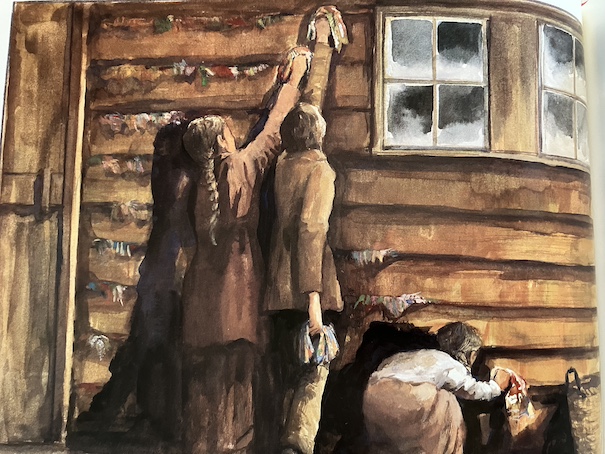
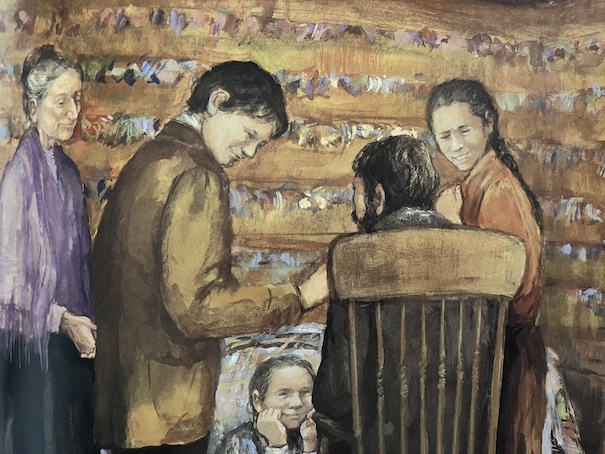
They’re worried about what happened to their father, and they’re worried about what they will do with the cold getting into the cabin. Then, suddenly, Elvirey has an inspiration. There is something they can use to fill the cracks in the cabin walls: Granny’s quilting scraps. With scraps from everyone’s clothes suddenly decorating the walls of the cabin, the cabin begins to look like it has turned into a quilt itself. When Elvirey’s father returns, he tells her that her mother would be proud of her, and for the first time, the cabin starts to feel like home to Elvirey.
The book is available to borrow and read for free online through Internet Archive.
My Reaction
There’s a pun in this story that people who don’t know the names of quilting patterns might miss. There are many patterns that the squares of a quilt can have, and Log Cabin is a traditional quilting pattern. When Elvirey and her siblings stuff the quilting scraps into the walls of their cabin, their Granny laughs about them creating a “log cabin quilt”, and it’s not just that she’s amused that they’ve made their cabin walls look like a quilt with all the scraps; it’s a pun on the name of the quilting pattern.
Although the story is about a family of pioneers, the focus of the story isn’t really their journey by covered wagon or the building of their cabin. It’s about loss and change and about what makes a new place feel like home. At first, Elvirey doesn’t feel like their cabin is their home because they no longer have the familiar things that belonged to her mother, and she can’t do some of the things that her mother used to do, like decorating the home with flowers. Even the quilt scraps and their associated memories don’t quite make her feel like home, although they do add a needed touch of color and hominess to the cabin. What finally makes Elvirey feel like home is when her father mentions her mother. Since her mother died, her father hasn’t smiled and hasn’t talked about her mother at all. When he sees what they did with the quilt scraps, he does both, and that makes Elvirey finally feel like they’re home. She really needed that sense of her mother’s presence or her memory to really get a feeling of home.
Elvirey is an unusual name, but I think it’s a nickname or variation of Elvira. Elvira is an unusual name in modern times, and in the United States in modern times, it usually reminds people of Elvira, Mistress of the Dark, a character portrayed by Cassandra Peterson and known for hosting horror movies since the 1980s. That reference has no relation to the story. Elvira/Elvirey is just an interesting and unusual name.












 Jestress's Forgotten Books and Stories