The Shimmering Ghost of Riversend

Kathy Wicklow is going to visit her Aunt Sharon at their old family home over the summer. The old family home, Wicklow Manor, is in Riversend, California, which is in an area where gold was found years ago. Kathy isn’t happy about the trip. She has to leave her dog behind because her aunt owns a cat. She doesn’t even really know her aunt very well. Aunt Sharon is her father’s sister, and her mother has said that she’s weird (which was not a good thing for her to say, both because it’s insulting and because that’s not something to make her daughter glad about spending time with her). Kathy blames her mother for going back to work. Because her mother is working and won’t be home with her, Kathy has to leave her home, her friends, and her dog for a month!

Although Kathy loves to draw, she doesn’t think that she’ll want to do that in a place she is sure she’s going to hate. She also thinks maybe her parents don’t trust her at home because of the weird dreams she’s been having. Kathy has dreams about things that later happen, although she doesn’t know why.

Her father has nostalgic memories of the old family home where he and Sharon grew up. Sharon has only recently returned there after living on the East Coast. Kathy’s father says that Sharon is looking forward to seeing Kathy again and getting to know her because she hasn’t seen Kathy since she was a baby.

Right from the first, Wicklow Manor gives Kathy the creeps. There’s even a small graveyard nearby where Kathy’s father says their ancestors are buried because people used to be buried close to their homes. When she can actually see the house, Kathy is also shocked to realize that she has drawn that house before! She thought that she had invented the house she drew from her imagination, but somehow, she had a vision of the real house. Her father thinks that she must have seen a picture of it somewhere or maybe was inspired by his descriptions of the place. However, Kathy has also done a drawing of Aunt Sharon’s pet cat, without knowing what it looked like before. When they meet Aunt Sharon, she mentions that she’s glad Kathy is there because the house has been lonely, especially at night. Kathy’s dad starts to ask her if something is still happening, but Aunt Sharon quickly denies it before he can finish the thought. Kathy can tell there’s some kind of secret between them.

Aunt Sharon has turned the family’s manor into an inn, and she’s expecting guests soon. It also turns out that part of the reason why Kathy’s mother says that Sharon is weird is that she’s into health food, and Sharon is aware that Kathy’s mother thinks that she’s a weird health nut. Kathy’s father volunteers her to help in the kitchen, although Kathy is a little worried that she won’t like the health food, although the lemonade that she makes with maple syrup instead of sugar is pretty good.

Still, Aunt Sharon gives Kathy a beautiful room with a balcony. Kathy also meets a boy named Todd who lives nearby with his great-grandfather, who is called Upstream Mike. Todd and his great-grandfather pan for gold in the nearby river, and Mike also takes his burro called Nugget into town so tourists can pay for rides on him and pictures with him. Todd is just a little older than Kathy, and he tells Kathy that he likes to write down stories that his grandfather tells him, especially scary stories about the old Wicklow Manor. Kathy asks if there are ghosts there, and Todd tells her to ask his great-grandfather about it. Kathy asks her aunt about ghosts, and Aunt Sharon tells her that Mike has told scary stories about the place for years that were apparently passed down in his family. Mike’s family lived in the area when the first Wicklows arrived.

Aunt Sharon shows Kathy some of the things in the house that belonged to their ancestors, including a portrait of a pretty young woman, who Aunt Sharon says was Jenny Wicklow, who died young by drowning in the river and was buried in the old family graveyard. One of their ancestors, James Wicklow, made his fortune as a banker during the Gold Rush days, and Jenny was his daughter. There is one room in the house where Kathy isn’t allowed to go, which is the old room in the tower. Aunt Sharon says that the staircase is broken, and she can’t have it fixed yet.

On her first night at the manor, Kathy sees a woman in a cloak with a lantern. When she asks Mike about it, he says that it’s a ghost or spirit of some kind that usually appears to young ladies at the manor, possibly a banshee or similar spirit that is a harbinger of death. Kathy worries about that, and Mike tells her the story about Jenny Wicklow. Jenny was one of three children of James Wicklow. She also had a sister named Lora and a brother named Daniel, and Kathy is a descendant of Daniel. After their parents died, Daniel went to work in the city and left the running of the manor and family farm to his sisters. The two young women hired a handsome young drifter to help them, but he started flirting with both of the sisters. The sisters seemed to develop a rivalry for him and argued with each other about it. Rumor had it that Lora was the one who pushed Jenny into the river so she could have not only her own inheritance but her sister’s as well and get the man they both wanted. After Jenny was dead, it seemed like all of their gold disappeared, and so did Lora. People assumed that Lora ran off with her lover and took the money. Mike thinks that the ghost is dangerous, and that Sharon is the one who’s in danger!

Kathy soon begins to learn that Mike is both right and wrong about the ghost. The ghost is Lora, but she’s not trying to hurt Sharon or anyone else. Something tragic happened at Wicklow Manor years ago, and Lora is trying to tell someone about it, if she can find anyone brave enough to listen … and to discovered what actually happened to Lora herself.

The book is available to borrow and read for free online through Internet Archive.

For a good part of the story, I wasn’t sure exactly what Lora’s ghost was attempting to accomplish, keeping me in suspense. I did have the sense that Lora wasn’t the one who had murdered Jenny and that she had probably been murdered herself, which was why nobody saw her after Jenny’s body was found.

Mike is correct that Lora is the ghost, but she was not Jenny’s murderer. Like Kathy, Lora was psychic. She has been trying to communicate with different girls in the family over the years to clear her name, but the other girls have all been frightened of her. Sharon claims not to believe Kathy at first about how Lora is trying to communicate with her, but she later admits that it was because she was frightened. She also saw Lora when she was young, and that’s part of the reason why she was afraid to return to the old family home for so long. She was afraid to admit that the house was really haunted and that she was afraid of the ghost. It was a long time before she could even tell her own mother and brother about seeing Lora because she was afraid of being different from everyone else in the family. Sharon is also psychic, and like Kathy was initially, she was afraid of her gift.

Kathy and Todd use the messages that Lora communicates through Kathy’s drawings and Lora’s old diary to learn the truth. Jenny was murdered by the man she loved. Lora didn’t actually love him at all. She saw that he was a violent person and tried to warn Jenny about him, but Jenny wouldn’t listen because she thought Lora wanted him for herself. Lora saw the murder that was going to happen in a dream, and she wanted to stop it by using her own inheritance to pay the man to leave her sister alone. However, Lora was unable to save her sister. After he killed Jenny, the man came after Lora and murdered her, too. Then, he stole both of their inheritances. He hid Lora’s body, which was why everyone thought she must have run away with him.

After Lora’s ghost leads Kathy to where her body is buried in the cellar and she is given a proper burial in the family graveyard, the haunting ends. However, Kathy learns to appreciate her psychic gift because of this experience. She finds it reassuring that she shares her abilities with other people in her family. When she reads in Lora’s diary that Lora thought of her own psychic abilities as a gift, Kathy also comes to think of being psychic as a gift rather than a weird defect or something to fear.

The mystery in the story was good, and I also liked the information about panning for gold that Mike gives to Kathy when he gives her a gold panning lesson. There is also a tie-in with real children’s literature because Kathy mentions that she is reading Down a Dark Hall by Lois Duncan. I’ve reviewed Down a Dark Hall on my site, and it is about girls with psychic abilities at a haunted boarding school who channel the spirits of famous people to complete their unfinished works. The channeling and spiritual possession in that book are dangerous and harmful to the girls doing it, but in this book, Kathy becomes reconciled to her psychic abilities and Lora’s gentle spirit, who needs her help.

Mystery of the Haunted Pool

Mystery of the Haunted Pool by Phyllis A. Whitney, 1960.

At the beginning of the story, Susan Price is traveling alone to visit her Aunt Edith. Her father is in the hospital, and her mother and brothers are tending to things at home. Her family wants her to make a good impression on Captain Daniel Teague, who lives in Aunt Edith’s town. Her father’s doctor has advised him to move to the country, where there is less air pollution, and the family would like to move to the small town along the Hudson River where Aunt Edith owns an antique store. However, the only available house that would be big enough for the family would be the Teague house, and Captain Dan hasn’t decided whether to rent or sell his house to them or not. Before Susan arrives, she isn’t sure what’s going on with Captain Dan and the arrangements regarding his house, but it turns out to be a complicated situation involving her aunt’s antique business, the Teague family history, and Captain Dan’s grandson, Gene.

When Susan’s bus reaches the bus stop, Aunt Edith isn’t there to meet her, so she walks to her aunt’s store. Aunt Edith apologizes for not meeting her. The reason why she didn’t is that a woman named Altoona was hanging around her shop, and she didn’t want to leave Altoona there alone. Lately, Altoona has been acting suspiciously, snooping around the shop as though she’s looking for something but doesn’t want anyone to know. Aunt Edith doesn’t know what Altoona is looking for, but it’s making her nervous. In particular, Altoona seems interested in a barrel of old books that Aunt Edith is selling on commission for Captain Dan, but Aunt Edith doesn’t want her looking through them until she’s had a chance to examine them herself.

Aunt Edith says that she’s known Altoona since they were children. Altoona was raised by her father and an older sister, both of whom were strict and unloving. Altoona led a very restricted life until her father and sister both drowned in a boating accident. Since then, Altoona has been indulging herself by spending her inheritance on antiques. However, rather than being a good customer of Aunt Edith’s, Altoona has turned into competition. She seems to delight in trying to beat Aunt Edith to some fascinating antique. Altoona seems to be on the trail of some new discovery, but Aunt Edith doesn’t want to give her the chance to poach something that might be right under her nose in her own shop.

Since Aunt Edith’s husband died years before, she’s been living in a back room of her shop. With her brother and his family wanting to move to the country, she’s planning on helping them get a house and living there with them. Aunt Edith has her eye on a particular house owned by Captain Daniel Teague, but he’s been reluctant to sell, which is why it would help if Susan made a good impression on him. Captain Dan has been living in a big old house with his grandson, Gene, but it’s an expensive house to maintain for just the two of them. He’s been considering renting it to Susan’s family with an option for them to purchase it later. However, he’s been dragging his feet on making a final decision because he wants to make sure that he approves of the Price family and that Aunt Edith won’t sell any of the antique furnishings from the house in her shop without permission. Also, Gene is upset at the idea of moving, and Captain Dan is concerned about Gene.

Aunt Edith explains that Gene is just a little older than Susan and that he was injured in an accident a couple of years before. He was hit by a car, and he’s been in and out of the hospital for treatment. Even now, his leg is stiff, and he has to wear a brace. Susan witnesses his frustration when she watches him trying to play basketball alone the first time she meets him. She can tell that he’s been trying really hard to overcome his disability, but things are still very hard for him. Susan is touched by Gene’s struggles and his stubborn efforts to succeed. She also discovers that he has strength and coordination in his arms, even though his left leg is very weak. When she asks Gene to teach her how to shoot baskets so she can impress one of her older brothers, she begins to realize that sometimes Gene tries too hard, and it makes his situation harder on him. When he gets tense, he has more trouble than when he’s relaxed.

Gene confesses to Susan that he feels guilty about being hit by the car, not only because he got hurt but because of what it’s done to his family. He admits that it was his fault for not looking more carefully before crossing a nearby highway. He feels terrible because his grandfather has spent most of his savings to pay for the hospital and doctors’ bills, and his mother had to get a job in New York City to pay the rest. Gene’s reluctance to move out of the family’s old home is that he knows how much his grandfather loves it, and he would feel even more terrible if his family lost the house because of his careless accident. The two of them seem to be getting along until Susan tries to climb a nearby rock, and Gene angrily tells her not to.

Captain Dan turns out to be a nice man. He’s called Captain because he used to be a river boat captain. He comes from a long line of sailors. When Susan tells him about meeting Gene and how Gene got angry at her for trying to climb a rock, Captain Dan tells her not to try too hard to accommodate Gene and his moods. He says that Gene’s biggest improvements have only come recently, when he started pushing Gene to work harder to improve. He thinks that Gene was a bit coddled up to that point and that he was too discouraged by the doctors’ predictions about what he wouldn’t be able to do anymore without really trying to test his limits and see what he could do for himself. In a way, Captain Dan is actually in favor of the Prices moving into their big family home because he knows that Susan has brothers. He thinks that having other boys around will be good for Gene, getting him to participate in more activities and push himself a little more.

One thing that’s making Captain Dan hesitate is the idea of having Aunt Edith in his house. He admits that he finds it difficult to say no to her when she wants something, and she’s been urging him to let her sell some of his old things in her shop. He’s concerned about what she might talk him into parting with next if she were living in his house. When Gene finds out that Aunt Edith talked his grandfather into parting with that barrel of old books, he gets angry again and talks back to his grandfather.

Susan is surprised at Gene’s rudeness and disrespect, but his grandfather says that part of that comes from Gene not liking himself much right now. Because Gene is unhappy with and disparaging of himself, he’s unhappy and disparaging with everyone. That’s part of why Captain Dan has been pushing Gene to improve himself, to give him more confidence and self-respect because he will see that he still has the ability to improve. Captain Dan also realizes that Gene has an intense attachment to their family home and family heirlooms because he takes more pride in their family’s history than in himself, thinking that he’ll never be able to be proud of himself now. Aunt Edith says that Gene’s father, a pilot who died in a crash, was also a decorated pilot during WWII. When Gene was younger, before he was injured, he was a much more active boy, and his father was proud of him for it. Aunt Edith thinks that Gene worries that his father would be ashamed if he saw his current condition.

Susan likes Captain Dan for his kindness and understanding of Gene. She’s not sure how much help her brothers would be with Gene, though. Her brother Adam, the closest in age to Gene, probably wouldn’t have much patience with a boy like him. That’s probably why Susan’s family decided that Susan would be the best person to break the ice with Captain Dan and Gene.

Susan tells Captain Dan that she saw Altoona watching the house when she came up to see him, and he says that he knows about Altoona’s obsession with antiques. He’s not sure what Altoona is looking for, but he thinks it must be some kind of antique. Mrs. Bancroft, Captain Dan’s housekeeper, says that the family has a secret. Aunt Edith says that rumor has been around their small town for years, but she doesn’t know what sort of secret it’s supposed to be, and with a town full of people who all know each other and each other’s family history, she can’t imagine what could still be secret about the Teague family.

Then, Susan finds an old ship’s log book in the bottom of the barrel of books that Aunt Edith got from Captain Dan. It’s the log book for the Flying Sarah, the ship that one of the Teague ancestors sailed. Aunt Edith returns the log book to Gene because she knows it must be a family heirloom, more valuable to the Teague family than anyone else. However, Gene is still sore about Aunt Edith having the barrel of books, and Susan catches him sneaking into the shop one night while Aunt Edith is out. He says that he wants one of the books, but he refuses to say which one he wants or why. Susan thinks that Gene knows more about his family’s secret than he’s telling and that his concern about the books has something to do with it. It seems like Gene may be on the trail of the same thing Altoona is searching for, but what is it? Captain Dan also seems to know, but he tells Gene in Susan’s presence that it doesn’t matter.

Susan gets a hint from Altoona when Altoona tells her that the old Teague house is haunted by the ghost of Sarah Teague, the wife of the captain who sailed the Flying Sarah, which was named for her. Altoona says that Sarah’s husband was murdered on the Flying Sarah and that Sarah took over the family’s shipping business after his death. Then, Sarah drowned in the little pool in the woods near their house. Altoona says that Sarah promised to come back and haunt the house if things didn’t go her way, but what does that mean?

Susan does some research in an old book about ships and discovers that the captain of the Flying Sarah had been carrying a valuable shipment of jewels for a friend when the ship was attacked by pirates. He died from the wounds he received from the pirates, and the pirates apparently took the jewels along with other valuable objects from the ship. After her husband’s death, Sarah Teague insisted on taking responsibility for the lost jewels and repaying the owner for their loss, which was financially crippling for the family. The book also repeats the story about Sarah Teague haunting the old family home. Soon after Susan and Aunt Edith move into the Teague house, someone break in during the night, apparently looking for something. Susan goes to look at the pool where Sarah drowned and thinks that she sees a strange face looking back at her from the water. What message from the past does Sarah Teague have for them, and what secret has the Teague family been hiding for generations?

The book is available to borrow and read for free online through Internet Archive.

My Reaction and Spoilers

For much of the book, the exact nature of the Teague family secret is a mystery to Susan, although readers can probably make a pretty good guess at what Susan eventually finds. Part of the difficulty is that the Teagues themselves don’t seem to quite understand what they really have. They know part of the secret, but only part of it. When Susan discovers the rest, it changes things for Captain Dan and Gene. Susan’s brother, Adam, helps Susan with the mystery for part of the book, but Susan is the one who makes the final discovery.

Altoona is kind of a rival/antagonist for solving the mystery, but not an evil one. She appears to be going through a kind of finding herself phase since the deaths of her father and sister. Her family was repressive, so for the first time in her life, she is taking advantage of opportunities to get involved with community activities and indulge her own whims. She dresses in strange ways because she’s trying out all of the things her father and sister would have never allowed her to wear when she was younger. She volunteers at the local library, but she has trouble deciding which books to recommend to the children who visit the library because she’s never read many of them herself. When Susan suggests to her that she should read some of the children’s books herself so she’ll know what they’re like and what they’re about, Altoona balks at the idea of an adult reading children’s books at first. However, she decides that maybe Susan is right, and when she tries some of the children’s books that Susan recommends, she says that she likes them.

Altoona’s pursuit of the Teague family secrets isn’t malicious. It seems to come from her newfound sense of independence and adventure. Figuring out the old mysteries of the Teague family is a sort of personal challenge for her and something that has fascinated her for her entire life, a fascination that she is now free to indulge. She almost messes things up by taking something that doesn’t belong to her, but it turns out to be an innocent mistake because of something Gene did, and she makes things right in the end. Altoona also comes up with a solution to the Price family’s housing problem. She says that she’s always wanted to travel, and at Adam’s encouragement, she’s decided to take an extended international trip for a year or so. While she’s away, she rents her house to the Price family so the Teague family can have their house to themselves again.

The book mainly focuses on self-discovery for Gene as a side plot to the story. At the end of the book, Gene’s problems aren’t completely solved, but he has become more reconciled to his condition and has a better understanding of things he can and can’t do because of the children’s adventures. By learning to get along with Susan and Adam, Gene becomes more ready to face other people and their reactions to his disability. When things improve for him and his family, he also seems less inclined to keep beating himself up over his accident. Things aren’t perfect for him at the end, and he’s probably never going to have completely normal use of his bad leg again. Still, there are signs that he’s mending, both physically and emotionally, and that things will get easier for him.

I like books that mention other books. In this book, the barrel of books that Aunt Edith gets from Captain Dan includes classics, like Little Women and Treasure Island. There are also books by Washington Irving, Gene Stratton Porter (known for A Girl of the Limberlost), and Harold Bell Wright and some “novels about an imaginary kingdom called Graustark.” These are all real authors and books. Aunt Edith says that some of them aren’t old enough to be considered real antiques, but this book was written more than 60 years, so modern standards would be different. Part of the story also includes books that have hidden pictures drawn on the fore-edges of the pages, which can only be seen when the pages are held at an angle. This type of fore-edge drawing or painting is something that can be found in real antique books.

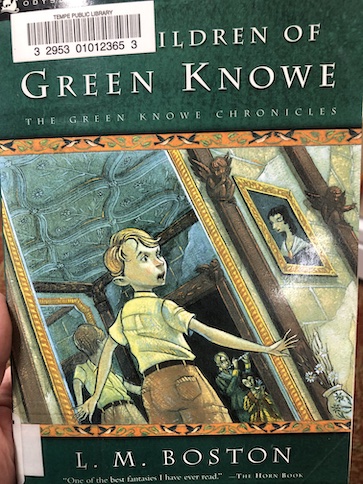
The Children of Green Knowe

Green Knowe

The Children of Green Knowe by L. M. Boston, 1954, 1955, 1982, 1983.

Seven-year-old Toseland is traveling by train to stay with his great-grandmother Oldknow at the old family home, Green Noah, for Christmas. His mother is dead, and his father now lives in Burma with his new wife, who Toseland doesn’t know very well. He has no brothers or sisters, and he spends most of his time at boarding school, so he is often lonely, wishing that he had a family outside of school, like the other boys. His great-grandmother is the only other relative he has, and he has never met her before. He is a little nervous at the idea of meeting her because he knows that she must be very old.

When Toseland arrives at the station, it’s raining, and there has been flooding, but there is a taxi-man waiting to take him to the house. When he arrives, he is immediately fascinated by the large, old house and all of the things in it. It reminds him of a castle, and he marvels at how his great-grandmother could live in such a place. He is surprised at how at home he feels there and how easily he likes and gets along with his great-grandmother. For the first time in his life since his mother died, he really feels at home, and when he asks if the house partly belongs to him, too, his great-grandmother reassures him that it does.

The two of them talk about what to call each other. Toseland’s great-grandmother asks him to call her Granny (although she is still often called Mrs. Oldknow throughout the book), and she asks him if he has any nicknames. Toseland says that the boys at school call him Towser and his stepmother calls him Toto, but he doesn’t like either nickname. Granny Oldknow says that Toseland is a family name and there have been other Toselands before him. The last one was his grandfather, and his nickname was Tolly, so Granny asks him if he would like to be called that also. Toseland says that he likes that nickname better than the others, and his mother used to call him that, so he is called Tolly from that point on.

Granny Oldknow shows Tolly to his room and helps him begin to unpack. It’s a wonderful room with many old toys that used to belong to the other children who have lived in the house in the past. Among the toys is an old dollhouse which Tolly realizes is a miniature version of the house they’re in. When he finds the miniature version of his room, he notices that there are four beds in it instead of one. He asks Granny Oldknow if other children stay at Green Noah, and she cryptically says that they do sometimes, and he might see them, but they come when they want to.

Tolly becomes fascinated by a portrait of three children in old-fashioned clothes with their mother and grandmother. Granny Oldknow tells him that those three children lived in the house long ago. The oldest boy was an earlier Toseland, who was nicknamed Toby. His younger brother was named Alexander, and their little sister was named Linnet. Granny Oldknow had been an orphan when she was a child and was raised at Green Noah by an uncle. Because she was an only child, she often lonely and liked to pretend that the children in the picture were her siblings, so Tolly decides that he’d like to do the same thing.

Tolly asks his great-grandmother questions about Toby, Alexander, and Linnet and learns details of their lives. Toby had a sword because he was going to be a soldier when he grew up, a pet deer, and a horse named Feste who loved him. Alexander had a book in Latin that he loved to read and a special flute. Linnet used to keep birds in a wicker cage that is still in Tolly’s room, along with the toy mouse that used to belong to Toby. Sometimes, Tolly thinks that toys in his room move when he’s not looking, and at night, he hears children moving about and laughing, and he thinks that it’s the three children from the painting.

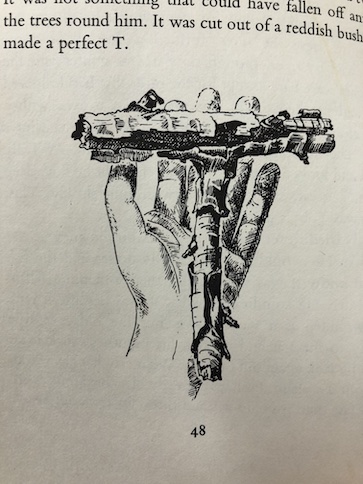
Tolly comes to the conclusion that the three children are still around Green Noah and that they’re playing hide-and-seek with them. He tries to play with them, too, and the children apparently give him a twig in the shape of a ‘T’. Granny Oldknow tells him that she used to play hide-and-seek with the children when she was young, and they would give her an ‘L’ twig because her first name is Linnet, like the little girl in the painting. Later, he hears the children singing Christmas carols. Tolly becomes frustrated that the children tease him and never really show themselves to him, but Mrs. Oldknow tells him that “they’re like shy animals” and that he has to give them a chance to decide that they’re ready to come to him.

He finds the key to the old toy box in his room, and inside the box, he finds more things that belonged to the three children. When he shows them to Mrs. Oldknow, she talks about how things were when the three children were alive at Green Noah. Tolly is shocked when he realizes for the first time that Toby, Alexander, and Linnet are all dead. Mrs. Oldknow gently tells him that they lived at Green Noah centuries ago and could not be alive now. Sadly, the children all died young in the Great Plague during the 17th century. Their illness was sudden and brief, and they all sickened and died in one day along with their mother. Tolly and his great-grandmother are descended from the children’s older brother, who wasn’t at home when this happened. However, the children never left Green Noah, which used to be called Green Knowe years ago. Tolly still loves the children, even though they’re ghostly and elusive. He craves the sense of family he gets from them, having been deprived of family feelings for so much of his young life.

Mrs. Oldknow continues to tell Tolly stories about the three children and other members of his family. As his connection to his ancestors grows, Tolly begins to catch glimpses of the children more and more, and eventually, he’s able to see them and talk to them. He asks the children about their mother, and the children say that she’s in heaven but doesn’t mind them coming back to visit their old home from time to time. The children don’t seem sad at being dead, enjoying the freedom of playing around their old home with the animals and the spirits of their old pets, who keep them company. Their final illnesses had only lasted a few hours before they died, and their deaths happened so long ago that they say that they hardly remember the Great Plague and what it felt like. Tolly is still sad and frustrated that the children appear and disappear so suddenly, but his attachment to them grows and so does his attachment to Green Noah itself. As Christmas comes, Tolly develops a bond with his family, both living and dead, and a realization that the old family home that connects them is also his home, a place they can all return to.

The book is the first in a series and is available to borrow and read for free online through Internet Archive (multiple copies).

My Reaction and Spoilers

This is a ghost story, but it’s not a scary ghost story. There’s nothing frightening about the three ghost children. It’s sad that they died so young, but at the same time, they’re not very sad about it themselves. They seem to enjoy playing together endlessly with the animals around their old home and seeing the new relatives who inhabit the house, their older brother’s descendants. Even their former pets are no longer sad at the children’s passing because they are also spirits who continue to play with them through the centuries. There is one semi-scary part of the story involving a witch’s curse placed on an old tree called Green Noah, which is how the name of the house was changed from Green Knowe, but Tolly is protected by the ghosts of his ancestors.

There is never any desire for the characters to rid Green Noah of its ghosts. They are family and are part of the place, as much a part of it as the living are. The ghosts do not feel trapped there, either. They are just revisiting the home they loved and the family members who now live there. They can come and go as they please, and the ghost children often do.

This also is not the kind of story where a child knows that a place is haunted but can’t convince the adults or tries to hide the ghosts’ presence from the adults. Mrs. Oldknow is fully aware that the ghosts are there and has known about them since her own childhood. Generations of children in the family have probably known about them and played with them, and they are also not the only family ghosts who inhabit the old house. At one point, Tolly and Mrs. Oldknow hear a woman singing and the rocking of a cradle, and Mrs. Oldknow says that she’s heard it before around Christmas, a grandmother singing to a baby. Tolly is confused because even little Linnet wasn’t a baby when she died, and Mrs. Oldknow says that this isn’t the children’s grandmother but somebody from generations earlier than the three children. This grandmother ghost has been around so long that Mrs. Oldknow doesn’t know who she or the baby are supposed to be, although we are told that they are about 400 years old, where the three children died about 300 years earlier. Generations of the same family have lived in the house and have all left their mark on it, and part of them is still there. Now, Tolly has also become part of this family home, and it’s also a part of him. The ghosts are hesitant to fully show themselves to Tolly at first and seem more attached to Granny Oldknow, probably because she’s lived there longer, since she was an infant. The ghosts know her, and she knows all of their stories. However, they are all family, and Tolly develops a new connection to his family as his great-grandmother tells him the stories about them, and he can hear and see the ghosts more often.

Really, that feeling of connection and connectedness is the primary focus of the story. In the beginning, Tolly is lonely, feeling like he doesn’t have a family and doesn’t belong anywhere or to anyone. His father lives far away in Burma with his new wife, and Tolly doesn’t feel connected to them. His mother is gone, and he spends most of his time at school, even having to remain there during the holidays when other students are going home to their families. His great-grandmother inviting him to Green Noah is the first time that Tolly feels a real connection to anyone in his family since his mother’s death, and through her stories and his encounters with the ghosts, he comes to see that he really is part of a much larger family, going back ages. Just because most of his family is now dead or scattered doesn’t mean that they’re not his family. They still love him, and he loves them, even across the centuries. Green Noah really is a family home, and it’s a place that family can return to, even those who seem to be gone forever. It’s a place that has known both the joys of a happy family and the tragedies of loss that families experience from time to time. Through it all, it’s still home, and importantly, it becomes the home that Tolly has been wishing for.

The story takes place in the days leading up to Christmas, and by Christmas, Tolly has received important presents. First, the ghostly Alexander grants him the give of his special flute, which had been a reward from King Charles II for singing so beautifully for him when he was alive. Tolly also has musical talents, and his great-grandmother decides to switch him to a different school so he can develop his talents and so he can stay at Green Noah during his school holidays. On Christmas, Tolly also receives his own pet dog, very much like the one that the ghostly Linnet owned, and he names his dog after hers, just as he has been named after all the other Toselands who have gone before.

In some ways, the story reminds me a little of When Marnie Was There (some people might know the story from the Miyazaki movie version), which has similar themes of family and belonging and ancestors reaching out across time to remind children that, while life is brief and often complicated, love is eternal and everyone belongs somewhere and to someone. However, The Children of Greene Knowe is a much gentler story, and it also contains some shorter stories about Tolly’s family.

Dancing with the Indians

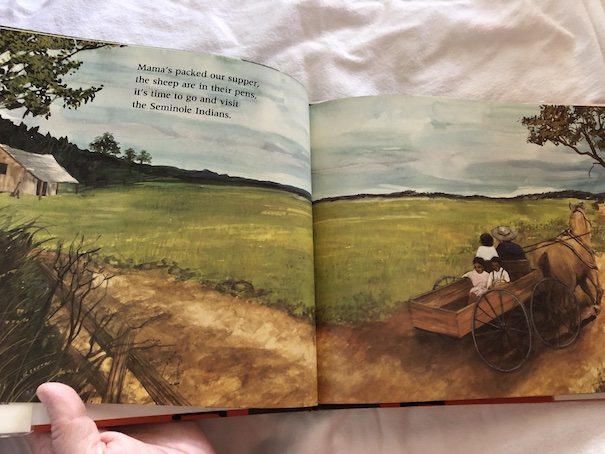
Dancing with the Indians by Angela Shelf Medearis, illustrated by Samuel Byrd, 1991.

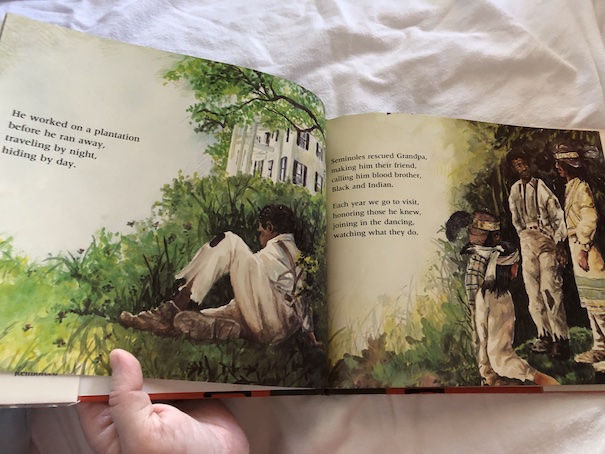
I love books with historical background, and this is a fascinating picture book that is based on the history of the author’s family. Like the author’s earlier book, Picking Peas for a Penny, it is told in rhyme, from the point of view of the author’s mother as a child in Oklahoma during the 1930s.

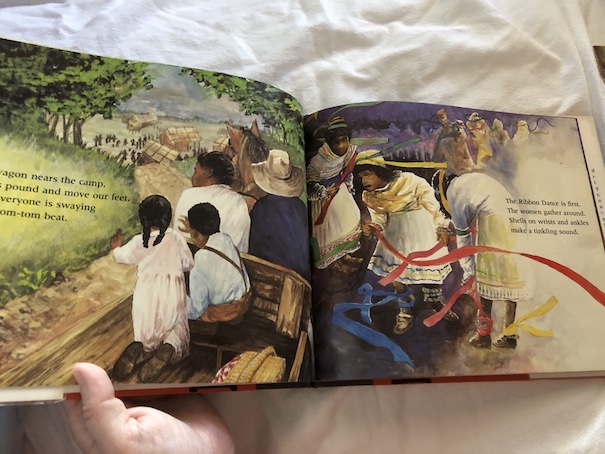
The girl and her brother are going with their parents to visit the Seminole American Indians. As they travel in their wagon, the parents explain to the children the history of their family. Many years before, the girl’s grandfather (the author’s great-grandfather) escaped from slavery and ran away to Oklahoma, where he was accepted by the Seminole tribe. Ever since, his descendants have continued to visit the tribe and join in Seminole celebrations and ceremonies as part of their extended family.

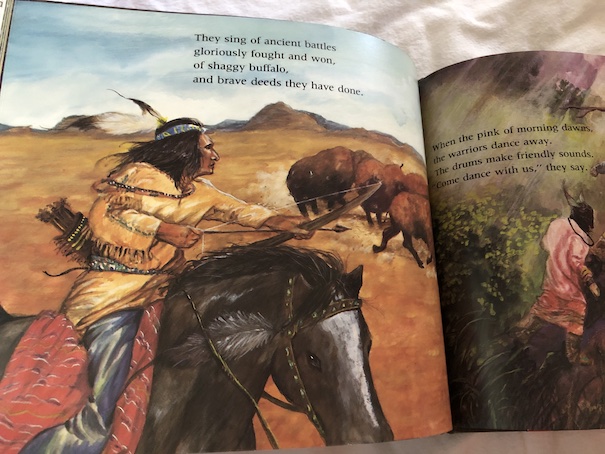
The night is an exciting celebration with dancing, drumming, and songs and stories of past triumphs.

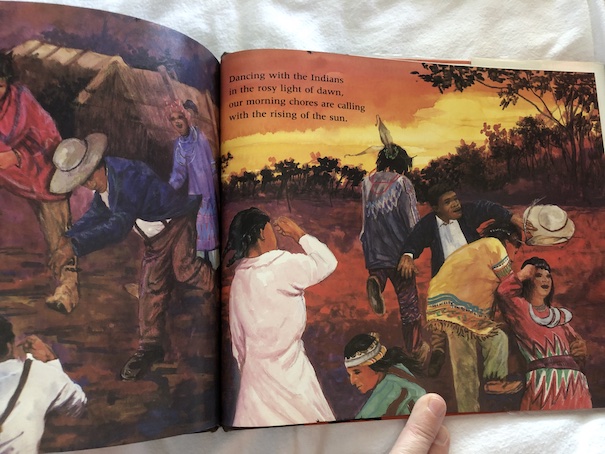
They all dance and celebrate through the entire night, until morning. As the family returns home to tend to their farm, the father promises them that they’ll return to dance with the Indians again.

I liked this book because it explains an aspect of American history that I don’t remember being discussed much when I was in school. In fact, I think that the first time I saw anything that explained that escaping slaves sometimes headed west instead of north before the Civil War was in a Disney Adventures magazine, where they were talking about cowboy, specifically mentioning black cowboys. However, another option was for escaped slaves to join up with Native American tribes. The Seminole tribe of Florida and Oklahoma was one group that was known to accept escaped slaves and adopt them into the tribe, starting in the early 1700s continuing into the 1850s. Some of the escaped slaves married into the tribe. The African Americans who joined the Seminoles and their descendants came to be called Black Seminoles. Parts of the two cultures intermingled. Black Seminoles adopted Seminole traditions, and they also introduced Seminoles to aspects of their traditions. The relationship has had complications as well, and even in modern times, there are debates about how much Black Seminoles count as part of the tribe and how much they should be entitled to certain benefits

This is a Reading Rainbow Book. The book is available to borrow and read for free online through Internet Archive (multiple copies).

The Mystery of the Cupboard

The Mystery of the Cupboard by Lynne Reid Banks, 1993.

This is the fourth book in the Indian in the Cupboard series. It’s also the longest book in the series and the one that reveals the most about the history of the magical key and cupboard and how their secrets tie into the secrets in Omri’s own family. It was my favorite book in the series when I was a kid!

Omri’s parents have surprised him by telling him that they’re planning on moving to a new house again. Omri wasn’t exactly happy with their last move, and his room and other parts of their new house were damaged after his last adventure with time travel, when his friend Patrick brought back a tornado with him. However, now that the house has been repaired and he’s settled in, Omri doesn’t like the idea of having to pack up and leave and get used to a new place again. His parents want to move to the country, but it’s not even the area where Patrick now lives. Instead, they’re planning to move to a house that his mother has just inherited.

The house Omri’s mother has inherited belonged to an older cousin of hers she never actually knew. He didn’t leave his house specifically to her; it’s just that he died and left no will, and Omri’s mother happens to be the nearest living relative his lawyers could find. When they finally see the house and find out how much land is attached to it, it turns out to be much better than Omri expected.

There are just two things that concern Omri. The first is the package that he asked his father to store at a bank for him – the magical cupboard and key. Although Omri asked his father to put them in a bank deposit box to keep them safe and prevent himself from being tempted to use them again because it’s too dangerous, he doesn’t like the idea of them being too far away from where he’s living. His father promises to have them transferred to a bank near their new home. The second thing that worries him is that his cat mysteriously disappears soon after they move into the new house. (The cat is okay, she just sneaked away to have kittens.) His parents say that she’s just roaming her new territory and might be a little angry for being moved from her old home and that she’ll come back to Omri once she’s settled in, he still worries about her.

One night, he think he hears his cat crying and goes looking for her. He doesn’t see her, but he stumbles on something that was hidden in some old thatch that fell of the roof of the house. It turns out to be a metal box and a notebook belonging to someone named Jessica Charlotte Driscoll, written in 1950. Omri doesn’t know who she is, but the notebook is a story of her life, in which she describes incredible things happening to her which her family doesn’t believe. Omri wonders if she could be a relative of his, and the name Charlotte reminds him of his grandmother, Lottie. He never knew his grandmother and his mother doesn’t even remember her mother because she died in a bombing during WWII, when she was very young. The woman who wrote the notebook couldn’t have actually been his grandmother because she would have been dead for several years by 1950, but perhaps it was a family name.

Omri questions his mother about the cousin who owned the house and her family’s history. Jessica Charlotte turns out to be the sister of Omri’s great-grandmother, his mother’s great-aunt. Great Aunt Jessica Charlotte was the younger sister of his mother’s grandmother. After her mother was killed in the war, Omri’s mother was raised by her grandmother. Omri’s mother had asked her about her younger sister when she was a girl, but her grandmother didn’t like to talk about her. Apparently, Jessica Charlotte had been an actress with a somewhat scandalous past. However, the cousin who used to own this house was Jessica Charlotte’s son, Frederick. Frederick never married, and although Omri’s mother thought that Jessica Charlotte had lived abroad somewhere, it’s possible that she lived at this house for a time.

Much of the story is told through entries in Jessica Charlotte’s notebook. When Omri begins to read the notebook, written toward the end of Jessica Charlotte’s life, he learns, to his shock, that Jessica Charlotte was the original owner of the magic cupboard and that she had her own Little People who visited her from other times and were her friends. After Omri reads that, he questions Gillon, the brother who gave him the cupboard, and he admits that he didn’t really find it in an alley, like he said. He actually found it in the basement of their old house with a bunch of other junk. He just didn’t have the money to buy Omri a birthday present at the time, and Omri had kind of a fascination for secret drawers and boxes, so Gillon thought that he might have some fun with the old cupboard, and he made up the story about mysteriously finding it to make it more interesting. (I suspect that the author was just retconning this part to make it agree with the idea that the cupboard was passed down through Omri’s family, but I like the way this comes out, so I’m okay with that.)

The notebook further explains that Jessica Charlotte had been envious of her older sister because she was prettier, luckier, and often seemed favored by everyone. However, in mocking the young men who came to court her older sister, Jessica Charlotte discovered that she had a talent for mimicry, which led her to become an actress, although her family thought that it was a disreputable profession and disapproved. Jessica Charlotte also discovered that she was psychic and sometimes had visions of the future. She eventually left home and became an actress. Her sister, Maria, still visited her secretly sometimes, against their parents’ wishes.

After awhile, Jessica Charlotte became pregnant with Frederick, which was when she first came to the old house where Omri’s family now lives. She didn’t have any money and couldn’t work while pregnant, and because she was unmarried, she would have been considered shameful if people knew. At that time, the house was a farmhouse belonging to a relative of Frederick’s father. By that point, Jessica Charlotte realized that her boyfriend wasn’t a good person and wasn’t going to be a good father to their son, but he did arrange for this relative of his to help her through her pregnancy. Frederick was born in the house, and because he was illegitimate and sensed his mother’s complicated feelings about him and the circumstances of his birth, he and his mother were never as close as they really should have been.

Meanwhile, Maria got married and had a daughter, Lottie, who was Omri’s grandmother, the one who was killed in the war. Jessica Charlotte says that she did something that wronged Maria and Lottie, and Omri stops reading the diary for a time, but he decides that he really has to continue and know the full story.

Over the years, Jessica Charlotte lived a hard life, supporting Frederick through a mixture of acting and other odd jobs, including fortune telling because of her psychic abilities (although she never used her gift to see into the future for herself or anyone close to her because she was afraid she might see something bad happen to them and be unable to stop it). Meanwhile, Maria was living a very comfortable life with her husband and daughter. Even after their parents died, Maria still had Jessica Charlotte visit secretly because of her tainted reputation, and she never wanted to meet Frederick or talk about him because his birth was the cause of her sister’s scandal. Still, Jessica Charlotte continued to see her sister and became fond of Lottie.

However, Maria was basically a pampered snob who didn’t understand her sister’s life and hardships and also had a streak of self-centeredness. One day, when Lottie was a young child, Maria said that when Lottie was older, she didn’t want her to see so much of her aunt, implying that Jessica Charlotte would be a bad influence on her. Jessica Charlotte was deeply offended by that, but she was also fearful about losing the last family members who were still speaking to her. She had lost so many of her other relationships that she still felt the need to be close to Maria and Lottie as much as she could and visit their pampered and comfortable little world, enjoying occasional tastes of their happier and more comfortable lives.

Yet, Jessica Charlotte’s jealousy for Maria’s pampered life and anger at her callousness continued to eat at her. One day, when Maria was showing her all of her nice jewelry, Jessica Charlotte got the urge to steal a beautiful pair of earrings. First, Maria was being, at the very least, thoughtless and callous for showing off all of her nice jewelry to her much poorer sister, who could never have things like that herself. Maria not only had no concept about what her sister’s life was like outside of her occasional visits, but she purposely never asked her about how she was doing, how her son was doing, or even where they were living, how they were getting by, if they needed anything, or if she could help them in any way. She didn’t know because she didn’t want to know any of these things, and the fact that she didn’t want to know any of that indicates that she knew enough to understand that their circumstances weren’t pleasant. To show off all of her pretty things like that just seems like rubbing it in. Second, Jessica Charlotte had been in need for so long that she saw all of the pretty jewels as symbols of Maria’s comfortable life, something she hungered for herself. The pair of earrings weren’t something that Jessica Charlotte wanted just for the sake of having them but because of what they represented to her, the life that she couldn’t share in and which she knew that Maria would soon shut her out of when she declared that her visits with her young niece would have to stop soon.

Jessica Charlotte planned out the theft in advance, making a duplicate key for her sister’s jewelry box and thinking that her sister would just assume that she’d mislaid that one pair of earrings somewhere. Unfortunately, when Maria noticed that the earrings were gone, she thought Lottie had done something with them, and when she kept insisting that Lottie tell her where they were, Lottie got upset and ran out of the house into the street. Matt, Maria’s husband and Lottie’s father, chased after her and was hit by a cab and killed. Jessica Charlotte felt terrible when she heard the news because she hadn’t meant for anyone to get hurt, but there was nothing she could do to take it all back.

Omri knows how Maria and Lottie’s lives went after that point because of what his mother told him about their family history. After Matt died, Maria and Lottie didn’t have very much money to live on, just a little pension, and then their house was burgled, and many of Maria’s nice things were stolen, including the rest of her jewelry, so she couldn’t sell them for extra money. Maria had to move to smaller, cheaper lodgings and get a job for the first time in her life in order to support herself and her daughter, living a life closer to what her sister had been doing. When Lottie was grown and married, she and her husband helped to support her mother, but after they were killed in WWII, Maria took in Lottie’s daughter (Omri’s mother) and had to keep working in order to raise her. Although they were now living in more equal circumstances, the two sisters did not become close again because of Jessica Charlotte’s guilt about what she’d done. Jessica Charlotte ended up buying the old house in the country where her son had been born and told her sister that she was going to live abroad, never telling her exactly where. She had not expected to see Maria again anyway since Maria was planning to cut her out of her daughter’s life before Jessica Charlotte stole the earrings, and after Matt died, Jessica Charlotte couldn’t bring herself to face Maria. Jessica Charlotte lived in the country house until her death in 1950.

When Jessica Charlotte became too weak to write any longer, shortly before her death, she had Frederick finish the story in the notebook. Aside from the difficult feelings between Frederick and his mother because of the circumstances of his birth and the rough and poor childhood he endured, Frederick also says that the two of them don’t really get along because they are very different types of people. When he was grown, Frederick went into business as a metal smith, eventually owning his own factory that made toy soldiers and other metal toys. During WWII, the government had him convert his toy factory to manufacture munitions. He wasn’t happy about it, but it did make him fairly well-off. After the war, Frederick had hoped to go back to making metal toys, but plastic was coming into vogue as the material of choice for toys, and Frederick couldn’t stand the stuff. He thought that the newer plastic toys were cheap and shoddy compared to his detailed works of art in metal. (It was kind of true.) There were basically two choices before Frederick: convert to making the cheap plastic toys he hated or switch to making different types of metal products. He switched to making metal boxes and cabinets.

Frederick never really believed in his mother’s supposed psychic powers, but when he was upset about plastic ruining his metal toy business, he admits that he let his mother talk him into participating in a silly ritual. He was so angry and upset that his emotions were ruining his health, so his mother told him to build something to put his feelings into and shut them away. Frederick built Omri’s magical metal cupboard. When he was finished making it, his mother had him visualize cleansing himself of all of his anger and hatred of plastic and shutting that feeling away in the cupboard. To his surprise, his mother shut and locked the cupboard with a different key from the one that he’d made to put in the cupboard’s lock (her key to her sister’s jewelry box). He thought that this ritual was kind of crazy at first, but he did feel better after he did it. He felt weak for a time, but then he recovered. He still didn’t like plastic, but not to the point where it harmed his health anymore.

Jessica Charlotte had said her son had also inherited her psychic “gift”, even though he didn’t believe in it. Apparently, his strong feelings about plastic produced a kind of magic spell or curse that affected the key and the cupboard and created the effect of bringing plastic toys to life. Jessica Charlotte discovered this herself because her son had given her a set of plastic figures in order to demonstrate to her how these little figures were inferior to his metal ones. Jessica Charlotte put them in the cupboard and brought them to life, and these little friends of hers brought her some happiness in her final days. Frederick thought that her mother was imagining that she was talking to fairies or something and never found out about his mother’s little friends or the magic of the cupboard.

When Jessica Charlotte realized that she was dying, she used the cupboard to send her little friends back to their own time periods, except for one little maid named Jenny, who refused to go back because she’d had a terrible life in her own time. Instead of making her go back, Jessica Charlotte confided in one of the workmen fixing the thatch on her roof and gave Jenny to him. This man, Tom, was lonely because his wife left him for someone else, so Jenny was good company for him for many years, until one day, she simply turned back to plastic suddenly. When Omri finds Tom as an old man and introduces himself as Jessica Charlotte’s distant nephew, Tom explains all of this to him, saying that all he can think of is that Jenny’s physical body must have died in her own time after having been in an apparent coma for years. He buried her little plastic figure respectfully. Tom is also the one who sent the cupboard and key to Maria after Jessica Charlotte died along with a note dictated to him by Jessica Charlotte, hinting at the nature of the cupboard and key and tacitly admitting to the theft of the earrings, so Maria knew the truth of the theft before her own death.

Omri comes to realize that the metal box that Jessica Charlotte left behind, and which was sealed with wax, must contain her collection of little figures. When his friend, Patrick, comes to visit him at his new house, Omri explains the whole situation to him, and Patrick suggests that Omri’s magic key will probably open this metal box, too. Of course, he also points out that if Omri opens the box with that special key, it will bring the figures inside to life, just as it has with the cupboard and Omri’s old trunk. Omri sees Jessica Charlotte’s old figurines as a way of finishing her story and feels compelled to bring them back to life one last time, although he knows that bringing figures to life always comes with complications, and he will have no way of knowing who or what the figures are until the box is open.

When Omri gets the chance to talk to Jessica Charlotte’s little friends, he not only learns more about his great-great-aunt’s past and the history of the cupboard but also sees an opportunity to change the past of his mother and great-grandmother by preventing the robbery that made them poor. But, if he meddles in the past, what will that mean for his future?

The book is available to borrow and read for free online through Internet Archive (multiple copies).

My Reaction:

This is my favorite book in the Indian in the Cupboard series. I suspect that the author of the series didn’t originally have an explanation for why the cupboard and key were magic, but that’s just a guess on my part. The explanation behind the magic in this book makes sense, and those parts that didn’t quite mesh with the earlier books (like Omri’s brother’s original explanation of finding the cupboard in an alley) were briefly explained. Sometimes, when book or movie series try to explain something magical or a mysterious secret they’ve left hanging, it turns into a let-down because the explanation feels rushed or implausible or fits clumsily into the earlier parts of the story, but this one was pretty smooth, intriguing, and also opened up some new story possibilities.

In previous books, Omri and Patrick both did impulsive things with the cupboard that put their small friends, themselves, and other people in danger, but in this book, both of the boys seem to have matured. Although Patrick thinks of Jessica Charlotte as a bad person and a thief for stealing her sister’s earrings, Omri tries to explain to him that she was a much more complex and conflicted person than that. Yes, Jessica Charlotte was a thief, but her motives were beyond mere greed, and it wasn’t long before she regretted what she’d done and the lasting hurt that she’d caused her family. In considering Jessica Charlotte’s theft and the theft that the burglar who was one of Jessica Charlotte’s little friends later committed against Maria, partly out of personal greed and partly as retribution against Maria on Jessica Charlotte’s behalf, Omri and his mother both come to terms with their family’s history. Patrick, who in previous books had been the more impulsive one when he and Omri interacted with the little people from the past, acts as a restraining influence in this book when Omri is tempted to change his family’s past for the better by preventing the thefts that left his great-grandmother without money. Patrick is the one who makes it clear to Omri that, just as Jessica Charlotte’s theft of a single pair of earrings radically changed the lives of her sister and niece, if Omri tries to stop those events from happening, he might change his family’s past so much that he might accidentally prevent himself or even his own mother from being born in the first place. After Omri tells the thief to give back the jewel box he stole, Omri worries that he’s gone too far, but it turns out that one request was actually fated to happen, just as it turns out that Jessica Charlotte later realized that she had met Omri briefly in what she thought was a dream when he brought her plastic figure to life. Not all of Omri’s “meddling” with the past was really meddling but was actually part of what was fated to happen and has already had an effect on the past even before he knew it.

At the end of this book, something that Omri has alternately dreaded and wanted to happen: his father discovers the secret of the cupboard and meets Omri’s small friends. In books, there is usually this assumption that if parents ever find out about their children’s magical adventures, they will end because the parents will put a stop to them or somehow, the magic will be ruined. However, in this case, the magic is not ruined, and there is one more book in this series where both Omri and his father take part in the magic.

Song and Dance Man

Song and Dance Man by Karen Ackerman, illustrated by Stephen Gammell, 1988.

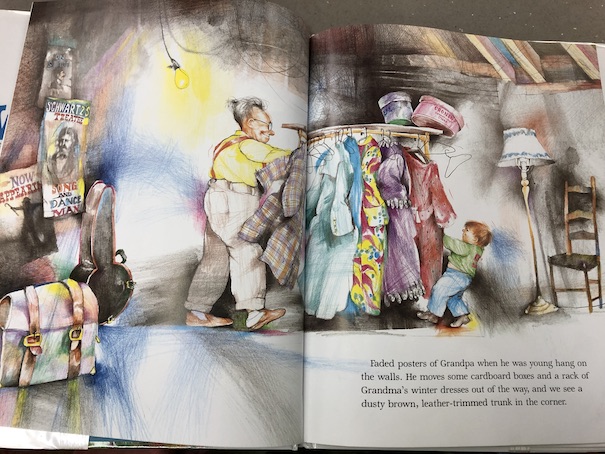
A grandfather likes to tell his grandchildren stories about when he was a young man and he was a vaudeville performer, a “song and dance man.” Back before the invention of television, live vaudeville performances were a major form of public entertainment in the United States during the late 19th century and early 20th century. A typical vaudeville performance in the United States was like a variety show with short skits, music, singing, dancing, comedy routines, juggling, magic acts, ventriloquists, and various other stunts, acrobatics, and miscellaneous acts.

When his grandchildren come to visit, he likes to take them up to the attic, where his old costume pieces and tap shoes are stored, and he gives them a private performance of his old vaudeville act.

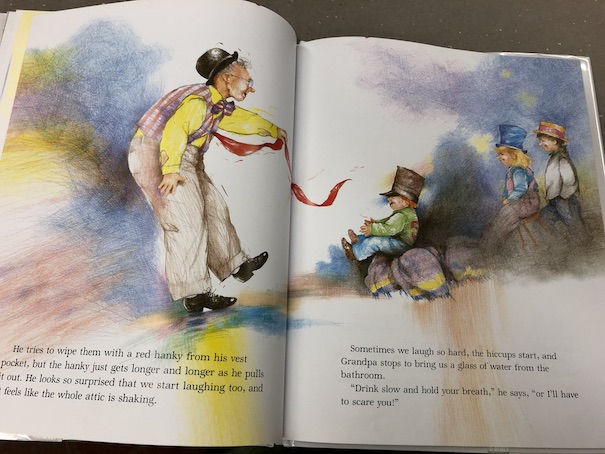
He sings songs, plays the banjo, tells jokes, and also does small magic tricks for the children, like pulling coins out of their hair.

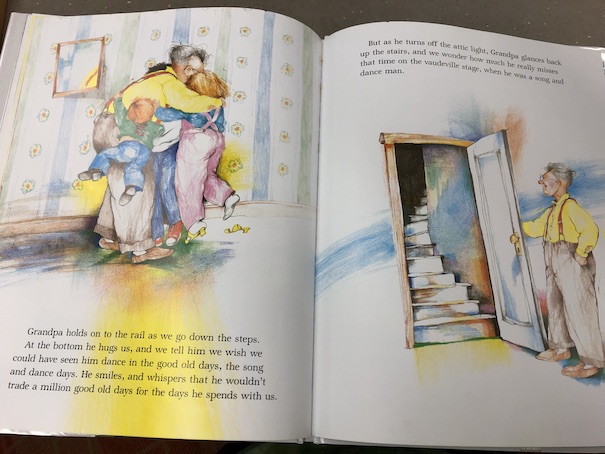
The grandfather loves performing for his grandchildren, and they love seeing him perform. The children can tell that he misses the “good old days” when he was a performer, although he says that he wouldn’t trade the time he has with his grandchildren for his life in the past.

In a way, the fact that the children’s grandfather was a former vaudeville performer dates this story. In the early 21st century, children’s grandparents are mostly people who were born in the mid-20th century, probably between the 1940s and 1970s, depending on the age of the grandchildren and how old the grandparents were when they were born. By the mid-20th century, vaudeville had already gone out of fashion, declining in popularity during the late 1920s and early 1930s, around the time when sound movies were first being produced, although some earlier vaudeville performances actually included short silent films among the other skits and acts. The book talks about television ending vaudeville’s popularity, but it was really movie theaters that were the main competition for vaudeville. Some movies produced during the 1930s and into the mid-20th century carried on some of the vaudeville traditions, like certain types of comedy and song and dance routines, as former vaudeville performers, including Fred Astaire and Bob Hope, transitioned into movie performers. Vaudeville elements show up frequently in Shirley Temple movies, and the Road series of movies with Bob Hope, Bing Crosby, and Dorothy Lamour also features many call-backs to vaudeville variety acts, which is part of the reason why they’re so episodic, light on over-arching plot, and punctuated with song and dance routines. The people who were adults when vaudeville was still big would have been the parents or grandparents of modern, early 21st century grandparents. I first saw this book when I was a child, and my grandparents would have been among those old enough to remember vaudeville. The book was published in the late 1980s, a little over 30 years ago. The children in this book would be from my generation, about the age I was when this book was new, not the current 21st century generation of children. Even so, it is a fun glimpse at the past and can be a good opportunity to introduce children to the idea of changing tastes in entertainment and occupations that used to exist but either don’t exist now or have taken different forms in modern times. Modern grandparents could still use this book to talk about family history and memories of the past.

This book is a Caldecott Medal winner. The book is available to borrow for free online through Internet Archive.