Are You There, God? It’s Me, Margaret

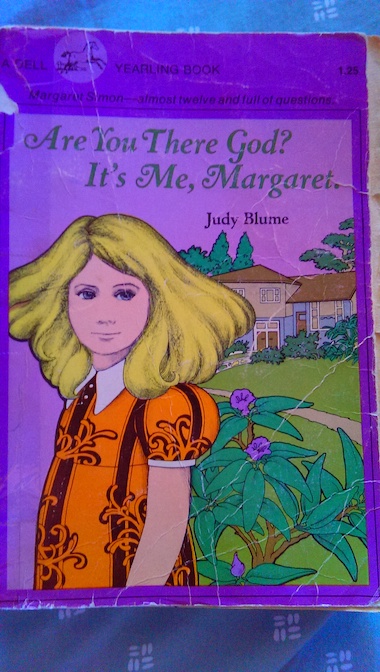
MeMargaretAre You There, God?  It’s Me, Margaret by Judy Blume, 1970.

This is one of the more controversial children’s books because parents raised concerns about the discussions of religion and puberty which are central to the story, and it has been banned or challenged in some libraries.  (Read to the end and see the spoilers before you decide if you agree with that.)

I wouldn’t recommend this book for young children because they wouldn’t understand the issues the story discusses, but it does speak to the concerns that pre-teen girls typically have about growing up, finding their place in the wider world, and fitting in with their friends as well as that haunting fear kids often have that they aren’t normal, compared to everyone else.  This isn’t a spoiler for the story (although there are plenty of those later on because I can’t really describe my thoughts about this book without them), but I just have to say that, in my experience, by the time people are done with college, maybe even by the time they’re done with high school, most of them come to realize that nobody out there is completely “normal.”  Some are just better at giving that impression.  Everyone out there has their quirks or issues, so if you think you’re a little odd in one way or another, or if you think your family is a little weird, you’re in pretty decent company.  Generally, it’s best not to worry too much about it and just get on with life.  In a way, I think that does fit in with the ending of the book.  But, I’ll talk a little more about my personal opinions about the controversial parts later.

When Margaret Simon is eleven years old, her parents decide to move from New York City to a suburb in New Jersey.  Margaret is accustomed to living in an apartment in a big city, and her new town and house seem a little odd to her.  She isn’t sure that she’s going to like her new home, and she knows that part of the reason why her mother wanted them to move was that she was worried that Margaret was becoming too close to her grandmother in New York and too easily influenced by her.

Margaret’s family is a little unusual in that her mother is Christian but her father is Jewish. (This is a little more unusual for when the book was first written than now because marriages of mixed religions are more common now than they were before, although they can still be complicated.)  The religious differences between her parents caused conflicts in their family even before Margaret was born.  Neither side of the family really approved of the match, so Margaret’s parents had to elope to get married.  Margaret’s mother’s parents disowned their daughter because of her marriage and haven’t seen or spoken to the couple in years or met their granddaughter.  However, Margaret’s father’s mother (his father is deceased) continues to spend time with the family, although she admits that it’s mostly for Margaret’s sake.  Margaret’s only close grandparent likes to spoil her and pays for her education at a private Jewish school, which is why her mother has become concerned that Margaret is influenced by her too much.  Margaret’s mother wants some separation so that she and Margaret can become closer as mother and daughter. The move and Margaret’s new friendships in New Jersey raise a number of troubling questions for Margaret about growing up, both physically and spiritually.

Because of the family religious conflicts, Margaret’s parents purposely raised her without a religion, telling her that she could choose for herself when she was old enough.  Until now, Margaret was not terribly concerned about it, but the move, the new friends she makes in New Jersey, and her increasing awareness of how religious differences have influenced her relationships with her family and other people cause her to question the choices she must make and what she really believes.  Throughout the book, she prays frequently in a casual, conversational fashion, telling God about the things that are happening in her life, the questions and problems she has, and what she really wants most.  Sometimes, she gets angry with God or disappointed when things don’t work out well, but the story makes it clear that her relationship with God is evolving, just as Margaret herself is changing as she grows up.  At one point, Margaret worries that, at age twelve, she is too old already to choose a religion and wishes that her parents had just given her one when she was little so she wouldn’t have this uncertainty.  However, growing up is a long process that Margaret is only beginning to appreciate.

The first new friend Margaret makes is a girl her age who lives next door, Nancy.  Nancy is eager to grow up and not at all shy about talking about things like boys, periods, bras, kissing, and even sex.  Sometimes, Nancy talks like she knows a lot about such things, although more mature people (and, eventually, Margaret) would realize that she doesn’t.  She introduces Margaret to two other girls, Gretchen and Janie, and the four of them form a kind of club that they call the Pre-Teen Sensations (PTS for short).  They give themselves secret names and hold meetings, talking about boys, people they know at school, and concerns that they have in their lives, especially related to growing up, periods, and sex (no one has any in the story, but the girls are fascinated by the idea).  One of the requirements of this club is that each of the girls has to wear a bra, and they feel each other’s backs at the beginning of each meeting to make sure.  Up until then, Margaret didn’t have a bra, so she has to buy her first one.  The girls worry about their breast size (none of them has much yet), and they try exercises to see if they can improve it (which is ridiculous, but it is the kind of thing that some pre-teen girls believe).  At the beginning, none of the girls has had their first period yet, and they’re looking forward to it with nervousness and anticipation, wondering what it’s going to be like.  They agree that whoever gets their period first has to tell the others about what it’s like.  Margaret nervously worries that she’ll be the last one to get hers or that she’ll turn out to be “weird” and never have one for some reason, although her mother assures her that it’s not likely and that it’s really just a matter of time.

Meanwhile, Margaret has some awkwardness at her new school, getting to know new people, sometimes making mistakes in the ways she relates to others, and figuring out which boys she likes the best. (She doesn’t get a boyfriend, just crushes.)  Her new teacher is also a little awkward because he’s young and this is his first teaching assignment, and he seems self-conscious that male teachers aren’t as common as female teachers.  Even adults can worry about being accepted by others.  He seems to be a good teacher, however, and he asks the students questions about themselves in an effort to get to know them better.  He learns early on that Margaret doesn’t have a religion and that it bothers her.  When he tells the students to choose a topic for a year-long research project into something that they care about, he allows Margaret to choose the topic of religion.

Margaret decides that her project for the year will be to learn about different religions and to finally choose one for herself.  Her focus is mainly on trying to decide between Judaism and Christianity because that’s what the two sides of her families are, that’s what most of the people her community are, and she says at one point that she doesn’t know anyone who is Muslim or Buddhist, so she can’t talk to them about their religions.   People in this community tend to belong either to the local YMCA or the Jewish community center, and Margaret thinks that if she figures out if she should be Christian or Jewish, she’ll be able to join one of those herself and fit in better.  Her friends help her in her project, some of them letting her come to church with them.  Each of the PTS girls is a different religion.  Janie is Jewish, and Nancy and Gretchen each attend a different Christian church.

Margaret’s friends aren’t particularly concerned about which choice Margaret will eventually make.  They find the story of her parents’ elopement romantic and are sympathetic to Margaret’s feelings.  However, Margaret notices that other people react differently to her project.  It seems like some of them view the idea of winning her to their side as some kind of personal victory for them, which hurts because she realizes that this is how her grandparents view her, even her beloved grandmother.  When her mother’s parents decide to visit them for the first time, there is an ugly scene where the family conflicts over religion come to a head, and Margaret feels so overwhelmed that she wants to give up on God and religion completely.  However, Margaret’s story isn’t over yet.  She’s really just started growing up, and whether she believes it or not at first, God hasn’t given up on her.  Getting what she wants most is really just a matter of time and patience.  Everyone grows up eventually.

So, what’s my overall opinion?  Generally favorable.  I read this book when I was about Margaret’s age and had the same concerns she did (or very similar, no two people are alike) and my friends and I were talking about the same kinds of things she and her friends were.  I think the key to this book is age-appropriateness.  Like I said, girls younger than about ten or eleven years old probably would not understand Margaret and her concerns because they just don’t share them.  It’s like Margaret and her friends themselves: they talk about the concerns that they all share, growing up and their new interests in boys and the idea of first periods.  If the reader isn’t a girl at that phase of her life, she just wouldn’t understand and connect with the story, and a few years later, those girls would likely move beyond all of that and on to other concerns (like whether or not they should go to college, what their major or career should be, etc. – life is full of things to figure out).  The things that seem so new and mysterious at age eleven, like real signs of growing up, later won’t matter so much because they’ve already lived it and found out that it’s not such a big deal.  Girls eager to get their first period or start shaving their legs at age twelve because they want to feel grown-up often start thinking of these things as hassles when they’re older and it’s all just become part of the routine of life.  They groan when a period starts on the day they want to go swimming or wear long pants on days when they’re too busy or just don’t want to bother shaving.  The novelty wears off, and you never look at it the same way again.  When older girls and women enjoy this book, it’s mainly as nostalgia for when they were Margaret’s age and still figuring things out.

The reason why this controversial story still remains popular even decades after its original publication is because it pretty accurately captures the thoughts and feelings of that pre-teen phase of life, when girls are just starting to grasp the complexities of life and the changes that lie ahead, alternately worrying about them and eager to get on with it and grow up.  It speaks to girls who are currently in that phase.  Reading it again as an adult, it reminds me of a time when I was in a similar place in life, although part of me now wishes that I could take young Margaret aside and tell her a few things that she eventually will come to realize:

  • That her friends are still finding their own way in life, just like she is, and even the ones who act like they know a whole lot really don’t (especially Nancy).
  • That growing up doesn’t end when you get your first period or even when you hit 18 or 21 because change is a life-long process and people mature at different rates, mentally as well as physically.
  • That many of the questions she’s struggling with are ones that everyone wonders about.  Some of them, like the religious issues and her own identity, are life-long struggles, even for people raised in more religiously-conventional households.  What human being can say that they thoroughly understand God and the mysterious ways in which He works?  It’s a worthwhile struggle, but not one that people resolve with complete certainty, certainly not by age twelve (Margaret’s age at the end of the book).  Margaret is far from being too old to consider these issues.  Philosophers and theologians have spent entire lifetimes on that subject.

But, even if I could say some of those things to young Margaret, they probably wouldn’t help completely because some things just have to be lived to be understood, which is the main reason why I would say banning the book is a mistake.  The issues Margaret deals with in the book are just common issues that come up in daily living, and the questions she asks about what she believes and what’s ahead for her are things that girls think about anyway and talk about with their friends, whether they read about them or not.  There’s no point in trying to get kids to stop thinking about these things because, at some point, they just have to because it’s a part of life, growing up, and the world around them.   Until they do consider some of these issues, it is difficult to move on to other, even more complex aspects of life, so I think it’s better to face them directly when the subjects come up instead of trying to dodge the subjects or put off thinking about them.

I think that Margaret’s elders were somewhat unhelpful in their approaches to Margaret’s religious life.  Her maternal grandparents are clearly selfish in their motives, caring only about winning the argument for their side, not really taking any interest in getting to know Margaret personally or caring about her feelings.  In fact, they only decide that they want to meet Margaret when they realize that she will be their only grandchild by blood, and even then, they make it clear that they expect the relationship to be on their terms alone.  Margaret’s paternal grandmother is better in her approach, nurturing Margaret from an early age in the hopes that she will grow up in the way she thinks best, but she endangers her relationship with her granddaughter when it seems like her previous nurturing and attention had the same selfish motive, wanting to win the argument in the same way that her other grandparents did.  Margaret wants them to like her for the person she is, not for what she might become or the ego boost they might get from her agreeing with their point of view.  Margaret’s parents are more interested in allowing her to develop her religious side on her own terms, loving her no matter what she chooses. However, Margaret might be correct in that they should have started discussing the issue honestly with her earlier in life, being a little too hands-off in order to avoid trying to win the argument or influence her too much one way or the other.

Even if the adults in Margaret’s life aren’t always the most helpful, children also learn the things that they don’t want to do from their elders.  Margaret at age twelve thinks that she’d like to raise any children she might have with a religion early in life so they won’t have to deal with the uncertainty and conflicts that she has, but she still has a lot of growing up to do, so anything can happen in her future.  Margaret’s future children (if any) will depend in equal measure on who Margaret’s eventual husband turns out to be and what he believes.  Life is a long journey, but Margaret seems headed for good things.

Many of Margaret’s growing-up issues will, like her first period, resolve themselves in time, and when she’s more experienced, part of her will look back and wonder why it all seemed so big and serious back then.  But, that’s just the phase of life she has to live through first.  Her religious issues will probably take a lot longer than physically growing up, but I think it’s important for readers to remember (as well as Margaret herself or anyone in a similar position) that Margaret is still young.  At the end of the story, Margaret still doesn’t know what religion she will choose (if any), but she’s still growing and changing, her life is changing, she’s becoming more aware of the larger world, and her mind may change many times with maturity and experience (like how many of us change majors about two or three times in college and then eventually end up in a completely different career).  Anything could happen in her life, and the range of possibilities in her life are part of the real magic of being young.  Because Margaret is a thoughtful person who seriously wants to understand the bigger issues in life, I think that she will probably be okay in the long run and that her personal relationship with God will continue to develop even if she finds it difficult to connect to an established religion.  That might not seem ideal to many people, but Margaret does the best she can with what she has in life, her circumstances and her understanding, and I think that’s a good sign.

Later editions of this book were revised to reflect new details of modern life, including how women and girls handle periods.  I’ve never actually seen the old belt-style of period pads that Margaret describes in the original version of the book, and later versions of the book describe the ones that are common today.  There is a movie version planned.

Janie’s Private Eyes

JaniesPrivateEyes

Janie’s Private Eyes by Zilpha Keatley Snyder, 1989.

This is part of the Stanley Family mysteries series.

Janie Stanley has decided to open her own detective agency, The J.V. Stanley Agency, Incorporated, Private Eyes, with the help of her younger siblings and some other friends.  Eight-year-old Janie has had many different aspirations in her young life, from being a Shakespearean actress to being a vampire, so her older brother, David, doesn’t take her detective games too seriously at first.

However, at Mr. and Mrs. Stanley’s New Year’s Eve party, Janie’s “investigations” come to everyone’s attention when she borrows David’s tape recorder to make audio recordings of guests talking and plays them on the stereo that has been hooked up to speakers to play music for the party.  Gossipy Mrs. Dorfman recognizes her own voice, saying uncomplimentary things about her hosts and the other guests, and leaves in a huff of embarrassment.  When Janie’s father confronts her over the incident, Janie says that she was trying to find evidence on a murderer.  When her father and David question her further, she says that old Mr. Rupert, the deceased father of the Mr. Rupert who owns the local grocery store in Steven’s Corners, was murdered.

When old Mr. Rupert died around Thanksgiving, all the kids in the area were sad.  He was always nice to kids when they were in the grocery store and would sometimes give them candy for free.  They called him Grandpa Rupert.  But, Grandpa Rupert’s death was a heart attack, natural causes.  When David asks Janie what makes her think it was murder, she says that she suspects his son and his wife because they inherited the grocery store.  David says that he doesn’t think that Al Rupert would have killed his father.  Janie also says that she heard that there was no autopsy after the death, and she thinks that’s suspicious.  David says that it was well-known that Grandpa Rupert had heart trouble, so a heart attack wasn’t unexpected.  Janie also says that Huy, the younger brother of her friend, Thuy Tran, saw the mailman talking to Grandpa Rupert just before he died, but David doesn’t see why that’s so suspicious.  Eventually, David and her father talk Janie out of her murder investigation idea, but it turns out that the “murder” wasn’t the only investigation that Janie has undertaken.

Dogs in the area have been disappearing, and the Tran family has come under suspicion.  The Trans haven’t been living in the United States for very long.  Originally, they came from Vietnam.  The reason why people are looking at them suspiciously is because dogs started disappearing around the time the Trans moved to the area, and there are rumors that Vietnamese people eat dogs. (Hint: No, the Trans aren’t eating dogs. That’s an old stereotype/rumor that’s been used against various immigrant groups, and no dogs are eaten in this story.)  Janie knows that the Tran family isn’t guilty of dognapping, but proving it is another matter.  After the trouble at the New Year’s Eve party, she asks David and Amanda to help her investigate.  At first, they don’t want to, but David does have to do a journalism project for school with a partner, Pete Garvey.  Pete Garvey is the school bully who also has a crush on Amanda (which is established in a previous book in the series), but he likes the idea of interviewing people about their missing dogs.

However, even though David, Amanda, and Pete Garvey begin talking to people about the missing dogs, Janie and the other members of her detective agency are still on the case!  David has great misgiving about Janie’s involvement.  Then, suddenly, Pete doesn’t want to work on the project anymore and starts behaving suspiciously.  What does he know that no one else does?

The book is available online through Internet Archive.

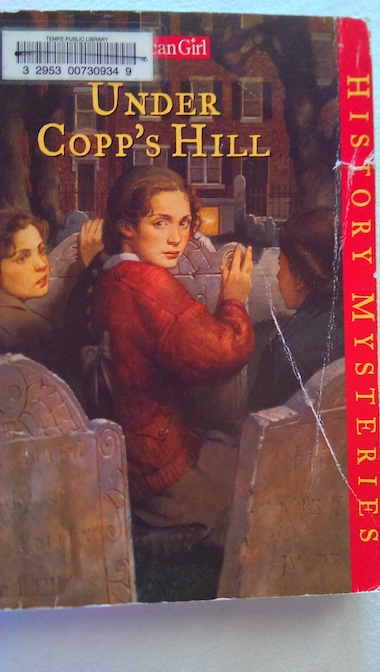
Under Copp’s Hill

UnderCoppsHill

Under Copp’s Hill by Katherine Ayres, 2000.

This book is part of the American Girl History Mysteries series.

The year is 1908, and eleven-year-old Innocenza Moretti lives with her relatives in Boston.  They are immigrants from Italy.  Innie, as her family calls her, is an orphan.  According to the story that her grandmother told her, she was the only one of her parents’ children to survive infancy, her siblings being born prematurely and dying shortly after birth.  Innie’s mother was so grateful that Innie survived that she promised her to the Holy Mother at her baptism.  Then, Innie’s parents died in a fire in their tenement building when she was about two years old.  Innie and her grandmother, Nonna, survived the fire only because little Innie had started crying in the night, and she took her outside to walk her around so that she wouldn’t wake her parents.  Because of that experience, Nonna is deathly afraid of fire and also has become convinced that the Holy Mother must have spared Innie (as well as herself).  She thinks that Innie is destined to become a nun and has continued to promise her to the Holy Mother in prayer, repeating the promise regularly.  Although Nonna thinks that the miracles surrounding Innie’s life are signs of a future life in the Church for Innie, her grandmother’s promises in prayer terrify Innie.

Innie feels trapped by her grandmother’s expectations for her, expectations that the rest of her family don’t even know about.  She doesn’t want to be a nun, but her grandmother is sure that she will be.  Because of her fears that her grandmother may force her to become a nun when she grows up, Innie is never on her best behavior.  She thinks that if she gets a reputation as a trouble-maker, the Church will decide that she is unsuited for a religious life.  Unfortunately, Innie’s long-practiced habit of ignoring rules and her problem child reputation lead her to be suspected of something worse than just minor misbehaving.

Innie’s family owns a boardinghouse where they provide food and lodging for young immigrant men.  Innie and Nonna live on the ground floor, and Innie’s aunt, uncle, and cousins live above them.  Innie spends a lot of time with her cousins, especially Teresa, who is about her age.  Her older cousin, Carmela, persuades both Teresa and Innie to join a library club at a new settlement house with her.  The settlement house helps girls and young women from immigrant families by teaching them work skills and aspects of American culture that they can use as they become American citizens in exchange for some of the work that the girls do on behalf of the settlement house.  Carmela has taken a new job as a pottery painter there and tells her parents that it will be good for Teresa and Innie to go there as well because they will receive help with their schoolwork and they will also have classes to teach them skills like sewing, knitting, and pottery, that they can use to make money later.  However, the real attraction of the club for the girls is that they get to listen to music, have dancing lessons, read books, and socialize with other girls about their age.  The prospect of sewing classes isn’t appealing for Innie, but she loves books and looks forward to borrowing some from the settlement house library.

At the settlement house, Innie meets a variety of girls from other immigrant families, not just Italian ones.  In particular, Innie makes friends with a girl named Matela, who is a Jewish girl from Russia.  As the girls talk about a recent, large fire in town, Matela talks about the czar’s soldiers burning things back in Russia and how she misses her grandfather, who is still there.  Innie understands Matela’s feelings because she knows what it’s like to miss someone.  She doesn’t really remember her parents, but she feels the lack of them in her life.  Teresa also becomes friends with Matela, but the three girls agree to keep their friendship secret because each of their families prefers them to associate with girls from backgrounds similar to their own.  Innie’s uncle wants the girls to spend time with other Italians, and Matela admits that her father prefers her to spend time with other Jewish girls.  The adults don’t really understand the cultural mix at the settlement house.

However, from the very first day that the girls begin going to events at the house, strange things start happening.  Things disappear or are oddly moved about.  Food disappears.  A silver teapot belonging to the ladies who run the settlement house is stolen.  Then, someone steals some pottery and a shawl.

To Innie’s horror, she ends up becoming the prime suspect for the thefts because she was caught snooping in an area of the house where she didn’t belong and because she accidentally broke one of the pieces of pottery that the others girls made and tried to sweep it up without telling anyone.  When she and her friends snoop around and try to find the missing objects, Innie discovers one of the missing pottery pieces.  However, instead of being happy for the clue, the ladies who run the house just think that Innie must have broken more of the pottery and tried to cover it up, like she did before, by hiding the rest of the set.  After all, if she was doing some things she shouldn’t have been doing, it’s plausible that she could be a thief, too.

If Innie is going to remain a member of the library club (and continue to have access to books that she can read), she’s going to have to prove her innocence.  In fact, proving her innocence may also be important for Carmela, who is supposed to have a citizenship hearing soon.  If Innie’s bad reputation causes problems for her at work, she may lose her job and be denied American citizenship!

Matela thinks that the thief could be a ghost from the nearby Copp’s Hill graveyard, but Innie is sure that it must be a human being.  There are secrets at the settlement house that even the ladies who run it are unaware of and someone who desperately needs help and can’t ask for it.

Teresa and Matela continue to help Innie, and in the process, Innie confesses to Matela her fears about becoming a nun.  It is Matela who helps Innie to find the solution to her problem, urging her to step outside of the small community of Italian immigrants that her family clings to and to seek advice from a priest in the Irish area of the city.  As a priest, he has the knowledge that Innie needs to understand her faith, and because he doesn’t know Innie’s family personally, he has the objectivity to help Innie to see her grandmother’s promise in a new light and to understand that her future destiny is still in her own hands.  No one can speak for another person or make important promises on their behalf.  A religious vocation is a serious decision that only a mature adult can make for herself, or not make, as the case may be.  The priest tells her that, as young as she is, Innie should focus on learning to be a good person, and then she will see what direction life leads her.  With that knowledge, of course, Innie realizes that she will have to put more effort into behaving herself, but it’s a relief to her to realize that she doesn’t need to purposely misbehave in order to control her life.

Eventually, Innie’s aunt also learns about the grandmother’s promise and Innie’s worries and reassures her that, although her grandmother can be an intimidating woman with what she wants, Innie’s family loves her and that she shouldn’t be afraid to come to them with her questions and concerns. Innie has thought of herself as parentless, at the mercy of her grandmother’s wishes and expectations, but her aunt says that she loves Innie like she does her own daughters and that Innie is as much a part of their family as they are.  If Innie has problems, her aunt will be there for her, helping her find whatever answers she needs.

There is also a subplot about how girls in immigrant families (at least, in ones like Innie’s family) aren’t as highly-regarded as boys.  When the family is discussing important matters, Innie often tries to comment on what she thinks, but her grandmother keeps telling her to be quiet because it isn’t a girl’s place to comment on business that men should handle and her male cousins sneer at her because they don’t think she knows anything.  However, when Innie’s uncle is worried about the legal papers he has to sign in order to open his new grocery business because his English still isn’t good enough to understand them, Innie points out that Carmela’s English is the best of the family because of all the books she had to read and the paperwork she had to complete when she was applying for citizenship and that she would be the best person to study the paperwork.  At first, her grandmother makes her try to be quiet and her male cousins laugh, but Carmela speaks up and says that she can help her father, if he wants her to, and her father agrees, on the condition that she act as translator and adviser and let him make the final decisions about the business.  Carmela is happy because the arrangement allows her to use her skills without taking her away from the pottery painting that she loves.  The point of this part of the story is about acknowledging the talents that people possess and not disregarding them because they are outside of the usual roles and expectations.  It fits in with the subplot about the grandmother’s expectations for Innie’s future, which are not really in keeping with either her talents or character.  The young people in the story are growing up under different circumstances than their parents, and they will have to learn to find their own way in life, using the abilities they have and the education they can find.

In the back of the book, there is a section with historical information about Boston in 1908.  The fire that happens around the time that the story takes place was a real event.  The settlement house with its library club was also real, and the ladies who run the settlement house, Miss Brown and Miss Guerrier, were also real people.  The book explains more about what life was like for immigrant families like Innie’s and about what the future held for girls like her.  Many of the girls who attended the library clubs later became librarians and teachers themselves, which may be Innie’s eventual destiny when she grows up.  The book also mentions that the area of Boston where Innie’s family lived still has many Italian restaurants and groceries that were started by immigrant families like Innie’s, so we can imagine that the grocery store that Innie’s uncle wants to open will be successful.

The book is currently available online through Internet Archive.

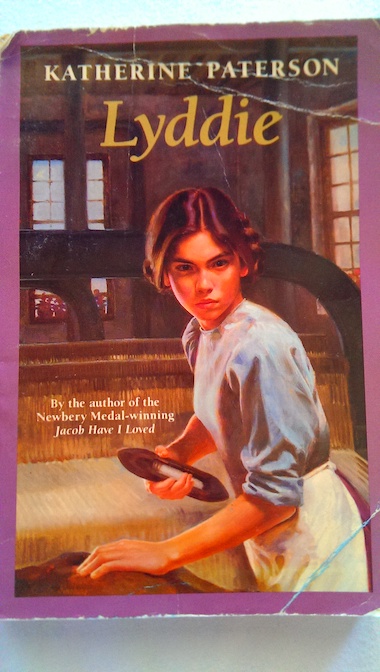
Lyddie

Lyddie

Lyddie by Katherine Paterson, 1991.

The year is 1843. Thirteen-year-old Lyddie’s father left home to go West and seek his fortune, and he hasn’t been heard of since. Lyddie helps her mother to take care of their farm in Vermont and the younger children, but they are very poor, and her mother has given up hope of their father returning home. The children’s aunt and uncle, Clarissa and Judah live nearby, but they are of little help, full of fire-and-brimstone talk. Lyddie and her brother Charlie, who is ten, more often turn to their Quaker neighbors, the Stevenses, for help. They are kinder than their aunt and uncle, although their mother disapproves of them for being abolitionists and, in her mind, heathens. Lyddie and Charlie are just grateful for their help. Because of their mother’s depression at the loss of their father, she pays little attention to the things that her children do to keep the farm going and the family together.

However, when a bear enters their house and eats the oatmeal that Lyddie was preparing, their mother, primed by Clarissa’s and Judah’s talk of signs of the end times and such, goes into a panic and sure that the world is going to end. Lyddie and Charlie let her go with their younger sisters to stay with Aunt Clarissa and Uncle Judah while they continue managing the farm as best they can. However, even though their mother sees that the world doesn’t end, she decides that she’s going to hire Lyddie out as a maid at the Cutlers’ tavern and Charlie to work at the mill because the family has too many debts and they will have to rent out their fields and animals.

Luke Stevens, the youngest of the Stevens sons, although much older than Lyddie and Charlie, gives them a ride to their new homes and employment at the mill and the tavern and promises to keep an eye on their house while they’re away. Lyddie is lonely and unhappy working at the tavern, badly missing the family farm and her siblings, especially Charlie. Then, one day, a woman visiting the tavern mentions that she’s one of the factory girls from Lowell, Massachusetts. The woman tells Lyddie that she seems like a good worker and that she could earn a good wage in the factories herself. At first, Lyddie doesn’t believe what the woman says that girls can earn there.

When Lyddie is allowed a brief visit home to her family’s farm, she discovers that Luke Stevens has been allowing a runaway slave to hide there. Lyddie isn’t sure what she thinks of it at first. Ezekial, the fugitive, frightens her because she has never met a black man before, and she knows that if she were to turn him in, there would be a handsome reward that could solve her family’s money problems. However, Ezekial seems to understand the situation that her family is in without her father. Although Lyddie and Charlie are not technically slaves, they have become a kind of indentured servant because of their family’s debts. Ezekial is a father himself, hoping to send for his family when he has found a safe place for them. Lyddie still wonders if her own father is alive, perhaps hoping to send for his family when he can. Having come to a better understanding of Ezekial, she knows that she can’t turn him in, even for the reward money.

Her talks with Ezekial make Lyddie understand that working in the tavern won’t solve her problems, though. As a maid there, she basically works all day for her room and board and has nothing else to show for it. Mrs. Cutler just sends a little money to her mother now and then and even then, she doesn’t always bother, and her mother is in little position to insist on proper wages, making Lyddie little better than a slave. Mrs. Cutler cares nothing about Lyddie or her family’s welfare, just trying to get as much labor out of her for as little as she can. Lyddie finally makes up her mind to seek factory employment in Lowell, Massachusetts, seeing it as her only chance to earn some real wages.

Life in Lowell turns out not to be as glamorous as the woman she met at the tavern made it sound, although the wages are definitely better. The company that owns the fiber mill where Lyddie gets a job has all sorts of rules and regulations for the girls who work there, even ones that intrude on their personal lives outside of work. Anxious to give the impression that all of their workers are of good moral disposition, they insist that the girls attend church on Sundays. Lyddie never had the money to pay pew fees back home, so she is unaccustomed to going to church, but finds that other girls in her position tend to go to Methodist churches, where there are no pew fees, saving their precious wages. Lyddie, who never had much time for schooling when she and her brother were trying to keep the farm going, has trouble understanding all of the terms of the employment contract that she signs but signs it anyway. Her employment turns out to be an education that changes Lyddie’s life, although not in all the ways that she had hoped.

Like Mrs. Cutler, the bosses at the factory have little real care for their workers, trying to get as much work out of them as they can for the least amount of pay they have to give them. The work is hard and the hours are long, but Lyddie keeps at it because the pay is the best she’s ever had and she is starting to save up for her family’s future. The poor working conditions contribute to health problems among the girls, and some of them petition for better working hours, but Lyddie is reluctant to do so because girls who are dismissed “dishonorably” from the factory are blacklisted all over town, and she fears not only risking the loss of her job but the potential to find a new one.

Through her interactions with the other girls and young women at the factory, Lyddie also develops into a young woman. She had previously wished that she’d been born a boy instead because a boy would have a better chance of running her family’s farm, but she comes to realize that there are opportunities out in the world for young women who are willing and able to go out and seek them. In Lowell, Lyddie gets a taste for literature through the books that her friend Betsy reads to her and acquires more lady-like behavior by watching the lady-like Amelia. Neither of them plan on working at the factory forever, and their ambitions, to get married or continue their education, cause Lyddie to consider what she really wants for her own future. Through the difficulties she encounters and everything she learns while facing them, Lyddie really becomes her own woman.

In the end, Lyddie is unable to save her family’s farm and reunite their family there. Her mother dies, and her father’s whereabouts are still unknown, so her uncle sells the farm to pay the debts. However, Charlie and her younger sister Rachel are provided for, the Stevenses decide that they will purchase the farm themselves, and Lyddie becomes reconciled to the loss of the farm through her new vision of the future. She is unfairly discharged from the factory after she catches an overseer molesting another girl and stops him because he blackens her name in retaliation. But, by then, Lyddie has acquired some money and new confidence in herself, and she begins making other plans for her future, which may include both further education and the possibility of marriage. One thing that she knows for certain is that, whatever she does with her life, she wants to move forward as her own, independent person.

The book is currently available online through Internet Archive (multiple copies).

The Traitor’s Gate

TraitorsGate

The Traitor’s Gate by Avi, 2007.

The story is set in London, in 1849. Fourteen-year-old John Huffam lives with his parents and sister and their servant, Brigit and attends a school taught by a former military man who acts like he is still in the army and teaches them little beyond discipline and what army life would be like.

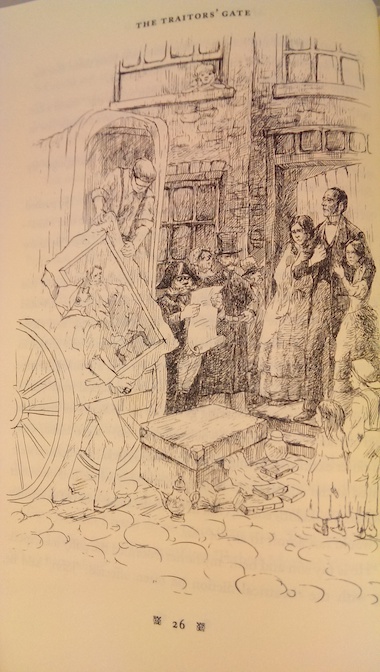
Then, one day, John is called home suddenly because of a family emergency. His family has fallen on hard times, and his father is in debt, so the family’s belongings are being confiscated. His father is summoned to appear in court, and if he cannot find the money to pay his debt, he will have to go to debtors’ prison. John’s father is shocked because he doesn’t actually owe any money to the man who is trying to call in the debt, Finnegan O’Doul.

TraitorsGateConfiscation

In spite of this, John and the rest of the Huffam family must spend the night in the bailiff’s sponging house, the Halfmoon Inn. There, John’s father again promises John that there is no debt between himself and Mr. O’Doul. He even says that he doesn’t really know O’Doul, although John doubts him. It seems like his father has had dealings of some kind with the man that he wants to keep secret.

John’s father, Wesley Huffam, was originally from a fairly well-off family, but all the family’s money ended up going to a great-aunt instead of to him (possibly because it became obvious to his relatives that he had little skill at handling money in the first place). John’s father is resentful toward the great-aunt, Euphemia Huffam, for inheriting when he thinks that, as a man, he should have been first in line for the family’s money. However, with this enormous (although possibly false) debt hanging over his head, he may be forced to appeal to Great-Aunt Euphemia for help. He persuades John to go and visit Great-Aunt Euphemia on his behalf, since he is not allowed to leave the sponging house for now and the past quarrels between him and his aunt would make it unlikely that his aunt would want to see him. John is beginning to realize that there are pieces of his father’s life and their family’s past that have been kept from him, and he doesn’t like the idea that his father has been deceiving him, but with their family in such a desperate situation, he agrees to visit Great-Aunt Euphemia.

TraitorsGateSary

The bailiff, John’s mother, and Brigid all agree that John is going to have to be instrumental in solving their family’s problems. Of all the people in his family, he is the most practical, in spite of his young age. His father is an impractical man, stuck in a vision of his family’s former glory (and his aunt’s current money, which he does not share in) that doesn’t fit their current circumstances. John’s mother thinks that her husband’s job as a clerk for the Naval Ordinance Office doesn’t provide enough money for the family to live on, even though he earns more than twice what typical London tradesmen of the time do. The real problem is that the family doesn’t live within its means (it is eventually revealed that Wesley Huffam has been withholding money from his family that he uses for gambling), and John’s father’s snobbish attitude because he thinks of his family as being more grand than the commoners around them alienates people who might otherwise be friends and help them. John knows that he’s young, and he’s not completely sure what he can do to help his family, but he knows that there is no other option but to try. In the process, he learns quite a lot about life, himself, the people in his family, and the wider issues in the world around him, including some political intrigue that hits uncomfortably close to home.

Great-Aunt Euphemia agrees to see John when he comes to her house, but their first meeting doesn’t go very well. Great-Aunt Euphemia is ill (or says she is), and she bluntly tells John that his father was always bad with money. She is not at all surprised that he is in debt and needs her help. John gets upset at the bad things that Euphemia tells him about his father, and she gets angry when John tells her the amount of the debt. At first, John is sure that she will refuse to help them completely, but Euphemia tells him not to assume anything but that he should come back the next day.  Her eventual contribution to helping John’s family in their troubles comes in the form of a job for John.

TraitorsGateRookery

As John moves around the city, he gets the feeling that he is being followed, and he is. One of the people following him turns out to be Inspector Copperfield (or so he calls himself) from Scotland Yard. When John confronts him, the inspector seems to have a pretty good idea of the difficulty that his family is in and what John himself has been doing. John asks him why he cares, and the inspector says that John’s father is suspected of a crime and that John had better learn more about what his father has been doing and share that information with him. John doesn’t believe that his father could be a criminal, but the accusation is worrying because he knows that his father is hiding something (his gambling addiction isn’t the only secret he has).

The other person following John is a young girl in ragged clothes. The girl, who calls herself Sary the Sneak, approaches John herself, freely admitting that she’s been following him. In spite of her young age, Sarah (or Sary, as she is frequently called) lives on her own and must support herself because her mother is dead and her father was transported to Australia. People don’t often notice a young girl on the street, so sometimes people will pay her to follow someone and provide information about them. The reason why she tells John about it is because she isn’t above playing both sides of the street; sometimes, she gets the people she’s been following to pay her to provide them with information about the people who hired her to spy on them. She considers it even-handed. However, John has no money to pay her for information and finds her spying distasteful, so he doesn’t want to take her up on the offer at first.

However, John does a little spying of his own when his father sneaks away from the Halfmoon Inn, which he is not supposed to do. He follows his father to a pub called the Red Lion, where he witnesses his father gambling with money that he had claimed not to have. More than that, he sees his father arguing with a man who turns out to be O’Doul, another gambler. To John’s surprise, his teacher also shows up and seems to know O’Doul. When John later confronts his father with what he saw at the Red Lion, all his father will say is that he is carrying a fortune around in his head. Later, John overhears the bailiff speaking with someone else, an Inspector Ratchet from Scotland, saying that it appears that Wesley Huffam may be a traitor involved with spies and that the Inspector Copperfield who spoke to John earlier was an imposter, probably also a spy.

Could it be true? Is John’s father really a traitor, selling naval secrets from his job? If so, who can John trust?  Conspirators seem to be around every corner, and John has the feeling that the people who are closest to him may be the biggest threats.

The book is currently available online through Internet Archive.

Daily Life in a Victorian House

VictorianHouse

Daily Life in a Victorian House by Laura Wilson, 1993.

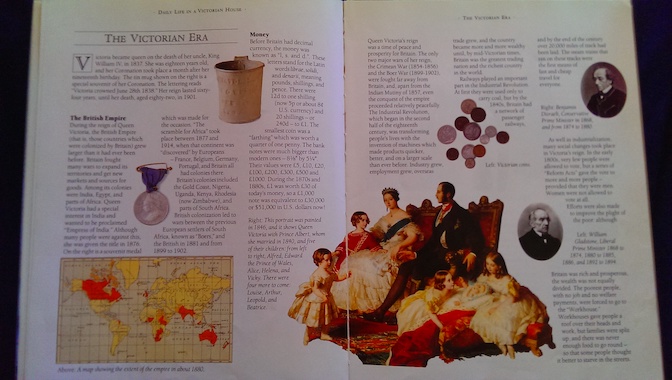
The book begins by giving some background on the Victorian era, which lasted from 1838, when Victoria became Queen of England, to Queen Victoria’s death in 1901. It was a time of expansion and colonization for the British Empire. Society was becoming increasingly industrialized and urban, although there was still great inequality about who had voting rights, and there were great gaps between rich and poor people.

VictorianHouseEra

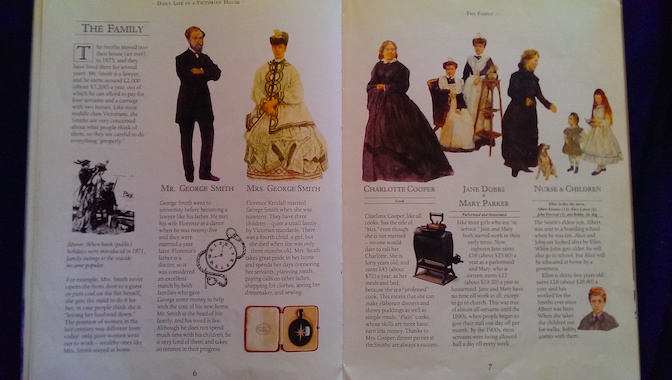
To explain what a typical day might be like for people living in the Victorian era, the book introduces a fictional upper middle class family, the Smiths. It explains some of the background of the Smith family and the members of the Smith household. Mr. George Smith, the head of the household, is a lawyer. His wife, Florence, does not need to work, so she spends her time overseeing the household servants, managing the household accounts (how much money is needed for household expenses such as food, clothes, and supplies), visiting friends, and shopping. Mr. Smith’s income is good enough to afford for the family to have a cook, two maids, and a nurse to look after the youngest children in the family.

VictorianHouseFamily

The Smiths have three living children. One of their daughters died in infancy, which was sadly common for that era. The eldest boy in the family, Albert, spends most of his time away at boarding school. The two youngest children, Alice and John, are cared for by their nurse. When John is old enough, he will go away to boarding school, like Albert, but Alice will probably be tutored at home. Their parents spend surprisingly little time with them, even in the general course of a day.

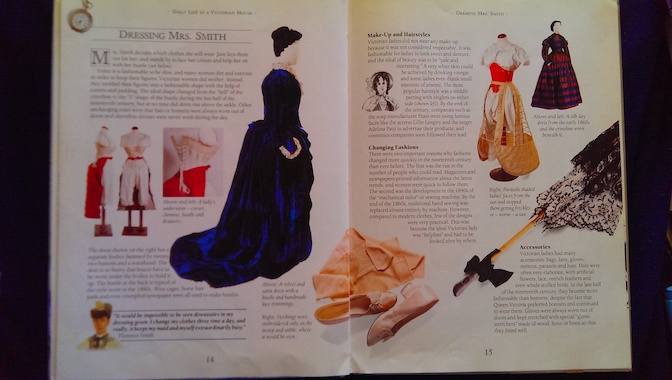
VictorianHouseClothes

There is a map of the Smiths’ house, and then the book begins explaining what each of the members of the house do at different times of the day. Each day, the servants are the first to get up because they need to light the fires to heat the house and start cleaning and making breakfast, which would be a large meal.

Something that I thought was interesting was that the cook typically purchased food from tradesmen who sold their goods door-to-door. This was also important to the maids, who are in their teens, because they worked such long hours that they really wouldn’t have had time to get away and met young men in any other way. Their suitors would likely be the young tradesmen. Of course, the young tradesmen would have met many young female servants at all of the households they visited during their daily rounds.

VictorianHouseKitchen

The maids would have spent their days cleaning, tasks that would have been more time-consuming without more modern inventions. Vacuum cleaners were invented toward the end of the era, in 1899. Cooking was also a time-consuming job, although the book does explain some innovations for the Victorian kitchen. Because Mrs. Smith had servants to do all of her cooking and cleaning for her, she never even went into her own kitchen at all. It was considered improper for a lady with servants to handle menial tasks herself, and the servants wouldn’t have welcomed her interference in their work.

I liked the sections of the book that explained about the lives of children in the Victorian era the best, although I was surprised at how little time children from well-off families would have spent with their parents. Generally, young children would see their parents in the morning for prayers and spend about an hour with their mother in the late afternoon. Other than that, they would spend most of their time in the nursery with their nurse, who would take care of them and didn’t welcome much parental interference any more than the cook would welcome the lady of the house supervising her work.

VictorianHouseToys

I also liked the sections about toys and games and entertainment as well as the description of what young Albert’s life would have been like at boarding school. The book also explains what life and childhood were like for less fortunate people during the Victorian era.

VictorianHouseSchool

Overall, I really liked this book. It’s a good introduction to Victorian history and life, and it does one of the things that I really wish adult books would do more often: have pictures. Pictures really are worth a thousand words, and actually showing the objects that people of this time would have used in their daily lives is far more effective than pages of lengthy descriptions of them in words only.

The book is currently available online through Internet Archive.

A Samurai Never Fears Death

SamuraiNeverFearsDeath

A Samurai Never Fears Death by Dorothy and Thomas Hoobler, 2007.

This book is part of the The Samurai Detective Series.

Sixteen-year-old Seikei returns home to visit his birth family in Osaka while Judge Ooka investigates reports of smugglers in the city.  Seikei is a little nervous about seeing his birth family because he hasn’t gone to see them since he was adopted by Judge Ooka about two years before.  All he knows is that his younger brother, Denzaburo, is helping his father to run the family’s tea business, which is probably a relief to Seikei’s father because Denzaburo was always more interested in the business than Seikei was.

However, things have changed in Seikei’s family since he left Osaka, and his homecoming isn’t quite what he imagined it would be.  Seikei had expected that his older sister, Asako, might be married by now, but she says that Denzaburo is keeping her from her dowry because he needs her to help run the family business.  Although Denzaburo enjoys business and the life of a merchant, it turns out that Asako has a better mind for it than he has.  The two of them have been running the family’s tea shop by themselves because their father is ill.  Also, although the family no longer lives above their shop, having bought a new house for themselves, Denzaburo says that he sometimes stays at the shop overnight to receive deliveries of goods.  Seikei knows that can’t be true because no one ever delivers goods at night in Osaka.  Denzaburo brushes off Seikei’s questions by suggesting that the three of them visit the puppet theater together to celebrate Seikei’s visit.

At the puppet theater, Seikei learns that Asako is in love with a young man who is an apprentice there, Ojoji.  Because Ojoji is only an apprentice, the two of them cannot afford to get married, something that Denzaburo laughs about.  However, before Seikei can give the matter more thought, they discover that one of the narrators of the plays has been murdered, strangled.

They summon an official from Osaka to investigate the scene, Judge Izumo, but Seikei isn’t satisfied with his investigation because it seems like Judge Izumo is quick to jump to conclusions.  Then, suspicion falls on Ojoji.  Asako doesn’t believe that the man she loves could commit murder and wants Seikei to ask Judge Ooka to intercede on Ojoji’s behalf, so Seikei begins to search for evidence that will help to prove Ojoji’s innocence.

The mysterious happenings and murders (there is another death before the book is over) at the puppet theater are connected to the smuggling case that Judge Ooka is investigating, and for Seikei, part of the solution hits uncomfortably close to home.  However, I’d like to assure readers that Asako and her beloved get a happy ending.

During part of the story, Seikei struggles to understand how the villains, a group of bandits, seem to get so much support and admiration from other people in the community, including his brother.  It is Asako who explains it to him.  It’s partly about profit because the outlaws’ activities benefit others monetarily, but that’s only part of it.  In Japan’s society, birth typically determines people’s roles in life, and each role in society comes with its own expectations about behavior, as Seikei himself well knows.  Seikei is fortunate that circumstances allowed him to choose a different path when he didn’t feel comfortable in the role that his birth seemed to choose for him; he never really wanted to be a merchant in spite of being born into a merchant family.  Others similarly do not feel completely comfortable with the standards that society has set for them, and their fascination with the outlaws is that the outlaws do not seem to care what society or anyone else thinks of them.  The outlaws do exactly what they want, when they want to do it, dressing any way they please, acting any way they please, and taking anything they want to use for their own profit.  Denzaburo, who was always willing to cut corners when it profited him, sees nothing wrong with this, and he envies the outlaws for taking this idea to greater lengths that he would ever dare to do himself.

The idea of throwing off all rules and living in complete freedom without having to consider anyone else, their ideas, their wants, their needs, can be appealing.  Asako understands because, although she is better at business than either of her younger brothers, she cannot inherit the family’s tea business because she is a girl.  She thinks that, because the system of society doesn’t look out for her interests, she has to look out for herself, and what does no harm and makes people happy (in the sense of giving them lots of money) shouldn’t be illegal.  At first, Asako sees their activities as victimless crimes. Although she doesn’t use that term to describe it, it seems to be her attitude.  However, do victimless crimes really exist?  Seikei has a problem with this attitude because what the outlaws are doing has already caused harm in form of two deaths and the risk to Ojoji, who may take the blame for the deaths even though he is innocent.  Asako might not care very much about the others at the puppet theater, but she does care about Ojoji.

It’s true that Seikei has defied the usual rules of society by becoming something other than what he was intended to be, and for a time, he struggles with the idea, comparing himself to the outlaws, who were also unhappy with their roles and wanted something different.  However, the means that Seikei used to get what he wanted in life are different from the means that the outlaws use, and Seikei also realizes that his aspirations are very different from theirs.  While Seikei had always admired the samurai for their ideals and sense of honor and order, the outlaws throw off the ideals of their society in the name of doing whatever they want.  Although the outlaws do benefit some of the poorer members of society, paying money for goods that the makers might otherwise have to give to the upper classes as taxes and tribute and trying to stand up for abused children when they can because their leader was also abused as a child, their main focus is still on themselves and what they and their well-paying friends want.  Seikei is concerned with justice and truth, which are among his highest ideals.  Even though he learns early on that, as a samurai, he could claim responsibility for the deaths at the theater himself because, in their society, a samurai would have the legal authority to kill someone for an insult.  Claiming responsibility for the killings would allow Ojoji to go free, and it would be one way to solve the problem quickly and make Asako happy, but Seikei cares too much about finding the truth behind the murders and bringing the real murderer to justice to take the easy way out.  It is this difference in ideals and priorities between Seikei and others around him which set them on different paths in life.

One thought that seemed particularly poignant to me in the story is when Seikei reflects that we don’t always understand the importance of the choices we make in life at the time when we have to make them because we don’t fully understand all the ways in which a single choice can affect our lives.  He thinks this when the leader of the outlaws offers to let a boy who was abused come with them and join their group after they intervene in a beating that the boy’s father was giving him.  They tell him that joining their group would mean that he could do whatever he wants from now on.  The boy, not being sure who they are or what joining their group would really mean for him, chooses to stay with his father.  Seikei wonders then whether the boy will later regret his decision or not.  His father obviously doesn’t treat him well and may not truly appreciate his show of loyalty by remaining, although joining the outlaws comes with its own risks.  It’s difficult to say exactly which two fates the boy was really choosing between in the long run and which would be likely to give him a longer, happier life, which is probably why the boy chose to stick with what he already knew.

There is quite a lot in this story that can cause debates about the nature of law and order, society’s expectations, and the effects of crime on society and innocent bystanders.  I also found Seikei’s thoughts about what makes different people choose different paths in life fascinating.  I’ve often thought that what choices a person makes in life  are determined about half and half between a person’s basic nature and the circumstances in which people find themselves, but how much you think that or whether you give more weight to a person’s character vs. a person’s circumstances may also make a difference.

The story also explains what fugu is, and there is kind of a side plot in which Judge Ooka wants to try some.  A lot of the characters think that the risk involved in eating the stuff isn’t worth it, but well, a samurai never fears death, right?

There is a section in the back with historical information, explaining more about 18th century Japan and the style of puppet theaters called ningyo joruri, where unlike with marionettes or hand puppets, the puppeteers are on stage with the puppets themselves, wearing black garments with hoods so that the audience will disregard their presence (except for very well-known puppeteers, who might reveal their faces).  For another book that also involves this style of puppetry, see The Master Puppeteer.

Katy Comes Next

KatyComesNext

Katy Comes Next by Laura Bannon, 1959.

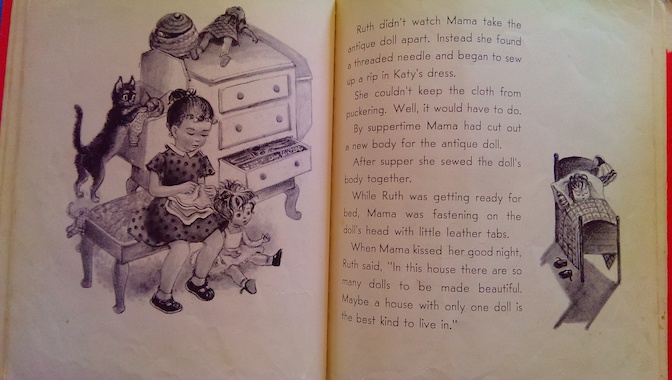
Ruth is little girl whose parents own a doll hospital. She has always been proud and fascinated by how her parents can make old or damaged dolls beautiful again.

KatyComesNextDollShop

However, Ruth’s own beloved doll, Katy, is in need of repair herself. As her parents rush around repairing dolls for their customers, they keep assuring her that Katy’s turn will come next.

KatyComesNextRuthsFather

After being put off repeatedly, Ruth starts to think that poor Katy will never get the attention that she needs.

KatyComesNextRuthMending

When Ruth’s parents realize how discouraged she is, they decide to take a day off for Katy to come first.

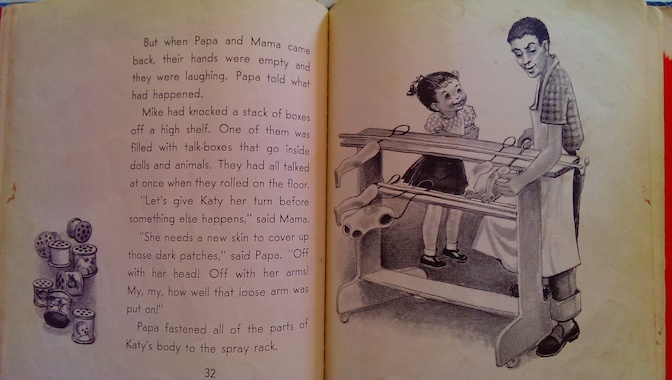
KatyComesNextFatherPaintSpray

This was one of absolute favorites when I was little!  The pictures alternate between black and white and color and show the process that Ruth’s parents go through to repair Katy, repaint her body and features, and give her new hair and eyes.

KatyComesNextWigs
KatyComesNextClothesTrunk

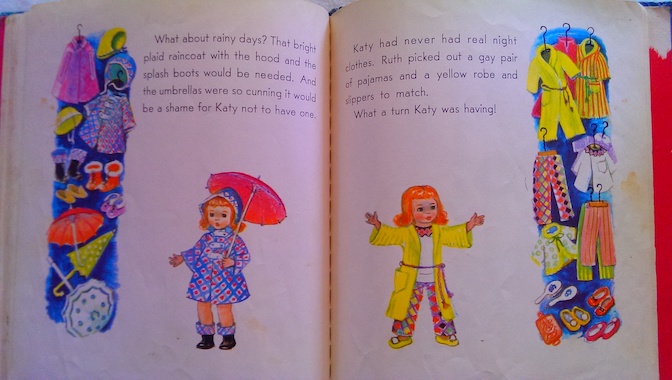
Ruth also gets to pick out an entirely new wardrobe for Katy. I was always fascinated with the description of how Ruth’s parents fixed the doll, and I enjoyed imagining the doll clothes that I would have selected from the ones they showed in the pictures.  Making the choices is half the fun!

KatyComesNextDresses
KatyComesNextPajamas

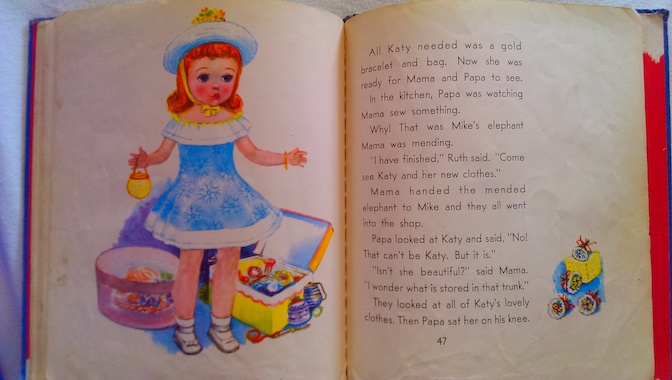
When Katy is finally finished, she looks beautiful, and Ruth is happy!  This is one of the many out of print children’s books that I wish would come back into print!

KatyComesNextPartyDress

Magic by the Lake

MagicByLake

Magic by the Lake by Edward Eager, 1957.

Jane, Mark, Katharine, and Martha are finally going to spend the summer at a lake with their mother and their new stepfather! The children were never able to do that before because their widowed mother always had to work during the summer. When they arrive at the cottage by the lake that their stepfather, Mr. Smith, has rented, there is a sign that says, “Magic by the Lake.” The children think that it could just be the name of the cottage because sometimes cottages are giving interesting or amusing names, but having had experience with magic before (this being the second book in the series), they consider the idea that they could be headed for more adventures. Of course, they are correct, but it turns out to be the lake that’s really magical, not the cottage.

MagicByLakeTurtle

The children are playing by the lake when they wish for more magic, and a talking turtle comes up to tell them that, because of their wish, the entire lake is magic. That sounds amazing, but too much magic all at once can be overwhelming. Fortunately, the turtle is also magical, and he has some ability to influence magic in the lake. The children make a deal with him that he can arrange for them to have adventures with magic in the lake, but only one at a time, because that’s what they feel that they can handle. Also, the adventures won’t happen every day, so they can have a chance to rest in between. The grown-ups around them won’t notice any of the magical happenings, and little Martha insists that nothing truly scary will happen to them. Jane protests at that request because she thinks that it will make their adventures as boring as overly-tame children’s books, but the turtle says not to worry because what he thinks of as “not scary” isn’t necessarily what Martha would think of as “not scary.” The turtle tells the children that when they’re ready for adventure, they should think about what they wish for and then touch the lake, and if the time is right for it to happen, it will.

That sounds simple enough, but what they consider the right time and what the lake considers the right time aren’t always the same thing, and just as before, their wishes and adventures don’t go quite as planned. In their first adventure, a mermaid takes them to an island of pirates, the stuff of high adventure. The children are delighted when they discover that the pirates, being adults, can’t really see them, as per their earlier wish for adults not to see their magical activities. It opens the potential for playing dirty tricks on rotten pirates, who seem to perceive them as some sort of ghosts. It’s all fun and games until the pirate captain decides to see if he can make ghosts walk the plank. Their turtle friend saves them by turning them into turtles, which, while magical, makes the rest of the day rather difficult for them because they have to go home and on errands with their mother. Walking on land can be difficult for turtles, and their mother has no idea that they’ve changed at all, still seeing them as children. Whatever magic the children get during the day seems to last until the sun sets, even when they wish it would end sooner.
MagicByLakeGrownUp

Then, while watching their mother and Mr. Smith at a dance, Jane and Katharine wish that they were old enough to join in, about age sixteen. Suddenly, the two of them are teenagers in evening dresses, getting attention from some teenage boys. The girls seem to enjoy the romance of it, but Mark and Martha follow them around, trying to convince the boys that the girls are really younger than they seem to be and dreading the moment when they will inevitably change back to themselves.

The children discover that they don’t even need to be at the lake in order to make the magic happen as long as they’re touching water from the lake. On a rainy date, when the roof of their cottage is leaking, the children realize that the rain water is also lake water. By making a wish on that, they end up at the South Pole in time to save a lost explorer and help him make an important discovery.

MagicByLakeDisappearance

The children enjoy their adventures, but they become worried about Mr. Smith, who has been making the commute back and forth from the lake to his bookshop, and it seems that business hasn’t been good at his bookshop this summer. They consider the idea of using the magic of the lake to solve Mr. Smith’s problems, perhaps by going back to the island where they saw the pirates bury a treasure chest. They figure that if they could bring Mr. Smith an entire chest of pirate treasure, he wouldn’t have to worry about money anymore.

But, of course, that idea doesn’t go as planned. When Martha argues with the others and goes to the island by herself to get the treasure, she breaks all the rules associated with the magic.   Because the rules that previous protected her and her siblings are gone, there is nothing to prevent her from being captured by the cannibals that live on the island. When her brother and sisters try to save her, they are also captured. It’s only the sudden appearance of Martha’s future children and Katharine’s future daughter (although they don’t know it yet), who are on a magical adventure of their own, in a cross-over from another book in the series, The Time Garden.

MagicByLakeTreasure

The children make one more attempt to get treasure for Mr. Smith in a kind of Arabian Knights adventure, but that doesn’t work, either. However, although the children seem to have used up their wishes on the lake, they have the feeling that the magic might allow them one last opportunity to get what Mr. Smith needs. It does in a way that may or might not be magical, although the buried treasure that they find and get Mr. Smith to dig up may be a representation of the pirates’ treasure and not of the old miser (now deceased) who was said to have lived at the old, abandoned cottage by the lake that the children decide to explore. It does seem like quite a coincidence that the old miser’s initials would match those of the pirate captain, and they are carved on the stone over the buried treasure, just like the marker the pirate captain left.

In the scene with the cannibals on the island, the cannibals are stereotypical “savage natives” (or “native savages”, or something generic of that sort, since the terms are used pretty interchangeably in the story). You find things like this pretty commonly in old children’s books, especially prior to the 1960s. But, what made this more palatable for me was that the entire scene is written as a joke on the usual stereotypical books that children of the era would have read. The cannibals speak kind of like American Indians in cheesy old Westerns, using words like “heap” for “very” and randomly adding “-um” to end of words. You know that it’s not really how anybody, even cannibals living on some remote island in an indeterminate ocean, would talk, but it might be how children raised on adventure stories and movies from the 1920s might imagine they would (adding to my earlier theory from the last book that at least some of the children’s adventures might actually take place in their own minds, not in their “real world”).  It may also be a reference to things in tv shows from the 1950s, the time period when the story was written. The best part for me is when the children try to remember what shipwrecked explorers do when confronted with cannibals in some of the stories they’ve read. They start throwing out random words that are meant to sound impressive combined with some gobbledy-gook in an effort to communicate/impress the cannibals. Then, Mark tries to convince them that he’s a powerful god with the ability to control fire. The cannibal chief is unimpressed, telling him that he recognizes what Mark has as an ordinary safety match, which he blows out. So much for the old adventure stories.

The book is currently available online through Internet Archive.

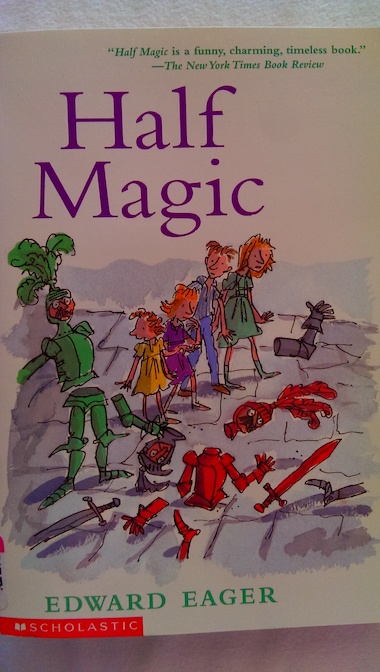
Half Magic

HalfMagicHalf Magic by Edward Eager, 1954, 1982.

Jane, Mark, Katharine, and Martha are siblings living in the 1920s. Their father is dead, and their mother works for a newspaper. While their mother is at work, Miss Bick takes care of the house and the children, although she isn’t really good with children. The children are often free to amuse themselves on their own during the summer, and they like to pick out books from the library for entertainment. They particularly enjoy the fantasy books by E. Nesbit (a real author, and they reference her real books during the story), and they wish that exciting, magical things like the ones that happen in her stories would happen to them.

They get their wish (and a great many others) when Jane finds a strange coin on the sidewalk that they mistake for a nickel at first. By accident, they discover that this coin grants wishes, but it has a peculiar habit of only granting half of what a person wishes for (and the coin seems to interpret the idea of “half” pretty liberally, depending on the type of wish, so results can be pretty unpredictable).

Jane is so bored after she finds the coin that she wishes that there would be a fire for some excitement. Suddenly, the children hear a fire engine and discover that a child’s playhouse had caught fire. It could have been coincidence, except that their mother borrows some change from Jane, getting the magical coin by accident. While she is visiting the children’s aunt and uncle and finds their conversation boring, she wishes that she were at home, but finds herself unexpectedly by the side of the road halfway home. She is confused but thinks that she must just be very tired or something and forgot that she was walking home. She ends up accepting a ride from a very nice man who happened to be passing her on the road and thought that she looked lost and confused.

HalfMagicChildrenThese early experiences and a series of odd wishes Mark makes when he doesn’t realize that he has the coin demonstrate to the children not only that the coin is magical but that they have to be extremely careful what they wish for when they have it. They have to word their requests very carefully, asking for twice as much of anything they want in order to counteract the half magic of the coin. Even so, they can’t help but make mistakes and get themselves into trouble.

When Katharine uses her turn with the coin to take them back to the days of King Arthur, she ends up causing trouble and disrupting history by defeating Lancelot in a tournament. Fortunately, Merlin realizes what the children have done and forces them to explain themselves and show him the magic coin. After inspecting it, Merlin gives the children a stern lecture about interfering with the natural course of history. He uses the coin’s magic to undo what the children have done and further uses it to restrict the children’s wishes to affecting only their own time period. He warns them to be more careful about what they wish for, keeping their wishes smaller and more personal, adding that the coin’s magic will eventually be exhausted, so they should save their wishes for what is important.

HalfMagicTheaterThere is one more disastrous experience when the children go to the movies (a silent film because this is 1920s), and Martha accidentally wishes that she wasn’t there while touching Jane’s purse, which holds the coin. Martha, of course, ends up being only halfway “not there,” almost like a living ghost, which terrifies onlookers. Straightening out that mess brings them into contact with Mr. Smith, the nice man who gave their mother a ride home. He owns a bookstore, and he enjoys fantasy stories as much as the children do. He becomes the only adult who knows that the children have been using magic, and he’s fascinated by it, enjoying witnessing their adventures.
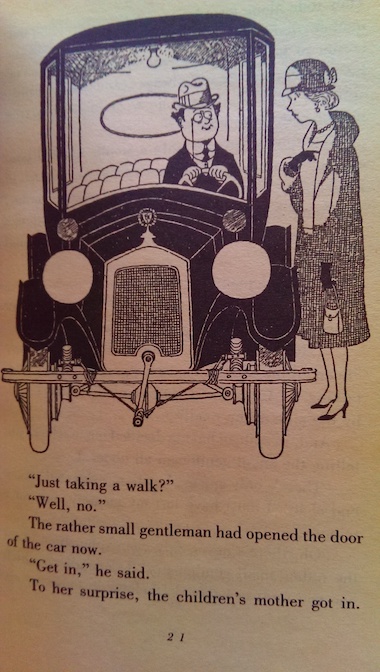
When the children’s mother comes to pick them up, Mr. Smith is pleased to meet her again and invites the family to join him for dinner. Mr. Smith is obviously fond of the children’s mother, and most of the children like him, too. However, Jane is uneasy. It’s partly that she worries that Mr. Smith will interfere with their use of the magic coin and partly that she worries about his new relationship with their mother. Of the four children, only Jane, as the oldest, really remembers their father, and she can’t stand the thought that Mr. Smith might become their stepfather and take his place.

HalfMagicSmithWhen Jane argues with the other children about Mr. Smith and rashly wishes that she belonged to another family, the other children call upon Mr. Smith to help them rescue Jane from her foolish wish, her unsuitable new family, and from herself.

In the end, Mr. Smith does marry the children’s mother, and even Jane is happy with the arrangement, having come to appreciate Mr. Smith much better.  Once their mother and Mr. Smith each have what they wished for most — each other and a happy family with the children — they forget about the magic coin.  Although none of the children realize it, the coin also grants Jane one final half-wish in which her father comes to her in a dream-like form, letting her know that he approves of her mother’s remarriage and the children’s new stepfather because he wants them all to be happy.  This gives Jane the reassurance she needs to fully accept Mr. Smith.  The children, deciding that the coin has given them all the wishes it’s going to, leave it in a convenient place for a new owner to find.

You don’t find out what happens with the coin’s new owner apart from when the children see a young girl pick it up and realize that it’s magic when she makes her first wish. However, there is a cross-over scene in another book in the series, Seven-Day Magic, which explains a little more about what happens next.  Books in this series frequently reference and sometimes parody other children’s books that were popular at the time they written, and individual books in the series even sometimes reference each other, even when the main characters have changed.

Speaking of literary references and parodies in this series, sometimes it’s a little difficult to tell for certain which scenes are really meant as parodies and which aren’t.  Knowing a bit about vintage children’s fiction helps, but there may be some scenes in the stories which can make modern readers a little uneasy.  One scene in the book that bothered me was near the beginning, when Mark wishes to be on a desert island.  This was before the children fully realize that the coin only grants half of a wish, so the children just end up in a desert, but not on an island.  The part that bothers me is that they are briefly kidnapped by a kind of wandering Arab man who seems to be planning to ransom or sell them.  This scene is like an old stereotype out of the sort of silent movies that the children would have been watching, and because of that, it was a little painful to read.  The man’s name is Achmed (still in keeping with the stereotype), and they keep referring to him as “Achmed the Arab,” in case you need reminding that that’s what he is.  They get out of their predicament with him by wishing for something that would make him really happy so that he’ll forget about them.  By then, they realize that they need to double their request in order to make the coin work properly, so their wish works.  The coin ends up giving Achmed a beautiful wife and “six plump Arab children” (in case you forgot that Achmed’s children would be Arab as well) and generally improves what Achmed owns, so Achmed becomes a happy family man and gives up his earlier, shady ways.  It’s eye-rollingly stereotypical and cliche, so I think it’s worth telling potential readers that this scene is there.

The cliches and stereotypes (not to mention the constant, unnecessary repetition of the word “Arab” just to remind you that that’s what everyone is, in case you were confused) in that scene were annoying, but unfortunately, things like that crop up pretty regularly in children’s literature from the 1950s and earlier when there are scenes that take place just about anywhere outside of the United States, Canada, or Europe.  That being said, there are a couple of things that make this scene easier to bear.  One is that Mark, realizing that the magic coin can get them out of this situation and that they have the power to put Achmed at their mercy, decides not to do it because it occurs to him that Achmed is probably a desperate man because he is poor.  Mark decides that Achmed would be a better person if he had whatever would make him feel the most fulfilled in life, so he wishes for that for him.  It’s nice that Mark sees him as being a person whose well-being needs to be considered, not just an enemy to be defeated.  Also, it occurs to me that it’s not completely certain that the desert they’re in is a real-life one, even in the children’s fictional world.  I think the assumption is that it is, like we’re supposed to assume that the world of Camelot that they visit is a real part of history, but it may not be.  In fact, the children in different books in this series in general sometimes get philosophical about their magical adventures, wondering about how their magical adventures fit into the real world around them or if they really do, and they never fully get all the answers.   Perhaps the coin took the children to their idea of what a desert or what Camelot would be like, not to those real places.  In 1921, there was a famous silent movie called The Sheik in which Rudolph Valentino played an Arab sheik named Ahmed (Achmed’s name could be a joke on that).  It’s not a movie for children, but it was very popular in the 1920s, and it inspired other movies with Arabian themes, at least a couple of songs, and probably a number of the stereotypes about Arabs of the time.  So, if the kids in the story were imagining an Arabian desert, it would probably be something resembling what they’d seen in movies like that.  This little adventure may have only taken place in the imaginary world, even from the children’s perspective, and the author may be poking fun at the notions children get from popular culture.  Even in the end, the children admit that there are many things they don’t understand about the coin and how it works, like where the other half of Martha went when she was only half there.   In a world where magic works, pretty much anything is possible.  Then again, since the entire book is fictional, it may be best not to worry too much about it.  Still, I just plain didn’t like this scene.  The rest of the book wasn’t so bad.

Overall, it’s a fun story.  Part of the fun for book lovers is in spotting the various literary references in the story because the children talk about the books they like and read and compare their adventures to ones they’ve read about.  The concept of the half-wishes also makes you think.  It’s worth pointing out that, although the children enjoy the general adventure of the coin, most of the children’s wishes, no matter how carefully they word them, don’t turn out the way that they expected, even when they get exactly what they asked for.  Mr. Smith marrying their mother is actually the best wish that comes true in the whole book.

The book is currently available online through Internet Archive (multiple copies).