Abigail

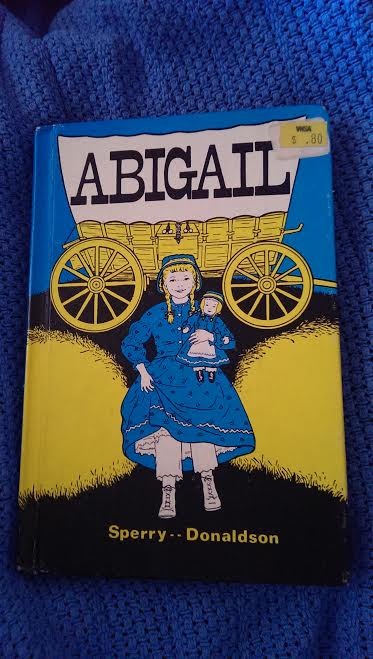
abigailAbigail by Portia Howe Sperry and Lois Donaldson, 1938.

Susan is a little girl living on a farm in Kentucky during the 1800s.  Her family has recently decided to move to Indiana, which is the new frontier of the United States.  Her uncle and his family are already living there, and he has persuaded Susan’s parents of the opportunities that await them.

As the family packs up to leave, Susan’s grandmother gives her a special present that she and Susan’s aunt made for her: a new doll.  Unlike Susan’s old wooden doll, this doll is a soft rag doll that she can sleep with.  They made the doll to look like Susan herself, but Susan names the doll Abigail after her grandmother.

Abigail accompanies Susan on her adventure as the family heads west to Indiana in their covered wagon.  Susan is sad and a little afraid at first, but when she thinks of what Abigail would say to her about her need to be brave and to explain to her all the strange things they will encounter on the journey, Susan regains her courage.

The family does have adventures on their two-week trek to Indiana.  They have to cross rivers, face down a bear, and worry about whether they will encounter unfriendly Indians (Native Americans).  Even after they arrive in Indiana, joining their other relatives, they will still have to get used to life in a new place.

Throughout the book, there are little side-stories, poems, and hymns that the family sings and tells each other.  Through it all, Abigail is Susan’s constant companion, helping her to feel at home in her new home.  I loved this book when I was a child because I always loved dolls.  This book was a bigger part of my youth than the Little House on the Prairie series, but it would probably appeal to Little House on the Prairie fans.

The book is available to borrow and read for free online through Internet Archive.

Starlight in Tourrone

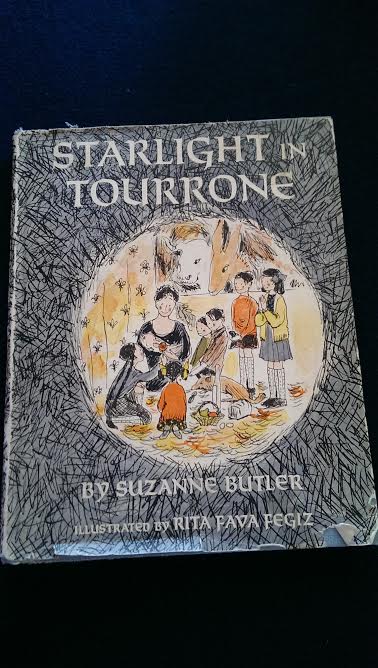
starlighttourroneStarlight in Tourrone by Suzanne Butler, 1965.

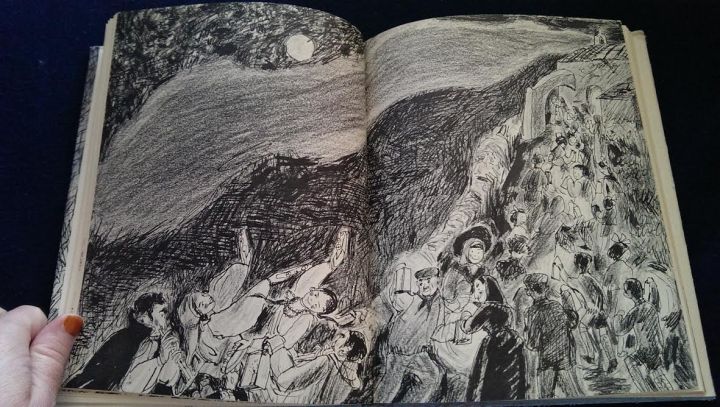
This is a story about a group of children in southern France during the middle of the 20th century, not too long after World War II, who want to stage a special Nativity scene at Christmas. One of the older men in the small village of Tourrone tells his grandchildren about how, when he was young, the village had held a live Nativity scene at the chapel on the hill with the youngest baby in the village playing the part of the Christ child and his mother playing Mary. Then, all the people in the town would climb the hill to the chapel and present gifts to Mary and the baby Jesus in a ceremony called the March to the Star.

However, these traditions have been lost because, following World War II, the village has lost much of its population, and the chapel is an unused ruin. The children and their friends, inspired by the grandfather’s stories, decide that they want to hold the March to the Star and the Nativity scene this year.

starlighttourronemarchAt first, most of the adults in the village are skeptical. Since there are no young couples living there anymore and no babies have been born there for several years, no one knows where the mother and child for the Nativity scene will come from. Many of the adults are too busy with their own problems and worries about the future to help. Still, the children continue to work faithfully on their plans, drawing in the adults in spite of themselves.

starlighttourronepreparationsstarlighttourronelanternJust as people in the village start to feel hopeful again, something happens that threatens to ruin everything, but there is still one more miracle yet to come, thanks in part to the one person who never doubted it would happen.

It’s a beautiful story about the power of faith and how miracles come to those who are prepared for them. The last page of the book contains the music for the Provencal Carol that the children sing along with the English translation.

The book is available to borrow and read for free online through Internet Archive.

starlighttourronenativity

starlighttourronecarol

Mystery Up the Winding Stair

Harry Hunter and his mother have been living with his grandfather in his big mansion while his father is in Japan doing work for the government. His family has owned the mansion for a long time, and it has a small museum in it containing Native American artifacts and things relating to pioneer life, including a small log cabin built in a large room up a winding staircase.

When Harry’s mother goes on a trip to see his father, Harry and his grandfather invite Harry’s cousins to visit them: Ned and his sister Lou, and Carol, whose family has only recently moved to the area.  When the children try to decide what they would like to do together, Carol suggests a treasure hunt.  Their grandfather sends them on a treasure hunt to find something that he hid himself a long time ago: a set of silver spoons made by Paul Revere and a diamond. The explanation is that the grandfather is rather absent-minded and has forgotten where he hid the treasure, although he knows that it’s somewhere in the house.

A storm leaves them all snowbound in the mansion, but they are not alone. There are mysterious footsteps, someone using a secret staircase to the attic, and signs that the bed in the cabin has been slept in. The children begin to realize that someone else is in the house with them, and this person wants the treasure for himself!

This book is out of print, but you can borrow and read it online for free through Internet Archive.  Internet Archive requires you to sign up for an account to borrow books, but the account is free, and you read the books directly in your browser.  There are no overdue fees because the books simply disappear from your virtual loan list when your time is up.  You are allowed to re-borrow books as long as copies are available (not being “borrowed” by other people).

The house the mansion in the book was based on was the old summer home of Governor Washington Hunt, located in Lockport, New York. (I learned about the house from an article about the story behind the book and an event related to the book that was held at the library in Lockport, but the site that had the article doesn’t have it up anymore. I think I saved a copy somewhere, but I’m having trouble finding it right now.)  It was called Wyndham Lawn and later became a children’s home. It’s now a private school called the Henrietta G. Lewis Campus School.  When the author, Helen Fuller Orton, was young, some of her relatives rented Wyndham Lawn from its owner, and she lived with them for a time.  In the article, the author noted that the house had been changed somewhat since the time when she lived there in the 1880s in order to accommodate the needs of the children’s home.

When I first read this book, I thought that the part about the grandfather simply forgetting where he hid an important treasure was a little cheesy, but the treasure hunt in a mansion with its own museum is fun. It’s a little spooky when the kids realize that there’s an intruder in the house with them while they’re snowbound, although it’s pretty obvious to readers of the story who the intruder was. The house really makes the story because it is a fantastic setting! It’s a very cozy mystery for winter.

I enjoyed the story and learning about the history of the real house. I also considered what Harry’s father is doing in Japan because this book was published just after WWII. I don’t think they ever explain why Harry’s father is in Japan on government work, but I’m sure he’s involved with the occupation and reconstruction of Japan after the war. It’s a subtle reference to current events at the time this story was written that’s not part of the main story but is used as part of the reason why the main story is happening.

Cranberry Thanksgiving

cranberrythanksgivingCranberry Thanksgiving by Wende and Harry Devlin, 1971.

Maggie and her grandmother like to invite friends to spend Thanksgiving with them.  Grandmother always tells Maggie to invite someone who doesn’t have anyone else to spend the holiday with.  This year, Grandmother has invited Mr. Horace, a pleasant man with an elegant manner staying at the local hotel.  Maggie has invited Mr. Whiskers, a friendly but somewhat scruffy sailor who has been on his own for years.

Grandmother has never really approved of Maggie’s friendship with Mr. Whiskers (whose real name is Uriah Peabody, but is called Mr. Whiskers because of his long, busy beard).  Mr. Whiskers’s unkempt appearance and lack of refinement have always bothered her.  She also suspects Mr. Whiskers of wanting to steal the secret recipe for her famous cranberry bread because he often shows up when she’s making it.  Some people have offered her a great deal of money for her recipe, but she insists that it’s a family secret that she’s leaving to Maggie.  Still, Mr. Whiskers has been a good friend to Maggie, so she allows him to come to Thanksgiving dinner.

As it happens, someone is out to steal Grandmother’s recipe, but not the person that she suspects.  It’s a nice holiday story about how appearances can be deceptive and real friendship is shown through honest behavior.

This book is part of a series, and like all the other books in the series, there is a recipe in the back.  The recipe in this book is for Grandmother’s Famous Cranberry Bread.

The Tap Dance Mystery

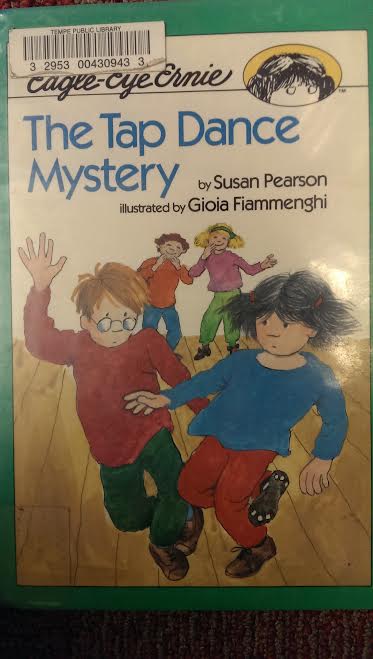
eeetapThe Tap Dance Mystery by Susan Pearson, 1990.

The kids in Ernie’s class are assigned to groups to plan different acts for the show that they will have when their parents visit the school on Parents’ Night. The Martians are assigned to different groups. R. T.’s group is going to do magic tricks. Michael’s group is going to pretend to be a music group from Jupiter and play different homemade instruments. Unfortunately, William and Ernie are in the same group as Marcie, a mean and bossy girl who always smells sticky and sweet, like Juicy Fruit gum.

Marcie convinces the others that their group should tap dance because she has been taking lessons and can teach the others. William and Ernie struggle to learn the steps and make homemade tap shoes by tacking washers onto the bottoms of their shoes. Jason, the fourth member of their group, really likes dancing and shows a lot of talent for learning the moves. Still, only Marcie really looks the part of a dancer in her fancy costume and beautiful tap shoes.

Several kids ask Marcie if they can try on her tap shoes, including Jason, but she refuses to let them. Every day, she hides her shoes in a different place in their classroom when she isn’t there to watch them. When the shoes disappear, Marcie is convinced that Jason took them, but he says he didn’t. Ernie believes him, but she has to hurry if she is going to find the shoes and clear his name before Parents’ Night.

The solution to this mystery is fairly simple, but the story also has some interesting insights into the reasons why Marcie acts the way she does and the effect that parents’ expectations can have on their children.

This is part of the Eagle-Eye Ernie series.  The book is available to borrow and read for free online through Internet Archive.

The Mystery in Old Quebec

mysteryoldquebecThe Mystery in Old Quebec by Mary C. Jane, 1955.

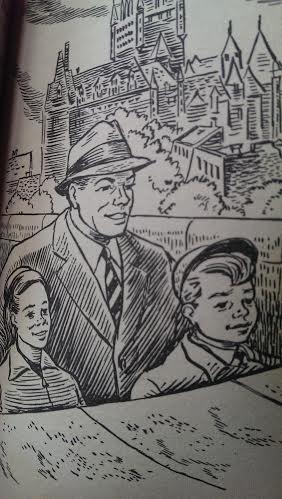
Mark and Kerry, a brother and sister, are visiting Quebec with their father, who is on a business trip. Their father allows them to explore the city on their own during the day while he works (something that would be unlikely to happen in modern times). The kids enjoy sight-seeing and learning French words and phrases.  They even make a new friend in the city, but they are troubled by events at the quaint little inn where they are staying.

On their first day there, Kerry’s coat mysteriously disappears and reappears with some strange messages in the pocket.  A boy wants them to take a message to someone in the city.  At night, Kerry hears someone crying in the next room. Is the boy being held prisoner at the inn? If so, why? Kerry and Mark are determined to help in any way they can, but time is running out.

The book is currently available online through Internet Archive.

My Reaction and Spoilers

mysteryoldquebecpicThe solution to the mystery involves family quarrels, custody issues, and racial tensions. In spite of that, this is actually a very gentle story.  In the end, the kids are dependent on the people the mysterious message was intended for to help a troubled, lonely child.  It turns out that the boy is an orphan, and some of his relatives are white, and some are First Nations (Native American). There is a fight for the boy’s custody, but the boy knows where he really wants to be.

The author describes the atmosphere of Quebec in some detail. The famous landmarks probably haven’t changed much, although I don’t know if all the descriptions are accurate anymore. I also thought it was interesting how the author includes some French phrases and their pronunciations and translations as the kids learn to communicate with French-speaking people in the city.

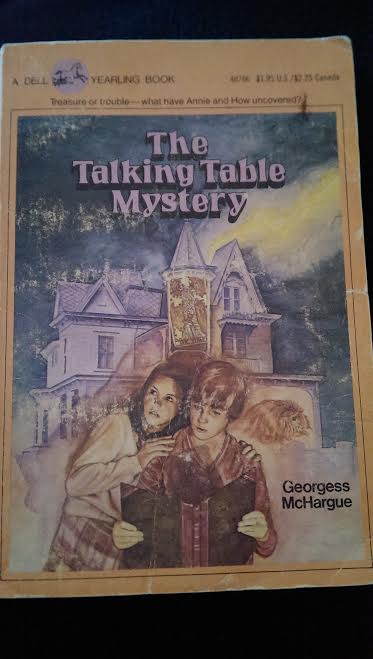
The Talking Table Mystery

TalkingTableThe Talking Table Mystery by Georgess McHargue, 1977.

Annie Conway and her friend How are helping her great aunt to clear out her basement when they find a table that How thinks would work for his pet guinea pig’s cage. However, it’s not an ordinary table. It makes strange noises whenever they press on it, and in the box tied to the top of the table, they find a strange assortment of objects, including a little silver piccolo and some diaries.

Most of the diaries belong to Annie’s great grandfather, but there is one written by an unknown young girl. The girl apparently stayed in Annie’s great grandfather’s house years ago, and her diary refers to the girl’s mother’s strange behavior and the girl’s fears that something bad will happen. The diary itself is mysterious, but soon the kids start receiving threatening notes, telling them to hand over the diaries or something bad will happen. Who wants the diaries and why?

The book is available to borrow and read for free online through Internet Archive.

My Reaction and Spoilers

The basis for the mystery is 19th century spiritualism.  The former owner of the table was a spiritualist who used it for seances, creating rapping noises when the “spirits” were present.  Her daughter was the girl who wrote the diary.  She wasn’t happy about how she and mother kept moving around in search of new clients and how she had to help her mother by playing ghost during seances. They were staying with Annie’s great-grandfather because he was suffering from grief over the death of his young son, and the spiritualist was holding seances to try to contact his spirit.  At least, that’s what Annie’s great-grandfather thought.  The bad thing that the girl thought would happen was that she and her mother would be caught faking their seances, which turns out to be exactly what happened.  Annie’s great-grandfather was angry at being deceived and threw them out of the house, but he confiscated the rigged table and other things they used in their seances, including the girl’s beloved silver piccolo, so they wouldn’t be able to try their act on anyone else.

However, there is one more secret about Annie’s great-grandfather and the spiritualist. Annie and How eventually discover that they had a love affair during the spiritualist’s stay in the house. There is some discussion among the adults about how the spiritualist suffered more consequences and stigma for the affair than the great-grandfather did, although he was a married man when it happened.  As for what eventually happened to the girl and her mother after this incident, the clues are contained in the diary and with the people who now want them.

I thought that the use of the rigged spiritualist table in the story was fascinating. It’s basically like a piece of antique magician’s equipment that not everyone would know existed.  The story also introduces some interesting historical details about the concept of 19th century spiritualism and the types of people who followed it.  Annie’s great-grandfather was grieving for the loss of one of his young children, and like others of his time, he wanted to reach out to the spirit of the one he lost, in search of solace for the loss.  How much of the affair with the spiritualist was fueled by his grief and gratitude for someone he thought was helping him is unknown because we never hear his perspective on that, but his anger at discovering how he had been deceived shows that he did honestly believe that the seances were real and felt betrayed to realize they weren’t.  However, actions have consequences, and there were still some consequences from this incident that were never fully resolved.

The author is very knowledgeable on the subject of spiritualism, and she also wrote a nonfiction book on the subject.

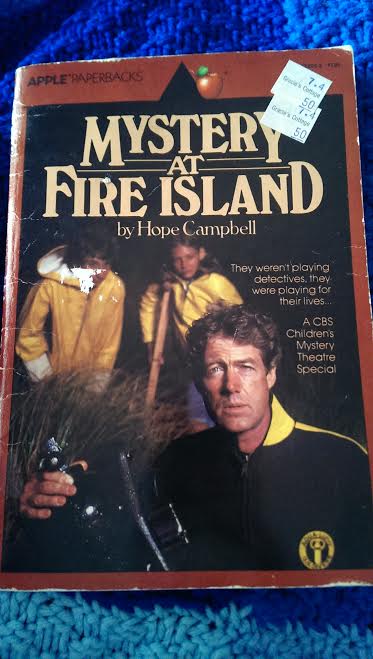
The Mystery at Fire Island

mysteryfireislandThe Mystery at Fire Island by Hope Campbell, 1978.

Darcy Littlewood, called “Dash,” is appalled when her art teacher tells her not to draw anything over the summer.  Drawing comes almost as naturally as breathing to Dash, who wants to be a cartoonist when she grows up.  She’s always doing sketches and caricatures of people she sees, especially her younger brother, JC (James Colson Littlewood, also known as “Coleslaw”).  But, her art teacher thinks that her style has grown too strong and inflexible too early in her life.  He thinks that if she takes a break from drawing for the summer, she’ll be able to come back to it with a fresh approach that will allow her to try different styles as she grows older.

To Dash, the idea of not drawing at all is intolerable, especially since she broke her leg shortly before the start of summer vacation.  She can’t go much of anywhere or do much of anything while her family is staying at their beach house on Fire Island.  Without much to do, she doesn’t know how she’d entertain herself if she couldn’t draw.

Her older sister, Candace, isn’t happy about spending the summer on Fire Island, either.  She says that there’s never anything to do there, although their mother attributes part of her boredom to the fact that she’s the only one in the family who doesn’t have an outstanding talent or a particular goal in her life.  Everyone else in the family is artistically-inclined in some way.  Mrs. Littlewood is a writer, Mr. Littlewood teaches drama, JC has acting skills and a special talent for imitating people, and Dash has her art.  Mrs. Littlewood thinks that Candy’s attitude would improve if she found something that she was especially good at and truly cared about.

While Dash is brooding about her inability to stop drawing in spite of her art teacher’s request, she makes the acquaintance of Mrs. Guizot, an eccentric older woman who spots her drawing caricatures.  It turns out that Mrs. Guizot is an art lover, and she quickly becomes a fan of Dash’s work.  But, there is something mysterious about Mrs. Guizot, or at least the man they see her talking to.

Both Dash and JC notice that the man has a peculiar way of standing and walking.  Dash draws it, and JC imitates it.  So, when they see the same man on the beach later that night, looking different without his beard and wig, but still walking and standing the same way, they wonder why the man was in disguise.  Also, he seems to be going out surfing when there aren’t any waves for surfing.  Then, they discover that he’s bringing scuba tanks with him, and they aren’t real scuba tanks.  What is the man doing?

The kids try to investigate the mysterious man with JC doing much of the leg work at first because Dash can’t get around very well.  JC is worried about what they might learn because the man might turn out to be truly sinister and violent.  He even has suspicions about Mrs. Guizot.  Later, Dash’s leg improves and she’s able to take a more active role in the investigation, but the kids pretend like she’s still laid up as a cover for their activities.  The kids’ investigation doesn’t go as planned, but they do uncover a crime and also inadvertently help their sister to find her life’s vocation.

Part of the story has to do with seeing with depth.  Part of the reason why Dash’s art teacher wants her to observe more and draw less is so that her art will contain more depth.  Dash also learns to see the depths of people, the things they keep hidden behind their facades.  Her sister, Candy, also has hidden depths which even she doesn’t appreciate yet.

The story was later made into a tv movie by the same name, and the picture on the front cover of this edition of the book is from the movie.

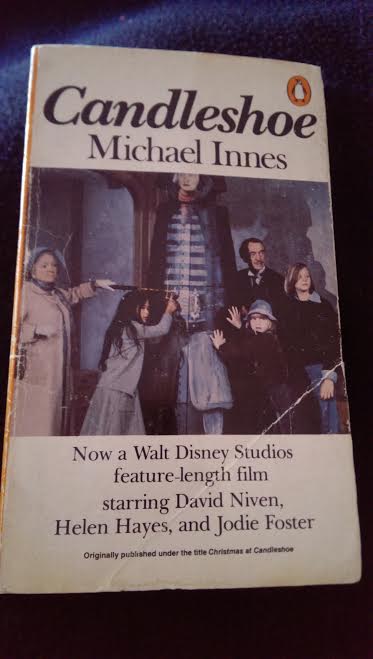
Candleshoe

candleshoeCandleshoe by Michael Innes, 1953.

I own the movie version of the book, which was originally named Christmas at Candleshoe (although it’s not about the holiday).  It contains the text of the original story, but the picture on the front cover is from the movie.

The Disney movie is very different from the original book.  For one thing, the hero of the story is a boy (Jay), not a girl (Casey/Margaret), and unlike the movie version, the child’s identity is established for certain by the end of the book. The book has a happy ending, and so does the movie, but part of the movie’s point was that the idea of family isn’t dependent on blood relations alone, so it isn’t important whether Casey is really Margaret or not (although there are strong hints that she is).

The book is a bit hard to follow at first because it jumps back and forth between different places and different sets of characters, although it all takes place during the course of a single day and night.  Actually, I’m not sure this can really be called a children’s book, but I included it here because of the movie tie-in.  Because of the difficulty level of the book, I’d really recommend it for older children or adults.  Personally, I have to admit that I liked the movie better.

The story takes place in the mid-twentieth century, after WWII. There are two manor houses involved, Benison Court and Candleshoe. Benison Court, the newer of the two, is owned by the Spendloves, and Candleshoe, the older one, is owned by the elderly Miss Candleshoe. The two families are related, and neither one of them has as much money as they used to. The Spendloves take in some extra money by offering tours of Benison Court and showing people paintings and antiques owned by the family for generations. To raise some additional money, they decide to sell a couple of the paintings by Titian. To their surprise, the expert they call in to evaluate the paintings tells them that the paintings are forgeries.  Archdeacon, who cares for the antiques and library at Benison, reminds the Spendloves that during the war, the paintings were sent to Candleshoe for safekeeping.

Meanwhile, a couple of American tourists, the wealthy Mrs. Feather and her son Grant, having seen Benison, stop by Candleshoe. Mrs. Feather is fascinated by the old place, in spite of its state of disrepair, and Miss Candleshoe invites them to have dinner there and spend the night. Mrs. Feather has an interest in purchasing Candleshoe for herself and fixing it up.  Miss Candleshoe and her longtime friend, the retired chaplain, Armigel, know that there is not enough money for them to fix up Candleshoe, and they like the idea of traveling, so they are willing to consider selling the manor house. This plan does not sit well with Jay, the orphaned son of Miss Candleshoe’s housekeeper, Mrs. Ray.

After Mrs. Ray died, Miss Candleshoe cared for Jay, and now, with Miss Candleshoe and Armigel showing signs of senility, Jay has been handling much of the practical running of Candleshoe. On this particular evening, Jay is worried about more than the possible sale of the property. He has been noticing strange people paying unusual attention to the house. He suspects, correctly, that they intend to break into the house that night, and he has assembled a small army of local children, armed with antique weapons, to defend the place. Grant, befriending Jay, admires the boy’s practical turn of mind but worries that they are not up to the task of handling the siege that is coming to this isolated country house. As the danger presses closer, the Spendloves, Archdeacon, and the art expert are heading toward Candleshoe in search of the missing paintings.

The answer to all of these problems may lie in the strangest feature of the house: the Christmas box, a stone monument in the gallery made by Gerard Christmas and dedicated to the memory of an ancestor of the Candleshoes, who may have been a pirate. According to the lore of Candleshoe, the box will open at a time when Candleshoe is in crisis and will save the day.

The book is available online through Internet Archive.

But, is Casey Really Margaret?!

I think so. I want to say, “yes, she is,” but “I think so” is about as definite as I can be because the movie changed the story from the original book.

Whether or not Casey is actually Margaret, the lost heir to Candleshoe, is the burning question everyone is left with after watching the Disney movie Candleshoe. The movie deliberately left Casey’s true identity unresolved at the end, probably because they wanted to have the people at Candleshoe decide to accept her into their family on her own merits, not just because they had to because she’s the heir to the place. In the beginning, the audience is told that missing heir of Candleshoe, Margaret, was kidnapped as a young child by her own father, apparently in some kind of marital/custody dispute, and that she disappeared after his death in a car accident and has not been located although attempts to find her were made in the ten years that have passed since her disappearance. Casey is a teenage girl who was apparently an abandoned child with an unknown past and no memory of her early life who bears an odd resemblance to Margaret, including a couple of distinctive scars that are like ones Margaret was known to have. She is recruited as by con artist to play the part of Margaret, returning to Candleshoe as the lost heiress in order to gain access to the house and find a hidden treasure. Although Casey initially came to Candleshoe under false pretenses as part of a con with the promise of a share of the Candleshoe treasure and a red Ferrari as her payment, she eventually becomes fond of the people there and decides that she can’t let them be cheated by the real villain. Casey proves herself to be part of the Candleshoe family through her loyalty to them, and in the end, they would accept her whether she really was Margaret or not. It’s a nice sentiment, but viewers still have the urge to ask who Casey really is.

Casey is legitimately an orphan or abandoned child, found at about the right time and the right age and in the right place to really be Margaret. She has no memory at all of her early childhood, her parents, or where she came from, and she also bears some telltale scars that match ones that young Margaret was known to have. That’s what we’re told about Casey. Casey’s history is never explained in detail in the movie (we never find out under what circumstances she was found and entered into the Los Angeles foster care system), but from what we do know, her history meshes well enough with Margaret’s known past that it would seem plausible for her to actually be Margaret. Is she really Margaret, and Harry Bundage, the con man, just persuaded her that she was only pretending in order to use her for his own ends? Or, is the real Margaret still out there somewhere? If Casey actually is Margaret, did she lose her memory in the car crash that killed her father, or did he abandon her somewhere before his death, even though he had kidnapped her from her mother and took her to a completely different country?

When Harry Bundage is briefing Casey about Margaret’s background, he poses the theory that Margaret was in the car when her father crashed it and that she may have wandered off in a state of shock after the accident. That explanation might be partly for the benefit of the viewers, helping to explain how Casey could be Marget and not remember it. A young child suffering from shock might be unable to tell anyone who she was or what had happened to her. An accident may even have left some bruising that might have obscured the telltale scars that could have identified her, but again, the matter is never fully settled, and we just don’t know enough of Casey’s background to make a full connection. There are enough pieces to make it possible, maybe even probable, but nothing that definitively settles the matter.

In the final scene of the movie, Casey asks Margaret’s grandmother what will happen if Margaret is ever really found and comes home, and the grandmother says cryptically that maybe she already has. It’s a brief hint that the grandmother thinks Casey might really be her kidnapped granddaughter, even though she accepts that Casey was lying to her earlier about things she said she remembered and knows that Casey herself thought that she was just an imposter. Casey does have those telltale scars, and it does seem like quite a coincidence that two random girls of the same age and similar circumstances would have identical sets of scars. However, the movie stops short of declaring that Casey really was Margaret all along, and the unanswered questions still rankle viewers. So, some of us turned to the original book to get more detail, but it turns out that it doesn’t completely help.

As I said, the original book was different from the movie. Not only was the child hero in the book a boy instead of a girl, he wasn’t kidnapped and taken to America the way that Margaret was. In the book, Jay definitely knows who his mother was, and it’s the question of who his father was that establishes his identity as the heir to Candleshoe. It turns out that Jay’s father was the nephew of the lady of Candleshoe, making her his great-aunt rather than his grandmother. Her nephew had been a ne’er-do-well, and although his family didn’t know it, he had married an American woman before his death. He died not too long after the marriage, but by that point, he had fathered Jay. Jay’s mother knew about her husband’s family, but she wasn’t sure yet whether or not she wanted to tell them about Jay. She took the job as housekeeper so she could observe the family and decide whether or not to reveal their relationship. Unfortunately, she died in an accident before she made up her mind. By the end of the book, Jay’s identity is established, and he is definitely proven and recognized to be the heir to Candleshoe, and because of that, I believe that Casey really is the missing Margaret. At least, that’s as close to confirmation as we’re likely to get. If the child in the book was the rightful heir to Candleshoe, it would make sense if the child in the movie was, too, even if it’s not really the same child.

Of course, that’s not full proof, and it doesn’t answer the questions about Margaret’s kidnapping or her father’s accident or how Casey was found and placed in foster care in California without anyone else connecting her with the missing Margaret when Margaret’s disappearance was reported to the authorities and newspapers. I have a theory that Harry Bundage was right that Margaret was in the car during the accident and that she did wander away from the scene of the accident in shock and possibly suffering injuries that covered up her identifying scars, but that’s still just a theory. There’s nothing in the movie or book that I could use to prove it. We don’t even know exactly why Margaret’s father in the movie kidnapped her in the first place or why Margaret’s mother died not long after she disappeared. (A convenient accident or illness for story purposes so there’s one less person to try to identify Casey/Margaret, or did she kill herself out of despair at the loss of her husband and daughter? The movie doesn’t say, so those are just guesses, too.) There’s a lot of backstory missing, and the book doesn’t clarify these points because of the differences between the book and movie. I guess it’s not really important to the story in the movie, but inquiring minds still want to know.
My Crazy Cousin Courtney Comes Back

CousinCourtneyBackMy Crazy Cousin Courtney Comes Back by Judi Miller, 1994.

The title is a little deceptive because Courtney hasn’t come back to New York to visit Cathy.  This time, Cathy has flown to Beverly Hills to spend Christmas with Courtney.  Courtney’s parents are now divorced, and Courtney’s adjusting to it, but she’s still as wild and unpredictable as she ever was.

Almost as soon as Cathy arrives, Courtney wakes her in the middle of the night to tell her that she needs her help to rescue an old man who’s being held against his will and maybe bring him cans of soup and sauerkraut.  Courtney’s heart is always in the right place, but as usual, she has the wrong idea.  In the best Courtney tradition, things work out amazingly well in the end.

In between spotting movie stars and getting into trouble, the girls manage to find time to get their nails done and visit with their friend Frank, who they met last summer in New York.  Cathy had fallen in love with Frank until she realized that he was more interested in being Courtney’s boyfriend.  Seeing him again over Christmas has brought back Cathy’s awkward feelings.  She still likes Frank, but the last thing she wants to do is to take a guy away from her lovable, if crazy, cousin.  But, if there’s one thing that Courtney specializes in, it’s happy endings.

This book isn’t as introspective as the first one in the series was, although Courtney and Cathy still help each other with their opposite personalities.  Cathy’s common sense and restraint can’t stop Courtney in her wild escapades, but she does inspire Courtney to be more thoughtful.  Courtney also helps Cathy to get out of shell, speak up for herself, have a little excitement, and see the possibilities that life has to offer.