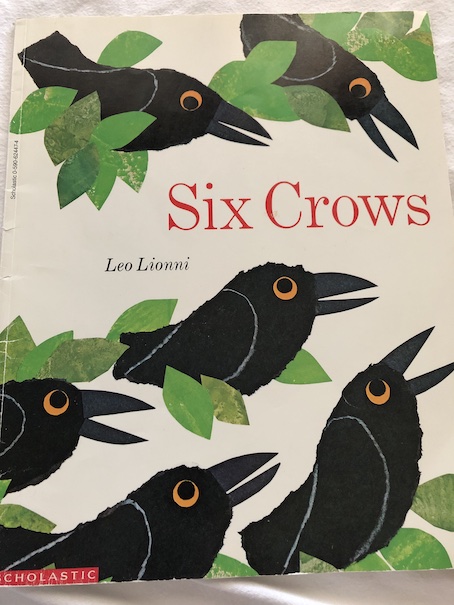
Six Crows by Leo Lionni, 1988.
A farmer in the Balabadur Hills (the book doesn’t explicitly say that this story takes place in India, but it’s implied) has a good farm, but he also has a problem with the crows who live nearby. Whenever his wheat is ripe and about ready to harvest, the crows come and eat it.

Chasing the crows away doesn’t work because they always come back. The farmer decides to try building a scarecrow instead. It does frighten the crows, but with an unexpected result.
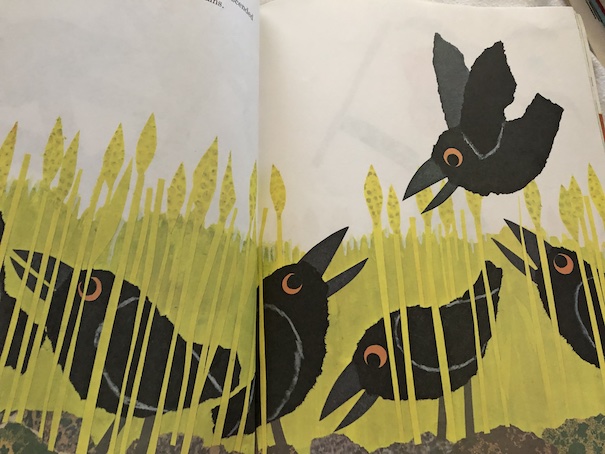
The crows decide that they must make their own scare-person, a kite that looks like a big, fierce bird, to scare away the scarecrow. When they fly over the field with their scare-person kite, the farmer gets scared and decides that he needs a bigger, scarier scarecrow.

The situation escalates, with the birds building an even bigger and scarier bird kite to scare the farmer.

Meanwhile, an owl who has been watching all of this unfold decides that it’s gone far enough and goes to talk to the farmer and the crows about the situation. The owl persuades both sides to speak to each other and work things out.

When they talk, the farmer and the crows realize that they don’t want to fight with each other. The crows depend on the farmer’s wheat for food, and the farmer realizes that he actually enjoys having the birds around. The owl fixes the mean-looking scarecrow to have a happy and friendly look.

I’m not sure that this is really a traditional fable because the book doesn’t provide any background information on the story and the author isn’t credited as doing a “retelling”, but the story is told in a folktale or fable format about conflict resolution. When the farmer and the crows are feuding, they continually escalate the situation with bigger and scarier “weapons” until the owl convinces them that the only way out of the situation is to talk it out and come to an agreement.
The book is available to borrow and read for free online through Internet Archive (multiple copies).


 Jestress's Forgotten Books and Stories