
In Darkness, Death

InDarknessDeath

In Darkness, Death by Dorothy and Thomas Hoobler, 2004.

This book is part of The Samurai Detective Series.

One night, after a party, Lord Inaba is killed in his room by a mysterious intruder. The only clue to the intruder’s identity is a red origami butterfly left at the scene. Lord Inaba’s death is an embarrassment to the shogun because Lord Inaba was in Edo under his protection.

It doesn’t take Judge Ooka long to decide that the murderer was a ninja. Ninjas are hired assassins known for their stealth and great skill with weapons. The butterfly left at the scene was to purify the spirit of the dead man and keep it from coming after his killer.

However, Judge Ooka says that it is not enough to know that that the murderer was a ninja; what they have to find out is who hired the ninja. He assigns Seikei the task of finding the source of the butterfly and learning who Lord Inaba’s enemies were. Judge Ooka finds a ninja he knows, Tatsuno, and convinces him to accompany Seikei on a journey through Lord Inaba’s territory and to teach him what ninjas are like. Although Seikei is not sure that he trusts Tatsuno, he learns to be grateful to him for his help and for saving him from the real danger, which comes from a surprising source.

While many children’s movies glorify the ninja, in real life, they were mercenaries, assassins for hire.  They used clever tricks in order to gain access to their victims and to get away without being caught, which ended up giving rise to a number of legends about them, attributing an almost supernatural quality to their skills.  While searching for the assassin and the person who hired him, Seikei learns a number of the tricks that ninjas used and the security measures that people would take to try to guard against them, such as nightingale floors (here is a video of a nightingale floor in a Japanese castle and another where you can hear the floor even better).

The book is currently available online through Internet Archive.
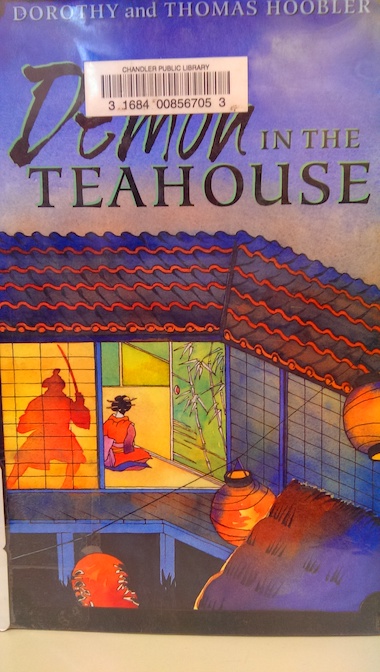
The Demon in the Teahouse

DemonTeahouse

The Demon in the Teahouse by Dorothy and Thomas Hoobler, 2001.

This is the second book in the Samurai Detective series.  Like other books in this series, it is not a book for young children!

Seikei is trying hard to learn all the things he must know as a samurai and Judge Ooka’s adopted son. One evening, while the judge is in Edo (now called Tokyo), he sends a message that Seikei and the other samurai must come immediately. Edo is in a state of emergency because of a series of fires that have been deliberately set in shops around the city. Although Judge Ooka helped to design a system of watch towers and fire brigades to help the city in case of fire, the threat of fire is still very serious because most of the buildings in Edo are made of wood.

The only clue they have to the person setting the fires is a geisha who was in one of the shops before it burned. Judge Ooka and Seikei go to the city’s pleasure district, Yoshiwara, where there are theaters and teahouses where geishas provide entertainment. While they are there, they learn that geishas have been dying under mysterious circumstances, and the people of Yoshiwara are afraid.

Judge Ooka has Seikei take a job as a servant at a teahouse in order to learn more. He soon discovers that the dead girls were all friends of Umae, one of the most popular geishas. Then, one of Umae’s many admirers brings her a present, and she is horrified to discover that it is the kimono that one of the dead girls was wearing. Who brought her the kimono, and what connection does she have to the fires?

The nature of the villain and the villain’s motives is rather dark for a middle school level book (although some middle school level books do get fairly dark).  Although the reading level of the book would be fine for someone aged twelve to fourteen, the subject matter might make the story more appropriate for someone a little older.  I recommend parental discretion on this one.  (Remember, it takes place in the “pleasure district” of Edo.)  It’s an exciting story, and it contains an interesting picture of feudal Japan, but it’s definitely not for young children!

The part about Judge Ooka organizing watch towers and fire brigades is something that the real, historical Judge Ooka actually did.

The book is currently available online through Internet Archive.