Cold Chills

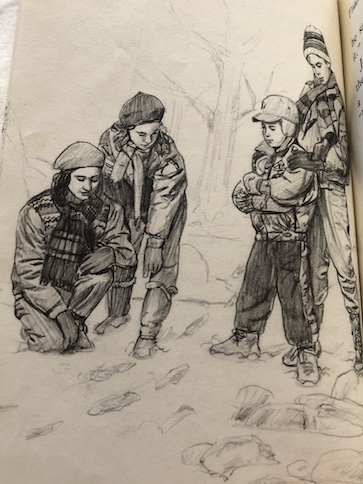
Fourteen-year-old twins Ryan and Chris Taylor are on a ski trip in Colorado with their parents, their eight-year old sister Lucy, and their friend, Billy Maguire. Although Billy is a friend of both of the twins, he’s really closer to Chris because the two of them are interested in sports. Ryan is more of an intellectual than either of them, and they tease him about not being as good at sports as they are. When the three of them get together, Ryan often feels left out, although he argues with them that he can do decently well at physical activities; he just cares more about other things.

The ski resort where they will be staying is called Moosehead Lodge. It used to be a very exclusive resort, but it’s fallen on hard times in recent years. The reason why they’re going there is that the current owner is an old friend of Mr. Taylor’s from college, and he’s asked Mr. Taylor to write a travel article about the lodge for a magazine to attract new customers.

It turns out that Dede and Wendy, two girls who attend the same school as the boys, will also be staying there over winter break. The twins have crushes on the girls, but they’re also at the age where they still think girls are weird or likely to spoil their fun, so they have mixed feelings about the girls joining them on the ski trip. The boys consider trying to avoid the girls for the entire trip and make them wonder what happened to them, but Ryan thinks that sounds like something a little kid would do. Billy says that, if the twins are going to hang around with girls, he wants a girl for himself, too.

When they arrive at the lodge, the girls greet them right away, so the hiding scheme definitely won’t work. The girls are enthusiastic that there will be a lot of fun things for them all to do. The lodge includes several stores for the guests to shop in, which the girls and Mr. and Mrs. Taylor find intriguing. However, the boys think that the lodge looks haunted. With all the old-fashioned furniture and paintings, it reminds them of something from a movie.

At their first ski lesson, Chris brags that he doesn’t really even need lessons because he’s such an athlete. However, skiing doesn’t come as naturally to him as soccer does. In spite of his bragging, he is clumsy at his first attempts. He apologizes to the instructor, saying that he’s just eager to get going because he knows that they’ll only be staying there a short time. The instructor says that he understands but that the instructions he’s giving them are important for keeping them safe while they have fun.

When the boys return to the lodge, Mrs. Taylor is very upset because a pearl necklace that’s a family heirloom is missing! When Mr. Taylor and the boys go to the manager to report the loss of the necklace, they find out that other pieces of jewelry have been stolen from other guests. The manager has hesitated to contact the police about it because he’s been hoping that the jewelry was merely misplaced and would turn up. The lodge is suffering financially, and if they have a bad season, they might have to close down. Mr. Taylor likes the lodge and wants to help his old friend, but the thefts have to be cleared up for the lodge to continue functioning. The twins decide that they’re going to be the ones to find their mother’s necklace, bring the thief to justice, and save the ski lodge!

The book is available to borrow and read for free online through Internet Archive.

I liked this book better than the last book I read in the series. It’s more of a mystery than the last one, although there’s still plenty of excitement and adventure. Unlike the other book I read, where the boys know right away who the villains are, in this story, the boys have no idea who the thief is for much of the book. They have to investigate different suspects, and their first suspects turn out to be completely wrong. The boys undertake a deliberate investigation into their suspects, moving from person to person. There are enough potential suspects with apparent odd behavior to keep readers guessing along with the amateur detectives. A skiing accident and a blizzard and avalanche add excitement and adventure to the story.

When the girls argue with the boys about one of their subjects, the boys say that girls would be more likely to fall in love with a jewel thief than to either be a jewel thief or catch one themselves. The kids turn their investigation into a contest, boys against girls, to see which of them can solve the mystery first. The competition between boys and girls gets carried over to the adults, and it even influenced some of my theories about the identity of the jewel thief. Part of what I suspected turned out to be true, but saying what it was would be a spoiler. 

The boys do solve the mystery before the girls, although the solution does disprove some of what the boys said earlier. Considering some of what they said, I would have liked to see more acknowledgement about that, but the book ends a little abruptly after the final solution is revealed. Overall, I liked the story, but I could see some room for improvement in the ending. Although I understand that part of the premise of this series is that the twins can sense each other’s thoughts, that doesn’t really enter into the story, either, which was also a disappointment.

The Year of the Perfect Christmas Tree

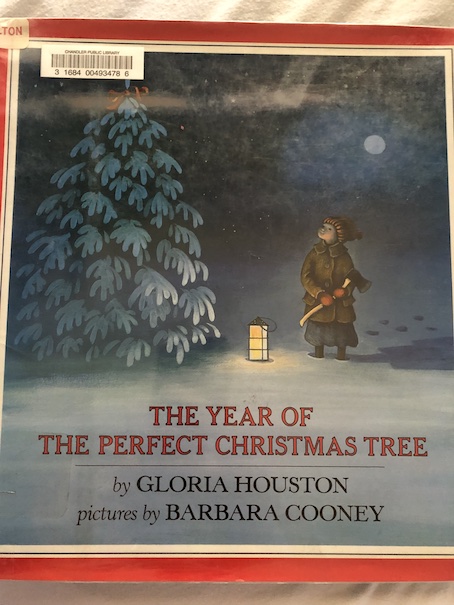
The Year of the Perfect Christmas Tree by Gloria Houston, pictures by Barbara Cooney, 1988.

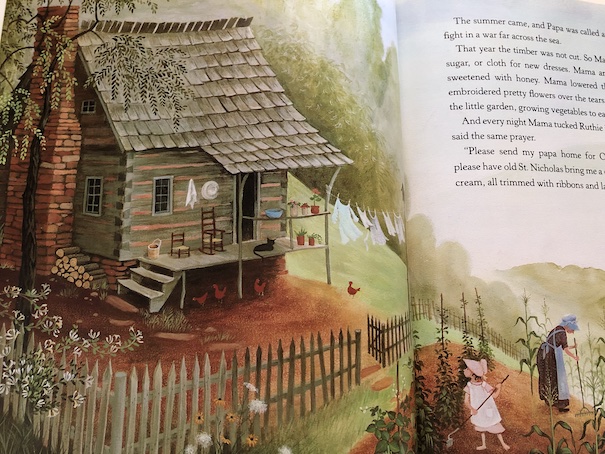
Ruthie is a little girl living on a farm in Pine Grove in the Appalachian Mountains during World War I. (The story calls it The Great War because that was its name before WWII.) During the spring, Ruthie’s father selected a tree for the village church’s Christmas celebration. The local families take turns providing the tree, and it’s their family’s turn. Ruthie goes with him to pick out the right tree and mark it with a red ribbon.

However, during the summer, Ruthie’s father has to go away to be a soldier overseas. Ruthie and her mother tend the farm while her father is away, but money is tight. Ruthie thinks ahead to Christmas and prays for her father to come home and for a special Christmas present for herself – a pretty doll with a cream-colored dress with ribbons and lace.

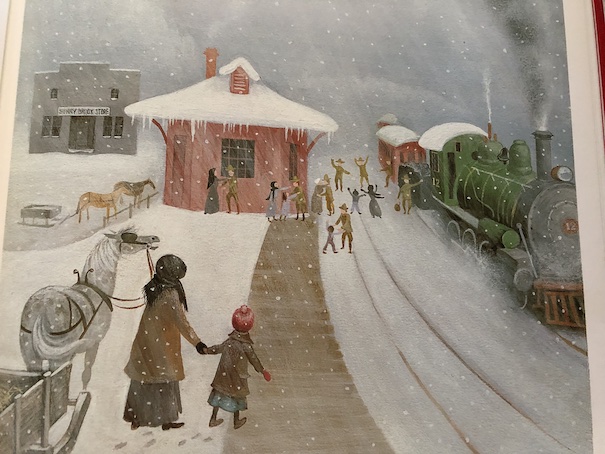
In the fall of that year (1918), Ruthie’s father writes a letter, saying that the Armistice has been signed, meaning that the war is over, so he’s sure he’ll be home for Christmas. Ruthie and her mother keep waiting for him to arrive any day, but he doesn’t seem to come, and they don’t know exactly when to expect him.

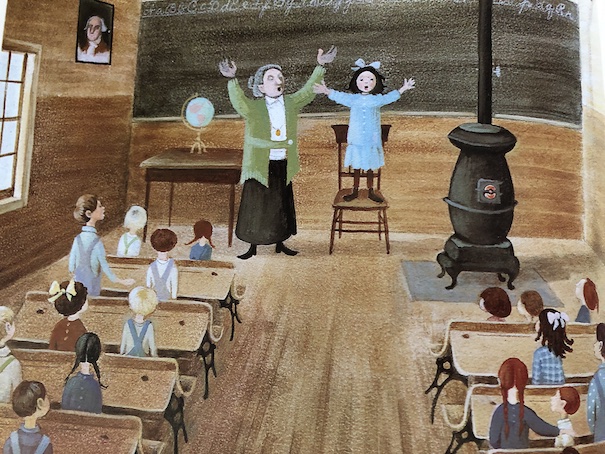
At school, Ruthie is told that she will have the role of the heavenly angel in the Christmas play and that they are still expecting Ruthie’s father to supply the Christmas tree. Ruthie is looking forward to it, but Ruthie and her mother don’t have enough money for a new dress for the angel costume, and there is still the worry about when her father will return home, and if he will make it in time to cut the Christmas tree and take it to the church.

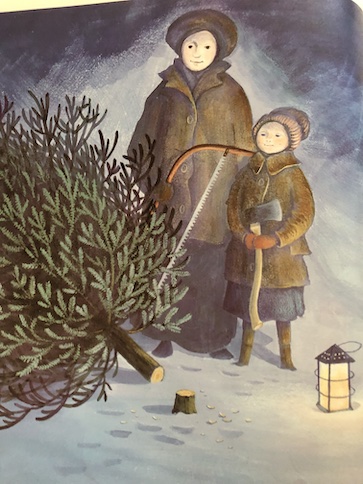
The local preacher tells them that the person who is due to provide a Christmas tree next year is willing to do it this year instead, if Ruthie’s father can’t get home in time, but Ruthie’s mother is still sure that their family can manage the tree. Ruthie’s mother decides that she and Ruthie will go get the tree themselves. It isn’t easy, but they manage it, and Ruthie’s mother also finds a way to make a dress for Ruthie’s angel costume.

However, there are two more things that would make this Christmas perfect for Ruthie – if her father returns home in time for Christmas and if she somehow receives the doll of her dreams.

The book is available to borrow and read for free online through Internet Archive (multiple copies).

My Reaction

This is a sweet, old-fashioned Christmas story about wishes coming true. Wishes coming true at Christmas is a popular theme in Christmas stories, and in this book, they come true because Ruthie’s mother and Ruthie do what they need to do to make everything work out the way they want it to. They could have let someone else provide the Christmas tree, and no one would have thought less of them for doing it because the father of the family was still away, but they were determined to see their family’s promise to provide the Christmas tree through. The mother also uses her old wedding dress for the material for Ruthie’s angel costume, and it’s implied that she also made the angel doll for the top of the Christmas tree that becomes Ruthie’s special Christmas present.

The pictures are charming, and they fit well with the Cottagecore aesthetic that’s been popular in recent years.

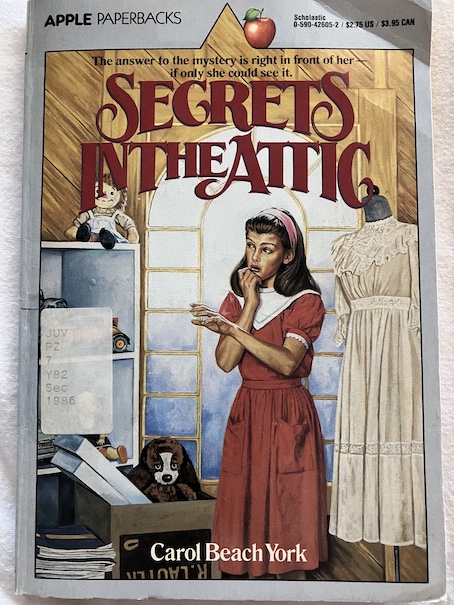
Secrets in the Attic

Following the death of Jodie and Peter’s father in a car accident, Jodie’s mother decides that she want to move to a new town and have a fresh start. For some reason, people have been gossiping about the family, particularly Jodie’s Aunt Claire. Jodie doesn’t really want to leave her old home, but she does make a new best friend in her new school. However, they don’t return to their home town of East Hill until Great Aunt Winifred invites them to visit for Christmas.

Jodie loves Aunt Winifred and her big, old-fashioned house with the old toys in the attic. She has fond memories of her whole family getting together for Christmas there, and she thinks that if they visit for Christmas, things will be like they used to be. Jodie’s mother knows differently. Things are not like they used to be with Jodie’s father gone and the gossip still hanging over the family, although Jodie doesn’t understand why. Her mother refuses to return to East Hill, but she says that Jodie can visit Aunt Winifred if she wants. Jodie doesn’t want to be away from her mother and little brother on Christmas itself, so they decide that Jodie can visit Aunt Winifred the week after Christmas, between Christmas and New Year’s.

Jodie still can’t understand why her mother doesn’t want to see Aunt Winifred, but it’s really Aunt Claire that she doesn’t want to see. Jodie’s mother explains that, around the time that Jodie’s father died in the car accident, some money was stolen from Mr. Carrington. Jodie’s father was a lawyer, and Mr. Carrington was once of his clients, and the theft was discovered after Mr. Carrington himself died of a heart attack. Aunt Claire accused of Jodie’s father of stealing the money, but since he was killed in the accident, he never had a chance to defend himself against the accusation. Uncle Phillip, Claire’s husband and vice-president of the bank where Mr. Carrington kept his safe deposit box, never believed that Jodie’s father took the money, but it was bad publicity for the bank when it was stolen. He was trying to get to the bottom of the situation, but he had been in the car with Jodie’s father during the car accident and was also killed. That may have been why Aunt Claire started making public accusations against Jodie’s father – to deflect any blame or suspicion of Phillip because of his role in the bank and maybe also because she blamed Jodie’s father for getting him killed in the car accident when they skidded on a snowy road.

In spite of everything that’s happened, and even because of it, Jodie feels like she has to return to East Hill to see Aunt Winifred and face Aunt Claire. She’s not sure how, but she thinks that if she goes back to East Hill, she might find something that will clear up the situation. There had been another suspect in the theft, a nephew of Mr. Carrington, who was known to be in debt, but nobody could figure out how he could have stolen the money. When it comes down to it, Aunt Claire herself spends more money than she should.

When she gets to East Hill, she realizes that her mother was correct that East Hill doesn’t feel like it used to. Jodie no longer feels like East Hill is her home. She likes her new town and misses her best friend. Her older cousin, Lisa, who is Aunt Claire’s daughter, used to get on her nerves sometimes because she was always the “perfect” child. She is very pretty and talented on the piano, always seems to look great and do everything right, and is also kind of a snob. When Lisa is at the train station with Aunt Winifred to meet Jodie on her arrival, Jodie realizes that Lisa bothers her even more than she used did before.

Lisa is still fussy and snobby and impatient with Aunt Winifred, who sleeps more because she’s getting old. One thing that interests Lisa about Aunt Winifred is that she’s heard that Aunt Winifred is making a new will, and she openly speculates about who is going to get the most out of it. Jodie is disgusted by this talk and asks her why anybody has to get more than anyone else, and Lisa matter-of-factly tells her that there is always a favorite and that the favorite always gets the most. (I can guess that her mother probably told her this.) From the way Lisa talks, Jodie can tell that she thinks of herself as the “perfect” favorite and, therefore, already entitled to receive the most. It disturbs Jodie that Lisa doesn’t seem to care that Aunt Winifred would have to die for her to get anything at all. One day, she overhears Aunt Claire lecturing Lisa that she needs to practice her piano music more while visiting Aunt Winifred because she wants Aunt Winifred to pay for Lisa to study music in Europe. Aunt Winifred seems to want it even more than Lisa does.

While Lisa busies herself with practicing at the piano and calling her friends on the phone, Jodie goes up to the attic to see the old toys they used to play with. When she looks in the attic, she is surprised that her feelings about the attic have also changed. There is something about the attic that now bothers her, but she can’t quite think what it is. She feels like something in the attic has changed or that she wants to change something there, but she’s not sure why. When she looks for a log cabin toy with little pioneer and Indian (Native American) figurines that her father always loved, she is surprised that it is missing. Aunt Claire doesn’t think much of it, suggesting that Aunt Winifred might have just thrown it away, not knowing that it was Jodie’s father’s old favorite toy. However, Jodie knows that can’t be it. Aunt Winifred never had any children of her own, and she loved her two nephews as if they were her sons. She was very sentimental about the toys that they loved, and Jodie doubts that she would just suddenly decide to get rid of one of them.

When Jodie finally figures out what happened to the log cabin toy, the whole truth about the theft comes out.

The book is available to borrow and read for free online through Internet Archive.

I liked the setting of the story. Big old houses like Aunt Winifred’s aren’t very common anymore, and I always wanted to live in a house with an attic that had a solid floor to it, like the one in the story. Jodie’s memories of playing with the old toys and dress-up clothes there sound fun. Although Jodie doesn’t spend Christmas itself at the house, she is still there during the Christmas season, so the Christmas tree with its unique, old ornaments is still there, and the family enjoys Christmas treats, like chocolates and mince pies.

I had theories about the mystery right from the start. I hoped that Mr. Carrington’s nephew, who we never met, wouldn’t be the thief because that felt too much like bringing in an outsider as the culprit. When Jodie meets a boy named Kenny and becomes friends with him, I thought his family might have something to do with the theft, but they don’t. He’s just a boy who likes Jodie and has fun with her, doing things that Lisa thinks she’s too grown-up to do anymore, like throwing snowballs and making a snowman.

I really suspected Aunt Claire as the thief from the beginning. She definitely has expensive tastes, and when she appears in the story, her clothes and hairstyle sound much more expensive than I would expect from a widow raising a daughter in a fairly small town. The way she and her daughter talk about getting their hands on Aunt Winifred’s money emphasizes how callous and money-grubbing she is. Even Lisa admits that she doesn’t really want to go to Europe to study music. Her mother is the one who wants to go to Europe, and she’s using Lisa as the excuse to get money so both of them can go there. Lisa doesn’t like her mother’s plans because she wants to stay at her school with her friends. It occurred to me that Claire’s accusations about Jodie’s father taking Mr. Carrington’s money could have been to cover up for herself doing it. Since her husband worked at the bank, she could have used his position to get access to the money herself. That’s not exactly what happened, though.

Claire is not the thief. In a way, she was the motive for the crime, so when the truth comes out, it’s still going to hurt. When Jodie discovers what really happened, she even feels sorry for her aunt because she knows that the truth will be hard for her to hear and will affect her reputation in this town in the same way that the suspicions about her father affected her mother. Jodie also feels sorry for Lisa, which I felt was more justified than sympathy for Claire. However, the story ends with Jodie finding out the truth for herself, and we aren’t shown the moment when she reveals it to everyone. We don’t get to see everyone’s reactions, and if it changes any of Aunt Winifred’s thoughts about her will, we don’t see that happen. We don’t know what arrangements Aunt Winifred made originally, so that doesn’t matter too much. The talk about the will is really to establish the moral characters of Aunt Claire and Lisa.

I suspected that Aunt Claire was set up as being so awful and unlikable that readers wouldn’t be sorry if she turned out to be the thief, kind of like how the people who get murdered in old episodes of Murder She Wrote are usually the people who are the most nasty to everyone during the first ten minutes of the show, so viewers are not too sad about them dying and can get on with the puzzle of figuring out who did it. Aunt Claire makes a great villain because I disliked her so much that I wouldn’t have cared no matter what she was guilty of or what happened to her. She’s the snotty kind of woman who says awful things about other people, both behind their backs and to their faces. She criticizes people she sees for being fat and offers unsolicited critiques of their clothes, like she’s the fashion police. She’s extremely manipulative of other people and their emotions for the sake of getting what she wants and making herself feel good, and this even extends to her own daughter. Basically, she’s one of those middle school mean girls who never grew up beyond that point. That she’s good at being awful to other people and getting things she wants is enough justification to her that she sees nothing wrong with being the way she is. I’ve known so many other horrible adults exactly like that in real life that I knew I would cheer to see her shoved under the proverbial bus.

I was expecting that her greediness and high maintenance lifestyle were her motives and that her nastiness was a set-up so readers could focus on the puzzle of how she gets caught. I even thought that the story might take a dark twist with her tampering with Aunt Winifred’s medicine to slowly poison her for the inheritance she expected, since Aunt Winifred said that her medicine was making her unusually sleepy. However, Aunt Claire isn’t an attempted murderer any more than she’s a thief. She’s just an awful person who uses people, and her high maintenance lifestyle was the motive for the real thief, who was probably also manipulated by Claire and her expensive tastes.

Lisa’s character softens a little during the course of the story. She’s still fussy and a little spoiled because of the way her mother is, but Jodie realizes that Lisa isn’t very happy with the way her mother is. Lisa likes music, but her mother is manipulating her as much as anyone else to further her lifestyle. Lisa knows what she wants for herself, and hopefully, even though the truth about the theft is going to hurt her, it might actually change things for Lisa’s benefit in the long term.

I also wondered whether the car accident had anything to do with the theft, but apparently, it doesn’t. It doesn’t seem to have been caused deliberately or by anything directly related to the theft. It was just an accident that took place at an unfortunate time.
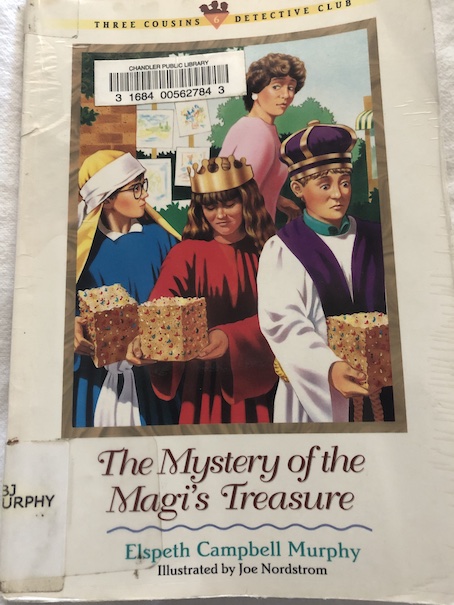
The Mystery of the Magi’s Treasure

Three Cousins Detective Club

#6 The Mystery of the Magi’s Treasure by Elspeth Campbell Murphy, 1995.

Timothy, Titus, and Sarah-Jane go to visit their grandparents in the resort town where they live over the summer. Their grandfather is the pastor of a church, and in their Sunday school class, there are three boys, all named Kevin, who are close friends and have a reputation for being troublemakers and goofs. The three cousins have little to do with the three Kevins, but it’s because of the three Kevins that they are recruited to help with the community’s Christmas in July art fair.

The community holds an art fair every summer, and this year, they’ve chosen Christmas in July as their theme. Some of the local churches are holding a special concert of Christmas music as part of the event, and someone through it would be a fun idea to have children dressed in costumes from the Nativity play, like shepherds and angels, to hand out flyers for the concert. The three Kevins get the roles of the Three Wise Men, but it becomes obvious pretty quickly that this arrangement isn’t going to work because they’re more like the Three Stooges than stately wise men. The choir director says that they need more reliable children to be the Three Wise Men, so naturally, he gives the roles to the three cousins. After all, their grandfather is the pastor, and their grandmother is always bragging about how well-behaved they are.

As soon as they put on the wise men costumes, Timothy realizes that there’s method to the Kevins’ madness. If you get a reputation for being reliable and doing good work, people give you more work. If you get a reputation for not doing anything right, nobody will even let you do certain jobs. The job of being wise men in July is anything but fun. The robes are too heavy and hot for summer. They can’t even complain because everyone says they look adorable, which is humiliating, and their grandmother keeps telling everyone how proud she is of them. It’s almost like they’re being punished for being good, and they can’t say a thing about it without disappointing Grandma.

Then, something really strange happens while they’re passing out flyers. A woman they’ve never seen before runs up to them and gives them three boxes. She says that they’re supposed to be part of their costumes, the gifts for Baby Jesus. She seems a little flustered and has trouble remembering exactly what the gifts are supposed to be, forgetting the words “frankincense” and “myrrh.” She tells the kids that she’s in charge of the props and that they have to take good care of these boxes and only return them to her. Then, she rushes off again.

The kids think that it’s an inconvenience to have to carry around the boxes as well as pass out flyers, but the woman’s manner struck them as strange. When they look more closely at the boxes, the workmanship also seems unusually good for objects used only for a Nativity play.

Then, the kids overhear a couple of artists talking about some artwork stolen from a fellow artist. Suddenly, they have an uncomfortable feeling that they know what was stolen, who took it, and where it is now. The big problem is that the thief is watching them.

Theme of the Story: Goodness.

The book is available to borrow and read for free online through Internet Archive.

My Reaction and Spoilers

After the kids hear about an artist’s work getting stolen, it doesn’t take them long to realize that the boxes they were give were probably the stolen artwork and that the “prop” lady who didn’t seem to know what she was doing was the thief. She was just looking for a convenient place to leave her stolen goods so she wouldn’t be caught walking around with them, and she happened to spot the children in their wise men costumes. Three fancy boxes look like what people would expect the gifts of the Three Wise Men to look like, so the thief could essentially hide the stolen goods in plain sight. The artists talking about the theft were uncertain exactly what type of art was stolen, so most people at the fair also wouldn’t know what to look for and would just assume that the boxes were props.

The Kevins got them into this mess in the first place, and they turn out to be the way out of it, too. The thief was counting on the kids being easy for her to watch because they stand out in their costumes but almost invisible to bystanders because everyone else just disregards them as being in costume and doesn’t look closer. What the kids realize is that maybe she also hasn’t looked closely enough to really recognize them and is only following the costumes, no matter who happens to be wearing them. Once the cousins explain to the Kevins what’s happening, it’s exciting enough for the Kevins to be more than happy to participate. They finally put their playacting and thrill-seeking to a good purpose!

Weirdly, the thief also unintentionally did a good deed for the artist. The artist has been doubting herself and the quality of her work. While stealing from her was a bad thing to do, the thief unintentionally confirmed that her work was so good that she was willing to steal it! It reminded me of a funny line from an old episode of Remington Steele with an artist whose work was stolen: “I’ve finally hit the big time! I’ve been stolen!”

The theme of “goodness” sounds somewhat generic, but the story is really about turning something bad into something good. The kids didn’t really like getting the roles of the Three Wise Men, but if they hadn’t taken them, they wouldn’t have found this mystery and saved the stolen artwork. Instead of goofing off and messing up like usual, the Kevins came through when it was really important. The woman who tried to take something that didn’t belong to her proved that it was something with value. The boxes themselves were made from pieces of junk, but they’re beautiful. It doesn’t mean that stealing becomes right if it unintentionally accomplishes something good, but the kids come to realize that even things that don’t seem like they’re worth anything can have unexpected good sides. Even Baby Jesus was born in a humble stable.

The Mystery in the Snow

The Boxcar Children

Boxcar Children Mystery in the Snow cover

The Mystery in the Snow by Gertrude Chandler Warner, 1992.

Boxcar Children Mystery in the Snow  arrival

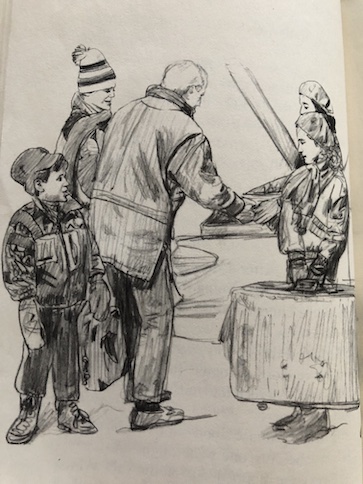
The Alden children are disappointed because there is still no snow this winter, and they’ve really been looking forward to snow. Their grandfather tells them not to worry because, soon, they’ll have all the snow they want. A friend of his, Mr. Mercer, owns a ski lodge and has been urging him to visit and bring his grandchildren. There’s going to be a winter carnival there. The children are eager to go and have fun in the snow!

Boxcar Children Mystery in the Snow choosing teams

At the ski lodge, the Alden children meet a boy named Jimmy. Jimmy is a regular visitor to the lodge, but for some reason, he says that his parents never stay. There is also a girl called Freddie, which is short for Fredrica. Her parents aren’t at the hotel, either, because they’re visiting her sister, but she says that they will come later. Freddie could have gone to visit her sister, too, but she didn’t want to miss the fun at the ski lodge. She and Jimmy are both team captains for the winter games, which include skiing, skating, sledding, snow sculpting, and ice carving. Strangely, when the team captains get the box where kids are supposed to submit their names to join the teams, they can’t find the keys. The loss of the keys is worrying because, if they can’t find them, they won’t be able to get into the equipment shop for the equipment they need for the games. They still manage to put together the teams, and the Alden children also join.

Boxcar Children Mystery in the Snow  skates

Then, Mr. Mercer discovers that all four of the tires on his truck are flat. Grandfather Alden offers to drive him into town to get a pump for the tires and to talk to a locksmith about getting into the equipment shop.

While the adults tend to that, the kids talk about the try-outs for different events. The Aldens are all excited about different events. Violet notices that one girl, Nan, isn’t enthusiastic about the events at all and doesn’t want to try out for anything. Violet asks her why, and Nan says that joining in the games was her parents’ idea, not hers. They say it will be fun, but she never really enjoys herself at these things. She doesn’t think there are any events she can do, and she’d hate to be the one to lose an event for her team. To encourage her and build up her confidence, Violet suggests that they both sign up for the ice carving event, which doesn’t require a try out. Violet says that she doesn’t know how to do ice carving, and Violet says that’s fine because she doesn’t, either. She says that it would just be fun to try it out together. Nan points out that they would be competing against each other because they’re on opposite teams, but Violet says that doesn’t matter because they’re both equals, neither one of them knowing what they’re doing. Nan is cheered by Violet’s friendliness and signs up for ice carving.

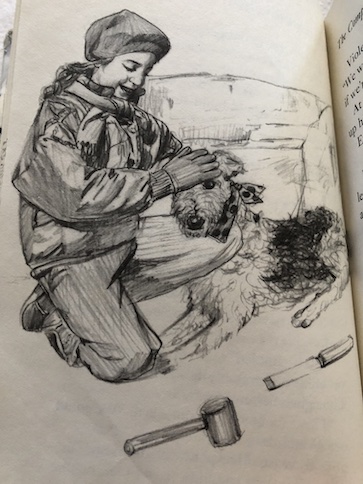
Boxcar Children Mystery in the Snow  Watch the dog

Nan isn’t the only unhappy child involved in the games, and the Aldens begin to feel that the focus on competition instead of simply having fun in the snow is partly to blame. A boy named Pete is upset that he didn’t get selected for any of the events he tried out for, and he says he doesn’t want to be the time team’s time keeper, which is the default position. Pete says he no longer wants to be involved in any of it. Freddie is angry because she and Jimmy drew names for their team members at random, and she thinks that Jimmy ended up with most of the really good team members. She wants a way to even things out. When the Aldens ask Jimmy if his parents will come to the awards dinner at the end of the games, he seems upset and doesn’t want to talk about it much. They’re not sure if Jimmy is more upset about his parents not being there than he pretends or if he’s worried about the awards ceremony in general.

Boxcar Children Mystery in the Snow  smashed sculpture and footprints

It soon becomes apparent that someone is intentionally trying to sabotage the winter games. Someone smashes the snow sculptures that the Aldens made for their team. Then, someone steals a skier’s skis and ruins the ice sculpture made by the other team. The entire skating event has to be postponed when someone ruins the ice.

Who is doing these things and why? It could be someone who’s trying to make their team win the competition, but the sabotage has been aimed at both teams and at the event in general. Is it a kid who is unhappy with the contest or their position on their team? Jimmy seems eager to cancel events every time something goes wrong. Can the Boxcar Children figure out who is responsible?

The book is available to borrow and read for free online through Internet Archive (multiple copies).

My Reaction

Boxcar Children Mystery in the Snow  skis

There are themes in the story about competition and family. The Aldens aren’t accustomed to thinking competitively about other people because they’re used to doing things with each other cooperatively, as a team. Because they’re accustomed to thinking cooperatively, they are friendly with people on the other teams, like Nan, and they’re more focused on the fun of the events than on winning. That makes them different from some of the other kids, who are concerned about winning, but there are other issues in the book besides competition that matter more.

Boxcar Children Mystery in the Snow  knocking on the door

There are indications in the story that the parents of the children in the competition don’t always want the same things that their children want. Nan, for instance, didn’t even want to join contest, but her parents urged her to do it. Also, some of the children aren’t as good at others at conveying to their parents what they really want. When the most troubled child in the group finally manages to say what they really want, many things get straightened out.

I feel like there are many stories where the conflicts revolve around people who don’t really communicate with each other. In this story, there’s a character who blames others for not understanding how they feel, but even they have to acknowledge that they haven’t actually explained their feelings. They’ve just been expecting everyone else to know what they’ve been feeling. Some honest communication straightens out the problem, and that’s a good life lesson for kids and families.