It’s winter, and Kirsten’s brother, Lars, is going to set animal traps in the woods with his friend, John Stewart, who lives nearby. Kirsten is friends with John’s sister, Mary. Trapping animals for their pelts is one of the ways that the boys make some extra money. The local men are all away, working at a logging camp for the winter. Kirsten isn’t really interested in trapping animals so much as she just wants to get out of her family’s little cabin because she’s been cooped up due to the winter weather, so she persuades the boys to let her come along on their trapping expedition.
As they go through the woods, Kirsten spots an animal snare that someone else set out, and John explains that there’s an old trapper called Old Jack who lives by himself in the woods. He has no family and often prefers to be by himself and avoids meeting many people, although he sometimes helps locals with their own traps. The snare is probably one of his traps. When they find a trap that has a baby raccoon caught by the tail, the boys say that it’s too small for them to kill it for its pelt, and Kirsten feels sorry for it. She persuades them to let her take it home and nurse it back to health, like she did with an injured bird, before releasing it into the wild again.
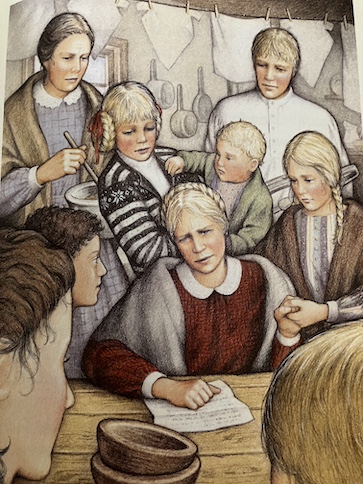
Kirsten is supposed to leave the little raccoon in the barn because, as her family tries to explain to her, wild animals are wild and uncontrollable. However, Kirsten feels sorry for the little thing because the barn is cold, so she brings it into the cabin. It turns out to be a terrible idea. The raccoon gets loose and knocks over an oil lamp that sets the cabin on fire! Kirsten makes her her little brother and sister get out safely, and when she realizes that the fire is spreading too fast for her to stop it, she manages to save the painted trunk with some of her family’s most important belongings. Unfortunately, the cabin is completely destroyed.
Kirsten’s aunt takes in Kirsten, her mother, and her siblings. It’s a little crowded in her house, but at least, they have a place to go. Everyone is understandably upset, although they are not too hard on Kirsten for causing the disaster. However, her mother says that they had been hoping that maybe they could buy a little land with the money Kirsten’s father is making at the logging camp, but she doesn’t see how they can now. They’re going to have to build a new cabin and replace some of essentials that they lost in the fire.
Then, John and Mary Stewart tell the Larsons that their family will be moving to Oregon because their father has found a new job managing a logging camp there. Kirsten is sorry to see the Stewarts leave because they’ve been good friends, but Aunt Inger points out that the Larsons’ problems will be solved if they can manage to buy the Stewarts’ house. The Stewarts’ house is much bigger than the little cabin where the Larsons lived, and the Stewarts will have to sell their home before they can move anyway. The problem is that the Larsons just don’t have the money to afford the Stewarts’ house.
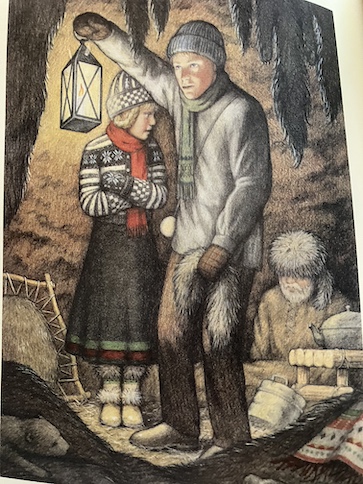
All Lars can think to do is try to make more money through trapping. Kirsten goes along to help him, and one evening, they stay out much later than they mean to and get lost in the dark woods. When the spot some human tracks in the snow, they think that they are probably the tracks of Old Jack, the trapper hermit. Kirsten thinks that Old Jack sounds frightening, but with no one else to turn to for help and shelter, they decide to follow the tracks to where Old Jack lives. When they find Old Jack’s home in a cave that he has turned into a rough house, they make an important discovery that changes everything for the Larsons.
The book ends with a section of historical information that explains how new settlers moving westward turned frontier areas like the area where Kirsten’s family lived into more settled towns. The farms where people lived became less isolated, and railroads connected cities and rural areas across the country. The first transcontinental railroad in the United States was completed by the time Kirsten would have turned 24 years old, changing the ways that people and goods traveled.
The book is available to borrow and read for free online through Internet Archive (multiple copies).
My Reaction and Spoilers
This was one of the books that I remember I didn’t like in the Kirsten series when I was a kid because it’s just so painful when the family’s cabin burns. Reading the book again, I appreciated how the family wasn’t overly hard on Kirsten about bringing the raccoon into the cabin that caused the fire. I couldn’t really blame the others if they were upset with Kirsten because it’s a major disaster that destroys their home and leaves them in a very precarious position. However, even though they’re understandably upset at the situation, it is nice that they don’t lay a guilt trip on Kirsten about it because that would have made it a much sadder story.
It also helps that the situation works out for the best in the end. When they hear that the Stewarts are moving, they do want the Stewarts’ house, but they just don’t think they will be able to afford it. What changes for the Larsons is that they receive an unusual sort of inheritance from Old Jack. When Kirsten and Lars are lost in the woods and seek shelter from Old Jack, they discover that Old Jack has died. There doesn’t appear to be any foul play. Old Jack was an elderly man, and he seems to have died from natural causes in his house. It’s a grim discovery, but while Kirsten and Lars shelter in his house with the body overnight, they also realize that Old Jack has a hoard of fine animal pelts. Since Old Jack has no family and no one to inherit his property, there is no dispute that the Larsons can claim his pelts because they found his body and plan to arrange for his burial. With the money that Old Jack’s pelts bring, they are able to afford the Stewarts’ house, which is much better than their old cabin. The Stewarts also leave them some furniture and household supplies.
I do like it that the story worked out for the best, although I wasn’t fond of the theme of trapping animals for pelts. I remember that this was an aspect of other books that I read as a kid, like Where the Red Fern Grows, but I never liked hearing or reading about it. I understand hunting for food, and I know the family in the story traps animals for fur because they badly need money, but it’s not a subject that I enjoy hearing about. The metal traps the boys use for trapping animals are considered inhumane in modern times, and their use is now banned or restricted in many countries and states.
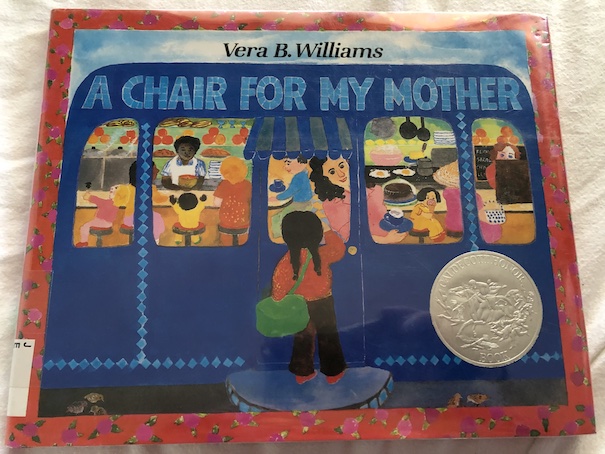
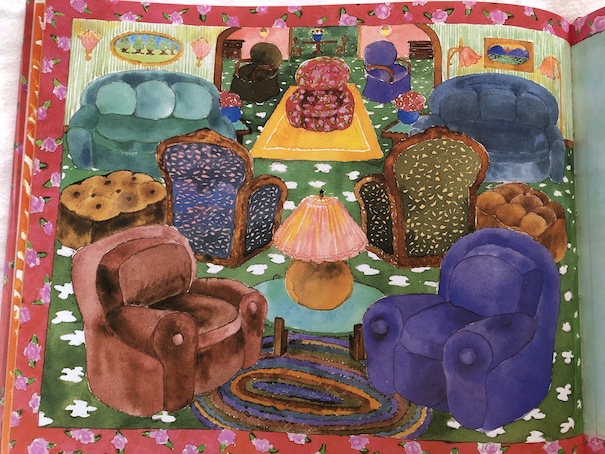
A girl explains how her family is saving up for a new chair after a fire destroyed all the furniture in their old home. The fire happened before the story really begins, but the girl explains how she and her mother returned from a shopping trip and discovered that their home was on fire.
The girl’s grandmother and the family cat escaped from the fire, but everything they had in the house burned.
The girl, her mother, and her grandmother all moved in with the girl’s aunt and uncle until they could move into a new apartment. However, they didn’t have any furniture in the apartment. Their relatives, friends, and neighbors all helped them by giving them food and pieces of furniture they didn’t need anymore.
It was a big help, however, a year later, they still don’t have a sofa or comfortable armchairs. The girl’s mother works in a restaurant, and when she comes home, she’s very tired from being on her feet all day. She wishes that they had a comfortable armchair where she could rest after work.
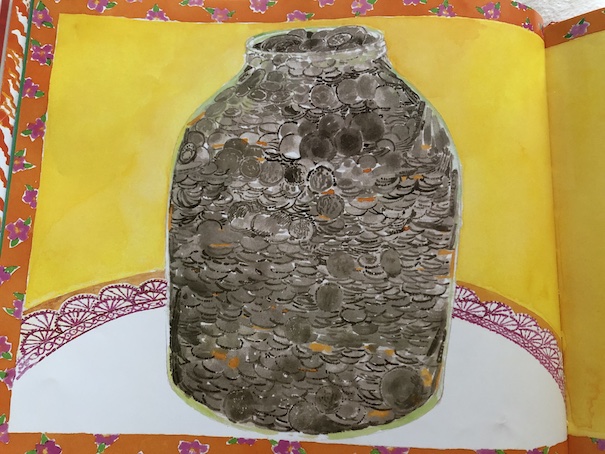
The mother starts saving part of her tips from the restaurant in a coin jar to save up for a new chair. Sometimes, the restaurant owner even pays the girl to do little chores, and she saves part of her money for the chair. Whenever the girl’s grandmother saves money on food she buys, she also puts the savings into the jar. They say that when the jar is full of coins, they will buy the new chair they want.
Eventually, the jar is completely full. They count the coins, roll them in coin wrappers, and take them to the bank to change them for ten-dollar bills. Then, they go shopping for a new chair! There are many chairs to choose from, but they know exactly what kind of chair they want.
The book is a Caldecott Honor Book. It’s available to borrow and read for free online through Internet Archive (multiple copies, including one in Spanish).
My Reaction
I remember this book from Reading Rainbow when I was a kid! The pictures are bright and colorful, and the story offers comfort and hope.
The people in the story have been through a tragedy where they lost almost everything they had, but the book shows how they recover. Although the fire was sad, the story starts after the fire happened, and the girl talks about the help they’ve received and what they’re doing to make their new home more comfortable. They’re over the initial shock of the fire and concentrating on improving their situation from there. This book felt both comforting and very real. I liked how it showed the family recovering from their ordeal through a combination of help from relatives and friends and their own efforts. Other people help them with some basic household items as they move into a new apartment, and they also save up their money for the chair they want to make their new place feel more like home.
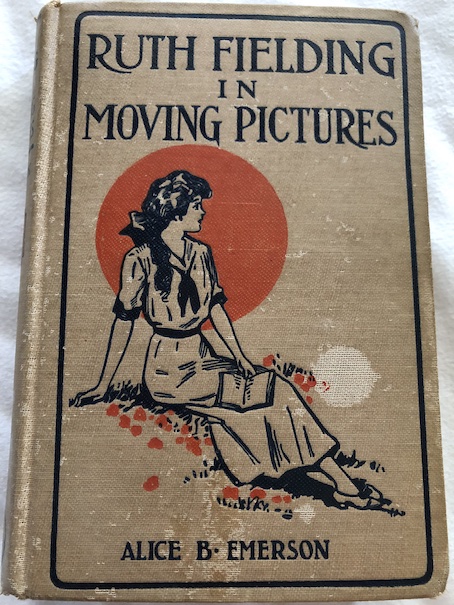
Ruth Fielding in Moving Pictures; Or, Helping the Dormitory Fund by Alice B. Emerson (Stratemeyer Syndicate), 1916.
One day, while Ruth Fielding is out with her friends, Helen and Tom, they see a film crew working by the river. (Because this is the 1910s, they are making a silent film and using the kind of old-fashioned movie camera that needs to be cranked, like the one shown in the picture to the right.) They talk about whether to not they would like to be in movies themselves. The girls think it sounds exciting, but Tom thinks that they’re too young. The girls say that they are not too young because the actress who is being filmed looks like she’s about their age. As they watch, the young actress accidentally falls into the river, which is freezing cold because it’s winter. Ruth and her friends hurry to help pull her out before she drowns. When they get her out of the river, Ruth is appalled at how unconcerned the director is for the actress’s health while she’s clearly suffering from the cold. Ruth and her friends take the actress, Hazel Gray, back to the Red Mill where Ruth lives, where she can warm up and recover.
While Hazel is resting at the Red Mill, she and Ruth tell each other about themselves. Like Ruth, Hazel is also an orphan. Her parents were actors, and some friends raised Hazel to be an actress after her parents died. Ruth tells Hazel that she has been thinking about writing a movie scenario (script) just for fun, and Hazel offers to show it to the director if she does. Ruth isn’t sure she likes the idea because she didn’t like the director, Mr. Grimes. Hazel explains that, while the director can be callous and abrasive, he is a famous director who really knows his business and can help actors and scenario writers make their careers.
The next day, Mr. Hammond, the manager of the film company, comes to the Red Mill to see how Hazel is and to ask Ruth about how the accident happened. He seems concerned about whether or not Ruth’s description of what happened matches what Mr. Grimes told him. Ruth explains what she saw to Mr. Hammond, and she also tells him what she thinks about Mr. Grimes’s lack of concern about Hazel’s welfare. Mr. Hammond says that it’s impossible to change other people, indicating that he knows how callous and unpleasant Mr. Grimes can be, but he promises to make sure that Hazel gets a fair deal for her acting and the accident she suffered.
While he is there, Mr. Hammond becomes fascinated by the quaintness of the Red Mill. He thinks that it would make an excellent setting for a movie. Ruth says that she would love to write a scenario about the Red Mill herself. Mr. Hammond asks her if she’s ever written a scenario before, and Ruth admits that she hasn’t, but there has to be a first time for everything. Mr. Hammond is amused and says that he would be very interested in any scenario that Ruth might write. However, he suggests to her that, before she writes a scenario about the Red Mill, she write a short story about something else, something exciting, so he can see what her writing is like. Ruth happily agrees, and after she returns to boarding school with her friends, she starts writing.
Ruth and Helen are now seniors at their boarding school, and they are starting to think nervously about their lives after graduation. They know that they want to go on to college, but they find the prospect intimidating, too. Neither of them is quite sure what they want to do with their lives. The idea of growing up in general sounds frightening.
The girls aren’t the only ones showing signs of growing up but feeling awkward about it. Ruth finds herself getting unexpectedly jealous about Tom having a crush on Hazel. Helen says that Ruth simply hasn’t been paying attention to the things the boys are doing. All of Tom’s friends at his school have crushes on actresses, and they’ve been collecting pictures of them from the newspapers and pinning them up in their rooms. At the same time, Tom seems oddly sullen that other people are starting to treat Ruth and his sister as young ladies. It’s one thing for him to have a crush on Hazel, who is a couple of years older than they are, but he doesn’t seem to like the idea of Helen and Ruth seeming too grown up.
These things are in the back of Ruth’s mind as she finishes writing her story. After she sends her story to Mr. Hammond, a fire breaks out in one of the dormitories at the school because of a neglected candle. The dormitory that is destroyed is the one where Ruth lives with her friends. Ruth is tempted to try to save their belongings, but the teachers tell her that it’s just too dangerous. They’re just thankful that all the girls are safe.
After the fire, there is the question of rebuilding the dormitory. At first, they think that the insurance money will pay for a new dorm, but it turns out that the school’s forgetful headmaster accidentally let the insurance policy lapse. Some of the girls at the school are from wealthy families, and they are sure that their parents would be willing to contribute to the building of a new dorm, but Ruth sees a couple of problems with that. First, while the wealthier students’ families would certainly be able to contribute sizable amounts toward the building project, the families of poorer students may hesitate to contribute at all because they may be embarrassed that they cannot possibly match the donations the wealthier families can contribute. Second, the girls are overly relying on their parents. While the parents may be glad to help, Ruth thinks it would be better to find a way that the students themselves can contribute to the building fund. The other students agree that they would all like to find a way for everyone to contribute.
An idea for a group project the entire school can participate in comes to Ruth when Mr. Hammond sends Ruth a check to pay for her first story. He thinks that Ruth has a great talent for writing, and he’s going to make her story into a short, one-reel movie! That makes Ruth realize that, if she can write a short story for a short movie, she can write one for a long, five-reel picture. If she can write a long scenario for a movie, all of the girls in the school can be in the film! She thinks that she can persuade Mr. Hammond to produce the picture and distribute it to the surrounding town, and the royalties from the movie can pay for the dorm reconstruction.
Mr. Hammond agrees to help Ruth and her friends make a movie on behalf of the school, and the school’s headmistress agrees to allow the students to participate in the project. The donations that the school has already received from the parents have paid for the removal of the ruins of the old dormitory and the beginning of the construction of the new one, and the money the girls earn from the movie can pay for the completion of the building project. Ruth already has an idea for the plot of the movie, one about girls at a boarding school, so they can film the movie on their own campus. Mr. Grimes turns out to be the film director, and he is still temperamental, but he shows more patience when dealing with the students than he had before.
There are complications, of course. Hazel Gray is one of the professional actresses helping with the movie, and Ruth is still jealous about how fond she seems of Tom. Then, there is drama when the other girls learn which girl left the candle unattended and vent their wrath on her. The girl, Amy, was already a troubled student with an unhappy home life. Then, Amy gets upset when the boy she likes seems to be getting too friendly with Ruth, and she runs away. Ruth and the other girls have to search for her, and they learn the embarrassing secret behind the dormitory fire and some other secrets that Amy has been hiding from them.
This book is now in the public domain and available to borrow and read for free online through Project Gutenberg.
My Reaction and Spoilers
Is There a Mystery in the Book?
Not exactly a mystery, but there are some things that Ruth and her friends discover some secrets about their prickly fellow student, Amy, and when she runs away, the other girls have to figure out where she went and rescue her. Although Ruth and the other girls are unhappy with Amy because of the dormitory fire and because Amy frequently has a sour attitude, but they become more sympathetic when they learn more about some secrets that Amy is hiding. The embarrassing secret behind the dormitory fire is that Amy is afraid of the dark. She doesn’t want to admit it to the other girls because she doesn’t want to be teased, but that’s why she left a candle burning in her room; she was afraid of returning to her room after dark. The school has electric lights, but she grew up in a more old-fashioned town and isn’t used to them.
Worse still, Amy is terrified that her father will find out that she caused a fire at school. He is already harsh with her, and it has gotten worse since he remarried. He seems to view the child from his first marriage as a nuisance, and it seems like he sent her to boarding school to get her out of the way as he starts a new life with her stepmother. Actually, Amy’s father’s reasons for sending her to boarding school were not just to get her out of the way. Ruth and the others learn that part of Amy’s difficulties with her stepmother have partly been because Amy behaved badly toward her because her aunts disliked her and were a bad influence on Amy. It wasn’t just that the boy she liked seemed to like Ruth that made her run away; she had gotten an angry letter from her father that not only accused her of doing something bad before she left home but also saying that he has heard rumors about her involvement with the fire. He is coming to the school to find out for himself what she’s been doing there, and Amy is terrified of what he will do when he gets there.
To find Amy, the girls and Curly (the boy Amy likes) have to think of all the things they know about Amy and the places she could have gone. Curly knows more than the girls do because Amy confides in him. I appreciated that Ruth and the other girls are much more active in this story in solving the problem of Amy’s disappearance than they often are in other books. In the earlier books in this series, Ruth and her friends frequently rely on chance and coincidence to reveal hidden information and other people to carrying out the final action, but this time, they use their own reasoning to figure out where to look for Amy and go after her themselves. In some ways, I think that the more active roles that Ruth and the others play in the story are because they are growing up. Amy is younger than Ruth and her friends, and they feel responsible for her. In earlier books, adults and others were looking after them and helping them, but now, they are older than someone else. I’m looking forward to seeing how this develops in other books in the series.
When they find Amy, she has had a bad reaction from poison oak or poison sumac, and everyone feels sorry for her. Amy gets the first sympathy that she’s had for some time. Amy straightens out her relationship with her father when he comes and realizes that she was unfair to her stepmother. The other girls at school forgive Amy for the fire when they find out what she’s been through, and her father makes a generous donation to the building fund.
Characters That Age
One of the most unique features of this book is that the characters are growing up, and it’s part of the story. That’s something that doesn’t happen in other, later Stratemeyer Syndicate books. In this book, Ruth and her friends graduate from their boarding school. As the girls think about their graduation and going on to college, they’re a little intimidated because they don’t know what they want to do with their lives, but Ruth discovers her talent for writing movie scripts/scenarios. (These are silent films in her time, so there’s no dialog for the “script.” Any dialog that the audience needs to understand would have been shown in text in the intertitles. I think that’s why they call this form of script a “scenario” in the book.) There is some awkwardness in the way the boys and girls in the story start looking at each other because they realize that they’re becoming young ladies and young men. They’re not used to thinking of themselves and each other in that way, and they’re developing crushes.
You won’t find this sort of thing much in the on-going Stratemeyer Syndicate book series, like Nancy Drew and the Hardy Boys. Those characters are frozen in age on purpose, and the Ruth Fielding series was part of the reason why. In early Stratemeyer Syndicate book series, like Ruth Fielding and the Rover Boys, the characters did age. They grew up, graduated from school, got married, and eventually, had kids of their own. The problem for the Stratemeyer Syndicate was that, when their characters got married and became parents themselves, they were starting to get too old to be teen detectives and young adventurers. Their child audiences wanted to read about kids like themselves or teenagers or young adults, not people who were more like their own parents. So, whenever characters started getting too old for the target audience, they would have to end that series and start a new one. After going through the Rover Boys and Ruth Fielding and some of their other popular series in this way, they realized that they could keep a book series going much longer if they just didn’t let the characters age.
That’s why Nancy Drew and the Hardy Boys are frozen in age somewhere in their late teens or early 20s, and the books typically leave it vague which it is. It’s mostly important that readers know that the characters are young but old enough to travel and have adventures by themselves. Nancy Drew is not going to school, and if she takes any classes in individual books, she isn’t studying for a degree. If she did, her series would eventually end because she would graduate and move on to adult life. Similarly, the Hardy Boys are learning to be private detectives by working with their father, who is a private detective, but they will always be in that apprentice phase, so their series can continue. There are times when the characters date other characters or have crushes, but their romances don’t progress to anything serious because that would also age the characters. Every decade or so, the books in those series get revamped or the characters get a new, updated series that incorporates modern technology and culture, but the characters stay roughly the same age throughout. It’s basically what happens with new Scooby-Doo cartoon series, but with books, and the Stratemeyer Syndicate did it with their characters first.
Part of the reason that I wanted to read the Ruth Fielding books was that I knew the characters would age, and I also knew that she was a kind of prototype for Nancy Drew. The Nancy Drew series started around the time Ruth Fielding’s series ended, as a replacement for Ruth Fielding. Fortunately, we’re not at the end of Ruth Fielding’s series yet. The series doesn’t end with her boarding school graduation. It continues through her time in college and into her career in the movies.
This book was originally called Twin Spell but was renamed Double Spell in reprintings.
Elizabeth and Jane Hubbard, a set of twelve-year-old twins, can’t really explain what made them stop to look at the little wooden doll in the window of the antiques shop. Ordinarily, they probably wouldn’t have noticed it at all, but something seemed to draw them to it while they were supposed to be going home to look after their little brother. The woman in the shop wasn’t going to sell the doll to them, either, but for some reason, she said that she felt that she ought to do it because it seemed like the doll belonged with them.
Buying the old doll starts off a chain of mysterious events in the twins’ lives. On impulse, still forgetting that they’re supposed to go home and baby-sit, the girls decide to visit their Aunt Alice and show her the doll. Aunt Alice had been living in England, but she had recently moved back to Toronto to live in the girls’ grandmother’s old house. Aunt Alice doesn’t know what to think of the doll, except that it might be worth something as an antique. She shows the girls around their grandmother’s old house, but Elizabeth has a sudden fall down the stairs, breaking her leg. Strangely, a week later, Aunt Alice suffers a similar accident, breaking her hip.
Because of her accident, Aunt Alice decides that the big old house is a bit much for her to handle, and she tells the twins’ parents that they can have it to live in instead. With five children in the family, including the twins, they could really use the larger house, and the children are excited about going to live there.
The twins find themselves thinking of odd things, as if they were old memories. They suggest taking a “sick basket” of goodies to their aunt, thinking that maybe their mother had done something like that for someone before or maybe they had dreamed something like it. Their brothers can’t remember any such thing happening, and it would be pretty weird for both of the girls to have the same dream.
However, the children think that a basket of goodies for their aunt would be a good idea. They put together some stuff from their kitchen and what they can buy with their money, and they decide to include a book that she can read while she’s recovering. Unfortunately, the book they choose from their shelves turns out to be a rare copy of a book about the history of Toronto that their father was using for a research project, so they have to get it back. They do, and Aunt Alice tells them that she enjoyed it and that she had forgotten that an uncle had written it.
As the family moves into Aunt Alice’s old house, the twins keep thinking that there is something strange about their doll, that it seems to be influencing them, giving them visions of the past. Besides the “sick basket” dream they both had, they have visions of a house and a blonde girl in old-fashioned clothes. They start to think that the doll, which they both have the impulse to call “Amelia,” might be magic or something. Jane is the more sensible of the two, and she insists that there must be some other explanation, like imagination or coincidence. Elizabeth, the dreamier twin, insists that it’s the influence of Amelia, that they’re somehow seeing Amelia’s memories of the past.
After the girls argue about the doll and the source of their odd visions, Jane starts ignoring Elizabeth. Elizabeth continues thinking about what they’ve seen, and the blonde girl, who she is sure is called Hester and was the former owner of Amelia. Eventually, Jane starts agreeing with Elizabeth about Hester being the doll’s former owner, but she is dubious when Elizabeth says that Amelia wants to find the house where she once lived with Hester. Jane doesn’t know how the two of them can do that.
They ask their father for his advice, and he suggests that they start at the museum. There, they learn by studying the styles of old clothes that Amelia is from the 1840s. They find an area of town with houses similar to the one they’ve seen in their minds, where Amelia once lived, but they have trouble finding the exact house they’re looking for.
Jane becomes increasingly afraid, though. More and more, she begins to feel like something is trying to take the doll away from them. Something that is mean and doesn’t like her is in their attic. Something like a ghost. Jane has an awful feeling that something horrible is about to happen.
When the Jane looks at the history book her father has been reading, the one written by her great-great-uncle, Jane suddenly has a startling revelation. The house they have been seeking in actually their house, changed over the years by new additions. Amelia came from their house, and that is where she really belongs. Through the visions, they see an old tragedy in their family reenacted, a tragedy that puts Jane’s life in danger.
The book is available to read for free online through Internet Archive. There is no need to borrow this copy and no time limit; you can just read it in your browser.
Themes and Spoilers
The girls had made a mistake when they first started receiving their visions. They had assumed that Hester was Amelia’s original owner, but she wasn’t. The glimpses they got of Hester weren’t through the doll’s eyes, but those of the doll’s real former owner. The doll was one of a set of two that originally belonged to another set of twins in the girls’ family, Anne and Melissa. Hester was their cousin, and she was not a nice girl. Both Jane and Elizabeth sensed it pretty early. During an argument with Anne years before, Hester accidentally lit Anne’s dress on fire with a candle she was holding, causing Anne to die. Hester hadn’t actually meant to harm Anne. The whole thing was just an accident, but Hester’s guilt and Melissa’s anger and grief at her twin’s death had caused Hester’s spirit to linger in the house. By learning the circumstances of Anne’s death and assuring Hester that they understand that she had not meant to kill her cousin, that it was all an accident, and that she couldn’t save Anne because she was just too frightened and didn’t know what to do, they help Hester’s spirit to finally rest and to reunite Amelia with her doll twin, which Hester had hidden years before.
The scene where the girls see Anne’s death is a little scary, but mostly sad. Hester lived on after the incident, but it was not a happy life. She ended up having to live in Anne and Melissa’s old room, where Anne died, because she never married and had to live with family. Aunt Alice remembers knowing her as a young child, when Hester was a bitter old woman. Perhaps if Hester hadn’t been carrying that guilt around for so many years, her life would have been much happier, although being a nice person had never particularly been her nature. However, the twins’ acceptance of Hester’s tragedy and assurance that they understand and forgive her for what happened set her spirit at peace.
The genealogy in the story is a little confusing, partly because certain family names repeat through the generations, but there is a chart in the back of the book to help. There are some other loose ends in the story which are also never completely clarified. The girls admit that they will probably never know how the doll Amelia came to be in the antiques store, but it doesn’t particularly matter because Hester, Anne, Melissa, and Amelia all seem to be at peace now.
The Partridge Family will be performing at the Larkland Rock Festival, which is great because, not only was their presence specially requested by the governor of the state, but Laurie will get the chance to meet her crush, fellow rock singer Jerry Jingo. There is a catch, though. Instead of arranging for the family to stay in a hotel, Reuben has rented an old mansion outside of town for them.
Shirley isn’t thrilled about the accommodations because it sounds like a lot of extra work with no one to do the cooking and cleaning for them, but Reuben promises that he will arrange for a housekeeper, cook, and chauffer. When Shirley asks Reuben about the owner of the house, Reuben says that the owner, J. Watterson Trumbull, doesn’t live there. In fact, he is currently living in a sanitarium because he’s an incurable firebug. That bit of disturbing news doesn’t daunt Shirley, though. Reuben finally wins her over to the idea of staying in this nice, old mansion, and she even starts thinking that it might be fun.
Unfortunately, due to a mix-up at Reuben’s office, there are no servants waiting for the Partridge Family when they arrive at the Turnbull mansion. The only person they find there is a young man named Duke, who says that he is the caretaker. When Shirley asks him if Reuben contacted him about the family staying there, he says that he hasn’t heard anything from anyone because the phone is out. However, he welcomes the Partridges in. There aren’t many provisions at the house, so they make do with some canned soup for dinner. There are plenty of beds, and bedding, though. Laurie thinks that Duke is handsome, but the house is creepy. She says that it reminds her of the Collins House from the Dark Shadows tv show. Duke tells the family more about the house’s firebug owner and that the house is called Satan Hall (a detail which Reuben had not mentioned before).
All in Satan Hall is not what it seems. On their first night there, Laurie hears crazy laughter coming from somewhere. Duke is also not what he appears to be. It’s soon revealed that he is not the caretaker, but he and his friends are rock music fans, squatting in what they thought was an abandoned house while they were on their way to the rock festival. They’re worried about the family discovering the truth. Meanwhile, unbeknownst to the people in the house, J. Watterson Turnbull has escaped from the sanitarium and is on his way home to stage what he hopes will be his biggest fire yet!
This story, while somewhat spooky, isn’t quite as mysterious as some of the other mysteries in this series because the reader ends up knowing the truth about Duke and that Turnbull has escaped before the Partridge Family figures it out. Really, I thought that Duke and his friends didn’t behave very realistically. When the Partridges moved into the house, most of Duke’s friends hid upstairs, in the attic, while he covered for them as the “caretaker.” However, being rock fans on their way to the very festival where the Partridges would be performing and realizing that the Partridges were in need of help, I’m surprised that he didn’t just explain their circumstances, that they were looking for a place to stay and just happened to seek shelter there, and maybe apply for a job working for the Partridges during their stay. It would have been a fairly easy way to earn a little extra cash doing some household chores or running errands for the family, it would have justified their stay in the house, and they would have gotten to brag about staying in a mansion with a rock group. Instead, they try to hide and be mysterious.
However, the youths hiding in the attic are not responsible for some of the other strange things about the house. Besides being a firebug, Turnbull also created some special illusions in different rooms in order to give guests a scare. Before the end of the story, Turnbull does burn down the mansions (something he ends up regretting, although fortunately, no one gets hurt). However, he does develop a new interest in music, which the sanitarium hopes will help take his mind off of fire.
The book is available to borrow for free online through Internet Archive.
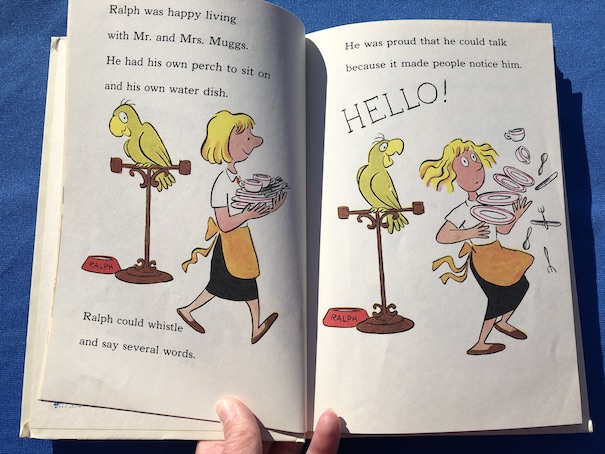
Ralph is a parrot, living in an apartment with Mr. and Mrs. Muggs. Ralph can whistle and talk, and he likes doing it because he enjoys the attention he gets from people when he does it.
He has certain times when he whistles, like when he wakes up Mr. and Mrs. Muggs in the morning, and certain words he says to get treats. Sometimes, in the evenings, Mr. and Mrs. Muggs will light a fire in the fireplace and make popcorn, so Ralph will say, “Fire!” to remind them.
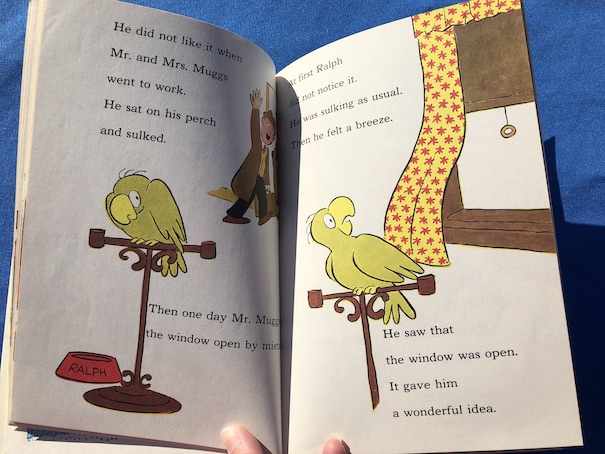
Ralph gets lonely when Mr. and Mrs. Muggs leave for work, and one day, he notices that they’ve left a window open. He decides to fly outside and look for people to give him attention.
When he reaches the street, there are plenty of people, but they don’t pay attention to Ralph. He tries whistling and using words he knows. It has an effect on the people around him, but not what Ralph expects, and still no one notices him.
Then, Ralph sees an apartment on fire, and says, “Fire!” It makes a man nearby notice the fire and call the fire department. The man who called the fire department realizes that Ralph is the one who yelled “Fire!” and calls him a hero. Finally, Ralph gets attention!
Mr. and Mrs. Muggs return home to see everyone with Ralph and hear the story about how he became a hero. Ralph is rewarded with a ride on the fire truck, his picture in the paper, and a lifetime supply of sesame seed crackers but it’s the attention he loves most.
I love this picture book and thought it was funny when I was a kid, when I had a pet bird myself.











 #2 The Haunted Hall by Michael Avallone, 1970.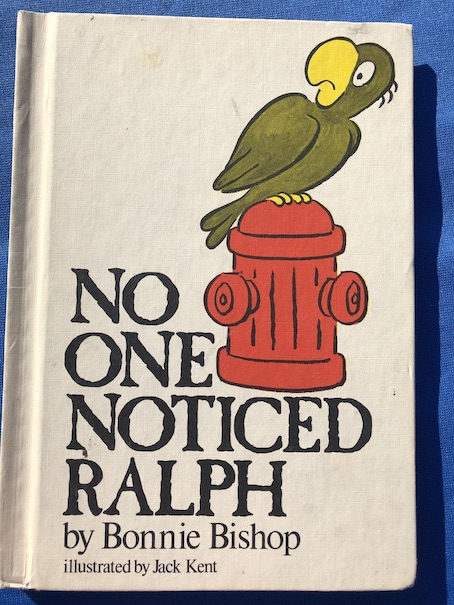



 Jestress's Forgotten Books and Stories