
Fishes by Bertha Morris Parker, 1943, 1957.
This is a reprint of an earlier book, and it’s interesting because this was part of an educational science series. The author was from the University of Chicago, and the accuracy was verified by Walter H. Chute, the Director of the John G. Shedd Aquarium at the time.
As a child, I was never particularly interested in fish. My mother had a fish tank with pet fish, but I lived pretty far from large bodies of water and never went fishing. For years, this book, probably purchased at one of the many used book sales my family attended over the years, went unread. However, as an adult, I like reading children’s books about very specific topics because they often include some fun and usual facts.

The book begins by explaining to child readers how goldfish are similar to and different from human beings. It seems pretty straight forward, but they point out some thoughtful similarities and differences. Both fish and humans need to breathe, but they do it in different ways, which is why humans drown in water and fish effectively drown in air. The book also points out that goldfish cannot move their heads independently of their bodies in the way that humans do.
In the section called “The Story of the Goldfish”, the book explains how wild goldfish were first kept as pets in China and Japan. Wild goldfish actually have a variety of colors, but hundreds of years ago in China, people liked the yellow or gold ones best as pets, and they began deliberately breeding fish with these colors, which is how they came to be known as “goldfish.”

The book defines “fish” as creatures with gills, fins, and backbones but no arms or legs. It uses this definition to separate fish from other aquatic creatures like whales (no gills, actually a mammal with lungs), jellyfish (no fins, gills, or backbone), crabs (gills but no fins, arms and an exoskeleton instead of a backbone), and starfish. It also explains the difference between fish that live in salt water vs. fish that live in fresh water.
The book explains what different types of fishes eat, how they’re born (most hatch from eggs), how they defend themselves, and how they migrate. In one section, the book explains how fish have some or all of the five senses that humans have (sight, hearing, smelling, taste, and touch), but they have them to different degrees and use them in different ways.
The book presents information about some specific types of fish, and it even mentions that some types of fish are endangered species. I usually associate environmental messages with the late 20th century, but this book discussed the over-fishing of sturgeon and the ecological dangers of erosion caused by deforestation on river banks and factory waste dumped in water in the mid-20th century.
The book ends with a list of tips for observing fish.
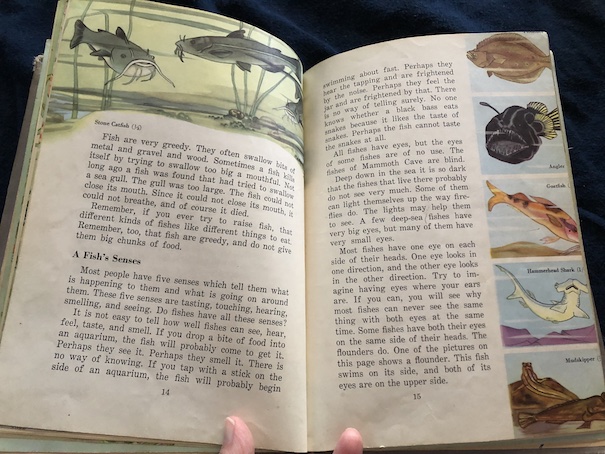
The book presents a pretty comprehensive beginner’s guide to fish in general, and I really appreciated the mentions of environmental issues. My one criticism is that the book could use more pictures and especially bigger pictures. All of the pictures are in full color, but most of them are rather small, just in the corners or edges of the pages, which are mostly full of text. I just think that larger pictures would be more appealing and more child-friendly. There are even places where the edges of the pictures and their captions are cut off by the edges of the book (as shown in two of the pictures of pages above), which looks clumsy and annoying. The book seems pretty authoritative, but I think it could have been presented better. I’m not sure how people who originally read this book looked at it, but I didn’t like the size and positioning of the illustrations.
I couldn’t find an online edition of this vintage nonfiction children’s book, but I did find online editions of other nonfiction books for children by the same author through Internet Archive.
 Jestress's Forgotten Books and Stories