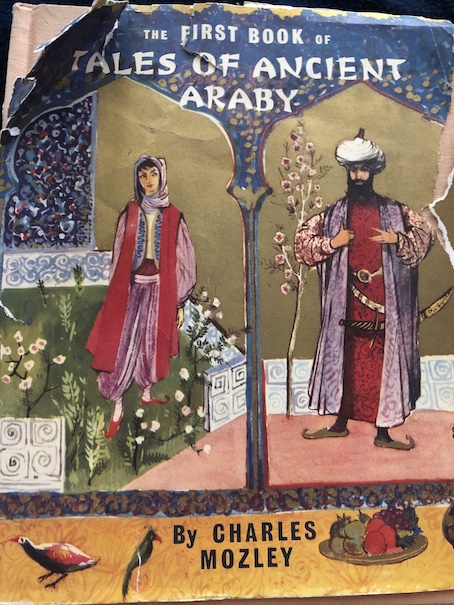
The First Book of Tales of Ancient Araby by Charles Mozley, 1960.
I’ve had this book for years, and one of the questions that I’ve had about this book is why is it Ancient “Araby”? Why “Araby” instead of “Arabia”? According to Wikipedia, “Araby” is an archaic name for Arabia, which explains it, I guess. This book was published in 1960, and I don’t think people were using “Araby” back then, but the book is trying to sound ancient.
The stories in the book are based on those from the collection of folktales called One Thousand and One Nights, in which Scheherazade tells stories to the murderous king who is her husband, but they’re simplified for children. The introductory section to this book says that . The book doesn’t explain, but the original stories in the book were rather racy.
The book has pictures for each story, but some are in black-and-white, some are monochromatic with a color other than black, and some are in full color.
The book is available to borrow and read for free online through Internet Archive.
The book contains the following stories:
Scheherazade – When the sultan’s wife betrays him, he not only has her executed but loses his mind with hatred for all women because he believes that they are all untrustworthy. He begins a murderous series of weddings, where he has his wives all executed the day after the wedding, so they can never betray him. (It’s dark stuff, but this story wasn’t originally intended for children). All of the unmarried women in the kingdom are terrified that they’ll be next, and the sultan’s vizier is beside himself because he doesn’t know how to stop the sultan and has an obligation to obey the sultan’s commands to bring him new brides. Then, his eldest daughter, Scheherazade, requests that her father send her to the sultan as his next wife. At first, the vizier doesn’t want to send her because it’s certain death to marry the sultan, but Scheherazade tells him that she has a plan to put an end to the weddings and executions. Every night, she starts to tell a story but leaves it unfinished, so the sultan keeps putting off her execution to hear the end of the story. This continues for 1,001 nights, until the sultan realizes that he’s actually happy with Scheherazade and no longer has any desire to execute her or any other woman. The rest of the stories in the book are among the ones that Scheherazade told the sultan. (The Scheherazade story is a frame story, a story that contains other, internal stories or creates the basis for the other stories.)


Aladdin and the Wonderful Lamp – A poor boy and his widowed mother are approached one day by a man claiming to be the brother of the widow’s dead husband, the boy’s uncle. At first, he is very nice to them, bringing them to live with him and providing them with everything they need. However, one day, he stakes the boy, Aladdin, to retrieve a strange old lamp from a series of treasure caves, giving him a ring to protect himself. Before the boy returns to the man, he comes to the realization that the man isn’t really his uncle but an evil magician who is just using him to get the lamp. The boy and his mother discover that there is a genie living in the lamp who will do their bidding and provide them with all they need. They use the lamp not only to provide for themselves but to make it possible for Aladdin to marry a princess. The evil magician almost ruins everything when he tricks the princess into giving him the lamp, but Aladdin and the princess get it back through some trickery of their own.

Ali Baba and the Forty Thieves – Ali Baba marries a kind but poor woman and makes his living as a woodcutter, while his brother, Kassim, marries a disagreeable woman from a wealthy family and becomes an wealthy merchant. One day, while cutting wood in the forest, Ali Baba sees a large group of horsemen. They are robbers, and they have a secret hideout nearby. Ali Baba hides and watches how they open the entrance to their secret cave with the magic words “Open, Sesame!” After the thieves stash their loot and leave, Ali Baba realizes that he can use their secret words to enter the cave himself and see what they left. He helps himself to some of the stolen loot. He and his wife decide to stash the second-hand loot and spend it a little at a time, ensuring their family’s security. However, Kassim’s wife finds out about their loot and tells Kassim, and Kassim damands that Ali Baba tell him where he acquired so much money. When Ali Baba explains about the thieves and the treasure cave, Kassim wants to go there and loot the place himself, but Ali Baba thinks it’s too dangerous to go back again because the thieves will be angry and will probably kill them if they get caught. When Kassim goes anyway and is caught and killed, Ali Baba must arrange a deception to prevent the thieves from learning who Kassim was and everyone else from learning how Kassim met his death so the thieves won’t take revenge on the rest of the family with the help of a clever slave girl, Morgiana.

The Fisherman and the Genie – A fisherman pulls a strange bottle from the sea that contains a genie, but to the fisherman’s shock, the genie threatens to kill him when he frees him from the bottle. The fisherman asks why he would do such a thing when the fisherman did him a favor, and the genie explains that he was imprisoned in the bottle by King Solomon for sins against Heaven. At first, the genie thought that he would reward whoever freed him, but as his imprisonment grew into hundred and hundreds of years with no rescue, he became increasingly enraged and decided to kill whoever released him. However, the genie decides to grant the fisherman one wish before death. The fisherman asks him to prove that he can actually fit into the bottle and imprisons the genie there again. He refuses to let him out again until the genie swears he won’t kill him. The genie promises the fisherman anything he wants, but the fisherman is a modest man and only asks that he always be successful as a fisherman. He gets his wish, and he uses the money he acquires from his success to build a better life for his family.
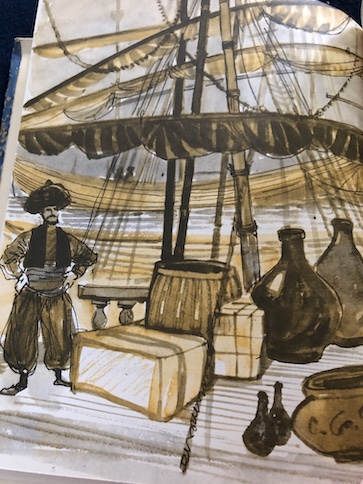
Sinbad the Sailor – When Sinbad’s father dies, he leaves Sinbad a considerable amount of money, but Sinbad quickly squanders most of his inheritance. When he realizes his foolishness, Sinbad uses what he has left to set himself up as a merchant sailor. However, this decision takes him on a series of wild adventures, from being nearly drowned to befriending a king to a hair-raising encounter with a roc (a giant bird that’s big enough to carry a grown man).
The Twice-blessed Arab – This is a legend about the origins of horses and camels.
The Story of Little Mukra – Little Mukra is a dwarf, and his father, fearing that the rest of the world will laugh at him and treat him cruelly for his size, hides him for his early life. When Little Mukra is sixteen years old, his father dies and the rest of his relatives declare that they don’t want him, so Little Mukra decides to go out and seek his fortune. One day, while Little Mukra is hungry, he hears an old woman calling for someone to come to eat. It turns out that she’s talking to her cats, but he persuades her to let him eat with the cats because he’s starving. The woman hires him as a servant to take care of her cats. It gives Little Mukra a place to live, but the problem is that the woman blames him for damage that the cats cause while the lady isn’t looking. The clever cats are always perfectly behaved when she’s watching but not when they’re alone with Little Mukra. Little Mukra escapes this situation with the help of the lady’s dogs, who are not so pampered as her cats and reveal to Little Mukra a paid of magical slippers that can make him run fast, securing him a position as the king’s special courier.
 Jestress's Forgotten Books and Stories