The Legend of the Indian Paintbrush

This story is a retelling of a Native American legend.

In the distant past, there was a boy called Little Gopher who never seemed able to keep up with the other boys with the skills they would need to be warriors. His parents worried about his future, but he had other talents. He had a skill for making things, and the shaman of the tribe told him that his destiny would be different from the others.

One day, Little Gopher had a vision of a grandfather and a young maiden, who came to him, holding an animal skin, a brush made of animal hairs, and paints. These figures told him that these would be the tools he would use to accomplish great things for his people. He would spend his life painting the warrior’s deeds and the shaman’s visions so people would remember them. The maiden told him to find a white buckskin and paint a picture with the colors of the setting sun.

From then on, Little Gopher gathered animal skins and painted them with the scenes of great hunts, warrior’s deeds, and visions from dreams. When he found a pure white buckskin, he tried to paint it with the colors of the setting sun, but they never looked right. He kept trying and studying the sunset to figure out how to make the right colors.

One night, he heard a voice telling him to take the buckskin with him to watch the sunset and that he would find what he needed on the ground there. He did as the voice told him, and he found brushes with paint stuck into the ground. He used the brushes, and they were just the right colors. The next day, everyone saw plants growing with beautiful colors, like the colors of a sunset, where the brushes had taken root.

I remember this book from when I was a kid, and I always kind of paired it in my mind with The Legend of the Bluebonnet by the same author, Tomie DePaola because both of them are retellings of Native American folktales about the origins of particular flowers. In the back of the book, there’s an Author’s Note about the story. A friend of Tomie DePaola had recommended to him that he write this story about the state flower of Wyoming, the Indian Paintbrush, because he had already written about the state flower of Texas in The Legend of the Bluebonnet. The folk tale about the origins of the Indian Paintbrush came from a book about stories and legends about Texas Wildflowers, which was given to Tomie DePaola by another friend. Although the Indian Paintbrush is the state flower of Wyoming, it also grows in Texas.

When I was a kid, I was often too impatient or absorbed with the main story to read Author’s Notes, Forewords, Afterwords, or any explanations outside of the main story, but as an adult, I find that they really do add to the story by adding context. I appreciated this story even more after understanding its connection to the other story, The Legend of the Bluebonnet, and how the author learned this story before making his own retelling.

The Legend of the Christmas Rose

The Legend of the Christmas Rose by William H. Hooks, paintings by Richard A. Williams, 1999.

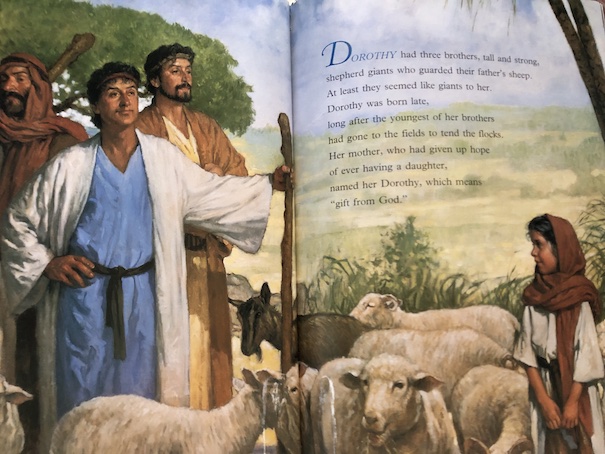
Dorothy is a 9-year-old girl with three brothers, who are all much older than she is. Her three brothers are all shepherds, and her daily chore is to take water to them when they’re out in the fields with the sheep. Her brothers love her, but they always treat her like a small child because they’re so much older.

One day, she spots some strange travelers on the road. She worries that they might be robbers, but her brothers tell her not to worry. There are more travelers on the road these days because the Roman Emperor has ordered everyone to return to their home towns to be taxed. However, because there are so many strangers traveling through the area, Dorothy’s brothers plan to spend the night in the fields with their sheep to keep an eye on them.

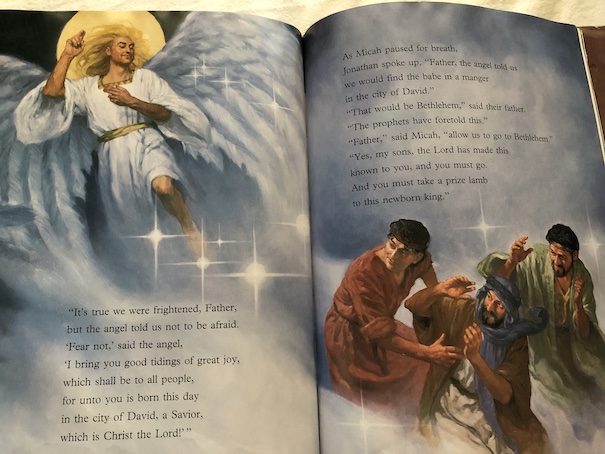
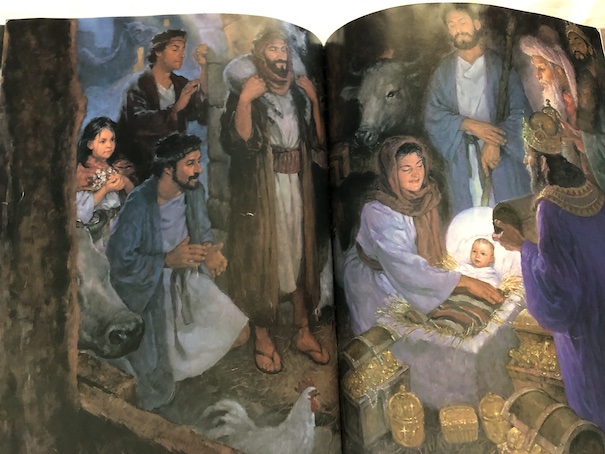
Early the next morning, the brothers return to the family home, excited. They tell their father that they saw angels in the field during the night. An angel appeared to them and told them that they would find a newborn Savior in a manager in the City of David, which is Bethlehem. Their father says that there is a prophecy about this. Because God has sent His messengers to announce the birth of the Savior to them, the brothers should go to the city and take a lamb with them as a present to the Savior.

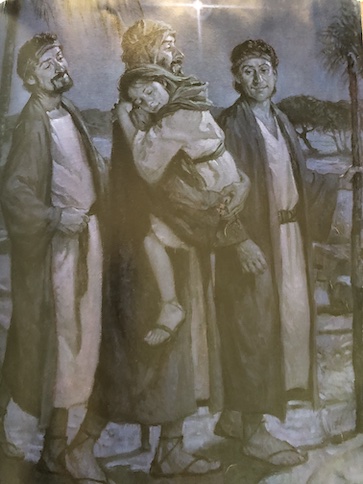
Dorothy helps her brothers to pack their supplies for the journey to Bethlehem, but she knows that she will not be allowed to go with them because she is too little. In spite of that, Dorothy makes the sudden decision to follow her brothers secretly. However, as they travel, Dorothy suddenly realizes that she doesn’t have a present of her own to offer when she arrives.

When Dorothy begins to cry about her lack of a present to give, an angel appears to her and produces snowy white flowers. Dorothy is happy because she can bring the flowers with her as a present.

The book is available to borrow and read for free online through Internet Archive (multiple copies).

My Reaction

There is an Author’s Note at the back of the book that explains about the Christmas Rose plant and its associated legends. The Christmas Rose is a real plant, but technically, it’s not a rose, and it doesn’t always bloom at Christmas. It’s native to southern and central Europe, where winters are relatively mild, and the flower can bloom in Christmas, but in colder climates, it tends to bloom in spring. It’s actually a member of the hellebore family, which is toxic to humans, although it has been used medicinally as a purgative, and it does contain a chemical that can be used to treat heart conditions. The story in the book also references the plants’ medicinal uses.

There are multiple legends about the origins of the plant. The version presented here, the legend about an angel giving the flower to a young shepherd girl to offer as a present to baby Jesus, comes from Medieval nativity plays. There is an older Greek legend where the plant was discovered by a shepherd around 900 BC. In that version of the story, the shepherd used the plant to cure three princesses who were afflicted with delusions that they were cows. After he cured them, the princesses’ father, the King of Argos, allowed the shepherd to marry his youngest daughter.

Overall, I liked this picture book version of the legend. I like books about folklore, especially ones that use lesser-known stories. The pictures in this book are also realistic and beautiful, taking up full pages.

The Legend of the Bluebonnet

LegendBluebonnet

The Legend of the Bluebonnet by Tomie dePaola, 1983.

This is a story about the Comanche People in what is now Texas, based on an old folktale.

There has been a severe drought and famine in the land for a long time, and many people have died.  The survivors pray to the spirits for help in ending the drought, and they receive a sign that it will not end until someone among the Comanches makes a sacrifice of the thing that is most dear to them.

LegendBluebonnetShaman

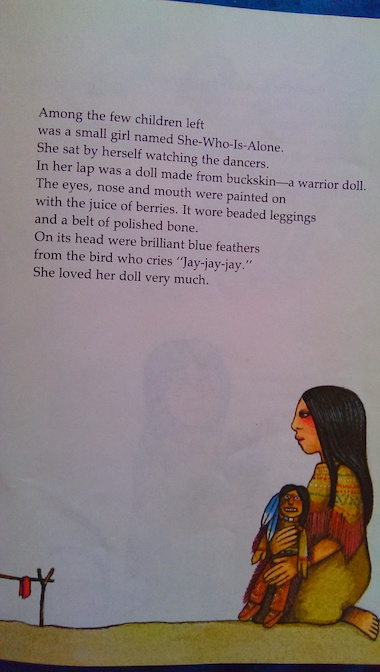
The people debate about who is supposed to make the sacrifice and what object the spirits could want, but one young girl thinks that the spirits are talking about her and her doll.  The girl is called She-Who-Is-Alone because she is the last of her family.  Her parents and grandparents are dead, victims of the famine.  The only thing she has left to remind her of them is her doll, a warrior with blue feathers in its hair, that her parents made for her before they died.

Desperate to end the drought and famine and to save her people, the girl makes the difficult decision to sacrifice her doll by burning it.  Her sacrifice is rewarded not only by the end of the drought but by the sudden appearance of a field of flowers as blue as the feathers in her doll’s hair.  The girl receives a new name from her people, acknowledging her sacrifice on their behalf.

LegendBluebonnetFlowers

A section in the back of the book explains a little about the Bluebonnet flower, which is the state flower of Texas, and the origins of the story in the book, which is based on a folktale.  This is also a little information about the Comanche People.

The book is currently available online through Internet Archive (multiple copies).