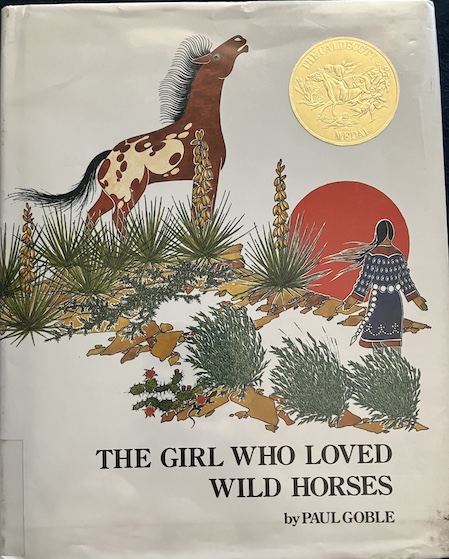
The Girl Who Loved Wild Horses

The Girl Who Loved Wild Horses by Paul Goble, 1978, 2001.

A Native American tribe is nomadic, following herds buffalo, and a girl among them is fascinated by wild horses. She loves to watch them, and she knows about their habits and how to care for horses that are injured.
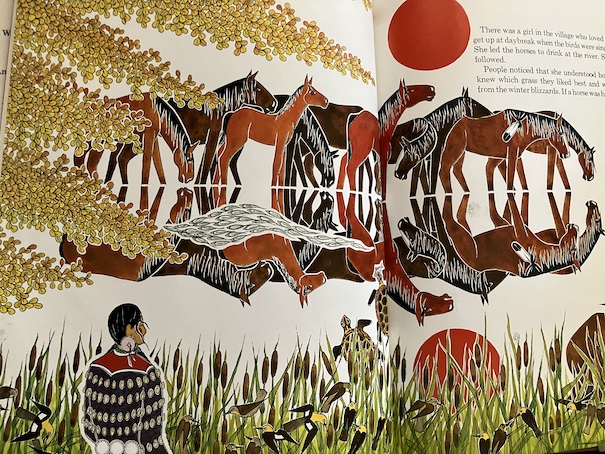
One day, she falls asleep outside of her village and is awoken by a terrible storm. The horses and other animals are frightened, and the girl jumps onto the back of one of the horses. She is carried away when the horses run from the storm! By the time the horses stop, they are in a strange place, far away away from the girl’s people.
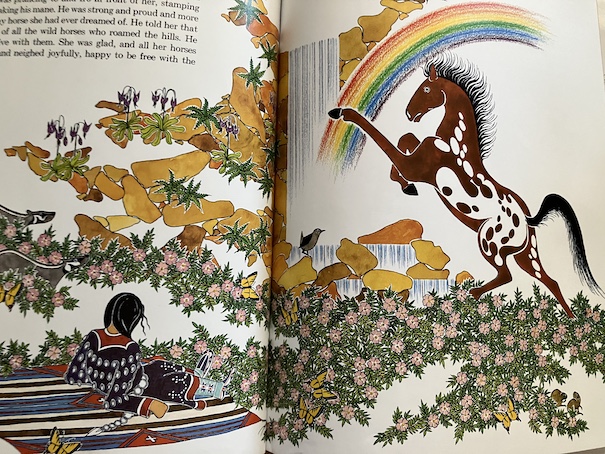
The next morning, the girl wakes up to see a beautiful stallion who tells her that he is the leader of the wild horses. He invites the girl to live with the horses, and she happily accepts.

The girl’s people search for her, and a year later, they spot her with the horses. When they see the girl, the stallion prevents her from joining them. They are only able to reclaim the girl when she falls from the horse she’s riding. Although they bring the girl back to parents, and they are happy to see each other, the girl misses her life with the wild horses.
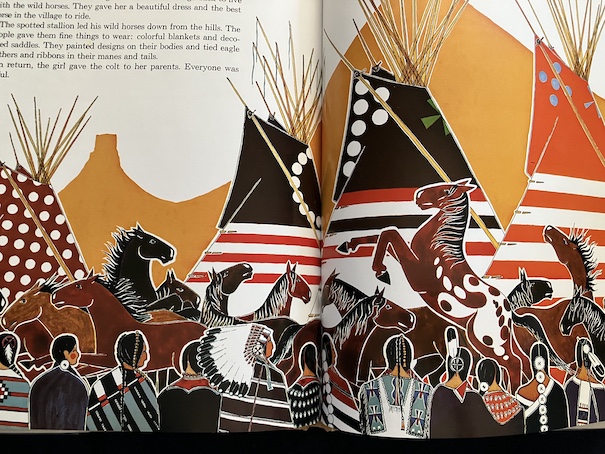
Finally, the girl’s parents agree that she can return to the wild horses. She returns to her people every year to see her parents, but one year, she doesn’t come. Then, the people see a beautiful mare with the stallion, so it seems that the girl became one of the horses she loved so much.
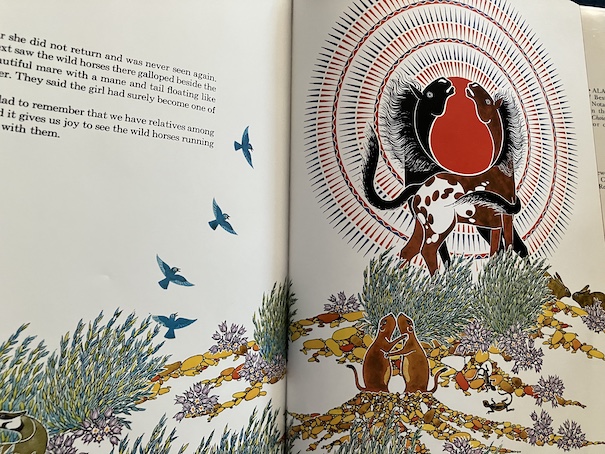
The story ends with a Navaho (Navajo) song about a horse and another song that came from a dream an Ogalala Sioux named Black Elk had.

The book is a Caldecott Medal winner.

My Reaction

Another book by the same author, The Gift of the Sacred Dog, show the spiritual significance of horses to Native Americans. This folk tale views horses as being connected to humans almost as family through a girl who loves them so much that she becomes one of them. When people are very close to companion animals, they do seem to have almost human qualities and an almost human connection.

The illustrations are colorful and dramatic, which fits the energy of the story.
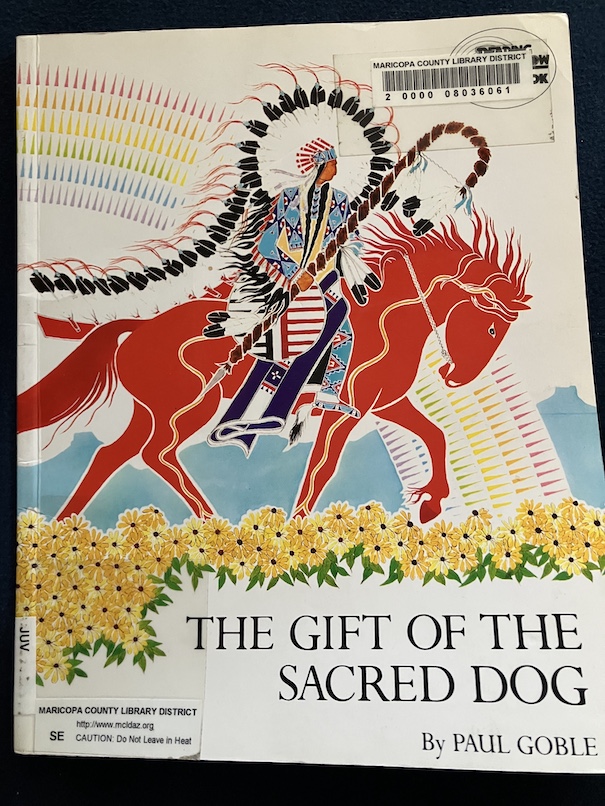
The Gift of the Sacred Dog

The Gift of the Sacred Dog by Paul Goble, 1980.

A Native American tribe is starving because they haven’t been able to find any buffalo. They send out searchers and try to do a dance to call the buffalo.

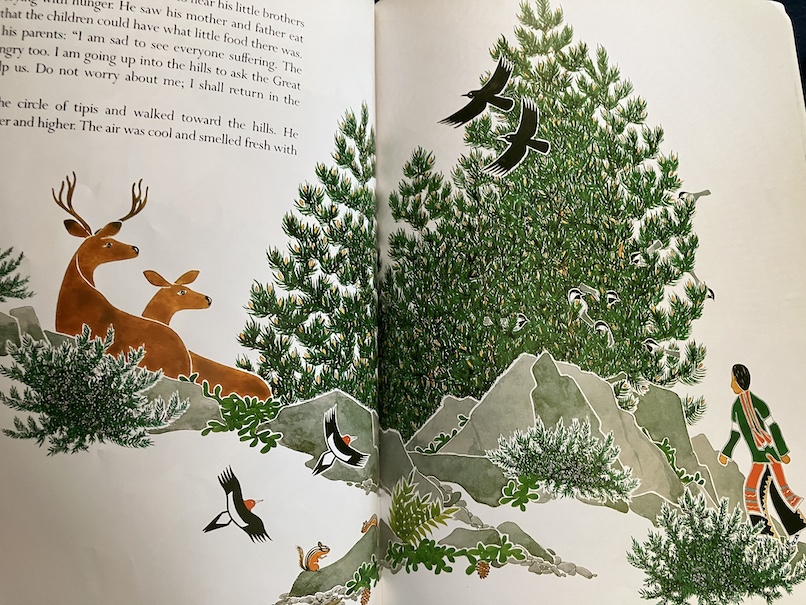
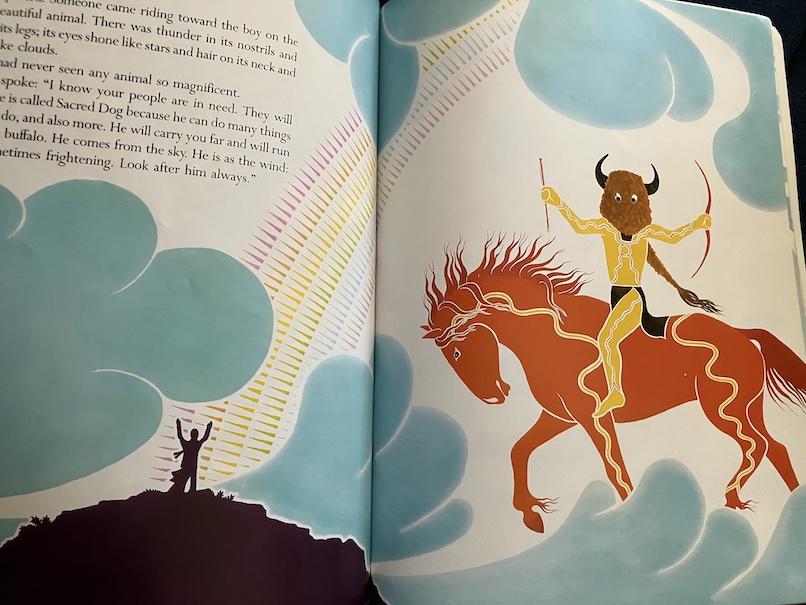
One boy decides to go into the hills to ask the Great Spirit for help. When he asks for help, Thunderbirds swoop down from the sky, and a figure rides toward him on an amazing animal.

The figure tells him that the “Sacred Dog” he is riding will help his people because it can travel faster than the buffalo. The rider disappears, and other Sacred Dogs appear, in various colors.

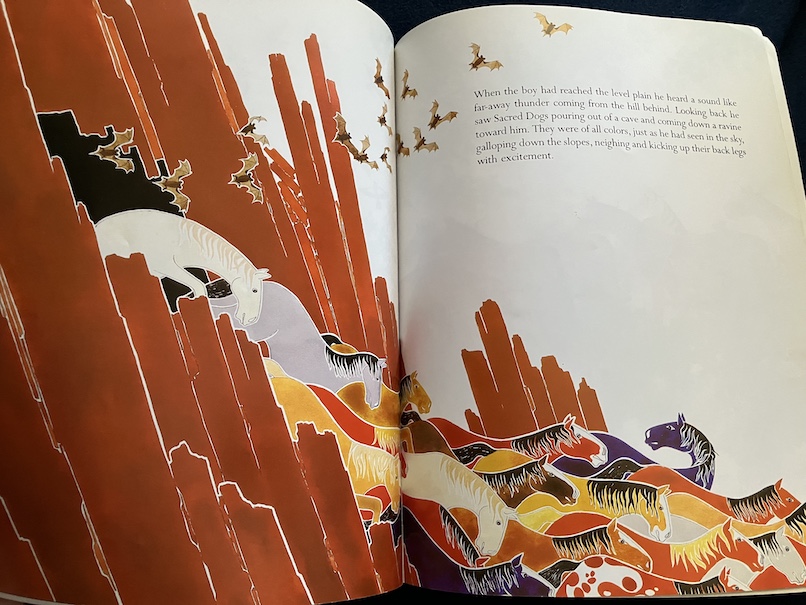
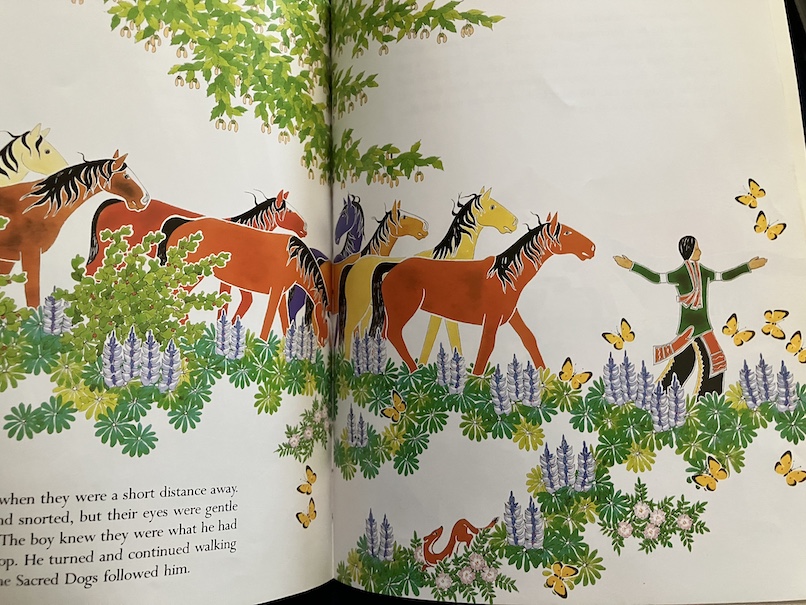
When he wakes up the next morning, a herd of Sacred Dogs rushes out of a cave. The boy leads the Sacred Dogs to his people so the hunters can ride them in pursuit of the buffalo.

The book ends with the English translations of Sioux songs about horses and the return of the buffalo.

My Reaction

I love folktales, and this is a colorful story to explain how Native Americans came to have horses. Historically, horses were brought to the Americas by Europeans (although there was an ancient form of horse in the Americas that went extinct thousands of years before Europeans re-introduced horses to the continent). However, this folktale presents a more fantastical story.

As the Sioux songs at the end of the book indicate, horses are very important to Native Americans. Aside from their utilitarian uses for hunting and transportation, horses have a spiritual significance to many Native Americans. They are companions to human beings and a truly wonderful gift!

The Legend of the Indian Paintbrush

This story is a retelling of a Native American legend.

In the distant past, there was a boy called Little Gopher who never seemed able to keep up with the other boys with the skills they would need to be warriors. His parents worried about his future, but he had other talents. He had a skill for making things, and the shaman of the tribe told him that his destiny would be different from the others.

One day, Little Gopher had a vision of a grandfather and a young maiden, who came to him, holding an animal skin, a brush made of animal hairs, and paints. These figures told him that these would be the tools he would use to accomplish great things for his people. He would spend his life painting the warrior’s deeds and the shaman’s visions so people would remember them. The maiden told him to find a white buckskin and paint a picture with the colors of the setting sun.

From then on, Little Gopher gathered animal skins and painted them with the scenes of great hunts, warrior’s deeds, and visions from dreams. When he found a pure white buckskin, he tried to paint it with the colors of the setting sun, but they never looked right. He kept trying and studying the sunset to figure out how to make the right colors.

One night, he heard a voice telling him to take the buckskin with him to watch the sunset and that he would find what he needed on the ground there. He did as the voice told him, and he found brushes with paint stuck into the ground. He used the brushes, and they were just the right colors. The next day, everyone saw plants growing with beautiful colors, like the colors of a sunset, where the brushes had taken root.

I remember this book from when I was a kid, and I always kind of paired it in my mind with The Legend of the Bluebonnet by the same author, Tomie DePaola because both of them are retellings of Native American folktales about the origins of particular flowers. In the back of the book, there’s an Author’s Note about the story. A friend of Tomie DePaola had recommended to him that he write this story about the state flower of Wyoming, the Indian Paintbrush, because he had already written about the state flower of Texas in The Legend of the Bluebonnet. The folk tale about the origins of the Indian Paintbrush came from a book about stories and legends about Texas Wildflowers, which was given to Tomie DePaola by another friend. Although the Indian Paintbrush is the state flower of Wyoming, it also grows in Texas.

When I was a kid, I was often too impatient or absorbed with the main story to read Author’s Notes, Forewords, Afterwords, or any explanations outside of the main story, but as an adult, I find that they really do add to the story by adding context. I appreciated this story even more after understanding its connection to the other story, The Legend of the Bluebonnet, and how the author learned this story before making his own retelling.