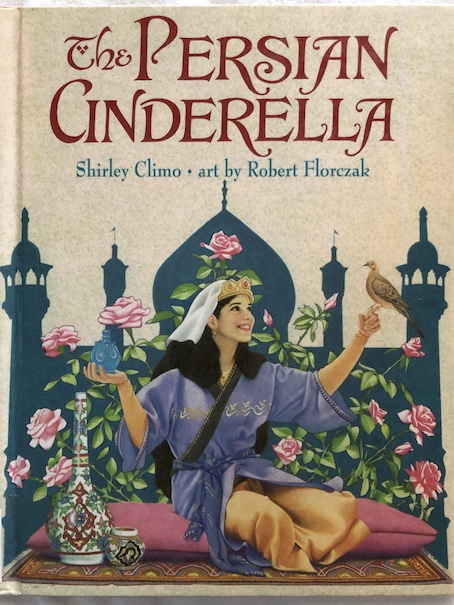
The Persian Cinderella by Shirley Climo, art by Robert Florczak, 1999.
This is a Persian version of the classic Cinderella story.
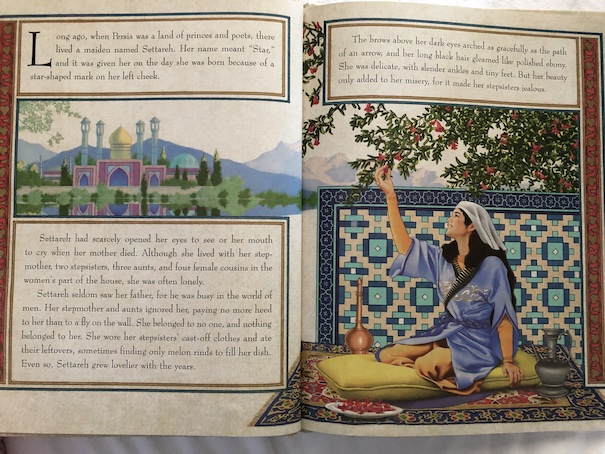
There is a lovely girl named Settareh, a name that means “star” because she has a star-shaped birthmark. Her mother died shortly after she was born, so she has grown up with a stepmother, two stepsisters and some aunts and cousins. Her father leaves her to the women of the family to raise, but she is often ignored and neglected by them. Her stepsisters are jealous that she is pretty and are mean to her.
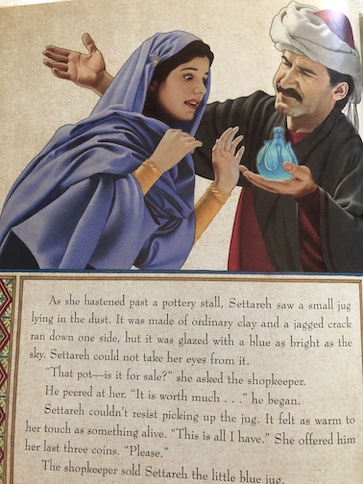
Then, one day, her father visits the women and gives them each some money to buy cloth for new clothes because the princes is inviting everyone to his palace to celebrate the New Year. However, in the market, Settareh spends her money on other things and has none left to buy cloth. She spends part of her money for something to eat because she’s hungry, and then, she gives some to a poor beggar woman as an act of kindness. Finally, she finds herself compelled to buy a strange blue jug. Her stepsisters tell her that she was a fool for buying the jug, which has an obvious crack in it and for wasting the money that she was supposed to spend on cloth, but Settareh still loves the little blue jug.
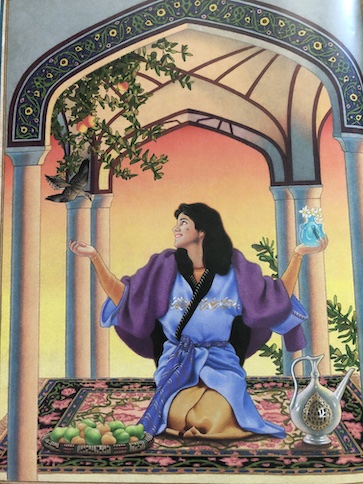
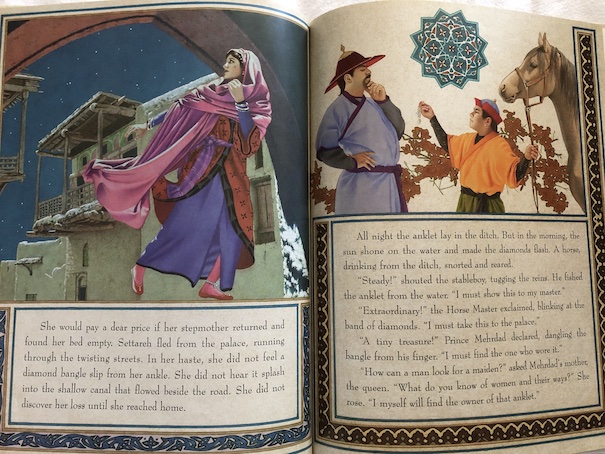
Then, Settareh discovers that the jug has a fairy inside and has the ability to grant wishes! Although her relatives think that Settareh won’t be able to attend the festival at the palace because she doesn’t have anything appropriate to wear, Settareh secretly asks the jug for a special gown and comes to the festival anyway. People at the festival don’t recognize her and think that she’s a visiting princess, and she catches the eye of the prince. However, she leaves the party quickly so she can return home before her family, accidentally losing a diamond anklet as she runs away. One of the prince’s servants finds it and gives it to the prince, who begins to search for the girl who wore it.
When the prince finds Settareh, he proposes to her, but Settareh’s jealous stepsisters scheme to get rid of her and take the magic jug for themselves! Settareh will need the prince’s help to escape!
There is an Author’s Note in the back, explaining more about this version of the story, which comes from The Arabian Nights, and some background information to the story, including a little about the New Year festival of No Ruz in the story, which is still celebrated in Iran. There is also an Artist’s Note about the style of the artwork.
The book is available to borrow and read for free online through Internet Archive.
My Reaction and Spoilers
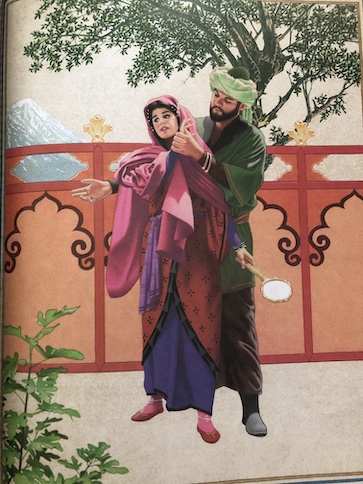
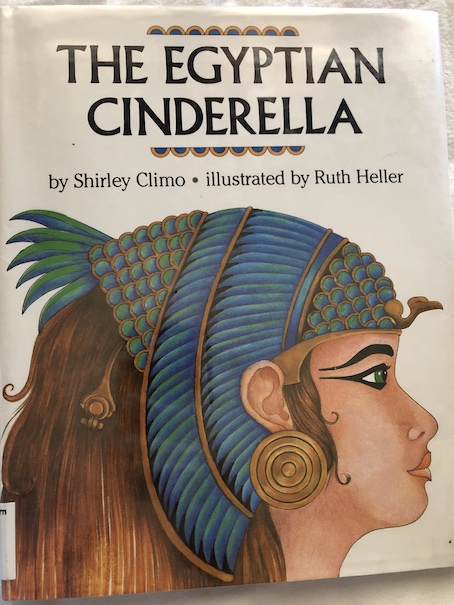
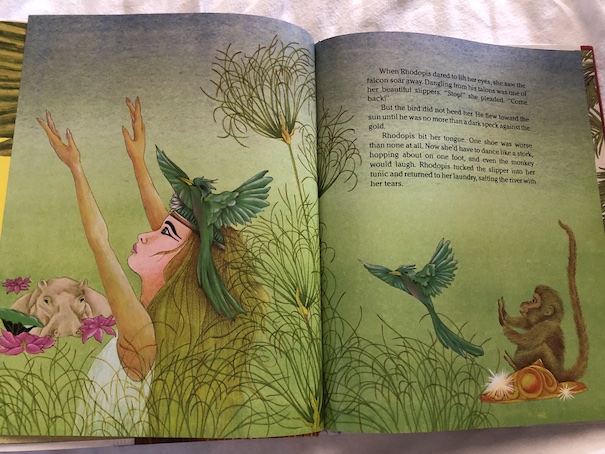
I enjoyed this Persian version of the Cinderella story! I like Shirley Climo’s picture book series showing different versions of Cinderella stories from around the world, including The Egyptian Cinderella and The Korean Cinderella. One of the parts of this story I found the most interesting is that the story doesn’t end when the prince finds the girl who attended his party, as so many other versions of the story do. There is one last obstacle for the couple to overcome, when Settareh’s mean stepsisters use the magic of the jug to turn Settareh into a bird, until she flies to the prince, and he changes her back. I don’t now whether adding one more obstacle to the story enhances it that much, but I appreciated it as an interesting twist. It also resolves the matter of the jug because, while it grants the stepsisters’ evil wish, their wish also destroys the jug, so the wishing is over.
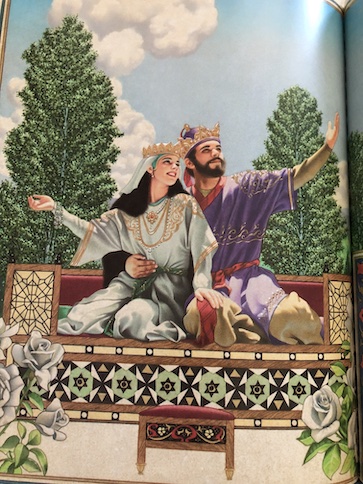
The artwork in the book is beautiful. The artist tried to make the art style as authentically Persian as possible, using models for the characters who were ethnically Persian (Iranian). The artist used a combination of water-based markers, colored pencils, and ink, and pictures are lively and full of color.










 Jestress's Forgotten Books and Stories