The Legend of the Indian Paintbrush retold and illustrated by Tomie DePaola, 1988.
This story is a retelling of a Native American legend.
In the distant past, there was a boy called Little Gopher who never seemed able to keep up with the other boys with the skills they would need to be warriors. His parents worried about his future, but he had other talents. He had a skill for making things, and the shaman of the tribe told him that his destiny would be different from the others.
One day, Little Gopher had a vision of a grandfather and a young maiden, who came to him, holding an animal skin, a brush made of animal hairs, and paints. These figures told him that these would be the tools he would use to accomplish great things for his people. He would spend his life painting the warrior’s deeds and the shaman’s visions so people would remember them. The maiden told him to find a white buckskin and paint a picture with the colors of the setting sun.
From then on, Little Gopher gathered animal skins and painted them with the scenes of great hunts, warrior’s deeds, and visions from dreams. When he found a pure white buckskin, he tried to paint it with the colors of the setting sun, but they never looked right. He kept trying and studying the sunset to figure out how to make the right colors.
One night, he heard a voice telling him to take the buckskin with him to watch the sunset and that he would find what he needed on the ground there. He did as the voice told him, and he found brushes with paint stuck into the ground. He used the brushes, and they were just the right colors. The next day, everyone saw plants growing with beautiful colors, like the colors of a sunset, where the brushes had taken root.
My Reaction
I remember this book from when I was a kid, and I always kind of paired it in my mind with The Legend of the Bluebonnet by the same author, Tomie DePaola because both of them are retellings of Native American folktales about the origins of particular flowers. In the back of the book, there’s an Author’s Note about the story. A friend of Tomie DePaola had recommended to him that he write this story about the state flower of Wyoming, the Indian Paintbrush, because he had already written about the state flower of Texas in The Legend of the Bluebonnet. The folk tale about the origins of the Indian Paintbrush came from a book about stories and legends about Texas Wildflowers, which was given to Tomie DePaola by another friend. Although the Indian Paintbrush is the state flower of Wyoming, it also grows in Texas.
When I was a kid, I was often too impatient or absorbed with the main story to read Author’s Notes, Forewords, Afterwords, or any explanations outside of the main story, but as an adult, I find that they really do add to the story by adding context. I appreciated this story even more after understanding its connection to the other story, The Legend of the Bluebonnet, and how the author learned this story before making his own retelling.
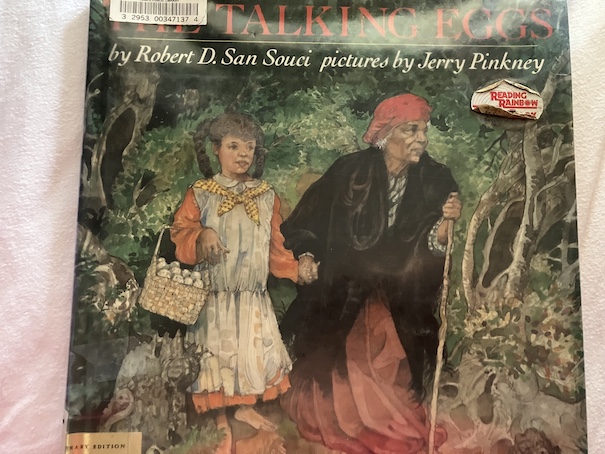
The Talking Eggs by Robert D. San Souci, pictures by Jerry Pinkney, 1989.
There was a poor widow who lived on a small farm with her two daughters, Rose and Blanche. Rose was the widow’s favorite daughter because she was so much like her mother. They were both mean and bad-tempered, and they had grand dreams of becoming rich someday, although neither of them had the slightest idea how to accomplish that. Blanche, on the other hand, was a sweet girl, and her mother made her do all the work while she and Rose just sat on the porch, talking about all of their grand dreams.
One day, when Blanche goes to fetch water from the well, an old woman approaches her and begs her for a drink. Blanche gives her some water, and the old woman thanks her, telling her that she will be blessed for her kindness.
However, when Blanche gets home, her mother and sister yell at her for taking so long. They hit her, and Blanche runs away into the woods. Then, she meets the old woman again. She explains to the old woman what happened, and the old woman invites her to come to her house. However, she cautions Blanche not to laugh at what she sees there. Blanche promises that she won’t laugh.
The old woman is no ordinary woman, and everything at her house is strange. Some of these strange things are amusing, some are amazing, and some are just plain weird and a little alarming. The animals are all strange, with chickens of different colors and cows with curly horns. Then, inside the house, the old woman removes her head and puts it in her lap to brush her hair. Then, the woman produces a fancy stew from just one old bone. After supper, they go outside and watch rabbits in fancy clothing dance.
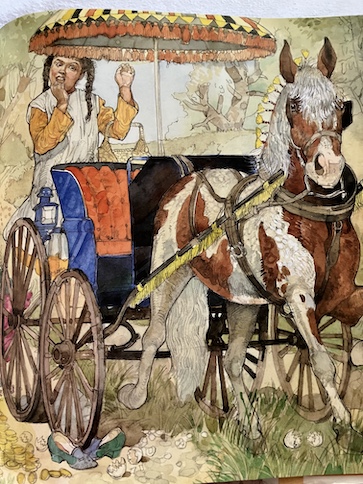
In the morning, the old woman tells Blanche to go out and gather some eggs before she goes home. Blanche is allowed to take any that tell her to take them and to leave ones that say not to take them. Blanche does as she is told, although the ones that tell her to take them are the plain-looking eggs, and the others are covered in jewels. The old woman tells Blanche to throw the eggs over her shoulder, one at a time, and when she does so, the eggs break and wonderful things burst out of them – fancy clothes, coins and jewels, and even a horse and carriage.
By the time Blanche gets home, she has many beautiful clothes, money, and luxurious things. Blanche’s mother pretends to be nice to her when she returns, but it’s only so Blanche will tell her where she got all the rich things. That night, when Blanche is asleep, her mother talks to Rose, telling her that she should also befriend the old woman and get the same rich rewards as Blanche. Then, they will steal all of Blanche’s things and head to the city to live the rich life that they’ve always dreamed of.
Of course, lazy and bad-tempered Rose isn’t as kind or hard-working as her sister. She ignores the old woman’s instructions and does everything she shouldn’t do. When she tries to force the old woman to give her riches, the old woman’s magic gives her and her mother their just desserts.
There is a note at the beginning of the book that this story comes from a Creole folktale that appeared in a 19th century collection of folktales from Louisiana by Alcee Fortier. It resembles folktales from Europe was probably adapted from fairy tales brought to Louisiana by French immigrants. It reminds me of the Mother Holle story, where a kind, well-behaved, hard-working girl is rewarded for following Mother Holle’s instructions, while her spoiled sister is punished for laziness and disobedience.
The old woman in this story is a similar figure to Mother Holle, with strange powers and magical objects, but there is no explanation of who she might be. The fact that she can remove her head just to brush her hair shows that she’s supernatural, but we don’t know if she’s supposed to be a witch or some other supernatural creature.
Personally, I don’t think I would laugh at any of the things in the old woman’s house. I think the strange animals sound more amazing than comical. I think I’d really be impressed by the different-colored chickens and the cows with the weird horns. I have to admit, though, that if someone takes off their head, my first reaction would probably be to run for it.
Mirandy and Brother Wind By Patricia C. McKissack, illustrated by Jerry Pinkney, 1988.
It’s springtime, and “Brother Wind” (the wind personified) is striding through the valley. Young Mirandy is getting ready for the junior cakewalk, and she imagines that, if Brother Wind was her partner, she would be sure to win the cakewalk. Her mother says that anyone who can catch the Wind can make him do whatever they want, so Mirandy decides that she’s going to catch Brother Wind before the cakewalk and make him dance with her!
That’s easier said than done. Mirandy doesn’t know how to catch the Wind, and her grandmother doesn’t think such a thing is possible. She asks different people what to do, and she tries different ways of catching him. She tries catching him in a quilt, but he gets away.
Then, Mirandy tries visiting Mis Poinsettia, the conjure woman (a sort of witch or woman with magical knowledge), and she asks her if she has a potion that would help. Mis Poinsettia’s advice is to trap the Wind in a bottle of cider, but that doesn’t work, either.
Eventually, Mirandy manages to trap Brother Wind in the chicken coop. Once she has Brother Wind, he has to give her a wish. However, on the night of the cakewalk, Mirandy realizes that there is someone else she wants for a partner besides Brother Wind, and she asks Brother Wind for help in a different way from the one she had planned.
My Reaction and Spoilers
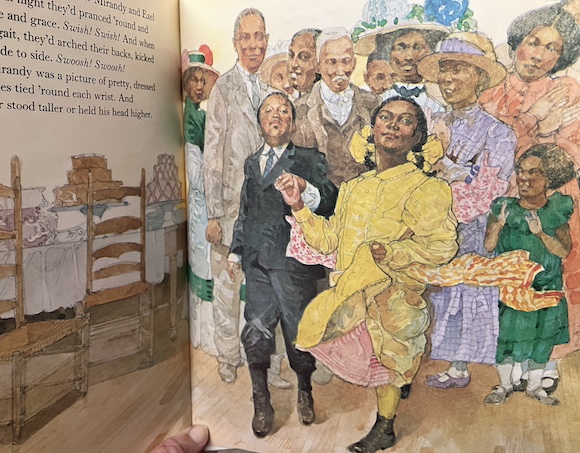
I thought this was a charming picture book, with bright, colorful illustrations that really conveyed that sense of lightness and air in the presence of Brother Wind! The old-fashioned clothing of the characters is part of the charm, and I like this sweet introduction to the concept of a traditional cakewalk. Cakewalks were a kind of traditional African American dance contest with a cake as a prize for winning. The people participating are dancing as they parade around the room, which is a little different from the cakewalks or candywalks that some modern people do at school or church carnivals as a kind of raffle game. In the game version, the players are just walking, not dancing, and they stop on numbered spots whenever the music stops, winning prizes if the number of their spot is drawn. For Mirandy, winning the cakewalk isn’t a matter of stopping in the right place but actually dancing well.
All through the book, there is a boy who likes Mirandy, but Mirandy doesn’t think of him as a dance partner because she has her heart set on Brother Wind as the perfect dance partner, and the boy is kind of clumsy. Mirandy really wants to win the contest, so it’s important to her to have the best partner she can. However, when one of the other girls at the cakewalk talks badly about the boy and his clumsiness, Mirandy can’t stand to hear him being insulted. She boldly declares that the boy will be her partner, and they will win in the contest together … with a little help from Brother Wind.
The Mysterious Giant of Barletta by Tomie dePaola, 1984.
This story is adapted from an Italian folktale. There is a note in the beginning about the town of Barletta and the statue that stands in front of the San Sepolcro Church. According to the note, nobody knows who the statue is supposed to represent, which is why there are stories about it. This one takes place during the Middle Ages, the 11th century.
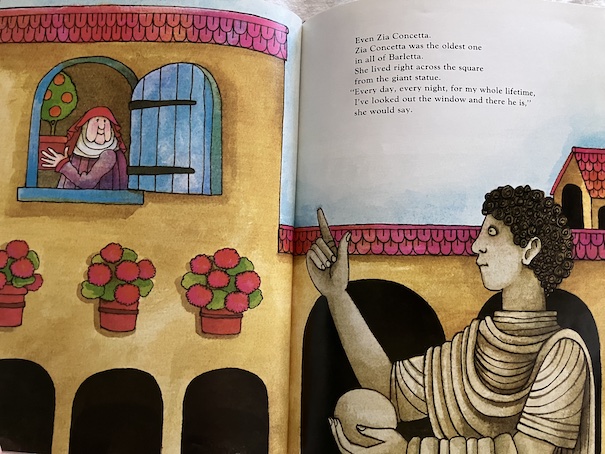
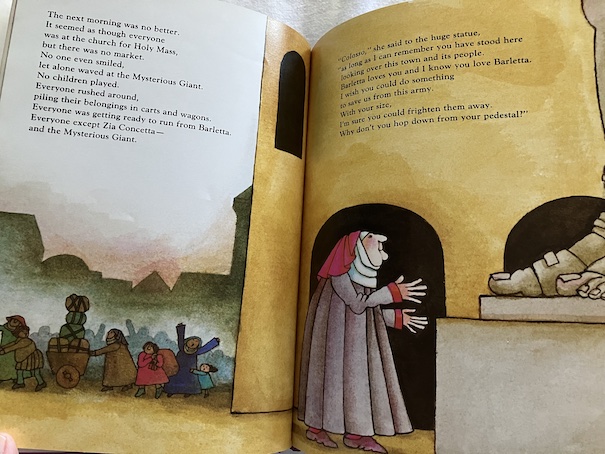
Because no one knows who the statue is supposed to be, the people of Barletta call it, “The Mysterious Giant.” No one even knows for sure how long it has been there. It has been there for as long as anyone can remember, including Zia Concetta, the oldest person in Barletta. People are accustomed to gathering around the statue to meet each other, and many of them will give the statue a friendly greeting or wish it good night.
However, one day, the town is threatened by an invading army. The people of Barletta are unprepared for invaders, and many of them prepare to flee, not knowing what else to do. Zia Concetta appeals to the statue to save their town.
The statue hears Zia Concetta’s request, and it comes to life, climbing down from its pedestal. Together, he and Zia Concetta come up with a plan to discourage the invaders.
When the invaders arrive, they see the statue, sitting by itself outside the city, crying. When they ask the giant statue why it’s crying, it says that the other boys at school are mean to him because he’s smaller than everyone else. When the invaders hear that everyone else in Barletta is bigger than the giant statue, they decide that they don’t want to meet the rest of the townspeople and leave!
The book is available to borrow and read for free online through Internet Archive.
My Reaction
I always like books that reference folklore! The theme of someone who is large pretending like they’re much smaller than other people to scare off an attacker is one found in other folktales. For example, in Fin M’Coul (a version of which was also written and illustrated by Tomie dePaola), Fin M’Coul, who is a giant, pretends to be his own baby to make an enemy think that his father must be larger and more fierce than he actually is.
I particularly liked this story because, unlike other folktales, it has a real setting and a definite landmark, the statue that is sometimes called the Colossus of Barletta. The way it is drawn in the book isn’t exactly as it appears in real life. In real life, it holds a cross in the hand that is raised, although the cross was not part of the statue originally. It probably originally held a spear or a flag standard. It is about three times the size of an adult human, which isn’t as large as it is shown the book. As in the book, it isn’t certain exactly who the statue is supposed to be, although it appears to be the statue of an emperor. He appears to be a middle-aged man wearing a jeweled diadem. The reason why nobody knows exactly who it was supposed to be is that it wasn’t originally made or displayed in Barletta. It was probably originally looted from Constantinople by the Venetians. There is a story from Barletta that it was once lost in a shipwreck on the way from Constantinople and washed up on the shores of Barletta in 1309, where some of its bronze was used for casting bells for a monastery. Then, in the 15th century, the statue was restored and displayed in front of the church. That, by itself is a fascinating story, although it isn’t explained in the book.
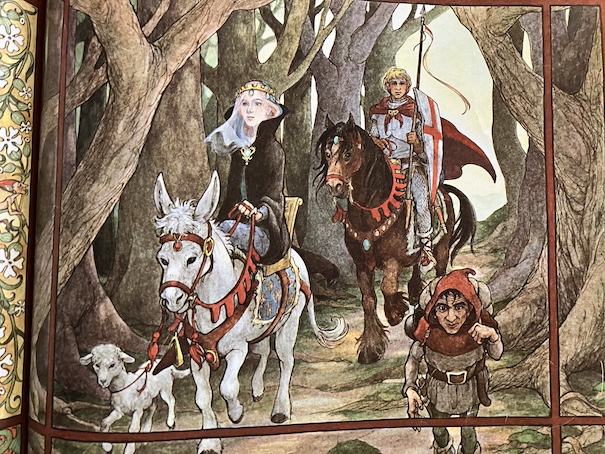
The Red Cross Knight, who carries a shield decorated with a red cross, does not know his own name or even where he came from. He only knows that the Queen of the Fairies has sent him to face a terrible dragon. He is accompanied on his journey by a princess with a little white lamb and a dwarf. The Princess’s name is Una, and her kingdom is being attacked by the dragon.
On their journey, they meet a hermit, who shows the knight a distant palace on a mountaintop, where angels travel between the palace and heaven. It’s so beautiful that the knight wants to go there immediately, but the hermit says that this palace is in another world and that he cannot go there until he faces the dragon. The hermit also reveals the knight’s past to him. He is not one of the fairy folk, although the fairy folk are the ones who sent him. The hermit knows that he was kidnapped by the fairies as a baby and hidden in a farm field, where he was discovered by a plowman who named him George. His true destiny is to become Saint George, the patron saint of England.
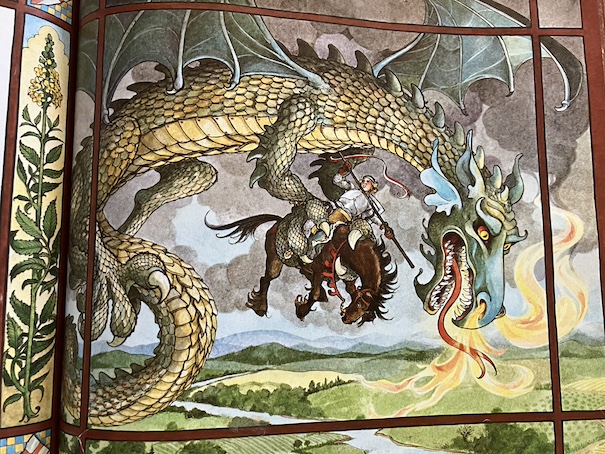
Una takes George to her parents’ fortress. As they approach, they see the dragon for the first time. George sends Una away from danger, and he and the dragon battle for the first time. The dragon picks up George, horse and all, and throws them to the ground. George manages to drive the dragon away, but he is also injured. At first, he and his friends think he is going to die, but he lies down in an ancient spring that cools and heals him. By morning, he is able to rise and fight again.
The second time George fights the dragon, he is able to cut off part of the dragon’s tail and one of its paws. The dragon’s fire finally drives George away, and once again, George seems too wounded to survive. However, he rests under an apple tree that drops healing dew, and George survives.
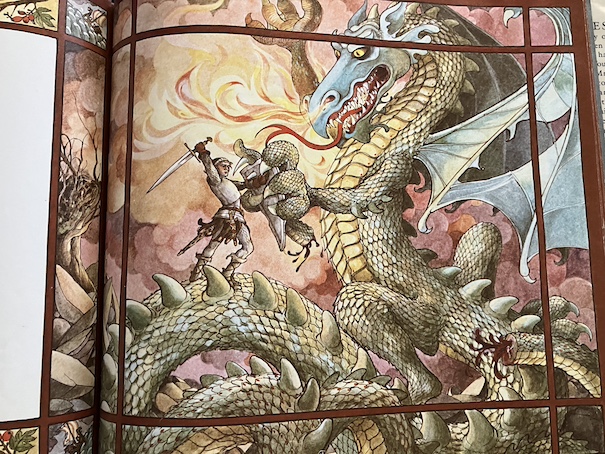
The third time George and the dragon fight, George manages to kill the dragon. Everyone celebrates, and Una’s parents thank George. The king gives George rich rewards, but George passes them on to the poor people. George is bound to the service of the Fairy Queen for six years, but the king allows George to marry Una and promises him that he will become the next king when his service is finished.
The book is available to borrow and read for free online through Internet Archive.
My Reaction
I love the colorful illustrations in this story, although some of them seemed a bit brutal for an audience of young children, showing George badly injured and the dragon spurting blood. Because I love folklore, I know that the legend of St. George and the Dragon is a Christian allegory, although it has some basis in earlier folktales and historical figures. I’ve heard different interpretations of what the dragon is supposed to represent. It can be a symbol of evil, the devil, or sin, and I think I’ve heard that it could represent paganism, which was replaced by Christianity (represented by St. George in the story), although I can’t remember where. In a way, I think this is one of those picture book that might mean more to adults because they would understand more of the symbolism, history, and folklore references in the story. On the other hand, who doesn’t love a story that ends with a gallant knight marrying a beautiful princess?
As another odd piece of literary trivia, the legend of St. George has a connection to another story that I’ve on this blog, Phoebe the Spy. The connection isn’t an obvious one because Phoebe the Spy was set in New York during the American Revolution, which seems far removed from Medieval England. However, on April 23, 1770 (St. George’s Day), the St. George Society (originally called the Sons of St. George) was founded at the Fraunces Tavern in New York, just six years before the story of Phoebe the Spy begins at the same tavern. The St. George Society was and still is a charitable organization that helps immigrants from Britain, using the patron saint of England as its namesake.
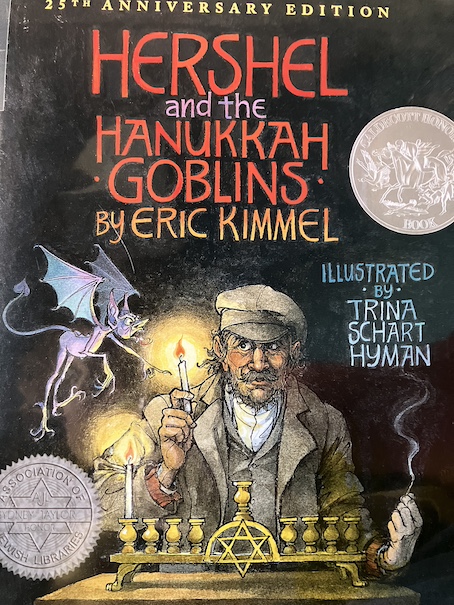
Hershel and the Hanukkah Goblins by Eric Kimmel, illustrated by Trina Schart Hyman, 1985, 1989.
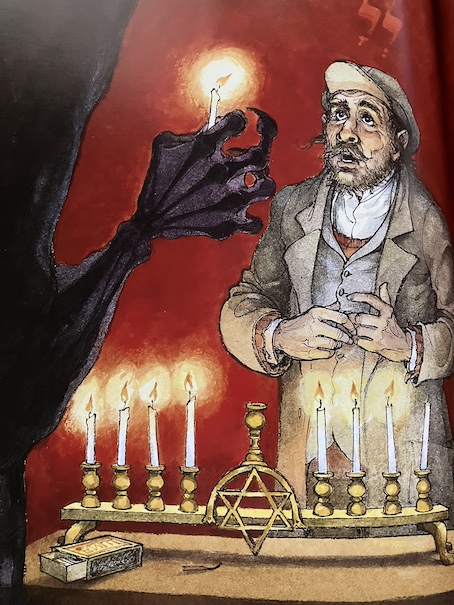
On the first night of Hanukkah, a tired travel, Hershel, trudges through the snow on his way to the next village. There, he hopes to get something to eat and celebrate the holiday with the local villagers. However, when he reaches the village, nobody is celebrating.
When he asks the villagers why they’re not celebrating, they tell him that they can’t because there are goblins haunting the old synagogue on the hill. Every time they try to celebrate Hanukkah, the goblins come after them, blow out the candles on their menorahs, breaks their dreidels, and throw all the potato latkes on the floor.
Hershel decides that he isn’t scared of the goblins, and he’s going to put an end to their mischief. The village rabbi says that the only way to get rid of the goblins is to spend all eight nights of Hanukkah in the synagogue, lighting Hanukkah candles every night. Then, on the final night of Hanukkah, the goblin king must light the candles himself. Although this sounds difficult, Hershel is confident that he can do it. Although the villagers aren’t really expecting Hershel to succeed, they support Hershel in his mission, and they give him some food, a menorah, candles, and matches.
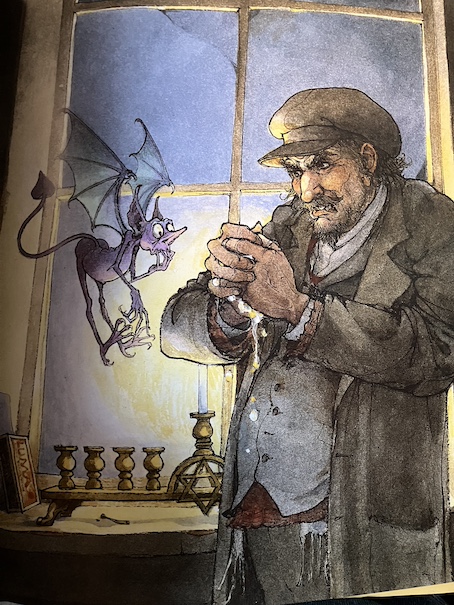
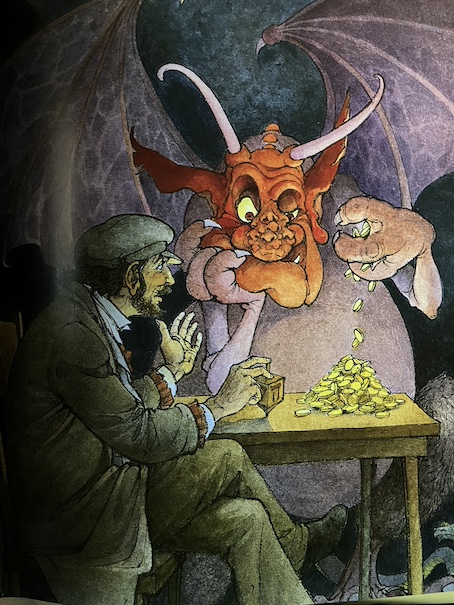
The old synagogue is creepy, and when Hershel lights his first candle, a small goblin appears to ask him what he’s doing. Herself isn’t intimidated by the little goblin, and he tricks the goblin into thinking that he’s strong enough to crush rocks in his hands by squeezing a hard-boiled egg in his hands until it breaks. The little goblins is scared away but warns him that bigger goblins than him will come later. The next night, a bigger goblin comes, but he isn’t very bright and gets his hand stuck in a jar of picks when he tries to take too many. The night after that, tricks the third goblin into playing dreidel with him and giving him all his gold.
It continues like this, night after night, with Hershel tricking the goblins in various ways so that they’ll let him light the candles on his menorah. Finally, Hershel comes face-to-face with the most sinister goblin of all – the king of the goblins. Can Hershel find a way to trick him and get him to light the candles of the menorah himself?
The book is a Caldecott Honor Book and named a Sydney Taylor Honor Book by the Association of Jewish Libraries. It is available to borrow and read for free online through Internet Archive (multiple copies). It was originally published as a short story in Cricket magazine and later as a book, which is why the story has two copyright dates.
My Reaction
I’m not Jewish, and I admit that this isn’t a book I read as a kid, although I do remember that it was one that was often recommended when I was young. As an adult, I decided to try it, since I just never got around to it before. I really do like this story. I enjoyed the folklore elements, and I also appreciated that the main character saves Hanukkah, in much the same way that various characters had to “save” Christmas when I was a kid.
It makes me laugh to think about it now, but Christmas always seemed to be an extremely endangered holiday in Christmas television specials from my childhood. Some evil person or being was always out to destroy Christmas, for various reasons, with varying degrees of logic, and popular television characters always had to “save” it from being destroyed or canceled or whatever. It was fun and entertaining, but when you consider the entire canon of endangered Christmas holiday specials all together, it does seem like there isn’t a single year when Christmas isn’t in danger from somebody or something, making it weirdly routine for Christmas to almost not happen. At some point, I think my brother pointed out that Christmas was always in danger, but it seemed like Hanukkah was relatively safe. (At least, in the land of holiday-themed winter television specials starring well-known cartoon characters.) I figured that Christmas was likely a bigger target for the forces of evil due to its wide mass appeal because there were just more people who celebrated Christmas where I lived than Hanukkah (and also because of the all the related Christmas toy tie-in commercials and advertising sponsors for those shows).
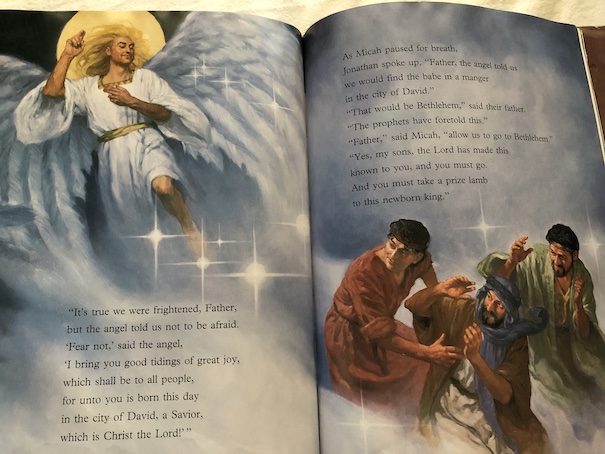
So, I was delighted to see Hanukkah get saved from a band of comically nefarious goblins in this book. The goblin king is a sinister figure in the pictures, but fortunately, he’s not too much brighter than his cohorts. The book has been adapted as a stage play (you can sometimes find clips or trailers from performances on YouTube), and there is also an animated short film of the story. I think it would be fun to see a longer version, though, in video or movie form. The book skims over the details of what Hershel does to trick some of the other goblins after the third one, so there’s room to elaborate and make the story longer. I think I would have been a little scared by the final goblin when I was a little kid, but the goblins not being particularly bright and easy to trick does help remove some of the scare factor.
At first, I though that the story of Hershel might have been a folktale because it reads like one. In the back of the book, the author explains that he wanted to write a story that was somewhat like A Christmas Carol by Charles Dickens but about Hanukkah, and he took his inspiration from the folktale Invanko, the Bear’s Son (also known as Jean de l’Ours or John the Bear), which is includes the hero tricking a goblin, and he added in a Jewish folk hero, Hershel of Ostropol. The resulting story is sort of like a new folktale, remixed from old ones, which is fitting because that’s what happens with folk stories Overall, I thought it was a fun story.
The Legend of the Christmas Rose by William H. Hooks, paintings by Richard A. Williams, 1999.
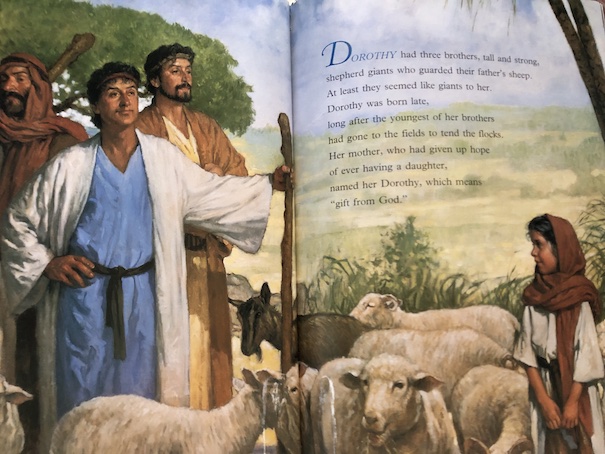
Dorothy is a 9-year-old girl with three brothers, who are all much older than she is. Her three brothers are all shepherds, and her daily chore is to take water to them when they’re out in the fields with the sheep. Her brothers love her, but they always treat her like a small child because they’re so much older.
One day, she spots some strange travelers on the road. She worries that they might be robbers, but her brothers tell her not to worry. There are more travelers on the road these days because the Roman Emperor has ordered everyone to return to their home towns to be taxed. However, because there are so many strangers traveling through the area, Dorothy’s brothers plan to spend the night in the fields with their sheep to keep an eye on them.
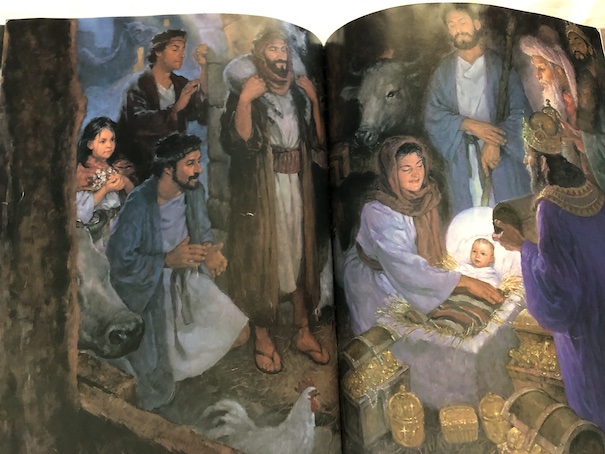
Early the next morning, the brothers return to the family home, excited. They tell their father that they saw angels in the field during the night. An angel appeared to them and told them that they would find a newborn Savior in a manager in the City of David, which is Bethlehem. Their father says that there is a prophecy about this. Because God has sent His messengers to announce the birth of the Savior to them, the brothers should go to the city and take a lamb with them as a present to the Savior.
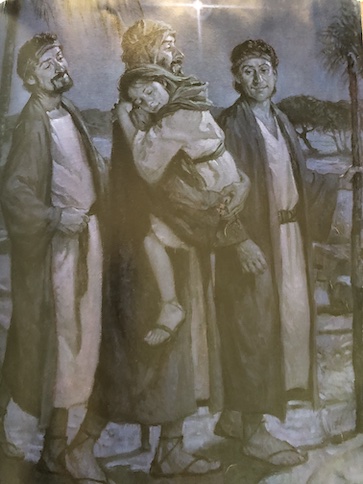
Dorothy helps her brothers to pack their supplies for the journey to Bethlehem, but she knows that she will not be allowed to go with them because she is too little. In spite of that, Dorothy makes the sudden decision to follow her brothers secretly. However, as they travel, Dorothy suddenly realizes that she doesn’t have a present of her own to offer when she arrives.
When Dorothy begins to cry about her lack of a present to give, an angel appears to her and produces snowy white flowers. Dorothy is happy because she can bring the flowers with her as a present.
The book is available to borrow and read for free online through Internet Archive (multiple copies).
My Reaction
There is an Author’s Note at the back of the book that explains about the Christmas Rose plant and its associated legends. The Christmas Rose is a real plant, but technically, it’s not a rose, and it doesn’t always bloom at Christmas. It’s native to southern and central Europe, where winters are relatively mild, and the flower can bloom in Christmas, but in colder climates, it tends to bloom in spring. It’s actually a member of the hellebore family, which is toxic to humans, although it has been used medicinally as a purgative, and it does contain a chemical that can be used to treat heart conditions. The story in the book also references the plants’ medicinal uses.
There are multiple legends about the origins of the plant. The version presented here, the legend about an angel giving the flower to a young shepherd girl to offer as a present to baby Jesus, comes from Medieval nativity plays. There is an older Greek legend where the plant was discovered by a shepherd around 900 BC. In that version of the story, the shepherd used the plant to cure three princesses who were afflicted with delusions that they were cows. After he cured them, the princesses’ father, the King of Argos, allowed the shepherd to marry his youngest daughter.
Overall, I liked this picture book version of the legend. I like books about folklore, especially ones that use lesser-known stories. The pictures in this book are also realistic and beautiful, taking up full pages.
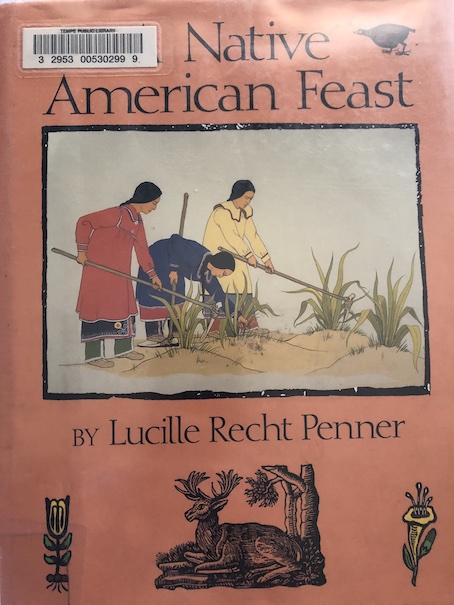
A Native American Feast by Lucille Recht Penner, 1994.
This nonfiction children’s book explains the traditional foods of different Native American tribes and how they were prepared. (Throughout the book, they are referred to both as “Native Americans” and “Indians”, but mostly, the book uses the term “Native Americans.” The focus is on Native American tribes in the area that is now the United States, but the book includes information about various tribes across the United States.)
It starts with an Introduction that explains how European settlers came to North America and how the first settlers almost starved to death because they weren’t prepared for the conditions they found and didn’t understand the plants and foods of the Americas. In those early years of the colonies, the colonists relied heavily on help from nearby Native American tribes in learning techniques for hunting and growing food in North America. These colonists had to adopt some of the Native American foods and techniques of getting food in order to survive. Not only did European colonists adopt some foods used by Native Americans, but Native Americans also adopted foods that were introduced to them from Europeans, including some plants and grains, like apples and wheat, and some domesticated animals, like sheep. The focus of this book is on Native Americans and their cooking and eating habits, both pre-colonization and post-colonization. For more information about what the colonists were cooking and eating, see The Colonial Cookbook.
The book explains how we know what we know about Native American foods and cooking. Some information was recorded by early European colonists in America and European scientists who were interested in plants of the Americas, and archaeology provides information in the form of animal bones, clamshells, and pollen from plants that Native Americans cultivated, going back hundreds and even thousands of years. Native American eating habits shifted throughout their history, although they shifted very abruptly with the European colonization of North America.
The book is available to borrow and read for free online through Internet Archive.
Contents
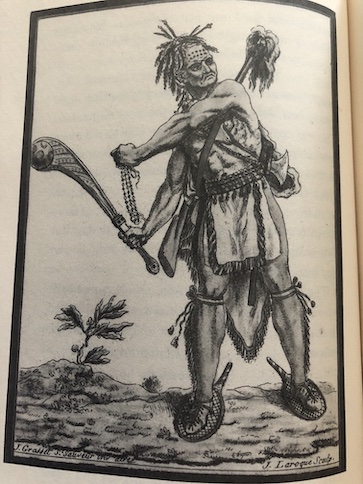
Every chapter, including the Introduction, contains recipes that readers can make at home. Some of them are easier than others. Some recipes include pieces of Native American folklore about them or the foods in the recipes. Many of the illustrations are 19th century drawings.
Rather than organizing the book based on tribe or geographic region, the chapters of the book are based around particular types of food or cooking and eating concepts:
Introduction
This section introduces how historians know about the history of food among Native American tribes and how their diets changed after the arrival of Europeans.
Recipes in this section are:
Hickory Nut Soup
Green Succotash
Pueblo Peach Crisp
Discovering America
This section includes information about the earliest known hunting and cooking habits of Native Americans. It includes a description of the “land bridge” theory of how the ancestors of Native Americans arrived in the Americas from Asia. As of the early 21st century, we still don’t have a definitive answer for precisely how ancient people first arrived in the Americas, more recent theories include the possibility of these ancient people being seafaring rather than finding a land crossing, although the land crossing theory is also still possible.
Then, it explains about the arrival of the European colonists. It doesn’t sugar coat that the arrival of the colonists and their westward expansion led to the extinction and endangerment of native animal species because these newcomers hunted them without restraint. The introduction of unfamiliar diseases, like measles and smallpox, to the Native Americans took many lives, sometimes even killing whole tribes. These drastic changes greatly impacted the lives and lifestyles of Native Americans, although some traditional habits survived, including the preparation of traditional types of foods.
There are no recipes in this chapter.
A Great Mystery
This chapter explains about hunting and gathering and the development of agriculture among ancient Native American tribes. The “mystery” is about the development of corn as we know it. It was never really a wild plant. The evidence suggests that ancient Native Americans deliberately created it by cross-pollinating different wild grass plants, but it isn’t really known which ones. Most of this chapter explains how widespread corn was as a food and the uses and folklore that different tribes had for it.
Recipes in this section are:
Roasted Corn on the Cob
Blue Pinole – a blue cornmeal-based drink with sugar and cinnamon, from the Southwest
Thumbprint Bread (Kolatquvil)
Hopi Blue Marbles – boiled balls of blue cornmeal dough, a traditional breakfast food
Wagmiza Wasna – a mixture of cornmeal and dried berries
Treasure
This section is about foods that Native Americans introduced to the rest of the world, like pumpkins, peanuts, chili peppers, sunflower seeds, maple sugar, and different varieties of beans, including kidney beans and lima beans.
Recipes in this section are:
Cherokee Bean Balls
Apache Pumpkin with Sunflower Seeds
Popped Wild Rice
Zuni Green Chili Stew
The Hunt
This chapter is about Native American hunting techniques and the animals they hunted.
Recipes in this section are:
Broiled Buffalo Steaks
Venison and Hominy Stew
Feast and Famine
This chapter is about Native Americans who lived in areas where food was scarce and ways of foraging for food during times of famine. It also explains special feast days.
Recipes in this section are:
Mouse Cache Soup – made with beef broth and seeds: sunflower seeds, sesame seeds, buckwheat groats, and millet
Iroquois Strawberry Drink
Mushrooms Cooked in Oil
Berries, Flowers, and Bear Fat
This chapter explains the seasonings that Native Americans added to food and cooking techniques that added nutrients.
Recipes in this section are:
Fried Squash Blossoms
Pemmican Cakes – the origins of beef jerky
Maple Sugar Drink
Wild Grape Dumplings
Inuit Ice Cream – a berry dessert originally made with seal oil but made with egg whites here
Wojapi – a Sioux fruit pudding
Lighting the Fire
This chapter is about how plants and animals were processed to make them ready for cooking, such as how corn and acorns were ground into flour and how animals were butchered. When they had to boil water, they often used vessels that would have been damaged if they were put directly over fire, so they would heat stones and put them into the water instead.
Recipes in this section are:
Broiled Salmon Steaks with Juniper Berries
Broiled Rabbit with Corn Dumplings
Baked Beans with Maple Sugar
A Basketful of Water
Native Americans didn’t have cooking pots and pans made out of metal or glass until after the European colonists arrived. Before that, their cooking vessels were made of wood, stone, pottery, or tightly-woven baskets. This chapter explains the different types of cooking vessels they had, including the shells of pumpkins and gourds.
Recipes in this section are:
Pumpkin Shell Soup
Good Manners
This short chapter is about eating manners, superstitions, and taboos among different tribes. There are no recipes.
Thanksgiving
This section explains how Native Americans would give thanks to their Creator or Great Spirit or Nature or to animals and plants themselves for the foods that helped keep them alive. There are no recipes in this chapter.
The Prince Who Knew His Fate by Lise Manniche, 1981.
This picture book is a retelling of an Ancient Egyptian story (sometimes called The Tale of the Doomed Prince) about a prince and a prediction regarding his death with an unknown ending. The only known original version of the story is incomplete. For this book, the author has given the story an ending.
An Egyptian king wishes for a child, but when his son is born, the seven Hathor goddesses offer a prophecy for the prince’s fate. They say that, “He is destined to be killed by a crocodile or a snake or a dog.”
The king is distressed by this prediction for his son’s fate, and he decides to protect him from it as best he can. He has a special house built for the prince, where he grows up, attended by servants and given all sorts of good things to keep him happy. The king wants his son to stay in this house, where he will be safe.
However, as the prince gets older, he becomes more interested in the outside world. One day, he sees a man passing the house with a dog, and the prince wants a dog of his own. The king relents and allows his son to have a dog, in spite of the prophecy.
The prince further demands that his father allow him to leave the house and travel. After all, he says, if his fate is already determined, it won’t matter if his father tries to protect him from it. He says that, if he must die eventually, he might as well live his life to the fullest while he can. The king allows his son to have a chariot and to hunt and travel the Nile. Everywhere the prince goes, he brings his dog with him.
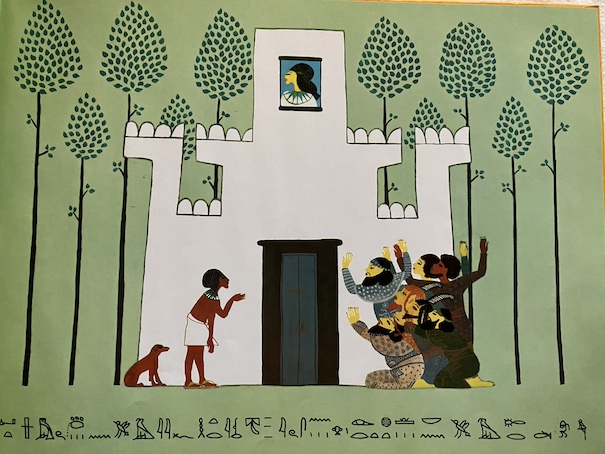
Eventually, he comes to the country of the Chief of Naharin, who only has one daughter. The chief keeps his daughter in a special house with a single window, high off the ground. He says that he will allow his daughter to marry the man who can jump up to that window. The prince manages to make the jump, and he marries the chief’s daughter.
After they are married, the prince explains to his wife the prophecy about his fate. His wife wants to kill the prince’s dog, but he refuses to allow it because he’s had the dog since it was a puppy. His wife begins to watch over him, to try to prevent him from being killed. She manages to kill the snake that comes for the prince, and the prince manages to make a deal with the crocodile, but can he truly escape his fate?
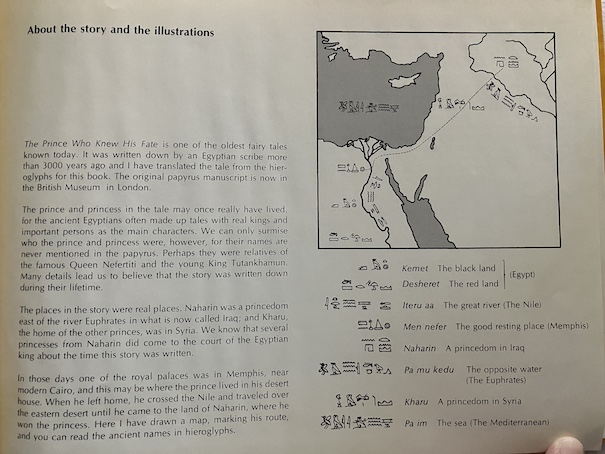
There is a section at the back of the book that explains more about the original story, which was written over 3000 years ago and is “one of the oldest fairy tales known today.” There is also some information about Ancient Egypt and the carvings that were the inspiration for the illustrations in the story.
My Reaction
I always enjoy folklore, and this story is fascinating because the original ending is unknown. The author of this book, Dr. Lise Manniche, who was a Danish Egyptologist, translated the story from the original hieroglyphics and added an ending to the story. I thought that the ending fit well enough, and I was pleased that it was a happy ending, even though it holds to the idea that the fate must be fulfilled. I also enjoyed the illustrations, based on Ancient Egyptian carvings from around the time that the story was created, and the addition of the hieroglyphs of the original story along the bottom of the pages.
I first heard about the folktale in this book in a mystery book for adults called The Snake, the Crocodile, and the Dog by Elizabeth Peters. It is part of the Amelia Peabody mystery series, about a Victorian era woman who is married to an archaeologist. Elizabeth Peters is a pen name for Barbara Mertz, who was an Egyptologist herself. Because this folktale featured prominently in that mystery novel, I was thrilled to find this version of it!
Fin M’Coul retold and illustrated by Tomie de Paola, 1981.
This is a retelling of a classic Irish folktale. The story is fun and silly, but one of the parts of this story I like the best is the introduction of the Giant’s Causeway – a real place with a magical look. There’s a geological explanation of this rock formation, but this story introduces the folkloric explanation.
In ancient times, when Ireland was inhabited by giants and magical creatures, a giant named Fin M’Coul lived on Knockmany Hill with his wife, Oonagh. One day, as he is building a causeway between Ireland and Scotland, Fin M’Coul hears that another giant, Cucullin, is coming.
Cucullin has a fearsome reputation, and he has beaten up many other giants, just to prove how strong he is. So far, Fin M’Coul has been able to keep out of his way, but Cucullin is now looking for Fin M’Coul to beat him. In fact, he’s so close that there’s no time for Fin M’Coul to get away.
Fin M’Coul goes home to his wife and asks her what he should do. Oonagh says that he won’t have any peace until he gets this confrontation with Cucullin over with, but Fin M’Coul doubts that he could be a match for Cucullin in a fight. Oonagh decides that they’re going to have to defeat Cucullin with cunning rather than strength.
She quickly does a special charm to bring them success, and then, she begins setting the scene for the trick they’re going to play on Cucullin. She makes up a giant cradle and makes her husband dress in baby clothes and sit in the cradle. It’s ridiculous, but Oonagh has a plan.
When Cucullin comes, Oonagh tells him that her husband isn’t home, but she invites him to come in and wait with her and her “baby.” Not only is the “baby” astonishingly large, even by giant standards, but Oonagh carefully convinces Cucullin of the baby’s unusual strength. She tricks him into thinking that the “baby” can eat bread and cheese that’s rock hard while giving Cucullin bread with a frying pan in the center and a real stone instead of cheese. Not only does Cucullin break his teeth on these things, but if Fin M’Coul’s “baby” can eat these things, how much stronger could Fin M’Coul be?
Oonagh’s tricks allow Fin M’Coul to get the upper hand against Cucullin and defeat him once and for all!
There is a brief section in the back of the book that explains a little about the background of the legend. I love the pictures in this version of the story. Tomie de Paola books always have fun illustrations, but if it weren’t for the little people and animals in the pictures with the giant characters, you might almost forget that the main characters in the story are all giants.
The book is available to borrow and read for free online through Internet Archive.