Flossie and the Fox

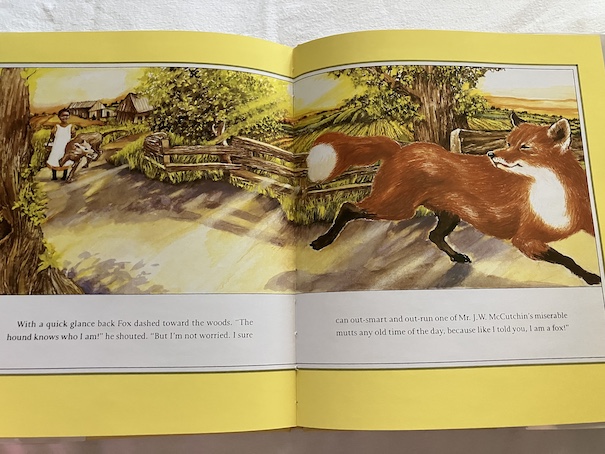
Little Flossie Finley’s mother asks her to take a basket of eggs to Miz Viola because a fox has been troubling her chickens, and they’re too scared to lay eggs. The fox is a sly creature, and he always seems to outwit the hounds.

Flossie doesn’t remember ever seeing a fox before, and her mother tells her that foxes will do just about anything to get eggs. Flossie isn’t sure what she’ll do if she meets the fox, but she remembers what her mother says about how “a fox be just a fox.” She decides that doesn’t sound too scary.

On the way, Flossie does meet the fox. The fox talks to her, and Flossie can tell that he wants the eggs she’s carrying. However, Flossie refuses to be impressed by the fox and tells him that she doesn’t even believe that he’s a fox because she’s never seen one before. The fox is surprised that she isn’t intimidated by him and tries to prove to her that he’s a real fox.

For everything the fox says to try to prove his identity, Flossie has an answer to deny it. He points out his thick fox fur, but Flossie says that rabbits also have thick fur. His pointed nose also doesn’t mean that he’s a fox because rats also have pointed noses. A cat they meet verifies that the fox is a fox, citing his yellow eyes and sharp claws, but since the cat also has yellow eyes and sharp claws, Flossie says that isn’t proof of being a fox. Even his characteristic bushy tail isn’t firm proof because squirrels also have bushy tails.

There is one being who knows for certain that the fox is a fox – the hounds that chase foxes. Flossie knows that as well as the fox does.

The author’s note in the front of the book says that the author enjoyed listening to stories told by her family when she was young, and the story in this book is one that she remembered from her youth. She particularly wanted to tell this story in a rural Southern dialect, like the one her grandfather used when he used to tell stories.

I enjoyed this fun story where a clever girl tricks a classical trickster. She knows that the fox is really fox, but she uses the similarities between the features of a fox and the features of other animals to pretend like she doesn’t and to keep the fox attempting to convince her until she reaches a point where the fox can no longer pursue her. Knowing the author’s connection to this folk tale style story adds an element of coziness, imagining the author hearing the story as a little girl herself.

The time period of the story is indefinite, but from the characters’ clothes, it looks like it might be some time during the late 19th century or early 20th century.

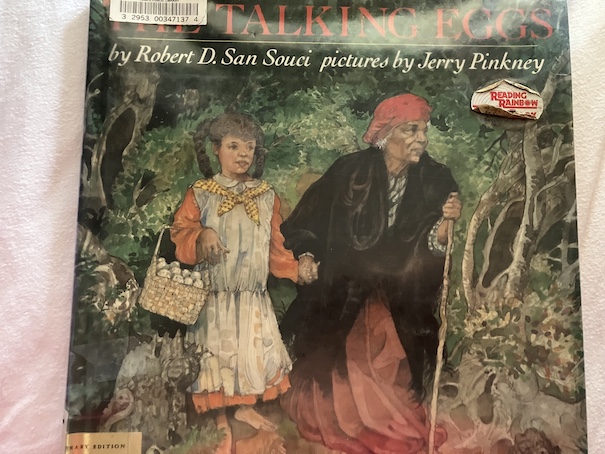
The Talking Eggs

There was a poor widow who lived on a small farm with her two daughters, Rose and Blanche. Rose was the widow’s favorite daughter because she was so much like her mother. They were both mean and bad-tempered, and they had grand dreams of becoming rich someday, although neither of them had the slightest idea how to accomplish that. Blanche, on the other hand, was a sweet girl, and her mother made her do all the work while she and Rose just sat on the porch, talking about all of their grand dreams.

One day, when Blanche goes to fetch water from the well, an old woman approaches her and begs her for a drink. Blanche gives her some water, and the old woman thanks her, telling her that she will be blessed for her kindness.

However, when Blanche gets home, her mother and sister yell at her for taking so long. They hit her, and Blanche runs away into the woods. Then, she meets the old woman again. She explains to the old woman what happened, and the old woman invites her to come to her house. However, she cautions Blanche not to laugh at what she sees there. Blanche promises that she won’t laugh.

The old woman is no ordinary woman, and everything at her house is strange. Some of these strange things are amusing, some are amazing, and some are just plain weird and a little alarming. The animals are all strange, with chickens of different colors and cows with curly horns. Then, inside the house, the old woman removes her head and puts it in her lap to brush her hair. Then, the woman produces a fancy stew from just one old bone. After supper, they go outside and watch rabbits in fancy clothing dance.

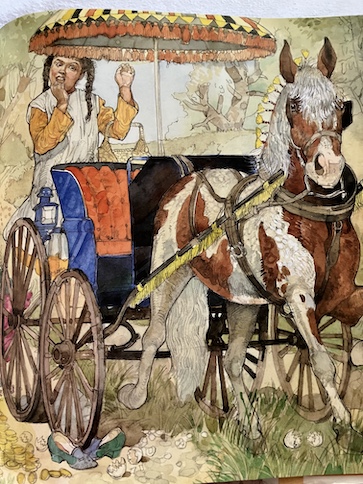
In the morning, the old woman tells Blanche to go out and gather some eggs before she goes home. Blanche is allowed to take any that tell her to take them and to leave ones that say not to take them. Blanche does as she is told, although the ones that tell her to take them are the plain-looking eggs, and the others are covered in jewels. The old woman tells Blanche to throw the eggs over her shoulder, one at a time, and when she does so, the eggs break and wonderful things burst out of them – fancy clothes, coins and jewels, and even a horse and carriage.

By the time Blanche gets home, she has many beautiful clothes, money, and luxurious things. Blanche’s mother pretends to be nice to her when she returns, but it’s only so Blanche will tell her where she got all the rich things. That night, when Blanche is asleep, her mother talks to Rose, telling her that she should also befriend the old woman and get the same rich rewards as Blanche. Then, they will steal all of Blanche’s things and head to the city to live the rich life that they’ve always dreamed of.

Of course, lazy and bad-tempered Rose isn’t as kind or hard-working as her sister. She ignores the old woman’s instructions and does everything she shouldn’t do. When she tries to force the old woman to give her riches, the old woman’s magic gives her and her mother their just desserts.

This book is a Reading Rainbow Book. It is available to borrow and read for free online through Internet Archive.
There is a note at the beginning of the book that this story comes from a Creole folktale that appeared in a 19th century collection of folktales from Louisiana by Alcee Fortier. It resembles folktales from Europe was probably adapted from fairy tales brought to Louisiana by French immigrants. It reminds me of the Mother Holle story, where a kind, well-behaved, hard-working girl is rewarded for following Mother Holle’s instructions, while her spoiled sister is punished for laziness and disobedience.

The old woman in this story is a similar figure to Mother Holle, with strange powers and magical objects, but there is no explanation of who she might be. The fact that she can remove her head just to brush her hair shows that she’s supernatural, but we don’t know if she’s supposed to be a witch or some other supernatural creature.

Personally, I don’t think I would laugh at any of the things in the old woman’s house. I think the strange animals sound more amazing than comical. I think I’d really be impressed by the different-colored chickens and the cows with the weird horns. I have to admit, though, that if someone takes off their head, my first reaction would probably be to run for it.

The Girl Who Loved Caterpillars

The Girl Who Loved Caterpillars adapted by Jean Merrill, illustrated by Floyd Cooper, 1992.

This story is a rendition of a 12th century folktale from Japan.

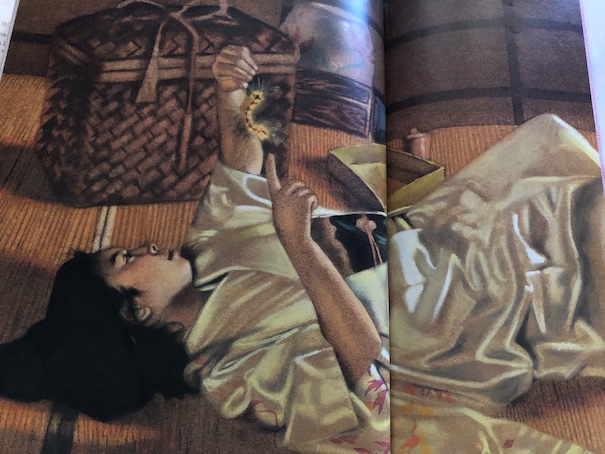
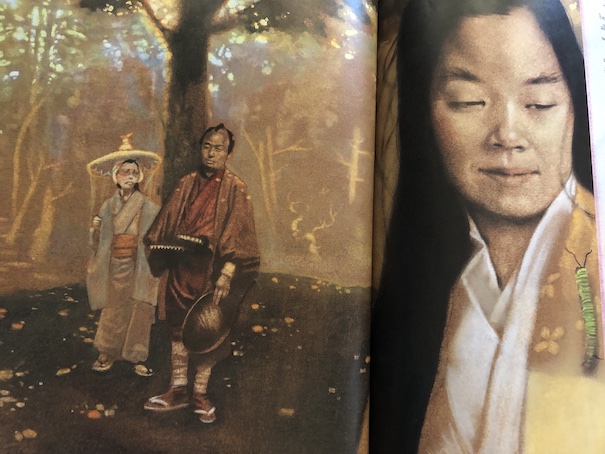
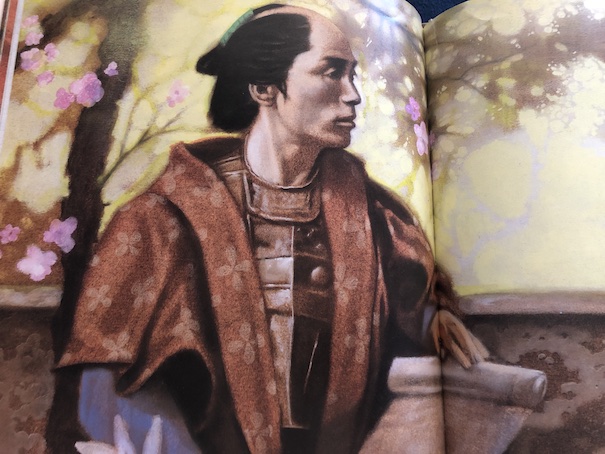
Izumi is the daughter of an important man, a provincial inspector who serves the emperor in Kyoto. Court life is full of elegance, and Izumi is a pretty and clever girl. Her parents have high hopes that she might become a lady-in-waiting or marry a nobleman, but she is mainly known for one thing: her peculiar love of caterpillars.

A beautiful and elegant woman who lives nearby is known for her love of butterflies, and she is considered to be The Perfect Lady. She has all of the skills that a noblewoman could aspire to, and Izumi’s parents think of her as a great role model for their daughter.

However, Izumi doesn’t see the appeal of beautiful butterflies. After all, they come from caterpillars, and caterpillars are much more interesting. Izumi also loves worms, toads, insects, and other things that most people would find unappealing. She likes to keep them as pets and observe how they live and grow. Izumi’s parents don’t approve of the lower-class boys who bring Izumi new creatures for her collection, and nobody else understands her fascination with these creatures.

Izumi just loves the natural world. To her, court life and the beauty standards for women there are too artificial. She also believes in reincarnation and the idea that any person might have been one of these unusual creatures in a past life or could be one in the next. Her parents love her, and they understand how she feels when she explains her reasoning to them, but they also worry about her future. If she doesn’t conform more to the standards of the court and develop more “normal” interests, will she ever make a desirable marriage? People at court gossip about Izumi and her odd tastes.

However, the rumors about Izumi reach a young nobleman who is as clever as Izumi, and he is fascinated at the idea of a pretty girl who isn’t afraid of the creeping creatures of the Earth.

The book is available to borrow and read for free online through Internet Archive.

My Reaction

I remember this story from when I was a kid! When I was a kid, I didn’t bother to read the Afterword of the book, which explains more about the origins of the story. Izumi’s story actually seems to be part of a much longer story about court life in Medieval Japan. The original author of the story is unknown, and Izumi’s part of the story is incomplete. It ends with the promise that what happens next will be revealed in the next chapter, but the rest of the story is unknown. We don’t know if she ends up marrying the nobleman who has developed a fascination with her or not.

I have a theory, based on a comment that Izumi made, comparing caterpillars to their adult forms and asking why people are only interested in the adult forms, that Izumi’s love of caterpillars is based both on her young age and perhaps a hidden affinity for children. Perhaps Izumi will grow to love butterflies as well as she grows up and be viewed as more of a butterfly herself, or maybe the nearby lady who loves butterflies will admit to a secret love of caterpillars as well. None of us stay young, and we all evolve as we grow, but part of us always remembers being in those early, awkward stages. Maybe everyone has a secret soft spot for the young, even when they’re fuzzy or grubby crawling things, and a desire to see them become the best form of themselves.

Whatever her future brings, readers get the impression that Izumi is happy and at peace with herself as she is, whether anyone else agrees or not. We can hope that the young nobleman will also love her for the person she is, but Izumi seems to believe that being true to her own nature is the way to achieve inner peace.

In other times and places, as the Afterward observes, Izumi might have been a scientist, naturalist, or philosopher. The traits that make her seem odd for her time and place are actually desirable ones that could make her more successful in other circumstances. In the early 21st century, Izumi’s sense of individualism and her value of the natural world would probably win her many friends. People who enjoy the aesthetic of Goblincore would probably relate to her feelings about caterpillars and other crawly creatures.

The Mysterious Giant of Barletta

This story is adapted from an Italian folktale. There is a note in the beginning about the town of Barletta and the statue that stands in front of the San Sepolcro Church. According to the note, nobody knows who the statue is supposed to represent, which is why there are stories about it. This one takes place during the Middle Ages, the 11th century.

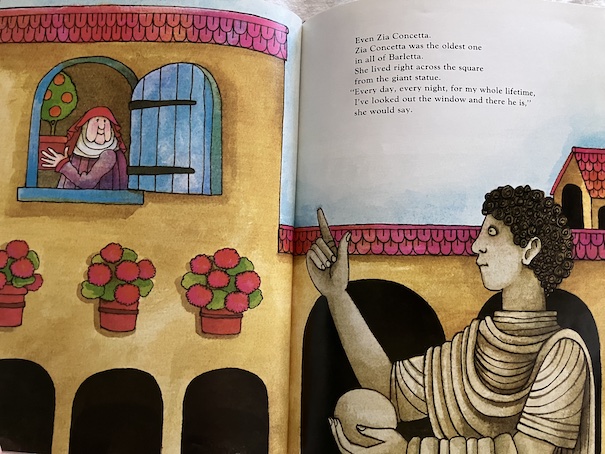
Because no one knows who the statue is supposed to be, the people of Barletta call it, “The Mysterious Giant.” No one even knows for sure how long it has been there. It has been there for as long as anyone can remember, including Zia Concetta, the oldest person in Barletta. People are accustomed to gathering around the statue to meet each other, and many of them will give the statue a friendly greeting or wish it good night.

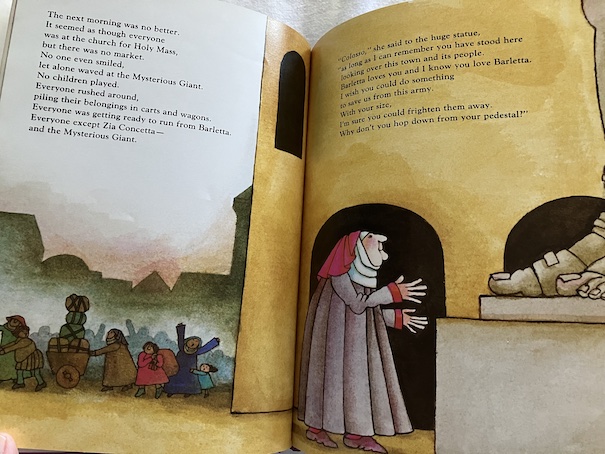
However, one day, the town is threatened by an invading army. The people of Barletta are unprepared for invaders, and many of them prepare to flee, not knowing what else to do. Zia Concetta appeals to the statue to save their town.

The statue hears Zia Concetta’s request, and it comes to life, climbing down from its pedestal. Together, he and Zia Concetta come up with a plan to discourage the invaders.

When the invaders arrive, they see the statue, sitting by itself outside the city, crying. When they ask the giant statue why it’s crying, it says that the other boys at school are mean to him because he’s smaller than everyone else. When the invaders hear that everyone else in Barletta is bigger than the giant statue, they decide that they don’t want to meet the rest of the townspeople and leave!

The book is available to borrow and read for free online through Internet Archive.

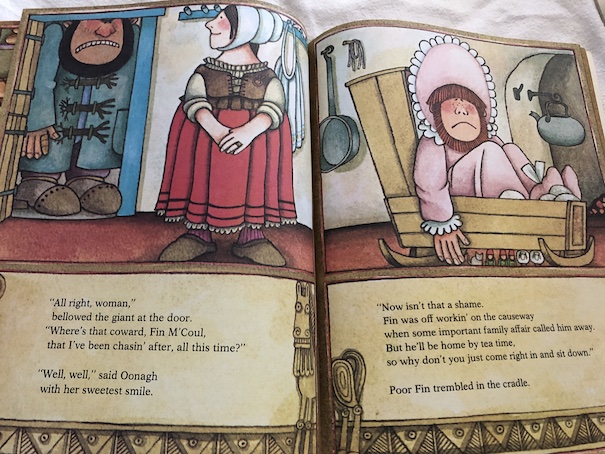
I always like books that reference folklore! The theme of someone who is large pretending like they’re much smaller than other people to scare off an attacker is one found in other folktales. For example, in Fin M’Coul (a version of which was also written and illustrated by Tomie dePaola), Fin M’Coul, who is a giant, pretends to be his own baby to make an enemy think that his father must be larger and more fierce than he actually is.

I particularly liked this story because, unlike other folktales, it has a real setting and a definite landmark, the statue that is sometimes called the Colossus of Barletta. The way it is drawn in the book isn’t exactly as it appears in real life. In real life, it holds a cross in the hand that is raised, although the cross was not part of the statue originally. It probably originally held a spear or a flag standard. It is about three times the size of an adult human, which isn’t as large as it is shown the book. As in the book, it isn’t certain exactly who the statue is supposed to be, although it appears to be the statue of an emperor. He appears to be a middle-aged man wearing a jeweled diadem. The reason why nobody knows exactly who it was supposed to be is that it wasn’t originally made or displayed in Barletta. It was probably originally looted from Constantinople by the Venetians. There is a story from Barletta that it was once lost in a shipwreck on the way from Constantinople and washed up on the shores of Barletta in 1309, where some of its bronze was used for casting bells for a monastery. Then, in the 15th century, the statue was restored and displayed in front of the church. That, by itself is a fascinating story, although it isn’t explained in the book.

Saint George and the Dragon

The story of Saint George and the Dragon is an old folktale. The story as told in this children’s picture book was adapted from Edmund Spenser’s Faerie Queene.

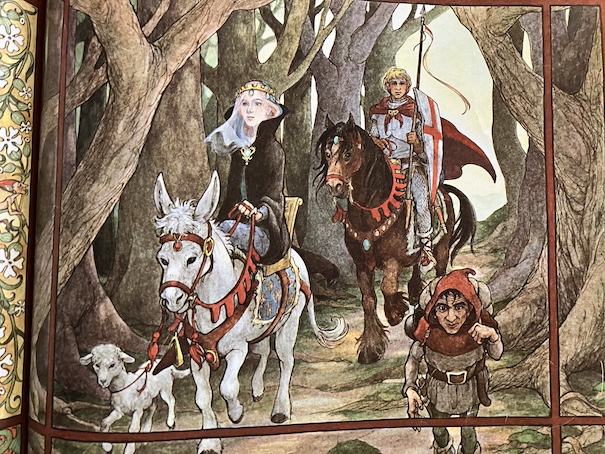
The Red Cross Knight, who carries a shield decorated with a red cross, does not know his own name or even where he came from. He only knows that the Queen of the Fairies has sent him to face a terrible dragon. He is accompanied on his journey by a princess with a little white lamb and a dwarf. The Princess’s name is Una, and her kingdom is being attacked by the dragon.

On their journey, they meet a hermit, who shows the knight a distant palace on a mountaintop, where angels travel between the palace and heaven. It’s so beautiful that the knight wants to go there immediately, but the hermit says that this palace is in another world and that he cannot go there until he faces the dragon. The hermit also reveals the knight’s past to him. He is not one of the fairy folk, although the fairy folk are the ones who sent him. The hermit knows that he was kidnapped by the fairies as a baby and hidden in a farm field, where he was discovered by a plowman who named him George. His true destiny is to become Saint George, the patron saint of England.

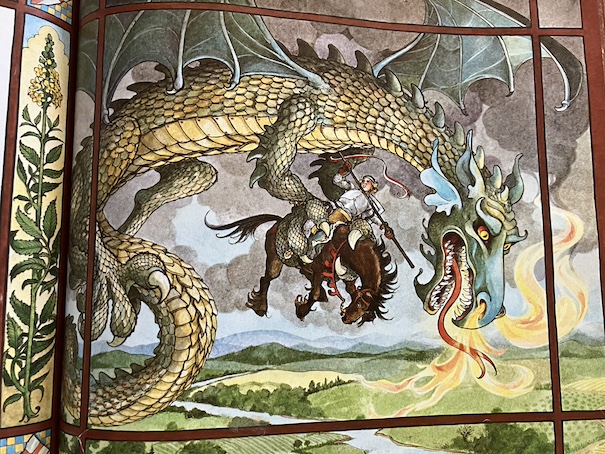
Una takes George to her parents’ fortress. As they approach, they see the dragon for the first time. George sends Una away from danger, and he and the dragon battle for the first time. The dragon picks up George, horse and all, and throws them to the ground. George manages to drive the dragon away, but he is also injured. At first, he and his friends think he is going to die, but he lies down in an ancient spring that cools and heals him. By morning, he is able to rise and fight again.

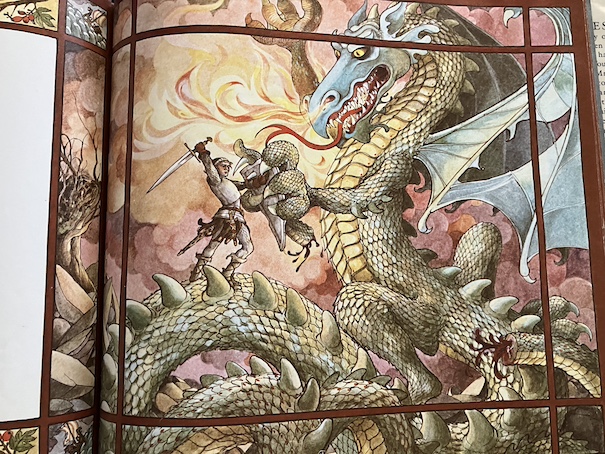
The second time George fights the dragon, he is able to cut off part of the dragon’s tail and one of its paws. The dragon’s fire finally drives George away, and once again, George seems too wounded to survive. However, he rests under an apple tree that drops healing dew, and George survives.

The third time George and the dragon fight, George manages to kill the dragon. Everyone celebrates, and Una’s parents thank George. The king gives George rich rewards, but George passes them on to the poor people. George is bound to the service of the Fairy Queen for six years, but the king allows George to marry Una and promises him that he will become the next king when his service is finished.

The book is available to borrow and read for free online through Internet Archive.

I love the colorful illustrations in this story, although some of them seemed a bit brutal for an audience of young children, showing George badly injured and the dragon spurting blood. Because I love folklore, I know that the legend of St. George and the Dragon is a Christian allegory, although it has some basis in earlier folktales and historical figures. I’ve heard different interpretations of what the dragon is supposed to represent. It can be a symbol of evil, the devil, or sin, and I think I’ve heard that it could represent paganism, which was replaced by Christianity (represented by St. George in the story), although I can’t remember where. In a way, I think this is one of those picture book that might mean more to adults because they would understand more of the symbolism, history, and folklore references in the story. On the other hand, who doesn’t love a story that ends with a gallant knight marrying a beautiful princess?

In case you’re wondering, the red cross on St. George’s shield isn’t the red cross used by the International Red Cross. However, Saint George’s Cross is on the national flag of England and is also part of the Union Jack flag of the United Kingdom.

As another odd piece of literary trivia, the legend of St. George has a connection to another story that I’ve on this blog, Phoebe the Spy. The connection isn’t an obvious one because Phoebe the Spy was set in New York during the American Revolution, which seems far removed from Medieval England. However, on April 23, 1770 (St. George’s Day), the St. George Society (originally called the Sons of St. George) was founded at the Fraunces Tavern in New York, just six years before the story of Phoebe the Spy begins at the same tavern. The St. George Society was and still is a charitable organization that helps immigrants from Britain, using the patron saint of England as its namesake.

The Prince Who Knew His Fate

This picture book is a retelling of an Ancient Egyptian story (sometimes called The Tale of the Doomed Prince) about a prince and a prediction regarding his death with an unknown ending. The only known original version of the story is incomplete. For this book, the author has given the story an ending.

An Egyptian king wishes for a child, but when his son is born, the seven Hathor goddesses offer a prophecy for the prince’s fate. They say that, “He is destined to be killed by a crocodile or a snake or a dog.”

The king is distressed by this prediction for his son’s fate, and he decides to protect him from it as best he can. He has a special house built for the prince, where he grows up, attended by servants and given all sorts of good things to keep him happy. The king wants his son to stay in this house, where he will be safe. 

However, as the prince gets older, he becomes more interested in the outside world. One day, he sees a man passing the house with a dog, and the prince wants a dog of his own. The king relents and allows his son to have a dog, in spite of the prophecy.

The prince further demands that his father allow him to leave the house and travel. After all, he says, if his fate is already determined, it won’t matter if his father tries to protect him from it. He says that, if he must die eventually, he might as well live his life to the fullest while he can. The king allows his son to have a chariot and to hunt and travel the Nile. Everywhere the prince goes, he brings his dog with him.

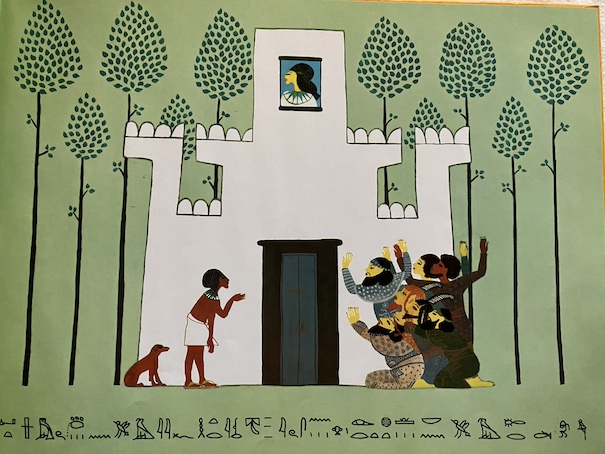
Eventually, he comes to the country of the Chief of Naharin, who only has one daughter. The chief keeps his daughter in a special house with a single window, high off the ground. He says that he will allow his daughter to marry the man who can jump up to that window. The prince manages to make the jump, and he marries the chief’s daughter.

After they are married, the prince explains to his wife the prophecy about his fate. His wife wants to kill the prince’s dog, but he refuses to allow it because he’s had the dog since it was a puppy. His wife begins to watch over him, to try to prevent him from being killed. She manages to kill the snake that comes for the prince, and the prince manages to make a deal with the crocodile, but can he truly escape his fate?

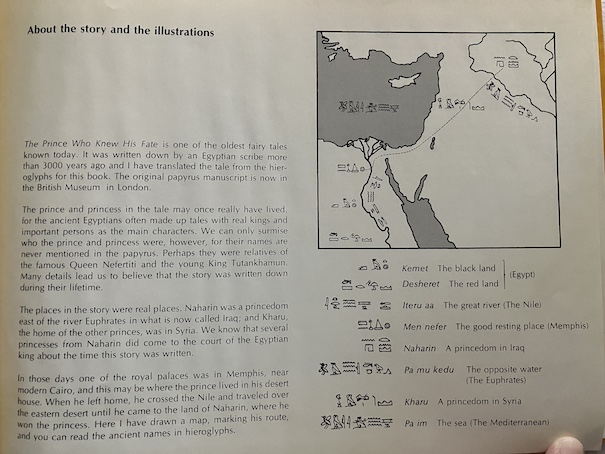
There is a section at the back of the book that explains more about the original story, which was written over 3000 years ago and is “one of the oldest fairy tales known today.” There is also some information about Ancient Egypt and the carvings that were the inspiration for the illustrations in the story.

I always enjoy folklore, and this story is fascinating because the original ending is unknown. The author of this book, Dr. Lise Manniche, who was a Danish Egyptologist, translated the story from the original hieroglyphics and added an ending to the story. I thought that the ending fit well enough, and I was pleased that it was a happy ending, even though it holds to the idea that the fate must be fulfilled. I also enjoyed the illustrations, based on Ancient Egyptian carvings from around the time that the story was created, and the addition of the hieroglyphs of the original story along the bottom of the pages.

I first heard about the folktale in this book in a mystery book for adults called The Snake, the Crocodile, and the Dog by Elizabeth Peters. It is part of the Amelia Peabody mystery series, about a Victorian era woman who is married to an archaeologist. Elizabeth Peters is a pen name for Barbara Mertz, who was an Egyptologist herself. Because this folktale featured prominently in that mystery novel, I was thrilled to find this version of it!

Fin M’Coul

Fin M’Coul retold and illustrated by Tomie de Paola, 1981.

This is a retelling of a classic Irish folktale. The story is fun and silly, but one of the parts of this story I like the best is the introduction of the Giant’s Causeway – a real place with a magical look. There’s a geological explanation of this rock formation, but this story introduces the folkloric explanation.

In ancient times, when Ireland was inhabited by giants and magical creatures, a giant named Fin M’Coul lived on Knockmany Hill with his wife, Oonagh. One day, as he is building a causeway between Ireland and Scotland, Fin M’Coul hears that another giant, Cucullin, is coming.

Cucullin has a fearsome reputation, and he has beaten up many other giants, just to prove how strong he is. So far, Fin M’Coul has been able to keep out of his way, but Cucullin is now looking for Fin M’Coul to beat him. In fact, he’s so close that there’s no time for Fin M’Coul to get away.

Fin M’Coul goes home to his wife and asks her what he should do. Oonagh says that he won’t have any peace until he gets this confrontation with Cucullin over with, but Fin M’Coul doubts that he could be a match for Cucullin in a fight. Oonagh decides that they’re going to have to defeat Cucullin with cunning rather than strength.

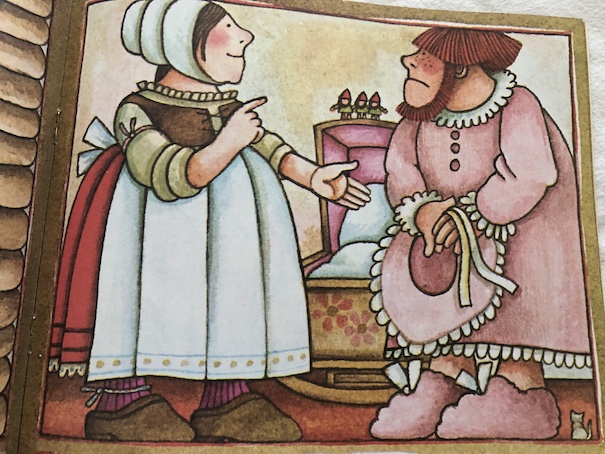
She quickly does a special charm to bring them success, and then, she begins setting the scene for the trick they’re going to play on Cucullin. She makes up a giant cradle and makes her husband dress in baby clothes and sit in the cradle. It’s ridiculous, but Oonagh has a plan.

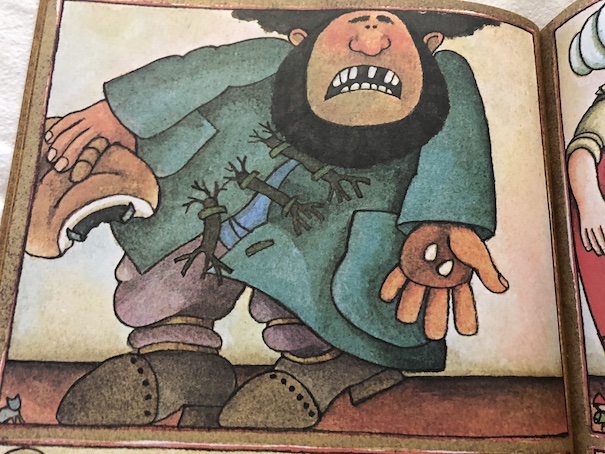
When Cucullin comes, Oonagh tells him that her husband isn’t home, but she invites him to come in and wait with her and her “baby.” Not only is the “baby” astonishingly large, even by giant standards, but Oonagh carefully convinces Cucullin of the baby’s unusual strength. She tricks him into thinking that the “baby” can eat bread and cheese that’s rock hard while giving Cucullin bread with a frying pan in the center and a real stone instead of cheese. Not only does Cucullin break his teeth on these things, but if Fin M’Coul’s “baby” can eat these things, how much stronger could Fin M’Coul be?

Oonagh’s tricks allow Fin M’Coul to get the upper hand against Cucullin and defeat him once and for all!

There is a brief section in the back of the book that explains a little about the background of the legend. I love the pictures in this version of the story. Tomie de Paola books always have fun illustrations, but if it weren’t for the little people and animals in the pictures with the giant characters, you might almost forget that the main characters in the story are all giants.
The book is available to borrow and read for free online through Internet Archive.

Pecos Bill

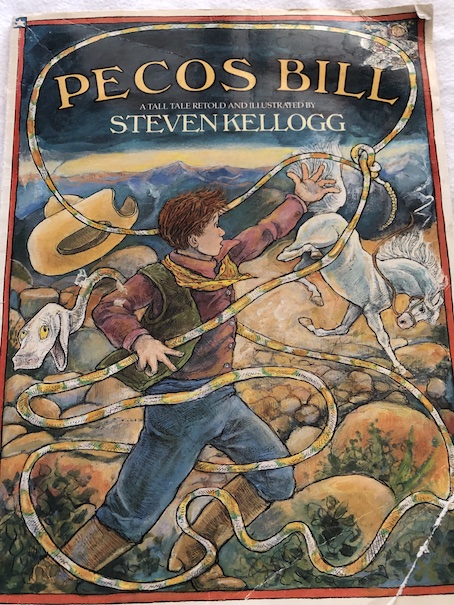
Pecos Bill retold and illustrated by Steven Kellogg, 1986.

I remember this book from when I was in elementary school! This was the book that my teacher or librarian (I forget which one now) used to introduce us to the concept of tall tales. Tall tales, like the story of Pecos Bill, are a major feature of American folklore, particularly Western American folklore.

When the story begins, young Bill is traveling west from New England with his family as part of a wagon train. As they cross the Pecos River, Bill tries to fish, but an enormous trout pulls him out of his family’s wagon. Bill is rescued by a coyote, and he spends some time living and growing up with the coyotes and other animals in Texas.

Eventually Bill meets up with a cowboy named Chuck, who explains to him that he’s a human and a Texan, not a coyote. Chuck gives him some extra clothes to wear (because he’s long outgrown his childhood clothes). Chuck tells Bill that many Texans are outlaws, but they would be better if they started herding cattle and became ranchers. Bill decides to try life as a Texas rancher.

Because of his wild upbringing, Pecos Bill is able to perform amazing feats of strength, like subduing a giant rattlesnake to the point where it becomes tame and allows Pecos Bill to use him as a lasso. He also gets the hide of a monster to make other lassos to give to the worst gang of outlaws around. The outlaws are so impressed with Bill’s ability to subdue wild creatures that they agree to make him the boss of their gang, and they all become cowboys.

Bill subdues a wild horse called Lightning and uses the language of wild animals to befriend him. He leads the other cowboys on a massive cattle drive, and he creates the impossible Perpetual Motion Ranch on Pinnacle Peak.

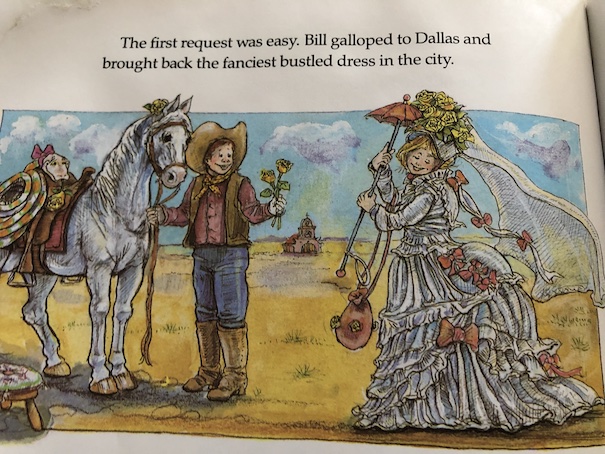
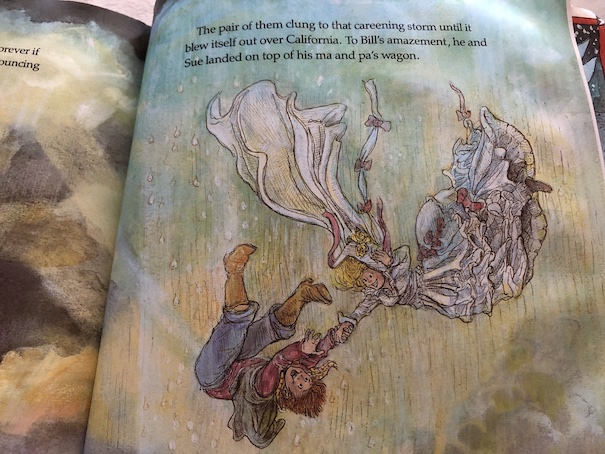
Then, Pecos Bill meets a pretty girl named Sue and decides to get married. However, Sue’s bustle is so tight that when she tries to sit on Bill’s horse, Sue bounces in the air so high that she reaches the moon. Every time she hit the ground, she bounces into the sky again, so Pecos Bill has to lasso a tornado to catch up with her.

When they finally land, they land on top of Bill’s family’s wagon in California. Apparently, they’re still wandering after all these years, trying to find a place to settle. Pecos Bill convinces his family to settle with him and his bride in Texas.

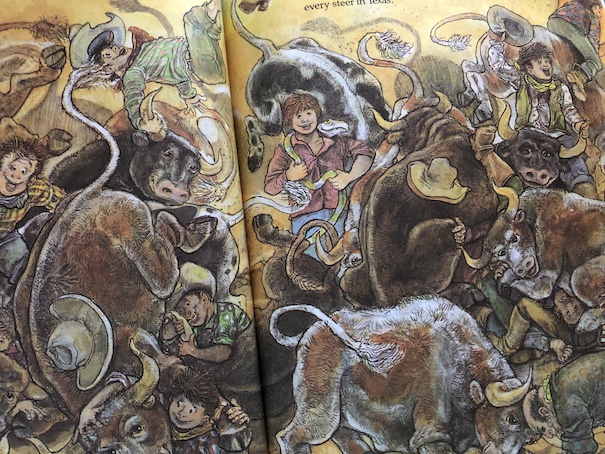
I’m not very big on tall tales, in spite of having grown in the American Southwest, where many of these types of stories evolved, but I have some sentimental attachment to this one because it was my first as a kid. The pictures in the book are wild and chaotic, just like the action in the story.

The book is available to borrow and read for free online through Internet Archive (multiple copies).

The Little Red Hen

The Little Red Hen pictures by Tadasu Izawa and Shigemi Hijikata, 1968.

This cute picture book is part of a series of Puppet Storybooks. What makes it distinctive from other picture books is that the pictures are all photographs of tableaux with detailed puppets. The story is a retelling of the classic Little Red Hen folktale.

A hen finds a grain of wheat, but no one is interested in helping her plant it, so she does it herself. When it’s time to harvest the wheat, none of the other animals will help her, so she also cuts the wheat herself.

Because no one wants to help her, she takes the wheat to the mill to be made into flour and bakes it into bread all by herself.

When she has the nice loaf of bread that she has made, all of the animals who didn’t want to help before suddenly come to help her eat it. However, since none of them helped with making the bread, the Little Red Hen eats the bread herself with her chicks.

My Reaction

I’ve had this book since I was a little kid, and I always liked the pictures! The puppets are detailed and posed in realistic ways. The picture on the cover of the book is a 3D hologram, and I was fascinated by it as a young child. It was one of the first holographic images that I saw as a child!

(In my defense, I might not have been the one who scribbled crayon on that cover image. I was pretty good about not drawing on books when I was little, and most of my childhood books were used, so that scribble might have happened before I got it. I don’t remember anymore, so it’s hard to deny it completely, but according to my memory, my messy scribbles were done on the back wall of my closet, behind my clothes, because I knew that drawing on walls wasn’t allowed, and I was realized that if you’re going to draw on the wrong surface, it’s best to do it where nobody’s going to see it and complain. I was sneaky like that.)

While my copy of this book was printed in English, the books in the series were originally written, illustrated, printed, and bound in Japan. I never noticed that when I was a kid because I never bothered to look at the names of the illustrators and had no interest in where it was printed, but I found it interesting as an adult. It makes me think that there are probably also versions of this book written in Japanese, but I’ve never seen any.

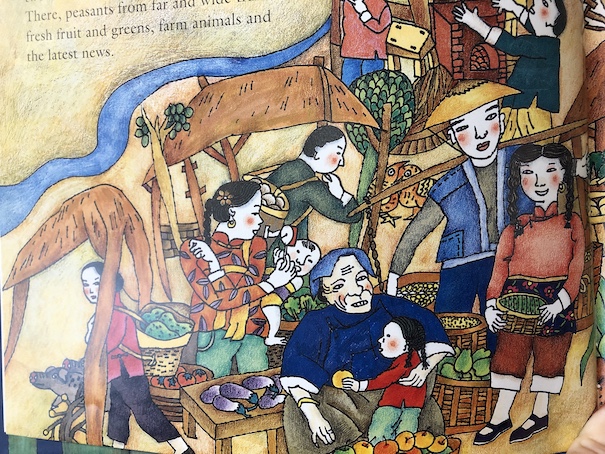
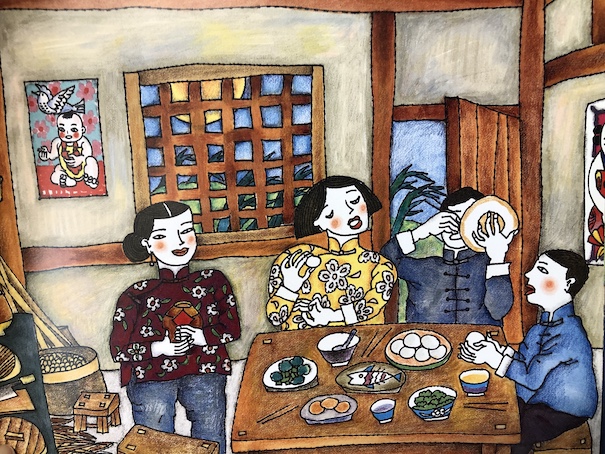
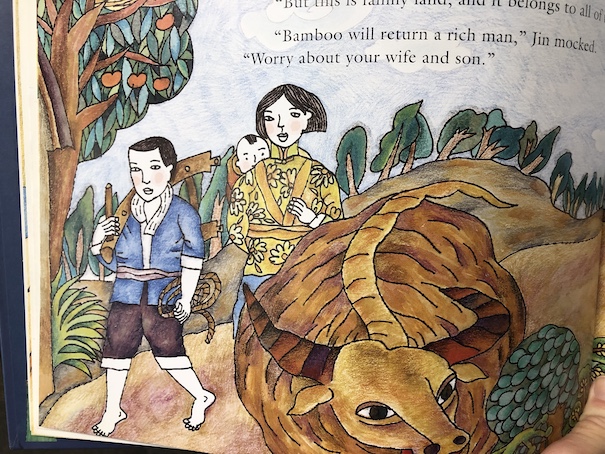
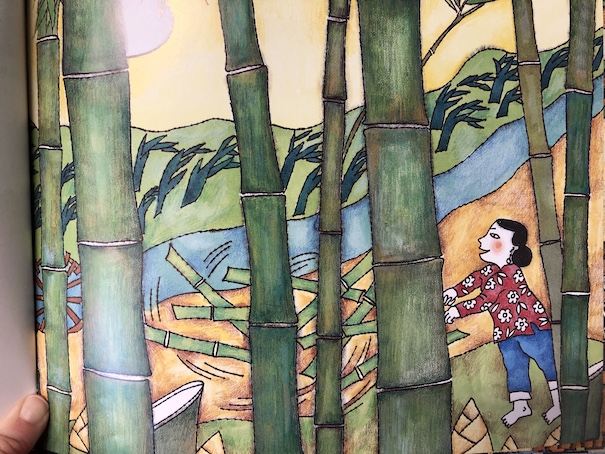
The Fourth Question

The Fourth Question retold by Rosalind C. Wang, illustrated by Ju-Hong Chen, 1991.

This is a retelling of a Chinese folktale.

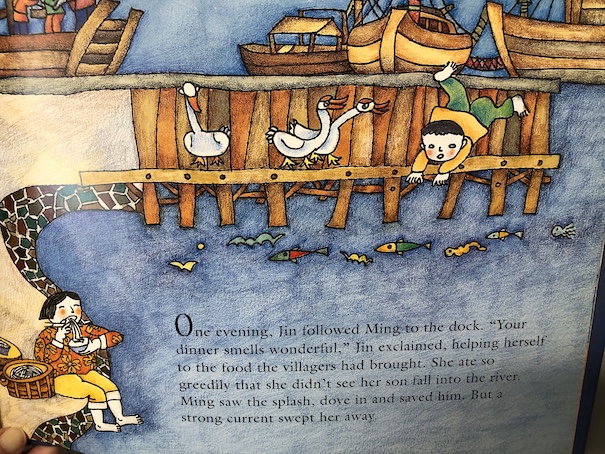
There was once a poor young man, Yee-Lee who lived with his mother. Even though Yee-Lee works very hard, he can barely make enough money to keep him and his mother alive. He wonders why he has so little money even though he works so hard and decides to go to the Wise Man of Kun-lun Mountain to seek the answer and his advice so he and his mother can have a better life.

It’s a long way to reach the Wise Men, and along the way, he encounters other people who also needed help. A kind old woman who gives Yee-Lee some water and food has a daughter who is unable to speak and wants to know how to help her. An old man has a tree in his orchard that won’t bear fruit, and he can’t figure out why. A dragon who helps Yee-Lee to reach the mountain cannot manage to fly to heaven even though he has lived a good life. Yee-Lee has sympathy for all of these people and the dragon and appreciates the help they give him, so he promises that when he reaches the Wise Man, he will seek the answers to their problems as well.

However, when Yee-Lee finally reaches the Wise Man, he is told that he is only allowed to ask three questions during his visit. It’s a problem because Yee-Lee now has four questions to ask, the three that he promised to ask for others plus the original question that he wanted to ask for himself. He has to decide which of the questions will go unanswered.

Yee-Lee’s question is important to him, but when he thinks about the other people who are now depending on him to come back with answers for him, he reluctantly decides to forget his own question and answer theirs. However, in solving the problems of others, Yee-Lee finds the solution to his own problem. Like the heroes of other folktales, Yee-Lee is rewarded for his good deeds!

The book is available to borrow and read for free online through Internet Archive.