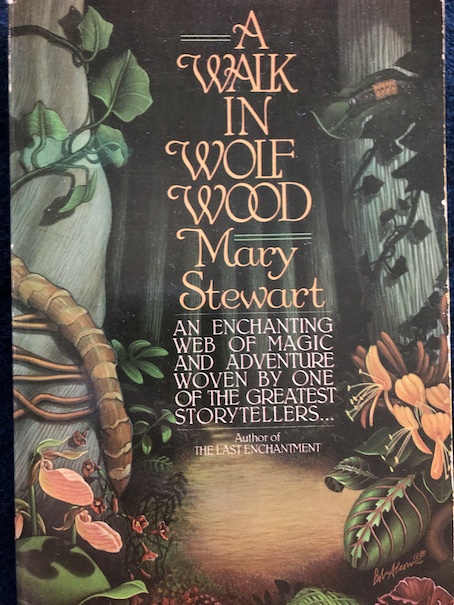
A Walk in Wolf Wood

A Walk in Wolf Wood by Mary Stewart, 1980.
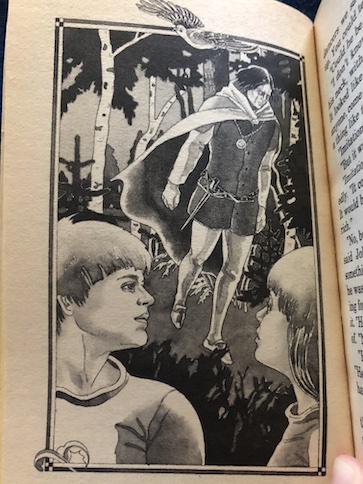
John and Margaret Begbie are traveling with their parents through Germany, and the family stops to have a picnic in the Black Forest. From their picnic spot, they can see the old castle on the hill that they visited earlier that day. The children’s parents doze off after lunch, but the children stay awake and see a strange man. The man walks by their picnic spot wearing an old velvet costume and a dagger in his belt, and the children see that he’s crying. The kids worry about the man because he seems so deeply distressed. They decide to leave a note for their parents and follow the man to be sure that he’s alright.

As they go after the man, they spot what looks like the tracks of a large dog, but the man didn’t have a dog with him. The kids realize that these are actually wolf tracks, and John remembers that their father told them that this area is called Wolfenwald, which means Wolf Wood. Then, they find the man’s gold medallion lying on the ground. Going a little further, they find an old cottage. The cottage looks abandoned, but they decide to explore around it anyway, just in case the man went inside. No one answers their knocks on the door, but they see the man’s clothes on the bed inside the house. They decide to leave the medallion with the man’s clothes and go back to their parents, but they suddenly notice that it has become night, and when they try to leave the cottage, they are confronted by a large wolf!

John frightens the wolf away by flinging the medallion at it. When the wolf is gone, the children decide that they have no choice but to risk going through the woods in the dark to find their parents. However, when they arrive at the picnic spot again, their parents aren’t there. The children find the note they left and a bar of chocolate. They eat the chocolate and lie down to wait for their parents to return for them, but the next thing they know, they are woken by the sound of a horn and the horses of a group of hunters. The hunters are pursuing the wolf. When they wave down one of the horsemen, he offers them a coin to tell him where the wolf is. Margaret points the man in the wrong direction to get the hunters off the trail of the wolf. The children aren’t really sure whether it’s a real wolf or just a dog that resembles one, but Margaret has the sense that the wolf needs their help.

The children also need help. They notice that the horsemen are dressed strangely, like people out of the past, and the coin that the man gave them is stamped with the year 1342 although it looks new. Even more strangely, the children suddenly realize that they understood what the man said even though neither of them can speak German. Is this is a dream, or have they gone back in time?

Not knowing what else to do, they decide to return to the cottage and see if the man who owns the medallion is there and can explain things. The man does have an explanation. He explains that he was the wolf. The man, whose name is Mardian, is a werewolf, and Margaret saved his life when she diverted the hunters. Mardian says that he and his family served the dukes who have ruled this land, and he and the current duke grew up together and were best friends for years. However, after suffering a terrible injury at the hands of an enemy and losing his wife, Duke Otho became a changed man, angry and bitter. In a fit of temper, he even accused Mardian of plotting against him. A real enemy in Otho’s circle, an enchanter called Almeric, used Otho’s suspicions to try to eliminate Mardian. When his plots to kill Mardian failed, Almeric used sorcery to turn him into a werewolf. Now, Alermic has promised a reward to the hunter who kills the wolf, and in the meantime, he has disguised himself as Mardian and taken his place in the duke’s castle. So far, the duke hasn’t even noticed that Mardian has been replaced by an imposter. Mardian believes that Alermic will use his position to kill both the duke and his young son so he can take the dukedom for himself. Can the children help Mardian expose the imposter and break the spell?

The book is available to borrow and read for free online through Internet Archive (multiple copies).

My Reaction

In order to reach the duke and get his help to expose the imposter, the children must disguise themselves as other children from this time period and join in the life of the duke’s castle. Mardian gives them a plausible cover story, in case anyone asks them who they are. They carry off the charade very well, and there are so many people and children in the castle that two more aren’t questioned. John is even mistaken for another boy, called Lionel. John doesn’t know who or where the real Lionel is, although he theorizes that the real Lionel might have died young because many children of this time period did. While real-life castles were full of many different types of people of all ages, I do find it a little difficult to believe that so few people are surprised by children who suddenly appear without any introduction. There does seem to be the implication that people do come and go from this castle, making it difficult to keep track of everyone.

Margaret and John also experience the different expectations people of this time have for girls and boys. John is immediately put to work as a servant, waiting on the noblemen of the duke’s court as a page along with the sons of the nobles. He also has to dodge the rough games that the other boys play that are meant to prepare them for war. On the other hand, Margaret is taken to the nurseries with the other young girls of the castle and lectured about how she should be quiet and modest. The girls are much more closely supervised than the boys, although she finds a way of slipping away from the others to meet with John.

I liked some of the descriptions of the Medieval food in the book. At one point, Margaret thinks she’s eating turkey (a bird native to the Americas and not found in Europe during this time period), but John tells her that it’s actually swan and peacock, birds which were eaten around this time. There are a few instances where alcohol is mentioned because people during this time period drink wine and small beer. The duke also insists that a boy bring him his favorite posset, a drink I discussed in my earlier review of the The Box of Delights.

Ruth Fielding at Snow Camp

Ruth Fielding

Ruth Fielding at Snow Camp or Lost in the Backwoods by Alice B. Emerson (the Stratemeyer Syndicate), 1913.

It’s shortly after Christmas, and Ruth and her friends, the Cameron twins, Helen and Tom, are home from boarding school. They’re excited because the twins’ father has purchased a snow camp, a kind of winter retreat in the woods, with a nice cabin that has enough room for the twins, Ruth, and some of their school friends. In fact, Mr. Cameron is allowing the young people to take a party of their friends there soon, before school starts again.

However, before they leave on their trip, Ruth and the twins have an unexpected confrontation with a neighbor’s bull that causes a boy hiding in a hollow log to be knocked into a freezing creek. They manage to rescue the boy and take him back to the Red Mill to warm up.

The boy reluctantly explains that he is Fred Hatfield and that he has run away from home, which is in Scarboro, New York, close to the snow camp. His father is dead, and he says that he has plenty of other siblings to help his mother at home. He is evasive about why he felt the need to run away, just saying that he was tired of where he was, and he’s sure his family won’t miss him. None of the adults are impressed by that explanation, saying that they’re sure that a mother would miss any of her children, no matter how many others she might have.

Ruth spots a newspaper clipping that Fred dropped, and when she picks it up and reads it, she realizes that Fred’s situation is more serious than anyone else thinks. At first, she doesn’t tell anyone else about the clipping, not sure how much she should reveal about what she knows (even to the readers). However, knowing that Fred might try to run away, she hides his trousers so he can’t leave in the middle of the night.

The next day, they tell Fred that the young people are going to the snow camp near Scarboro, and that Mr. Cameron will take Fred there on the train when he escorts his children and their friends there. As Ruth anticipates, Fred doesn’t want to go back to Scarboro. He tries more than once to run away, and one of his attempts to run and Ruth’s attempt to stop him cause them both to be separated from the rest of the party, lost in the winter woods. Fred isn’t happy with Ruth for tagging along with him and interfering in his business, and Ruth says that she’s not going to let him abandon her in the woods.

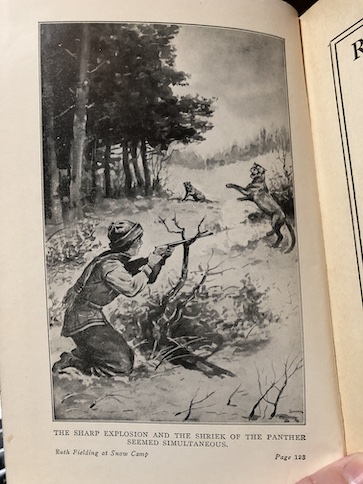
Together, they have a frightening encounter with a with a panther and get help from a hermit living in the woods. The hermit is a strange man who keeps rattlesnakes as pets, although the poison sacs have been removed. He teaches the Ruth and Fred to walk in snow shoes, and he helps them to reach the snow camp. They actually manage to get there before the rest of their party does, but Fred disappears just as they arrive.

When Ruth calls her friends in town to let them know that she’s all right and that she’s reached the snow camp, Mr. Cameron shocks her by telling her that the boy she’s known as Fred can’t possibly be the real Fred Hatfield. Mr. Cameron has learned from the local authorities that Fred Hatfield was killed in an apparent hunting accident months ago, although some people wonder if it was actually a murder. Fred’s half brother is being held by the authorities for Fred’s death. Did Fred just fake his death and run away? Or is the boy they know as Fred someone else entirely?

The book is now public domain and is available to borrow and read for free online through Internet Archive (multiple copies) and Project Gutenberg.

My Reaction and Spoilers

When we’re first told that Fred Hatfield was supposedly killed in a hunting accident, they mention that the boy’s body apparently rolled into a river after being shot, making it seem like Fred could still be alive, but then we’re told that the boy’s body was recovered from the river. That means that either Fred is actually dead and this new runaway Fred is an imposter or some other boy has been killed and Fred is just letting everyone think that the dead boy is him. Either way, there is a runaway boy whose identity needs to be established and a dead body whose identity also needs to be confirmed, and the circumstances of that death also need to be established. What really happened during that fateful hunting trip?

I liked the premise of this book because it’s much more of a mystery than the previous two books in the series. However, as an early Stratemeyer Syndicate book, there isn’t much deliberate investigation of the mystery. Most of the story is more adventure-oriented, and the characters learn the truth of the mystery almost by accident and through Fred’s eventual confession. In between, the characters have some outdoor winter fun. The girls make some homemade candy, which the boys spoil with a prank, causing some boy/girl rivalry. The girls get lost in a bad snow storm while trying to prove that they can be as daring and innovative as the boys when it comes to having fun and end up having to rescue Fred as well, which is when the solution to the story is revealed.

The solution is pretty much what people thought it was, which is a bit of a let down. At first, I thought that there might be more of a plot twist. Even the true identity of the dead body isn’t very exciting. Fred was labeled as a bad boy in the beginning, and that turns out to be true, but his half brother also admits that he was pretty hard on Fred at home because he’s smaller and not as physically strong as his older half brothers. They criticized Fred for not keeping up with the physical work they were doing and called him lazy, but realistically, Fred can’t do all the things they do, and his half brothers realize that they have to acknowledge and accept that. They say that they’re going to try to find him a different kind of work that he can do.

It’s not a bad ending, but I’d like to see a little more deliberate investigation from Ruth Fielding. I would have liked to see Ruth Fielding talk to other members of Fred’s family and maybe have one of them produce a picture of Fred to help establish his identity. Then, I’d like to have Ruth and her friends find Fred more deliberately than accidentally. The story isn’t bad the way it is, and there’s plenty of adventure, but as a mystery fan, I usually prefer more deliberate detective work.

Peter and the Wolf

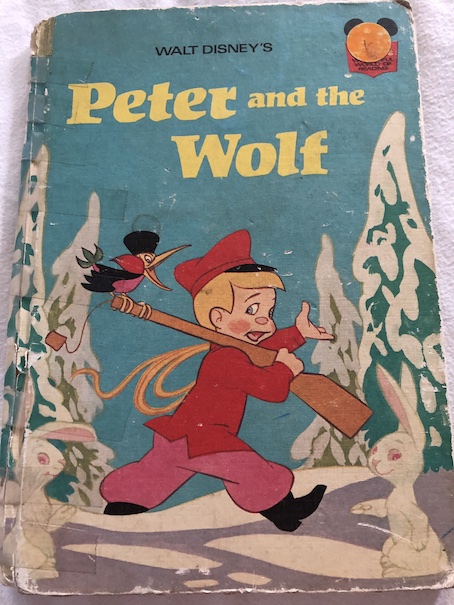
Peter and the Wolf by Walt Disney Productions, 1974.

This is the picture book version of Disney’s cartoon from 1946 based on Peter and the Wolf, which was originally a musical symphony for children, written by Sergei Prokofiev in 1936 for the Central Children’s Theatre in Moscow.

Young Peter lives with his grandfather near a forest in Russia. Peter’s grandfather warns him to stay away from the forest because there are hungry wolves there, but Peter thinks that he can catch a wolf himself. One day, while his grandfather is asleep, Peter sneaks out of the house to go catch a wolf.

Along the way, Peter’s friend, Sasha the bird, also warns him that there really are dangerous wolves in the woods and that he can’t hope to catch one with his toy gun. Peter insists that he’s going to try anyway, and Sasha says he’ll go along and help.

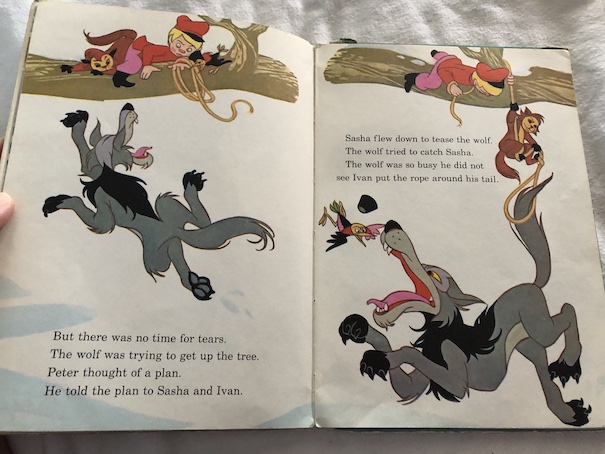
As they venture further, they are also joined by Sonia the duck. Ivan the cat tries to eat Sasha, but Peter makes him let Sasha go. Then, suddenly, a wolf appears!

The wolf chases Sonia, and at first, the others think he actually caught and ate her. They manage to catch the wolf by the tail. Sasha attracts some help from some passing hunters.

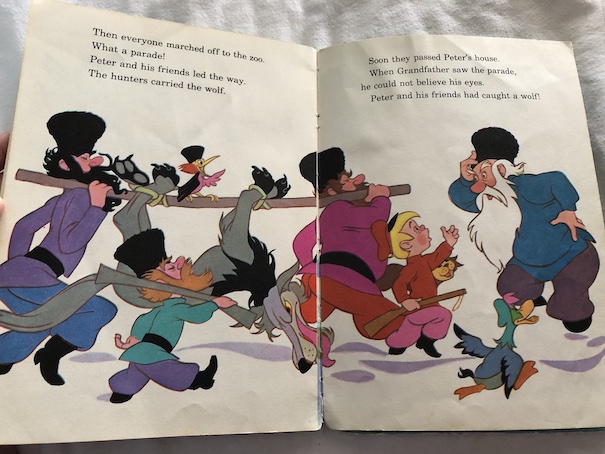
At first, the hunters want to shoot the wolf, but Peter asks them to take the wolf to the zoo instead, realizing that the wolf was just hungry. It tuns out that Sonia is safe after all, and they all take the wolf to show Peter’s grandfather.

The book is available to borrow and read for free online through Internet Archive (multiple copies).

The Enchanted Forest

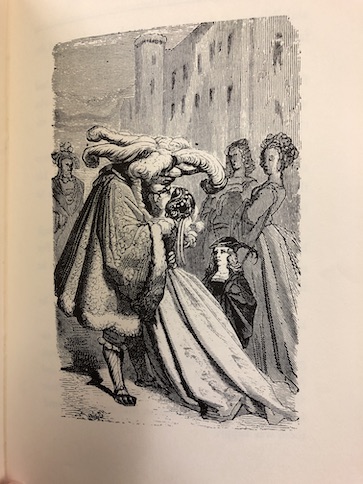
The Enchanted Forest by La Comtesse de Segur, translated by Beatrice Schenk de Regniers, 1856, 1974.

This is an English translation and retelling of one of La Comtesse’s stories.  I can’t read French, and I’ve never read the original version of the story, but the translator, Beatrice Schenk de Regniers, had a note in the book that she altered the story slightly from its original version.

King Goodheart has a lovely little daughter named Goldenhair, who he loves very much.  Unfortunately, his wife dies, and his people urge him to remarry.  His new wife, Queen Meanette, is as mean as her name sounds, and she does not like Goldenhair at all.  The King, realizing this, does his best to keep her away from his daughter and puts his daughter in the care of some trusted servants. 

Meanette, still jealous of the love and attention the King gives Goldenhair, plots to get rid of her.  One of the princess’s attendants is a boy who takes her out in her little carriage in the garden every day.  The boy is greedy for sweets, and the queen bribes him into tricking the princess into going into the enchanted forest.  People who go into the forest have been known to disappear forever.  When the princess becomes lost in the forest, she is befriended by a cat who takes her to a palace where he lives with a doe.  They are very kind to her, but Goldenhair still longs for a way to return home.

One day, while Goldenhair is living with the cat and the doe in their palace, a parrot comes and claims that he knows a way that the princess can return home.  He insists that she leave the palace, against the doe’s wishes, and pick a single rose that grows in the forest.  What the girl doesn’t know is that the parrot is an evil wizard in disguise.  When the girl picks the rose, the doe’s palace is destroyed, and the evil wizard reveals himself. 

Thinking that she has killed her friends, Goldenhair wanders, lonely and miserable, through the forest.  Then, a large tortoise comes and tells her that her friends are still alive and that she can find out what happened to them if she’s willing to take a long journey on the tortoise’s back without saying a single word the whole time.  Goldenhair does so and arrives at a fine palace where she learns that the doe was really Fairy Kindheart and the cat was really her son, Prince Charming.  They had been turned into animals by the evil wizard, and they had been freed when the princess picked the rose.  However, the princess had then fallen under the spell of the evil wizard, and the other trials were necessary to free her.  Fairy Kindheart takes the princess home to her father, who is overjoyed to see her.  The King marries Fairy Kindheart, and Goldenhair marries Prince Charming, and they all live happily ever after.

The book is currently available online through Internet Archive.

My Reaction and Further Information

The life of La Comtesse de Segur, the original author of this story, is almost like a fairy tale itself. Her first name was Sophie, and she was born in 1799 in Russia.  Her father was a Russian Count, and she grew up with her seven siblings on his vast estate.  However, even though her family was wealthy, her mother believed that children shouldn’t have life easy.  Sophie and her brothers and sisters had to sleep on small, hard beds and were never given much food to eat or any sweets.  When she was 18, Sophie went to live in France, and she married a French Count named Eugene de Segur.  It was not a particularly happy marriage, but she had four daughters and four sons and many grandchildren.  She wrote stories for them and became the most popular children’s writer of her time in France.  She died in 1874, but her stories are still popular with children in France.

I found the story of La Comtess’s life even more interesting than the story in the book, although the story in the book isn’t bad. It seems like a pretty obvious variation on the story of Snow White, but it is a charming story.

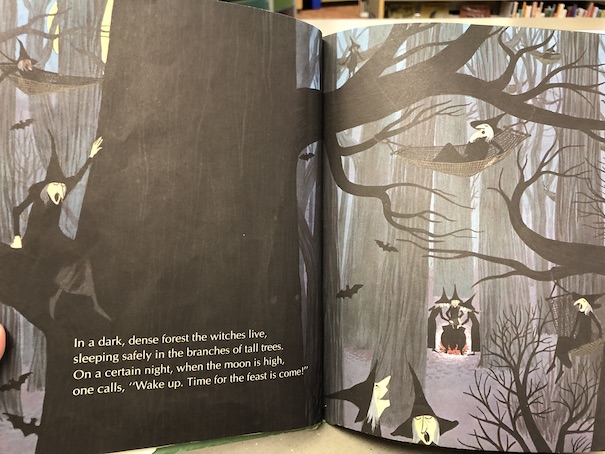
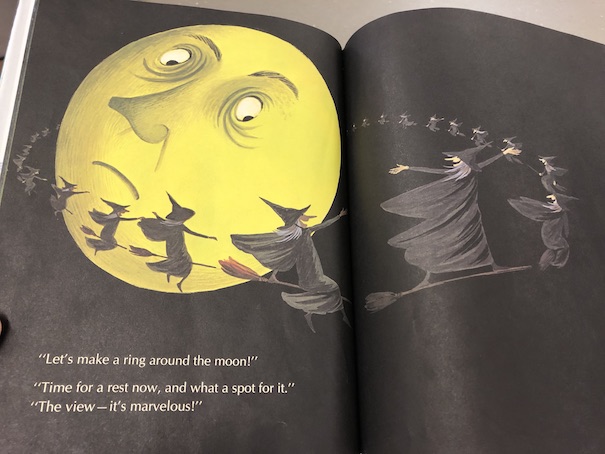
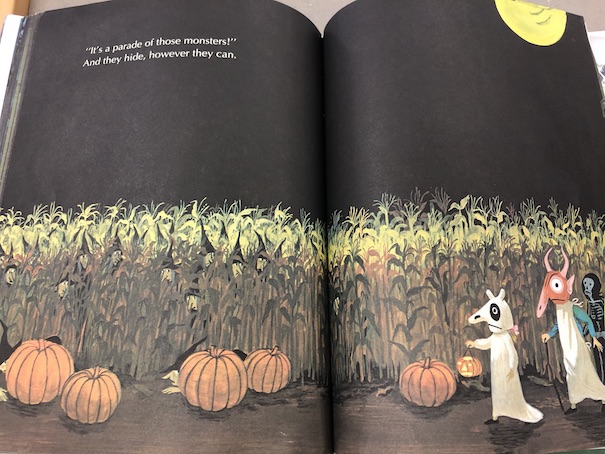
A Woggle of Witches

A Woggle of Witches by Adrienne Adams, 1971.

Witches live in a dark forest, sleeping in hammocks in the trees.  When they wake up on Halloween night, they have a feast.

Then, they take to the skies and fly in fancy formations.  They fly in rings around the moon, even stopping on the moon to take a rest.

After they return to the ground, they are startled by some trick-or-treaters and hide from them, thinking that they’re monsters.

Finally, they return to their forest and go to sleep in their hammocks once again.

The story is minimal, but the pictures really make the book!

The book is available to borrow and read for free online through Internet Archive.

Talking to Dragons

Talking to Dragons by Patricia C. Wrede, 1985.

This is both the fourth book in the Enchanted Forest Chronicles and the first book in the series that was written.  The author wrote this story before the others and then wrote the other three to explain how the characters got to this point.  The first three books in the series focus on Princess Cimorene and her adventures, but this book focuses on her son, Prince Daystar.

Partly because this series is kind of backwards, with the last book being the first written, I’m going to start with a spoiler.  When the book begins, Daystar is unaware that he is a prince and that his father is the king of the Enchanted Forest.  He grew up in an ordinary cottage on the edge of the forest, so he is accustomed to the presence of all kinds of fantasy creatures and fairy tale characters.  He thinks of himself and his mother as ordinary poor folk.  However, his mother has taught him not only reading and writing but other skills that are more unusual for peasants, like music, fighting, and even a little magic.

When Daystar is 16 years old, a wizard named Antorell comes to their house.  Daystar’s mother, Cimorene, seemed to know him, and he knows her.  Antorell demands “the sword” and the boy, and Cimorene casts a spell to melt him.  (“’No! Not again!’ he screamed.”  If you’ve read the other books, you already know why.  But, again, this book was written first.)

The next day, Cimorene gives Daystar a sword that he’s never seen before but which seems to draw him to it, and she starts giving him instructions.  The instructions are vague, but Cimorene insists that Daystar is to go into the Enchanted Forest and not to come back until he can explain why he had to go in there in the first place.  Also, he is not allowed to draw the sword from its scabbard unless he really needs to use it.  Cimorene says that she can’t explain more because it might “ruin everything.”  Not knowing what else to do, Daystar starts into the Enchanted Forest.  When he glances back, Cimorene and the cottage have suddenly disappeared.  Daystar has no idea why, but he has no choice but to keep going.

In the forest, Daystar meets a talking lizard called Suz, who claims to know everything about the Enchanted Forest and what goes on there (a tall claim, considering everything that goes on there).  When Daystar asked him if he knows anything about the mysterious, magical sword that his mother gave him, Suz tells him that it’s the Sword of the Sleeping King and that everyone has been looking for it.  Daystar knows nothing about it, which surprises Suz.  To Daystar’s surprise, both the sword and Daystar’s lack of knowledge agitate Suz, who says that he must get Kazul, who will know what to do.  Before he then runs off, leaving Daystar wondering who Kazul is, Suz tells him that he’s going to have to learn about the sword by himself because there are certain rules associated with magic, but that he should follow the sword to find out.

The next person Daystar meets is a red-haired girl who is stuck in a hedge.  She is surprised by how easily Daystar can get into the magical hedge, and at first, she thinks that he is a wizard.  She is relieved when she finds out that he’s not.  The girl, Shiara, tells Daystar that wizards have been chasing her because she burned the Head Wizard’s staff.  Most people could never accomplish that because wizards’ staffs are extremely powerful and have protective spells on them, but Shiara is a fire-witch.

As the two of them talk, Daystar learns that, while fire-witches are extremely rare and powerful come by their powers naturally, Shiara’s abilities are more unpredictable than most.  She has trouble casting spells on purpose, but when she gets mad, she can do some extremely powerful ones without really trying.  Fire-witches tend to have tempers, and Shiara is no exception.  Because of that, she doesn’t have many friends.  Most people are afraid to be around her because they never know when she’ll lose her temper and accidentally set things on fire.  Even worse, for Shiara, is knowing that most fire-witches are able to do very impressive spells and are almost invulnerable, but yet, she can’t even burn her way through a hedge when she tries it.  The wizards are very interested in her because most fire-witches are immune to their spells.  When they learned that she was a fire-witch who couldn’t cast her own spells, they tried to kidnap her in order to study her magic, which she how she ended up setting the Head Wizard’s staff on fire.

Daystar and Shiara finally get out of the magical hedge when Daystar suggests that Shiara try being polite to it instead of losing her temper.  Creatures and objects in the Enchanted Forest tend to respond well to politeness.  When they’re out of the hedge, a wizard shows up and tries to kidnap Shiara again, but Daystar defends her with his sword.  However, Daystar’s hand is injured when he tries to pick up the pieces of the wizard’s staff, and it explodes.

Daystar and Shiara seek help from Morwen, a witch who lives nearby.  It is from Morwen that Daystar begins to get a sense of what his sword is capable of doing.  He also meets up with Suz again, who tells him that he should go to the castle and that Kazul will meet him there.  Daystar still doesn’t know what he’s walking into, but missions in the Enchanted Forest can’t be ignored, and he has a mission to complete that everyone has been waiting for since before he was born.

By the end of the story, Daystar has learned what he needs to do to rescue his father, and Cimorene and Mendanbar are reunited.  Shiara ends up getting what she wants, partially, because she gains the ability to use her powers, but is forced to be polite in order to do so, which really irritates her.  She becomes Kazul’s new princess, where she will learn both the personal skills and magical skills she needs to control both herself and her ability.  Cimorene believes that Shiara will end up marrying Daystar eventually and becoming the next queen of the Enchanted Forest.  However, the series ends here, and the future is left to the imagination.  Morwen also decides to marry Telemain, a character from the previous books.

Like other books in this series, this book contains a lot of humor and parodies on popular fairy tales and fairy-tale creatures. Personally, I like the first two books in the series the best, but this one is also fun. There is a mild touch of romance to it, which is also nice.

The book is currently available online through Internet Archive.

There is one more story after this series, a short story in the collection Book of Enchantments that features Daystar and both of his parents but does not have Shiara.

Calling on Dragons

Calling on Dragons by Patricia C. Wrede, 1993.

This is the third book in the Enchanted Forest Chronicles. Cimorene is now married to Mendanbar and expecting their first child.

Morwen, a witch living in the Enchanted Forest, realizes that something strange is going on when she encounters a rabbit that is more than six feet tall. The rabbit, called Killer, has no idea how he managed to grow so big. It just happened suddenly that morning while he was eating some clover. Morwen goes to investigate the clover patch in the hopes of finding what might be responsible for the change. She discovers a wizard’s staff nearby, which is never a good sign.

She contacts King Mendanbar, Queen Cimorene, and her friend Telemain, a magical theoretician. Part of what they discover is that one of the wizards has shrunk himself in size. Mendanbar also discovers that someone has stolen the sword that he uses to control the threads of magic in the Enchanted Forest. The sword helps to maintain the protective spell around the Enchanted Forest that keeps wizards out. If the wizards have it, they may be able to enter the forest and soak up its magic. Mendanbar wants to go with the others to get it back, but Telemain points out that he can’t because he’s the other main focus of the protective spell; if he leaves the forest, it will be completely vulnerable. Even worse, they don’t have much time to retrieve the sword because whenever it’s outside of the Enchanted Forest, it leaks magic. Although Mendanbar doesn’t want to let Cimorene go on the mission to retrieve the sword while she’s pregnant, he has to let her go with the others. Before the book is over, Killer, who accompanies them on their mission, changes from a giant rabbit in to a flying blue donkey.

Among the fairy tale parodies that the characters encounter on their journey are a farmer named MacDonald (E-I-E-I-O) and a sorceress named Rachel who lives in a tower that can only be entered via a chair which Rachel lowers to bring people up (“Rachel! Rachel, send down the chair”). They keep in touch with Mendanbar in the castle using a magic mirror (“Mirror, mirror on the wall, I would like to make a call.”), until, for some reason, they are unable to reach him.

They are able to retrieve the magic sword, but the wizards capture Mendanbar and seal him inside his castle, trapped in a transportation spell to keep him safe yet contained. They don’t want to kill him because the Enchanted Forest would be plunged into chaos by his death, and they can’t keep him prisoner in a normal way because his friends would rescue him. Cimorene and the others know that the sword has the power to break through the shield spell on the castle, but the problem is that only a member of the royal family can wield it to do so. The sword allows Cimorene to carry it because she is Mendanbar’s wife, but only a blood relative can use the sword to break the spell . . . which mean that they have to wait for Cimorene’s baby to be born and become old enough to do it.

Although I like this series and think it’s a lot of fun, I’m not really fond of the last two books because of Mendanbar’s years of imprisonment. He’s okay when they finally get to him, but I still don’t like it. The ending of this book leaves things hanging until the fourth book.

This book is currently available online through Internet Archive.


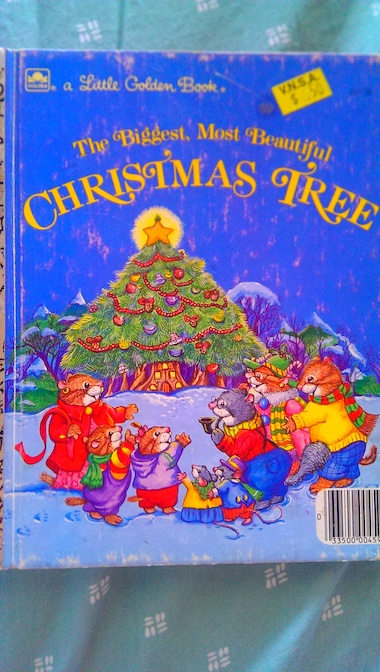
The Biggest, Most Beautiful Christmas Tree

BiggestChristmasTree

The Biggest, Most Beautiful Christmas Tree by Amye Rosenberg, 1985.

This is a Little Golden Book.

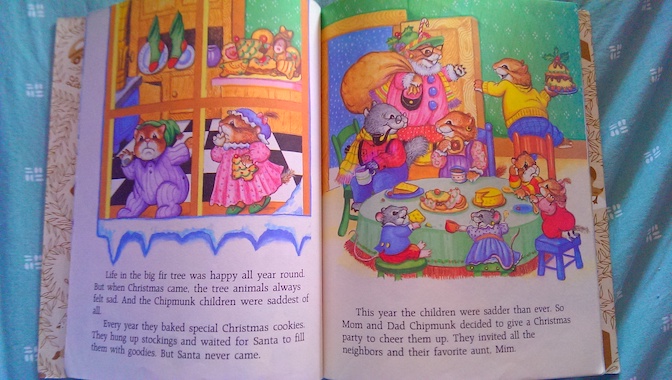
Every year at Christmas, the Chipmunk children, Nina and Nutley, are disappointed because Santa doesn’t visit their home in a large fir tree in the forest.  They always hang up their stockings and put out cookies, but for some reason, Santa never comes.

BiggestChristmasTreeDisappointment

However, this year, their Aunt Mim has figured out the reason why Santa passes them by and what to do about it.  Aunt Mim has realized that Santa can’t find their tree because it looks like every other tree in the forest.  What they have to do is to decorate their tree so that Santa can find it among all the others.

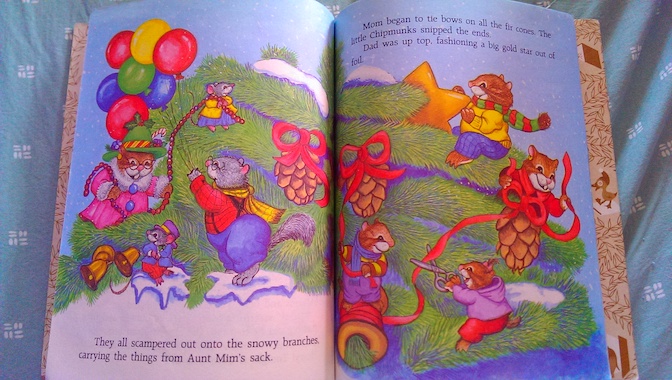
Aunt Mim brings lots of things they can use as decoration, and all of the other animals who live in the tree help with the decorating.  They tie bows on the pine cones, hang strings of berries, and paint balloons to look like large Christmas tree ornaments.

BiggestChristmasTreeDecoration1
BiggestChristmasTreeDecoration2

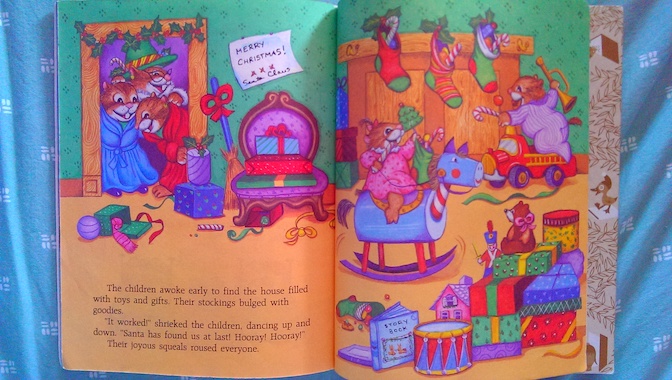
Sure enough, once Santa knows how to find the Chipmunk children, they get the kind of Christmas they’ve been waiting for!

BiggestChristmasTreePresents

This is just a cute picture book that I liked when I was young.  It is available to borrow and read for free online through Internet Archive.

The Little Old Lady Who Was Not Afraid of Anything

OldLadyNotAfraid

The Little Old Lady Who Was Not Afraid of Anything by Linda Williams, 1986.

“Once upon a time, there was a little old lady who was not afraid of anything!”

This is a cute picture book based on word and sound repetition.

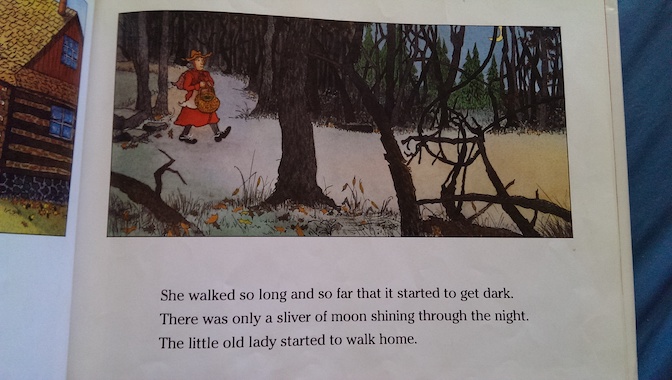
A brave lady ventures out into the woods one day, and as she makes her way home again when it gets dark, she begins to encounter some strange things.

OldLadyWoods

First, a pair of shoes with no one in them begin to follow her.  Then, she meets a part of pants with no one in them, and a shirt joins the parade of  clothes.  But, as weird as it is, nothing frightens the lady, not even the addition of a living jack o’lantern.

OldLadyClothes

OldLadyRun

When everything fails to frighten the woman (although she does look a little scared at one point), she has to help this strange collection of living clothes and pumpkin head to find a new purpose for themselves.

The book is currently available online through Internet Archive.

OldLadyScarecrow