The Hidden Message

Adventures in the Northwoods

The Hidden Message by Lois Walfrid Johnson, 1990.

The story, like the others in its series, is set on a farm in Wisconsin during the early 20th century.

One night, Kate McConnell wakes up to hear her mother and stepfather talking. The family needs money for the new planting season, so Papa Nordstrom has decided to take a job in a lumber camp over the winter. It will keep him away from home for a couple of months. He doesn’t really want to leave his family, but there’s a new baby on the way, and they really need the money. His absence on the farm means that the children will have to take on extra chores to help out. Kate also worries because conditions in lumber camps can be dangerous. Her birth father was killed in an accident in a similar camp, and she doesn’t want the same thing to happen to Papa Nordstrom.

Before Papa Nordstrom leaves for the lumber camp, he butchers a pig so his family will have meat while he’s gone. With winter setting in, it’s important to make sure that food supplies are secure. That’s why Kate knows it’s serious when her friend Josie tells her at school that someone stole her family’s steer, the one they were planning to butcher for meat this winter. Her family has no other source of meat, and they might go hungry if they can’t find the steer. Josie asks Kate for help because she and Anders solved a mystery involving a mysterious stranger who took things before.

One of the possible suspects is an older boy who has recently returned to school, who the others call Stretch. Kate has never met Stretch before because he’s been gone from school, doing farm work, since before she arrived in the community. Anders knows him, though, and he tells Kate that Stretch is trouble. Part of the reason they call him “Stretch” is that he has a habit of stretching the truth. Kate finds Stretch handsome at first, but Anders warns her not to get involved with him. Kate thinks Anders is exaggerating about Stretch because other people at school seem to like him. Anders says that if Kate wants to like someone, she should like Erik instead. Kate has a kind of rivalry going with Erik since he dipped her braid in his inkwell, and it permanently stained her dress. Anders says that Erik didn’t really mean to ruin her dress, but Kate is still unhappy about the incident. So, although Kate can tell that Erik is more responsible in other ways and is a bright and dedicated student, and they go to the same church, she has reservations about liking him.

However, Kate soon comes to realize just how dangerous Stretch is. Their teacher warns them all away from the frozen lake because the springs in the lake make the ice unpredictable. While the others play on the playground, Stretch talks Kate into walking by the lake with him. He says that he knows it’s safe because he was out on the lake earlier that morning, although Kate has her doubts about it. Then, Kate spots Anders’s dog out on the ice. Worried about the dog, Kate tries to call to him, but the dog doesn’t come to her like he usually does. Kate steps onto the ice to get the dog, and the ice breaks. Kate nearly drowns in the icy water, but Erik saves her. Kate realizes that, when she was in danger because of Stretch, Stretch actually abandoned her to drown. Later, he won’t even admit that he was the reason why Kate went down to the lake in the first place. When Kate is warmer and able to think better, she also begins to realize that the reason why Anders’s dog wouldn’t come to her when she called was because she was with Stretch, and the dog is afraid of Stretch, indicating that Stretch has been cruel to the dog in the past.

Kate’s brush with death opens her eyes to what Stretch is really like. It also creates a problem because the teacher writes a letter to Kate’s mother about the incident, letting her know that Kate did something very dangerous. Kate doesn’t want her mother to know what happened because it would upset her, especially with Papa Nordstrom being away and the children supposed to be behaving responsibly to help her on the farm. Kate wants to hide the teacher’s letter and not tell her mother, although Anders and Lars try to persuade her to be honest about what’s happened. They argue about it, and Kate accuses them of wanting to tattle on her, threatening to tell on them if they do something wrong. She feels sorry for upsetting them, especially young Lars, but she’s afraid of how her mother might react when she finds out what happened. Anders warns her that her mother might still find out what happened from someone else and that by being dishonest and fighting with Lars, she’s starting something that she’s going to regret. But, Kate can’t even bring herself to confide in anyone that Stretch was the reason she went down to the lake. Even though he almost got her killed and didn’t even try to help her, she can’t bring herself to tattle on him. (That’s dumb, on several levels. I’ll explain why below.)

After the incident with Kate falling through the ice, Stretch avoids going to school for awhile. Then, one day, Kate sees him stealing candy at the general store. Even though Kate knows what she saw, she still can’t bring herself to tell on him, and she even begins making excuses for him in her mind to make him seem less bad. When he offers her a ride home, she’s a little hesitant, but she decides to accept to avoid the long walk home. On the way, she asks him why he didn’t help her when she fell through the ice, but he never answers her. She also notices that his hand is oddly blue, and when she asks about that, he says that he must have just worked that hand too hard when he was cutting wood. However, he doesn’t have wood in the back of his wagon. He’s hauling boxes of something. This time, she decides to tell Anders about Stretch stealing, but she doesn’t mention the boxes in the back of Stretch’s wagon because she still doesn’t know what to think about them.

The secret about the ice incident comes out when Kate’s step-siblings, feeling uncomfortable about her deception, play a prank on her to get her to tell on herself. Knowing how afraid of mice Kate is, they put a dead one in a box with the label, “Pretty on the outside, like this on the inside,” on top. When Kate opens it, she screams, and her mother comes running. Knowing why they played this prank on her, Kate explains the truth to her mother. Her mother gives her a punishment for lying to her before, and Kate sees how upset she is that Kate didn’t tell her the truth earlier.

However, Kate hasn’t quite learned her lesson about lying. She sneaks out when she’s supposed to be grounded in her room by climbing down the tree outside the window. While she’s outside without permission, she spots a loose cow belonging to Josie’s family and guides it back to them. It’s a good deed, but she was still out without permission, and Tina spots her. Kate is angry and accuses Tina of “spying” on her and tries to persuade her not to tell. Kate can tell that Tina is upset and worries about lying to her mother and making her mad. Kate feels badly, but she can’t seem to stop herself from doing these things. She still continues to sneak out during her period of being grounded. When little Tina tries to imitate her by climbing down the tree herself and gets stuck, Kate has to rescue her. Her mother spots them once they’re down on the ground, and Kate confesses everything.

Kate feels like an awful person because Tina could have been badly hurt or even killed by following her example. Her mother says that everyone is awful in the sense that humans are all imperfect, and that’s why they commit sins. That is why God sent His son to redeem human sins. It’s good to be sorry when you’ve done something wrong and ask for forgiveness because forgiveness will be granted, and if you accept Jesus as your Savior, he will take away your sins. (I’ve heard this before, the part about everyone being “awful”, or words to that effect. This is kind of a Protestant way to phrase this. When I’ve heard it before, it usually seems to be from Protestants with a more Evangelical outlook, although that might vary. I don’t disagree with the principles, but Catholics would say it differently, and I may include a little more about it in my reaction.)

Meanwhile, there are still more thefts occurring in the community. Someone robs Erik’s family of all of the vegetables and fruit they’ve canned for the winter. Having food stores stolen at the onset of winter puts the family in a precarious position, and everyone else in the community worries about their foods stores, too.

One day, when Erik is at Windy Hill, Anders starts teasing Kate about her organ playing. He takes it too far, and both Kate and Erik tell him to stop. To Kate’s surprise, Erik hits Anders when he refuses to stop when asked, and the boys start to fight. Kate’s mother comes in, stops the fight, and makes the boys clean the room as punishment, which leads to several revelations. Kate comes to realize that Anders is a major reason why Erik has been teasing her. Anders has been urging Erik to tease her and also using Erik as an excuse for his own teasing. Now, Erik is getting as tired of it as she is. Erik confides in Kate that he knows that Stretch was the reason she went down to the lake when she fell in, and the only reason he hasn’t told anyone else is that he can’t prove that Stretch was there or that he abandoned Kate when she got into trouble.

As the kids move Kate’s organ back into position from the cleaning, Anders almost drops his end, and he accidentally opens a secret hiding place in the organ, knocking a hidden book onto the floor. The book contains church hymns in Swedish, but there’s also a torn part of a note in English. Unfortunately, they don’t have enough of the note to really understand what it means. (This is the “hidden message” of the title, and it doesn’t enter the story until about the final third of the book. I suspected it was a Biblical quotation, but I couldn’t place it from the fragment.) The note fragment contains the word “fear”, which makes the children worry that someone might be in trouble and asking for help. Erik asks them when and where they got the organ, but Kate explains that they bought it a few months ago at a fair in Grantsburg, and she doesn’t even know the name of the man who sold it. Papa Nordstrom might know, but since he’s away, they can’t ask him.

Stretch still seems like the likely suspect for the food thefts. Kate has seen him do some suspicious things, and he’s been telling some obvious lies, but she and Anders have difficulty finding any positive proof to get the authorities to intervene. Then, the thief takes the pig that Papa Nordstrom left for his family and the lid from their stove, rendering the stove useless until it’s replaced. With the stakes that much higher, Kate knows that they have to catch the thief, fast!

Kate also manages to figure out who originally owned the organ and who left the book and the message in the secret hiding place. The original owner is someone Kate already knows who used to play the organ. As I guessed, the message is actually part of a Biblical quotation (Psalm 118, Verse 6). The message is part of the theme of the story, but it doesn’t have anything to do with the theft directly. However, some strange things that the former owner of the organ has observed help to provide Kate and Anders with the proof they need to get back everything that was stolen. The story ends at Christmas.

The book is available to borrow and read for free online through Internet Archive.

Themes and My Reaction

In some ways, I was disappointed in this book. The identity of the thief isn’t really a surprise. Most of the mystery concerns how to prove it. Also, even though the title of the book refers to the hidden message, the mystery doesn’t center around the hidden message, and the hidden message doesn’t contribute directly to the solving of the mystery. Its main contribution to the story is to provide a theme: “The Lord is on my side; I will not fear. What can man do to me?” This quotation does give Kate the courage she needs to confront the thief.

Honesty in Relationships

I don’t blame Kate for having reservations about liking Erik at first. I know that things end up improving between them as the series goes along and even during this book, but he really did do something dumb and started off on the wrong foot with her. He’s not the first to do it, and frankly, it’s become a rather sad cliche. (It’s not unlike Gilbert in Anne of Green Gables and the way he started off wrong with Anne by making those “carrots” comments about her hair.) I’ve heard people say that boys will do mean things like that because they like girls and just don’t know how to say it, but you can’t just let people keep causing problems without some feedback about it because it doesn’t lead to good relationships. You don’t want to give someone the impression that you’re okay with teasing or rough play when you’re not because, if they don’t know it bothers you, they’ll never stop doing it, and it will drive you crazy. We all teach people how to treat us through the feedback we give. If Erik really cares about Kate, he’ll learn to give her the kind of attention she wants instead of the kind she doesn’t.

I started feeling better about Erik when he started standing up to Anders because Anders was going to far and wouldn’t stop even after both Erik and Kate telling him to stop. I appreciated that, while Erik may have initially felt compelled to join Anders in teasing Kate, Erik seems to have developed a sense of when to stop teasing and is willing to draw a hard line when necessary, even standing up to a friend and telling him “no.” Toward the end of the story, Anders finally has an honest talk with Kate, asking her why she didn’t tell him that Stretch was with her at the lake and abandoned her when she got in trouble. The answer is that Anders teases Kate all the time about everything. His constant teasing prevents her from confiding in him about things that they really should discuss. His teasing shuts down conversations before they even start. Anders finally tells Kate that he is her brother and wants to help her when she needs it, and he says that he wouldn’t tease her about anything really important. That attitude sounds promising. Unfortunately, he still insists that he’ll be the judge of what’s important, so I think that relationship still needs some work.

I’ll never understand people who say that teasing helps build relationships. Never. I’ve never seen it work that way in real life, not for building relationships of any depth, at least not unless the relationship has already been established on another basis first. It usually goes the other way, preventing relationships from developing or getting deeper than being shallow because relentless teasing does tend to shut down conversations and prevent people from opening up to each other. Why should someone tell you anything at all if they know that’s the reaction they’re going to get from you and that you don’t care that they don’t like it? The only times when teasing seems tolerable in real life is when the people involved already have built solid relationships with each other based on other qualities, really know each other well, and trust each other. Relationships are frequently based on trust, and you simply can’t trust someone who’s not really listening to what you say so much as trying to figure out how to use any and every little thing you say as a punchline for a dumb and hurtful joke for their own amusement or so they can score a few points off someone else and feel clever about it. I see it more as using other people than building a relationship with them. I just don’t feel endeared to anyone who only seems to be using me to score points to impress some third party onlookers. You can’t build a relationship based on teasing by itself. At least, I know I can’t. It just doesn’t work. What I’m trying to say is that Anders has not built a relationship with Kate and is both oblivious or resistant to feedback. He does not know when to take a hint and shut up even when people tell him plainly and not even when someone physically tackles him to the ground over it. So far, Kate has been doing all the heavy lifting in her relationship with Anders, trying to win him over, and he’s not really giving her much in return, although he’s slowly starting to show some signs of being helpful.

The characters in the story also alternately worry about being thought of as tattle-tales or criticize others for “tattling.” I’ve always thought all that “tattling” stigma was dumb. I know sometimes “tattling” means complaining about really petty things to one-up someone else, which is truly annoying (as I think all forms of one-upmanship are). However, people also use that word to try to shame people for talking about problems that really do need to be discussed. The way I look at it, if you’re going to be either mean or an idiot in a way that hurts other people, you forfeit your rights to complain about those other people talking about your meanness or idiocy. It’s not like the person talking about you made you do what you did, they didn’t ask to hurt by you, and if you did what you did in public, where other people could see it, it already counts as public knowledge anyway.

In 1906, when the story takes place, the Kate’s biggest worry is that her mother will hear about things she’s done from a neighbor at church because that’s their biggest opportunity for seeing and talking to other people. Every kid at school knows that she almost drowned, and since that was the big event of the day, they all no doubt told all of their parents about it. It’s common knowledge, not tattling. In the early 21st century, news of Kate’s brush with death at the lake would be all over social media before the end of the day because an entire classroom of people is aware of what happened and will be excited to talk about it. Even in cases where something happened that wasn’t serious enough for the school to immediately call the parent and tell them directly, any usual incident at school will get around fast. Usually what irritates people about “tattling” is that it can be pointless, petty nitpicking. However, the lake incident in this book was a matter of life and death, so I think complaining about anybody “tattling” is pretty dang petty itself. I think there needs to be a distinction between petty complaining and serious discussion. I think the anti-tattling attitudes people have teach bad morals, including dishonesty, self-delusion, and excuse-making, all issues that Kate has to confront in herself during the course of the story.

By choosing not to “tattle” on Stretch, which actually wouldn’t be “tattling” so much as just giving an honest answer to questions people were directly and specifically asking Kate about how she happened to be out on the frozen lake, Kate has also left Stretch open to doing similar things in the future to other innocent victims. She isn’t helping herself or the next person who could use some honest warnings. She didn’t initially trust Anders’s warnings about Stretch because he wouldn’t answer her questions about Stretch in specific terms (perhaps for fear of being thought a tattler), but Kate is now in a position to describe Stretch’s behavior in very specific terms herself, from first-hand knowledge. Anders was trying to be honest with Kate in his warnings, but he wasn’t fully honest and is already known for being an annoying teaser, which is why he didn’t seem believable. For all Kate knew, it just might have been another of his dumb jokes to embarrass her. (Another problem with too much teasing – no one knows when you’re actually trying to be honest and sincere about something, and few people are prepared to believe it because those are not a teaser’s default modes. If the teaser has already built a relationship based on qualities other than teasing alone, I suppose those close to him might be able to tell the difference, but no one else will, and Anders hasn’t built that kind of relationship with Kate yet.) If Anders had simply said why he didn’t trust Stretch, maybe Kate would have believed him and been more careful in the first place. Kate had to learn the hard way that Anders was telling her the truth about Stretch, and now, she’s going to have to learn the hard way that she also needs to drop her “tattling” hang-ups and be fully honest with herself and other people. Again, we teach others how to treat us, and Stretch could use some fully honest lessons from various people in his life. Don’t worry; he does get some help at the end of the book.

I was interested in what Anders said at the part of the story where he and Kate are talking about whether it’s better for her to like Stretch or Erik. Anders says that Papa Nordstrom has said that liking people is a choice, and people can make good choices or bad choices about who to like, which leads me to a few comments I have about the religious themes in the stories.

Sin and Forgiveness

I’ve explained before that I came from a family of mixed religions, although I was raised Catholic, and my religious education has also been somewhat mixed from childhood, although mainly Catholic. The only reason why I mention it is because, although Catholics and Protestants have similar ideas about the flawed nature of humanity, the causes of sin, and the role of Jesus in redeeming humanity, they have different ways of phrasing these concepts, which can sometimes give people wrong impressions and make it seem like their views are more different from each other than they actually are. When I see it, the differences are partly on where each puts the emphasis and the words they use.

A friend of mine (Mormon) was taking a college religious studies course and she was irritated by the way the teacher talked about original sin and about human beings as being “awful.” I can’t remember the exact phrasing she said that the teacher used, but it was something similar to what the mother says in this book about everyone being “awful.” My friend told me about it because she knows I’m Catholic and don’t mind discussing these things, and she thought her teacher was Catholic. I said that didn’t sound like a Catholic speaking. I looked it up, and it turns out that the teacher was specifically speaking from an Evangelical viewpoint, which is what I expected would be the case because, as I said, I’ve heard this before. I get the concept, but I don’t like that phrasing. It seems like it implies that all humans are inherently “bad” (which is what got on my friends’ nerves), but that’s not really the concept, not in real life or in this book.

The article that I linked in the first paragraph of this section explains it very well, but as a quick overview, the real issue is not that humans are inherently “bad” or “awful.” Not completely. (That’s what some people call the doctrine of “total depravity“, although even some of its adherents say that’s still a misunderstanding of the concept of “total depravity.”) It’s just that human beings are not perfectly good. Humans are inherently imperfect, which is different from just being flat-out “awful.” We’re not completely good or completely bad, just imperfectly between the two. Since we have elements of each in us, neither side can be ignored to get the full picture, and we can make choices about which of our sides we favor and try to maximize. Because we are imperfect as humans, we all sometimes have impulses, desires, and lapses in judgement that lead us to sin. That’s a part of who we are, but at the same time, we also have other desires for relationships with God and our fellow human beings that lead us to self-improvement and a desire to do good for others.

As Papa Nordstrom observed, we all have the ability to make choices. (This is part of the concept of “free will.” Catholics believe strongly in the concept of free will and reject any concept that original sin renders people unable to use their free will to make good decisions and consciously reject flawed impulses. I think that helps make “original sin” seem less of a tragedy because, while there’s always a struggle, knowing that there are still things you can do about it helps. Nobody’s doomed just for being human.) People can make good choices or bad choices. They can choose to give in to their worst impulses or practice mindfulness and self-discipline to resist them and strive for improvement. Understand that there are times when anyone could potentially do the wrong thing or have the impulse to do it. It happens to everyone from time to time, in varying degrees, throughout their lives. But, having the impulse to do something doesn’t mean you have to give in to it every time. Because human beings are imperfect, we often need some help and support to make the right choices when we’re struggling, and that’s the help that Christians look for when they turn to Jesus, accepting Him as their Savior, the example of what to do when they’re not sure how to control their feelings and impulses. People just need to make the choice to seek out that help when they’re struggling with bad habits or a crisis of conscience because there is help available, both spiritual help and help from other human beings. People can choose to say they’re sorry for bad decisions they’ve made and ask for forgiveness and guidance for making better choices, both from God and their fellow humans. (Kate should have been honest with her mother because she’s there to help and guide her and needs to know when something serious happens.) I prefer that description to saying that “we are all awful.” We’re not “awful.” We’re imperfect, and even if we’ll never be perfect in our human state, we can improve. That doesn’t sound as bad, does it?

The part where Kate rescues Tina from the dangerous situation she was in because of Kate’s bad example sort of reminds me of the end of Disney’s Freaky Friday from 1976, when the mother and daughter are talking about what they’ve done and what they’ve learned from being each other for a day:

“I am so much smarter than I thought. And so much dumber.”
“Oh, my darling, aren’t we all?

Other Interesting Topics

I thought the part of the story where Kate was talking to her organ teacher, Mr. Peters, about the difference between playing by ear and learning the notes was interesting. Mr. Peters points out that Kate is in the habit of playing songs by ear but she hasn’t really learned to read music. He tells her that she’ll learn more if she gets in the habit of reading the music for herself instead of depending on someone else playing a song for her to learn it. She later uses her new knowledge of reading music to learn to play one of the songs in the Swedish book of hymns. Musical notes are the same even if the songs are written in other languages.

Mystery of the Witches Bridge

Mystery of the Witches’ Bridge by Barbee Oliver Carleton, 1967.

Thirteen-year-old Dan Pride is an orphan. His father was an international correspondent, and during his early years, Dan lived in different European countries, as his parents traveled around to his father’s assignments. However, three years ago, his parents died in a plane crash. Since then, Dan has been living in a British boarding school. Now, he has returned to the United States to live with his father’s brother, Uncle Julian. Dan doesn’t know what to think about his new town because it’s very different from everything that he’s known before, but he likes the idea of belonging to a family once again because he has been lonely since his parents died.

The Pride family lives in a New England seacoast town. They were one of the founding families of the town in Puritan times, but Dan discovers that the local people aren’t particularly friendly with the Pride family. Billy Ben Corey, a man who works for his Uncle Julian, explains that the Pride family has been rather stand-offish with the townspeople, and there are also rumors and stories about witches that go back to Puritan times. Billy Ben says that most of the modern locals don’t really know all the details of the witch incidents, but the vague rumors that have circulated about the Pride family have caused the townspeople to treat them with suspicion.

This sounds like a somewhat sinister beginning to Dan’s life in York, Massachusetts as he comes to understand how much of life there is governed by the past relationships between the oldest families of the area. Billy Ben tells him that the Coreys have worked for the Prides for generations, but relations between the Prides and the Bishop family haven’t been good and that Dan should avoid them.

Dan presses Billy Ben for more information, and Billy Ben tells him the story of how one of his ancestors, Samuel Pride, was accused of witchcraft back in Puritan times. Some unfortunate happenings at the time, which were probably just the result of bad luck and bad weather, were blamed on him because he was kind of an odd, temperamental person. He was known for playing the fiddle extremely well, and people said that he used it to summon up the devil in the form of a black dog out of the marsh. The person who made the accusation and who led the group that came to arrest Samuel Pride was an ancestor of the Bishop family. Samuel came out to meet the group that came to apprehend them on the old stone bridge that leads to the island in the marsh where the Pride family has their house and farm, Pride’s Point. The story goes that when Samuel met the mob on the bridge, he placed a curse on them, that doom would come for them out of the night, out of the fog, and out of the marsh. Samuel and his wife were executed for witchcraft, and not only after, there was a terrible fog and a sickness that killed many people in town. People said that it was the result of Samuel’s curse. That’s why the Prides and the Bishops have a bad relationship even though they’re neighbors, why the townspeople are still a little suspicious of the Prides, why the Prides are somewhat standoffish of the townspeople (When you think about it, who really wants to be outgoing and friendly with people whose ancestors not only killed yours but who are not welcoming or friendly themselves because they have continually looked at you and your family with suspicion for generations, like you’re the weird ones? The townspeople basically created this situation and have been perpetuating it ever since, yet they act like the problem is with the Pride family instead of themselves. Gaslighting is a relatively new term from the 20th century, but the concept has been around forever, used even by people who don’t know what it is and that it’s what they’re really doing.), and why people in the area are afraid of the stone bridge that they call the Witches’ Bridge, the place where the curse was supposedly delivered. Even into modern times, people in the area see strange lights in the marsh and hear mysterious fiddle music or dog howls that they think might be Samuel’s ghost.

There is still more to come because the mysterious misfortunes of the Pride family have continued even into modern times. Dan is named for his grandfather, Daniel Pride, who died suddenly under very mysterious circumstances, something that still haunts his Uncle Julian. Young Dan learns the story from Mrs. Corey, a relative of Billy Ben’s, who is Uncle Julian’s housekeeper. Daniel Pride had been working to change the family’s image in the eyes of the local people, debunk all the old ghost and witch stories, and lay past quarrels to rest. To try to make peace with the Bishop family and restore the Pride family’s former fortunes, Daniel had been trying to arrange to buy the shipyards that the Bishop family owned, which had formerly been owned by the Pride family. The Bishop family initially agreed to the sale, and one foggy night, Daniel went to see the Bishops to finalize the sale. What happened after that is still a mystery. Daniel was found dead the next day near the old chapel with a look of terror on his face. It’s known that he had a heart condition, so he apparently had a heart attack, but from the marks on the ground, it also appears that he had been running before he collapsed, possibly deliberately frightened to death. Also, there were marks on the ground nearby where his briefcase fell, but the briefcase containing the sale papers was never found. The superstitious people in the area think that Daniel’s death was another symptom of the family’s curse, but it might also have been deliberate murder and theft. The Bishop family insist that they never finalized the sale of the shipyard with Daniel before his death, but Uncle Julian believes that the sale was finalized and that the Bishops are lying to take advantage of his father’s sudden death, just like their ancestors arranged the execution of Samuel for their own advantage. Uncle Julian remains suspicious and bitter about what has happened, just as the townspeople continue to look at the Prides suspiciously.

All of this makes York seem like it’s not the best place to raise a sensitive young orphan, and that’s basically what Uncle Julian says to Dan when Dan arrives at Pride’s Point. Uncle Julian seems elderly and physically frail, and Dan senses that he is a deeply troubled man. Uncle Julian tells Dan that the family and the old family home have a troubled history. That’s why Dan’s father decided to go away and live his life traveling to different places, and that’s why Uncle Julian delayed sending for Dan for so long after his parents’ deaths. Uncle Julian doesn’t seem to think that Pride’s Point is a very healthy place, and he hints at buried secrets. However, he does say that, now that Dan is there, there are going to have to be some changes.

Dan doesn’t think this sounds too hopeful, and he’s lonely and disappointed that he hasn’t found the happy family and home he was hoping for and that he doesn’t even seem particularly welcome there. He can’t even really enjoy playing his violin because of the connection people there seem to have between “fiddle” music, witchcraft, and his supposedly sinister ancestor. As Dan is looking around his new bedroom that night, he suddenly spots a mysterious flashing light from his window, outside in the marsh. It’s creepy because it not only supports all the ghost and witch stories that Dan has just heard but because he recognizes the patterns in the flashes of light as Morse Code … and the message being sent is his own name: D-A-N P-R-I-D-E.

Dan doesn’t believe that any supernatural force was using Morse Code to flash his name at night. It was obviously some human person, but who would do that and why? What is the truth about his grandfather’s death? Is Uncle Julian right that the Bishops caused Daniel Pride to die and then lied about the sale of the shipyard to cheat the Pride family? Or is someone else responsible?

The book is available to borrow and read for free online through Internet Archive.

My Reaction

I stand by my earlier statement that there is basically inter-generational gaslighting of the Pride family going on. It’s gone on for so long that the townspeople have trouble recognizing what they’re doing or stopping themselves from doing it, even though some of them seem to have the feeling that it isn’t right. At one point, some of the townspeople who come out to Pride’s Point to help fight a fire make jokes about the Pride curse. I could sense tension in them, and I think it was an attempt to lighten the mood, but under the circumstances, it wasn’t really appropriate for them to joke around, especially not about something that’s been a sensitive topic for the Prides, something that has literally caused members of their family to die and others to be persecuted for generations. Keep your audience in mind, and learn how to read a room, people of York!

Uncle Julian hates the stories and rumors that have circulated about his family since before he was born, but he doesn’t know what to do to stop it, and he sometimes wonders if it wouldn’t be better for the family to simply leave their old family home and start up again somewhere else. Mrs. Corey tells Dan that every single time anything bad happens in the area, people either look at the Prides suspiciously or find a way to blame them, even though they didn’t have anything to do with whatever it was. Dan can tell that Uncle Julian is so accustomed to having people blame him and his family for things and repeat scary stories about them that he halfway believes the stories in spite of himself, and he’s overly sensitive anytime it looks like the townspeople might be trying to blame the Prides for something yet again. That’s what makes this situation gaslighting, because the community’s constant untrue stories have warped even the Prides’ sense of reality and views of themselves. The community of York as a whole has created a situation that makes it difficult for the Prides to make friends with other people and get reality checks, and the most dangerous part of it is that among the few people that the Prides are in the habit of trusting is someone who turns out to be the person they should fear the most.

I couldn’t help but notice that there was someone in the story that Dan trusted too much in the beginning. It’s partly because Dan is young and in a situation where he is just getting to know the circumstances and people involved, but even when this person says things that are untrue, contradictory, or just plain mean, he doesn’t call him on it or seem to question within himself why this person is talking like that, at least not until about the middle of the book. Gaslighters will do this to a person, playing mind games, lying, alternately being friendly and praising their victim and then putting down their victim and/or trying to blacken their name to other people, discouraging them from getting close to people who care about them and might actually help them, acting like normal things that the victim does or feels are somehow weird or abnormal, trying to keep their victims in a constant state of confusion, unsure of what the reality of the situation really is. Although I found myself angry with the people of York in a general way for perpetuating something awful that their ancestors did for generations and for being apparently oblivious to what they’re doing in modern times, there is a definite villain in the story who is both deliberately and concretely evil.

There is a parallel drawn in the story between Uncle Julian’s big, black dog, Caliban, who is disfigured from an old injury and the Pride family themselves. Dan is afraid of the big dog, and Billy Ben tells him that it attacked him once, but Uncle Julian says that Caliban is just distrustful because he was badly abused and injured in his earlier life. People are like that, too. I understand that because I used to volunteer at an animal shelter, and that’s where I got my dog, Betty. (If you look at my About page, you’ll see a picture of Betty.)

I’ll never know Betty’s complete history because she was found wandering alone without a collar before she was brought to the shelter. However, I’m pretty good at reading between the lines, and I can read at least part of the story from her behavior. Betty is afraid of anyone, even me, walking behind her, and I’ve noticed since her shelter days that sometimes, her back end looks a little off-center when she runs. Her tail has an odd, permanent bend at the very tip that we didn’t discover until we had the hair on it trimmed. I think she’s been kicked hard from behind before, hard enough to leave permanent injury. She’s not as scared of things as she used to be after having lived with my family for a few years, but she used to be terrified of newspapers or anybody standing over her with anything in their hands, so I think she’s been hit with things before. Betty also gets scared when people laugh. She’s not as scared as she used to be because she’s gotten used to us laughing at something funny on tv, but there are times when she’s cringed and slunk away with her tail between her legs from people when they laugh and she can’t figure out why they’re laughing. Betty’s fear of laughter actually disturbs me because I think I know why it scares her. Based on her reaction, I’ve think that it’s likely that whoever hurt Betty before laughed when they did it. I think Betty has an association between laughter and pain, and that’s why she takes laughter as a bad sign, reacting fearfully to it when she thinks it might be directed at her. Laughing while inflicting pain is a sick thing to do, the product of a sick mind. There are stories in Betty’s reactions, and I’m disturbed by the mental picture I have of the person who had Betty before.

I have to admit that my own history has also both colored/given me insight into Betty’s behavior. If it isn’t obvious from comments in my previous reviews, I don’t see teasing as a positive thing. I’ve reacted to it in the past much like Betty does to sudden, unexplained laughter, which is why I understand the feeling behind it. Some people say that they like to tease their friends and people they like, but I just don’t like it, and I’ve learned to be more open and honest about how I never will like it. I do not have good feelings about people who tease others for fun, and I deeply resent being told that I have to like it because the people doing it are “just having fun.” It’s not a bonding activity, not with me, no matter who says it is. I absolutely refuse to “bond” with anyone who does it. Anyone telling me that I have to change myself to like people who tease is 100% guaranteed to get on my bad side. I have a bad history with teasing and bullying, I have a bad history with the people who do it, and I just don’t want to be around it. Teasing involves getting a laugh at someone else’s expense, benefiting from their discomfort, and getting a good feeling from making someone else feel bad. I don’t think any of that is right, and it doesn’t take much for it to get way out of hand, especially when people have the impulse press harder to get the reaction they want to their “jokes”, like the other person just didn’t get it, instead of cutting it out when their “jokes” just aren’t funny. It’s always awkward when it comes from people who don’t know the sore spots that they shouldn’t poke at and try to act like they’re special friends who should be cut some slack when the reality is that we don’t really know each other that well, we’re not really close friends, and no such special relationship actually exists between us. Real friends understand and demonstrate respect for each others’ feelings, and they don’t intentionally poke at a friend’s sore spots, like the people of York did to Uncle Julian with their jokes in this story.

What ties all of this together is that Betty’s reaction to laughter is like Uncle Julian’s reaction to the townspeople and their jokes and comments; it’s a conditioned response from long-term negative association. The townspeople are uneasy because Uncle Julian doesn’t laugh with them, but Uncle Julian doesn’t laugh with the townspeople because none of it was actually funny. By perpetuating these witch stories, even in the form of “jokes”, they’re constantly feeding the myths and ghost stories and making the situation worse, and they don’t seem to care about how he or his family feels or how it affects their lives. You can tell who respects you and who doesn’t by seeing who tries to treat you the way you want to be treated. The people of York were making jokes to soothe their own feelings, sharing in-jokes that they’ve had with each other at the Prides’ expense, and they got really uncomfortable when suddenly confronted with Uncle Julian’s, feelings that they helped to provoke and didn’t want to deal with.

Don’t worry about Betty. It’s sad that she’s been afraid of things and it’s kept her from being more outgoing and friendly, but we’re working through it. In non-pandemic times, I take her to places where I know she’s welcome, and she has acquired a fan club of people who like to see her and say hi whenever we visit. Anytime she seems uneasy because we’re laughing about something, I sit next to her, pet her, and praise her for being a Good Girl so she knows that nobody is trying to be mean to her and that we value her. When someone has been programmed through negative reinforcement, positive reinforcement is needed for balance. I’m trying to build more positive associations for her. It’s working, and she’s improving. She behaves very well and is very happy little dog when she’s treated well. Don’t worry about me, either. I’ve had some bad experiences, but I’m not the only one who’s had to deal with this stuff. There are lots of different kinds of people in the world, and I’ve learned some things about finding the kind of people I want to be around and making it clear how I want to be treated. I just gripe and vent now and then because I don’t like mean behavior or seeing others in these situations, and I’m all out of patience for it. I’ve learned what to do to help remedy such problems, but that doesn’t stop me from resenting the people who create problems that need to be solved.

The way both people and animals behave offers clues about what’s been happening with them. Sometimes, they offer warning signs of people to avoid, and sometimes, they are signs that the person or animal is in distress and needs some outside help and support. Caliban’s behavior in the story is more defensive than aggressive. That is, Caliban is reacting, not instigating … and if I saw what Dan saw in the story, I would know immediately to be very suspicious of the person Caliban hates the most because it explains where the source of harm in his life is. In a similar way, the Pride family is mostly reacting, not instigating. They have been harmed, both physically and psychologically, for an extended period of time, and while they seem to have the sense that’s the case, they’ve been too close to the problem for too long to see what the source of the greatest harm really is. But, about halfway through the book, Dan does learn to correctly read the people around him and comes to realize who is really his friend and how isn’t, based not on how others talk about them but by how they each actually treat him. When you pay attention and think about people’s actions in context, you can see who really has your best interests at heart and who doesn’t.

Dan spends much of the story, particularly at the beginning, feeling like he is unwanted, both in York and at Pride’s Point. At first, he thinks that his Uncle Julian doesn’t want him, but he gradually realizes that’s not it. There is someone else who doesn’t want Dan there, for reasons of their own. As I was reading, I noted times when this person said and did things that manipulated Dan’s feelings, even actively trying to make Dan feel bad while carefully seeming “honest” or “helpful” so Dan would continue to listen. I felt so much better when Dan finally realized the truth about this person. I have to say that I was really angry with Uncle Julian when I discovered that he was fully aware of who hurt his dog and that he still trusted this person. For me, the first hint of that would have caused me to permanently sever the relationship because it’s sick behavior and a sign of a disturbed mind, but I can only suppose that he felt unable to because he had been dependent on this person for too long, largely shunned by the wider community, who could have given him a reality check if they’d had a firmer grasp on reality themselves.

Dan, who had never heard of the Bishops before arriving in York, finds himself becoming angry and resentful of them, hating them for what they’ve done to his family for generations. His uncle even warns him not to get involved with the family, but that’s exactly what the real villain wants. When Dan makes friends with a boy named Pip Cole and his twin sister, Gilly, he confides his anger at the Bishops and how he blames them for this whole mess and for perpetuating it for generations, but Pip knows more about the situation than Dan suspects, and he has seen a different side of the problem. Pip tells Dan his family would have less problems if they would just forgive the Bishops, but Dan doesn’t believe it at first because, the way he sees it, the Bishops are the villains, who have actively profited from their villainy all along. I appreciate Dan’s situation. Pip doesn’t fully appreciate that, for Dan and his uncle, it’s not just about the past because they’re still actively suffering from the townspeople’s stories, rumors, and suspicions about them. It’s hard and maybe impossible to forgive something that’s ongoing from people who see no problem with the situation and aren’t particularly sorry. On the other hand, the resolution of this situation requires at least one of the parties involved to make the first move. Dan’s grandfather was trying, but his mysterious death prevented his mission from being completed. Even Uncle Julian reveals that he had been prepared to forgive the Bishops and marry their daughter, but some of the circumstances of his father’s death led him to believe that his fiance actually had a hand in it, and that apparent betrayal is what has left him such a haunted man all of these years.

The stories that Dan has heard about his family are not the complete story. Dan eventually comes to realize that the Prides and the Bishops each have only half of the real story, and because of their reluctance to associate with each other, the Bishops partly out of continued superstition and guilt, not knowing how to deal with the Prides’ anger, and the Prides, because they are both justifiably angry and accustomed to unfair treatment and being shunned by the community. However, it’s important that they do talk to each other because it’s the only way for each of them to get the complete picture of what’s really been happening and learn the real villain’s true motives.

The key to establishing the truth is in the missing briefcase, and both Dan and his enemy are searching for it. Dan needs to make peace with his family’s past, and he finds some help from a mysterious hermit called Lamie, who lives alone in the marsh. Lamie is another outcast of the York community. People avoid him because he has a reputation for being weird. People in this community in general may be “normal” in the sense that their behavior is fairly uniform, but uniformity by itself isn’t a virtue. When you’ve got an entire community doing something they shouldn’t, being the odd one out can be a good thing. Lamie helps Dan when he needs it, and Dan discovers that Lamie is actually a very kind and understanding person. Lamie’s solitary lifestyle is rather unorthodox, but he’s actually happy in his solitude because he knows who he is, he takes care of himself, he’s comfortable with himself, and he’s living the kind of life he likes, in touch with the natural world. When Dan talks to Lamie, he realizes that Lamie is comfortable with his own identity and at peace in his own mind in a way that his uncle isn’t. Even more importantly, Lamie sees things from a different perspective because he isn’t part of the groupthink of this community.

Lamie was friends with Dan’s grandfather, and he tells Dan about a hidden chamber built by the Prides’ ancestors, where Dan’s grandfather kept important family papers. However, Lamie tells Dan that he isn’t sure that he should look for it if his only motive is revenge. Dan does have a desire for revenge after all of the stories of injustice toward his family that he’s heard and what he’s suffered himself since he arrived in this area. Lamie helps to calm Dan’s desire for revenge by quoting from St. Francis of Assisi, emphasizing the importance of forgiveness instead of revenge. The part about truth speaks to Dan, and he comes to realize that what he really wants, more than revenge, is to know the truth about what happened to his grandfather. Lamie tells him that he saw some of what happened the night his grandfather died, from a distance. Because of the fog, he couldn’t see everything, but he knows that the Bishops were telling the truth that Dan’s grandfather didn’t make it to their place that night to complete their deal, defusing Dan’s anger at them for their supposed lies. Lamie’s memories also give him clues about the true identity of his grandfather’s attacker and the location of the secret hiding place. However, to find it and to evade his enemy, Dan will need the help of the very people his uncle has forbidden him to associate with.

I found the parts about the gaslighting of the Pride family and the poisonous duality of their true enemy frustrating and anger-inducing, but once Dan speaks to Lamie (really, my favorite charcter in the story) and begins to sort out who he can trust and who he can’t, I felt a lot better. The story is very atmospheric, with a grand old house and property, surrounded by a foggy marsh, and even when the characters know who their enemy really is, they are kind of trapped with him in a dangerous cat-and-mouse situation as they both race to find what they’re really looking for. By the end of the book, all of the old mysteries are wrapped up, including the source of the the mysterious “fiddler” music.

Lilly’s Purple Plastic Purse

Lilly’s Purple Plastic Purse by Kevin Henkes, 1996.

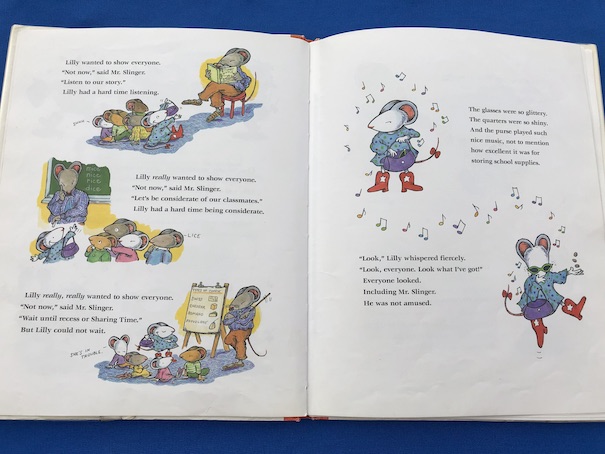
Lilly loves going to school, and she especially loves her teacher, Mr. Slinger. Everyone in class thinks that he’s great, and he inspires a lot of them, including Lilly, to want to be teachers themselves.

One day, after a special shopping trip with her grandmother, Lilly gains a some special new treasures: movie star sunglasses, some quarters, and a purple plastic purse that plays a tune when she opens it. Eager to show off her new things to her friends, Lilly brings them to school. However, she just can’t wait until recess or Sharing Time to show everyone. She keeps trying to draw attention to these things while the teacher is talking and opening the purse so it keeps playing its tune.

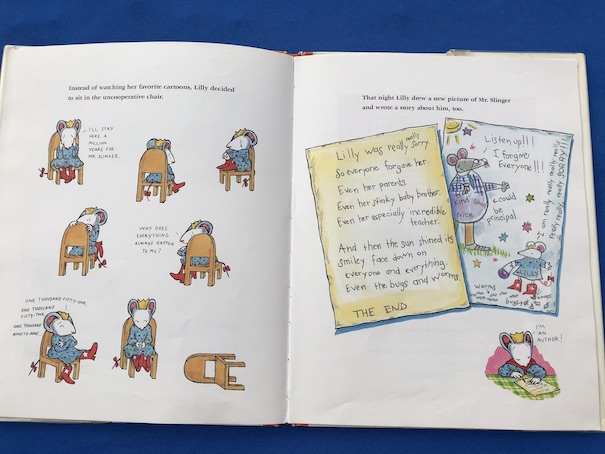
Finally, after repeated warnings, Mr. Slinger is forced to confiscate Lilly’s purse with its other treasures. Lilly is hurt and feels betrayed by her favorite teacher. Sad and angry at having her treasures taken from her, she draws a mean picture of her teacher as a purse thief, leaving the picture where she knows he will find it.

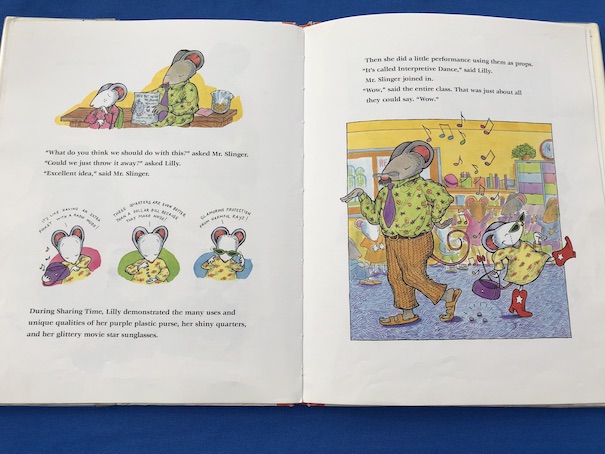
However, Mr. Slinger isn’t as mean as Lilly thinks that he is when he takes her purse. After he gives the purse back to her, she discovers a nice note from him inside, telling her that tomorrow will be a better day, and there’s even a little bag of snacks. Now, Lilly feels guilty about her mean picture. It’s too late to get it back, and she worries that her teacher will never forgive her.

The story is really good at showing how Lilly’s emotions change through the course of the day and how her sadness and anger grow more urgent the more she thinks and worries about them. It’s a good story to use when talking about feelings with young children (through the course of the story, Lilly is happy, excited, sad, betrayed, angry, guilty, worried, and embarrassed – some of these are stated explicitly and some are more implied) and how to deal with emotions. Adults can talk to children how one kind of emotion can lead to another (like how Lilly’s sadness turns to anger at her teacher for making her feel sad by confiscating her purse) and how some ways of dealing with emotions are better than others. It is both creative and appropriate that Lilly used her drawing ability to both insult her teacher and, later, apologize to him.

Fortunately, both Lilly’s parents and her teacher are very understanding. Her parents reassure her that her teacher will forgive her. Lilly draws a new, nicer picture of her teacher to go with her apology to him, and her parents give her some snacks to give to him as well. He does forgive her, and she finally gets to show everyone her amazing purple plastic purse at Sharing Time (being careful not to disturb anyone with them at other times.

The book is currently available online through Internet Archive. It is part of Mouse Books series.

Caleb’s Story

Caleb’s Story by Patricia MacLachlan, 2001.

This book is part of the Sarah, Plain and Tall Series, but while the first two books are narrated by Anna, this book is narrated by her brother, Caleb.

When the book begins, Caleb says that Anna is now going to live in town, finishing school and working for the local doctor.  Her boyfriend, Justin, is the doctor’s son, and he has gone to Europe to fight in World War I.  Sarah worries about Anna because of the influenza epidemic.  Anna has given him a journal in order to write about the things happening on the farm while she’s away.  Caleb isn’t as much of a writer as Anna, and he can’t imagine what he’ll find to write about, but Anna assures him that he’ll find something.

While Caleb is play hide and seek with his little half-sister, Cassie (who is now four and a half years old), Cassie says that she saw a man behind their barn who asked her about their father.  At first, Caleb thinks that Cassie imagined the whole thing, but she insists that she didn’t.  However, Caleb later finds the man in the barn, suffering from cold.  The family brings him inside to warm up, and he says that his name is John.  They try to ask John about who he is and where he came from, but he is evasive at first.  He says that he used to be a farmer, and he starts to help a little with farm chores.

The truth about John comes out when Jacob returns from taking Anna to town.  John is actually John Witting, Jacob’s father.  For years, Jacob believed that his father was dead.  It comes as a terrible shock to see him suddenly, after all this time.  Jacob is angry that John apparently abandoned his family and left him to believe that he was dead.

The children have many questions about their grandfather and where he’s been all these years, but John remains evasive for some time.  Sarah tries to encourage Jacob to talk to his father and learn what he needs to know about him, but Jacob resists because he’s too angry.  Caleb notices his grandfather taking pills, and Sarah discovers that it’s heart medicine.

The imagery in the story is pretty bleak, compared to the other books, even the drought descriptions from Skylark.  It’s winter, and people are dying during the influenza epidemic.  People have black wreaths on their doors, some because of influenza deaths and some because they have relatives who died fighting in World War I.  At one point, they see a bonfire in the cemetery because the ground is frozen, and they need to thaw it enough to dig a new grave.  When they get closer, they see that it’s a baby’s coffin, which upsets Sarah.

When Jacob finally demands that his father explain himself and his presence there, John says that he wanted to see how things turned out.  The two men argue and push each other, and Jacob accidentally falls over a plow and breaks his leg.  John sets the broken leg, saying that he’s done it before, but Jacob is still angry with him.

Eventually, John talks to Caleb about his past, admitting that he was wrong to leave years ago and saying that he can’t really blame Jacob for how he feels about it because his bad decision has affected Jacob’s whole life.  John quarreled with his wife years ago, and he felt like the two of them couldn’t live together anymore. (I have to admit that, after John had earlier tried to tell Jacob that things weren’t the way he thought they were, I was really disappointed because this explanation is exactly the way I figured it was.)  Jacob keeps saying that John could have at least written, but the truth is that John can’t read or write until Caleb begins teaching him. (If this is what John meant by things not being the way Jacob thought they were, it’s a little less disappointing.)  When Sarah is accidentally lost in a snow storm outside, and John helps Jacob save her, the father and son finally make peace with each other.

The movie version of this book is called Winter’s End, and it is the last of the series to be made into a movie. Actually, I think that the movie may have actually been made before the book (I’m a little confused by the movie’s date, but it looks like it was first). The movie and the book are pretty close to each other. The book is available to borrow and read for free online through Internet Archive.