Double Trouble

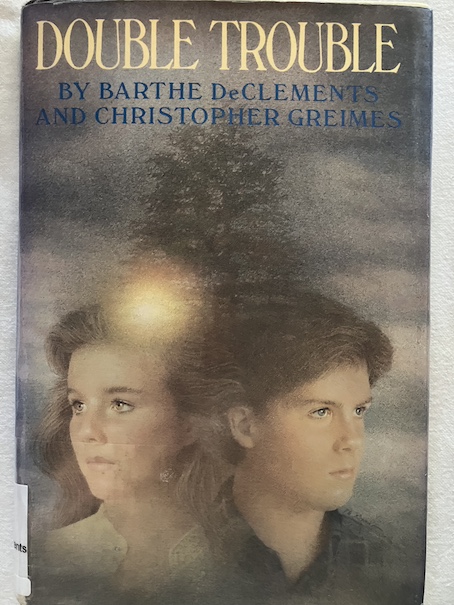
Faith and Phillip are twins and the only members of their immediate family who are alive. Their parents and their older sister were killed in a car accident. Faith was taken in by their aunt, but their aunt didn’t think that she could manage to care for two children, so Phillip was sent to a foster home. The story is written in the form of letters to each other (this is called epistolary style) after their separation.

Separating is cruel, especially when they’re orphans, but there is something about Faith and Phillip that other people don’t know. They have psychic powers, and they have the ability to communicate their feelings to each other with their minds. They have to communicate specific information to each other in writing because their psychic abilities only communicate their general mood and circumstances, but their psychic link to each other makes them feel less alone when they’re apart. Apart from dealing with their grief over the loss of their parents and the changes to their lives, each of them is also in a troubling situation.

In her first letter to Phillip, Faith tells him about a disturbing encounter with a teacher at her new school. Faith was selling candy with another classmate, Sue Ellen, to support the school band. Sue Ellen gets the idea of going by Mr. Gessert’s apartment. Mr. Gessert is their social studies teacher and is considered one of the cool teachers in school. Faith can tell that Sue Ellen has a bit of a crush on him. He buys one of their candy bars, and Sue Ellen asks to use his bathroom. When Sue Ellen seems to be taking awhile, the teacher goes to see if everything is okay, and he catches Sue Ellen snooping around. He gets especially angry when Faith is about to touch his cane near the door. He grabs both girls by the arm and throws them out of the apartment. Although snooping in someone’s private rooms is rude, the girls are startled by how angry Mr. Gessert is. Faith asks Sue Ellen what she saw in his apartment, and Sue Ellen says that she didn’t see anything. She had just started to open the door to a room when he found her. The next day, Sue Ellen brags to other kids at school about having been in the teacher’s apartment, but Faith is still concerned about how angry Mr. Gessert was.

When Phillip replies, he says that he can understand why the teacher would be annoyed at someone snooping through his stuff, and he tells Faith about his new foster parents, the Wangsleys, Howard and Cynthia. He’s now living in Seattle, about 50 miles from where Faith is living. Phillip also got picked on at school by a bully, but a girl named Roxanne spoke up for him. He thinks Roxanne is pretty, and he describes her aura as being indigo. (The twins also have the ability to see people’s auras and use them to learn things about other people.) His new foster parents don’t take his vegetarianism seriously, trying to convince him to eat meat. They say that God put animals on Earth for people to eat and that he has to eat like they do. Their house is shabby, and Howard keeps Cynthia on a tight budget. That surprises Phillip because he thinks Howard must be making decent money at the shipyards. He wonders how Howard spends his money, if it’s not on his wife or home. He knows that Howard and Cynthia belong to some kind of religious group and that, whenever they return from one of their meetings, they act strangely, and their auras are weird. He’s still grieving their parents and sister, and with all the stresses of his new home, the only time he feels better is when he’s using astral projection, to get away from it all.

The twins learned their psychic skills from their sister Madalyn and Madalyn’s friend, Roger, who is an archaeologist. Faith doesn’t quite have Phillip’s ability with astral projection, but she can sometimes get visions of other people and what they’re doing. She uses this ability to try to learn more about Mr. Gessert, and she sees that his cane is actually a gun. She watches him loading it. Why would a teacher have a cane with a hidden gun?

Faith is still angry that her aunt didn’t take Phillip, too. She also hesitates to ask her aunt for things she needs because she doesn’t want to seem like a charity case. She has a part-time job taking care of her neighbors’ dogs while the neighbor is on vacation, and she uses the money to buy a pair of second-hand boots. When Aunt Linda finds out that Faith bought second-hand shoes, she says that Faith should have told her that she needed shoes because she doesn’t want people thinking that she isn’t taking care of her niece. Still, after she cleans them up, they don’t look bad, and she gets compliments on them at school.

The next time she sees Mr. Gessert in class, he seems normal at first. He gives the class a lesson on the Donner Party of pioneers, who were trapped by a snowstorm and resorted to cannibalism to stay alive. (This is actually described in gruesome detail in the book. Some kids like a good gross-out, but I never did.) After Mr. Gessert describes all the gory details in class, one of Faith’s other classmates comments that Mr. Gessert seems crazy. Faith knows that he was telling them the truth about what happened, but she finds it disturbing how much he seemed to enjoy recounting all the grossest parts, and other classmates agree. Phillip is concerned about Faith’s description of the teacher, so he uses astral projection to spy on him, and he agrees that Mr. Gessert gives off weird vibes.

Both Faith and Phillip connect with other kids at their schools who have an interest in psychic abilities. Faith meets a boy named Jake, who is intrigued because his father has been reading a book about remote viewing, which is what Faith does. As Phillip becomes friends with Roxanne, who is interested in the topic of astral projection. When Phillip confides in her about his astral projection abilities, she asks him to teach her how to do it.

One day, when Phillip and Roxanne are at the library, they see Mr. Gessert there. Mr. Gessert has an interest in Spanish treasure, and there is a special exhibit at the library with some very valuable pieces. Soon after that, the Spanish treasure is stolen from the library. It doesn’t take a psychic to see that Mr. Gessert, who has already been established as creepy and suspicious, might have a motive to steal it, but he’s not the only suspect. Working separately, with the help of their friends, Phillip and Faith use their special mental abilities to get to the bottom of Mr. Gessert’s secrets.

The book is available to borrow and read for free online through Internet Archive.

There are a lot of metaphysical themes to this story with the kids exploring their psychic abilities. It is revealed that their old family friend, Roger, is a kind of archaeologist/treasure hunter, but he is regarded as unorthodox by his colleagues because he uses his psychic abilities to guide his discoveries. Roger is the one who taught the twins and their older sister how to use their abilities.

In the story, the people who are open to developing their psychic/spiritual/metaphysical sides are the heroes, and they thrive when they connect to other, like-minded people and share what they know with each other, helping each other to develop. However, there are unhealthy forms of spiritual development in the story. Phillip is unnerved about the Wangsleys and their religious group from the beginning because the Wangsleys always act strangely after one of their meetings. Initially, I was concerned that this group might be doing drugs or something like that, but that’s not the case. It’s a little vague exactly what group the Wangsleys are part of, but it seems to be a very conservative Christian group with a cult-like devotion to their leader, and the the Wangsleys have an unhealthy relationship with it.

I don’t think it’s an unhealthy group for being Christian, but it seems like devotion to this particular group encourages overly harsh discipline and emotional manipulation and that Howard and Cynthia’s relationship with each other is troubled because of disagreements about their level of devotion to the group’s standards. I sometimes think that people who don’t have a religion imagine that all Christian groups are like that, but I’ve been to various Christian churches throughout my life, and most are not like this. There are some extreme groups like this, but this is definitely an extreme group. It seems to be an isolated group that isn’t part of a larger denomination. It seems to have just one charismatic leader. I think it’s implied, although not directly stated, that the reason why Howard isn’t spending more money on keeping up his house is that he’s contributing a large portion of his income to this religious group. I’m a little suspicious about the money issue and the long periods that the group’s leader seems to spend in Hawaii, ostensibly on religious business. While it isn’t stated explicitly, and I could be wrong, I think there are some implications about the Hawaii trips and the money of this group that make them seem suspicious.

Besides the metaphysical elements, there are themes of children adjusting to loss and trauma and major life changes with the deaths of the twins’ parents and their adjustments to their new homes. Initially, Faith doesn’t have a very good relationship with her aunt. She’s angry that her aunt didn’t accept her twin brother and sent him into the foster system, and she finds her aunt’s manners cold. She doesn’t trust her aunt enough to ask for the things she needs, even basic clothing, and her aunt gets upset about that. Things improve between them when they learn to communicate more openly with each other. Aunt Linda does care about Faith, but she’s also dealing with her own feelings and uncertainties about raising her niece. She has never married or had children, and while she does want Faith living with her, becoming a single parent is a major adjustment for her.

The Wangsleys are completely unsuitable as guardians for Phillip. They don’t accept his vegetarianism and complain about having to make special things for him. They keep trying to convert him, both to eating meat and to their religious group. I feel like their religious affiliation should have been disclosed from the beginning and that there should have been some discussion between them, Phillip, and Phillip’s caseworker about the differences between their lifestyle and the lifestyle that Phillip is accustomed to living, so they could all reach an understanding about what living together would mean for them before he actually went to life in their house. Phillip does describe some meetings with the Wangsleys and his caseworker during his time with the Wangsleys, where the caseworker tries to mediate circumstances between them and offer suggestions, such as ways they can deal with Phillip’s vegetarianism. Cynthia does make some efforts to accommodate Phillip’s eating habits, but they’re kind of half-hearted, and the Wangsleys absolutely cannot accept that Phillip doesn’t want to join their religious group. They heavily pressure him to convert, and when they discover Phillip’s astral projection activities, they’re convinced that he’s having visions given to him by the devil and demons. They tell Phillip’s caseworker that they want to adopt him, but Phillip finally speaks out about what life with them is really like. In the end, Roger decides that he will take Phillip, and the Wangsleys are forced to relinquish him to his caseworker.

From now on, Phillip will be living with a family friend who understands him and shares his lifestyle, and there are even hints of a possible romance between Roger and Aunt Linda. The hints of romance with Roger and Aunt Linda feel awkward, partly because the kids know that Aunt Linda is about 10 years older than Roger, a significant although not insurmountable age gap. Mostly, it just feels awkward to me because it seemed like there had been a romance relationship between Roger and the twins’ deceased elder sister. Switching attention from the niece to the aunt, even if the niece is now dead, just feels odd. Although, it’s not definite that their relationship will really be romantic. It might just end up being friendly.

The authors, Barthe DeClements and Christopher Greimes, are a mother and son team, and the inspiration for this story came from their own shared interests in psychic phenomena and “nontraditional methods of expanding awareness.”

I remember reading this book when I was a kid, and I was fascinated with the idea of communicating psychically with other people or being able to do astral projection. I don’t really believe in all of the metaphysical ideas that the book presents, but I think most children go through a phase where they’re interested in things like ESP and try to test themselves to see if they can do it. I actually had an English teacher in middle school who tested the whole class for ESP after we read some science fiction or fantasy story, just for fun. I can’t remember which story that was now, although I don’t think it was this one. I think it might have been a story about a typewriter that predicts the future, although I can’t remember the name of that one. I didn’t do very well on most of the tests, although there was one in particular where I did pretty well. After thinking it over for about 30 years, I’ve decided that it wasn’t because I had any significant psychic ability. The one test I did well involved predicting another person’s actions, and I think anybody could do that fairly well if you know something about the other person’s personality. The teacher did say that people do this activity much better if they do it with close friends, implying that friends have a special connection to each other, but I think it’s more the case that friends understand each other’s thinking better.

I can’t remember whether I read this particular book before or after I was tested for ESP, but I think it was after. I still had an interest in the subject, and I remember, one night, I tried my own experiment in astral projection. When I did it, I had a vision of space aliens. It was probably because I was dozing off in bed at night, and I was going through a sci-fi phase at the time, but I got spooked. You see, the punchline to this story is that I grew up in Arizona, and the night of my experiment happened to be the night of the Phoenix Lights. I was so creeped out the next day, when people were talking about UFOs that I stopped the astral projection experiments. Although I’m sure that it was all a coincidence, just a dream brought on by my own fascination with science fiction and space aliens, I decided that, while I was curious about how such things worked, I didn’t really want them to work for me. I might have been a cowardly child with a habit of spooking herself, but I was also a cowardly child who decided that there was no point in continuing to do things that she knew would spook her. I had my fun with that phase, and then it was time to move on to my next obsession.
Behind the Attic Wall

This story is told as a flashback, so we know that things get better for the main character, but she is still haunted by her past experiences.

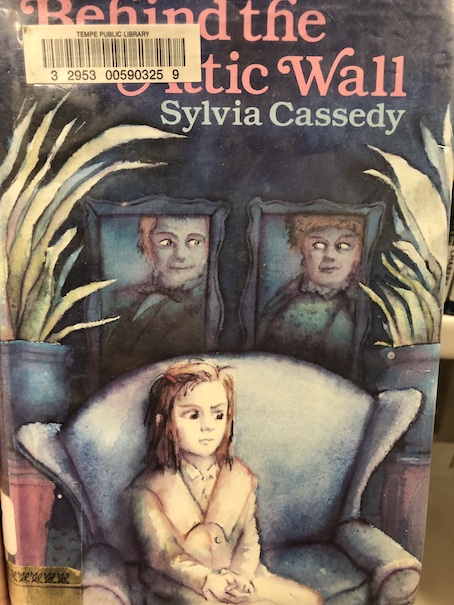
Twelve-year-old Maggie is an orphan who has been bounced around between foster homes and boarding schools because of her bad behavior. Her bad behavior is because she feels neglected and unloved. She eventually comes to live with her great aunts and an uncle in an old house that used to be a boarding school. Maggie has memories of the house where she once lived with her parents before they died, but no place she’s been since has seemed home-like.

When she first arrives, her eccentric Uncle Morris picks her up at the station. Uncle Morris has a sense of humor, which is both charming and also gets on Maggie’s nerves. When she gets a look at the institutional-looking old house where her great aunts and uncle live, she is physically ill. She has lived in various boarding schools and is horrified at the idea of living in another. Her last boarding school expelled her, and the headmistress called her a “disgrace.” Maggie had hoped that, for once, living with relatives might mean living in a real home.

Her two aunts, Harriet and Lillian, remind her of the headmistresses at boarding schools, although their rules are different from most headmistresses. They lecture her about health and nutrition and worry about her being undernourished. They give her old-fashioned, hand-me-down clothes to wear that Maggie assumes are the uniforms of this old school. One of her aunts gives her a baby doll, but Maggie tells her that she doesn’t like dolls and doesn’t play with them. She doesn’t have any dolls, and if she ever had any before in her life, she doesn’t remember. Her aunt thinks her rejection of this gift is horrible. Her aunts don’t seem to understand much about children, and they are both horrified when Maggie dumps out her glass of milk because they gave her warm milk instead of cold. However, her Uncle Morris is amused and tells her that she might be the “right one” after all. Maggie isn’t sure what he means by that.

After her aunt leaves her alone in her new room, Maggie plays with the doll a little, imagining that she’s explaining it to a group of girls who have never seen a doll. A game that Maggie often plays with herself is to mentally explain common things to a group of imaginary girls who don’t know what any of them are. Then, she goes exploring the rest of the old house. Because this building is so obviously an old school, she keeps expecting that she will eventually encounter other students, but there are no students. Maggie is the only child in the old house.

Maggie finds her aunts’ rooms and tries on their curlers, a necklace, and a fancy pair of shoes. She gets in trouble with her aunts for doing that, and that’s the moment when Maggie understands that there really are no other children around to see her get in trouble. At first, her aunts think that maybe agreeing to accept Maggie was a mistake and that they can’t handle her. However, they decide to keep her, at least for the present.

They explain to Maggie that the building where they live did use to be a boarding school for girls. It was founded by some ancestors of their, whose portraits hang in the parlor. Maggie is amazed at the idea of ancestors because she barely even remembers having parents and has little concept of her extended family. The old school closed after some kind of disaster, and it reopened in a new location down the road. Now, the new school is a private day school for both boys and girls, catering mostly to wealthy families, who can afford the fees. Maggie is horrified when she finds out that she will be attending this school because she knows that a poor orphan like her in her shabby, hand-me-down clothes is going to be an oddity among the wealthy private school students.

On her first day at the school, Maggie has a panic attack while imagining going through the routine of her teacher telling the whole class about her unfortunate history and the tragic deaths of her parents in a car accident when she was little and asking the other students to be patient and charitable to her. She’s experienced this before, and she knows that, while the other students start off treating her charitably, they soon get tired of being charitable and start picking on her. Maggie tries to run away from the class, and that earns her a reputation as a weirdo right off the bat. The other kids immediately start treating her like a weirdo and calling her the usual nasty names, and Maggie’s only relief is that, this time, they didn’t go through the false kindness phase first.

Uncle Morris doesn’t live at the old school with the aunts, but he lives nearby and sometimes comes to visit. He continues to spout his witty nonsense and plays weird practical jokes that make no sense. Maggie starts to understand that her uncle’s form of teasing isn’t meant to be mean, unlike the kids at school, but none of it really makes any sense to her. His jokes are pointless, and he doesn’t respond to anything, even Maggie’s emotions, in a normal way, turning everything into some kind of bizarre joke.

Then, Maggie starts to hear voices in the house. She can’t tell where the voices are coming from, but she knows they’re not her aunts, and her aunts never seem to hear them. They talk about random things, like tea, roses, a lost umbrella, and a dog. Maggie asks her aunts who’s talking, but her aunts say no one is. They think that it’s just Maggie’s imagination because she’s highly strung, but Maggie knows that she’s not imagining it. Her Uncle Morris also seems to hear the voices because he reacts to them at one point, but when Maggie tries to ask him about it, he dodges the question and makes another of his nonsense jokes.

One day, while her aunts are out of the house, the voices call to Maggie and ask her to join them. Maggie searches for the source of the voices, and behind the wall in the attic, she discovers a small room with a pair of mysterious dolls who are alive. They walk and talk. At first, Maggie thinks this must be some kind of trick, but it isn’t. She tries to ask the dolls what they are, but they speak in nonsense jokes in response to serious questions, like Uncle Morris.

Maggie is unnerved by the dolls at first, and she throws a fit about how stupid their pretend tea party is, kicking the dolls aside in fear because she can’t understand them and is afraid of what they might do to her. The dolls simply conclude that they must have been wrong and that Maggie isn’t the right one and stop talking to her. Maggie tells them that she doesn’t care and doesn’t want to be the right one, but actually, she can’t stop thinking about the dolls. She wonders what they mean about the “right one” and what kind of person would be the right one. She also feels guilty about damaging the dolls when she kicked them, so she returns to the attic to fix them. When she starts to fix them, the dolls begin speaking to her again.

The dolls become Maggie’s friends, giving her the love she so desperately needs. Maggie also feels needed by someone else for the first time in her life, enjoying the feeling of taking care of the dolls, sort of the way she took care of the girls in her imagination. However, the dolls have a spooky origin, and when Maggie realizes the truth about the dolls, it changes her life forever.

The book is available to borrow and read for free online through Internet Archive (multiple copies).

I wasn’t sure if I was going to like this one or not because, while I like sort of atmospheric spooky themes, I have limits on how many scary and sad themes I can take. It did help that the book is divided into sections, each with a prologue about Maggie in the present day as she looks back on this strange period in her life. The prologues explain how Maggie is now in a happier home with people she has come to think of as her parents and younger children that she has also come to love as little sisters. The other kids are fascinated by the stories that she tells about her time with her aunts at the old boarding school, and Maggie enjoys explaining things to them, like she used to do to the imaginary girls, only she speaks more politely to the real girls. Since her time with her aunts, she has learned to get along better with people, and this ghost story is about how she learned how to build connections with people.

The book makes it clear that Maggie’s bad behavior is because she has been lonely, neglected, and mistreated since her parents’ deaths. She has been in various foster homes and boarding schools, but the people who were her caretakers didn’t really love her or have any patience with her. The other children in her boarding schools used her as a target for teasing and bullying, causing Maggie to look at everyone new she meets with suspicion, waiting for them to turn on her, even if they acted nice at first. The adults don’t really build a relationship with Maggie and just expect Maggie to be perfectly behaved, regardless of her provocation. Maggie remembers having spoken to psychologists before, who had her draw pictures of her feelings and family, but they never really solve anything for Maggie. Maggie still feels neglected and unloved, and when the adults at each place she’s been get tired of her, they just ship her off to somewhere else, where the process continues. Maggie’s bad behavior is like shooting herself in the foot, sabotaging possible friendships and relationships, but it becomes more understanding when you realize that this is the only pattern of relationships she knows. Children and adults have both mistreated her, so she doesn’t have any knowledge of healthy and loving relationships to draw on to know how people are supposed to treat each other.

That’s been Maggie’s life for as long as she remembers. The only clothes she has are old, worn pieces of various school uniforms from the various boarding schools where she’s been, and she has no toys or personal possessions except for a pack of cards that she uses to play solitaire, a game that one of her former boarding school roommates taught her. It’s the only game Maggie knows how to play other than imaginary games.

Maggie’s aunts and even her Uncle Morris aren’t particularly good for her. Her aunts have no patience or understanding for her. The aunts do care about Maggie. Maggie does become better fed and healthier because the aunts are concerned about her health, but they don’t understand how to take care of her emotional health. They also have some selfish motives in their care of Maggie, wanting to show off her improvement to their health society because they want to prove their health theories. Uncle Morris is quietly supportive of Maggie, but I found him rather trying because, when Maggie tries to speak to him seriously and sincerely, he just makes jokes and never really addresses her feelings or the realities of her situation. Admittedly, it’s partly because he knows the truth about the dolls but can’t admit it. Still, constant jokes aren’t what Maggie really needs, and his jokes and nonsense wear on her. The dolls also speak nonsense, but they give Maggie the opportunity to learn valuable lessons about how to get long with others and build relationships with them.

One of the first lessons that Maggie learns is that, while other people have done things to hurt her, she also does things that hurt other people’s feelings. Before she can begin to develop relationships, she has to learn to control herself, to not treat other people in hurtful ways, and to apologize and do things to repair damage she’s done. She can’t begin to build a relationship with the dolls until she repairs the damage she did the first time she met them. Maggie is actually amazed that she was able to do it because she has never fixed anything in her life. She is unaccustomed to the idea that she can make things better when things have gone wrong or when she’s done something wrong. Most of her past problems have just ended in failure and with her being sent away.

Maggie also learns that building relationships with other people means caring about their needs, and Maggie likes the feeling of being needed by someone. Acting out the tea parties with an empty tea pot and wooden pieces of bread and watering the fake roses on the wallpaper is still ridiculous, but she does it all anyway because the dolls need her to do it. She gives them presents, too, the first presents that she’s ever given anybody. One of the girls at Maggie’s school, Barbara, sees Maggie making a present for one of the dolls and gives Maggie a little paper umbrella for a doll. Maggie learns that it’s possible for people to bond over shared interests.

However, there is a dark side to this story. There are hints all along about what the dolls really are. The man doll, Timothy John, is always reading a torn scrap of a newspaper about a fire, but he can never finish the story because most of it is missing. Every day is Wednesday for them, and they say that is the day they arrived in that room. When they show Maggie their best Sunday clothes, which they never wear because every day is Wednesday to them, Maggie is surprise to see that the clothes are burned. The dolls also speak of a third person who is supposed to join their doll household at some point, but they say that it can’t be Maggie because she’s supposed to be their visitor.

The truth is that the dolls are the ghosts of her ancestors, the ones who founded the school. They were killed in a fire in the 1800s, along with their dog, who is now a little china dog in their attic room. The story in the little newspaper scrap is about them, and the fire is the reason why the school had to be moved to another building. Maggie doesn’t realize the truth until she runs away after an argument with her aunts because she didn’t come to the party of their society and finds their grave stones. It’s the anniversary of their deaths, and she meets Uncle Morris at their graves. The only time Uncle Morris doesn’t make jokes is when he explains to Maggie how they died.

After the aunts catch her in the attic with the dolls and Maggie finds out who and what they are, the dolls stop moving and talking to her. Maggie tries moving them herself, acting out their tea party, and talking for them. Maggie is afraid that the dolls have now died forever, but there is the third person the doll spoke of to consider. The third person is Uncle Morris. It occurred to me that the story leaves it a little ambiguous about whether the dolls were really the ghosts of the ancestors or if Maggie’s own lonely imagination, inspired by Uncle Morris’s nonsense and bits of family history made her feel like they did. However, the ending of the story indicates that Maggie didn’t imagine any of it because her Uncle Morris dies of a heart attack and becomes a doll in the attic with the other dolls. When Uncle Morris joins the other dolls, the other dolls come to life again. However, it could still be the imaginings of a lonely and grieving child.

Maggie’s aunts decide that they simply can’t handle Maggie, so they are the ones who arrange for her to go to her new family. It was the best thing that they could have done for Maggie. The new family is the family that Maggie really needs, and they want to keep her permanently. She never tells her new sisters the truth about the dolls. Maggie misses being with the dolls, who are also her family, but the idea that they are still alive and that Uncle Morris is keeping the other two in the attic company so they won’t be lonely without her makes her feel better. It’s a bittersweet story.

One of the things that bothers me about ghost stories is that it’s sad to think about how the people got killed. I like stories that are kind of mysterious, but behind the ghost story, there is real tragedy. I feel really bad for Maggie’s ancestors and their poor dog, although they don’t seem to mind their condition too much. On the other hand, maybe some of their nonsense talk is to cover up the sad parts, so they can forget the tragedy and pretend like they’re still living their normal lives and make it so they don’t have to answer Maggie’s uncomfortable questions. Maybe that’s even where Uncle Morris learned that trick.

There are times when the dolls seem to have some memory of the past and what happened to them, but they’re kind of caught in a sense of timeless, so it’s hard to tell how much they really remember. If they really are ghost dolls and not just dolls who are alive in Maggie’s imagination, there’s no explanation about why they are dolls. Did they have dolls made of themselves while they were alive that they came to inhabit after death? Is it because they’re now playing at a life they’re no longer living? The story doesn’t say. Uncle Morris seems to know more than he tells, and he may have known somehow that he would also become a doll after his death. If he met the dolls himself when he was young, he may have made a conscious decision that he would join them one day. However, we don’t know for sure how much he knows or how or why the other dolls know to expect him after his death. Poor Maggie’s life has been about loss since the death of her parents. She lost them and her first home and every home she’s had since then. The idea that people she loves stay alive in the dolls could still be her imagination. The story indicates it’s all really happening, but readers can still decide for themselves.

Maniac Magee

Maniac Magee by Jerry Spinelli, 1990.

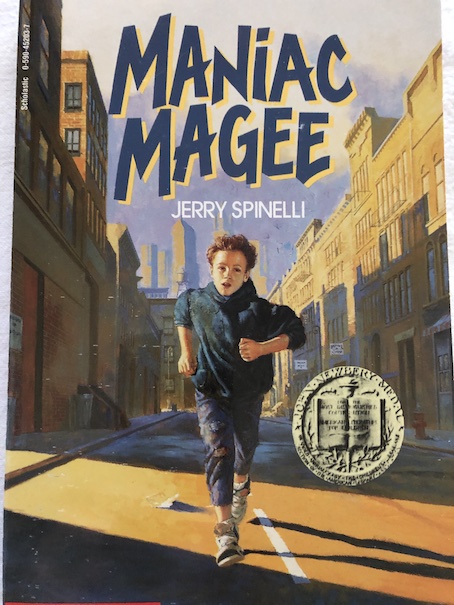
When the character of Maniac Magee is introduced, he is described as a legend or a tall tale. Even though he is a young boy, his origins are unusual, and people have built up stories around him. The story even admits that his personal story is part fact and part legend.

The truth is that “Maniac” is an orphan. His real name is Jeffrey Lionel Magee, and he was born a normal boy with normal parents, but his parents were killed in a trolley accident when he was only three years old. After that, he went to live with his aunt and uncle in Pennsylvania. However, his aunt and uncle had an extremely dysfunctional marriage. They didn’t believe in divorce, so they stayed married, but they lived a strange, separated life in their house. They divided their home in half so they could effectively live apart, avoiding each other most of the time. They shared Jeffrey by taking turns eating meals with him, but they never ate together as a whole family. Eventually, Jeffrey couldn’t take this weird life anymore, where his aunt and uncle never talked to each other. One day, he blew up at them at a program at his school, and he ran away.

For the next year, Jeffrey seems to have wandered around by himself. Nobody is sure exactly where he was during that year, but he eventually turned up in another town about 200 miles from where he started. He wore ragged clothes and worn-out shoes, but he greeted people with a cheery, “Hi.” One of the first people he meets is a black girl named Amanda with a suitcase, and he asks her if she’s running away. Amanda tells him that she’s not running away, just going to school. Her suitcase is full of books. Jeffrey is fascinated by the books, and he offers to carry her suitcase. Amanda thinks it’s strange that a white boy like him is in an area of town that is almost entirely black, and she asks him who he is and where he lives. Jeffrey doesn’t quite know how to answer her at first because he doesn’t really live anywhere.

He asks her why she carries so many books to school, and she explains that she has younger siblings who color all over everything and a dog who chews everything, so she feels like she has to carry her whole personal library around with her to protect it. Jeffrey begs Amanda to loan him a book. At first, she refuses because she doesn’t know if he’ll give it back, but he swears he will. After they argue about it, Amanda tosses him a book because she has to hurry off to school and can’t take time to argue anymore.

Jeffrey continues to wander around the town for several days. People begin to notice him, how he runs everywhere goes, how he’s always carrying a book, and how he shows off his sports prowess by bunting a frog during a baseball game he joins. He lives in the deer shed at the zoo and eats some of the food for the animals, although he also joins a large family at dinner one night because they’re always taking in people or inviting people to dinner, so one extra person doesn’t attract too much attention. Nobody knows what to call him, so they start thinking of him as that “maniac” and start calling him Maniac.

The bully who threw the frog at him in the baseball game gets angry because Maniac’s bunt ruined his perfect record of strikeouts, so he decides to beat up Maniac in revenge. When he and his friends chase after Maniac, Maniac runs in the direction of the invisible line that divides the town in half, into the white portion and black portion of town. Maniac doesn’t understand the division between the parts of the town, but the other kids do, and they won’t follow him across the line between their part of town and the other part of town. Maniac’s disregard of the racial separations in this town is one of the things that sets him apart from other people and accentuates his oddness. He’s not afraid to share food with a black kid, even eating over the same place where the other kid bit.

When one of the black kids fights with Maniac, trying to get the book away from him, a page is torn. Fortunately, Amanda knows immediately which of them ripped the book. Jeffrey/Maniac reassures her that they can fix the torn page, so Amanda invites Jeffrey home with her. He spends the rest of the day with Amanda and her family. In the evening, Amanda’s father offers to take him home, but Jeffrey doesn’t know how to explain that he lives the deer shed at the zoo. In the car with Amanda’s father, Jeffrey tries to pretend that he lives in a house a few blocks down the street, but Amanda’s father knows immediately that it can’t be true. Jeffrey still doesn’t understand the division in the neighborhoods in town, and the house he picked for his pretend house is in the black area of town. When Amanda’s father presses Jeffrey for an explanation, Jeffrey admits that he doesn’t have a home and explains about his past. Amanda’s father immediately takes Jeffrey back to his family’s house, and Amanda’s mother insists that Jeffrey stay with them.

For the first time in about a year, Jeffrey has a home! Jeffrey gets along well with the family and is good with Amanda’s little brother and sister. He likes reading Lyle, Lyle Crocodile to them. He doesn’t even mind taking baths with the little kids or untying their knotted shoelaces.

Maniac starts feeling at home in the black neighborhood, although he’s still regarded as an oddity. His new family calls him Jeffrey, but everyone else calls him Maniac. He is a strange kid, who turns out to be allergic to pizza and breaks out in a pepperoni-shaped rash when he eats it. He’s a very fast runner and good at sports, and he seems to have a special talent for untying knots. Because of his time spent living in a dysfunctional house where people didn’t talk to each other and his time living alone on the streets, there are many things that Jeffrey doesn’t understand about other people. He doesn’t understand social dynamics and racial issues, and it takes him some time to understand how other people look at him as well as at each other.

One day, when he’s playing with the other kids in the street, an older black man calls him “whitey” and tells him to go home, back to his “own kind.” He doesn’t believe that Maniac lives in the neighborhood. His new siblings tell the old man to go away, and the old man keeps ranting about people belonging with their “own kind” until a woman leads him away. The incident disturbs Maniac. Amanda says that the old man is a “nutty old coot” and that Jeffrey should ignore him, but the incident makes Jeffrey realize that there are some people in the neighborhood who don’t want him there. Jeffrey wants to stay with his new family, and they want him to stay, but Maniac worries that his presence is creating a problem for them. Can he find a way to truly become part of this new family he so desperately needs?

This book is a Newbery Medal winner. It’s available to borrow and read for free online through Internet Archive (multiple copies), and there is also a Literature Circle Guide for book groups and classrooms.

My Reaction and Spoilers

I remember reading this book in class when I was in elementary school. The story is interesting because it’s framed as a tall tale but about a contemporary boy. “Maniac” Magee is described as being a legendary child because of his unusual ability for untying knots and his strange allergy to pizza. No real human being can actually be allergic to pizza because pizza isn’t a single food. There are many different ways of making pizza using various combinations of common ingredients. People can be allergic to some of the ingredients in a pizza, but if they were, that wouldn’t be an allergy to pizza itself, and those people would also be allergic to other types of food containing those same ingredients. That’s not Maniac’s problem, though. He seems to be particularly allergic to just pizza by itself. Maniac does things that are impossible and inherently beyond the normal child in everything he is, even in his defects, a classic tall tale character. One of his famous feats, untying an infamous knot in the neighborhood, is like the legendary Gordian Knot. The story is dressed with humor and tall tale elements, but it has themes that are very serious and even heart-rending.

Tall tale elements aside, this is a story about racial issues and a lonely, neglected child who desperately needs a family and a place to belong. Because the story focuses on Maniac as a tall tale character, the racial issues in the story aren’t immediately obvious, although they begin entering the story as soon as Maniac finds his way to his new town and encounters the girl who will be his new sister. The one thing that Maniac really needs is a stable and loving home. He is an orphan, and he ran away from his aunt and uncle’s home because they were too dysfunctional. As a runaway, he wanders for a time, looking for a better home and people who really care about him. He eventually finds that loving home with a family of a different race. Some people might find it strange that he feels a sense of belonging with people who, on the surface, seem quite different from him, but a sense of family goes much deeper than surface appearances. Maniac himself, on the surface, is a very unusual boy compared to most boys in the world, but deep down, he’s still a kid who needs love, attention, a family, and a place to call home. His new family offers him all these things, regardless of how unusual he is, and what they look like doesn’t matter.

The opposition of some parts of the community messes up this loving home for Maniac partway through the story, and he runs away and spends time on his own again. For a time, he lives in the locker room of a baseball stadium, looked after by a groundskeeper who is an elderly, washed-up baseball player. The groundskeeper, Grayson, passes away during the course of the story, but their friendship helps Maniac to understand some things about people. Grayson was also a neglected child. His parents were drunks, and unlike Maniac, he never learned to read because his teachers never tried to teach him. He was placed in a class with kids who were considered unable to learn because they were troubled or had learned problems. Because his teachers never had any faith in his ability to learn, he never really tried. Maniac is like a grandson to him and opens his eyes to many things before his death.

After Grayson dies, Maniac returns to wandering again, believing that he is jinxed to lose any home he has and anybody he cares about. However, Maniac still cares about other people, and he discovers that other people also care about him. When he tries to introduce a tough black boy to some white boys he’s staying with, hoping to make a connection, it goes wrong, and Maniac starts to think it’s all hopeless. However, when Maniac is unable to help one of the white boys when he’s in trouble and the black boy saves him, the white boys come to see the black boy in a different light, grateful to him for saving one of them and taking care of them. The black boy also comes to look at Maniac differently. When he confronts Maniac about why he couldn’t rescue the boy, Maniac admits for the first time that he’s still haunted by the memory of how his parents died, and the situation reminded him too much of it, so he was unable to handle it. The black boy softens at seeing this human side to Maniac and the other white boys. He’s the one who brings Amanda to Maniac, and Amanda insists that he come home with her. Maniac hesitates at first because he thinks he’s jinxed, but Amanda won’t put up with any nonsense from him, and Maniac comes to realize that they really are a family and that he is really going home.

As a side note, I also remember my elementary school librarian reading Lyle, Lyle Crocodile to my class when I was in first grade. In fact, she said it was one of her favorite books, and she also read others in the series to us. I had forgotten that the book was mentioned in this story, which was published the year after I first heard Lyle, Lyle Crocodile, but it did bring back some nostalgia for me. When Maniac teaches Grayson to read because Grayson never learned when he was a kid, they find well-known picture books on the sale rack at the library, including The Story of Babar, Mike Mulligan’s Steam Shovel, and The Little Engine That Could.

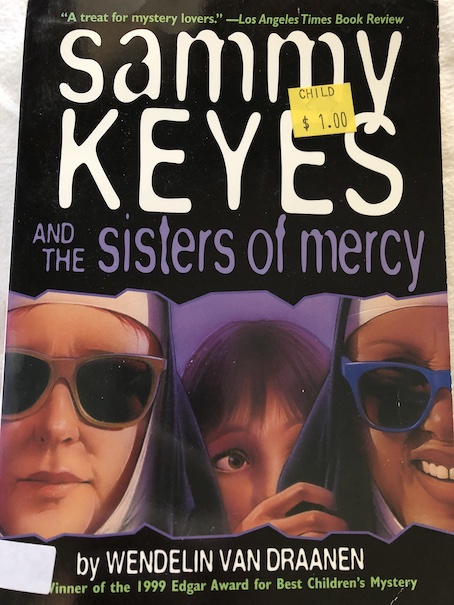
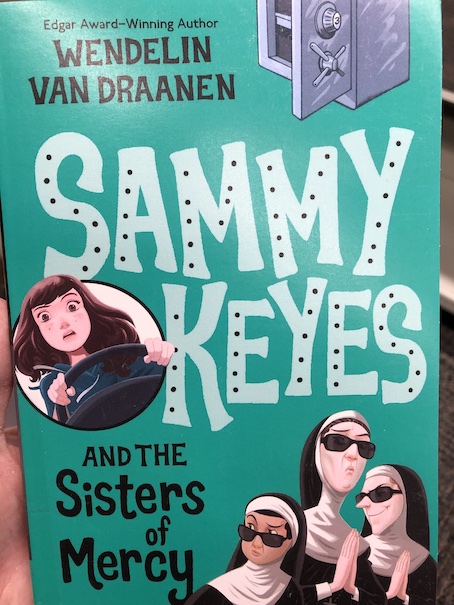
Sammy Keyes and the Sisters of Mercy

Sammy Keyes

Sammy Keyes and the Sisters of Mercy by Wendelin Van Draanen, 1999.

At the end of the previous book in the series, Sammy was given a punishment from her school for causing a disturbance during an assembly that requires her to complete 20 hours of community service. She’s working off her volunteer hours at St. Mary’s Church under the supervision of Father Mayhew. When Sammy lived with her mother, they weren’t religious, and Sammy hadn’t even been baptized. However, her grandmother is much more religious, and she had Sammy baptized by Father Mayhew soon after Sammy moved in with her. Father Mayhew is kind and understanding with Sammy. There are also some nuns at St. Mary’s from an order called the Sisters of Mercy. They’re helping out in the soup kitchen. When elderly Sister Josephine sees that Sammy is painting a wall in Father Mayhew’s office, she complains that he’s always getting the services that the nuns ask for and never get. They’ve been asking to have the house where they live painted for years, and it still hasn’t happened.

Father Mayhew’s gratitude for Sammy’s help fades when a small ivory cross is stolen from his office, and he thinks that Sammy did it because she was in there. Sammy tells him that she didn’t take it, but he doesn’t believe her and sends her to go work in the soup kitchen for awhile. (He didn’t ask her to turn out her pockets before she left his office. I would have because that would settle the matter right there.) In the soup kitchen, Sammy sees another girl about her age who reminds her somewhat of herself, partly because of the high-top shoes she wear. Sammy wonders who the girl is and why she’s eating at the soup kitchen, but she isn’t able to talk to her there.

Later, Sammy discusses the missing cross with Father Mayhew again. This time, he seems less certain that Sammy took it, and Sammy asks him if it was something valuable that might have been sold for money or if someone who is angry with him could have taken it as revenge. The one person who seems angry with Father Mayhew is Sister Josephine, but he can’t picture her taking the cross. However, there are other people who might have a reason to be angry with Father Mayhew. Brother Phil, who works in the soup kitchen, wants to become a full priest, but Father Mayhew doesn’t think that he’s suited to it.

The thefts also continue. A couple of gold chalices are stolen from the church. The nuns who are part of the Sisters of Mercy turn out to be traveling and staying in a trailer, and they’re only staying at St. Mary’s temporarily to hold a fundraiser. They tell Father Mayhew that someone tried to break into their trailer, but they scared the thief off. One of the nuns ask Father Mayhew to keep an heirloom locket in his safe until she can deliver it to her niece.

Meanwhile, at school, Sammy is playing on one of her school’s two softball teams. Her school nemesis, Heather, plays on the other school team, so their feuding and rivalry has transferred to the school’s sports field.

This book is the first book in the series to bring up the subject of Sammy’s father. Sammy’s grandmother gives her a catcher’s mitt that once belonged to her father. Sammy’s mother was going to throw it out, but her grandmother rescued it from the trash, and it’s the only thing Sammy has that was once her father’s. She sees her love of playing catcher at softball as a connection to the father she’s never known. Sammy has never seen a picture of her father and doesn’t know his name, and her mother has admitted that he has no idea that Sammy exists. She has asked her mother about her father in the past, but her mother refuses to tell her who he is or what happened to him. All she has ever told Sammy is that she was young when they met and her relationship with him was a mistake. Sammy can’t help but feel that her mother things of her existence as a mistake as well, maybe even a bigger one than her relationship with her father. The fact that her mother has essentially abandoned her to pursue her dream of being an actress has left her feeling like her mother never really wanted her. Sammy has to stay with her grandmother, even though it means keeping her living arrangements a secret, because staying with her father isn’t even an option.

The next time that Sammy sees the mysterious girl in high-tops at the soup kitchen, she and her friends follow her to see where she lives. It turns out that she’s homeless and living in a cardboard box. This discovery raises some personal questions and concerns for Sammy. On the one hand, she’s unfortunate because her living situation is precarious and depends on not being caught in her grandmother’s apartment, which is meant only for seniors, but on the other, she does have her grandmother to rely on. This other poor girl doesn’t seem to have anyone. At one point, Sammy asks her grandmother about what would have happened to her if she hadn’t been able to take Sammy when her mother left. It’s an uncomfortable question for both of them because it raises the question of whether Sammy’s mother would have just abandoned her completely if she hadn’t had her mother willing to take her. Sammy’s mother doesn’t seems to care how awkward their living arrangement is because they have to keep Sammy’s presence in the apartment a secret. Without Sammy’s father in the picture, there is no one else but her grandmother to take her. There is also the constant question of what would happen to Sammy and her grandmother if someone manages to prove that Sammy is living with her against the rules. Sammy is better off than the homeless girl, not by much, but still better.

Later in the story, after Sammy’s beloved mitt is stolen, Sammy tells Hudson about everything that’s going on. She’s pretty sure that Heather is the mitt thief because she’s the one person who’s always doing awful things to her. Hudson points out that, in a way, Sammy is fortunate to know who she can trust and who she can’t, and she has one definite enemy. Holly has never really had anybody to trust before, and Father Mayhew has no idea who he can trust or not trust in his church. His thief is obviously one of the people who works with him on daily basis, someone who can come and go while seeming above suspicion, and Father Mayhew is only just beginning to realize that there are people around him he can’t trust as much as he thought.

The book is available to borrow and read for free online through Internet Archive (multiple copies).

My Reaction

For awhile, Sammy suspects that the homeless girl who visits the soup kitchen might be the thief who is stealing things from the church, but she’s not. The girl, whose name is Holly, becomes a regular character in the series. She is a runaway foster child who’s had an even tougher life than Sammy. When she and Sammy talk, she explains how she was abused in previous foster homes, which is why she ran away to live on her own. At one point, she is attacked by a man, and Sammy has to help fight him off. The girls realize that Holly can’t keep camping out on her own, and Sammy helps her find a place to stay with people who turn out to be able to provide a much more stable home for her, which is how she remains a character for the rest of the series. Holly begins attending school with Sammy and her friends, with her new foster family making up a story about how she transferred from New Mexico. Her new home seems to be a kind secretive foster home, not unlike Sammy’s living arrangements. Her new foster family doesn’t seem to try to legalize their custody of Holly (not in this book, anyway), possibly out of fear of her being taken away and put in other abusive or dysfunctional foster homes in the flawed system she came from. There is also a standalone book which focuses specifically on Holly called Runaway, which explains more about her personal history. Some of the things that happened to Holly are an indication that this series isn’t meant for young children. I would say that it’s best for tweens and up, probably about around the middle school level.

One of my favorite characters in this series is Hudson Graham, a retired old man who acts like a grandfather to Sammy. She often goes to see him when she needs help and advice. He is knowledgeable on an eclectic range of topics, and he has a massive private library that can answer most of Sammy’s questions. In this book, Sammy thinks about how, even though she and Hudson have talked about many things together, including his wide-ranging hobbies, she doesn’t really know that much about his past, even what he used to do for a living before he retired. Because he has a collection of foreign language dictionaries and recording devices, Sammy thinks that he might have once worked for the CIA or something. When the people who own the dog grooming business down the street lose the key to their safe because a dog ate it, Sammy asks Hudson what they can go, and he tells her some fascinated facts about safes and how to get into them. The fact that he knows about that suggested to me that he probably worked in law enforcement or security at some point. My thought is that he might have once been a private investigator because they do security work and would have some basic law knowledge and use devices that Hudson has, like recording machines and cameras. My next guess would be that he was a journalist, also because of the recording devices and cameras and because journalists can write on a wide range of topics, giving Hudson his eclectic knowledge and the need for his own private research library. Aspects of Sammy’s life and the lives of people she knows add extra mystery to the story. Hudson’s past isn’t explained in this book in the series, and I’m not sure if it ever is.

Susannah and the Purple Mongoose Mystery

Susannah and the Purple Mongoose Mystery by Patricia Elmore, 1992.

This is the third book in the Susannah Higgins mystery series.

It’s summer, and Lucy has been helping Susannah practice for the Black Poetry Recitation contest. She’s not expecting the summer to get any more exciting than that because her father has told her that he can’t afford summer camp for her this year.

One day, Lucy and Susannah go to visit a friend of Susannah’s grandmother, Mrs. Quigley. Mrs. Quigley, often called Quiggy, says that she has a surprise for them. The “surprise” turns out to be that Quiggy has taken in a foster child, a girl named Theresa. Theresa is about the same age as the other girls and will be going to school with them in the sixth grade. Theresa tells the other girls that she likes Quiggy, but she doesn’t like Ruth, Quiggy’s cousin who lives with her. Ruth is a fussy woman who doesn’t like kids much, and Lucy tells Theresa that she’s like that with everyone. The only people Ruth really seems to like are Quiggy and her dog, Pipsqueak.

However, the girls are also shocked when they see that Quiggy’s garage has burned down. Fortunately, the fire didn’t spread to her house, but the garage is destroyed, and it looks like arson. Susannah tries to question Theresa about the fire, but Theresa says that she was asleep until Quiggy smelled smoke and woke her. Lucy thinks that the fire reminds her of when a girl she knew in second grade tried to set fire to a storage shed on the playground. Then, Lucy suddenly realizes why Theresa looks so familiar to her – Theresa was that girl from the second grade. Susannah doesn’t remember Theresa or the shed incident because she was going to a different school then.

Lucy is quick to suspect that Theresa is the one who set the garage on fire because of her firebug past, but Susannah is more doubtful. She wants to learn a little more about Theresa’s past since the second grade, where she’s been living, and whether she’s continued her firebug habit in other places she’s lived.

However, Theresa falls under suspicion again when another fire destroys Quiggy’s back porch, deliberately set by lighting a pile of newspapers on fire. Quiggy and Ruth were out at the time, and Theresa was home, but she says that she went to the park and didn’t know about the fire until she got back. Ruth is quick to accuse Theresa, saying that she knew that she’d be trouble from the beginning.

Mrs. Weinberger, the woman who called the fire department, said that she noticed the smoke right away because she was working in her garden around the time the fire started. When Susannah asks her if she was in the garden the whole time, she says that she did leave for awhile because she got an unexpected delivery of roses from a secret admirer, and the delivery boy even sang “You Are My Sunshine.” It sounds suspicious, like someone who knew Mrs. Weinberger’s normal habits deliberately tried to distract her so she wouldn’t see the arsonist arrive. Mrs. Weinberger describes the delivery boy, saying he looked about 18 years years old, he was blonde, and he had a tattoo on his arm. Also, both his shirt and his bicycle were purple. All she can remember about the name of the florist is “Mongoose”, which is a pretty odd name for a flower shop. The roses make it seem less likely that Theresa would have been the arsonist. Roses would be an expensive gift/distraction for a recently-arrived foster child to send.

When the girls learn from a boy Theresa used to live with in another foster home that she was sent away for trying to set a fire there, it looks bad for her. The girls talk to Theresa and suggest that she needs professional help, but Theresa denies ever setting any fires at all, at least, not on purpose. The fire at her last foster home was just a cooking accident, and Theresa wasn’t sad to leave there because the family wasn’t nice to her. As for the shed in the second grade, Theresa explains that she wasn’t actually trying to light the shed on fire. She was living in a foster home back then, too, and she’d just gotten a bad report card and a letter from her teacher that she was afraid to show to her foster family. She was trying to destroy them, and things just got out of control. Theresa insists that she would never want to do anything to hurt Quiggy or make her mad because she’s been nicer to her than any of her previous foster parents have, and she really wants to stay with her.

Theresa isn’t the only suspect for the arsonist, though. Could Ruth have somehow arranged the fires to get rid of the child because she didn’t want to share a home with her? What about Mr. Reid, the cranky next door neighbor who is annoyed about the sound of kids playing? There’s also Toby, Quiggy’s handsome nephew, who does handyman work for his aunt. He has access, but does he have a motive? What about George Peterson, who wants to buy Quiggy’s house? What about Arthur Featherstone from Theresa’s former foster home? Could he be holding some kind of grudge? It seems like the key to finding the real arsonist is finding the boy who delivered the flowers on the purple bike with the name “Mongoose” printed on it.

The book is available to borrow and read for free online through Internet Archive (multiple copies).

My Reaction

One of my favorite things about this series is that the author does a good job of making a number of people look like equally good suspects. In the beginning, I had multiple theories about who the real arsonist could be, and I honestly wasn’t sure who it was for much of the book. One of my early theories turned out to be correct, but I changed my mind two or three times along the way.

Something else that I’d like to mention is that, at one point, the characters go to the library to do some research, and they use microfiche to read some old newspaper articles. When this book was written, the Internet and the World Wide Web were just starting to evolve into something that the general public could use, but most people didn’t have access yet. Even libraries didn’t have the rows of Internet-capable computers they have now. Some may have been starting to get them by this point, but it was a gradual process, and I don’t think my local library had them until a few years later. In fact, I think this was around the time that my school’s library replaced the old card catalog with the new computer catalog, and it wasn’t an online catalog; it was just a database stored on the computer in the library. Remembering things like this makes me feel old, but I was part of that 1980s/1990s generation of kids (the very oldest of the Millennials) who were first taught to use more manual forms of data storage before being gradually trained in more digital forms as we moved up through the grades in school.

Because, in those days, in the 1980s and into the early 1990s, there was no ability for most public libraries and other institutions to scan documents, like newspapers, and upload them to the Internet for easy sharing, or just write them directly to the Internet in the first place, they would convert printed materials to microfiche, which are essentially smaller film images taken of the documents. In order to read them, you would have to use a microfiche reader, physically load the images you want on sheets of transparent film, and look at a magnified version of them on the screen, scrolling through them until you found the information you were looking for. There was no way to make the process go faster with a keyword search. It was a royal pain. I had to do it a few times for various school reports, and I never thought it was fun. If you look at this video of people demonstrating how to use a microfiche reader, you see how they have to turn the dial to get the image aligned properly so they can read it, and also when they physical move the piece of film in the opposite direction to the way the image scrolls on the screen. I always thought that was annoyingly counter-intuitive. I know why it does that, because it’s about where the viewer is positioned over the image, not where film is moving, but I remember being annoyed with it when I was a kid because I’d move it in the wrong direction and get mixed up. Maybe it’s just how my mind works. When you find the image/page you want on the microfilm, there is a way to print it out on paper. Some libraries still use microfiche (which is why this video exists), and it can be useful for looking at old records, but online archives are starting to replace this method of data storage. When my local library underwent renovations in the early 2000s, they decided to replace their old microfiche area with a new teen center and more computers. I think they sent the microfiche machines and archives to the local university library. I’m not even 40 yet, and I feel old.

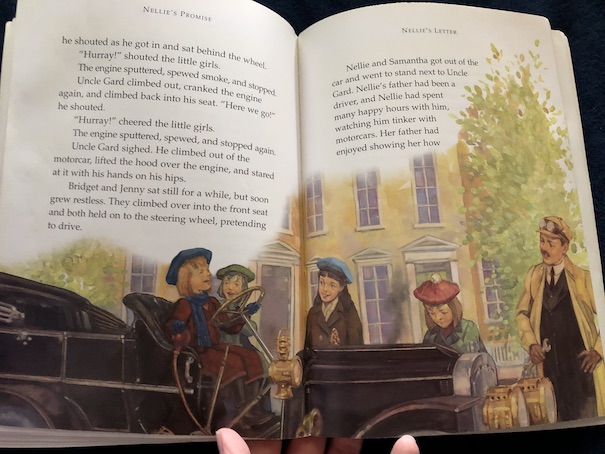
Nellie’s Promise

American Girls

Nellie’s Promise by Valerie Tripp, 2004.

This book is a companion book to the Samantha, An American Girl series, focusing on Samantha’s best friend, Nellie. Personally, I don’t like the companion books to the main American Girls books as well as the original books, but this book does follow up on the events to the main series. At the end of Samantha’s series, Samantha’s aunt and uncle took in Nellie and her sisters, Bridget and Jenny, after their parents died. Nellie and her sisters were from a poor family and had to start working from a young age before their parents died. After their parents died, their disreputable uncle abandoned them, and they were sent to an orphanage before Samantha discovered where they were. Samantha’s aunt and uncle are wealthy, and the girls’ lives have improved considerably.

Nellie’s happiness is threatened by the sudden reappearance of her Uncle Mike. Uncle Mike sees Nellie walking down the street in her nice new clothes and wants to know what rich family the girls are living with. Nellie runs away from him, but he threatens to find out where she’s living and to take her and her sisters back, saying that it’s his right as her uncle. He says that he means to put the girls to work earning money for him. Nellie is afraid that he might be able to reclaim them from Uncle Gard and Aunt Cornelia because he is a blood relative.

At first, Nellie is afraid to tell anyone that she’s seen her uncle and that he threatened to take her and her sisters back. Before her parents died, her mother made her promise to look after her younger sisters, so Nellie makes up her mind that’s what she’s going to do.

Nellie worries about the future for her and her sisters. She feels like she doesn’t fit in with the wealthy girls at Samantha’s school, who have had very different lives from hers, and the lessons they learn are the type of lessons for fine young ladies who will marry rich men and spend most of their time raising families, overseeing a house with servants, and entertaining friends and their husbands’ business associates, not preparing for practical professions outside the home. Nellie thinks that it’s important that she have some kind of job skills because the future can be very uncertain, and she wants to know that she can provide for her sisters, no matter what happens.

Samantha senses that Nellie is unhappy, and she asks her if she likes living with Uncle Gard and Aunt Cornelia. Nellie tells her that she does, but she hesitates to explain what’s really worrying her. Instead, she lets Samantha think that she just wants to feel like she’s doing something useful for the family. Before her parents died, Nellie used to get sewing lessons at a settlement house (a place where immigrant families could go to learn English, new job skills, and other skills they would need in their new lives in the United States) run by Miss Brennan. Aunt Cornelia is involved with many good causes, and she wants to visit a settlement house and get an introduction to Miss Brennan. Because Nellie knows Miss Brennan, she can help arrange that. It’s in a rough part of town, but Nellie is more accustomed to navigating rough neighborhoods than Samantha or her aunt. It also occurs to Nellie that she could ask Miss Brennan what to do about Uncle Mike.

Miss Brennan is glad to see Nellie, and she lets her show Aunt Cornelia and Samantha around the settlement house. They have many different types of classes for children as well as adults. Nellie says that she likes the practical classes that she used to have there, and even the types of dances that they do seem more practical than the more purely artistic ones that they do at the school she now attends with Samantha. Aunt Cornelia is pleased with the classes that they offer for women, and because she is interested in women’s education, decides that she wants to help out at the settlement house. However, the visit to the settlement house leaves Samantha irritated for reasons that Nellie doesn’t fully understand.

As Nellie begins spending more time with Aunt Cornelia at the settlement house, Samantha begins spending more time with Bridget and Jenny, and Nellie becomes jealous of how Samantha seems more like their older sister than she is. However, the others still don’t know about Uncle Mike’s reappearance, and Nellie is still fearful of what he might do and what will happen to her and her sisters if Uncle Mike tries to take them away. She feels like her only option is to try to prepare herself for a better job than that of factory worker.

When Nellie finally gets the courage to tell Miss Brennan about her worries, Miss Brennan tells her that she needs to discuss the situation with Uncle Gard. Uncle Gard is a good man, but he’s also a lawyer, and he will know how to legally stop Uncle Mike from trying to take custody of the girls. However, Miss Brennan adds that, whatever else happens, Nellie will still need to make some decisions about her future and what she wants to do with her life and education. The more Nellie thinks about it, the more certain she is about what she wants to do. She wants to become a teacher, like Miss Brennan.

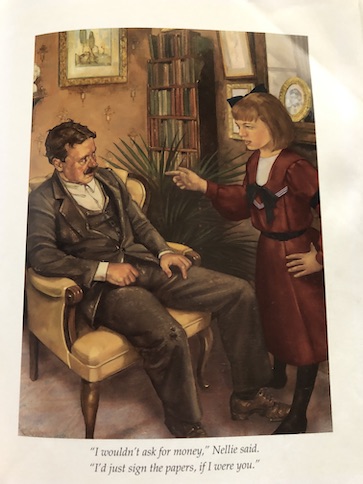
Nellie provokes more drama by applying to the boarding school in Boston where Miss Brennan said that she trained to be a teacher without talking to Aunt Cornelia, Uncle Gard, or Samantha about her decision or about her uncle. However, when the truth comes out about Uncle Mike, everyone understands that she was trying to hide and protect her sisters from him. It turns out that Uncle Gard has actually been looking for Uncle Mike because he already has the documents that he needs to legally adopt Nellie, Bridget, and Jenny, and he just needs Uncle Mike to legally release them into his custody. At first, Uncle Mike tries to extort money from Uncle Gard for the girls, but Nellie gets up the courage to tell him off, promising that if he doesn’t sign the papers and leave, she’ll tell everyone about how he stole all of their money and abandoned them to freeze the last time they were in his custody. The book ends happily, with Aunt Cornelia and Uncle Gard adopting the girls and understanding Nellie’s ambition to be a teacher. They enroll Nellie in a school in New York that teaches the skills she really wants so that she can continue living with them and not go to Boston. It also turns out that Samantha was mostly uncomfortable at the settlement house because she felt so sorry for the young children there and that spending time taking care of Bridget and Jenny was part of her way of trying to help Nellie by leaving her more free to do some of the things that she felt like she had to do. With everything out in the open, Nellie and her sisters are able to more fully become part of the family.

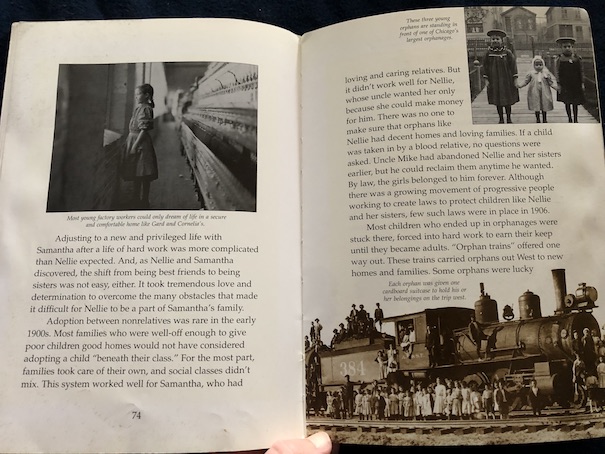
In the back of the book, there is a section with historical information about orphans and adoption in the early 1900s. There were not many laws and regulations governing care of orphans. Usually, orphans would be taken in by relatives, like Samantha was when her parents died. If a child didn’t have any relatives who were willing and able to take them, the child might be sent to an orphanage and possibly sent west on an orphan train as Nellie almost was at the end of the Samantha series. Families didn’t usually adopt children from different levels of society.

Settlement houses were important resources for poor immigrant families, and the education they received allowed immigrants to enter higher professions than servant or factory worker, which had been the primary source of income for many of them. It was common for settlement houses to help train young women to become teachers. There are still similar institutions and organizations in operation in 21st century America.

The book is available to borrow for free online through Internet Archive.

My Reaction and Further Historical Information

Part of the reason why I don’t like the companion books as much as the original American Girls series is that they tend to get more dramatic than the original books, and sometimes, I feel like the attitudes of the characters are less realistic for their time periods than they were in the original books. I think what made the original books more realistic was the restraint of the stories – they had their share of excitement and sometimes drama, but they never went overboard. The return of Nellie’s disreputable uncle struck me as both unlikely and unnecessary to Nellie’s and Samantha’s larger stories.

The historical details in this book are good. What they say about orphans of the time is basically true, although they note in the historical information section in the back of the book that Nellie’s experience of being adopted by a wealthier family was not typical of the time, and I think that’s part of what bothers me. Adoptions in general during the early 1900s were less formal than they are in modern times, and the idea of Uncle Gard hiring a private detective to find Uncle Mike and get him to sign legal documents doesn’t seem entirely realistic. I think it would have been more realistic to me the way that the last Samantha book ended, with Uncle Mike leaving and the assumption that none of the characters would see him again.

The reason why Nellie and her sisters were sent to the orphanage and why the orphanage was considering sending Nellie west on the orphan train was that no one expected that Uncle Mike would ever want to see the girls again. He’d already taken everything he could from them and left with them with no concern for what would happen to them. In the time that has passed since then, I would have expected that Uncle Mike would already have gotten into trouble that would keep him busy and out of their lives, maybe ended up in prison for being drunk and disorderly or hopping from job to job or begging for money as their little money ran out. Even if Uncle Mike had some thought of finding the girls, I don’t think it’s likely that he would have succeeded or even gotten close on his own because he is not that bright and he is not the kind of person who makes friends in places where he’s been before. I doubt that his former neighbor who took his nieces to the orphanage would have told him much if he had shown up again, looking for them. She knew that he was a drunk who abandoned the girls, and she made it clear that she didn’t like him. The people at the orphanage would have probably sent him away with no information because they would probably view the situation as closed since the girls are already placed out and Mike may not even have any proof of his identity and relationship to the girls. There is no such thing as a driver’s license during this period and many people did not even have birth certificates, so it’s possible that the people at the orphanage could simply choose to disbelieve this disreputable character and send him away. When I was watching a documentary about the orphan trains, former orphan train riders said that the orphanages that sent them west deliberately took notes from them that had their living parents’ addresses and otherwise cut off contact with living parents because they wanted the children to sever their ties to their difficult pasts and devote their attention to their new families, not maintain contact with the parents who were unable to care for them financially, so I wouldn’t expect that anyone at the orphanage in these books would go out of their way to reunite the orphaned girls with a rather shady uncle when they knew that the girls were already placed with a wealthy family and no longer their responsibility. Without help, which would be unlikely to be forthcoming, it doesn’t seem likely that Uncle Mike would be able to stumble on the girls by accident. As mentioned in Changes for Samantha, New York is a big city, people can be difficult to find if you don’t have a hint of where to look, and the wealthier part of the city where Nellie and her sisters live now is not a part of town where a guy like Uncle Mike would be likely to hang out. They could all easily live in New York City for years without meeting each other.

I feel like the situations in the story were a little contrived. By now, I would have thought that Nellie would know that Uncle Gard is a lawyer and would be the best person to ask about the laws. I don’t recall the earlier books saying what Uncle Gard did for a living, but Nellie lives with him now, and I would think that someone would have mentioned Uncle Gard’s profession by now. In the book, it oddly seems like as much of a surprise to Nellie as it is to the readers. I could believe that Nellie would go to the settlement house and do volunteer work there with Aunt Cornelia because it was already established in the previous books that Aunt Cornelia supports good causes, and although women of her level of society didn’t usually work for living, supporting good causes and charitable works would have been acceptable. Nellie’s level of knowledge seems a little odd, considering that she needed extra tutoring in basic subjects, like reading, in Samantha Learns a Lesson. In that book, Nellie never mentioned settlement house lessons, which she would have done if it hadn’t been a sudden decision to insert that this in book. Here, Nellie talks about classes that she had at the settlement house, where I would have expected to have more lessons to improve her reading, and it seems like she learned more there than she seemed to know before, even knowing a few words of foreign languages. In Samantha Learns a Lesson, one of Nellie’s skills was her ability to do math quickly handle money because she used to do the shopping for her mother, and in this book, she mentions that she helped to teach immigrants about American money, which she never mentioned before. These things are necessarily contradictory, but it all just seems a little off because they don’t quite fit into Nellie’s established character and history, and it implies that Nellie has had more education and training than she seemed to have before. It’s not necessarily impossible for a girl of Nellie’s time to know some of these things, but it’s the departure from what was already established about Nellie and her situation in life than kind of grates on me.

I think it could be reasonable for Nellie to develop the ambition to be a teacher. Even Samantha has previously some interest in that direction, having helped to tutor Nellie before. Not all women of this time went on to higher education, but those who did might attend a normal school, which is basically a college that focuses on training teachers. By contrast, the daughters of wealthy, high society families would be more likely attend a finishing school that emphasized social skills and entertaining more than academics. Both Samantha and Nellie are about twelve years old during this story and would be a little young for either of these options, but Samantha’s school seems to be more inclined toward preparing the girls for a finishing school. Given Aunt Cornelia’s interest in education and social causes and Uncle Gard’s support of it, I would expect that Samantha would be more likely to attend a women’s liberal arts college when she gets older, preparing her to marry a well-educated and culturally aware man as well as a wealthy one and probably engage in some form of social work and/or the arts in her spare time, but that’s just a guess. (I discussed some of this already in my review of Happy Birthday, Samantha. See also the book Daddy-Long-Legs for a description of what that might have been like for a girl of Samantha’s and Nellie’s time. The book was written a little later in than the time period of this book, but it’s set at about the right time for Samantha and Nellie to be old enough for college and includes characters of approximately their social backgrounds.) This book doesn’t really go into the subject, but if that’s the case, Samantha’s future might not be as different from Nellie’s as it first seems, and there might be a kind of middle path that both of them could choose. The Finch College in Manhattan, which was a fairly new preparatory school in Samantha’s and Nellie’s time, seems like it would have been a good option for both Samantha and Nellie, catering to upper-class girls while focusing on a more practical liberal arts education than the less academic finishing schools. Its founder, Jessica Finch, was a women’s rights activist and may have moved in similar circles to Aunt Cornelia. Her attempts to balance theoretical and practical knowledge sound like they would have appealed to the characters in the story. I’m not an expert on the Finch College, only having heard a little about it, but I think a school like that would present an intriguing possibility for the girls’ futures.