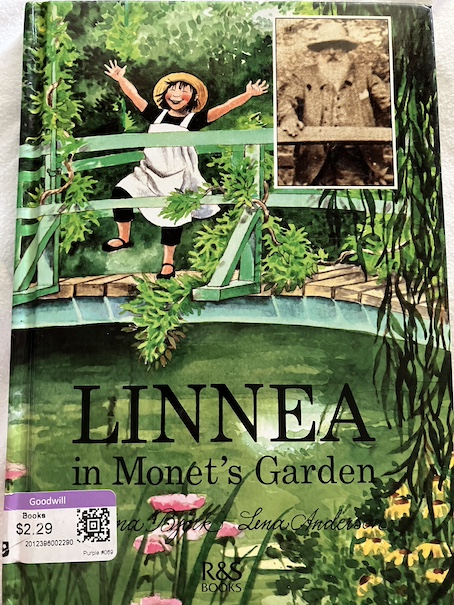
Linnea in Monet’s Garden

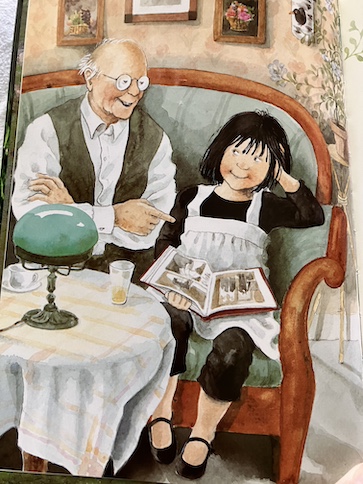
Young Linnea loves plants and flowers. Linnea’s upstairs neighbor, Mr. Bloom, used to be a gardener before he retired. He knows all about plants, and she likes to talk to him about them. Mr. Bloom has a particular book that Linnea likes about the French artist Claude Monet and his garden. Monet was famous for his paintings of the flowers and water lilies in his garden, and the book also has photographs of him, his wife, their children, and their garden. When Linnea looks at that book, she likes to imagine that she really knows the Monet family and that she’s visiting their garden.

One day, Mr. Bloom tells her that it’s possible to really go visit the garden because it still exists. Monet’s house had become run down and the garden was overgrown, but they have since been restored and turned into a museum. They could visit the garden if they go to Paris. They live a long way from Paris, but Mr. Bloom arranges with Linnea’s family for her to go on the trip with him.

Linnea and Mr. Bloom stay at a tiny, old hotel on the River Seine in Paris that was built in 1640. They can see the Notre-Dame Cathedral from the hotel, and it reminds Linnea of The Hunchback of Notre-Dame.

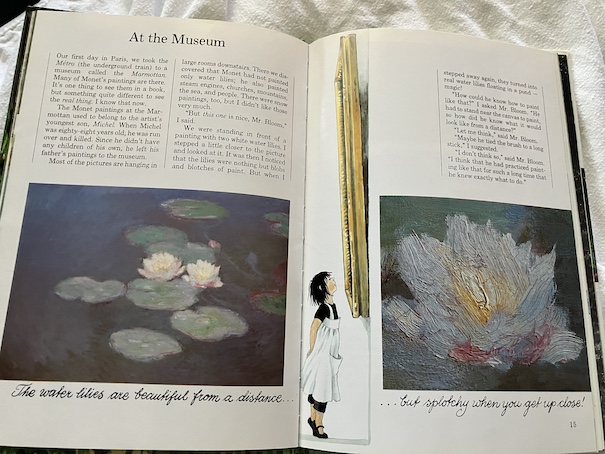
On their first day in Paris, Linnea and Mr. Bloom go to the Marmottan Museum to see Monet’s paintings. Monet’s youngest son left his father’s paintings to the museum when he died because he had no children of his own to inherit them. Mr. Bloom explains to Linnea that Monet painted in the impressionist style, which means that he tried to capture the rough images and impressions of the moment rather than creating detailed, completely realistic paintings. (I’m nearsighted, so impressionist paintings always look to me like what I see when I’m not wearing my glasses. I see colors and rough shapes, but everything is fuzzy with no sharp lines or fine details. I can still tell what objects are without my glasses, but nothing is distinct. I have impressions of things.) Mr. Bloom says that Monet particularly liked to show how light reflects off water and other objects in his paintings.
The next day, they take a train to the town of Vernon, and from there, and from there, they take a taxi to Giverny, where the Monet house and garden are. Along the way, they also buy some food for a picnic. Then, they go to see Monet’s garden.

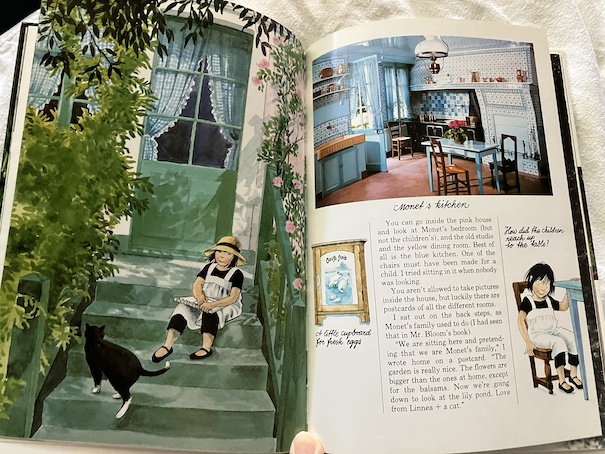
When Linnea sees the garden in person for the first time, it’s much bigger than she had imagined from the pictures in the book. Mr. Bloom tells Linnea all the names of the different flowers, and they take pictures of them. Then, they go inside Monet’s house. They’re not allowed to take pictures inside the house, but they get some postcards of the house’s interior.
One of the best moments for Linnea is that she is able to stand on the Japanese bridge in the garden, over the lily pond, as she always imagined she could do when she looked at the pictures in Mr. Bloom’s book! Monet painted pictures of that bridge multiple times. Each painting looks different because he painted them at different times and in different weather, so had different impressions of the bridge each time. The book shows Monet’s paintings of the bridge and how different they are from each other, and Linnea tries to capture her own impressions of the bridge.
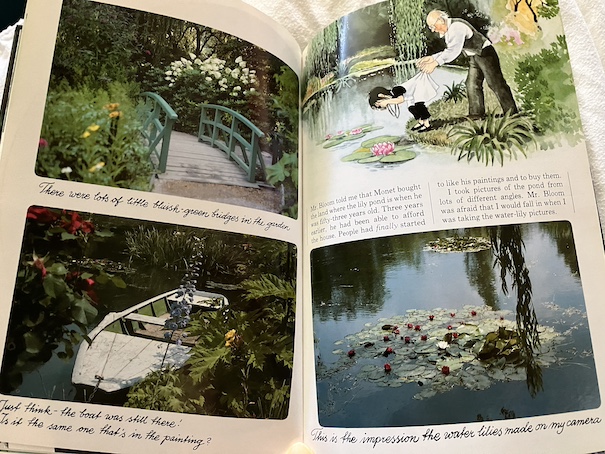
They aren’t allowed to have their picnic lunch inside Monet’s garden, so they have lunch by the nearby river. Then, they return to Paris.

Back in Paris, they visit the Jeu de Paume museum to see more impressionist paintings. At the Orangerie, they try to see Monet’s giant water lily painting in the Water Lily Rooms. At first, they are told that the exhibit is closed for repairs, but when Mr. Bloom explains that they have come a long way to see them and Linnea starts to cry, the museum staff decide to make an exception.

For the last day of their trip, Linnea and Mr. Bloom decide that they want to return to Giverny. When they make their second visit, a man recognizes them as return visitors, and he turns out to be a member of Monet’s family, his step-great-grandson, Jean-Marie Toulgouat. He lives nearby, and he is also an artist, although his art style is very different from Monet’s. He talks to them about Monet’s life and family, and it also turns out that his wife was the author of the book about Monet that inspired Linnea and Mr. Bloom to take this journey!

When they return home, Linnea and Mr. Bloom go through all the pictures they took in France, and Linnea puts up a bulletin board with postcards and pictures from their trip. She also has a little wooden box with other souvenirs.

In the back of the book, there is a family tree for the Monet family and a timeline of events from Monet’s life. There is also a section of information about museums and sites in Paris and a list of books about Monet.

The book is available to borrow and read for free online through Internet Archive (multiple copies, including one in Chinese). The book was originally written in Swedish and published in Sweden in 1985. The English translation was published in 1987.

This is a lovely book about travel, art, and the beauty of nature and plants. Initially, Linnea becomes interested in Monet because of her love of plants and flowers, and when her neighbor says it’s possible to visit the garden Monet painted, she becomes interested in Monet’s life and work. I grew up learning about art and famous artists because my mother used to teach art lessons through a special program at my school. I don’t remember seeing this book at that time, although it is old enough that I could have. I found it by accident at a thrift store, and it reminded me of the art books that my mother kept around the house when I was a kid.

I enjoyed how the book brought a historical person to life, explaining Monet’s life story as well as his art and showing child readers that it’s possible to see the setting of his paintings in person. The book shows pictures of Monet’s art and photographs of the garden and flowers he painted so children can see the connection between the artwork and the real places and objects. Although not everyone can go to France just on a whim, the book does show what such a trip would be like, and it also shows kids how they can delve deeper into subjects that interest them and even go to places connected with their passions. The journey in the book is a magical trip that even adult armchair travelers can enjoy!

Famous French Painters

Famous French Painters by Roland J. McKinney, 1960.

This book is part of a series of Famous Biographies for Young People. Reading older non-fiction books can be problematic because non-fiction books are often updated with new information. In this particular book, there are people who are described as being still alive because they were at the time of the book’s publication, but they are not alive anymore. However, older non-fiction books sometimes interest me both because they are an indication of what people knew and studied at the time of publication and they sometimes cover odd topics that don’t commonly appear in new books. So far, this is the only book I own from this particular series, but the other biographies in the series

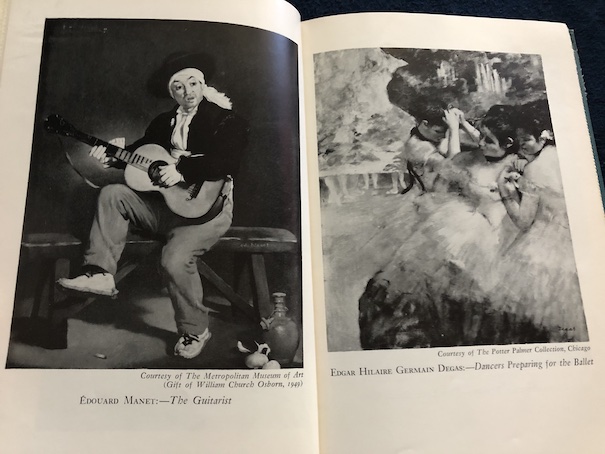
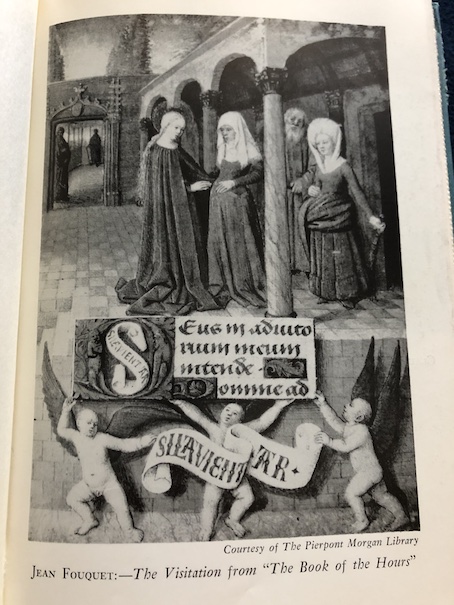
It begins with a section of black-and-white prints of famous French paintings and an introduction to the history of French painting in general. The introduction begins with a discussion of illuminated manuscripts in the 15th century and the artistic and architectural endeavors promoted by King Francis I in the 16th century. Francis I was particularly fascinated by Italian art, and he hired artists of the Italian Renaissance, including Leonardo da Vinci, to work at his court. Francis I helped to fuel an increasing interest in the arts in France called the French Renaissance. Although the French Renaissance was initially heavily influenced by the Italian Renaissance, French artists continued to develop their own styles. Popular subjects in French art were portraits, realistic landscapes, scenes from Classical mythology, and religious themes. The introduction ends with artists who painted during the late 18th century and early 19th century, explaining how their departure from neoclassical styles led to the development of new art styles.

After the introduction, there is a series of short biographies of famous French artists, beginning in the early 19th century and leading into the early 20th century. One of the first things that struck me about the list of artists included in the book is that, when their birth and death dates are included, none of the artists were born later than the 1880s, and the last two in the book have no death dates listed. Since the book was published in 1960, those last two artists were still alive at the time of publication, although they have died since then.

The artists included in the book are:

Eugene Delacroix (1798-1863) – He was a leader in the Romantic style of painting and one of the first French artists to use watercolor paints, which the French learned from English artists.

J. B. (Jean Baptiste) Camille Corot (1796-1875) – Originally, he trained in business, but he didn’t think he was suited to business and decided that his future was in art. He was particularly known for his landscapes, which were his specialty. He was also known as a charitable benefactor.

Edouard Manet (1832-1883) – Manet’s parents originally wanted him to become a lawyer, but it soon became apparent that he did not have the interest or temperament for a law career. When he first began his art studies, he quarreled with his teacher over the teacher’s strict insistence on realism in art because Manet preferred a more creative form of expression. He eventually developed a more simplified realistic style that did not focus on small details, a style that contributed to the development of impressionism.

Edgar Hilaire Germain Degas (1834-1917) – His specialty was portraits, and following the lessons that his teacher impressed on him, he emphasizes the importance of lines and drawing in his work. Much of his work was in oil paint, but he switched to pastels because he found that it was easier to work with and less of a strain on his eyes. Some of his best known works were of ballet dancers.

Paul Cezanne (1839-1906) – He initially doubted his own artistic talents, but a fellow painter, Pissarro, advised him to stop trying to imitate others and put his focus on studying nature. Cezanne’s association with Pissarro helped him to develop his own style.

Pierre Auguste Renoir (1841-1919) – Early in his life, Renoir was known for his singing ability, but his parents insisted that he learn a trade. He started learning how to decorate china, but this was the era when factories began using machines to decorate china. For a time, Renoir decorated fans and window shades, but his focus on improving his drawing abilities led him to a career in art. He became a friend of Monet, and the two would discuss art techniques with each other, although they had different styles.

Vincent van Gogh (1853-1890) – He was originally from the Netherlands but lived in France. He was a contemporary of Gauguin, and the two were even friends. Unfortunately, van Gogh was plagued by mental illness, leading to the fit where he cut off part of his ear after an argument sparked by ridicule from Gauguin. Eventually, he committed suicide. He was not a famous artist during his lifetime, partly due to his mental illness and early death, but his work became famous after his death.

Paul Gauguin (1848-1903) – Although he was originally from France, Gauguin is known for his travels to islands in the South Pacific, where he eventually died. Much of his work was inspired by his travels in the South Pacific.

Henri Matisse (1869-1954) – He was a leading figure in a group of artists known as the fauves, which mean “wild beasts.” They painted in an unorthodox way that included few details and ignored perspective.

Pablo Picasso (1881- ) – Picasso was originally from Spain, but he lived in France for most of his adult life. He began studying art at a young age and is known for his work in surrealism and cubism. He was alive at the time this book was written, but he died in 1973.

(Odd fact not included in the book – Picasso was actually born one day before the shootout at the OK Corral in Tombstone, AZ. It doesn’t mean anything and isn’t important, but I noticed the date and just thought I’d tell you.)

Georges Braque (1882- ) – Braque was a contemporary of Picasso, and the two artists were instrumental in the development of cubism, although they each did their own work. The collaboration between the two artists was interrupted by the outbreak of WWI. Braque was alive at the time this book was written, but he passed away in 1963. On the subject of limitations in art, he once said, “Progress in art does not lie in extending its limits, but in knowing them better.”

Something that struck me was how much artists who were contemporaries of each other worked together, met to discuss and analyze each other’s art, and were actual friends. I prefer collaboration to competition, and I like that many of these artists seemed to appreciate and learn from each other’s skills and techniques.

I was also surprised at the number of artists whose parents initially wanted them to become lawyers, like Manet, Degas, Cezanne, and Matisse.

The book is available to borrow and read for free online through Internet Archive.

Cathedral

Cathedral by David Macaulay, 1973.

This is the story of the construction of a Medieval cathedral. The story takes place in a fictional town in France, Chutreaux, but it is based on the construction of real Medieval cathedrals.

In 1252, the people of Chutreaux decide to build a new cathedral because their old cathedral was badly damaged by a lightning strike and other towns in their part of France are building grand cathedrals. The people know that it takes decades to construct a grand cathedral, perhaps even more than 100 years. The people making the decision to build the cathedral know that they will never see the end of the construction themselves, but they believe that this is an important undertaking, both for the welfare of their community in the future and for the glory of God.

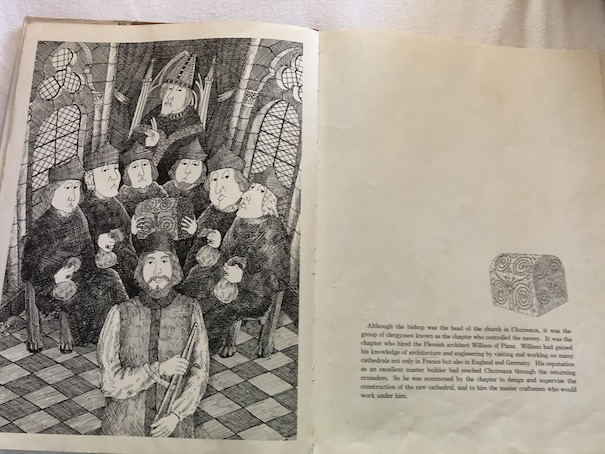
The church leader in Chutreaux is the bishop, but a group of clergymen have been given control of money for the cathedral project. They have chosen to hire a Flemish architect, William of Planz, to create the design for their cathedral and hire the craftsmen who will actually build the cathedral.

Building a cathedral is a massive undertaking that requires many different types of craftsmen and laborers. The book explains that the craftsmen building the cathedral will include a quarryman, a stone cutter, a mason, a sculptor, a mortar maker, a blacksmith, a carpenter, a glass maker, and a roofer. All of these craftsmen are masters of their crafts, with apprentices, assistants, and many general, unskilled laborers doing much of the heavy work.

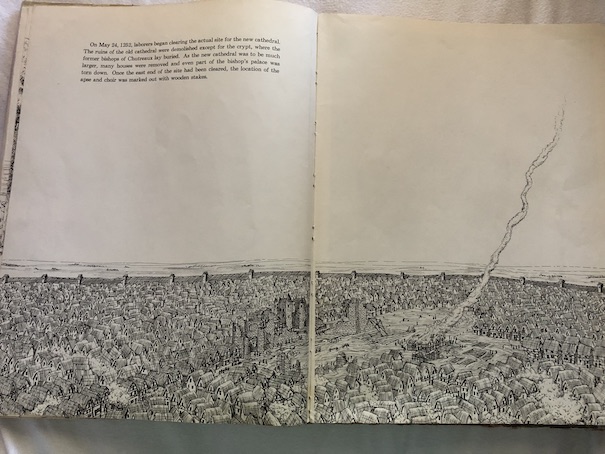
The building of the cathedral begins with the clearing of the site, marking the basic layout of the building, and building workshops where the craftsmen will be doing their work. The book shows the tools that the various types of craftsmen use. They also need to gather the materials that they will use. There is a quarry where they will cut the limestone blocks they will use to construct the cathedral, and the wood for the roof is brought from Scandinavia by boat.

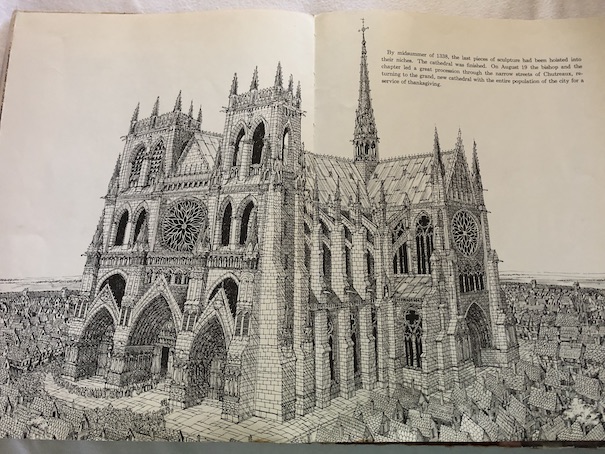
From there, the cathedral is built in stages, beginning with the foundation and then the walls. The book explains each step of the construction and how it was managed, giving the dates when each phase is completed. It also explains the purpose of various architectural features, such as the flying buttresses that support the walls. There is also a glossary in the back of the book that defines various architectural terms.

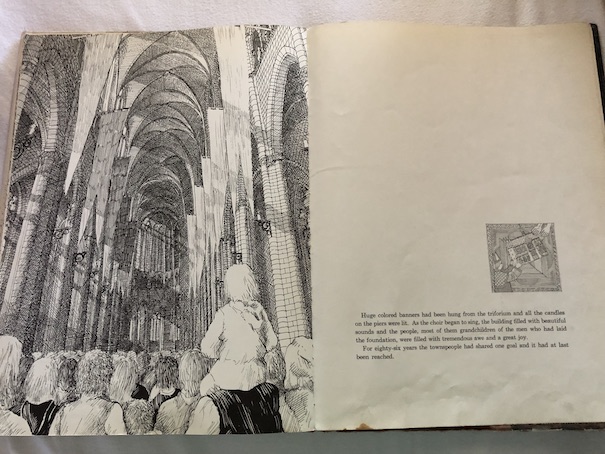
Because this is an extremely long-term project, over the course of the book, William of Planz and various craftsmen age and one person dies in a work-related accident, and they are replaced by younger people. The construction is finally finished 86 years after it was started.

I recommended this book to people after the burning of Notre Dame in Paris last year because this cathedral is similar to Notre Dame and can give people an idea of what went into its construction. I think that the time invested in the cathedral construction is one of the key points of the story. The ability to delay gratification in the pursuit of larger goals is an important life skill, but the people who began the cathedral project showed this ability to an even higher degree than most. The book carefully notes that the people of this town understand that they will never see the final product of their contribution of money and labor because the project will take decades to complete, but they still begin the undertaking because they believe that it is the right thing to do for their community, for future generations, and for God. Their ultimate reward is not in immediately profiting from this project but in their legacy, laying the foundations (literally) for the future. In the end, it is their grandchildren who become the ones to complete the project and enjoy the beauty of the finished cathedral, and they consider it more than worth the wait.

The book was also made into a documentary film. The film follows the basic course of the book but with more focus on the lives of the characters, giving them more personality than the book does and inserting more drama into the construction of the cathedral. The story of the town and townspeople alternates with explanations about the history and architecture of cathedrals. The fictional cathedral serves as an example not only of the process of constructing a Medieval cathedral, but the difficulties and dangers it might involve.

The book is available to borrow and read for free online through Internet Archive (multiple copies).

For Those Thinking of Notre Dame …

Sometimes, current events remind me of the events of children’s books. I debated about bringing this one up because I haven’t gotten hold of this particular book recently (partly because I’m probably not the only person who’s thinking about it right now), and I don’t have a proper post prepared for it, but years ago, a teacher introduced my class to Cathedral by David Macaulay. David Macaulay wrote a series of children’s books, explaining the architecture of historical buildings, including one about the construction of Gothic cathedrals, like Notre Dame in Paris.

The pictures in these books are fascinating, which is why I’m sorry that I don’t have a proper post prepared with example pictures. (I’ll probably do one later, when I can get hold of the book again) The book is available in multiple copies through Internet Archive, although there is a waiting list to get it right now.

However, the book was also made into a documentary film. Part of the story-line involves a fictional Medieval town replacing their cathedral after their first cathedral was destroyed by fire. (In the book, the cathedral was damaged by lightning, not destroyed by fire. The two stories aren’t the same.) This fictional cathedral serves as an example of the process of constructing a Medieval cathedral and the difficulties and dangers it might involve. The story of the town alternates with explanations about the history and architecture of cathedrals. This short clip explains the basic architecture of a Gothic cathedral, using Notre Dame as an example toward the end.

One of the aspects of the story that I find most inspiring is the dedication that the people who funded and built the cathedral showed. The construction of a cathedral in the Middle Ages could take a lifetime or even longer, and not everyone who began the task would live to see its completion. Their motivation was not mere personal gain but a glorious accomplishment that would both honor their beliefs and last far beyond them.

I’m not sure how long it will take to complete the renovations after the fire that damaged Notre Dame, but whatever it takes, I’m sure it will be worth it.

The Court of the Stone Children

The Court of the Stone Children by Eleanor Cameron, 1973.

Nina and her parents have recently moved to San Francisco from Nevada.  Nina doesn’t like living in the city, but the move was necessary because her father has been ill and in need of a job.  Still, Nina misses her friends, and her parents don’t understand how difficult Nina has found it to make friends in their new home.

One of the most popular girls, Marion Charles, nicknamed Marnychuck, and her friends like to tease Nina at every opportunity. Nina doesn’t think that she even wants to try to be friends with them because hanging out at Marnychuck’s house would mean always having to be on her guard about every little thing she says, knowing that they would twist every innocent comment she makes into some sort of joke so they could laugh at her.  They could never be friends because there would be no way that Nina could ever open up to them about anything.  (Sadly, I know the type all too well.)  For example, one day, while the girls are walking home from school, they start talking about things they want to be when they grow up.  Nina says that she wants to be “something in a museum,” momentarily forgetting the word “curator”, until a boy nearby helpfully supplies the word. Of course, Marnychuck and her friends ignore the helpful word and just laugh about “something in a museum” as they walk away.

However, the boy who was listening turns out to be genuinely curious about why Nina wants to work in a museum, saying that it sounds like an unusual ambition.  Nina tells him that, until she had come to San Francisco, she’d never been in a big museum before, and she describes how the one in the park impressed her.  She used to work in a small one in her home town. The boy understands the way she feels and shares her love of the past.  He tells her about Mam’zelle Henry, a local woman who owns a private museum called the French Museum.

Nina visits the French Museum and loves the rooms with old-fashioned furniture.  They give her a strange feeling of timelessness, and before she knows it, she finds herself in a room with another young girl who says, “I knew you’d come.”  Nina isn’t sure who this mysterious girl is, but she asks her to come back another time.

When Nina returns to the museum the next day to return an umbrella that she borrowed from Mrs. Staynes, the registrar at the museum, she speaks to the girl again in the museum courtyard.  The courtyard is full of stone statues of children, and the girl tells Nina that when she was young, she used to wish that they would come to life.  The girl’s name is Dominique, although she says that people usually call her Domi. The two girls begin talking about their lives, although Domi oddly talks about her past in the present tense. Domi tells Nina about her emotionally-distant grandmother and her loving father, who was imprisoned and shot.  The news of Domi’s father being shot comes as a shock to Nina.  Domi tells Nina that, after her father was (“is”) imprisoned and shot, she had a dream about Nina in which her father said that Nina would help them.  Domi also says that the rooms at the museum are from her home in France, which was taken apart to be “modernized”and some of the pieces were sent to the museum. Nina finds Domi’s story confusing, but Domi says that they will talk more later.

Nina meets up with the boy who introduced her to the museum, whose name is Gil, at the cottage of Auguste, who lives on the museum property.  As she talks with the two of them and Mrs. Staynes, Mrs. Staynes brings up the subject of the ring that Nina saw Domi wearing and which also appears in a painting in the museum.  Earlier, Mrs. Staynes had told Nina that she couldn’t possibly have seen anyone wearing that ring, and Mrs. Staynes now explains that the reason why is that she owns the ring herself.  At first, Nina thinks that she must own a ring which is similar to Domi’s, since the two of them couldn’t have the same ring,but then, it turns out that the cat that Domi said was hers also belongs to Auguste.

The answer, as Nina discovers the next time she meets Dominique, is that Domi is a ghost.  Mrs. Staynes does own Domi’s ring now because Domi died a long time ago. Nina faints when Domi’s hand goes right through hers.  When Nina recovers, Domi is gone, and Mam’zelle Henry gives her a ride home.  The two of them bond as they discuss Nina’s ambition to become a curator.

Mam’zelle lets Nina borrow a journal that she found in the garden that belonged to Odile Chrysostome in 1802.  Odile was one of the names of the stone statues in the courtyard, according to Dominique, and Nina learns that the others are also named after members of the Chrysostome family.  The people at the museum say that they don’t know which of the statues is supposed to have which name, but thanks to Dominique, Nina does.

Gil becomes Nina’s first friend her own age, and he’s been working on a project involving time.  Someday, he wants to write a book about the concept of time. Time is important because Domi needs Nina’s help to resolve problems that occurred in the past.

Domi was young during the time of Napoleon.  Her mother had died in childbirth along with Domi’s younger sibling.  After her mother died, her grandmother moved into the house to oversee things and help care for Domi.  However, Domi’s father had protested some of Napoleon’s policies of conquest, and it led to his downfall.  One day, Domi discovered her father’s valet,Maurice, murdered in her father’s bedroom. She had thought that her father was there the night before, having returned from being away for a time, but he was nowhere to be found.  A short time later, her father was charged with conspiring against Napoleon and executed. Domi knows that her father was innocent of the charges, and she suspects that Maurice was killed because he knew something important, but she needs Nina’s help to find the missing pieces.  Domi knows that Mrs. Staynes is working on a book about her father’s life, and she doesn’t want the false accusations against him to be printed.

This book is available to borrow and read for free online through Internet Archive.

My Reaction and Spoilers

I thought that the book started out a little slowly.  It takes quite a while before Nina discovers that the boy’s name is Gil or learns anything about him, and it’s about halfway through the book before Nina learns that Domi is a ghost, although there are hints before it.  I knew that Domi was from the past, although I thought at first that she might be a time traveler of some kind.  Even after Nina learns that Domi is a ghost, it takes a while before Domi tells Nina her full story and what she really needs her to do.  The first part of the book dragged a little for me, and I was a little confused at first about why Odile’s diary was so important, but it turns out to contain the vital clues that Domi needs.  Domi’s father was with the Chrysostome family at the time that he supposedly murdered his valet and was conspiring against Napoleon. There is a piece of physical evidence that proves it, and finding it convinces Mrs. Staynes to change her book. 

One of Nina’s strengths is her power of imagination, and she helps Mrs. Staynes not only to see the truth about Domi’s father but to see him as a living, breathing person.  Before, Mrs. Staynes’ book was mostly facts with little sense of the feelings of the living people behind it, but Nina’s discoveries and imagination help breathe life into the work.  At the end of the book, the past remains unchanged (Domi’s life and that of her father are what they were before), but having the truth known gives Domi peace. Nina also makes peace with her new life in San Francisco, having discovered new opportunities and friends there as well as a nicer apartment for her family to live in.

Mirette on the High Wire

Mirette

Mirette on the High Wire by Emily Arnold McCully, 1992.

About 100 years ago (the book says, so it’s around the 1890s), a young girl named Mirette and her widowed mother run a boardinghouse in Paris. Most of the people who live there are actors and performers of various kinds.

MiretteBoardinghouse

One day, a strange, quiet man named Bellini comes to stay at the boardinghouse. Most of the time, Bellini prefers to keep to himself, but then Mirette catches him walking on the rope they are using for clothesline in the courtyard of the house. It turns out that Bellini is a tightrope walker. Mirette begs him to teach her how to do it, but he refuses.

MIretteRequest

Not to be daunted, Mirette begins experimenting with tightrope walking herself. After repeated falls, Mirette eventually learns to balance on the rope. When she shows Bellini that she can walk the length of the rope, he is impressed with her perseverance and teaches her more things to develop her skills. However, he becomes very upset when she boasts that she will never fall again.

MirettePractice

Mirette learns that Bellini was a world-famous tightrope walker until a friend of his was killed in a fall, and he lost his nerve. She talks to Bellini about it, and he says that he doesn’t know how to get over being afraid. Seeing Mirette’s disappointment and worry, however, gives Bellini the courage to try once again.

MiretteBellini

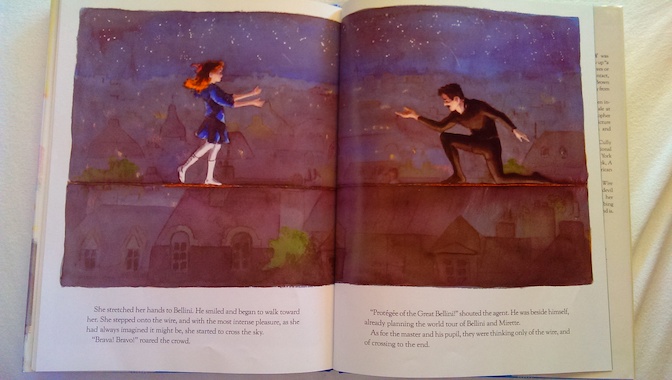
After talking with a performing agent staying at the boardinghouse, Bellini arranges a performance where he will walk a tightrope over a Paris street. When Mirette sees him hesitating at the beginning of the performance, she joins him on the wire, bolstering his courage and realizing her own dreams of becoming a real tightrope walker.

MiretteBelliniTightrope

There are other books in a series about Mirette and Bellini, where they perform tightrope acts and have adventures around the world, but I think that the first book is really the best.  The pictures are beautiful, done in an impressionistic style.

This book is a Caldecott Award winner.  It is currently available online through Internet Archive.

The Mona Lisa Mystery

monalisamystery

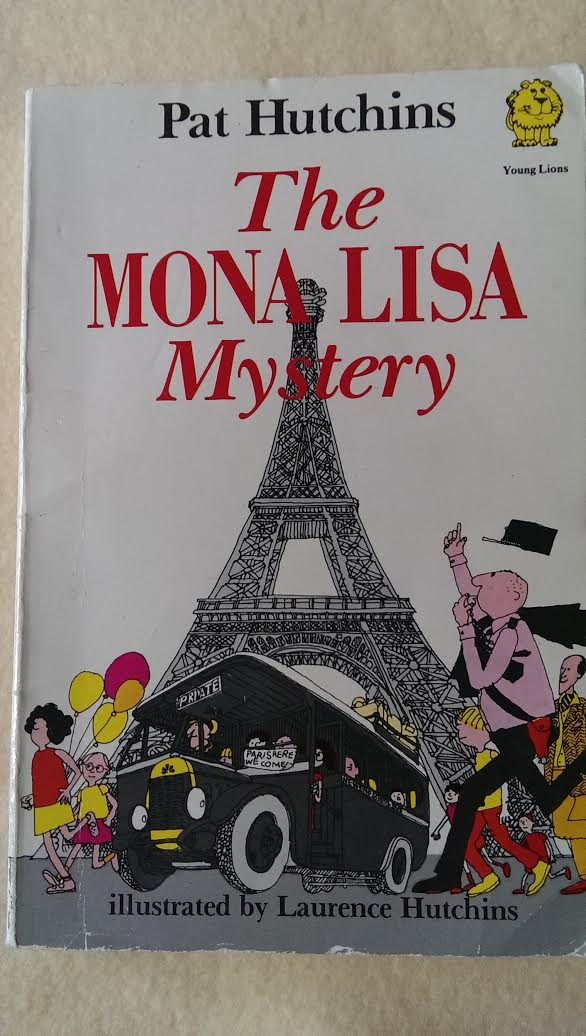
The Mona Lisa Mystery by Pat Hutchins, 1981.

Class 3 from Hampstead Primary School is taking a trip to France with their teacher, Mr. Jones. Miss Barker, their headmistress, was supposed to go with them, but she became ill, so their substitute French teacher, Miss Parker, will be going with them instead.  The kids aren’t happy about the substitution because they really like Miss Barker, and Miss Parker isn’t nearly as nice.

From the very beginning of the trip, strange things start happening. A black car follows them to the ferry and even around France. A doctor they meet on the ferry takes a room at their hotel, and unusual characters follow them everywhere they go, some of them in disguise. One of them even enters Jessica and Avril’s hotel room in the middle of the night.

At first, the children think that someone may be trying to kidnap Miss Parker since the mysterious strangers are showing unusual interest in her.  Then, the Mona Lisa is stolen while the children visit the Louvre!  The thief temporarily holds Jessica hostage before making his escape. Later, the painting shows up at their hotel, and Mr. Jones is arrested as a conspirator in the crime!

The children struggle to unravel the clues and the tangled mass of identities and prove their teacher’s innocence.  Who was really following who, who is the real conspirator, and can the children prove it and find the missing painting?

The book is available to borrow and read for free online through Internet Archive.

monalisamysterypic2

My Reaction

When I was a kid, I wished that my class could take a field trip to a foreign country! Technically, I suppose we could have since I live in a border state, but there’s nothing to see in the border towns here that would be as exciting as the Louvre. But, part of the fun of reading books like this is vicariously experiencing things you otherwise wouldn’t do.

This mystery story is the kind I think of as a fun romp – the characters are traveling around a bit and hijinks ensue as the students try to solve the mystery and save both the Mona Lisa and their teachers. One of my favorite parts as a kid was the running gag with the ketchup bottle.

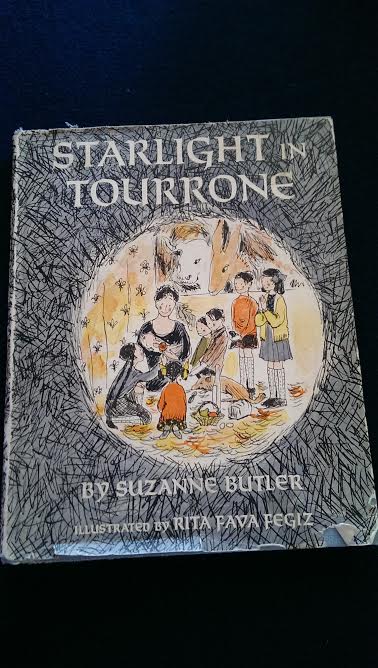
Starlight in Tourrone

starlighttourroneStarlight in Tourrone by Suzanne Butler, 1965.
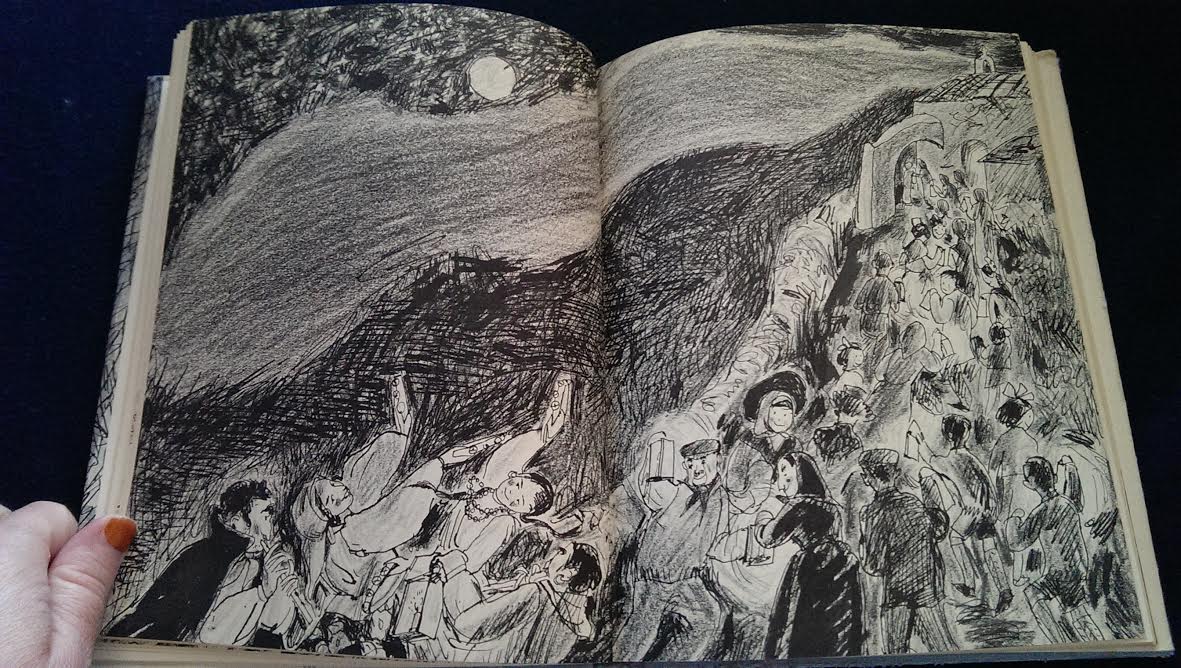
This is a story about a group of children in southern France during the middle of the 20th century, not too long after World War II, who want to stage a special Nativity scene at Christmas. One of the older men in the small village of Tourrone tells his grandchildren about how, when he was young, the village had held a live Nativity scene at the chapel on the hill with the youngest baby in the village playing the part of the Christ child and his mother playing Mary. Then, all the people in the town would climb the hill to the chapel and present gifts to Mary and the baby Jesus in a ceremony called the March to the Star.

However, these traditions have been lost because, following World War II, the village has lost much of its population, and the chapel is an unused ruin. The children and their friends, inspired by the grandfather’s stories, decide that they want to hold the March to the Star and the Nativity scene this year.

starlighttourronemarchAt first, most of the adults in the village are skeptical. Since there are no young couples living there anymore and no babies have been born there for several years, no one knows where the mother and child for the Nativity scene will come from. Many of the adults are too busy with their own problems and worries about the future to help. Still, the children continue to work faithfully on their plans, drawing in the adults in spite of themselves.

starlighttourronepreparationsstarlighttourronelanternJust as people in the village start to feel hopeful again, something happens that threatens to ruin everything, but there is still one more miracle yet to come, thanks in part to the one person who never doubted it would happen.
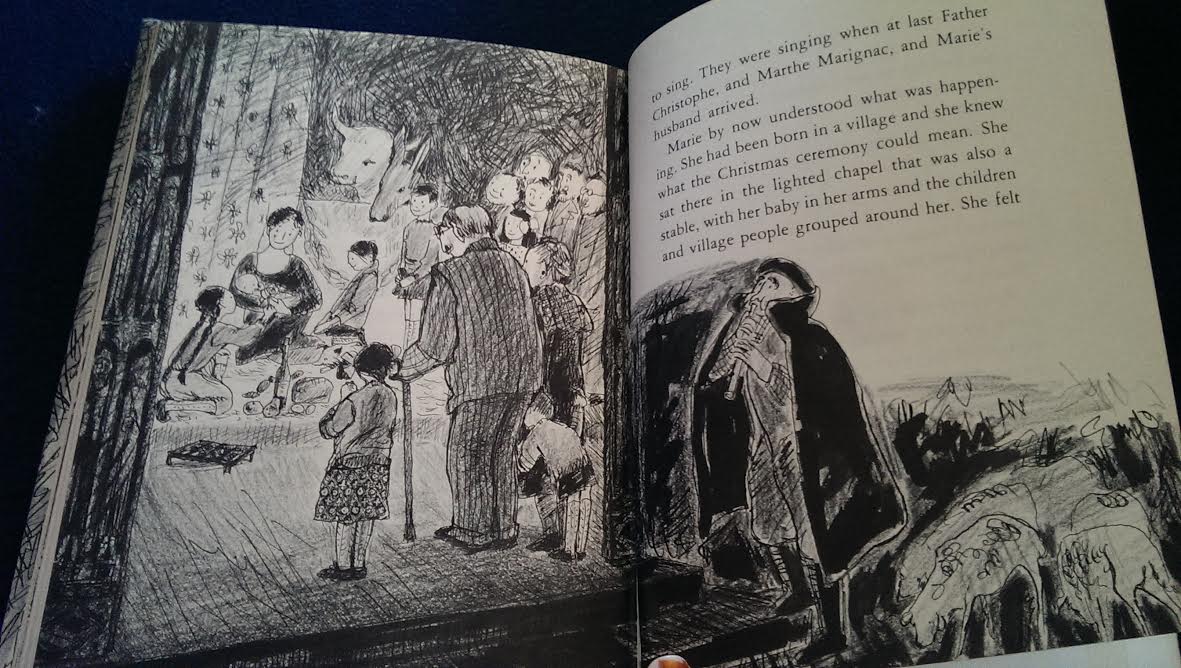
It’s a beautiful story about the power of faith and how miracles come to those who are prepared for them. The last page of the book contains the music for the Provencal Carol that the children sing along with the English translation.

The book is available to borrow and read for free online through Internet Archive.

starlighttourronenativity

starlighttourronecarol

Twenty and Ten

TwentyTenTwenty and Ten by Claire Bishop, 1952.

The story takes place in occupied France during World War II.  Children were often sent to the countryside to escape the violence of war, and a group of twenty children, both boys and girls, are staying at a small school taught by a nun, Sister Gabriel.  Most of them are about eleven years old, although four-year-old Louis is allowed stay at the school with his older sister, Denise.

Janet, another student at the school, tells how a strange man comes to the school and begs them to help him hide ten Jewish orphans from the Nazis.  Sharing their school with these newcomers means that they will have to share their already meager rations with them and to keep their presence at the school absolutely secret.  In spite of the danger and difficulty, everyone at the school agrees to help.  They think of it as being like when Mary and Joseph had to take baby Jesus to Egypt to hide him from King Herod, a story they had recently acted out in play form.

TwentyTenPic1The two groups of children soon make friends, and one of the Jewish children, Arthur, shares something special with his new friend, Henry: a small piece of chocolate.  With the rationing, none of them have seen chocolate in a long time.  Henry decides to share a little with Janet because he likes her, and they decide to hide the rest and save it for later.  When Denise spies them with the chocolate and wants to have a little herself, she steals the piece of chocolate from where Henry has hidden it. The others chase after her to get the chocolate back, and they end up accidentally discovering a cave that none of them knew was there.

This becomes a vital discovery when the children spot a pair of Nazis heading toward their school.  Sister Gabriel is away, so the children have to take care of the situation themselves.  Quickly, Arthur leads the other Jewish children to the cave, where they can hide.  The other children remain at the school and try to keep the Nazis from learning anything.  They try not to even talk to the Nazis when they start asking questions.  But, how long can they keep it up?  Something has obviously happened to Sister Gabriel, and the Jewish children can’t hide in the cave forever.

There is a movie version of this book called Miracle at Moreaux.  The movie differs significantly from the book.  In the book, the children at the school are all welcoming to the Jewish children, but in the movie, some of the children at the school are afraid of the Jewish children (there are only three of them in the movie), one of them in particular hating Jewish people because she believes anti-Semitic stories she’s heard.  Also, instead of the cave that appears in the book, the movie uses a Christmas pageant as the device for confusing the Nazis and allowing the Jewish children to escape to Spain (instead of staying at the school until the end of the war, as they did in the book).

This book is available online through Internet Archive.