Schoolhouse Mystery

The Boxcar Children

It’s June, and the Aldens are trying to decide what to do for the summer. Benny says that his friend Max remarked that the Aldens always seem to find something exciting everywhere they go, but Max doesn’t think anybody could find anything exciting about the little village where his father likes to go fishing. Max says that it’s a tiny and isolated village on an island with little to do, and he doubts even the Aldens would find anything interesting or exciting there. The only people who usually go there are summer visitors going fishing, like Max’s dad. Mr. Alden has been thinking over other plans for the summer, but he says that, if the children want to take a short visit to his village, called Port Elizabeth, to test out Max’s theory of how boring the place is and see if they can find something exciting about the place, it’s fine with him. The Aldens think that purposely visiting a dull town and seeing what they can find there sounds interesting by itself, so they decide to go.

When they arrive, they find that the place is as small as Max described. It doesn’t take them long to explore the town. There is a small store, but it’s well-stocked with all the food they need. There’s a big old house that seems to be abandoned, and there’s a quaint little schoolhouse with a bell and an odd-shaped chimney.

The people of the town seem suspicious of them at first. They don’t get many outsiders coming to their town, and they can tell immediately that the Aldens are rich because of their car and their clothes. However, because the Aldens are friendly and polite visitors, people gradually begin warming up to them.

The Aldens learn that most people in town work for the local sardine factory. There aren’t many other job prospects in the area, and they don’t have access to higher education or even outside sources of information, like television, so the local kids don’t aspire to much more. Local kids work, too.

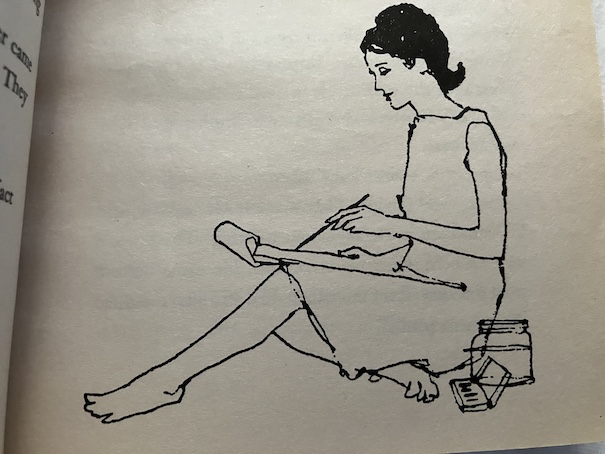
One day, a pair of twins approach Violent while she’s painting a picture and start talking to her about painting. They’ve never really owned any proper art supplies themselves, only some crayons, but they’ve been interested in learning to paint since a professional artist came to town to paint the seaside. They also tell Violet and her siblings that the town has had trouble keeping teachers. Most people don’t want to stay in the town very long because it’s so small, and there’s so little to do. Because they change teachers so often, the kids never really advance much in their classes. Every teacher basically keeps starting over in their lessons. The last one told them to study this summer to make progress and prevent themselves from forgetting what they’ve learned, but the local kids don’t really know how to study or what to study, and they’ve never had a teacher who taught any of the really fun subjects, like art.

The local kids ask the Aldens if they could help them study this summer, and the Aldens get the idea to set up their own summer school in the local schoolhouse. They speak to the lady who owns the schoolhouse, Miss Gray, and she gives her permission. The Aldens recognize her as a famous author, but now, she lives like she’s a recluse in her big, old house. She also asks the Aldens whether or not they know a blond man who smiles a lot, but the Aldens don’t know who she’s talking about.

The people in town don’t have much money, and they save what they can in cash rather than using a bank. However, something odd has happened recently because a man has bought a couple of coins from some of the locals for more than the face value of the coins. The locals don’t know why he was willing to do this, but they’re always grateful for anything extra they can get. The locals have started calling this blond man “the money man” because he not only buys coins but also various other odd, old things that most of the locals think of as junk. They don’t know why he wants these things, but they’re just glad he’s willing to pay something fro them. Mr. Alden is very interested in this man and wants to know more about him.

The Alden kids buy some art supplies and school supplies so they can get started with lessons for their summer school. Even though they provide some supplies and have some textbooks in the schoolhouse, they find that there are things they need because previous teachers in town haven’t left some of the things they need, like easy reading books. They improvise as best they can, with Benny helping the kids in class write simple stories about themselves and their lives to use for reading lessons. The local children talk more about the “money man” and how he trades them new toys for old ones they’ve had. The children think that’s great, but the Aldens are suspicious about the “money man’s” apparent generosity.

It isn’t long before Mr. Alden and the children have an encounter with the blond “money man.” The man, called Freddie, notices that Mr. Alden has a rare penny on his watch chain and offers to buy it. He explains that he deals in coins and antiques. Mr. Alden can tell that Freddie is knowledgeable but slick when it comes to buying collectible items. Mr. Alden refuses to sell the man his coin or his watch, and after he leaves, the children tell their grandfather what they know about his dealings with the local people.

It has become apparent that Freddie is cheating the locals, buying antiques and collectibles from them while either paying them much less than what they’re really worth or trading them for newer but cheaper items. Because this town is relatively isolated and the people don’t have much money, they’ve spent generations keeping and reusing antique items without knowing how valuable they’ve become. The local children are thrilled when he lives them newer and more colorful toys in exchange for their old ones, because they don’t know how much their antique toys are worth. Technically, Freddie hasn’t done anything illegal because the people he’s been buying from and trading with have agreed to the deals so far and been satisfied with what they’ve gotten, but that’s only because they don’t know that they could have gotten much better deals from someone else. Freddie’s dealings aren’t really fair or ethical, and Mr. Alden and the local author have become concerned that he may take even bigger advantages of the local people than he already has.

When some valuable collectors’ books disappear from the little village’s neglected library, the author, Miss Gray is convinced that Freddie is responsible. How can they catch him and prove to everyone what he’s been doing?

As with many of the earlier Boxcar Children books, there is an element of mystery but more emphasis on the adventure and the kids’ summer experiences than on the mystery. We have an obviously suspicious right at the beginning, and we have a sense of what he’s doing that’s a problem pretty quickly. This is one of those mysteries where the protagonists have an obvious villain and a good understanding of what’s going on, but the mystery is about getting the evidence and proving it. Part of the issue at first is that duping people into trading things with him or selling them to him for less than what they’re really worth is more unethical than illegal because, as long as the participants are satisfied with the trade and willingly agree to it, it’s difficult to prove that they were deceived. It’s when the villain crosses the lines and actually steals something nobody agreed to give him or sell him that they can really start to nail him for what he’s been doing.

Part of the solution felt a little contrived because it turns out that the villain has been hiding his ill-gotten gains in a location that is right under the children’s noses, and there is something special about the place that allows them to watch the villain without being observed. It’s an interesting set-up, but I usually prefer a more traditional style mystery where there’s more for the amateur detectives to figure out.

The Case of the Invisible Dog

McGurk Mysteries

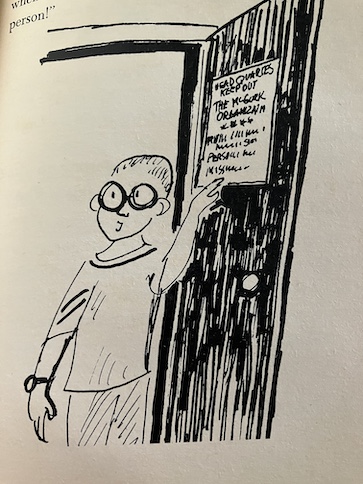
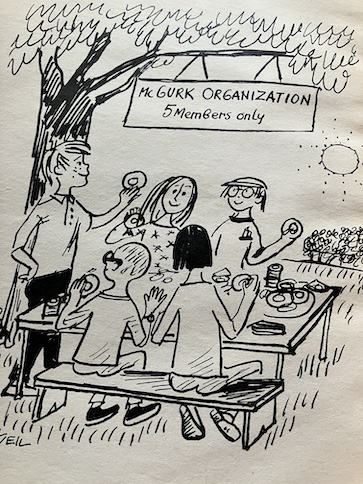
The members of the McGurk Organization are having their annual picnic in McGurk’s backyard when, suddenly, a doughnut leaps off the table and begins traveling through the bushes and grass. None of them can understand what’s happening because they can’t see anything that would cause the doughnut to move like that.

They go after the doughnut to see what happened, and they find Brains Bellingham, the nephew of Miss Bellingham, who lives next door. Brains has been staying with his aunt while his parents are out of town, and he always has a put-down for the members of the McGurk Organization. Brains is holding his aunt’s Yorkshire terrier, Dennis, and the missing doughnut, which has apparently been chewed by the dog. Brains apologizes for the dog ruining their “crummy” picnic, but he says that Dennis can’t resist doughnuts. However, that explanation doesn’t satisfy the McGurk Organization because none of them saw a dog carrying the doughnut, just the doughnut moving by itself. Brains makes an excuse about the dog being small and blending in with his surroundings, but the others can tell that he’s hiding something.

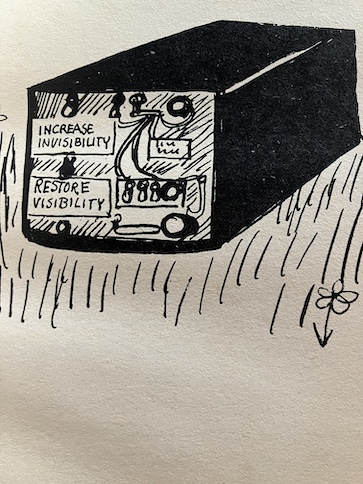
When Brains leaves for a moment because he says his aunt is calling him, they spot a strange black box in the grass. The box has dials and switches on it, and there are two labels: “Increase Invisibility” and “Restore Visibility.” Brains is known for building various inventions, so they know this is probably something he made, but does this device really make things invisible? Is that why they couldn’t see the dog when he stole the doughnut? They have a look inside the device, but since none of them is particularly good with electronics, they just know that it contains a bunch of wires and seems to be powered by batteries, and there is some kind of light inside the box. There are also doughnut crumbs inside the box.

When Brains sees them messing with the box, he yells at them to stop snooping. Joey, the organization’s secretary, knows that part of Brains’s problem with the organization is that he’s jealous because he really wants to join. He’s hinted before that they need a laboratory man to help them with forensics. McGurk might have taken him up on the offer except that Brains was condescending and insulting in the way he made it, calling them “dummies.” He’s a little younger than the rest of them, too, so his condescending attitude makes him seem even more like an annoying little kid. McGurk tries to ask Brains about his strange device, but Brains just refuses to answer and takes the box and the dog away.

The members of the McGurk Organization return to their picnic, but they can’t stop wondering about Brains, his strange invisibility device, and how he accomplished the trick with the dog and the doughnut. Most of the organization members are pretty sure that there must be some kind of trick to it, but they can’t figure out how Brains did it. While they discuss it in their basement meeting room, they hear what sounds like the jingle of dog tags, and Willie, who has a very sensitive nose, says that he smells a dog. They search the basement and find a dog’s rubber bone. Then, Brains shows up, looking for Dennis. To their astonishment, Brains seems to pick up an invisible dog, who seems to be struggling and making dog noises, growling and jingling tags!

When the organization goes to confront Brains about what just happened, they find him with his strange box. The box appears empty on the inside, but they hear dog sounds from it. Brains operates the controls and opens the box again, and Dennis comes out! Brains claims that he invented the invisibility box by accident while he was trying to develop a treatment for getting rid of Dennis’s fleas and ticks using light rays. Brains says that there is a side effect where Dennis sometimes turns invisible at random times without Brains intentionally turning him invisible but that he’s working on the problem.

McGurk is thrilled at the possibility that Brains might be able to build a machine big enough to turn a person invisible, and he even offers Brains membership in the organization if he can do it. Brains says he could, but to everyone’s surprise, he turns down the membership offer. He says that he knows they don’t really want him in the organization; they just want his machine. It’s a little embarrassing, but it’s true.

The members of the McGurk organization consider ways that they could get Brains to change his mind. McGurk considers blackmail, but Wanda says that wouldn’t be right for a detective organization. Wanda thinks McGurk should apologize to Brains for the way he turned Brains away when he tried to join earlier, but McGurk can’t stand the idea of apologizing. Willie thinks they could offer to pay Brains, but they don’t really have anything they could pay him. They all ponder what would happen if they let word of Brains’s invention get out to the public or even the government.

Then, Brains comes to them, asking for help. He says that Dennis has turned invisible again, and he’s run off! Can the McGurk Organization find an invisible missing dog?

The book is available to borrow and read for free online through Internet Archive (multiple copies).

I didn’t read this book when I was a kid, although I read many others in the series. Because I didn’t read this book before, I didn’t really know the story of how Brains joined the McGurk Organization. There are some references to it in some of the later books in the series, so I knew that, when the other members of the organization first met Brains, they were investigating him for some trick he’d played on them. I was used to Brains being their friend, so it seemed odd to see him as the antagonist/suspect they are investigating in this book.

During the story, the members of the McGurk Organization are pretty sure from the beginning that Brains is playing some kind of trick, but they’re not sure how. He does manage to convince them temporarily that he has successfully developed an invisibility device, but McGurk soon realizes that something Brains has said contradicts what’s happened. Then, he and the others reexamine what happened to figure out how Brains staged his tricks. They’re a little mad at being tricked, so they pull one more trick on Brains to get even before they all forgive each other. Brains shouldn’t have called the others “dummies” or been condescending to them, and the others shouldn’t have been too quick to write him off just because he’s a year younger than they are. In the end, McGurk says that anybody who’s clever enough to work out a complicated trick like this one deserves to be a member of the organization, and they hold another picnic to celebrate their new member.

The Mystery of the Blazing Cliffs

The Three Investigators

Jupiter Jones and his friends are helping out at his uncle’s salvage yard when they have a strange encounter with a disagreeable customer and his wife. Mr. Barron is a very demanding customer who throws a fit whenever something goes wrong, blaming other people when he’s at least somewhat at fault for what happens. He gets upset when one of the employees of the salvage yard tells him that they need to move his car because they’re expecting a delivery truck, and his car is in the way where he parked it. Mr. Barron gets angry because he parked his car “perfectly”, and he calls them incompetent for making him move.

The only reason why Mr. Jones puts up with Mr. Barron is that he’s buying a large amount of stuff, and it’s stuff that few other people would want, like a buckboard wagon, an old stove and stovepipes, and a broken butter churn. The weird thing is that Mr. Barron doesn’t seem interested in these things as antique collectibles or unique pieces of vintage decor, which would be what most people would use such things for. (I’m thinking of those restaurants where they have miscellaneous farm implements, wagon wheels, and antique/vintage items on the walls, and I think that’s what they’re thinking about, too.) Mr. Barron actually seems to want to fix them up and use them for their intended purposes.

Mrs. Barron glosses over her husband’s rudeness and talks about her belief in aliens as described by a popular book called They Walk Among Us. This book describes “the time for deliverance”, when our planet will be in danger from some kind of disaster, and aliens from the planet Omega will arrive to rescue people from the human race so our species won’t be lost. Mr. Jones thinks that the Barrons are crazy, but his own wife interrupts the conversation before Mr. Jones can say something that will ruin the sale.

Jupiter is intrigued by these weird people, and he persuades his uncle to let him and his friends go along on the trip to deliver all of the things they bought to their ranch up north. Jupiter’s friends are a little reluctant to see the Barrons again, but Jupiter points out that going on the delivery trip will allow them to also go on a buying trip at the same time, something that his uncle has promised them they can do. Jupiter has been wanting to take charge of a buying trip, but he also wants to learn more about the Barrons.

Before they leave, the boys do some research on Mr. Barron and learn that he came from a wealthy business family in the Midwest. However, he has been in and out of trouble with every business he’s ever run. He did pretty well at first after he inherited his family’s business, which made tractors, but then, workers went on strike for better pay and working conditions. Mr. Barron was forced to give them what they wanted, but he was so angry about the strike and being forced to make concessions that he sold that business and bought a different one. In his next business, he had problems complying with government anti-pollution regulations, so he sold that business and bought another one. In his third business, he was sued for discriminatory hiring processes, so he once again sold out and tried another business.

Since then, he has had a string of different businesses, and each and every time, he ran into some kind of problem with government regulations or labor disputes. Every time he has any kind of problem in business, he immediately quits that type of business entirely rather than sticking to it and working things out. He just can’t accept imperfection in any form, and he defines imperfection as anybody or anything that goes against what he, personally, wants to do, regardless of circumstances. He denies that he could be imperfect himself, that he needs to adjust to new or changing situations, or that he needs to improve in any way, blaming everyone else for all of his problems. Finally, unable to find any business where everything goes absolutely perfectly all the time, where there are no rules or standards to follow other than his own and nobody to check that he’s following them, and where he never gets any form of negative feedback, Mr. Barron decided to sell off his remaining business interests and buy a ranch in California, which is where he is now. He’s planning to use the ranch to experiment with new crops and self-sufficient living.

When the boys arrive at the ranch with one of Mr. Jones’s delivery drivers, Konrad, they realize that the ranch is a kind of commune. The people who work for Mr. Barron and live at the ranch show them around and explain how the ranch has its own power supply and water supply. Elsie, who is the cook at the ranch, tells them that Mr. Barron seems to be preparing for some kind of “revolution”, when there will be some kind of catastrophe and society falls apart. (Remember, for Mr. Barron, society and all other humans besides Mr. Barron are idiots and incompetents, so of course, everything is falling apart.) Most of the people at the ranch don’t really believe that’s going to happen. They’re there mainly because Mr. Barron hired them to work there. However, it seems like the Barrons are deep into this notion of a coming disaster.

Konrad thinks that this ranch is very weird, and he wants to leave, but the boys persuade him that they should accept Mrs. Barron’s invitation to stay for dinner. Konrad chooses to eat with the staff rather than face Mr. Barron again. During dinner, the boys are treated to Mr. Barron’s negative attitude about everything, from his disappointment in his adopted sons (and, by extension, in young people in general) to “the evils of plastic in almost any form”, from synthetic leather to polyester clothing. By contrast, Mrs. Barron is very fond of her adopted sons, one of whom is part of a rock band and the other of whom is a poet who supports himself by making wooden clogs. Mrs. Barron says that the rock drummer son will be coming to the ranch in August for the Blue Light Mission convention, a meeting of other people who also believe in aliens who will save humanity. The author of They Walk Among Us will also be there as a guest speaker. 

Although Mr. Barron seems to have at least some belief in the idea that society is falling apart because of “anarchists and criminals who want to take over”, his criticism of people in general also extends to his wife and the other people who attend these alien conventions and believe in They Walk Among Us. Even though he’s hosting this convention for his wife’s sake, he thinks that the convention attendees are a bunch of kooks and crazies who would victimize his wife if he didn’t keep an eye on her. Basically, both of the Barrons are conspiracy theorists, but they’re not following quite the same conspiracy theories. Mrs. Barron is the more positive and hopeful of the two of them, believing that things will somehow turn out okay when the aliens show up, cheerfully ignoring her husband’s negativity, and continuing to talk about how much she’s looking forward the convention and meeting other, like-minded people. By contrast, Mr. Barron thinks society is just going to fall apart, and it will be everyone for themselves, and that’s about it.

The Three Investigators’ involvement with the Barrons would have ended after their delivery errand and dinner, but when they try to leave the ranch, they are stopped by army officers. The officers tell them that the roads are closed because of orders from Washington. The boys and Konrad are forced to return to the ranch, and Mr. Barron is angry about the roads being closed. The army officers tell Mr. Barron that they are just following orders. They further say that something has happened in Texas, and because of that, there is no electrical power, and the telephones, televisions, and radios aren’t working. Elsie has a battery-operated radio, and she turns it on to find out what’s happening. They hear a speech, apparently from the US President, about unidentified aircraft being seen around Texas, New Mexico, and California and possible landings in those states.

Naturally, when confronted with this serious situation, Mr. Barron is ready to take charge and deal with it in his usual way – by immediately finding someone to blame, dishing out criticism, and calling other people stupid and incompetent. He complains that the President gave a stupid speech that doesn’t provide any useful information and that he can’t understand how this guy ever got elected in the first place. Then, he goes off on a rant against communists and anarchists. (Seriously, that’s how both this book and his thought processes go. In a way, he’s very 2020s, a man decades ahead of his time.) Elsie points out that the people at the ranch are safe, no matter what’s happening, because the ranch is designed to be self-sufficient. Mr. Barron may be an angry mess of paranoia and negativity, but he is thorough and has been planning ahead for disaster this entire time.

The military officers say that the roads are being blocked off to the public so they can be used for military vehicles. Mr. Barron becomes convinced that either some disaster has happened or that the politicians believe that one is imminent. He also thinks that the politicians blocked off the road to the ranch so they can come and shelter at his amazing, self-sufficient ranch themselves. (Once again, everyone else, from the government to the general public, is incompetent, and only Mr. Barron does things right. He further assumes that the rest of the world must somehow secretly know this, quietly envies him, and plots to take advantage of him.) There’s no sign of anyone else arriving, at least not yet, but Mr. Barron, who has a deep disdain for fools of all kinds, doesn’t like the idea of welcoming a bunch of political fools. However, he does show sympathy to the boys and Konrad because he can recognize that nothing that’s happening is their fault. He tells them that they’re welcome to stay at the ranch until this situation, whatever it is, is cleared up.

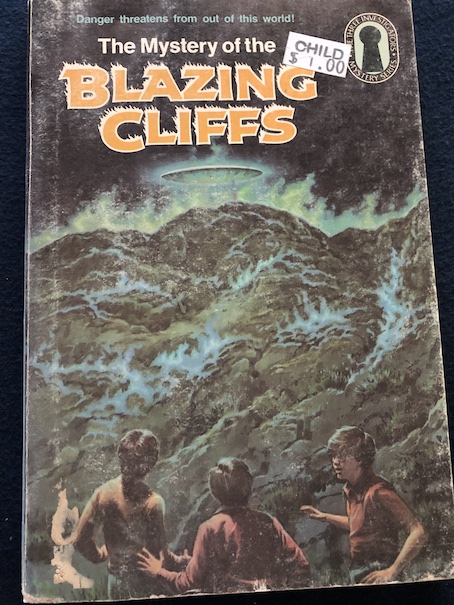
The Three Investigators decide that they need to find out what’s really happening in the cities outside of this ranch and verify what they’ve been told about the situation because everything was fine when they left home. Since they can’t leave by the road, they do a little scouting around the area to see if there’s a route they can use to walk to another town. Since it’s getting dark, they decide that it would be too dangerous to try hiking and climbing in the area at night. They plan to wait until morning to actually leave, but while they’re looking around, they witness something very strange. They see what looks like blue fire on the cliffs near the ranch and some kind of silver, oval-shaped object in the sky! Have they really witnessed a flying saucer? Is what Mrs. Barron believes about aliens coming to Earth true?

The book is available to borrow and read for free online through Internet Archive (multiple copies).

I love this Three Investigators mystery because the premise was so unusual! Three Investigators mysteries are often what I call Pseudo-Ghost Stories, like the mysteries in Scooby-Doo because any supernatural inevitably turns out to be faked in some way for some ulterior motive. This also applies to science-fiction other-worldly phenomena, like aliens. The great thing about this book is that the phenomena is so over-the-top that it’s difficult to think of a plausible way that it could be faked or a reasonable reason why someone would even do it. In this case, we know immediately that the boys see what looks like blue flames and a flying saucer, and there are either military personnel or people pretending to be military personnel blocking the roads out of the ranch. This is a plot that would seem to involve some impressive special effects and a significant cast of conspirators, and the purpose behind it doesn’t seem obvious.

Pretty early in the story, I had a couple of theories about who could profit from faking a UFO, but I had doubts about it because of the relatively small audience involved and because it seemed like there would be much easier methods of them accomplishing their goals. It is a pretty over-the-top plot, although it’s partially explained because Mr. Barron is a rather over-the-top figure to target. It is his paranoia and reluctance to call in authorities and outside help with anything that sets him up for this. Mr. Barron’s attitude that anything that contradicts him or his view of anything is inherently wrong cuts him off from the kind of reality checks he needs, even though he understands that his own wife can use some reality checks outside of her group of fellow alien enthusiasts. 

I knew that, for anybody to get the idea of doing this type of hoax and to plant the evidence to create the illusion of alien landings, one or more of the conspirators would have to be directly involved with the ranch. One of them is obvious, when you think about it, because it’s one of the people who directly supplies some of that evidence. Part of the mystery is about who else is involved. I could see multiple ways that could have gone, and I considered different possible masterminds for the scheme and different motives behind it. Most of what I considered turned out to be wrong, although my theory that Mrs. Barron could have engineered the whole thing with the help of her adopted sons and some friends from the alien conventions with the goal of demonstrating to Mr. Barron just how vulnerable his own paranoia and obsession with his personal conspiracy theories has made him would have been fun. Mrs. Barron may be gullible when it comes to her favorite alien conspiracy theory book, but I would have enjoyed a little role reversal, where she turns out to be more clued about human nature than Mr. Barron, who is so self-obsessed and ultra-skeptical about other people, refusing to receive information, advice, or criticism from anyone else, that he routinely fools himself without outside help. 

Alternatively, I though that the Barrons’ sons could have teamed up to pull this off to make both of the Barrons see the folly of their ways. In a way, I think that Mrs. Barron’s belief in the aliens is partly as a remedy to her husband’s relentless negativity. She believes him that disaster is impending because she actually thinks a lot of her husband and trusts his opinion on the way society is going, but being a more hopeful and trusting person, she has latched onto the idea of rescuing aliens because her husband doesn’t believe in fellow humans. Of course, Mr. Barron disdains that theory because he can tell that it comes from fellow human beings, who are all varying degrees of stupid, incompetent, and scheming, but Mrs. Barron clings to it as a hopeful thing that binds her to like-minded people because she needs that sense of hope and connection. At least, that’s how I read the situation. Mrs. Barron believes everything, even things she shouldn’t, and Mr. Barron refuses to believe anything, even things he should. There is a happy medium between believing everything other people say and allowing them to lead you around by the nose and being so paranoid that everyone is either wrong or out to trick you that you refuse to engage with the real world and turn aside legitimate sources of help and outside information. Neither of the Barrons represent that happy medium, and I would have liked the conspiracy to bring that to light. In a way, it does, but that’s not really the main focus. It’s more about taking advantage of the Barrons and their eccentricities.

I also considered the idea that the entire plot could have been a publicity stunt by the author of Mrs. Barron’s favorite book and the convention organizers. I even thought that Mrs. Barron might have been in on it as a true believer, trying to get her husband and others to believe. However, that’s not the case. The book and the convention just supply the inspiration for the conspiracy.

In a way, this story reminds me a little of the Sherlock Holmes story The Red-Headed League, where there’s a seemingly outlandish scheme to cover an ordinary theft. There is a twist to this one because nobody but Mr. Barron knows exactly where the thing they’re trying to steal is. In the end, only Jupiter reasons it out because he has really come to understand the way Mr. Barron’s mind works.

The mystery is intriguing because there are so many possibilities to consider. In a way, I preferred all the possibilities to the eventual resolution of the mystery, but the solution does make sense. It’s still an over-the-top plot that involves a significant number of people, equipment, and special effects, but it does appeal to my inner Scooby-Doo fan, who enjoys a good, complicated scheme and a villain behind the mask.

Freckle Juice

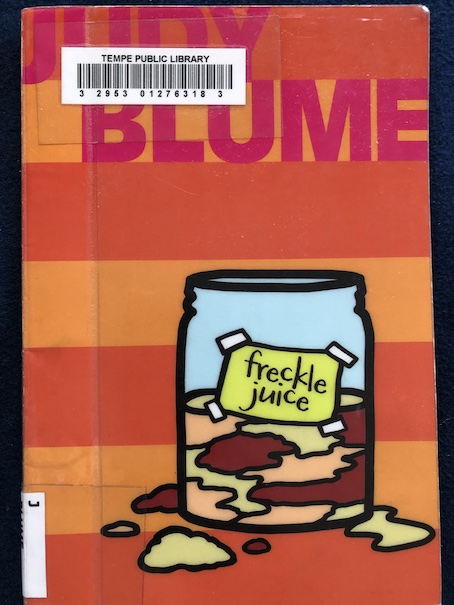
Freckle Juice by Judy Blume, 1971, 2014.

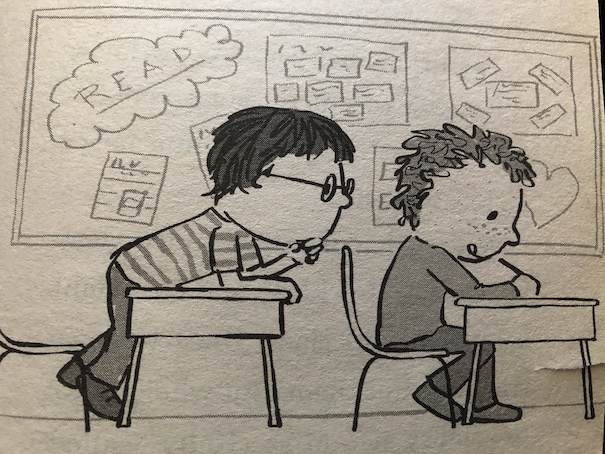
Andrew admires his friend, Nicky, for all his freckles. Andrew thinks freckles are interesting, and if he had a bunch of freckles, maybe his mother wouldn’t notice when his neck was dirty and make him wash it every morning.

When Andrew asks Nicky how he got so many freckles, Nicky says that he was just born with them. However, a classmate, Sharon, overhears the boys talking and claims that she has a secret family recipe that can give a person freckles. She offers to sell her secret recipe to Andrew for 50 cents.

Andrew isn’t sure that he really believes that Sharon has a recipe that can give him freckles, but he figures that he has nothing to lose by trying it. After all, if it doesn’t work, he can always ask for his money back.

Sharon’s recipe is a disgusting conglomeration of weird ingredients. Does it actually stand a chance of working, or will the only thing it gives Andrew be a stomach ache?

I couldn’t find an online copy of this book, but I did find an online literature guide for using this book in the classroom on Internet Archive.

My Reaction and Spoilers

This is a short, easy book for kids in early elementary school, but it’s also a fun story about self-acceptance. Through this experience and the help of the kids’ understanding teacher, he comes to realize that there’s no point in envying other people, but there are benefits to learning to appreciate yourself. It turns out that, while Andrew was envying Nicky for his freckles, Nicky never liked them himself. The kids’ teacher helps them both to appreciate themselves for the qualities they have, pointing out that Nicky’s freckles suit him while they just wouldn’t look the same on Andrew. Hopefully, the kids also learn to beware of miracle cures and anything people like Sharon have to sell!

Ruth Fielding on Cliff Island

Ruth Fielding

Ruth Fielding on Cliff Island, or The Old Hunter’s Treasure Box by Alice B. Emerson (the Stratemeyer Syndicate), 1915.

Ruth Fielding and her friend, Helen, are waiting for their friend Jane Ann to arrive by train from her uncle’s ranch so they can all go off to boarding school together. Then, Helen’s brother, Tom, arrives with the news that the train has had an accident. They all get in Tom’s car and rush off to see if they can help Jane Ann.

When they reach the site of the train wreck, they discover that Jane Ann was rescued from the train by a young man named Jerry. Jane Ann is fine, but Jerry was hurt in the rescue. After a harrowing escape from a panther that was released during the train crash (Stratemeyer Syndicate books are like this. There has to be suspense and cliff hangers in every chapter.), they take Jerry to the Red Mill, where Ruth lives with her Uncle Jabez and have the local doctor come to treat him.

Jerry explains to the others that he wasn’t actually riding the train when it crashed. He had just been following the train tracks on foot while on his way to look for a job. Jerry used to live on Cliff Island with his Uncle Pete. Jerry is sure that his uncle actually owns the island because they always lived there, and he always said it was his. His uncle used to keep money and important papers in a lockbox hidden on the island because he didn’t trust banks, but there was a landslide that buried the box in its hiding place. After that, his uncle became distraught because the papers that proved he owned the island were in that box. Then, someone else, a man called Rufus Blent, claimed ownership of the land, and his uncle had trouble proving that the claim was false. Jerry’s uncle got into a physical fight with this man, and because he seemed so violent and unreasonable, the local authorities locked him up in an asylum, which is why Jerry is on his own now. Jerry is sure that Blent is on the island now, trying to find his uncle’s buried treasure box.

Jane Ann is touched by this story of injustice, and she immediately wants to write to her own uncle and get help for Jerry and his uncle, but Uncle Jabez urges caution, telling Jane Ann that they should verify Jerry’s story first before committing themselves to his cause. Uncle Jabez gives Jerry a job at his mill and a place to stay. Ruth and Jane Ann have plans to make for returning to boarding school and for preparing for Jane Ann’s first term there. Jane Ann doesn’t like her name, so they decide that when she starts classes, she’ll go by the name Ann.

Ann has a difficult time at school. She has never had formal education before, and she is behind the other girls her age. Some of the other girls at school tease her mercilessly about it, and after a particularly mean prank, Ann hits some of them until her friends finally restrain her. Ann is so upset that she thinks she can’t handle life at the school and doesn’t belong there. She thinks about running away, but she did that once before in a previous book, and after the last experience, she doesn’t want to do it again.

Ann later has a couple of opportunities to use some of the skills she learned from life on the ranch to save some of the other girls and an injured boy, and some of the girls who were mean to her apologize for the earlier prank. They say that they see her in a different light now and feel guilty about what they did earlier. The mean girls do start treating Ann better (their respect now having been bought), but the damage has already been done. Their belated improvement to the level of minimally-acceptable behavior isn’t enough to make Ann feel better before the school goes on winter break.

Mercy, who has been accustomed to being picked on by people because she uses crutches, understands Ann’s feelings and tells her that she should be mean back to people who are mean to her. Ruth thinks that sounds awful, but Mercy tells her that she doesn’t understand what it’s like. Mercy does use her disability to explain that she should have some allowances for her temperament and behavior, especially when people pick on her, although Ruth doesn’t think that’s quite right.

The conversation leads some of the girls to talk about their life goals. Mercy is glad that she’s able to go to school now because her disability made it difficult when she was younger. She’s determined to be the top of the class to show others that she’s as smart or smarter than they are, even if her legs don’t work as well. Mercy’s self-esteem suffered badly when she wasn’t able to walk, even with crutches, and people looked down on her (or at least, she felt like they did). Now that she can walk with crutches and go to school, she finds a new self-esteem in her ability to excel in her studies. That her ambitions are partly rooted in spite toward people who teased her in the past isn’t healthy, but she is determined to take her education as far as she can go and wants to get a scholarship to college. Other girls also start talking about their own ambitions and what they want from their education.

Rather than feeling better, Ann feels worse because she’s still not doing great at her studies, and she’s not sure about her own ambitions and what she really wants from her education. It makes her wonder what her real purpose is at the school and if she should really be there. The school friends are planning to spend the Christmas holidays together. Ann isn’t sure if she really wants to go with them after all, but they persuade her that she really does belong with them, and they want her.

Ruth hasn’t forgotten about Jerry and his situation. The family of a friend of hers at school, the Tingleys, has purchased some land on Cliff Island, where Jerry used to live, and they’re building a lodge there. The Tingleys have invited some of their children’s school friends, including Ruth, to the island over the Christmas holidays, and Ruth persuades them to hire Jerry to work at their lodge. Jerry is happy to be able to return to the island, and Ruth says that this will give him the opportunity to look for his uncle’s hidden box again. Jerry doesn’t have much hope of finding the box because it’s been buried, but Ruth thinks it could still be possible. Blent also seems to think it’s possible because he does everything he can to get Jerry fired and drive him away from the island.

The book is available to borrow and read for free online through Internet Archive (multiple copies) and Project Gutenberg (multiple formats).

My Reaction

Although books by the Stratemeyer Syndicate, especially the early ones, were criticized for being shallow and formulaic, I will say that they do have a way of making you care about the characters. In fact, I think that I found some of the characters in this book more personable than characters in the Nancy Drew books because there is more reflection on what people are feeling and why.

In particular, I really felt for Ann when she was being bullied, and I don’t blame her for hitting the ones responsible when she lost her temper. The other girls were deliberately mean and picked a fight. Learning that they get a fight when they pick one is a valuable life lesson. Actions have consequences, and these “girls” are too old to be doing this with any degree of innocence. I really wished that someone had made it clear to them that the situation was entirely their fault, not Ann’s, and that they failed in their obligations to behave respectfully to a classmate. A thoughtless prank that hurt someone unintentionally would be forgivable, but in this instance, it’s deliberate, calculated, and repeated cruelty. The book says that the mean girls pick on Ann even harder when they realize that they can hurt her and have hurt her, and deliberately hurting people who are obviously hurting for pleasure is really a very sick thing to do. I don’t like it that the book treats this behavior like it’s a normal thing for them to do. Even though I know this is something people do in real life, this type of behavior shouldn’t be normalized because causing pain for pleasure really is a disturbing thing to do when. The prank that broke Ann’s patience was dumb, but when you look at everything that led up to it and the emotions behind it, it says disturbing things about the nature of the people who did it. I always hate it when people give that sort of thing a pass without pointing out the full reality of their motivations to the people doing it.

I never really felt better about the mean girls during the course of the book, even after they started acting better because I didn’t like their motivations for fixing their behavior. The didn’t repent because they felt badly about hurting someone unfairly. Oh, no, they didn’t care that they had caused someone distress and hurt their feelings. No, they do it because Ann used her ranch skills to rescue people in danger. Not only that, but it took two such rescues, not just one, to get them shut their mean mouths. Yeah, it’s like in Rudolph the Red-Nosed Reindeer, if Rudolph had to do two missions to save Christmas instead of one. I now that the moral of Rudolph is supposed to be that people should be nice to other people because you never know if someone you don’t like might have something good to offer you later, but it leaves a bad taste in my mouth that they think that they’re entitled to be offered something in exchange for their good behavior instead of seeing good behavior and kindness as the minimal level of their own obligations. These mean girls (as all mean girls do) see themselves as being so self-important and such a high level of authority that other people have some obligation to prove themselves to them personally in order to be treated with even basic human respect, even though the reality from an objective observer is that the mean girls are nothing but a bunch of bratty, badly-behaved, immature children who should have their eyes opened to that reality. Their level of morality is that people have to buy their good behavior with some amazing deed or service. Otherwise, they’re fair game as bully prey. I’m not buying this, and I’m not buying their supposed reformation.

If relationships are really as transactional as the mean girls make them, someone should point out to them that they’re the most undeserving people of all because they have not offered Ann any sort of service to merit the payment she gives them. In fact, they are burdens to have around. If behavior is transactional, they’re actually in debt, and they’re not very good debtors. The whole thing about relationships being repaired when a victim becomes a hero to an abuser is a bad cliche. I think it sets terrible examples and warped views of human worth, but it’s admittedly a behavior I’ve seen in real life. When it comes to behavior, I prefer a line from an old Murder She Wrote episode, where a snobby man apologizes to being rude to Jessica Fletcher when they first met because he didn’t realize that she was “somebody” as a famous writer. She tells him that it’s perfectly acceptable to be polite to nobodies. Someone should really tell the mean girls that and make it stick. Fortunately, the mean girls do change their behavior for the long term. After they start treating her better, Ann has an easier time at school and can concentrate on her studies better.

There is a kind of parallel in the book between the way the mean girls at school treat Ann because they don’t think she’s good enough for “their” school (as if they owned it themselves instead of just being clients who have to pay money to go there) and how the local people, who are easily swayed by Blent, treat Jerry and his uncle. Mr. Tingley, who bought his property on the island from Blent, is appalled when Blent tries to not only drive Jerry away from the island but even gets together a posse to try to hunt him down with guns like an animal. The local authorities side with Blent because, first, they seem to be corrupt, and second, Jerry’s uncle was always a little strange, so they’re more than willing to believe that he was really crazy. Blent and his cronies even go so far as to kidnap Jerry and bribe the staff on a train to take him to another town, miles away. Tingley is horrified at the locals and what they’re doing. He recognizes that it’s difficult to fight them because they are presenting a united front in their wrongness and are laughing about his inability to stop them, so he has to call in some outside legal help. It’s not unlike the united school bullies, who think that their ability to get away with what they’re doing makes them superior and gives them the right to continue.

When Jerry’s uncle’s box is finally found, the papers inside establish the reality of the situation. Uncle Pete was in the process of buying the island from Blent, so Blent did originally own it. At the time of the box’s loss, Uncle Pete had paid most of the installments he owed to Blent, so although he hadn’t fully completed the transaction, it wasn’t true that he had no claim to the land, either. Blent covered up that he had already taken Uncle Pete’s money for the land or that they had been involved in a transaction at all, seeing it as his opportunity to not only keep Uncle Pete’s money but to make more by selling that same land to someone else. When his land fraud is uncovered, Mr. Tingley and Uncle Pete drag a humiliated Blent through the law courts. Since Mr. Tingley paid for the land he bought in good faith and with the entire amount, his sale stands, but Blent is forced to pay Uncle Pete back with interest. Mr. Tingley and Uncle Pete work out an arrangement where Uncle Pete will live on the island and work for Mr. Tingley, so Uncle Pete will be able to stay on the land he loves. Mr. Tingley also convinces Uncle Pete that banks are more trustworthy than hiding his money and important papers in a cave.

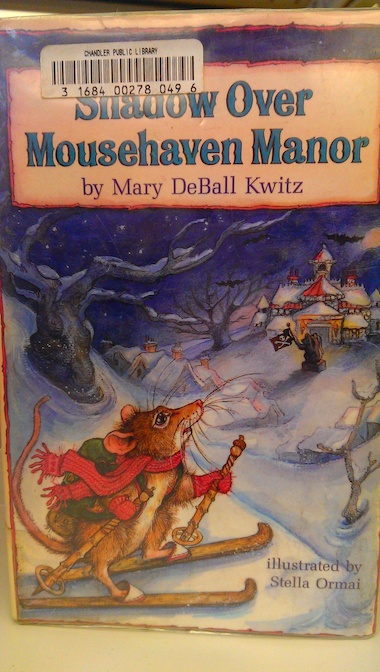
Shadow Over Mousehaven Manor

Shadow Over Mousehaven Manor by Mary DeBall Kwitz, 1989.

Minabell Mouse is happily looking forward to her Aunt Pitty Pat visiting her for Christmas with her new husband, Magnus, but she receives an urgent message from Magnus, saying that her aunt is very ill and may not survive much longer. He urges Minabell to home to her aunt’s home, Mousehaven Manor right away and bring the copy of her aunt’s will that her aunt left with her. With her home suddenly damaged badly by a storm, Minabell does immediately set out for Mousehaven Manor, crossing the Illinois prairie through the tunnel called Rodent Run, which small animals use to travel in safety. Before she leaves home, one of her friends gives her a Christmas present to take with her, something long and thin. It’s awkward to carry, but her friend insists that she take it with her and open it on Christmas. Another friend warns her to beware of the tough Chicago rats who are a gang of criminals who have invaded Chicago’s City Hall.

On the way, Minabell Mouse stops to rest and has a fearful encounter with a group of rats carrying a pirate flag with the name “Prairie Pirates” on it. She witnesses them murder a chicken at a farm, pluck it, and carry it off. It’s horrifying, and Minabell is lucky that the pirates didn’t see her. She is alerted by a stranger who makes her keep quiet.

The stranger introduces himself as Secret Agent Wendell Weasel, a member of the Illinois State Ski Patrol, a form of animal law enforcement. Minabell asks Wendell who those pirates were, but before he answers her questions, he insists that she identify herself and tell him where she’s going and why. Minabell explains to Wendell about her aunt, and he looks at the copy of the will she is carrying, which leaves everything to her, as her aunt’s closest relative.

Wendell urges Minabell to turn around and go home because it’s too dangerous for her to continue her journey. The Prairie Pirates are a band of Chicago rats, and the “Sungam” that they heard the pirates chant is the code name of their leader. Wendell says that he can’t tell her more than that because the information is classified, but he says that if Minabell really thinks about the word “Sungam”, she will see that there is a good reason not to go to her Aunt Pitty Pat and Uncle Magnus. (Hint, hint.) Of course, Minabell doesn’t see what Wendell is talking about at first and continues her journey because she thinks Aunt Pitty Pat needs her. She does, but not in the way Minabell expects.

Minabell does realize the significance of the word “Sungam” when she uses it to frighten off cats who attack her. Puzzling over the word more, Minabell tries writing it out in the snow and sees that it’s “Magnus” spelled backward. Minabell realizes that her aunt has actually married the leader of the Prairie Pirates! The Prairie Pirates have taken over Mousehaven Manor, and her beloved aunt is their prisoner! (Flying their pirate flag over the house isn’t the most subtle way to lure an innocent victim into their new hideout. I don’t think it even counts as a hideout anymore if you have a banner advertising that you’re there. Even if Minabell hadn’t already figured out the code name clue, the flag is a dead giveaway. Just saying.)

There is still time for Minabell to turn back before meeting the pirates, but she can’t leave her aunt in danger and Mousehaven Manor occupied by the enemy. However, she’s going to have to come up with a clever plan, or she’s going to be in danger, too.

I haven’t found a copy of this book online, but there is also a sequel called The Bell Tolls at Mousehaven Manor. There are only two books in the series.

My Reaction and Spoilers

I had to get this book because I vaguely remembered a teacher reading it to my class years ago in elementary school. There was a lot about the book that I forgot over the years. I had completely forgotten that it was actually a Christmas story. My strongest memory of this story was actually a small detail, but one that they repeat during the book. Minabell has a little ritual that she does whenever she needs to remember something, particularly when she needs to remember where she hid something. I had forgotten the rhyme she says, but I remembered her writing what she needs to remember on her forehead with her finger. That struck me as actually a clever trick because writing something, even if you never look at it again, helps things to stay in your memory because you really need to concentrate in order to write, and you can remember the act of writing, which brings back the memory of what you’ve written. When I was a kid, after hearing this story, I used to do that sometimes, write something on my forehead with a finger to help me remember.

Reading the book as an adult, the Sungam/Magnus clue is pretty obvious. The plot also sort of reminds me of The Mysteries of Udolpho, which I read several years ago because I really like Jane Austen’s Northanger Abbey, which references and parodies that book. The connection that book and this one is that part of the long, rambling, episodic plot of The Mysteries of Udolpho involves an aunt who has cluelessly married the leader of a gang of bandits, and the leader of the gang just wants to acquire her money and property. This book is a little different because the mouse aunt has not actually married the rat; he’s just holding her captive so he can take over her house and use it as the base for his gang and claiming that they’re married to justify occupying the manor. Like in The Mysteries of Udolpho, the bandit leader holds the aunt and her niece captive at an isolated manor house, trying to get the aunt to not only sign over all her money and property to him but also her niece’s inheritance. That’s why Magnus told Minabell to bring her copy of her aunt’s will. He needs to change the will so that it leaves Mousehaven Manor to him.

So, strangely, Shadow Over Mousehaven Manor is a little like The Mysteries of Udolpho for children. I actually recommend it more than The Mysteries of Udolpho because The Mysteries of Udolpho is rather long and disjointed. Both books contain some admiration of the beauties of the countryside while the character that travel, but the scenery descriptions are much longer in The Mysteries of Udolpho, and Shadow Over Mousehaven Manor is just more fun to read because it involves talking mice and pirate rats. The mice in this book are also much more sensible than the humans in The Mysteries of Udolpho. The mouse aunt knows darn well what Magnus is, while the human aunt was completely clueless almost up to the point where her husband caused her death. I’ve amused friends sometimes with describing The Mysteries of Udolpho, and I might put my short (short-ish) explanation of the plot (plots) of the book on the Internet sometime just for fun, but I mostly recommend reading that book only if you’ve already read and like Northanger Abbey.

I’m going to include some spoilers for the story because this book isn’t currently available to read online. Minabell has the presence of mind to realize that, before she attempts to enter Mousehaven Manor and save her aunt, she needs to hide the will she is carrying because she can’t let it fall into Magnus’s hands. When she does reach the manor, she is also imprisoned with her aunt in the manor’s dungeon, along with a friend who came to try to help her. (I don’t really know why any mansion in the US, mouse or human, needs a dungeon, but maybe mouse history in the US was more feudal than human society or something. It doesn’t really matter. It’s just a really cool mouse manor house, and it has a dungeon. It also has secret passages.) They get out of the dungeon because the aunt remembers an old song that has a clue to a secret way out of the dungeon, and they find their way to the belfry tower, where they ring the bell to signal for help. There, they meet a family of bats hibernating in the bell tower. The bell wakes them up, and one of them helps them reach their friends. Minabell, her aunt, and their friends battle the pirates and drive the out of Mousehaven Manor. They celebrate with a big New Year’s party, and Minabell decides that she wants to continue living at Mousehaven Manor with her aunt.

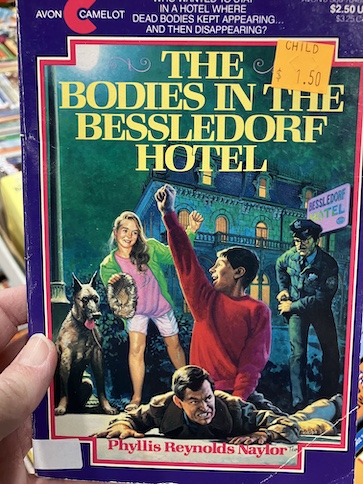
The Bodies in the Bessledorf Hotel

The Bodies in the Bessledorf Hotel by Phyllis Reynolds Naylor, 1986.

Officer Feeney is the first person who suggests that, someday, there might be a dead body at the Bessledorf Hotel. The hotel is coincidentally located next to the local funeral parlor, which is why the subject of dead bodies comes up, and Officer Feeney has a way of suggesting frightening things that scare Bernie Magruder, son of the hotel’s manager. Officer Feeney’s reasoning is that most people die in bed, so it only makes sense that some of them would be hotel beds. The hotel has 30 rooms, and with people coming and going, it’s surely just a matter of time before a guest dies there. It’s a morbid thought, although Bernie reasons that Officer Feeney is overestimating the number of people who pass through the hotel because it isn’t always full and some of the guests are long-term residents.

Still, Bernie gets a shock after he returns to the hotel, and the cleaning lady, Hildegarde bursts in on him and his parents, hysterical about finding a body in a bathtub of Room 107 with all his clothes on. Bernie’s father tells his wife to call Officer Feeney to write a report of the death and considers whether they can remove the body secretly, perhaps in a laundry cart, to avoid bad publicity for the hotel. Unfortunately, some of their guests already heard Hildegarde screaming about a dead body, so word is out. They want to know if it’s a case of murder or suicide and how it’s being investigated, and one of the long-term guests, who is a poet, has already written a short poem for the occasion.

However, by the time they all get to the room where Hildegarde saw the body, it’s gone. There is nothing in the bathtub, not even water. Officer Feeney shows up and demands to know what’s going on, and Hildegarde insists that she really saw something. The Magruders believe her, but they have no explanation for where the body could have gone. The guests speculate about body-snatchers and ghosts.

All they know about the man who occupied that room is that he gave his name as Phillip A. Gusset, he checked in the evening before, and he said that he would be leaving the next morning. Officer Feeney asks them if there was anything odd about him, like if he seemed nervous or unwell. Nobody remembers anything like that. They remember that he had a mustache and a hat with a red feather and just a single bag with him. He did kind of make Bernie’s parents uneasy, and he seemed to have a strange scent about him, although they find it difficult to describe what it actually smelled like. Officer Feeney says that, without a body or any evidence that something has happened, there doesn’t seem like anything to investigate. Bernie’s father is relieved that there won’t be any report of a murder or death occurring at the hotel because, otherwise, the owner might fire him. Bernie remembers that the man’s slippers were still in the room and goes to get them in case they’re evidence. When he gets there, he discovers that the slippers have mysteriously disappeared.

Bernie’s friends, Weasel and Georgene, think that people will probably never want to rent that hotel room ever again, and Bernie’s father renumbers the rooms so there will be no Room 107. Weasel convinces Bernie and Georgene to help him search the area for the body, thinking that whoever took it would most likely want to dispose of it quickly. They search down by the river, but they only find a bag of garbage that Bernie’s younger brother, Lester, left there to trick them.

Even though there’s no evidence that anything happened and the police aren’t investigating the situation, the incident of the disappearing guest appears in a newspaper in Indianapolis, where the hotel owner, Mr. Fairchild, lives. Mr. Fairchild calls the hotel to demand to know what’s going on. Mr. Fairchild says that he want the hotel to put on live entertainment in the evening on weekends to draw attention away from the incident and bring people in. However, he expects Bernie’s father to hire the entertainment out of his own money since Mr. Fairchild thinks this situation is his fault, and most entertainment is out of the Magruders’ price range. Fortunately, Bernie’s father has joined a barbershop quartet, so his group can do their singing at the hotel.

The singing goes well, but a strange woman with orange hair checks into the hotel and keeps making comments about dead bodies there. Then, one of the waiters finds this woman dead in her room, Room 321. Just like the first body, this body also vanishes. By this time, Bernie’s father suspects that the woman faked her “death” just to scare the waiter and ran away as soon as he was gone. As Bernie’s parents investigate the room, they notice an odd smell that reminds them of the first guest who disappeared. The smell really unnerves his father, but strangely, not his mother. It’s a faint smell that’s difficult to identify, but it conjures different images for both of them. Bernie’s father says it reminds him of sweaty clothes, cigars, and pastrami, while his mother says it makes her think of flowers and a porch swing in the evening.

The Magruders aren’t sure why someone wants to fake deaths at the hotel, but this latest faker didn’t pay for either her room or dinner, and somehow, the newspaper has heard about it and reported it again. Mr. Fairchild is angry, and Bernie knows that they need to figure out who the prankster is before they do it again!

The book is part of the Bessledorf mystery series, also known as the Bernie Magruder series. It is available to borrow and read for free online through Internet Archive (multiple copies).

My Reaction

Attempts to investigate the mystery alternate with the Magruders’ attempts at cheap hotel entertainment. The barbershop quartet works until one of the members gets laryngitis. Some of the guests start a food fight when the entertainment is bad. Then, Joseph gets some of his friends from the veterinary college who play instruments to come. Personally, I like the part where Lester suggests that they hold a haunted house at the hotel and take people on tours of the rooms where “dead” bodies have been found. They reject that idea, but there are hotels and bed-and-breakfasts that give haunted tours, and people come to investigate ghosts. That actually can be a successful gimmick. I once intentionally stayed in a supposedly haunted hospital that had been turned into a hotel in an old western mining town. A possible murder once occurred there, but I enjoyed the visit.

When a new guest shows up at the hotel with that same, strange scent, Bernie knows that it’s their culprit, back again in another disguise. Now that he knows who to watch, he starts planning how they’re going to trap the person.

I had a couple of ideas in beginning about who was doing all of this and why, but there are some surprising twists in the story. Bernie’s first attempt to catch the villain is weirdly thwarted by the discovery of a dead body that is actually a real, dead person. It’s not a guest; it’s a body stolen from the funeral parlor next door. The bad guy decided to change his tactics.

One of the clues to the person’s identity is that mysterious smell and the way it has an opposite effect on Bernie’s parents. It irritates Bernie’s father but makes his mother feel strangely nostalgic. The truth is that they’re both remembering the same thing or the same person, but although they can’t remember right away exactly what they’re remembering, they have very different feelings about it.

Surprisingly, although Mr. Fairchild threatens to replace Mr. Magruder with another manager, he actually shows up at the hotel himself and discovers that he likes playing detective and figuring out what’s going on. He’s also impressed with the way Mr. Magruder stayed to finish managing things even after he told him that he was planning to hire someone to replace him, and that secures the family’s position.

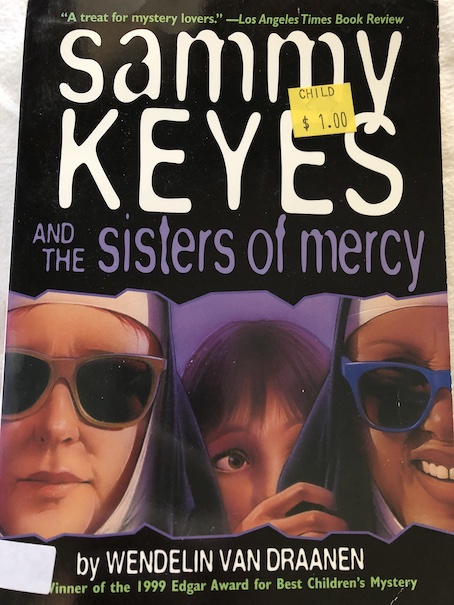
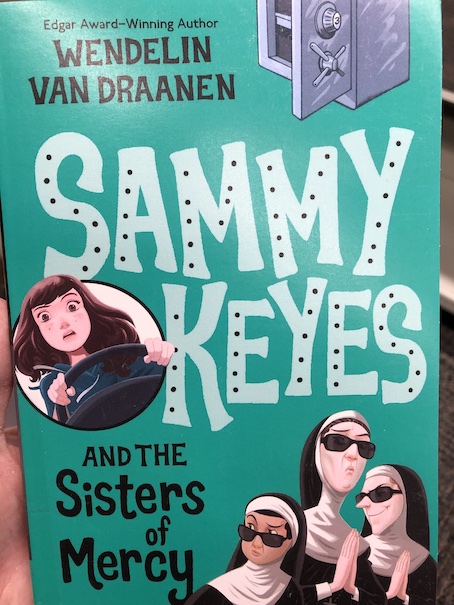
Sammy Keyes and the Sisters of Mercy

Sammy Keyes

Sammy Keyes and the Sisters of Mercy by Wendelin Van Draanen, 1999.

At the end of the previous book in the series, Sammy was given a punishment from her school for causing a disturbance during an assembly that requires her to complete 20 hours of community service. She’s working off her volunteer hours at St. Mary’s Church under the supervision of Father Mayhew. When Sammy lived with her mother, they weren’t religious, and Sammy hadn’t even been baptized. However, her grandmother is much more religious, and she had Sammy baptized by Father Mayhew soon after Sammy moved in with her. Father Mayhew is kind and understanding with Sammy. There are also some nuns at St. Mary’s from an order called the Sisters of Mercy. They’re helping out in the soup kitchen. When elderly Sister Josephine sees that Sammy is painting a wall in Father Mayhew’s office, she complains that he’s always getting the services that the nuns ask for and never get. They’ve been asking to have the house where they live painted for years, and it still hasn’t happened.

Father Mayhew’s gratitude for Sammy’s help fades when a small ivory cross is stolen from his office, and he thinks that Sammy did it because she was in there. Sammy tells him that she didn’t take it, but he doesn’t believe her and sends her to go work in the soup kitchen for awhile. (He didn’t ask her to turn out her pockets before she left his office. I would have because that would settle the matter right there.) In the soup kitchen, Sammy sees another girl about her age who reminds her somewhat of herself, partly because of the high-top shoes she wear. Sammy wonders who the girl is and why she’s eating at the soup kitchen, but she isn’t able to talk to her there.

Later, Sammy discusses the missing cross with Father Mayhew again. This time, he seems less certain that Sammy took it, and Sammy asks him if it was something valuable that might have been sold for money or if someone who is angry with him could have taken it as revenge. The one person who seems angry with Father Mayhew is Sister Josephine, but he can’t picture her taking the cross. However, there are other people who might have a reason to be angry with Father Mayhew. Brother Phil, who works in the soup kitchen, wants to become a full priest, but Father Mayhew doesn’t think that he’s suited to it.

The thefts also continue. A couple of gold chalices are stolen from the church. The nuns who are part of the Sisters of Mercy turn out to be traveling and staying in a trailer, and they’re only staying at St. Mary’s temporarily to hold a fundraiser. They tell Father Mayhew that someone tried to break into their trailer, but they scared the thief off. One of the nuns ask Father Mayhew to keep an heirloom locket in his safe until she can deliver it to her niece.

Meanwhile, at school, Sammy is playing on one of her school’s two softball teams. Her school nemesis, Heather, plays on the other school team, so their feuding and rivalry has transferred to the school’s sports field.

This book is the first book in the series to bring up the subject of Sammy’s father. Sammy’s grandmother gives her a catcher’s mitt that once belonged to her father. Sammy’s mother was going to throw it out, but her grandmother rescued it from the trash, and it’s the only thing Sammy has that was once her father’s. She sees her love of playing catcher at softball as a connection to the father she’s never known. Sammy has never seen a picture of her father and doesn’t know his name, and her mother has admitted that he has no idea that Sammy exists. She has asked her mother about her father in the past, but her mother refuses to tell her who he is or what happened to him. All she has ever told Sammy is that she was young when they met and her relationship with him was a mistake. Sammy can’t help but feel that her mother things of her existence as a mistake as well, maybe even a bigger one than her relationship with her father. The fact that her mother has essentially abandoned her to pursue her dream of being an actress has left her feeling like her mother never really wanted her. Sammy has to stay with her grandmother, even though it means keeping her living arrangements a secret, because staying with her father isn’t even an option.

The next time that Sammy sees the mysterious girl in high-tops at the soup kitchen, she and her friends follow her to see where she lives. It turns out that she’s homeless and living in a cardboard box. This discovery raises some personal questions and concerns for Sammy. On the one hand, she’s unfortunate because her living situation is precarious and depends on not being caught in her grandmother’s apartment, which is meant only for seniors, but on the other, she does have her grandmother to rely on. This other poor girl doesn’t seem to have anyone. At one point, Sammy asks her grandmother about what would have happened to her if she hadn’t been able to take Sammy when her mother left. It’s an uncomfortable question for both of them because it raises the question of whether Sammy’s mother would have just abandoned her completely if she hadn’t had her mother willing to take her. Sammy’s mother doesn’t seems to care how awkward their living arrangement is because they have to keep Sammy’s presence in the apartment a secret. Without Sammy’s father in the picture, there is no one else but her grandmother to take her. There is also the constant question of what would happen to Sammy and her grandmother if someone manages to prove that Sammy is living with her against the rules. Sammy is better off than the homeless girl, not by much, but still better.

Later in the story, after Sammy’s beloved mitt is stolen, Sammy tells Hudson about everything that’s going on. She’s pretty sure that Heather is the mitt thief because she’s the one person who’s always doing awful things to her. Hudson points out that, in a way, Sammy is fortunate to know who she can trust and who she can’t, and she has one definite enemy. Holly has never really had anybody to trust before, and Father Mayhew has no idea who he can trust or not trust in his church. His thief is obviously one of the people who works with him on daily basis, someone who can come and go while seeming above suspicion, and Father Mayhew is only just beginning to realize that there are people around him he can’t trust as much as he thought.

The book is available to borrow and read for free online through Internet Archive (multiple copies).

My Reaction

For awhile, Sammy suspects that the homeless girl who visits the soup kitchen might be the thief who is stealing things from the church, but she’s not. The girl, whose name is Holly, becomes a regular character in the series. She is a runaway foster child who’s had an even tougher life than Sammy. When she and Sammy talk, she explains how she was abused in previous foster homes, which is why she ran away to live on her own. At one point, she is attacked by a man, and Sammy has to help fight him off. The girls realize that Holly can’t keep camping out on her own, and Sammy helps her find a place to stay with people who turn out to be able to provide a much more stable home for her, which is how she remains a character for the rest of the series. Holly begins attending school with Sammy and her friends, with her new foster family making up a story about how she transferred from New Mexico. Her new home seems to be a kind secretive foster home, not unlike Sammy’s living arrangements. Her new foster family doesn’t seem to try to legalize their custody of Holly (not in this book, anyway), possibly out of fear of her being taken away and put in other abusive or dysfunctional foster homes in the flawed system she came from. There is also a standalone book which focuses specifically on Holly called Runaway, which explains more about her personal history. Some of the things that happened to Holly are an indication that this series isn’t meant for young children. I would say that it’s best for tweens and up, probably about around the middle school level.

One of my favorite characters in this series is Hudson Graham, a retired old man who acts like a grandfather to Sammy. She often goes to see him when she needs help and advice. He is knowledgeable on an eclectic range of topics, and he has a massive private library that can answer most of Sammy’s questions. In this book, Sammy thinks about how, even though she and Hudson have talked about many things together, including his wide-ranging hobbies, she doesn’t really know that much about his past, even what he used to do for a living before he retired. Because he has a collection of foreign language dictionaries and recording devices, Sammy thinks that he might have once worked for the CIA or something. When the people who own the dog grooming business down the street lose the key to their safe because a dog ate it, Sammy asks Hudson what they can go, and he tells her some fascinated facts about safes and how to get into them. The fact that he knows about that suggested to me that he probably worked in law enforcement or security at some point. My thought is that he might have once been a private investigator because they do security work and would have some basic law knowledge and use devices that Hudson has, like recording machines and cameras. My next guess would be that he was a journalist, also because of the recording devices and cameras and because journalists can write on a wide range of topics, giving Hudson his eclectic knowledge and the need for his own private research library. Aspects of Sammy’s life and the lives of people she knows add extra mystery to the story. Hudson’s past isn’t explained in this book in the series, and I’m not sure if it ever is.

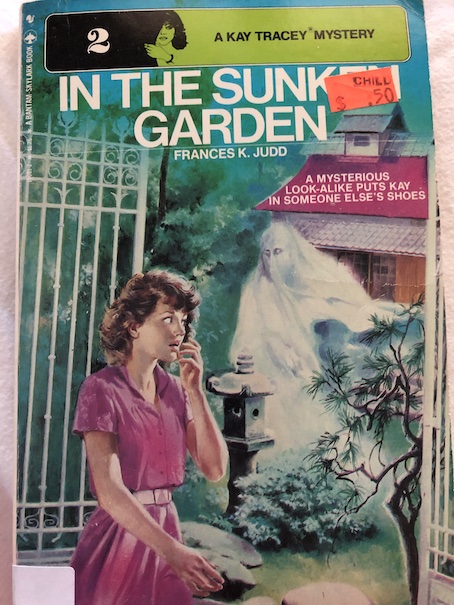
In the Sunken Garden

Kay Tracey

In the Sunken Garden by Frances K. Judd (Stratemeyer Syndicate), 1952 (revised from 1941 edition), 1980.

Kay Tracey discovers that she has a doppelganger when she’s running some errands for her mother and some people in town act like they know her even though she’s never seen them before. As she heads home, a dog even follows her car, as if it thinks that she’s his owner. Kay is bewildered by this, but she decides to take the dog home with her until she can figure out who really owns him.

This is just the beginning of Kay’s entanglement with her mysterious double. Ronald Earle, the boy who likes Kay, gets angry because he thinks that he’s seen her out riding with someone else in his car after turning down a ride with him to attend her mother’s luncheon party. Kay straightens Ronald out only to be confronted with her cousin, Bill, who returns home, very upset because he has heard that Kay was in a car accident and is now in the hospital. Bill is relieved to see Kay perfectly fine at home, but that still doesn’t clear up the question of who this mysterious double is.

According to the hospital, the girl who was in the car accident told them she was Jane Barton, but she checked herself out of the hospital because she only had minor injuries. That isn’t the end of the matter, though. A man named Joe Craken shows up and accuses Kay of wrecking his car in the car accident. He says that the police identified her as the driver of the other car in the accident based on her physical description. With Joe Craken attempting to sue her for damages and the injuries done to a passenger in his car, Kay needs to find her mysterious double!

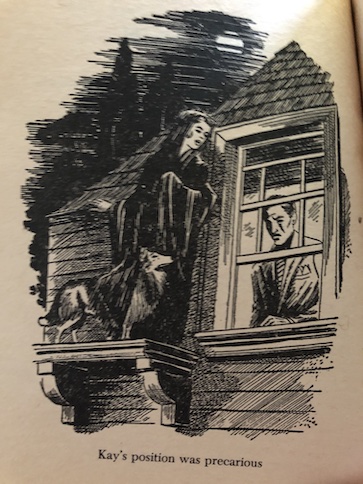
This mysterious double seems to have some connection to the old Huntley place, a mansion outside of town. The Huntleys were distant relatives of Ronald’s, and Kay learns about the family scandal from someone who used to work for the family. Years ago, Mrs. Huntley’s sister, Trixie Rue, was a dancer with a promising career, but she gave it all up to get married. Unfortunately, the marriage didn’t really work out, and she and her husband fell on hard times. Mrs. Huntley gave her sister some money to help her get by, but apparently, it wasn’t enough because the sister resorted to stealing to help support herself and her baby daughter and ended up having to leave town in disgrace. Does this local scandal have any bearing on the sudden appearance of Kay’s double? One night, while having a look at the old Huntley mansion, Kay sees a ghostly white figure dancing in the garden. Was it her mysterious look-alike or someone else? Before the mystery is over, Kay’s look-alike will need her help as much as Kay needs hers.

The book is available to borrow and read for free online through Internet Archive.

My Reaction

The various parts of this mystery fit together much better than the first Kay Tracey book I read. The first book I read in this series seemed rather awkward, but there is a more cohesive thread in this story. The mysterious double, the Huntley family scandal, and the ghostly dancing figure in the garden all fit together in a way that makes sense. However, there are two sets of villains in this story, and although Kay was not involved in the car accident, it turns out that, rather than her double trying to fob off responsibility on Kay, it’s actually the driver of the other car who was responsible for the accident and had always planned on trying to blame Kay for the accident to extort money from her. It was just his bad luck that he crashed his car into the car Jane was driving instead of Kay’s. This story also has a side plot involving a benefit show that Kay and her friends are putting on with others who are also taking dance lessons, and there’s more rivalry with Chris Eaton, the nasty snob they know from school.

I still find that the Kay Tracey books aren’t particularly good on readability, though. The language is a little old-fashioned, and at times, the plot seems to drag. I think this is one of the better books, plot-wise. The story felt more cohesive than the previous one and mystery stories with mysterious doubles, long-lost relatives, spooky mansions, and inheritance are pretty classic and compelling. However, I did get a little bored while reading it because I just didn’t find the writing style to be very engaging.

The Case of the Muttering Mummy

MutteringMummy

The Case of the Muttering Mummy by E.W. Hildick, 1986.

Joey Rockaway needs to buy a special present for his mother’s birthday. Having broken his mother’s china cat ornament recently, he has decided that he will buy one of the replicas of a golden cat statue from Egypt at the Egyptian exhibit at the local museum. The other members of the McGurk Organization come to the museum with him, and McGurk uses this as an opportunity to give them a kind of memory test about objects in the exhibit.

Actually, everything in the exhibit is a replica, not just the items sold in the museum gift shop. Justin Matravers, a wealthy man who has recently died, collected Egyptian artifacts, but part of his will specified that the collection should never be put on public display. However, his widow, who wanted to show off the collection, had replicas made of everything in the collection so that she could have those put on display.

MutteringMummyCase

McGurk sneers about how everything in the exhibit is fake, although he is actually surprisingly superstitious. The museum always did have a real mummy case on display. They always said that the mummy case was empty, but some of the more superstitious kids, like McGurk, believe that there is a mummy inside the case and that there is a curse on it. McGurk has nicknamed the mummy Melvin. The other kids aren’t afraid of Melvin or Egyptian curses, and while they are looking around the Egyptian exhibit, Mari plays a joke by using her ventriloquist skills to make the mummy case “talk.” This trick sets off a bizarre mystery for the McGurk Organization.

A scholar and author, Harrison Keech, is sketching the replicas at the exhibit and witnesses Mari’s trick and Joey picking out the replica cat for his mother. After he asks Joey if he can take a look at the cat, Keech suddenly becomes very upset, saying that the cat statue is cursed! He says that Mari’s joke has angered the spirit of the mummy and awakened the spirit of Bastet. The mummy was a follower of Bastet, the Egyptian cat goddess, and it will now be drawn to the statue if they remove it from the museum. Mari tells Joey that she can tell from Keech’s voice that he’s making up the whole story and that he shouldn’t let that stop him from buying the cat.

MutteringMummyNight

However, strange things start happening after Joey buys the cat. It seems like someone is following him home, a dark, shadowy figure. Joey thinks it might even be the mummy, come back to life! The others are skeptical, and McGurk arranges a kind of test where Joey brings the statue with him to a meeting of the organization. Sure enough, a strange figure lurks outside their meeting, and they hear strange whispers in a foreign language!

The spookiness doesn’t last for long. It turns out that Mari, as well as being a ventriloquist, has some skill with different languages and recognizes what the “mummy” says as being Greek, not Egyptian, and the phrases as being typical things that someone might say in a restaurant. When the kids find a scrap of bandage outside, they are quick to notice that it’s a modern, elasticized bandage, like the kind you can get at any pharmacy.

So, the question becomes who is playing at being a mummy and why? Is it Keech, wanting to make the kids think that the mummy story he told them is real, and if so, what would he have to gain from it? The only other two people who know about the story are Joanne, who works at the museum, and Donny, her fiancé, who is jealous of the attention she’s been paying to Keech when he comes to the exhibit.

MutteringMummyLies

I have some complaints about this book that hadn’t occurred to me when I read it as a kid. At one point, Donny, who is described as being a social worker, comes to visit the kids because he wants to hire the organization to check up on Keech and his relationship with Joanne. Donny is very jealous, and when he explains how Joanne seems to be falling for all of Keech’s crazy mummy stories, he suddenly turns to Wanda and Mari and says, “You women, you’ll believe anything when a smarmy two-bit jackass like that starts shooting his mouth off!” That’s just really inappropriate for an adult to say to kids, and the whole situation is weird on several levels. First of all, Donny is an adult, and if he’s having issues with his love life, especially with the woman he thinks he wants to spend the rest of his life with, the last thing he should do is hire kids (even really smart ones) to handle the issues for him. Second, Wanda and Mari are young girls, not “women,” and what little girls believe is no business of Donny’s. Trying to imply that Wanda and Mari might someday fall for a “jackass” is not only insulting but implies that Donny is thinking about Wanda and Mari in terms that no grown man should be thinking about girls their ages. I find it disturbing that Donny is apparently a social worker, a person in a position of trust who is supposed to help people in difficult situations to manage their lives, and he’s acting like this. Also, toward the end of the book when the bad guy (I won’t say who it is here, although I thought that the answer was pretty obvious even early in the story) is making his escape, he shoves Joanne aside and calls her a “slut.” That’s pretty strong language for a kid’s book of this level. None of this occurred to me when I was a kid, so maybe other kids reading this wouldn’t notice, but I thought that I’d mention it because these things bother me now.

At one point, Brains gives a demonstration of using water displacement to determine the volume of irregularly-shaped objects, explaining how Archimedes discovered the principal (although I’m not sure that Archimedes’ Principal was quite as he explains it), as the kids investigate what makes Joey’s cat statue so special. You might be able to guess what it is. It seemed pretty obvious to me. The one thing that seemed the most puzzling was how it was done. Mari also offers an interesting explanation of the different kinds of lies that people tell and their motives for doing so.

The book is currently available online through Internet Archive.